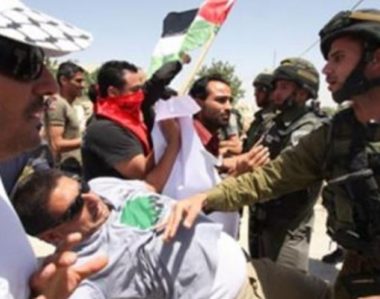
’Endless trip to hell’: Israel jails hundreds of Palestinian boys a year. These are their testimonies
They’re seized in the dead of night, blindfolded and cuffed, abused and manipulated to confess to crimes they didn’t commit. Every year Israel arrests almost 1,000 Palestinian youngsters, some of them not yet 13
Netta Ahituv | Mar. 14, 2019 | 9:14 PM | 2
It was a gloomy, typically chilly late-February afternoon in the West Bank village of Beit Ummar, between Bethlehem and Hebron. The weather didn’t deter the children of the Abu-Ayyash family from playing and frolicking outside. One of them, in a Spiderman costume, acted the part by jumping lithely from place to place. Suddenly they noticed a group of Israeli soldiers trudging along the dirt trail across the way. Instantly their expressions turned from joy to dread, and they rushed into the house. It’s not the first time they reacted like that, says their father. In fact, it’s become a pattern ever since 10-year-old Omar was arrested by troops this past December.
The 10-year-old is one of many hundreds of Palestinian children whom Israel arrests every year: The estimates range between 800 and 1,000. Some are under the age of 15; some are even preteens. A mapping of the locales where these detentions take place reveals a certain pattern: The closer a Palestinian village is to a settlement, the more likely it is that the minors residing there will find themselves in Israeli custody. For example, in the town of Azzun, west of the Karnei Shomron settlement, there’s hardly a household that hasn’t experienced an arrest. Residents say that in the past five years, more than 150 pupils from the town’s only high school have been arrested.
At any given moment, there are about 270 Palestinian teens in Israeli prisons. The most widespread reason for their arrest – throwing stones – does not tell the full story. Conversations with many of the youths, as well as with lawyers and human rights activists, including those from the B’Tselem human-rights organization, reveal a certain pattern, even as they leave many questions open: For example, why does the occupation require that arrests be violent and why is it necessary to threaten young people.
A number of Israelis, whose sensibilities are offended by the arrests of Palestinian children, have decided to mobilize and fight the phenomenon. Within the framework of an organization called Parents Against Child Detention, its approximately 100 members are active in the social networks and hold public events “in order to heighten awareness about the scale of the phenomenon and the violation of the rights of Palestinian minors, and in order to create a pressure group that will work for its cessation,” as they explain. Their target audience is other parents, whom they hope will respond with empathy to the stories of these children.
In general, there seems to be no lack of criticism of the phenomenon. In addition to B’Tselem, which monitors the subject on a regular basis, there’s been a protest from overseas, too. In 2013, UNICEF, the United Nations agency for children, assailed “the ill treatment of children who come in contact with the military detention system, [which] appears to be widespread, systematic and institutionalized.” A report a year earlier from British legal experts concluded that the conditions the Palestinian children are subjected to amount to torture, and just five months ago the Parliamentary Assembly of the Council of Europe deplored Israel’s policy of arresting underage children, declaring, “An end must be put to all forms of physical or psychological abuse of children during arrest, transit and waiting periods, and during interrogations.”
Arrest
About half of the arrests of Palestinian adolescents are made in their homes. According to the testimonies, Israel Defense Forces soldiers typically burst into the house in the middle of the night, seize the wanted youth and whisk him away (very few girls are detained), leaving the family with a document stating where he’s being taken and on what charge. The printed document is in Arabic and Hebrew, but the commander of the force typically fills out the details in Hebrew only, then hands it to parents who may not be able to read it and don’t know why their son was taken.
Attorney Farah Bayadsi asks why it’s necessary to arrest children in this manner, instead of summoning them for questioning in an orderly way. (The data show that only 12 percent of the youths receive a summons to be interrogated.)
“I know from experience that whenever someone is asked to come in for questioning, he goes,” Bayadsi notes. She’s active in the Israeli branch of Defense for Children International, a global NGO that deals with the detention of minors and promotion of their rights.
“The answer we generally get,” she says, “is that, ‘It’s done this way for security reasons.’ That means it’s a deliberate method, which isn’t intended to meet the underage youth halfway, but to cause him a lifelong trauma.”
Indeed, as the IDF Spokesman’s Unit stated to Haaretz, in response, “The majority of the arrests, of both adults and minors, are carried out at night for operational reasons and due to the desire to preserve an orderly fabric of life and execute point-specific actions wherever possible.”
About 40 percent of the minors are detained in the public sphere – usually in the area of incidents involving throwing stones at soldiers. That was the case with Adham Ahsoun, from Azzun. At the time, he was 15 and on his way home from a local grocery store. Not far away, a group of children had started throwing stones at soldiers, before running off. Ahsoun, who didn’t flee, was detained and taken to a military vehicle; once inside, he was hit by a soldier. A few children who saw what happened ran to his house to tell his mother. Grabbing her son’s birth certificate, she rushed to the entrance to the town to prove to the soldiers that he was only a child. But it was too late; the vehicle had already departed, headed to an army base nearby, where he would wait to be interrogated.
By law, soldiers are supposed to handcuff children with their hands in front, but in many cases it’s done with their hands behind them. Additionally, sometimes the minor’s hands are too small for handcuffing, as a soldier from the Nahal infantry brigade told the NGO Breaking the Silence. On one occasion, he related, his unit arrested a boy “of about 11,” but the handcuffs were too big to bind his small hands.
The next stage is the journey: The youths are taken to an army base or a police station in a nearby settlement, their eyes covered with flannelette. “When your eyes are covered, your imagination takes you to the most frightening places,” says a lawyer who represents young Palestinians. Many of those arrested don’t understand Hebrew, so that once pushed into the army vehicle they are completely cut off from what’s going on around them.
In most cases, the handcuffed, blindfolded youth will be moved from place to place before actually being interrogated. Sometimes he’s left outside, in the open, for a time. In addition to the discomfort and the bewilderment, the frequent moving around presents another problem: In the meantime many acts of violence, in which soldiers beat the detainees, take place and go undocumented.
Once at the army base or police station, the minor is placed, still handcuffed and blindfolded, on a chair or on the floor for a few hours, generally without being given anything to eat. The “endless trip to hell” is how Bayadsi describes this process. Memory of the incident, she adds, “is still there even years after the boy’s release. It implants in him an ongoing feeling of a lack of security, which will stay with him for his whole life.”
Testimony provided to Breaking the Silence by an IDF staff sergeant about one incident in the West Bank illustrates the situation from the other side: “It was the first night of Hanukkah in 2017. Two children were throwing stones on Highway 60, on the road. So we grabbed them and took them to the base. Their eyes were covered with flannelette, and they were handcuffed in front with plastic cuffs. They looked young, between 12 and 16 years old.”
When the soldiers gathered to light the first candle of the Hanukkah holiday, the detainees remained outside. “We’re shouting and making noise and using drums, which is a kind of company thing,” the soldier recalled, noting that he assumed the kids didn’t know Hebrew, although maybe they did understand the curses they heard. “Let’s say sharmuta [slut] and other words they might know from Arabic. How could they know we aren’t talking about them? They’ll probably thought that in another minute we were going to cook them.”
Interrogation
The nightmare can be of differing duration, the former detainees relate. Three to eight hours after the arrest, by which time the youth is tired and hungry – and sometimes in pain after being hit, frightened by threats and not even knowing why he’s there – he’s taken in for interrogation. This may be the first time the blindfold is removed and his hands freed. The process usually starts with a general question, such as, “Why do you throw stones at soldiers?” The rest is more intense – a barrage of questions and threats, aimed at getting the teen to sign a confession. In some cases, he’s promised that if he signs he’ll be given something to eat.
According to the testimonies, the interrogators’ threats are directed squarely at the boy (“You’ll spend your whole life in jail”), or at his family (“I’ll bring your mother here and kill her before your eyes”), or at the family’s livelihood (“If you don’t confess, we’ll take away your father’s permit to work in Israel – because of you, he’ll be out of work and the whole family will go hungry”).
“The system shows that the intention here is more to demonstrate control than to engage in enforcement,” suggests Bayadsi. “If the boy confesses, there’s a file; if he doesn’t confess, he enters the criminal circle anyway and is seriously intimidated.”
Imprisonment
Whether the young detainee has signed a confession or not, the next stop is prison. Either Megiddo, in Lower Galilee, or Ofer, north of Jerusalem. Khaled Mahmoud Selvi was 15 when he was brought to prison in October 2017 and was told to disrobe for a body search (as in 55 percent of the cases). For 10 minutes he was made to stand naked, along with another boy, and in winter.
The months in detention, waiting for trial, and later, if they are sentenced, are spent in the youth wing of the facilities for security prisoners. “They don’t speak with their families for months and are allowed one visit a month, through glass,” Bayadsi relates.
Far fewer Palestinian girls are arrested than boys. But there is no facility specially for them, so they are held in the Sharon prison for women, together with the adults.
The trial
The courtroom is usually the place where parents have their first sight of their child, sometimes several weeks after the arrest. Tears are the most common reaction to the sight of the young detainee, who will be wearing a prison uniform and handcuffs, and with a cloud of uncertainty hovering over everything. Israel Prisons Service guards don’t allow the parents to approach the youth, and direct them to sit on the visitors’ bench. Defense counsel is paid for either by the family or by the Palestinian Authority.
At a recent remand hearing for several detainees, one boy didn’t stop smiling at the sight of his mother, while another lowered his eyes, perhaps to conceal tears. Another detainee whispered to his grandmother, who had come to visit him, “Don’t worry, tell everyone I’m fine.” The next boy remained silent and watched as his mother mouthed to him, “Omari, I love you.”
While the children and their family try to exchange a few words and looks, the proceedings move along. As though in a parallel universe.
The deal
The vast majority of trials for juveniles ends in a plea bargain – safka in Arabic, a word Palestinian children know well. Even if there is no hard evidence to implicate the boy in stone-throwing, a plea is often the preferred option. If the detainee doesn’t agree to it, the trial could last a long time and he will be held in custody until the proceedings end.
Conviction depends almost entirely on evidence from a confession, says lawyer Gerard Horton, from the British-Palestinian Military Court Watch, whose brief, according to its website, involves “monitoring the treatment of children in Israeli military detention.” According to Horton, who is based in Jerusalem, the minors will be more prone to confess if they don’t know their rights, are frightened and get no support or relief until they confess. Sometimes a detainee who does not confess will be told that he can expect to face a series of court appearances. At some stage, even the toughest youth will despair, the lawyer explains.
The IDF Spokesman’s Unit stated in response: “The minors are entitled to be represented by an attorney, like any other accused, and they have the right to conduct their defense in any way they choose. Sometimes they choose to admit to guilt within the framework of a plea bargain but if they plead not guilty, a procedure involving hearing evidence is conducted, like the proceedings conducted in [civilian courts in] Israel, at the conclusion of which a legal decision will be handed down on the basis of the evidence presented to the court. The deliberations are set within a short time and are conducted efficiently and with the rights of the accused upheld.”
Managing the community
According to data of collected by the British-Palestinian NGO, 97 percent of the youths arrested by the IDF live in relatively small locales that are no more than two kilometers away from a settlement. There are a number of reasons for this. One involves the constant friction – physical and geographical – between Palestinians, on the one hand, and soldiers and settlers. However, according to Horton, there is another, no less interesting way to interpret this figure: namely, from the perspective of an IDF commander, whose mission is to protect the settlers.
In the case of reported stone-throwing incidents, he says, the commander’s assumption is that the Palestinians involved are young, between the ages of 12 and 30, and that they come from the nearest village. Often the officer will turn to the resident collaborator in the village, who provides him with the names of a few boys.
The next move is “to enter the village at night and arrest them,” Horton continues. “And whether these youths are the ones who threw the stones or not, you have already put a scare into the whole village” – which he says is an “effective tool” for managing a community.
“When so many minors are being arrested like this, it’s clear that some of them will be innocent,” he observes. “The point is that this has to be happening all the time, because the boys grow up and new children appear on the scene. Each generation must feel the strong arm of the IDF.”
According to the IDF Spokesperson’s Unit: “In recent years, many minors, some of them very young, have been involved in violent incidents, incitement and even terrorism. In these cases, there is no alternative but to institute measures, including interrogation, detention and trial, within the limits of and according to what is stipulated by law. As part of these procedures, the IDF operates to uphold and preserve the rights of the minors. In enforcing the law against them, their age is taken into account.
“Thus, since 2014, among other measures, in certain instances, the minors are invited to the police station and are not arrested at home. In addition, proceedings relating to minors take place in the military court for juveniles, which examines the seriousness of the offense that’s attributed to the minor and the danger it poses, while taking into consideration his young age and his particular circumstances. Every allegation of violence on the part of IDF soldiers is examined, and cases in which the soldiers’ actions are found to be flawed are treated sternly.”
The Shin Bet security service stated in response: “The Shin Bet, together with the IDF and the Israel Police, operates against every element that threatens to harm Israel’s security and the country’s citizenry. The terrorist organizations make extensive use of minors and recruit them to carry out terrorist activity, and there is a general tendency to involve minors in terrorist activity as part of local initiatives.
“Interrogations of suspected terrorists are conducted by the Shin Bet under the law, and are subject to supervision and to internal and external review, including by all levels of the court system. The interrogations of minors are carried out with extra sensitivity and with consideration of their young age.”
Khaled Mahmoud Selvi, arrested at 14 (October 2017)
“I was arrested when I was 14, all the boys in the family were arrested that night. A year later, I was arrested again, with my cousin. They said I burned tires. It happened when I was sleeping. My mother woke me up. I thought it was time for school, but when I opened my eyes I saw soldiers above me. They told me to get dressed, handcuffed me and took me outside. I was wearing a short-sleeved shirt and it was cold that night. My mother begged them to let me put on a jacket, but they didn’t agree. Finally, she threw the jacket on me, but they didn’t let me put my arms in the sleeves.
“They took me to the Karmei Tzur settlement with my eyes covered, and I had the feeling that they were just driving in circles. When I walked, there was a pit in the road and they pushed me into it, and I fell. From there they took me to Etzion [police station]. There they put me in a room, and soldiers kept coming in all the time and kicking me. Someone passed by and said that if I didn’t confess, they would leave me in jail for the rest of my life.
“At 7 A.M., they told me the interrogation was starting. I asked to go to the toilet before. My eyes were covered and a soldier put a chair in front of me. I tripped. The interrogation went on for an hour. They told me that they saw me burning tires and that it interfered with air traffic. I told them it wasn’t me. I didn’t see a lawyer until the afternoon, and he asked the soldiers to bring us food. It was the first time I had eaten since being arrested the night before.
“At 7 P.M., I was sent to Ofer Prison, and I remained there for six months. In that period, I was in court more than 10 times. And there was also another interrogation, because a friend of mine was told while being questioned that if he didn’t confess and inform on me, they would bring his mother and shoot her before his eyes. So he confessed and informed. I’m not angry at him. It was his first arrest, he was scared.”
Khaled Shtaiwi, arrested at 13 (November 2018)
Khaled’s story is told by his father, Murad Shatawi: “On the night he was arrested, a phone call from my nephew woke me up. He said the house was surrounded by soldiers. I got up and got dressed, because I expected them to arrest me, on account of the nonviolent demonstrations I organize on Fridays. I never imagined they’d take Khaled. They asked me for the names of my sons. I told them Mumen and Khaled. When I said Khaled, they said, ‘Yes, him. We’re here to take him.’ I was in shock, so many soldiers showed up to arrest a boy of 13.
“They handcuffed and blindfolded him and led him east on foot, toward the settlement of Kedumim, all the while cursing and hitting him a little. I saw it all from the window. They gave me a document showing that it was a legal arrest and I could come to the police station. When I got there, I saw him through a small hole in the door. He was handcuffed and blindfolded.
“He stayed like that from the moment they arrested him until 3 P.M. the next day. That’s a picture that doesn’t leave me; I don’t know how I’ll go on living with that picture in my head. He was accused of throwing stones, but after four days they released him, because he didn’t confess and there was no other evidence against him. During the trial, when the judge wanted to speak to Khaled, he had to lean forward in order to see him, because Khaled was so small.
“What was it like to see him like that? I am the father. That says it all. He hasn’t talked about it since getting out, three months ago. That’s a problem. I’m now organizing a ‘psychology day’ in the village, to help all the children here who have been arrested. Out of 4,500 people in the village, 11 children under the age of 18 have been arrested; five were under the age of 15.”
Omar Rabua Abu Ayyash, arrested at age 10 (December 2018)
Omar looks small for his age. He’s shy and quiet, and it’s hard to talk to him about the arrest, so members of his family recount the events in his place.
Omar’s mother: “It happened at 10 A.M. on Friday, when there is no school. Omar was playing in the area in front of the house, he threw pebbles at birds that were chirping in the tree. The soldiers, who were in the watchtower across the way here, picked up on what he was doing and ran toward him. He ran, but they caught him and knocked him down. He started to cry, and he wet his pants. They kicked him a few times.
“His grandmother, who lives here below, immediately went out and tried to take him from the soldiers, which caused a struggle and shouts. In the end, they left him alone and he went home and changed into dry pants. A quarter of an hour later, the soldiers came back, this time with their commander, who said he had to arrest the boy for throwing stones. When the other children in the family saw the soldiers in the house, they also wet their pants.”
Omar’s father takes up the story: “I told the commander that he was under 12 and that I had to accompany him, so I rode with him in the jeep to the Karmei Tzur settlement. There the soldiers told him not to throw stones anymore, and that if he saw other children doing it, he should tell them. From there they took him the offices of the Palestinian Authority in Hebron. The whole story took about 12 hours. They gave him a few bananas to eat during those hours. Now, whenever the children see a military jeep or soldiers, they go inside. They’ve stopped playing outside since then. Before the incident, soldiers used to come here to play soccer with the children. Now they’ve stopped coming, too.”
Tareq Shtaiwi, arrested at 14 (January 2019)
“It was around 2 P.M. I had a fever that day, so Dad sent me to my cousin next door, because that’s almost the only place in the village with a heating unit. Suddenly soldiers showed up. They saw me watching them from the window, so they fired shots at the door of the building, knocked it down and started to come upstairs. I got scared, so I ran from the second floor to the third, but they stopped me on the way and took me outside. The soldiers wouldn’t let me take my coat, even though it was cold and I was sick. They took me on foot to Kedumim, handcuffed and blindfolded. They sat me on a chair. I heard doors and windows being slammed hard, I think they were trying to scare me.
“After a while, they took me from Kedumim to Ariel, and I was there for five-six hours. They accused me of throwing stones a few days earlier with my friend. I told them I hadn’t thrown any stones. In the evening they moved me to the Hawara detention building; one of the soldiers told me I would never leave there. In the morning I was moved to Megiddo Prison. They didn’t have prisoners uniforms in my size, so they gave me clothes of Palestinian children who had been there before and left them for the next in line. I was the youngest person in the prison.
“I had three court hearings, and after 12 days, at the last hearing, they told me that it was enough, that my father would pay a fine of 2,000 shekels [$525] and I was getting a three-year suspended sentence. The judge asked me what I intended to do after getting out, I told him I would go back to school and I wouldn’t go up to the third floor again. Since my arrest, my younger brother, who’s 7, has been afraid to sleep in the kids’ room and goes to sleep with our parents.”
Adham Ahsoun, arrested in October 2018, on his 15th birthday
“On my 15th birthday, I went to the store in the village center to buy a few things. Around 7:30 in the evening, soldiers entered the village and children started to throw stones at them. On the way home with my bag, they caught me. They took me to the entrance of the village and put me in a jeep. One of the soldiers started to hit me. Then they put plastic handcuffs on me and covered my eyes and took me like that to the military base in Karnei Shomron. I was there for about an hour. I couldn’t see a thing, but I had the feeling that a dog was sniffing me. I was afraid. From there they took me to another military base and left me there for the night. They didn’t give me anything to eat or drink.
“In the morning, they moved me to the interrogation facility in Ariel. The interrogator told me that the soldiers caught me throwing stones. I told him that I hadn’t thrown stones, that I was on my way home from the store. So he called the soldiers into the interrogation room. They said, ‘He’s lying, we saw him, he was throwing stones.’ I told him that I really hadn’t thrown stones, but he threatened to arrest my mother and father. I panicked. I asked him, ‘What do you want from me?’ He said he wanted me to sign that I threw stones at soldiers, so I signed. The whole time I didn’t see or talk to a lawyer.
“My plea bargain was that I would confess and get a five-month jail sentence. Afterward, they gave me one-third off for good behavior. I got out after three months and a fine of 2,000 shekels. In jail I tried to catch up with the material I missed in school. The teachers told me they would only take into account the grades of the second semester, so it wouldn’t hurt my chances of being accepted for engineering studies in university.”
Muhmen Teet, arrested at 13 (November 2017)
“At 3 A.M., I heard knocking on the door. Dad came into the room and said there were soldiers in the living room and wanted us to show ID cards. The commanding officer told my father that they were taking me to Etzion for questioning. Outside, they handcuffed and blindfolded me and put me in a military vehicle. We went to my cousin’s house; they also arrested him. From there we went to Karmei Tzur and waited, handcuffed and blindfolded, until the morning.
“In the morning, they only took my cousin for interrogation, not me. After his interrogation, they took us to Ofer Prison. After a day there, they took us back to Etzion and said they were going to interrogate me. Before the interrogation, they took me into a room, where there was a soldier who slapped me. After he hit me in one room, he took me to the interrogation room. The interrogator said I was responsible for burning tires, and because of that the grove near the house caught fire. I said it wasn’t me, and I signed a document that the interrogator gave me. The document was also printed in Arabic, but the interrogator filled it out in Hebrew. I was taken back to Ofer Prison.
“I had seven hearings in court, because at the first hearing I said I hadn’t intended to confess, I just didn’t understand what I signed and it wasn’t true. So they sent me back for another interrogation. Again I didn’t confess. Then they sent me to interrogation another time and again I didn’t confess. That’s what it was like in three interrogations. In the end, my lawyer did a deal with the prosecutor that if I confessed in court – which I did – and my family would pay 4,000 shekels, they would release me.
“I’m a good student, I like soccer, both playing and watching it. Since the arrest I hardly wander around outside.”
Khalil Zaakiq, arrested at age 13 (January 2019)
“Around 2 A.M. someone knocked on the door. I woke up and saw a lot of soldiers in the house. They said we should all sit in the living room sofa and not move. The commander called Uday, my big brother, told him to get dressed and informed him that he was under arrest. It was the third time they arrested him. My father was also once under arrest. Suddenly they told me to put my shoes on too and go with them.
“They took us out of the house and tied our hands and covered our eyes. We went like that on foot to the base in Karmei Tzur. There they sat me on the floor with hands tied and eyes covered for around three hours. At about 5 A.M., they moved us to Etzion. On the way there in the jeep they hit us, they slapped me. In Etzion, I was sent to be checked by a doctor. He asked if I had been beaten and I said yes. He didn’t do anything, only checked my blood pressure and said I could stand up to an interrogation.
“My interrogation started at 8 A.M.. They asked me to tell them which children throw stones. I said I didn’t know, so the interrogator gave me a slap. The interrogation went on for four hours. Afterward, they put me into a dark room for 10 minutes and then took me back to the interrogation room, but now they only fingerprinted me and put me into a detention cell for an hour. After an hour, Uday and I were moved to Ofer Prison. I didn’t sign a confession, neither about myself nor about others.
“I got out after nine days, because I wasn’t guilty of anything. My parents had to pay 1,000 shekels for bail. My little brother, who is 10, has been really afraid ever since. Whenever someone knocks at the door, he wets his pants.”