Une grande honorabilité bardée d’expertise. Des postes prestigieux dans la haute administration américaine républicaine : La vitrine d’exposition est parfaite, mais sous le vernis de la respectabilité, une façade lézardée, un personnage gangréné.
Contrairement à ce que suggère son nom patronymique en arabe, Walid Pharès n’est pas le fils d’un preux chevalier, mais plutôt le parfait exemple d’un dévoiement par sectarisme. Libanais d’origine, naturalisé américain, il est en fait « UN ISRAELIEN d’ORIGINE LIBANAISE », comme l’a très justement qualifié le quotidien libanais « Al Akhbar ».
« La propulsion de Walid Pharès au poste de conseiller du président Donald Trump ne constitue pas, loin s’en faut, une reconnaissance du savoir faire libanais encore moins un succès diplomatique pour le Liban, mais plutôt une percée majeure de la stratégie israélienne par la promotion d’un des affidés libanais de l’État Hébreu dans le cercle décisionnaire du pouvoir à Washington.(…) Preuve est faite qu’il est plus aisé pour les Forces Libanaises (milices chrétienens) de décrocher un poste regalien à Washington qu’à Beyrouth », poursuit Al Akhbar dont le portrait de l’ancien milicien se trouve sur ce lien pour le lectorat arabophone.
►http://www.al-akhbar.com/node/268049
UN ISOLATIONNISTE VINDICATIF
La biographie en langue française de cet isolationniste vindicatif est lisse.
Sa biographie en langue anglaise, éditée par le site Mother Jones, est infiniment plus caustique et toxique.
Sur ce lien : ►http://www.motherjones.com/politics/2011/10/walid-phares-mitt-romney-lebanese-forces
Natif de la localité de Ghouma, district de Batroun, dans le Nord Liban, en 1957, Walid Pharès a effectué une scolarité éclectique à l’Université Saint Joseph des Pères Jésuites et à l’Université Libanaise à Beyrouth, avant de décrocher, en 1981, à 24 ans un Master en Droit International à l’Université Jean Moulin LYON III, une structure où a longtemps professé une figure de proue de l’extrême droite française Bruno Gollnisch, passé à la postérité pour avoir matraqué des journalistes avec son parapluie.
Précoce, il publie à 22 ans, en 1979, son premier ouvrage « At Taadoudiya Fi Loubnane », « le pluralisme au Liban ». Edité par l’Université du Saint Esprit de Kaslick, le fief du militantisme des moines maronites lors la guerre civile libanaise sous le magistère du Père Charbel Kassis, ce livre paru quatre ans après le déclenchement de la guerre civile, reprend en les popularisant les thèmes des milices chrétiennes sur la spécificité chrétienne, particulièrement maronite, dans le Monde arabe.
Considérant qu’il existe au Liban deux cultures distinctes, la culture chrétienne par essence démocratique et la culture islamo-arabe qui l’est moins ou pas du tout, l’idéologue en herbe reprend à son compte en l’amplifiant le thème « du choc des civilisations », théorisé par l’universitaire américain Samuel Huttington. Il préconise en conséquence la ségrégation entre groupes libanais et prône le développement séparé, s’inspirant de thèses de la « white supremacy », si courantes dans certains milieux du Sud des États-Unis.
LE CORPUS IDÉOLOGIQUE DE CE SOLDAT DE LA GUERRE FROIDE
En 1981, l’année qui précède l’invasion israélienne du Liban, il fonde une publication « La voix de l’Orient » pour poulariser ses idées et adhère au « Comité des Chrétiens du Moyen Orient » (MECHRIC), et trois ans plus tard, à l’ Union Sociale Démocratique Chrétienne (USDC). Une démarche destinée à se doter, via ce gropuscule, d’ un vernis social démocrate chrétien, afin d’atténuer quelque peu les aspérités de son personnage belliqueux animé de surcroît d’une volonté de croisade.
Prolixe, il récidive en 1981 en publiant Hiwar Dimucrati (Le dialogue démocratique), dans une maison d’édition libanaise Dar Al Mashreq Press, conviant ses compatriotes de confession musulmane au dialogue. Une proposition de pure forme, destinée à la galerie en vue de bonifier l’image des milices chrétiennes, discréditées par leurs massacres successifs. Son idole, Bachir Gemayel dont il fut un proche collaborateur, ayant décrété qu’il existait « un peuple de trop » au Moyen orient, en pointant du doigt les Palestiniens, avait initié la première guerre d’épuration ethnique de l’époque contemporaine en ordonnant les massacres de la Quarantaine, janvier 1976, Tall El Zatar, en juillet 1976, enfin Sabra Chatila, septembre 1982 que son assassinat suscita par réflexe pavlovien.
Sous l’effet du matraquage idéologique, ses frères d’armes miliciens chrétiens ignoreront d’ailleurs allégrement, l’année suivante, cette invitaiton au dialogue envers les musulmans, s’en donnant à cœur joie, au mépris de la tradition chrétienne de commisération, aux massacres des camps de réfugiés palestiniens de Sabra Chatila, dans la banlieue est de Beyrouth, en 1982, sous la supervision israélienne.
Pour aller plus loin sur ce sujet :
►http://www.madaniya.info/2017/09/15/malediction-de-sabra-chatila-35-ans-apres
Celui qui avait gouverné par l’épée périra par l’épée, dynamité dans son fief d’Achrafieh, le secteur chrétien de Beyrouth Est, à la veille de son entrée en fonction. Farouchement islamophobe et araphobe, épris d’Occident, son idéologie xénophobe et populiste irriguera naturellement la pensée de ses disciples qui en seront les apôtres sur la scène internationale :
« Le Liban ne fait partie du Monde arabe. Le Liban est une civilisation et n’a aucun apport avec le tiers monde. Veuillez bien marquer dans vos démarches que nous n’appartenons pas au Tiers monde. Sortons de ce monde d’arriérés. Rallions le monde européen et le Monde libre de l’Amérique », lancera-t-il à ses subordonnés à peine élu président.
Sur la pensée de Bachir Gemayel et ses méfaits :
▻http://www.madaniya.info/2017/09/05/sabra-chatila-operation-salami-1-2
▻http://www.madaniya.info/2017/09/10/sabra-chatila-operation-salami-2-2
Walid Pharès appliquera à la lettre ses enseignements. C’est ainsi qu’en 1986, l’année où le Liban vivait une spirale infernale de prise d’otages occidentaux, le graphomane publie, dans le droit fil de la pensée de son idole, un opus révélant l’objet de sa fixation. Non son oeuvre majeure mais le sujet de sa vindicte publique : Al Thawra al Islamiya al Khumaynia (La Révolution de Khomeiny – Dar Al Machreq Press).
Pour ce milicien chrétien, l’Ayatollah Ruhollah Khomeiny avait eu le triple tort d’évincer le Chah d’Iran, gendarme du Golfe pour le compte de l’OTAN, grand bailleur de fonds des formations paramilitaires chrétiennes libanaises, et surtout grand allié d’Israël, parrain de ses camarades de combat.
Thème gratifiant s’il en est en ce qu’il diabolisait la République Islamique d’Iran et exonérait de leurs turpitudes les pays occidentaux : la France de son satut de « co belligérant de l’Irak » contre l’Iran (1979-1989) et le double jeu américain à l’égard des deux belligérants, illustré par le scandale de l’Irangate et les promesses d’assistance faites simultanément à Saddam Hussein par Donald Rumsefd en personne, à l’époque secrétaire général de la Mlaison Blanche, sous la présidence Ronald Reagan et futur ministre de la défense sous présidence George Bush jr, artisan de l’invasion américaine de l’Irak, en 2003.
Putchiste dans l’âme, nulllement légaliste, il trempera dans la conjuration visant à évincer de la présidence des Forces Libanaises, les deux successeurs de Bachir Gemayel : son Frère et successeur Amine ainsi que son ancien lieutement Elie Hobeika. Il en sera gratifié en retour d’un siège au commandement de la formation milicienne sous la présidence de Samir Geagea.
Inconsolable de la perte de Bachir Gemayel, il quitte les milices chrétiennes en 1989 pour rallier le général Michel Aoun lors de la guerre fratricide inter chrétienne. Il demeurera fidèle jusqu’à la chute du chef du gouvernement intérimaire libanais, le 13 octobre 1990. Placé sur une liste des opposants les plus recherchés du Liban, il s’exile en même temps que son deuxième mentor. Il fuit le Liban, via Israël et s’établit aux États-Unis, obtenant sans retard la nationalité américaine.
Des mésaventures des milices chrétiennes libanaises, il en tirera deux ouvrages relatant les avatars de la guerre inter-factionnelle inter-chrétienne libanaise : « Lebanese Christian Nationalism : The rise and fall of an ethnic resistance (L. Rienner Published 1995) et « The Nationalist claim and the Lebanese Christian resistance : an ethnic case study ».
À l’heure de la mondialisation, ce chrétien issu d’une société libanaise pluriconfessionnelle prônera, non le brassage culturel et le métissage humain, mais la ségrégation, la séparation, la grande muraille de démarcation, à l’exemple du Mur d’Apartheid dressé par ses amis israéliens en Cisjordanie. Le ghetto en somme.
Mais, faille capitale de son argumentaire, ce fervent admirateur de l’Occident occultera le fait majeur de l’histoire contemporaine, le fait que ses idoles, -l’Amérique suprématiste et puritaine et l’Europe chrétienne,- auront été les principaux fossoyeurs de la cause des chrétiens arabes, maronites ou non : De la création d’Israël, en 1948, provoquant l’exode des Palestiniens chrétiens vers la Californie, à l’expédition franco anglo israélienne contre l’Egypte, en 1956, entraînant l’exode des chrétiens égyptiens vers l’Europe et l’Amérique du Nord, à la guerre civile libanaise (1975-1990), à l’invasion américaine de l’Irak, à la guerre de Syrie, 2011, vidant quasiment le Moyen Orient de sa population chrétienne.
Pour aller plus loin sur ce thème :
►https://www.renenaba.com/france-vatican-les-deux-francois-et-la-chretiente-d-orient
LE PARCOURS AMÉRICAIN
Mariée à une américaine, il atterit en Floride, le fief des anticastristes cubains, où il enseignera à l’Université Atlantique de Floride (1993-2004), qu’il quittera au lendemain de l’invasion américaine de l’Irak pour présider the « Global Policy Institute ».
Collaborateur du « Centre Ariel de Recherches Politiques » de Jerusalem, il se livrera, en tandem avec le lobby juif américain, à un actif lobbying anti syrien en vue de faire adopter par le Congrès américain la « Syrian Accountability Act » et de criminaliser le Hezbollah libanais, via une disposition législative similaire le « Hezbollah accountabilty Act ». Via son réseau israélien, il fait parvenir aux dirigeants israéliens un vade mecum pour une nouvelle gouvernance du sud Liban à la suite de la déconfiture de leurs supplétifs libanais dans la zone frontalière libano-israélienne ; une zone à forte majorité chiite, qui deviendra par la suite le fief du Hezbollah.
Pour aller plus loin sur ce sujet :
►https://www.renenaba.com/sous-la-syrie-le-hezbollah
Taiseux pendant pendant les cinq premières années de l’occupation américaine de l’Irak, alors que l’armée américaine était en butte à la guerilla anti américaine tant djihadiste que baasiste, Walid Pharès retrouvera l’inspiration en 2007, -l’année qui a suivi la riposte balistique victorieuse du Hezbollah contre Israël de 2006-, pour commettre un ouvrage intitulé « The War of Ideas : Djihadisme against Democracy » (Palgrave Mac Millan).
Mais, en bon soldat de la guerre froide, il s’attaquera aux combattants islamistes, les terroristes islamiques, ses semblables musulmans du temps où il était milicien chrétien, de surcroit « idiots utiles » de la stratégie atlantiste dans la fragmentation du Monde arabe. Amnésique, il s’abstiendra de dénoncer la connivence des pétromonarchies dans le financement du terrrorisme islamique, de même que la complaisance des États-Unis à l’égard de l’islamisme politique et de son instrumentalisation en Afghanistan et ailleurs dans une guerre de détournement du champ de bataille de la Palestine.
Pour aller plus loin sur ce sujet :
►https://www.renenaba.com/de-l-instrumentalisation-de-l-islam-comme-arme-de-combat-politique
Sa qualité de correspondant du Centre israélien Ariel renforce sa crédibilité dans les milieux néo conservateurs américains et le propulse au sein du cercle dirigeant du parti conservateur. Il sera ainsi tour à tour conseiller du candidat Mitt Romney pour les présidentielles américaines de 2008, puis conseiller du président Donald Trump pour le Moyen Orient et le terrorisme en 2016.
À l’accession de Donald Trump à la présidence américaine, Walid Pharès, dévient Secrétaire général du Groupe parlementaire transatlantique sur le contre-terrorisme (TAG), une tribune destinée à asseoir son rôle prescripteur, dans un domaine de prédilection des Etats Unis, à détourner en fait l’attention de l’opinion internationale sur le rôle trouble des administrations successives américaines avec le terrorisme islamique.
La promotion simultanée de l’ultra faucon John Bolton président de l’ultra conservateur « Gatestone Institute » au poste de conseiller de Donald Trump à la Maison Blanche et de Mike Pompeo, l’homme des ténèbres de la CIA, à la tête du Département d’état, a placé Walid Pharès dans un état de lévitation comparable à celui qu’il a vécu à l’élection de son mentor Bachir à la présidence libanaise, avant son trépassement violent. En synchronisation avec Joseph Jibeily, le dirigeant du « Centre des Renseignements du Liban », une officine des Forces Libanaises de Samir Geagea basée à Washington, il mulitiplie ses actions de lobbying au sein du Congrès américain en vue d’obtenir l’exclusion du gouvernement libanais, le Hezbollah, pourtant grand vainqueur des élections législatives libanaises de Mai 2018, et disposant de surcroït, d’une majorité relative à la chambre des députés.
La propulsion de John Bolton à l’épicentre du pouvoir américain a renforcé la capacité de nuisance de son correspondant libanais, Samir Geagea, dont le discours souverainniste masque en fait une servilité à l’égard des Saoudiens en substitution à sa soumission aux Israéliens durant la guerre civile libanaise (1975-1990), consacrant le chef des « Forces Libanaises », l’un des plus grands criminels de la guerre comme l’un des plus grands mercenaires du personnel politique libanais.
Sur l’équipée des milices chrétiennes particulièrement Samir Geagea, ce lien :
►https://www.madaniya.info/2017/09/15/malediction-de-sabra-chatila-35-ans-apres
GATESTONE, JOHN BOLTON, ANNE ELIZABETH MOUTET, ET L’ÉMISSION 28 MINUTES SUR ARTE
Présidée par le monarchiste iranien Amir Tahiri, ancien directeur du journal Keyhan sous le règne de la dynastie Pahlevi, dans la décennie 1970, la structure européenne de Gatestone est composée de Marc D’anna, aka Alexandre Del Valle, le théoricien du « patriotisme intégrateur », ainsi que de l’universitaire Guy Millière et d’Anne Elizabeth Moutet, deux « dinstinguished senior fellow » de cette instance.
La liste des auteurs de Gatestone sur ce lien :
▻https://www.gatestoneinstitute.org/authors
En dissonance toutefois avec Bernard Henry Lévy, Amir Tahéri, une fois n’est pas coutume, brisera net le délire fabulatoire du philo mondain sur les origines hitlériennes du terme Iran, lancée par le fer de lance médiatique du lobby pro israélien en Europe dans une campagne d’intoxication de l’opinion occidentale préludant à sa préparation à une intervention militaire de l’Otan contre la République Islamique d’Iran. Monarchiste revanchard, Amir Taheri ciblera dans son argumentaire de refutation les « Gardiens de la Révolution et le régime islamique, ces deux bêtes noires, mais non le fondement même de la démarche du théoricien du Botul.
▻https://www.gatestoneinstitute.org/12333/hitler-reza-shah
Intervenante régulière de la chaîne franco allemande ARTE dans l’émission d’Elizabeth Quinn « 28 Minutes », la chroniqueuse du Daily Telegraph justifiera le carnage israélien des Palestiniens de Gaza (57 morts et 2.400 blessés), -le jour du transfert de l’ambassade américaine vers Jérusalem, le 14 Mai 2018-, en reprenant textuellement les « éléments de langage » de la propagande israélienne.
Cette séquence a plongé dans la stupeur les autres participants à l’émission par la virulence de sa défense de la politique israélienne, faisant volet en éclat l’apparente objectivité qu’elle s’evertuait à afficher pour la défense de la politique atlantiste.
L’émission a été diffusée le vendredi 17 mai sur Arte en présence des deux présentatrices du programme Elizabeth Quin et Nadia Daam, ainsi que de l’historien Pascal Blanchard et Alexis Poutin, journaliste au Monde Moderne. Elle demeurera dans les mémoires comme un morceau d’anthologie de la duplicité professionnelle, lorsqu’elle se pare de la qualité journalistique pour propager des thèses d’un think tank néo conservateur, sous l’apparence de la neutralité.
Sur ce lien, la séquence :
▻https://sites.arte.tv/28minutes/fr/le-club-28-revisite-lactualite-de-la-semaine-28minutes-75
LE JOURNALISME MILICIEN EN FRANCE
La reconversion des journalistes miliciens dans l’expertise contre terroriste est une pratique courante. Une forme de recyclage dans la respectabilité, qui s’est développée tant aux Etats Unis qu’en France.
Walid Pharès a ainsi fait son apparition dans les lucarnes françaises notamment sur France 24, sous la direction de Christine Ockrent, auditrice assidue du groupe de Bilderbeg, réputé pour son atlantisme.
Sur ce lien le portrait de Christine Ockrent : ▻https://www.renenaba.com/christine-ockrent-le-passe-droit-permanent
Le journalisme milicien qu’il incarne si parfaitement a trouvé son illustration en France, sous couvert d’expertise anti terroriste, en la personne de deux libanais maronites habitués des plateaux français : Antoine Basbous, Directeur de « l’Observatoire des Pays arabes », auparavant ancien porte-parole des Forces Libanaises, l’organisation dirigée par Samir Geagea, un des plus grands criminels de la guerre libanaise et fossoyeur du leadership chrétien, et, Antoine Sfeir, Directeur des « Cahiers de l’Orient et des Pays arabes », auparavant cheville ouvrière sur le plan médiatique de la campagne pour l’élection à la présidence de la République Libanaise du chef milicien phalangiste Bachir Gemayel, en 1982, puis de son frère Amine.
Pour aller plus loin sur ce sujet, cf ce lien : ►https://www.renenaba.com/les-thuriferaires-libanais-de-la-dictature-ben-ali-sur-le-grill-tunisien
Et pour le recyclage des membres de l’« État Profond américain » dans les médias américains, sur ce lien : ▻https://www.mondialisation.ca/des-anciens-de-letat-profond-sont-embauches-par-les-medias-grand-public/5623065
Walid Pharès a vécu 33 ans au Liban de 1957 à 1990. Mais ses nuisances continuent à se faire encore sentir de nos jours contre sa patrie d’origine. Son retour au pays natal, il l’a accompli muni d’un passeport diplomatique américain. Doté d’une immunité et d’une impunité pour revisiter ses méfaits, comme étranger à ses forfaits comme étranger au pays qu’il a tant contribué à sinistrer.
Le tropisme pro israélien des dirigeants maronites libanais, auquel il a grandement contribué, a conduit le président phalangiste Amine Gémayel à conclure un Traité de Paix entre le Liban et Israël, en 1983, mais la mise en œuvre de ce document a été entravée par un soulèvement de la population de Beyrouth, cas unique dans les annales diplomatiques internationales d’un traité mort-né, abrogé par la volonté populaire.
Parfait exemple d’un dévoiement par sectarisme, Walid Pharès appartient à la cohorte des soldats perdus d’une cause perdue, sécrétée par la guerre interfactionnelle libanaise ; À l’exemple du commandant Saad Haddad, l’officier félon libanais, garde frontière d’Israël au sein de l’Armée du Sud Liban (ASL), de son successeur, le général Antoine Lahad, dont la famille a eu l’outrecuidance de vouloir enterrer au Liban mais que la vox populi l’en dissuada ; Tous vivant sans le savoir une pathologie passée dans l’histoire comme étant « le complexe des exilés de Coblence », du nom de ses exilés monarchistes français qui ont rallié les ennemis de la France pour abattre la révolution.
Autant de manifestations des pulsions mortifères de l’irredentisme maronite qui débouchèrent sur la relégation politique du leadership maronite, désormais réduit à un rôle d’appoint ou de nuisance, non à un rôle constructif de proposition, mais à un rôle destructeur d’obstruction, au terme de quinze ans de bruits et de fureurs, de dérives et de délires.
EPILOGUE : LE SYNDROME MARONITE
Cadeau empoisonné de la France, le confessionnalisme constitue une négation de la démocratie en ce que la citoyenneté libanaise est conditionnée et handicapée par la naissance.
Mur de verre invisible et infranchissable, il contribue à ce titre à la nécrose de la vie poilitique libanaise. Sur un point nommé, dans des domaines précis, la naissance confère un primat à une communauté au détriment des autres communautés par le Fait du Prince, l’arbitraire du pouvoir colonial.
Elle prédétermine les membres d’une communauté à des fonctions indépendamment de leur compétence. Elle conforte une communauté dans un sentiment de supériorité ou de frustration.
Les exemples sont nombreux des dérives du confessionnalisme. Le leadership maronite a ainsi assumé, par une sorte de Hold up, la direction des combats du camp chrétien lors de la guerre civile libanaise (1975-1990), à l’exclusion des autres composantes de la chrétienté libanaise, quand bien même elles en subissaient les conséquences.
Le primat conféré par la France à la communauté maronite dans l’exercice des responsabilités suprêmes au Liban aurait dû se vivre comme une délégation de pouvoir au bénéfice de l’ensemble des communautés chrétiennes du Monde arabe et non comme la marque d’une supériorité immanente d’une communauté spécifique au détriment des autres, en ce que les Maronites constituaient la plus importante minorité des minorités chrétiennes du Liban et non la communauté chrétienne majoritaire d’un Monde arabe, majoritairement musulman.
Pour n’avoir pas observé cette règle non écrite de la prudence politique, elle en paiera le prix par le déclassement de ses prérogatives constitutionnelles, entraînant dans sa relégation les autres composantes chrétiennes innocentes de cet emballement.
Victimes innocentes souvent, bourreaux parfois plus que de besoin, les camps palestiniens de la quarantaine (est de Beyrouth), en 1976, et de Sabra Chatila (sud de Beyrouth), en 1982, passeront dans l’histoire comme de sanglantes illustrations pathologiques de la déraison humaine, au passif du leadership maronite, particulièrement les milices chrétiennes des Forces Libanaises.
Par une sorte d’abus de position dominante conféré par la France en sa qualité de puissance mandataire sur le Liban et la Syrie, les Maronites ont procédé à une sorte de captation d’héritage se présentant comme les dépositaires des intérêts supérieurs de la chrétienté d’Orient, réduisant la chrétienté aux seuls intérêts de l’Eglise maronite, confondant en somme maronitisme et chrétienté, se vivant en maître incontesté du Liban.
L’extravagante position de Camille Chamoun, président du Liban (1952-1958), se refusant seul contre l’ensemble arabe, à rompre ses relations diplomatiques avec la France, dans la foulée de l’expédition de Suez, alors que l’Egypte faisait l’objet d’une agression concertée entre la France, Israël et la Grande Bretagne (1956) et que l’Algérie ployait sous le joug des ratonnades coloniales, constituait déjà un indice prémonitoire de la psychorigidité maronite, de la cécité politique de ses dirigeants et de la serviabilité extrême dont témoignent des membres de cette communauté à l’égard des puissances occidentales particulièrement de la France et des États-Unis, se plaçant paradoxalement en situation de « dhimitude » par rapport à leurs protecteurs occidentaux, une servitude qu’il dénonçait du temps de l’époque ottomane. Le discours souverainiste des Libanais masque mal une logique de vassalité à l’ordre atlantiste.
L’inculpation en juillet 2010 de plusieurs officiers supérieurs chrétiens de même que des cadres supérieurs exerçant des responsabilités sensibles à un poste stratégique de leur entreprise de communications pour « intelligence avec l’ennemi », au même titre que la formation d’une armée de supplétif sous commandement chrétien au service des israéliens durant la guerre civile libanaise (1975-1990), ont alimenté la suspicion sur la loyauté des chrétiens arabes à leur environnement avec ses conséquences corrosives sur le sort des chrétiens dans le monde arabe.
L’alliance du leadership maronite avec Israël, l’ennemi officiel du Monde arabe, constituera l’un des points noirs de l’histoire de la chrétienté arabe, et les chefs de cette équipée suicidaire, Bachir Gemayel, président éphémère du Liban, et ses successeurs, Elie Hobeika et Samir Geagea, comme les plus sinistres personnages de l’histoire du Liban en termes de bilan pour la chrétienté, en ce qu’ils ont substitué la lutte pour la réalisation des droits nationaux des Palestiniens, par la recherche de l’éradication d’un peuple déjà spolié de sa patrie, les Palestiniens, en compensation des turpitudes occidentales à l’égard des Juifs européens.
Les miliciens chrétiens ont intériorisé, ce faisant, la perversité de la logique occidentale dans un tragique dévoiement de la pensée, ne s’imaginant pas un seul instant que « le peuple de trop au Moyen orient », selon l’expression du chef phalangiste Bachir Gémayel, pourrait être un jour « le peuple chrétien arabe ».
Pour aller plus loin sur les Maronites, ce lien :
www.renenaba.com/france-liban-a-propos-des-maronites/
ILLUSTRATION
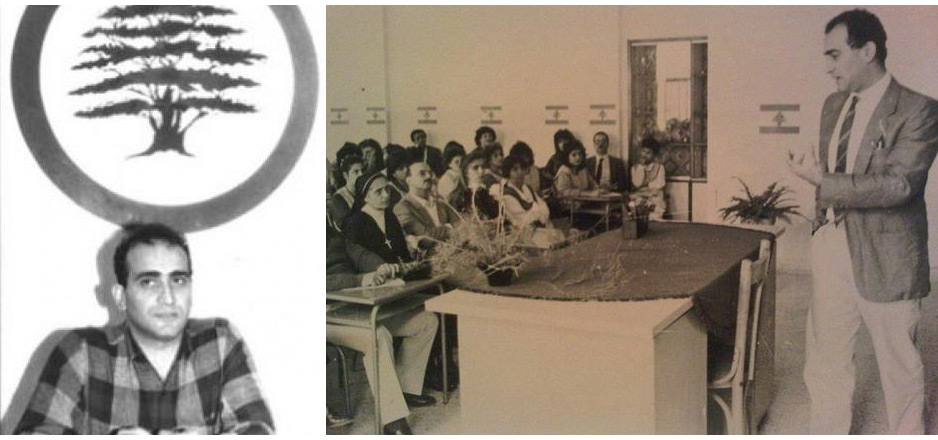
Walid Phares lecturing in front of a Lebanese Forces banner in 1986Photo courtesy of An-Nahar By René Naba , in Actualités Liban Moyen-Orient Portrait on 6 novembre 2018 .