Seenthis
•
 
Identifiants personnels
  • [mot de passe oublié ?]


Jasmine

@jasmine
jasmine//
RSS: Jasmine
tous les messages de Jasmine
  • @jasmine
    Jasmine @jasmine CC BY 1/02/2014
    10
    @fil
    @simplicissimus
    @lyco
    @reka
    @7h36
    @nicolasm
    @rastapopoulos
    @ze_dach
    @ianzan
    @supergeante
    10

    How to screw learning with one simple belief
    ▻http://pjf.id.au/ethics/2014/01/25/how-to-screw-learning-with-one-simple-belief.html

    This. Right here. Look at it.

    It’s a graph showing the performance of children after they’ve been praised for their intelligence (“you must be smart”) versus their effort (“you must have put a lot of effort into that”), and then given a series of hard problems to try to solve. The kids who are taught that effort count increase in the number of problems they can solve. Those who are told that they’re smart show a frightening decrease.
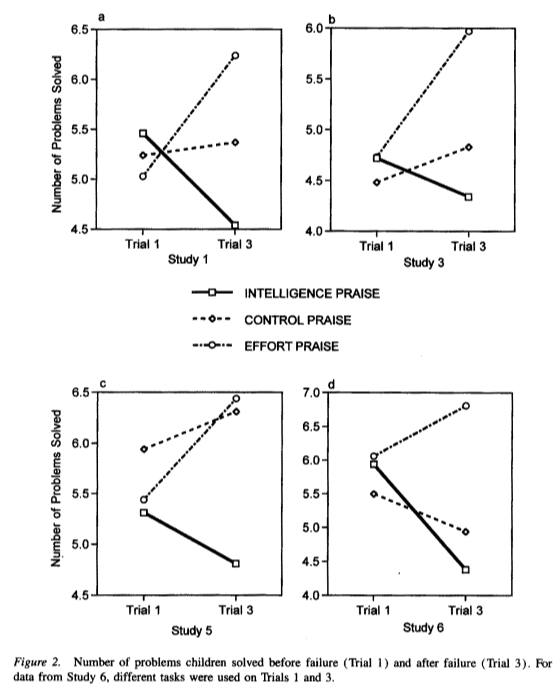
    http://pjf.id.au/images/ethics/praise-fail.png

    #enfants #éducation

    Jasmine @jasmine CC BY
    • @simplicissimus
      Simplicissimus @simplicissimus 1/02/2014

      Le titre abrégé du papier (de 1998) : Praise can undermine motivation
      Et complet Praise for Intelligence Can Undermine Children’s Motivation and Performance ▻http://www.uky.edu/~eushe2/mrg/MuellerDweck1998.pdf

      Simplicissimus @simplicissimus
    • @lyco
      Lyco @lyco 1/02/2014

      Un article plus récent sur l’effet non pas du type d’éloge mais de leur intensité :
      When Being Called “Incredibly Good” Is Bad for Children
      ▻http://www.psychologicalscience.org/index.php/news/releases/when-being-called-incredibly-good-is-bad-for-children.html

      Researchers found that adults seem to naturally give more inflated praise to children with low self-esteem. But while children with high self-esteem seem to thrive with inflated praise, those with low self-esteem actually shrink from new challenges when adults go overboard on praising them.

      Lyco @lyco
    • @nicolasm
      Nicolas🌱 @nicolasm CC BY-SA 2/02/2014

      Ça rappelle furieusement la #communication_non_violente (#CNV). Ça m’avait frappé à l’époque mais même si elle est utilisée en général pour résoudre les conflits, elle est aussi pertinente pour les situations où l’on cherche à exprimer sa gratitude. Car finalement un jugement même « positif » reste un jugement, donc enfermant et violent. La preuve éclatante ici. Par contre la phrase la mieux notée correspond juste à la partie « fait » de la CNV, ça serait encore plus puissant si la phrase comportait le sentiment que ça provoque en nous et les besoins comblés.

      Nicolas🌱 @nicolasm CC BY-SA
    Écrire un commentaire

thèmes

  • #éducation
  • #enfants

  • IndustryTerm:Car finalement un jugement même
thématisation automatique par OpenCalais
Propriété intellectuelle Recommandations API