• The Everywhere Border. Digital Migration Control Infrastructure in the Americas

    The US is building a digital border infrastructure in neighbouring countries that expands and deepens surveillance, while hiding state violence. The implications of this new infrastructure will be long-lasting and need to be integrated into strategies of resistance of migrant justice movements worldwide.

    In 2021, José Eusebio Asegurado, a farmer in El Salvador, was arrested by the Salvadoran National Civil Police for ‘promoting human trafficking’. The basis for the arrest was a WhatsApp group chat (external link)
    that Asegurado and other migrants1 were using to coordinate a caravan, which had been infiltrated by a police agent. According to the screenshots used to incriminate him, Asegurado’s only participation in the chat was responding ‘OK’ to a migrant’s message that he would be at a meeting point at around 5 o’clock. Police arrested Asegurado at the meeting point, telling him he was ‘profiled’ as a caravan organiser.

    The same day, the Salvadoran police also charged Fátima Pérez, a cook, and Juan Rufino Ramírez, a private security guard, with promoting ‘human trafficking’ based on messages on a WhatsApp group they had created to coordinate a caravan. Screenshots in Ramírez’s case show him giving instructions to the 55-member group to meet at the bus station, and the prices of tickets to Guatemala. The police arrested Ramírez and Pérez the morning they were planning to leave.

    These three arrests took place in the span of four hours. The then-US ambassador in El Salvador, Katherine Dueholm, promptly congratulated (external link)
    the General Prosecutor’s office, stating: ‘I applaud the Salvadoran authorities who are taking action against those who want to deceive citizens with caravans and false promises. They promote only #UnViajeEnVano (external link)
    ’ – ’a journey in vain’.

    The arrests and Ambassador Dueholm’s praise reflect the critical role of covert surveillance and data-driven ‘smart’ technologies in US migration-control practices operating deep within countries outside the US. Over the past twenty years, the US (and other wealthy countries) have made strides to externalise border-control regimes well beyond their actual territory. This often involves effectively enrolling agencies in other countries in migrant surveillance, policing, and exclusion.

    The new digital infrastructure that enables border externalisation, however, is little understood. This digital infrastructure relies on both military-grade technology built by major weapons manufacturers and Silicon Valley innovation: inter-operable databases that share fingerprints seamlessly between police agencies across borders; biometric collection devices used by Mexican detention authorities to track migrants for US Customs and Border Protection (CBP); social media apps that serve as critical communications networks for migrants and surveillance tools for police; digital ID systems that enable access to essential services, but double as tracking devices.

    Infrastructure – digital or material – has real sticking power; that’s the point. Once a highway splits a community in half, a new permanence stifles the din of protest, and people move on. We use the term digital infrastructure to describe the establishment of a foundation that will be fundamental to how world powers will practise migration control; and, as it embeds itself, increasingly beyond challenge – a unified strategic intervention by powerful countries, with the US coveting the vanguard. While it may look like technological experimentation (like AI-powered robot dogs on the border) or one-off opportunistic data-grabs (like networks of international data-sharing agreements), the growth of digital border infrastructure is by design. This is enabled through joined-up digital technologies that settle into the kind of rigid, ‘motiveless’ permanence granted to other infrastructures, like submarine communications cables, protocols and servers that run the internet, an electrical grid or a superhighway.2

    The profound implications of new infrastructures persist long after their creation, as is the case for the digital infrastructure deployed to police migrants in the so-called US ‘backyard’. Its impacts are frequently rendered invisible. Governments promote border policing technologies as fundamentally safe, humane and non-violent (external link)
    while migrant advocates struggle to make visible the violence on the other side of this unseen ‘borderland circuitry’.3

    The implications range from digitally triggered violence and killings by local police in Central America to actions by the US, its allies and competitors in geopolitical contests over the control of global security. The US government and private industry have worked themselves into a largely covert entrepreneurial frenzy to own and control the migration policing interface of the future. Monitoring and control capabilities – a longstanding and routine part of US aid packages to fight organised crime – both expand domestic spying by partner governments for their own ends and serve US border externalization interests in controlling the movement of people and diverting them away from the US territorial border.

    This essay will focus primarily on how digital infrastructure serves US interests . What do we know about this strategy and how it is already affecting mobility and human rights in the region? What are its historical foundations? What challenges lie ahead? It is impossible to answer these questions simply by dissecting the cruelty or provenance of any single technology, system or actor. We first need to understand the transnational motivations driving these incremental, more observable, facts on the ground. We need, in other words, to make visible the invisible digital infrastructure.
    Digital infrastructure is key to border externalisation and a rise in unaccountable violence

    Understanding border externalisation through the lens of digital infrastructure captures the true scale of border practices envisaged by the US (and its competitors and allies) as well as their envisaged permanence within the future world order. Digital border infrastructure feeds on histories of domination, control and atrocities in the name of transnational ‘crime-fighting’ projects, setting the stage for tremendous social costs.

    First, as to scale, we are witnessing an escalation of US border imperialism and borderland violence4 – both in terms of geographical reach far into national territories and the further extension of ‘policeability’5 to an increasing number of individuals and groups through this digital infrastructure. This includes anyone an algorithm decides might be ‘dangerous’, those who might migrate, as well as humanitarian actors, migrant advocacy groups, and aid organisations. Scaling and the rapid growth it engenders is a quintessential property of digital technologies, regardless of their origin or application. The shifts to new targets under digital infrastructure are frictionless compared to earlier analogue-based border policing tactics. Asegurado, the farmer assisting migrants in El Salvador, was swept up in the US border externalisation dragnet with a simple ‘OK’ on a WhatsApp chat.

    Second, as to permanence, advocates of digital borders in national capitals, industry and development agencies embrace the term ‘digital public infrastructure’ as a brand, to bestow (unearned) trust, normalisation and the inevitability of contested digital tools such as biometric IDs and payment systems.6 Ceding the privilege of defining ‘digital infrastructure’ to actors with vested interests in current migration-control practices is reckless. Without a counternarrative that articulates their violent disposition, digital border externalisation tools – including widespread biometrics collection, real-time transaction data-collection in payment systems, and the confiscation of smartphones at the border – can easily be normalised as ‘digital public infrastructure’, rather than resisted.

    The scale and enduring impact of the rapidly hardening digital infrastructure that fuels border externalisation calls for urgent transnational organising. As writers and activists, we have come together to resist the use of digital infrastructure in US migration-control policy in Mexico, Central and South America, and the Caribbean. We have only traces and not the whole picture. Building on the work of others, we weave all this together to show how the fusion of state and digital power to construct digital border infrastructure is neither humane nor safe: rather, it is increasing unaccountable forms of violence.

    Convergence: Drugs war, border externalisation, digital infrastructure and the militarisation of US’ neighbouring regions

    Economic and political initiatives since the 1970s have driven relentlessly towards US investments in more militarised, criminalising, and digitised migration-control practices. Since 9/11, the US convergence of ‘national security’ with unauthorised migration has fueled an ever expanding border externalisation regime—currently there are 23 CBP offices and 48 ICE offices worldwide—and consequently has provided an especially lucrative market for digital surveillance corporations.7 Through programmes such as the Mérida Initiative and the Central American Regional Security Initiative, the US has tied aid to countries such as Mexico, El Salvador, Guatemala and Honduras to increased militarisation, policing, incarceration, and migration control.

    Yet migration patterns to the US from Mexico, Central America and the Caribbean cannot be divorced from the practices and policies that the US employed for over a century to dominate countries in these regions. Decades of US practices and policies have fuelled economic, political, and environmental instability – key factors that drive migration to the US. Over the past 20 years the number of people migrating from Central America has more than doubled (external link)
    , the largest increases coming from Guatemala, Honduras and Mexico. The US-backed ‘war on drugs’ in Mexico and Central America has dramatically increased violence and instability.8 In Mexico, the fight against organised crime has resulted in 350,000 deaths and more than 72,000 disappearances (external link)
    between 2006 and 2021. According to the World Bank, 60% of rural Central Americans live in poverty (external link)
    . While the largest contributors to the climate crisis are wealthy countries, these already impoverished populations suffer the most acute impacts of climate change. For decades, prolonged droughts together with natural catastrophic events such as hurricanes (external link)
    and floods (external link)
    have deeply affected Central America. The number of people facing food insecurity tripled between 2019 and 2021, affecting 6.4 million people (external link)
    . Asegurado, Pérez and Ramírez – like many others – are grasping for alternatives to this intolerable situation.

    Rather than acknowledge these underlying causes, the US response has been to extend its border ever further. General John Kelly, former Secretary of the US Department of Homeland Security (DHS), stated (external link)
    , ‘I believe the defense of the Southwest border starts 1,500 miles to the south’. Mexico has long been central to the US border-externalisation regime, and digital infrastructure plays an increasingly critical role. Tony Crowder, former director of CBP’s Air and Marine Operations, shared Kelly’s sentiment ‘We have taught the Mexicans how to fish…[but] even though we have all this surveillance capability, we don’t have enough, we need more’.9

    While part of a continuum of US efforts to enlist Mexico in support of its regional objectives, this ‘security and rule-of-law partnership (external link)
    ’ accelerated following 9/11. In 2007, the US shifted the focus of its drug war (external link)
    from Colombia to Mexico, Central America, and the Caribbean. Under this frame of securitisation, the drug war merged with the migrant-control regime. In 2008, the Mérida Initiative was launched – a bilateral partnership between the US and Mexico in the name of the US war on drugs. It initially provided financing for Mexico to purchase equipment for its military and police forces and for intelligence gathering. In 2013, Mérida was revamped to include four pillars (external link)
    , incorporating the creation of a ‘21st century US-Mexican border, while improving immigrant enforcement in Mexico and security along Mexico’s southern borders’. Effectively an extension of US policy, some $3.5 billion (external link)
    has helped shape Mexico’s migration-control agenda since 2008.

    In 2014, Programa Frontera Sur further securitised Mexico’s southern border by increasing the migration policing and deportation apparatus. Consequently, Mexico now has one of the world’s largest (external link)
    immigration detention systems. Between 2014 and 2017, Mexico deported more Central Americans (external link)
    than the US Border Patrol. Doris Meissner, the former commissioner of the Immigration and Naturalization Service (INS, the predecessor to ICE and CBP), underscored the importance of Mexican migration control, explaining in 2017 the need to look at both US and Mexican data to assess the effectiveness of US border enforcement (external link)
    .10

    Under these agreements, the US Department of Defense has provided training and sold millions in military equipment to Mexico, including an array of ‘smart border’ technologies provided by corporations (external link)
    such as Dev Technology, General Dynamics, Amazon Web Services, and NEC. The CBP and ICE have provided training on intelligence-gathering, info-sharing, and migration policing. A key element of US support to Mexico has been to develop an infrastructure to collect and share data – such as biometric and biographical information, and criminal history – in a manner that interfaces seamlessly with US databases.

    The digital infrastructure that tracks and catalogues migrants is central to US migration policy in Mexico. The US-backed Instituto Nacional de Migración (INM) strategy relies on this infrastructure (external link)
    as the primary means to control migration rather than sealing Mexico’s southern border with Guatemala. Biometric collection is essential to making migrants more legible to the state. In 2011, the US provided four biometric kiosks (external link)
    to Mexico’s southern border, and 117 additional biometric scanners (external link)
    the following year. Between 2018 and the first half of 2022, the Mexican government gathered and shared information on over 360,000 migrants in detention facilities.11 Information from CBP reveals that Mexican authorities shared information from 10,000 humanitarian visa (external link)
    applications with DHS. The release of approximately 1,800 unregistered migrants from a shelter in Piedras Negras was conditional on the registration of their data.12

    An ‘Information Sharing Environment’ that includes inter-operable data-sharing systems (external link)
    is central to achieving the objectives of the homeland security state. ‘Inter-operability’ enables seamless connectivity between police, immigration agencies, foreign governments, and more.13 Key forms of US-initiated digital infrastructure rely on widespread information-gathering and seamless sharing of data for surveillance across borders.

    This vast amount of data-collection and sharing has been fuelled by unleashing the power of the carceral state – including the centrality of the ‘criminal alien’, ‘gang member’ and ‘drug trafficker’ as threats to national security – at all geographic levels of the US migrant-control regime. For example, the Biometric Identification Transnational Migration Alert Program (BITMAP) allows DHS and its partner countries to know where and when an individual arrives in the Western Hemisphere (external link)
    and their travel patterns before they reach the southwest US border. BITMAP is currently deployed to 18 countries (external link)
    , including Mexico. DHS also has a Criminal History Information Sharing (CHIS) programme that allows for the global sharing of biographic, biometric, and descriptive information on individuals deported from the US (e.g. alleged immigration, employment, family, and criminal histories).

    The structural criminalisation of poverty in both countries is amplified with CHIS. According to the National Survey of Imprisoned Population in Mexico, conducted by the National Institute of Geography and Statistics (INEGI) in 2021, nearly 44% of the respondents declared having been imprisoned on the basis of false accusations or incriminations (external link)
    . Forty-two percent claimed they had been forced to plead guilty or to incriminate someone else. Nearly half of those who are jailed have not been convicted (external link)
    , and nearly half of all convictions are for theft of under US$100 (external link)
    . This is the kind of data that feeds CHIS.

    In another example, DHS is developing the Homeland Advanced Recognition Technology System (HART) (external link)
    to replace its current centralised biometric database, IDENT, through a contract with Peraton (external link)
    (a subsidiary of Veritas Capital, a private equity firm). Hosted by Amazon Web Services, HART will enable DHS to aggregate and compare biographical and biometric data on hundreds of millions of people across the globe. This includes so-called encounter data from police stops, facial recognition, DNA, iris scans, and voice prints – usually gathered without the individual’s knowledge or consent. The massive HART database draws from widespread biometrics collection in all realms – for example, the US DOS INL’s development of integrated DNA databases in Mexico and Central America in the name of combating trafficking or the proposed national biometric digital ID in Mexico (external link)
    . In this way, multiple state initiatives merge, and the power of the state to police, track and control migrants and all people under their watch grows exponentially.

    While the Mérida Initiative formally ended in 2019, its approach has been sustained by the Mexican government. In 2021, the Mexican government increased (external link)
    the military by 46% and the National Guard dedicated to stopping migrants by 300%. In July 2022, President López Obrador committed $1.5 billion in smart border infrastructure (external link)
    over the next two years.

    For US partner states, any technological and data-sharing channels that are financed and exported to them become assets – not just for monitoring migrants, but to advance multiple agendas of coercive power-building. This infrastructure can therefore end up fuelling violence and criminalisation, undermining the right to asylum, exacerbating inequality, and expanding the power of paramilitaries and the police (external link)
    , while privileging securitised neoliberal and corporate prerogatives.
    The geopolitical nature of digital infrastructure

    In their research on digital payment systems, Marieke de Goede and Carola Westermeier use the term ‘infrastructural geopolitics’ to stress the growing centrality of infrastructure to geopolitics and the ways in which US economic power is rooted in financial infrastructures (which, like migration control, are rapidly digitising).14

    The global financial messaging network SWIFT is an example of infrastructure that is invisible to most people and yet plays a major role, as the writers describe, in reinforcing power relations of the post-war global order in which it emerged. Seventy years after the Second World War and fifty years since SWIFT’s establishment, bank messaging routes flow through former colonial capitals and map onto a ‘core’ of Western countries, leaving large swaths of Latin America, Africa, and the Middle East in a permanent, but effectively invisible, economic periphery. Similarly, digital IDs, social media monitoring and infiltration, and data-sharing platforms are essentially component parts, nodes, or partially visible layers of deeper, longer-term geo-strategic digital infrastructure projects.

    Extension of borders through digital infrastructure serves US political and economic goals well beyond the policing of human mobility. Geopolitical contests for control over infrastructures play out across several domains. Military establishments covet ‘identity dominance (external link)
    ’, an objective that drove US forces to gather massive stores of biometric data in Afghanistan and Iraq as a weapon of war. US digital services giants like Amazon and Google mastered ‘platformisation’ by building e-commerce (digital advertising, search, social media, etc.) infrastructure to dominate the digital economy. Often, public and private-sector interests converge, including in the form of public–private partnerships (PPPs) to build infrastructure. In each case, the true contest among states and corporate giants centres on control over the interface, or the most essential, invisible, infrastructural methods of digital communication and control. As Michael Kwet explains (external link)
    , ‘Transnational “Big Tech” corporations based in the United States have amassed trillions of dollars and gained excessive powers to control everything, from business and labor to social media and entertainment in the Global South. Digital colonialism is now engulfing the world’. The US quest for domination through externalised migration policing infrastructure goes hand in hand with its geopolitical and corporate designs for economic power.

    These forms of infrastructural digital power pose unique challenges for documentation and ultimately for any form of systemic change. Challenges include blurred lines of responsibility, mission, and function; governments and corporate actors are seen or presented as passive conduits or intermediaries in digital public infrastructure; and infrastructures can easily appear to be ‘ahistorical’ and motiveless. In Mexico and Central America, migration control converges with ongoing US foreign policing operations (such as the war on drugs, and gang wars). We explore the several simultaneous effects of this complex merger: the turn to digital infrastructure; its relationship to violence and human suffering; and its foreclosure of accountability for these harms.
    Digital border infrastructure in your phone: Information and Communications Technology (ICT) policing techniques along migration routes

    Surveillance infrastructure is tangible in physical migration detention centres and in police arrests: mugshots, cheek swabs, confiscation of the detainee’s mobile phone. The deepening integration of daily life, telecommunications and computers open extensive avenues for more covert, opportunistic surveillance of private communications and activity by users who rely on social media, mobile communication and messaging apps. The surveillance of mobile phones and social media ranges from overt disclosure requirements for visa and benefits applications to government listing and tracking of protesters and other ‘undesirable’ actors. Migrant surveillance is immersed in these control schemes where surveillance technology serves as a silent tool for government violence and repression.

    This has had an impact on how migrants travel and keep safe, such as through safety in numbers. Travelling in caravans has therefore become both a survival and a protest strategy: sources of both physical and economic security (external link)
    and opposition (external link)
    to the economic policies that contributed to their displacement. Social media and messaging apps are key tools for the coordination of caravans and for migrants more broadly. Migrants use these tools to identify routes, look for shelter and food, communicate with their support networks, warn each other about risks (external link)
    , and coordinate travel. Governments as well as organised crime understand these dynamics and use these same tools to monitor and extort migrants.

    On 5 June 2019, Irineo Mujica, from Sin Fronteras – a civil society organisation (CSO) dedicated to the protection of human rights of migrants in Mexico and the US, and which has supported multiple migrant caravans – was arrested in Mexico, falsely charged with human trafficking (external link)
    . Mujica appeared in the CBP’s watchlist database published in 2019 (external link)
    that contained photos, names, professions, and other details of journalists, activists, and social media influencers both from Mexico and the US with links to the migrant caravan.

    A DHS Office of Inspector General (OIG) report (external link)
    on the database and other surveillance practices found that CBP established electronic alerts (lookouts) on journalists, attorneys, and advocates who were connected by social media to the migrant caravans. Those tagged by the lookouts were constantly flagged for secondary screening (external link)
    when entering the US, and interrogated about their work, organisation, family, education, and political leanings.

    The weaponisation of such information had grim effects on the Mexican side of the border. According to Sin Fronteras activist Alex Mensing (external link)
    , after the CBP shared information gathered through lookouts with the Mexican government, other members from his organisation who assisted migrant caravans in the same period saw an increase in border scrutiny and death threats (external link)
    . Organising and supporting migrants threatens lucrative operations that depend on the criminalisation of migration across the region. Civil society assistance makes migrants less prone to kidnapping and extortion, which therefore reduces the income for organised crime linked to these activities, and, as a domino effect, bribes to authorities also drop, pitting the collective interests of such groups against activists and those providing humanitarian assistance.

    Surveilling anyone who might pose a threat to the system has long been a generalised and systematic form of government control in Mexico. A leaked document from the NSO Group, the Israeli company that created Pegasus, revealed that 50,000 people were possible surveillance targets (external link)
    in Mexico. The list included opposition politicians, journalists investigating government corruption and extrajudicial killings, activists advocating the taxing of sugary drinks, judges, academics, and international experts who investigated the case of the enforced disappearance and extrajudicial killing of the 43 students, among others.

    In 2022, mobile phones from two journalists and an activist who investigated abuses committed by the Mexican army were found to be infected with the malware Pegasus (external link)
    . In 2020, the Mexican government sought to create a SIM card registry that would link to the card owner’s biometrics and other personal data. This would have intensified government digital surveillance via ICT infrastructure, and was opposed by civil society (external link)
    .

    CBP internal documents show (external link)
    that government agencies across the border continually share information about the location of migrants, their origin, and the number of people in each group, even before they start to migrate. In 2018, US DHS agents infiltrated a WhatsApp group (external link)
    of Honduran migrants travelling in a caravan of about 4,000. These policing practices are also being reproduced by the Mexican government.15

    Impact: Infrastructural violence and accountability deficits in globalised migration policing

    Roberto M., a young man in El Salvador, was shot and taken away by police shortly after being deported from the US. The rural police officers who shot Roberto also threatened an eyewitness at gunpoint, telling him that Roberto was a gang member and if he revealed what he’d seen, the same would happen to him. Police in El Salvador receive data on gang-member affiliation from the US, and share these lists (external link)
    with neighbourhood-level police where deportees plan to live. These databases have been found to be problematic and unreliable (external link)
    . Police departments confirmed (external link)
    that this information is used to target people (external link)
    : ‘We think that if a person wasn’t wanted in the United States, it must be because the deported person is bad’.

    Violence can increasingly be tied to digital border technologies, particularly in combination with one another and with physical and environmental realities that envelop them. Studies show the effects of integrated fixed-tower surveillance on migrant mortality rates in Arizona’s Altar Valley. Here, digital infrastructure merges with the ineffective yet longstanding US deterrence policy that purposefully makes migration routes more dangerous, on the theory that migrants would not risk the journey. The fusion of technology and policies that inflict deliberate harm produces these predictable results of increased migrant deaths (external link)
    .

    The story of Roberto M. and the witness to his post-deportation shooting and disappearance in El Salvador reflects another pattern of violence tied to information-sharing through digital infrastructures. The criminologist Ana Muñiz documents a ‘cycle of violent policing, migration, more violent policing, detention, deportation, violent policing, migration, and so on’, in which the labels themselves (‘criminal alien’ or ‘gang member’) become inescapable vectors of precarity.16 Such labels channel individuals into a ‘sort of statelessness’ as constant, quantifiable scapegoats that provide an easy diversion for state security forces and corporations that produce and perpetuate the ‘structural causes of violence’.17

    Digital infrastructure merges not with a physical terrain, but with pre-existing social and political factors that make violence a foregone conclusion. Today’s multipurpose digital infrastructure also permits the efficient incorporation of new undesirable criminalised categories, including ‘caravan organisers’ or ‘migration promoters’ – as in El Salvador’s attempt (external link)
    to reform its penal code, criminalising the ‘promotion of migration’ on social media.
    Challenges and way forward

    We are interested in developing deeper knowledge about the political origins of these infrastructures to challenge the violence of global migration control systems. This essay only sets out the field of engagement. Far more collective work is required to document and design models of resistance to meet such challenges.

    The diffuse and structural nature of power behind the seemingly ahistorical, and motiveless characteristics of digital infrastructures undermine classic approaches to accountability. Furthermore, the familiar national and international judicial avenues to hold perpetrators of these forms of indirect violence responsible – however imperfect or ineffective they may already be – are exceptionally ill-suited to the conditions at play in the migration policing context specifically, for several reasons.

    First, the technologies in use such as biometric databases, and the means of using civilian technologies like social media and other ICTs, are simply not designed to respect or be held to democratic scrutiny; they are military-grade and converted for use in quasi-militarised spaces, by institutions permeated with military ideology. Nearly a third of CBP personnel previously served in the US military. Biometric surveillance technologies advanced by leaps and bounds within US military operations before being integrated with ‘civilian’ border policing. Private-sector military contractors play an integral role in this transition.

    As journalist Annie Jacobsen documents, as part of the US military biometric data-collection in Afghanistan, Palantir Technologies served as a critical link between US intelligence operations to track and kill military targets and quasi-civilian policing operations like the piloting of rapid DNA samples from migrant families at the US border in 2019.18 Today, the biometric kits used in Afghanistan, some still storing biometric data collected on the battlefield, are for sale on eBay (external link)
    .

    Second, justice and oversight bodies are ill-equipped to serve their intended function in this ecosystem. Within criminal proceedings and investigations, the use of technologies that capture and record evidence of allegedly criminal activity or purport to biometrically match records are extremely difficult to challenge because of their scientific veneer and opaque data-collection and analysis methods, which leaves no practical room (external link)
    to impeach or exclude such evidence. The design of technologies that predetermine risk factors keyed to criminalised behaviour, including migration, contravenes the presumption of innocence. In the civil context, national-level justice mechanisms deny standing to non-nationals located outside the US who are victims of violations linked to digital surveillance.

    Finally, there are huge incentives for both state and corporate power to hide violence. The political positioning of ‘smart borders’ as more ‘humane’ conceals the state’s role in violence and insulates corporations from negative PR or constraints by participating in repugnant markets. Their task is made easy by rendering physical pain abstract rather than affecting real human beings,19 and features of the data economy like the way corporates have helped the movement towards running government functions like private digital platforms.

    Mitigation ‘risk assessment’ tools like data protection or human rights impact assessments provide cover (external link)
    , favouring the continuation of these business practices because firms undertake them voluntarily and face little or no consequences for a poor risk assessment. Unsurprisingly, these industry-led tools often fail to provide (external link)
    a means for real accountability; they reveal scant information that would be actionable if and when products do cause harm; and the burden of proving rights violations and finding an effective remedy (external link)
    after the fact is shouldered entirely by victims. The interests of powerful actors converge around a web of financial stakes in the system, leading to the aggressive harassment and potential silencing of activists as the case of Irineo Mujica and Sin Fronteras illustrates.

    We need tools and methods for transnational cooperation to document, gather and share information safely, and organise. Fusing new understandings about how digital power functions within existing resistance movements transnationally, holds potential for challenges to the digital infrastructure of border externalisation.

    We are in the initial stages of our collective effort to understand and expose this digital infrastructure. Through this analysis, we can begin to identify the interventions to start to tear it apart and break it down. Transnational organising against tech corporations offers opportunities for shared understanding and meaningful solidarity. This year, organisations in France and Kenya, with support from actors in other countries, sued biometrics giant IDEMIA (external link)
    for its failure to meet even minimum human rights standards of due diligence as it reaps billions in secret border security tech sales to low- and middle-income countries. This emerged from collaborative evidence-gathering and organising across borders.

    As the US military establishment recognised decades ago: whoever dominates the field of externalised borders defines ‘friend and foe’ everywhere.20 The faster the US establishes economic and political dominance over digital migration-control infrastructure, the greater its security in maintaining global digital power. Digital infrastructure serves multiple purposes at once, but the ultimate geopolitical function is raw, generalised power over global affairs. The tools examined here will ‘contain’ human life within spaces of catastrophic violence, by design. This specific effect betrays the most fundamental commitments of international human rights and humanitarian law in the face of unprecedented challenges to human survival across most of the world. But this pernicious effect is also ruthlessly beside the point.

    In reality, as facets of infrastructural power, the technologies that fix the ‘calculation of who must live and who must die’22 do not do so as an end in itself, but in the service of power and its reproduction in this digital age.23 In this way the complicity of state and corporate actors in the production of violence is cast in the starkest relief. This geopolitical analysis is our starting point for building resistance towards transformation.

    https://www.tni.org/en/article/the-everywhere-border
    #externalisation #migrations #frontières #réfugiés #USA #Etats-Unis #infrastructure #infrastructure_numérique #violence #violence_d'Etat #surveillance #caravane #whatsapp #criminalisation_de_la_migration #arrestation #technologie #technologie_intelligente #externalisation_des_contrôles_frontaliers #bases_de_données #interopérabilité #empreintes_digitales #coopération_policière #impérialisme #biométrie #Mérida_Initiative #Central_American_Regional_Security_Initiative #war_on_drugs #Amérique_centrale #Mexique #Programa_Frontera_Sur #rétention #détention_administrative #ICE #smart_borders #frontières_intelligentes #Dev_Technology #General_Dynamics #Amazon_Web_Services #complexe_militaro-industriel #NEC #Instituto_Nacional_de_Migración (#INM) #Guatemala #Biometric_Identification_Transnational_Migration_Alert_Program (#BITMAP) #Criminal_History_Information_Sharing (#CHIS) #criminalité #Homeland_Advanced_Recognition_Technology_System (#HART) #IDENT #Peraton #Veritas_Capital #reconnaissance_faciale #ADN #DOS_INL #infrastructural_geopolitics #géopolitique #SWIFT #multinationales #colonialisme_numérique #téléphones_portables #smartphones #criminalisation_de_la_solidarité #NSO_Group #border_deaths #décès #morts_aux_frontières #mourir_aux_frontières

  • Policing migration: when “harm reduction” means “multipurpose aerial surveillance”

    The EU’s latest “#operational_action_plan” on migrant smuggling gives a central role to #Europol, which will receive data resulting from more than two dozen joint police operations launched by EU member states, EU agencies and a range of non-EU states. The UK is heavily involved in the plan, and is leading one activity. One objective is for harm reduction and assistance to victims, but the only activity foreseen is for Frontex to increase use of its “#EUROSUR_Fusion_Services, including the #Multipurpose_Aerial_Surveillance aircraft service.”


    Police against people smuggling

    The action plan (pdf) covers the 2024-25 period and contains an outline of 25 activities listed under eight strategic goals, but offers no insight into the causes of human smuggling, and none of the activities are framed at addressing causes.

    The overall aim is to control migration flows both into the EU and within the EU, and to enhance police cooperation between national law enforcement authorities, EU agencies (Europol, #Frontex and the #EU_police_database_agency, #eu-LISA) and with countries outside the EU, through joint operations and the exchange of information and intelligence.

    Many of the activities include targets for arrests: one led by Poland, for example, foresees the arrest of 200 facilitators of irregular migration per year; another, led by Cyprus, expects at least 1,000 “apprehensions/arrests”.

    In 2015, Statewatch exposed a planned EU-wide police operation against irregular migrants called ‘Mos Maiorum’, which led to significant media coverage and political controversy, as well as numerous actions to inform people of their rights and to try to map police activities. Since then, the number of such operations has skyrocketed, but attention has dwindled.

    European plan

    The 2024-25 plan is part of the #European_Multidisciplinary_Platform_Against_Criminal Threats, a now-permanent initiative (https://www.statewatch.org/statewatch-database/eu-joint-police-operations-target-irregular-migrants-by-chris-jones) through which joint police operations are coordinated. It is managed by Europol, with political control exercised by the member states in the Council of the EU.

    A “leader” is assigned to each activity in the action plan, responsible for initiating and reporting on the relevant activity, with “key performance indicators” often indicated in respect of each one.

    The leaders include nine EU member states (Austria, Cyprus, France, Germany, Greece, Italy, Poland, Portugal and Spain), the UK, as well Frontex, Europol, eu-LISA and the European Police College (CEPOL).

    Europol will provide overall support across all the different activities and is specifically responsible for leading four activities.

    In many activities led by national police forces, it is specified that a goal is also to participate in other Europol initiatives, such as the “Europol Cyberpatrol to target and identify targets” and Europol’s European Migrant Smuggling Centre. The Operational Action Plan stipulates that other, unspecified, “Europol tools” may be used “where appropriate”.

    The action plan specifies that the operational data emanating from the activities is to be shared with Europol to be processed through its Analysis Projects, further swelling the databases at its headquarters in The Hague.

    The first version of the action plan was circulated amongst member states two weeks before the European Commission published a proposal to reinforce Europol’s powers in relation to migrant smuggling, arguing that they were urgently needed – though this assessment was not shared by the member states.

    Strategic goals

    The 26 activities outlined in the plan are designed to contribute to eight strategic goals:

    - Criminal intelligence picture. The activities under this heading are for Europol to provide a “situational picture of migrant smuggling” including threat assessments, updates on migratory routes, “modi operandi” and future trends, which will be made available to member states and third countries. It will involve sharing information with Frontex. Europol also aims to “strengthen the strategic and tactical intelligence picture on the use/abuse of legal business structures by criminal networks” not only in respect of migrant smuggling, but throughout “all main crime areas affecting the EU”.
    - Investigations and judicial response. There are 11 activities planned in relation to this goal. The objective is to prepare and conduct investigations and prosecutions. Police forces of different member states lead the activities and set out specific targets by reference to the numbers of arrests, initiated investigations and identified networks. Each planned activity appears to reflect specific national or local police force priorities. Germany for instance aims to “detect 5,000 irregular migrants” per year, and arrest 500 “facilitators”, whilst France focuses on seizing 100 small boats crossing the Channel to the UK. Spain focuses on air routes, including links between human smuggling and drug trafficking; and Portugal’s aim is to disrupt “marriages of convenience abuse and associated threats” (400 cases specifically). Europol also leads an activity aimed at the development of “intelligence products in support of MS investigations” (50 per year) and Frontex aims to focus on border checks and surveillance measures on the EU external borders (with 1,000 “apprehensions/arrests”).
    - Coordinated controls and operations targeting the online and offline trade in illicit goods and services. The only activity planned in relation to this goal is by the French police forces, to improve law enforcement response against “those utilising the Dark Web and other internet messenger applications to enable illegal immigration and document fraud”. The dark web is identified as an “intelligence gap” in this context.
    - Criminal finances, money laundering and asset recovery. Led by the UK, the activity planned under this goal heading is to disrupt money flows specifically within hawaladar networks.
    - Document fraud. Frontex, as well as French and German police forces each lead activities under this goal aimed at “targeting networks or individuals” involved in document fraud. In this respect, Frontex’s “Centre of Excellence for Combating Document Fraud” has a key role.
    – Capacity building through training, networking and innovation. This involves activities aimed at improving the skills, knowledge and expertise of law enforcement and judicial authorities, led by CEPOL, eu-LISA (on the use of SIS and Eurodac databases) and German police forces.
    - Prevention, awareness raising and harm reduction, as well as early identification and assistance to victims. The only goal that is expressed as being aimed at improving the safety of people is led by Frontex, and is focused on the detection of migrant smuggling through the “use of EUROSUR Fusion Services, including the Multipurpose Aerial Surveillance aircraft service, for [member states] and stakeholders to support more effective detecting, preventing and combating illegal immigration and migrant smuggling.” No mention is made of identification, assistance or victims.
    - Cooperation with non EU partners: under this last goal, one activity is led by Austrian police forces, aimed at expanding the geographical focus of the Task Force Western Balkans to Turkey and “other relevant countries of origin and transit”. The work is already based on intelligence information provided by Europol and Frontex and aims to “enhance mobile phone extractions” (the link here is not clear). The second activity listed under this last goal is led by Europol, and aims to provide a “common platform for EU agencies, military, law enforcement and other stakeholders to exchange intelligence on criminal networks operating along the migration corridors”, creating a broad and focal role for itself in information exchange with a wide range of stakeholders, including private companies.

    For the purposes of the Operational Action Plan, “migrant smuggling” is broadly defined as:

    “…the process of facilitating the unlawful entry, transit or residence of an individual in a country with or without obtaining financial or other benefits. Migrant smuggling entails the facilitation of illegal entry to the EU and of secondary movements within the EU. It can also involve facilitating the fraudulent acquisition of a residence status in the EU.”

    It therefore does not require the involvement of any benefit and includes movements within the EU.

    https://www.statewatch.org/news/2024/april/policing-migration-when-harm-reduction-means-multipurpose-aerial-surveil
    #surveillance #surveillance_aérienne #migrations #réfugiés #données #coopération_policière #European_Police_College (#CEPOL) #European_Migrant_Smuggling_Centre #Europol_Cyberpatrol
  • Hungary, Austria and Serbia leaders outline plan to curb migration Access to the comments

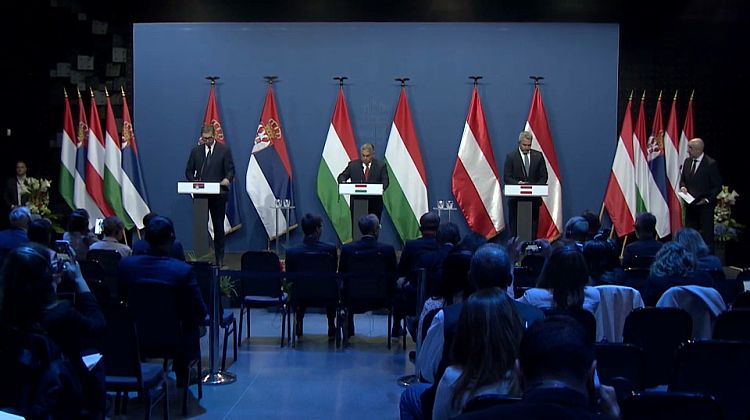
    The leaders of Hungary, Austria and Serbia met Monday in Budapest to find solutions on how to stem what they claim is the increasing number of migrants arriving in Europe.

    The three leaders agreed to take joint action to control the new arrivals along the migration route that leads through Serbia.

    Austrian Chancellor Karl Nehammer told reporters after the meeting that the joint action plan would include increased police cooperation along the borders as well as supporting Serbia when it comes to deporting migrants back to their home countries.

    "We will directly support Serbia to carry out repatriations and not only support technical know-how, but also do everything possible that is necessary, and financially support them,” Nehammer said.

    The Austrian chancellor lauded Serbian President Aleksandar Vučić’s announcement that by the end of the year, Serbia would align its visa policies with the European Union so that the visa-free regime with some non-EU countries is no longer used for migration purposes.

    Serbia is a candidate country for full-fledged membership in the bloc.

    “We will thus prevent the situation when someone uses Serbia as a country of arrival but not because of their real needs but for illegal migration toward the west,” Vučić said.

    Hungarian Prime Minister Viktor Orban called for an overall political change in how to approach migration and suggested so-called hot spot centres outside the European Union where asylum-seeker requests should be processed. He added that "we are not satisfied at all with the situation that has developed.”

    That procedure would, however, undermine the national laws of some European countries. Among them is Germany, which has enshrined in its constitution every foreigner’s right to apply for political asylum and have his or her request individually checked while staying in the country.

    Among the migrants recently detained in Austria who have applied for asylum to avoid immediate deportation, Indian nationals accounted for the biggest group in September, according to government data.

    Indian nationals need a visa to enter the EU but can enter Serbia without one. From there, many are trying to reach Western European countries with the help of traffickers, according to government claims.

    Monday’s meeting in the Hungarian capital came after announcements by the Czech Republic and Austria last week that they would launch temporary border controls at their crossings with Slovakia to stop migrants from entering.

    In addition to the meeting in Budapest, the interior ministers of Austria, the Czech Republic, Hungary and Slovakia called on the EU on Monday to better protect the outer borders to curb the latest increase in migration.

    “We’re facing problems that affect all of Europe,” said Czech Interior Minister Vit Rakušan.

    While Serbia has not had any major incidents in handling prior waves of migration, Hungary has been accused of serious human rights violations in the past, including becoming the only EU country that has legalised pushbacks, some of which were said to have been violent.

    Orban is one of the most vocal anti-migration politicians in Europe, known for publically labelling non-European immigrants “Muslim invaders” in an interview with the German newspaper Bild in 2018 and stating migration was “poison” in 2016.

    https://www.euronews.com/2022/10/04/hungary-austria-and-serbia-leaders-outline-plan-to-curb-migration

    #Hongrie #Autriche #Serbie #Balkans #route_des_Balkans #asile #migrations #réfugiés #frontières #fermeture_des_frontières #coopération_policière #police #renvois #expulsions #visa #visas #Slovaquie #République_Tchèque

  • La UE aumenta los fondos de gestión migratoria en Marruecos con 500 millones

    La asignación para el periodo 2021-2027 es de casi un 50% más que los 346 millones que había recibido en el anterior.

    La Unión Europea (UE) aumentará el paquete de ayuda a Marruecos para la gestión migratoria en unos 500 millones de euros para el periodo 2021-2027. Esto supone un 50% más que en el periodo anterior (2014-2020) cuando el paquete presupuestario era de 346 millones.

    Estos paquetes de «ayuda sustancial» para Rabat en el ámbito migratorio incluyen un programa de apoyo presupuestario que se encuentra en negociación, pero que podría suponer unos 150 millones de euros, según fuentes comunitarias. Además, se está considerando para el futuro otra fase del programa de apoyo presupuestario por un montante «aproximadamente similar».

    La Comisión Europea y Marruecos acordaron una nueva asociación operativa contra el tráfico de personas, cuando la comisaria de Interior, Ylva Johansson, visitó el país el pasado 8 de julio.

    En particular, prevé un apoyo en la gestión de fronteras, la cooperación policial reforzada (incluidas las investigaciones conjuntas), concienciación sobre los peligros de la migración irregular y una mayor cooperación con las agencias de la UE que trabajan en el ámbito de los asuntos de interior. La Comisión considera que Marruecos «es un socio estratégico y comprometido» con el que los Veintisiete han cooperado en temas migratorios desde hace años.

    Rabat también se beneficiará de nuevas acciones nacionales junto con otras regionales, en las áreas de lucha contra el tráfico y la trata de personas, protección, retorno y reintegración, así como en el ámbito de la migración legal, señalaron fuentes comunitarias. Precisaron, por otra parte, que está en discusión el apoyo futuro a Marruecos en ese contexto y que solo se podrá dar detalles una vez que los diferentes programas estén finalizados.

    La UE tiene la intención de seguir apoyando la gobernanza y la gestión de la migración en Marruecos, incluso con acciones específicas destinadas a garantizar que las fronteras sean gestionadas de acuerdo con las normas internacionales de derechos humanos, indicaron las fuentes. El apoyo financiero de la UE es parte de un diálogo integral UE-Marruecos sobre migración, en línea con los principios consagrados en el Pacto Europeo para la Migración y el Asilo.

    El enfoque principal de la cooperación es la promoción de los derechos y la protección de los migrantes y refugiados vulnerables, el apoyo institucional para la gestión de la migración, así como la creación de oportunidades económicas y el apoyo a los esquemas de movilidad legal como alternativas a la migración irregular, aseguraron las fuentes.

    https://www.publico.es/internacional/ue-aumenta-fondos-gestion-migratoria-marruecos-500-millones.html#md=modulo-p
    #UE #EU #Union_européenne #Maroc #asile #migrations #réfugiés #externalisation #frontières #aide_financière #coopération_policière #police

    • Lutte contre l’immigration clandestine : comment l’UE a fait du Maroc son « #partenaire_privilégié »

      Près de 500 millions d’euros : telle est la somme que va verser l’Union européenne au Maroc pour lutter contre l’immigration clandestine. Un pas de plus dans la collaboration entre l’Europe et le royaume, qui cherche depuis des années à « asseoir son leadership » en matière de migration.

      C’est une preuve de plus du rapprochement qui s’opère entre le Maroc et l’Union européenne (UE) au sujet des questions migratoires. Bruxelles va verser au royaume la somme de 500 millions d’euros « pour renforcer ses actions dans la lutte contre l’immigration clandestine », a affirmé, lundi 15 août, le journal espagnol El Pais.

      Cet argent servira à consolider les nouveaux mécanismes de coopération entre l’UE et le Maroc, à savoir l’appui à la gestion des frontières, le renforcement de la coopération policière (y compris les enquêtes conjointes), et la sensibilisation aux dangers de l’immigration irrégulière.

      Une partie de la somme sera aussi dédiée « au développement des politiques d’intégration et de protection des réfugiés au Maroc », ainsi qu’à « la lutte contre les mafias », relaie le site d’informations marocain Médias24.

      Les 500 millions d’euros d’aide annoncés dépassent largement les 343 millions d’euros reçus précédemment par le Maroc, fait savoir aussi El Pais.

      L’immigration irrégulière, « une source d’instabilité »

      Cette somme promise vient clore un cycle de rencontres et de rapprochements mutuels ayant eu lieu ces derniers mois entre l’UE et le Maroc. Le 8 juillet, la commissaire européenne chargée des affaires intérieures #Ylva_Johansson et le ministre espagnol de l’Intérieur, #Fernando_Grande-Marlaska, avaient rencontré à Rabat le ministre de l’Intérieur marocain, #Abdelouafi_Laftit. Ensemble, ils avaient lancé « un partenariat rénové en matière de migration et de lutte contre les réseaux de trafic de personnes », peut-on lire dans un communiqué de la Commission européenne. Celui-ci couvre les mêmes prérogatives que l’aide financière décidée ces derniers jours.

      En mars, le commissaire européen chargé du voisinage et de l’élargissement #Oliver_Varhelyi avait posé, depuis Rabat, les jalons de cette #collaboration renforcée. « Nous sommes très reconnaissants du travail dur et persistant réalisé par le Maroc et qui doit se poursuivre. Et nous sommes prêts à contribuer de notre part pour faciliter ce travail, parce que nous sommes convaincus que l’immigration irrégulière est une source d’instabilité et de vulnérabilité pour la région », avait-il assuré au ministre marocain des Affaires étrangères, Nasser Bourita.

      Le commissaire avait même affirmé vouloir « élargir cette coopération », avec « des moyens financiers plus élevés qu’avant ».

      Les migrants comme outil de pression

      Pour l’Europe, l’objectif est clair : « Faire face, ensemble, aux réseaux de trafic des personnes, notamment suite à l’émergence de nouveaux modes opératoires extrêmement violents adoptés par ces réseaux criminels », indique encore le communiqué de la Commission européenne, qui voit en Rabat « un partenaire stratégique et engagé [...] en matière de migration », « loyal et fiable ».

      L’enthousiasme de l’UE à l’égard du Maroc avait pourtant été douché en mai 2021, après le passage de plus de 10 000 migrants dans l’enclave espagnole de Ceuta, les 17 et 18 mai. En cause ? Les tensions diplomatiques entre Madrid et Rabat à propos de l’accueil, par l’Espagne fin avril, du chef des indépendantistes sahraouis du Front Polisario, Brahim Ghali, pour des soins médicaux. L’UE avait alors suspendu son aide financière au Maroc tout juste décaissée, et qui devait courir jusqu’à 2027. « Personne ne peut faire chanter l’Europe », avait alors déclaré Margaritis Schinas, vice-présidente de la Commission européenne.

      Un peu plus d’un an plus tard, les drames survenus sur les routes migratoires marocaines qui mènent à l’Europe ont, semblent-ils, changé la donne. La pression migratoire qui s’exerce aux frontières de Ceuta et Melilla et en mer, ont poussé l’UE à faire évoluer sa relation avec le Maroc, qui y trouve son intérêt.

      « Cela fait longtemps que l’Europe et le royaume essaient de trouver des points de convergence. Mais ce dernier a longtemps résisté aux propositions européennes, ne voulant pas être ’otage’ d’un accord multilatéral sur ces questions, et abîmer son image auprès des pays africains, dont il cherche à se rapprocher », explique à InfoMigrants Catherine Withol de Wenden, directrice de recherche au CNRS, spécialiste des migrations internationales. Mais aujourd’hui, le royaume s’attache au contraire « à tirer profit de sa position géographique, pour faire monter la pression côté européen, et asseoir son leadership à ce sujet », précise la spécialiste.

      La stratégie du récent « partenaire privilégié » de l’UE fonctionne aussi sur ses membres. Le 19 mars, Madrid a en effet soutenu pour la première fois publiquement la position de Rabat sur le dossier du Sahara occidental. Et ce, alors même que le pays avait toujours prôné jusqu’ici la neutralité entre Rabat et le Polisario. « En faisant volte-face sur la question du Sahara occidental, l’Espagne a montré son point faible. Elle ne veut plus se brouiller avec le Maroc, car les conséquences, on le sait, sont très fâcheuses », avait confirmé à InfoMigrants Brahim Oumansour, chercheur à l’IRIS (Institut des relations internationales et stratégiques), spécialiste du monde arabe.

      À l’intérieur des frontières du Maroc, dont la politique migratoire est tant vantée par l’UE, s’appliquent pourtant de nombreuses violences à l’égard des migrants, sans papiers ou demandeurs d’asile. La répression des exilés est bien souvent privilégiée par les autorités, en lieu et place d’un accueil digne. Mercredi 17 août, un groupe de 28  migrants doit être jugé à Nador, dans le nord-est du pays, pour avoir tenté de franchir les hautes clôtures qui séparent Melilla du territoire marocain, avec 1 500 autres personnes. Ces prévenus sont, pour la plupart, originaires du Tchad et du Soudan, pays parmi les plus pauvres du monde.


      https://www.infomigrants.net/fr/post/42670/lutte-contre-limmigration-clandestine--comment-lue-a-fait-du-maroc-son

      #partenariat

  • Schengen borders code: Council adopts its general approach

    As part of the work carried out under the French presidency to reform and strengthen the Schengen area in the face of new challenges, the Council today adopted its general approach on the reform of the Schengen borders code.

    This reform: (i) provides new tools to combat the instrumentalisation of migrant flows; (ii) establishes a new legal framework for external border measures in the event of a health crisis, drawing on the lessons learned from the experience with COVID-19; (iii) updates the legal framework for reintroducing internal border controls in order to safeguard the principle of free movement while responding to persistent threats; (iv) introduces alternative measures to these controls.

    The general approach now enables the Council to start negotiations with the European Parliament, once the Parliament has adopted its own position.
    The fight against the instrumentalisation of migration flows

    The text defines the instrumentalisation of migrants as a situation in which a third country or non-state actor encourages or facilitates the movement of third-country nationals towards the EU’s external borders or to a member state in order to destabilise the EU or a member state. It introduces new measures to combat this phenomenon, including limiting the number of crossing points at the external border or limiting their opening hours, and intensifying border surveillance.
    External border measures in the event of a health crisis

    The text provides for the possible swift adoption of binding minimum rules on temporary travel restrictions at the external borders in the event of a threat to public health. This will strengthen the currently available tools applied during the COVID-19 pandemic, which have been based on non-binding recommendations.

    The binding implementing regulation to be adopted by the Council in such situations will include minimum restrictions, with the possibility for member states to apply stricter restrictions if the conditions so require. It will also include a list of essential travellers to be exempted from certain measures, which will be decided on a case by case basis.
    Reintroduction of internal border controls

    The text sets out more structured procedures for the reintroduction of internal border controls, with stronger safeguards. It takes into account a recent judgment by the European Court of Justice, which confirmed the principle of freedom of movement within the Schengen area, while specifying the conditions for the reintroduction of internal border controls. In this regard, it offers possible responses to persistent threats to public policy and internal security.

    If a continued need for internal border controls is confirmed beyond two years and six months, the member state concerned will need to notify the Commission of its intention to further prolong internal border controls, providing justification for doing so and specifying the date on which it expects to lift controls. The Commission will then issue a recommendation, also relating to that date, and with regard to the principles of necessity and proportionality, to be taken into account by the member state.
    Promotion of alternative measures

    The text updates the Schengen borders code by providing for alternative measures to internal border controls, in particular by proposing a more effective framework for police checks in member states’ border regions.

    The text introduces a new procedure to address unauthorised movements of irregular migrants within the EU. In the context of a bilateral cooperation framework based on voluntary action by the member states concerned, this mechanism will allow a member state to transfer third-country nationals apprehended in the border area and illegally staying in its territory to the member state from which they arrived, in the context of operational cross-border police cooperation.

    https://www.consilium.europa.eu/en/press/press-releases/2022/06/10/schengen-area-council-adopts-negotiating-mandate-reform-schengen-bo

    en français:
    https://www.consilium.europa.eu/fr/press/press-releases/2022/06/10/schengen-area-council-adopts-negotiating-mandate-reform-schengen-bo

    #Schegen #code_frontières_Schengen #frontières #frontières_extérieures #frontières_intérieures #frontières_internes #migrations #asile #réfugiés #réforme #menaces #liberté_de_circulation #surveillance_frontalière #instrumentalisation #contrôles_frontaliers #mouvements_secondaires #coopération_policière_opérationnelle_transfrontière

    • Joint Civil Society statement on the Schengen Borders Code

      The undersigned civil society organisations would like to express their concerns with regard to several aspects of the Commission’s proposal amending the Schengen Borders Code.

      Overall, the proposal embraces a very harmful narrative which assumes that people crossing borders irregularly are a threat to the EU and proposes to address it by increasing policing and curtailing safeguards. At the same time, the proposal fails to recognise the lack of regular pathways for asylum seekers, who are often forced to turn to irregular border crossings in order to seek international protection within the EU, and further complicates access to asylum. The measures put forward by the Commission would have a detrimental impact on the right to freedom of movement within the EU, the principle of non-discrimination, access to asylum and the harmonisation of procedures under EU law. Furthermore, the proposal would increase the use of monitoring and surveillance technologies, without any adequate safeguards.

      Freedom of movement within the EU and violation of the principle of non-discrimination

      Several provisions of the proposed amended Schengen Borders Code would encroach the right to freedom of movement within the EU (art. 3(2) TEU, art. 21 and 77 TFEU) by expanding the possibility to reintroduce internal border controls and facilitating the application of so-called “alternative measures” which in practice amount to discriminatory border controls. The discretionary nature of these border checks is very likely to disproportionately target racialised communities, and practically legitimise ethnic and racial profiling and expose people to institutional and police abuse.

      While the amended Schengen Borders Code reiterates that internal border controls are prohibited in the Schengen area, it also introduces the possibility to carry out police checks in the internal border areas with the explicit aim to prevent irregular migration, when these are based on “general information and experience of the competent authorities” (rec. 18 and 21 and art. 23). In addition, the proposal clarifies the meaning of “serious threat” which justifies the temporary reintroduction of border controls (which was already possible under art. 25 of the 2016 SBC). Problematically, the proposed definition of “serious threat” also includes “a situation characterised by large scale unauthorised movements of third country nationals between member states, putting at risk the overall functioning of the area without internal border control” (art. 25).[1]

      Such provisions, together with the new procedure set by article 23a and analysed below, will in practice legalise systematic border controls which target people based on their racial, ethnic, national, or religious characteristics. This practice is in clear violation of European and international anti-discrimination law and a breach to migrants’ fundamental rights.

      Research from the EU Fundamental Rights Agency in 2021 shows that people from an ‘ethnic minority, Muslim, or not heterosexual’ are disproportionately affected by police stops, both when they are walking and when in a vehicle. In addition, another study from 2014 showed that 79% of surveyed border guards at airports rated ethnicity as a helpful indicator to identify people attempting to enter the country in an irregular manner before speaking to them.

      The new provisions introduced in the amended Schengen Borders Code are likely to further increase the discriminatory and illegal practice of ethnic and racial profiling and put migrant communities at risk of institutional violence, which undermines the right to non-discrimination and stands at odds with the European Commission’s commitments under the recent Anti-Racism Action Plan.

      Lack of individual assessment and increased detention

      The proposed revisions to the Schengen Borders Code set a new procedure to “transfer people apprehended at the internal borders”. According to the proposed new rules, if a third country national without a residence permit or right to remain crosses the internal borders in an irregular way (e.g., from Germany to Belgium, or from Italy to France) and if they are apprehended “in the vicinity of the border area,” they could be directly transferred back to the competent authorities in the EU country where it is assumed they just came from, without undergoing an individual assessment (art. 23a and Annex XII). This provision is very broad and can potentially include people apprehended at train or bus stations, or even in cities close to the internal borders, if they are apprehended as part of cross-border police cooperation (e.g. joint police patrols) and if there is an indication that they have just crossed the border (for instance through documents they may carry on themselves, their own statements, or information taken from migration or other databases).

      The person will be then transferred within 24 hours.[2] During these 24 hours, Annex XII sets that the authorities might “take appropriate measures” to prevent the person from entering on the territory – which constitutes, in practice, a blanket detention provision, without any safeguards nor judicial overview. While the transfer decision could be subject to appeal, this would not have a suspensive effect. The Return Directive would also be amended, by introducing an obligation for the receiving member state to issue a return decision without the exceptions currently listed in article 6 (e.g., the possibility to issue a residence permit for humanitarian or compassionate reasons). As a consequence, transferred people would be automatically caught up in arbitrary and lengthy detention and return procedures.[3]

      Courts in Italy, Slovenia and Austria have recently ruled against readmissions taking place under informal or formal agreements, recognising them as systematic human rights violations with the potential to trigger so-called chain pushbacks. The courts found the plaintiffs were routinely returned from Italy or Austria through Slovenia to Croatia, from where they had been illegally pushed back to Bosnia and Herzegovina.

      In practice, this provision would legalise the extremely violent practice of “internal pushbacks” which have been broadly criticised by civil society organisations across the EU and condemned by higher courts. The new procedure, including the possibility to detain people for up to 24 hours, would also apply to children, even though this has been deemed illegal by courts and despite international consensus that child detention constitutes a human rights violation.

      Access to asylum

      The new Code introduces measures which member states can apply in cases of “instrumentalisation of migrants”, which is defined as “a situation where a third country instigates irregular migratory flows into the Union by actively encouraging or facilitating the movement of third country nationals to the external borders” (art. 2). In such cases, member states can limit the number of border crossing points and their opening hours, and intensify border surveillance including through drones, motion sensors and border patrols (art. 5(4) and 13(5)). The definition of instrumentalisation of migrants should also be read in conjunction with the Commission’s proposal for a Regulation addressing situations of instrumentalisation in the field of migration and asylum, which provides member states with numerous derogations to the asylum acquis.

      These measures unjustifiably penalise asylum seekers by limiting access to the territory and de facto undermining art. 31 of the Refugee Convention which prohibits States from imposing penalties on refugees on account of their entry or presence in their territory without authorization, and are therefore in violation of international law.

      Harmonisation of procedures under EU law and asylum acquis

      The proposal lifts the standstill clause introduced by the 2008 Return Directive (art. 6(3)) which prohibits member states from negotiating new bilateral readmission agreements. When negotiating the 2008 Return Directive, both the Commission and the European Parliament had clarified that bilateral readmission agreements should remain an exception, as they undermine the objective of harmonising procedures under EU law.

      By incentivising states to adopt new bilateral agreements, and proposing a new internal transfer procedure, the Commission’s proposal promotes the proliferation of exceptional procedures, which are outside the framework set by the Return Directive and the asylum acquis, and circumvents the procedural safeguards included in the Dublin Regulation.

      The proposed provisions undermine the substantive and procedural guarantees for third country nationals, such as the right to request asylum, the respect of the principle of non-refoulement, and the right to an effective remedy.

      As mentioned above, several national-level courts have ruled on the unlawfulness of readmissions carried out under formal and informal agreements, which often led to instances of chain-refoulement. There is a serious risk that readmission agreements, if they remain a part of the current legislative proposal, could be further abused to perpetrate chain refoulement and collective expulsions, which are in violation of Article 4 of Protocol No. 4 to the European Convention on Human Rights and Article 19 of the Charter of Fundamental Rights of the European Union.

      Use of monitoring and surveillance technologies

      Lastly, the proposal also facilitates a more extensive use of monitoring and surveillance technologies, by clarifying that these are part of member states’ responsibility to patrol borders (art. 2). In addition, article 23, analysed above, clarifies that internal checks, including to prevent irregular migration, can be carried out “where appropriate, on the basis of monitoring and surveillance technologies generally used in the territory”.

      By removing obstacles for a more extensive use of monitoring and surveillance technologies, these provisions would create a loophole to introduce technologies which would otherwise be discouraged by pre-existing EU legislation such as the General Data Protection Regulation.[4]

      Artificial Intelligence (AI) and other automated decision-making systems, including profiling, are increasingly used in border control and management for generalised and indiscriminate surveillance. Insofar as such systems are used to ‘detect human presence’ for the purpose of ‘combating irregular migration’, there is serious concern that such systems can facilitate illegal interdiction, violence at border crossings, and further limit access to asylum and other forms of protection.

      Furthermore, these technologies disproportionately target racialised people, thus further exacerbating the risks of increased racial and ethnic profiling. Indeed, monitoring and surveillance technologies which make use of artificial intelligence by nature violate the right to non-discrimination insofar as they are trained on past data and decision-making, and therefore codify assumptions on the basis of nationality and other personal characteristics, which is prohibited by international racial discrimination law.[5]

      Recommendations

      In light of the concerns discussed above, the undersigned civil society organisations:

      – Express their concerns on the harmful impact of narratives which consider people crossing borders irregularly as a threat, and recommend the European Parliament and the Council to delete such references from recital 29, article 23 and article 25(1)(c);
      – Call on the EU institutions to uphold the right to freedom of movement and the principle of non-discrimination, including by prohibiting the use of technologies which make use of artificial intelligence and other automated decision-making systems. In this regard, we recommend the European Parliament and the Council to amend article 23, paragraph (a) by deleting the reference to “combat irregular residence or stay, linked to irregular migration” in point (ii) and deleting point (iv) on monitoring and surveillance technologies;
      – Urge the EU institutions to uphold the right to apply for asylum, and recommend deleting the definition of ‘instrumentalisation of migration’ in article 2, paragraph 27 and all the ensuing provisions which would apply in this circumstance;
      – Condemn the proliferation of exceptional procedures which undermine the right to an individual assessment, and recommend deleting article 23a, annex XII, and the proposed amendment to art. 6(3) of the Return Directive;
      – Express their concerns at the glaring inconsistency between some of the proposed provisions and the European Commission’s commitments under the EU Action Plan against Racism, i.e. with respect to ending racial profiling, and call on the EU institutions to uphold their commitment to address and to combat structural and institutional discrimination and include explicit references to the Action Plan against Racism in the text of the Schengen Borders Code.

      https://picum.org/joint-civil-society-statement-schengen-borders-code

      #discrimination #non-discrimination #détention #rétention #détention_administrative #réadmission

  • Schengen : de nouvelles règles pour rendre l’espace sans contrôles aux #frontières_intérieures plus résilient

    La Commission propose aujourd’hui des règles actualisées pour renforcer la gouvernance de l’espace Schengen. Les modifications ciblées renforceront la coordination au niveau de l’UE et offriront aux États membres des outils améliorés pour faire face aux difficultés qui surviennent dans la gestion tant des frontières extérieures communes de l’UE que des frontières intérieures au sein de l’espace Schengen. L’actualisation des règles vise à faire en sorte que la réintroduction des #contrôles_aux_frontières_intérieures demeure une mesure de dernier recours. Les nouvelles règles créent également des outils communs pour gérer plus efficacement les frontières extérieures en cas de crise de santé publique, grâce aux enseignements tirés de la pandémie de COVID-19. L’#instrumentalisation des migrants est également prise en compte dans cette mise à jour des règles de Schengen, ainsi que dans une proposition parallèle portant sur les mesures que les États membres pourront prendre dans les domaines de l’asile et du retour dans une telle situation.

    Margaritis Schinas, vice-président chargé de la promotion de notre mode de vie européen, s’est exprimé en ces termes : « La crise des réfugiés de 2015, la vague d’attentats terroristes sur le sol européen et la pandémie de COVID-19 ont mis l’espace Schengen à rude épreuve. Il est de notre responsabilité de renforcer la gouvernance de Schengen et de faire en sorte que les États membres soient équipés pour offrir une réaction rapide, coordonnée et européenne en cas de crise, y compris lorsque des migrants sont instrumentalisés. Grâce aux propositions présentées aujourd’hui, nous fortifierons ce “joyau” si emblématique de notre mode de vie européen. »

    Ylva Johansson, commissaire aux affaires intérieures, a quant à elle déclaré : « La pandémie a montré très clairement que l’espace Schengen est essentiel pour nos économies et nos sociétés. Grâce aux propositions présentées aujourd’hui, nous ferons en sorte que les contrôles aux frontières ne soient rétablis qu’en dernier recours, sur la base d’une évaluation commune et uniquement pour la durée nécessaire. Nous dotons les États membres des outils leur permettant de relever les défis auxquels ils sont confrontés. Et nous veillons également à gérer ensemble les frontières extérieures de l’UE, y compris dans les situations où les migrants sont instrumentalisés à des fins politiques. »

    Réaction coordonnée aux menaces communes

    La proposition de modification du code frontières Schengen vise à tirer les leçons de la pandémie de COVID-19 et à garantir la mise en place de mécanismes de coordination solides pour faire face aux menaces sanitaires. Les règles actualisées permettront au Conseil d’adopter rapidement des règles contraignantes fixant des restrictions temporaires des déplacements aux frontières extérieures en cas de menace pour la santé publique. Des dérogations seront prévues, y compris pour les voyageurs essentiels ainsi que pour les citoyens et résidents de l’Union. L’application uniforme des restrictions en matière de déplacements sera ainsi garantie, en s’appuyant sur l’expérience acquise ces dernières années.

    Les règles comprennent également un nouveau mécanisme de sauvegarde de Schengen destiné à générer une réaction commune aux frontières intérieures en cas de menaces touchant la majorité des États membres, par exemple des menaces sanitaires ou d’autres menaces pour la sécurité intérieure et l’ordre public. Grâce à ce mécanisme, qui complète le mécanisme applicable en cas de manquements aux frontières extérieures, les vérifications aux frontières intérieures dans la majorité des États membres pourraient être autorisées par une décision du Conseil en cas de menace commune. Une telle décision devrait également définir des mesures atténuant les effets négatifs des contrôles.

    De nouvelles règles visant à promouvoir des alternatives effectives aux vérifications aux frontières intérieures

    La proposition vise à promouvoir le recours à d’autres mesures que les contrôles aux frontières intérieures et à faire en sorte que, lorsqu’ils sont nécessaires, les contrôles aux frontières intérieures restent une mesure de dernier recours. Ces mesures sont les suivantes :

    - Une procédure plus structurée pour toute réintroduction des contrôles aux frontières intérieures, comportant davantage de garanties : Actuellement, tout État membre qui décide de réintroduire des contrôles doit évaluer le caractère adéquat de cette réintroduction et son incidence probable sur la libre circulation des personnes. En application des nouvelles règles, il devra en outre évaluer l’impact sur les régions frontalières. Par ailleurs, tout État membre envisageant de prolonger les contrôles en réaction à des menaces prévisibles devrait d’abord évaluer si d’autres mesures, telles que des contrôles de police ciblés et une coopération policière renforcée, pourraient être plus adéquates. Une évaluation des risques devrait être fournie pour ce qui concerne les prolongations de plus de 6 mois. Lorsque des contrôles intérieurs auront été rétablis depuis 18 mois, la Commission devra émettre un avis sur leur caractère proportionné et sur leur nécessité. Dans tous les cas, les contrôles temporaires aux frontières ne devraient pas excéder une durée totale de 2 ans, sauf dans des circonstances très particulières. Il sera ainsi fait en sorte que les contrôles aux frontières intérieures restent une mesure de dernier recours et ne durent que le temps strictement nécessaire.
    – Promouvoir le recours à d’autres mesures : Conformément au nouveau code de coopération policière de l’UE, proposé par la Commission le 8 décembre 2021, les nouvelles règles de Schengen encouragent le recours à des alternatives effectives aux contrôles aux frontières intérieures, sous la forme de contrôles de police renforcés et plus opérationnels dans les régions frontalières, en précisant qu’elles ne sont pas équivalentes aux contrôles aux frontières.
    - Limiter les répercussions des contrôles aux frontières intérieures sur les régions frontalières : Eu égard aux enseignements tirés de la pandémie, qui a grippé les chaînes d’approvisionnement, les États membres rétablissant des contrôles devraient prendre des mesures pour limiter les répercussions négatives sur les régions frontalières et le marché intérieur. Il pourra s’agir notamment de faciliter le franchissement d’une frontière pour les travailleurs frontaliers et d’établir des voies réservées pour garantir un transit fluide des marchandises essentielles.
    - Lutter contre les déplacements non autorisés au sein de l’espace Schengen : Afin de lutter contre le phénomène de faible ampleur mais constant des déplacements non autorisés, les nouvelles règles créeront une nouvelle procédure pour contrer ce phénomène au moyen d’opérations de police conjointes et permettre aux États membres de réviser ou de conclure de nouveaux accords bilatéraux de réadmission entre eux. Ces mesures complètent celles proposées dans le cadre du nouveau pacte sur la migration et l’asile, en particulier le cadre de solidarité contraignant, et doivent être envisagées en liaison avec elles.

    Aider les États membres à gérer les situations d’instrumentalisation des flux migratoires

    Les règles de Schengen révisées reconnaissent l’importance du rôle que jouent les États membres aux frontières extérieures pour le compte de tous les États membres et de l’Union dans son ensemble. Elles prévoient de nouvelles mesures que les États membres pourront prendre pour gérer efficacement les frontières extérieures de l’UE en cas d’instrumentalisation de migrants à des fins politiques. Ces mesures consistent notamment à limiter le nombre de points de passage frontaliers et à intensifier la surveillance des frontières.

    La Commission propose en outre des mesures supplémentaires dans le cadre des règles de l’UE en matière d’asile et de retour afin de préciser les modalités de réaction des États membres en pareilles situations, dans le strict respect des droits fondamentaux. Ces mesures comprennent notamment la possibilité de prolonger le délai d’enregistrement des demandes d’asile jusqu’à 4 semaines et d’examiner toutes les demandes d’asile à la frontière, sauf en ce qui concerne les cas médicaux. Il convient de continuer à garantir un accès effectif à la procédure d’asile, et les États membres devraient permettre l’accès des organisations humanitaires qui fournissent une aide. Les États membres auront également la possibilité de mettre en place une procédure d’urgence pour la gestion des retours. Enfin, sur demande, les agences de l’UE (Agence de l’UE pour l’asile, Frontex, Europol) devraient apporter en priorité un soutien opérationnel à l’État membre concerné.

    Prochaines étapes

    Il appartient à présent au Parlement européen et au Conseil d’examiner et d’adopter les deux propositions.

    Contexte

    L’espace Schengen compte plus de 420 millions de personnes dans 26 pays. La suppression des contrôles aux frontières intérieures entre les États Schengen fait partie intégrante du mode de vie européen : près de 1,7 million de personnes résident dans un État Schengen et travaillent dans un autre. Les personnes ont bâti leur vie autour des libertés offertes par l’espace Schengen, et 3,5 millions d’entre elles se déplacent chaque jour entre des États Schengen.

    Afin de renforcer la résilience de l’espace Schengen face aux menaces graves et d’adapter les règles de Schengen aux défis en constante évolution, la Commission a annoncé, dans son nouveau pacte sur la migration et l’asile présenté en septembre 2020, ainsi que dans la stratégie de juin 2021 pour un espace Schengen pleinement opérationnel et résilient, qu’elle proposerait une révision du code frontières Schengen. Dans son discours sur l’état de l’Union de 2021, la présidente von der Leyen a également annoncé de nouvelles mesures pour contrer l’instrumentalisation des migrants à des fins politiques et pour assurer l’unité dans la gestion des frontières extérieures de l’UE.

    Les propositions présentées ce jour viennent s’ajouter aux travaux en cours visant à améliorer le fonctionnement global et la gouvernance de Schengen dans le cadre de la stratégie pour un espace Schengen plus fort et plus résilient. Afin de favoriser le dialogue politique visant à relever les défis communs, la Commission organise régulièrement des forums Schengen réunissant des membres du Parlement européen et les ministres de l’intérieur. À l’appui de ces discussions, la Commission présentera chaque année un rapport sur l’état de Schengen résumant la situation en ce qui concerne l’absence de contrôles aux frontières intérieures, les résultats des évaluations de Schengen et l’état d’avancement de la mise en œuvre des recommandations. Cela contribuera également à aider les États membres à relever tous les défis auxquels ils pourraient être confrontés. La proposition de révision du mécanisme d’évaluation et de contrôle de Schengen, actuellement en cours d’examen au Parlement européen et au Conseil, contribuera à renforcer la confiance commune dans la mise en œuvre des règles de Schengen. Le 8 décembre, la Commission a également proposé un code de coopération policière de l’UE destiné à renforcer la coopération des services répressifs entre les États membres, qui constitue un moyen efficace de faire face aux menaces pesant sur la sécurité dans l’espace Schengen et contribuera à la préservation d’un espace sans contrôles aux frontières intérieures.

    La proposition de révision du code frontières Schengen qui est présentée ce jour fait suite à des consultations étroites auprès des membres du Parlement européen et des ministres de l’intérieur réunis au sein du forum Schengen.

    Pour en savoir plus

    Documents législatifs :

    – Proposition de règlement modifiant le régime de franchissement des frontières par les personnes : https://ec.europa.eu/home-affairs/proposal-regulation-rules-governing-movement-persons-across-borders-com-20

    – Proposition de règlement visant à faire face aux situations d’instrumentalisation dans le domaine de la migration et de l’asile : https://ec.europa.eu/home-affairs/proposal-regulation-situations-instrumentalisation-field-migration-and-asy

    – Questions-réponses : https://ec.europa.eu/commission/presscorner/detail/en/qanda_21_6822

    – Fiche d’information : https://ec.europa.eu/commission/presscorner/detail/en/fs_21_6838

    https://ec.europa.eu/commission/presscorner/detail/fr/ip_21_6821

    #Schengen #Espace_Schengen #frontières #frontières_internes #résilience #contrôles_frontaliers #migrations #réfugiés #asile #crise #pandémie #covid-19 #coronavirus #crise_sanitaire #code_Schengen #code_frontières_Schengen #menace_sanitaire #frontières_extérieures #mobilité #restrictions #déplacements #ordre_public #sécurité #sécurité_intérieure #menace_commune #vérifications #coopération_policière #contrôles_temporaires #temporaire #dernier_recours #régions_frontalières #marchandises #voies_réservées #déplacements_non_autorisés #opérations_de_police_conjointes #pacte #surveillance #surveillance_frontalière #points_de_passage #Frontex #Europol #soutien_opérationnel

    –—

    Ajouté dans la métaliste sur les #patrouilles_mixtes ce paragraphe :

    « Lutter contre les déplacements non autorisés au sein de l’espace Schengen : Afin de lutter contre le phénomène de faible ampleur mais constant des déplacements non autorisés, les nouvelles règles créeront une nouvelle procédure pour contrer ce phénomène au moyen d’opérations de police conjointes et permettre aux États membres de réviser ou de conclure de nouveaux accords bilatéraux de réadmission entre eux. Ces mesures complètent celles proposées dans le cadre du nouveau pacte sur la migration et l’asile, en particulier le cadre de solidarité contraignant, et doivent être envisagées en liaison avec elles. »

    https://seenthis.net/messages/910352

    • La Commission européenne propose de réformer les règles de Schengen pour préserver la #libre_circulation

      Elle veut favoriser la coordination entre États membres et adapter le code Schengen aux nouveaux défis que sont les crise sanitaires et l’instrumentalisation de la migration par des pays tiers.

      Ces dernières années, les attaques terroristes, les mouvements migratoires et la pandémie de Covid-19 ont ébranlé le principe de libre circulation en vigueur au sein de l’espace Schengen. Pour faire face à ces événements et phénomènes, les pays Schengen (vingt-deux pays de l’Union européenne et la Suisse, le Liechtenstein, la Norvège et l’Islande) ont réintroduit plus souvent qu’à leur tour des contrôles aux frontières internes de la zone, en ordre dispersé, souvent, et, dans le cas de l’Allemagne, de l’Autriche, de la France, du Danemark, de la Norvège et de la Suède, de manière « provisoirement permanente ».
      Consciente des risques qui pèsent sur le principe de libre circulation, grâce à laquelle 3,5 millions de personnes passent quotidiennement d’un État membre à l’autre, sans contrôle, la Commission européenne a proposé mardi de revoir les règles du Code Schengen pour les adapter aux nouveaux défis. « Nous devons faire en sorte que la fermeture des frontières intérieures soit un ultime recours », a déclaré le vice-président de la Commission en charge de la Promotion du mode de vie européen, Margaritis Schinas.
      Plus de coordination entre États membres

      Pour éviter le chaos connu au début de la pandémie, la Commission propose de revoir la procédure en vertu de laquelle un État membre peut réintroduire des contrôles aux frontières internes de Schengen. Pour les événements « imprévisibles », les contrôles aux frontières pourraient être instaurés pour une période de trente jours, extensibles jusqu’à trois mois (contre dix jours et deux mois actuellement) ; pour les événements prévisibles, elle propose des périodes renouvelables de six mois jusqu’à un maximum de deux ans… ou plus si les circonstances l’exigent. Les États membres devraient évaluer l’impact de ces mesures sur les régions frontalières et tenter de le minimiser - pour les travailleurs frontaliers, au nombre de 1,7 million dans l’Union, et le transit de marchandises essentielle, par exemple - et et envisager des mesures alternatives, comme des contrôles de police ciblés ou une coopération policière transfrontalières.
      Au bout de dix-huit mois, la Commission émettrait un avis sur la nécessité et la proportionnalité de ces mesures.
      De nouvelles règles pour empêcher les migrations secondaires

      L’exécutif européen propose aussi d’établir un cadre légal, actuellement inexistant, pour lutter contre les « migrations secondaires ». L’objectif est de faire en sorte qu’une personne en situation irrégulière dans l’UE qui traverse une frontière interne puisse être renvoyée dans l’État d’où elle vient. Une mesure de nature à satisfaire les pays du Nord, dont la Belgique, qui se plaignent de voir arriver ou transiter sur leur territoire des migrants n’ayant pas déposé de demandes d’asile dans leur pays de « première entrée », souvent situé au sud de l’Europe. La procédure réclame des opérations de police conjointes et des accords de réadmission entre États membres. « Notre réponse la plus systémique serait un accord sur le paquet migratoire », proposé par la Commission en septembre 2020, a cependant insisté le vice-président Schengen. Mais les États membres ne sont pas en mesure de trouver de compromis, en raison de positions trop divergentes.
      L’Europe doit se préparer à de nouvelles instrumentalisations de la migration

      La Commission veut aussi apporter une réponse à l’instrumentalisation de la migration telle que celle pratiquée par la Biélorussie, qui a fait venir des migrants sur son sol pour les envoyer vers la Pologne et les États baltes afin de faire pression sur les Vingt-sept. La Commission veut définir la façon dont les États membres peuvent renforcer la surveillance de leur frontière, limiter les points d’accès à leur territoire, faire appel à la solidarité européenne, tout en respectant les droits fondamentaux des migrants.
      Actuellement, « la Commission peut seulement faire des recommandations qui, si elles sont adoptées par le Conseil, ne sont pas toujours suivies d’effet », constate la commissaire aux Affaires intérieures Ylva Johansson.
      Pour faire face à l’afflux migratoire venu de Biélorussie, la Pologne avait notamment pratiqué le refoulement, contraire aux règles européennes en matière d’asile, sans que l’on donne l’impression de s’en émouvoir à Bruxelles et dans les autres capitales de l’Union. Pour éviter que cela se reproduise, la Commission propose des mesures garantissant la possibilité de demander l’asile, notamment en étendant à quatre semaines la période pour qu’une demande soit enregistrée et traitée. Les demandes pourront être examinée à la frontière, ce qui implique que l’État membre concerné devrait donner l’accès aux zones frontalières aux organisations humanitaires.

      La présidence française du Conseil, qui a fait de la réforme de Schengen une de ses priorités, va essayer de faire progresser le paquet législatif dans les six mois qui viennent. « Ces mesures constituent une ensemble nécessaire et robuste, qui devrait permettre de préserver Schengen intact », a assuré le vice-président Schinas. Non sans souligner que la solution systémique et permanente pour assurer un traitement harmonisé de l’asile et de la migration réside dans le pacte migratoire déposé en 2020 par la Commission et sur lequel les États membres sont actuellement incapables de trouver un compromis, en raison de leurs profondes divergences sur ces questions.

      https://www.lalibre.be/international/europe/2021/12/14/face-aux-risques-qui-pesent-sur-la-libre-circulation-la-commission-europeenn
      #réforme

  • Schengen/Dublin : un effet positif pour la Suisse, également sur les plans économique et financier

    Lors de sa séance du 21 février 2018, le Conseil fédéral a adopté un rapport sur les conséquences économiques et financières de Schengen/Dublin. Selon les conclusions de ce rapport, la Suisse bénéficie de son association aux accords de Schengen et de Dublin tant économiquement que financièrement. Le visa Schengen et la circulation facilitée des voyageurs grâce à la suppression des contrôles systématiques aux frontières intérieures ont un impact important sur l’économie suisse, en particulier dans les régions frontalières et pour le secteur du tourisme. Les économies que permet Dublin dans le domaine de l’asile ont elles aussi une influence positive sur le bilan financier.

    Le rapport du Conseil fédéral en exécution du postulat 15.3896 du groupe socialiste a été élaboré par le Département fédéral des affaires étrangères (DFAE) avec tous les services fédéraux concernés. Le bureau de conseil et de recherche Ecoplan a quant à lui été chargé de réaliser une étude pour déterminer quels étaient les effets économiques de Schengen/Dublin. Les résultats de cette étude ont été intégrés dans le rapport.

    Conséquences économiques de Schengen/Dublin
    Les principaux effets économiques de l’association à Schengen/Dublin sont enregistrés dans les domaines du contrôle aux frontières et des visas : en cas d’abandon de l’association à Schengen/Dublin, les États voisins devraient assurer des contrôles systématiques à la frontière extérieure de l’espace Schengen nouvellement créée avec la Suisse, ce qui entraînerait d’importants temps d’attente et embouteillages aux points de passage. En outre, les personnes en provenance d’un État dont les ressortissants doivent se munir d’un visa devraient faire une demande de visa supplémentaire pour pouvoir se rendre en Suisse, avec toutes les conséquences que cela impliquerait pour la Suisse en tant que destination touristique et place économique et scientifique.

    L’étude Ecoplan montre que l’abandon de l’association à Schengen/Dublin aurait d’importantes conséquences négatives pour l’économie suisse : à l’horizon 2030, cela signifierait, en fonction de la variante choisie, une perte de revenu annuelle située entre 4,7 et 10,7 milliards de francs pour l’économie suisse, ce qui correspond à une baisse de 1,6% à 3,7% du PIB. Le commerce extérieur aussi serait affecté, les exportations enregistrant un recul plus marqué que les importations. Enfin, les régions métropolitaines que sont Genève, Bâle et le Tessin ainsi que les grandes destinations touristiques suisses (région de la Jungfrau, Zermatt, Suisse centrale) qui attirent de nombreux visiteurs en provenance d’un État dont les ressortissants doivent se munir d’un visa seraient particulièrement touchées sur le plan économique.

    Conséquences financières de Schengen/Dublin
    Le rapport se fonde sur la période de référence 2012-2016 et compare les données disponibles en matière de coûts et d’économies. Durant cette période, l’association à Schengen a entrainé des coûts moyens pour les pouvoirs publics d’environ 53 millions de francs par an. Ces coûts sont principalement liés à l’exploitation et au développement des systèmes d’information dans les domaines de la coopération policière (système d’information Schengen SIS) et des visas (système d’information sur les visas VIS) ainsi qu’à la participation de la Suisse à l’agence européenne de garde-frontières et de garde-côtes (Frontex) et au Fonds pour les frontières extérieures (FFE, renommé Fonds pour la sécurité intérieure FSI).

    L’association à Dublin permet par ailleurs à la Suisse de réaliser des économies substantielles dans le domaine de l’asile, bien plus élevées que les coûts liés à Schengen. Ces dernières sont dues au fait que la Suisse transfère beaucoup plus de personnes à d’autres États Dublin qu’elle ne doit en accepter de leur part. Elles ont atteint environ 270 millions de francs en moyenne par an.

    Grâce à Schengen/Dublin, la Suisse a donc pu économiser environ 220 millions de francs par an entre 2012 et 2016. Cependant, ces chiffres ne suffisent pas à donner un aperçu complet de la situation. Un abandon de l’association à Schengen/Dublin entraînerait des coûts supplémentaires pour la Suisse. En effet, sans les instruments Schengen dans le domaine de la coopération policière, des lacunes de taille apparaîtraient dans le domaine de la sécurité intérieure, étant donné que la Suisse n’aurait plus accès aux banques de données SIS, VIS et Eurodac. Or ces instruments se sont avérés être des outils incontournables et irremplaçables pour la lutte contre la criminalité transfrontalière. En faisant partie de l’espace européen de sécurité, la Suisse profite des réseaux reliant les États Schengen, de l’échange automatique d’informations et de sa participation à l’espace de recherches européen (plus de 15’000 recherches SIS abouties par an). Pour assurer un niveau satisfaisant de sécurité intérieure également sans association à Schengen, il faudrait donc prendre des mesures supplémentaires dans le domaine de la sécurité, avec les conséquences financières qui en découleraient. De telles mesures pourraient aisément engendrer des coûts annuels supplémentaires estimés entre 400 et 500 millions de francs.

    Avantages liés à Schengen/Dublin dans d’autres domaines
    Les avantages de Schengen/Dublin ne se limitent pas à des considérations strictement financières : le trafic frontalier entre la Suisse et ses voisins n’étant pratiquement pas restreint, les zones urbaines de part et d’autre de la frontière ont pu se développer largement au cours des dernières années. Pour la Suisse, cela signifie que des régions métropolitaines telles que Genève ou Bâle ont vu naître des zones économiques et des espaces de vie binationaux ou trinationaux. Sans association à Schengen/Dublin, les frontières nationales de la Suisse diviseraient à nouveau ces espaces.

    https://www.admin.ch/gov/fr/accueil/documentation/communiques/communiques-conseil-federal.msg-id-69884.html
    #Schengen #Dublin #asile #migrations #économie #réfugiés #Suisse #économie #frontières #contrôles_frontaliers #visas #coopération_policière #police #Prüm #Europol #Eurodac #Dublin #renvois_Dublin

    Lien vers le #rapport :
    https://www.newsd.admin.ch/newsd/message/attachments/51407.pdf

    Tout un scénario #Suisse_sans_Schengen est proposé...
    Voici les conséquences liées à #Frontex :

    Dans le scénario « sans Schengen », la Suisse ne participe pas à l’Agence européenne de garde - frontières et de garde - côtes (Frontex) ainsi qu’au Fonds pour la sécurité intérieure dans le domaine des frontières (#FSI_Frontières), qui a succédé au #Fonds_pour_les_frontières_extérieures (#FFE). La Suisse ne verserait donc plus de contributions et le #Cgfr ne dépêcherait p lus de garde - frontières dans le cadre des opérations Frontex. En revanche, la Suisse ne pourrait plus participer aux vols de rapatriement de Frontex et n’aurait plus accès aux analyses de risque Frontex. Le FSI Frontières ne soutient pas de projets suisses .

    #renvois #expulsions #coûts #avantages

    v. aussi l’étude #Ecoplan (en allemand) :
    https://www.newsd.admin.ch/newsd/message/attachments/51397.pdf

  • 26 novembre - bilan de l’état d’urgence et instrumentalisation de la guerre contre le #Terrorisme
    http://survie.org/qui-sommes-nous/nos-groupes-locaux/survie-paris-ile-de-france/article/26-novembre-bilan-de-l-etat-d-5175

    Une journée de tables rondes, témoignages et analyses autour d’une envie de faire front commun contre la politique nationale (état d’urgence, répressions, #Racisme) et internationale (françafrique, interventionnisme militaire, coopération sécuritaire, alliance avec « nos amis les dictateurs »,etc) Face aux discours et méthodes de guerre employées actuellement par l’Etat français, que ce soit en France ou dans sa politique étrangère, Survie souhaitait réunir de nombreuses voies critiques pour décrypter et (...)

    #Survie_Paris_Ile_de_France

    / Racisme, #Manifestations, Dictateurs (Amis de la France), #Coopération_policière, Terrorisme, #Réforme_des_institutions,_justice,_armée, Revendications des (...)

    #Dictateurs_Amis_de_la_France_ #Revendications_des_collectifs

  • Coopération sécuritaire française et répressions au Gabon
    http://survie.org/activites/campagnes-et-mobilisation/article/cooperation-securitaire-francaise-5144

    Face à la répression massive au Gabon, la France doit suspendre sa coopération sécuritaire ! Alors que l’élection présidentielle est prévue le 27 août, le dictateur #Ali_Bongo vient de lancer une nouvelle vague de répression contre toutes les voix dissidentes du pays, dans un contexte pré-électoral déjà extrêmement tendu. Le 8 juillet a débuté l’opération militaire « Nguéné » qui met les forces de sécurité « en alerte » sur l’ensemble du territoire, replaçant des « checkpoints » dans les rues, à l’instar de ce (...)

    #Campagnes_et_mobilisation

    / #Campagnes, #Interpellation_des_élus, #Coopération_policière, Ali Bongo, #Réforme_de_la_politique_de_la_France_en_Afrique, Une, François (...)

    #François_Hollande

  • Tchad : Déby force le passage
    http://survie.org/billets-d-afrique/2016/257-mai-2016/article/tchad-deby-force-le-passage-5113

    Alors que les résultats provisoires annoncés par la CENI et contredits par l’opposition donnent sans surprise Déby vainqueur, Paris maintient le soutien sans faille à son allié militaire. Les résultats provisoires du premier tour de l’élection présidentielle ont donné Déby gagnant à 61,56% des voix, confirmant le « un coup KO » qu’il avait annoncé, même si ces résultats sont considérés comme non valides par une partie de l’opposition qui en a demandé l’annulation auprès du Conseil Constitutionnel et avance que (...)

    #257_-_mai_2016

    / #Idriss_Déby, #Élections, Dictateurs (Amis de la France), #Coopération_militaire, #Coopération_policière, Jean-Yves Le (...)

    #Dictateurs_Amis_de_la_France_ #Jean-Yves_Le_Drian

  • Arrestation d’un militant des droits de l’Homme au #Tchad : Survie demande à la France de réagir
    http://survie.org/francafrique/tchad/article/arrestation-d-un-militant-des-5093

    L’assocation Survie a appris l’arrestation ce 21 mars 2016 de Mahamat Nour Ahmed Ibedou, le secrétaire général de la Convention Tchadienne de défense des droits de l’homme (CTDDH) et porte parole du mouvement « ça Suffit », plateforme de la société civile qui conteste la candidature d’Idriss Déby. Cette arrestation est intervenue justement à la veille d’une nouvelle journée de mobilisation, alors que s’ouvre la campagne électorale pour l’élection présidentielle prévue le 10 avril. Il y a quelques jours, (...)

    #Tchad

    / Tchad, #Idriss_Déby, Dictateurs (Amis de la France), #Coopération_militaire, #Coopération_policière, (...)

    #Dictateurs_Amis_de_la_France_

  • Elections en Françafrique - le #Congo_Brazzaville
    http://survie.org/activites/campagnes-et-mobilisation/article/elections-en-francafrique-le-congo-5090

    Survie publie aujourd’hui la première partie d’un dossier d’analyse sur les élections présidentielles en Françafrique programmées ces prochaines semaines. Cette première partie est consacrée au Congo Brazzaville dont le premier tour (l’unique ?) des élections est prévu ce dimanche 20 mars. Dans ce dossier, Survie vous propose de revenir sur les enjeux principaux autour de cette élection ; une meilleure compréhension du régime de Sassou (cumulant aujourd’hui 32 ans de règne), un retour sur les récents (...)

    #Campagnes_et_mobilisation

    / Congo Brazzaville, #Dictateurs_africains_en_France, #Denis_Sassou_Nguesso, #Coopération_militaire, #Coopération_policière, Une, (...)

    #Congo-Brazzaville
    http://survie.org/IMG/pdf/mars_2016_Survie_-_Dossier_elections_-_Congo.pdf

  • Exigeons la fin de la coopération sécuritaire avec le #Tchad !
    http://survie.org/francafrique/tchad/article/exigeons-la-fin-de-la-cooperation-5088

    Nous vous proposons d’interpeller les député-e-s membres de la commission des Affaires étrangères au sujet de la coopération sécuritaire de la France avec le #Tchad

    Tchad

    / Tchad, #Répression, #Interpellation_des_élus, #Idriss_Déby, #Coopération_militaire, #Coopération_policière

    http://survie.org/IMG/odt/courrier_interpellation_coope_France_Tchad-2.odt
    http://survie.org/IMG/xlsx/Commission_Affaires_etrangeres.xlsx

  • Lettre ouverte au ministre des Affaires étrangères Jean-Marc Ayrault
    http://survie.org/francafrique/article/lettre-ouverte-au-ministre-des-5086

    Lettre ouverte à Monsieur Jean-Marc Ayrault, ministre des Affaires étrangères, au sujet de sa position sur la coopération sécuritaire de la France à l’occasion de la 31ème session du Conseil des droits de l’Homme, le 29 février 2016. Paris, le 28 février 2016 Monsieur le Ministre, Vous participerez ce lundi 29 février à la 31ème session du Conseil des droits de l’Homme et indiquez qu’à cette occasion vous souhaitez « renouveler l’engagement déterminé de la France en faveur de l’universalité (...)

    #Françafrique

    / #Tchad, #Congo_Brazzaville, #Djibouti, #Coopération_militaire, #Coopération_policière, Une

  • #Gabon : #Ali_Bongo sur la sellette
    http://survie.org/billets-d-afrique/2015/242-janvier-2015/article/gabon-ali-bongo-sur-la-sellette-4852

    L’année 2014 a marqué un regain à la fois des contestations du régime d’Ali Bongo et de la violente #Répression qui s’est abattue sur les militants gabonais, dans l’indifférence française. Rappel préalable En 2009, Ali Bongo, alors ministre de la Défense, succède à son père Omar Bongo au pouvoir depuis 1967, ceci grâce à un coup d’État électoral soutenu par la France. Alors que la Constitution ne le limitait pas sur le nombre de ses futurs mandats, Ali Bongo décide tout de même de la modifier fin 2010 afin de (...)

    #242_-_janvier_2015

    / Répression, Gabon, #Salves, #Coopération_militaire, #Coopération_policière, Ali Bongo, (...)

  • De Ben Ali à Compaoré : les élites françaises contre les peuples
    http://survie.org/francafrique/burkina-faso/article/de-ben-ali-a-compaore-les-elites-4793

    Alors que le régime de Blaise Compaoré vacille sous la pression de centaines de milliers de burkinabè, la classe politique française ne se départit toujours pas clairement du soutien qu’elle apporte depuis 27 ans à l’autocrate. La France semble même tenter de s’opposer à un départ précipité de Compaoré revendiqué par le peuple du #Burkina_Faso. On ne trouvera pas cette fois de Michèle Alliot-Marie pour proposer au régime de Compaoré le « savoir-faire de nos forces de sécurité », comme elle l’avait fait en (...)

    #Burkina_Faso

    / Burkina Faso, Blaise Compaoré, #Communiqués_de_presse, Dictateurs (Amis de la France), #Coopération_militaire, Coopération (...)

    #Blaise_Compaoré #Dictateurs_Amis_de_la_France_ #Coopération_policière

  • Valls en #Mauritanie ou Tintin dans un état narco-terroriste ?
    http://survie.org/billets-d-afrique/2013/230-decembre-2013/article/valls-en-mauritanie-ou-tintin-dans-4589

    Le 17 novembre dernier, le ministre de l’intérieur français, #Manuel_Valls, s’est rendu en Mauritanie dans le cadre de sa tournée en Afrique de l’Ouest. Il a signé avec son homologue mauritanien un protocole d’accord portant sur le renforcement de la coopération entre la France et la Mauritanie dans le domaine de la sécurité, de la lutte contre le terrorisme, le trafic des drogues. Au vu du bilan du régime mauritanien dans ces domaines, il paraît bien peu pertinent de coopérer avec lui. D’une part, il (...)

    #230-_décembre_2013

    / Mauritanie, #Salves, #Coopération_policière, #Ould_Abdel_Aziz, Manuel Valls, (...)

    #MNLA

  • Naufrages en Méditerranée : la même politique produira les mêmes effets
    http://survie.org/billets-d-afrique/2013/229-novembre-2013/article/naufrages-en-mediterranee-la-meme-4574

    Sans surprise, l’emballement médiatique récent sur les naufrages de migrants ne change en rien la ligne politique européenne. Au contraire, les mécanismes criminels décriés depuis des années par les associations de solidarité seront renforcés. Alors que de nombreuses associations égrènent depuis longtemps le nombre de migrants morts en Méditerranée en tentant de rejoindre l’Europe (près de 20 000 depuis le milieu des années 1990), les médias et dirigeants européens ont fait mine de découvrir l’ampleur de (...)

    #229_-_novembre_2013

    / #Répression, #Migrations, #Salves, #Coopération_policière, #Europe, #Maroc, #Union_Européenne, (...)

    #Libye