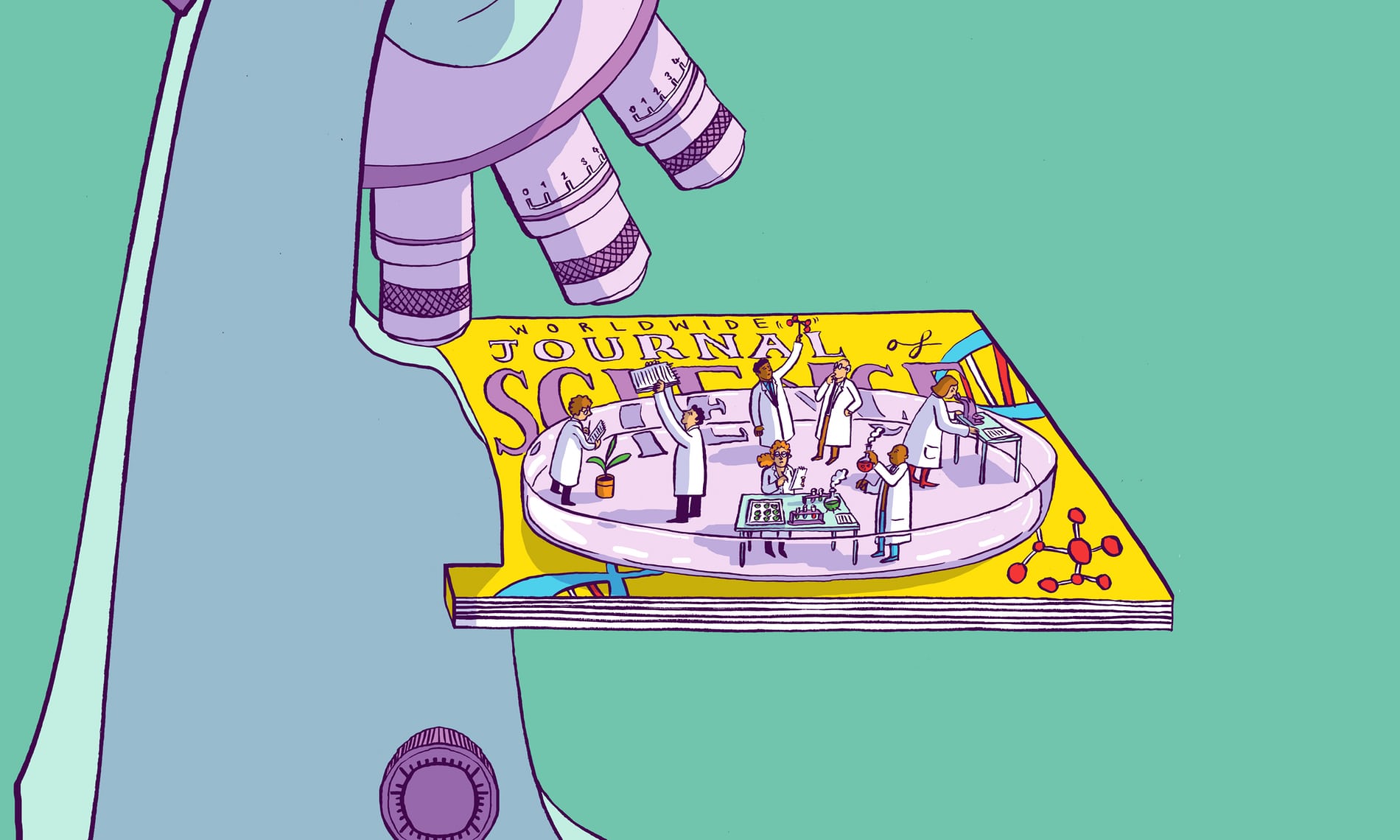
• Un grand pas de plus vers la science ouverte

    A partir du 1er janvier 2026, le #CNRS coupera l’accès à l’une des plus importantes bases bibliométriques commerciales : le #Web_of_Science de #Clarivate_Analytics ainsi que les #Core_Collection et #Journal_Citation_Reports.

    https://journals.openedition.org/cybergeo/42519

    #science_ouverte #édition_scientifique #revues_prédatrices #résistance #WOS #Elsevier #Scopus #ESR #science #recherche #publications_scientifiques

    –-

    ajouté à la #métaliste sur la #publication_scientifique* :
    https://seenthis.net/messages/1036396

  • The fall of a prolific science journal exposes the billion-dollar profits of scientific publishing

    One of the 15 publications that put out the most studies globally has been expelled from the indexing system for irregularities. Its publisher, #Elsevier, has a 38% profit margin that reached $1.5 billion in 2024

    With humanity terrified by the deadly second wave of the coronavirus, in the fall of 2020, a scientific journal published a study with a solution: jade amulets from traditional Chinese medicine could prevent COVID-19. The proposal was outlandish, but the editor-in-chief of the weekly, Spanish chemist Damià Barceló, defended its quality controls. That journal, Science of the Total Environment — one of the 15 that publishes the most studies worldwide — has just been expelled from the group of reputable publications by one of the leading evaluation companies, after dozens of irregular articles were discovered. The scandal exposes the windfall profits of scientific publishers, who in recent years have amassed billions of dollars in earnings from public funds earmarked for science.

    Damià Barceló, 71, took over as editor of the journal in 2012. In just two years, he doubled the number of studies published. In a decade, he increased the number tenfold, with the journal reaching nearly 10,000 articles annually. As the number of articles increased, the quality declined, because there was a perverse incentive to accept mediocre work: to publish research open access in the journal, a scientist has to pay $4,150 plus taxes.

    Emilio Delgado, professor of documentation at the University of Granada in Spain, explains it this way: “It’s clearly an open-door journal that takes almost anything. It’s what I call a mega-journal, that is, a mega-business.” The publication belongs to the Dutch publishing giant Elsevier, which dominates the world of science publishing, with a 17% share of the global market. Its 3,000 journals published 720,000 studies last year. Swedish businessman Erik Engstrom, CEO of RELX (the multinational that owns Elsevier), earned more than €15 million ($17.4 million) in 2024 between his salary and other compensation.

    Delgado and his colleague Alberto Martín analyzed the unusual behavior of the mega-journal at the request of EL PAÍS. Of all the studies published in Science of the Total Environment, 40% are by Chinese authors and 8% are by Spanish authors — percentages that are double the usual ratio in the subject area. The third institution that publishes the most articles in this journal, after two Chinese organizations, is the Spanish National Research Council (CSIC), Spain’s largest scientific organization, where Barceló himself worked until his retirement last year. “With these patterns, one might consider the possibility of publication fraud, but this is speculation,” says Delgado.

    The scientific system operates in a controversial way. Researchers’ funding and promotions depend largely on the number of studies they publish in journals, which are validated by a handful of private companies. One of these companies, the London-based multinational Clarivate, removed Science of the Total Environment from its database on November 18. “The journal was removed because it no longer meets our publicly available quality criteria,” explained a spokesperson, who declined to offer further details.

    In theory, the quality of scientific journals is safeguarded by anonymous experts who voluntarily review manuscripts to determine whether they should be published. In Science of the Total Environment, this system was allegedly compromised. The publisher Elsevier itself has retracted some 50 studies published by the Brazilian biologist Guilherme Malafaia, after discovering that his work had been “reviewed” through fake peer reviews signed with the names of real scientists without their consent — as was the case with an article on coronavirus in fish and another on the toxicity of a herbicide in turtles. Malafaia and Barceló are co-authors on several studies on microplastic pollution, but these shared investigations have not yet been retracted.

    The four major scientific publishers — Elsevier, Springer Nature, Wiley, and Taylor & Francis — earned more than $7 billion in 2024, with profit margins unimaginable in almost any other industry, exceeding 30%, according to a new analysis led by British anthropologist Dan Brockington of the Autonomous University of Barcelona. This collective windfall is explained by the “publish or perish” system — which rewards improbably prolific scientists who produce a study every two days — as well as a shift in the industry’s business model. Previously, readers paid subscription fees to access quality journals. Now, amid the push for open access to science, it is the authors themselves who must pay to have their research published so that others can read it for free. This perverse incentive — whereby both scientists and journals earn more the more they publish, regardless of quality — has fueled a flood of millions of low-quality studies.

    Elsevier is the publisher that publishes the most studies and earns the most, with a 38% profit margin ($1.5 billion in 2024), according to the analysis by Brockington and his colleagues. The researchers call for efforts to “dismantle the system” that sees billions of dollars of public money being spent on publishing empty studies for the exclusive benefit of private companies. According to their calculations, Elsevier, Springer Nature, Wiley, and Taylor & Francis have received more than $14 billion in profits over the last six years. Among the co-authors of the analysis is the Spanish engineer Pablo Gómez Barreiro, from the Royal Botanic Gardens, Kew, in southern England.

    An Elsevier spokesperson defended the company’s actions. “We uphold the highest standards of rigor and ethics in our publishing to protect the quality and integrity of research,” they stated. The publisher conducted an initial investigation that resulted in dozens of retractions in Science of the Total Environment, officially due to the fraudulent peer review of articles. “We are now undertaking a broader investigation focused on conflicts of interest, as well as reviewing papers flagged for other potential indicators of misconduct,” the spokesperson added. The publisher intends to “fully rehabilitate” the journal.

    Damià Barceló is a hyper-prolific scientist, one of those who publishes a new study every five days or even less. He has authored some 1,800 papers in his lifetime, more than 200 of them in Science of the Total Environment, his own journal. His name appears numerous times as editor of his own studies, such as one on drugs in wastewater in Mexico and another on chemical pollution in the Ebro and Guadalquivir rivers in Spain.

    The Elsevier spokesperson explained that Barceló “stepped down” as editor-in-chief in March 2025. “This change was part of a broader effort to strengthen the journal’s governance and address concerns raised,” the spokesperson stated. Elsevier maintains that the “systemic problems” that led to the expulsion of Science of the Total Environment “cannot be attributed to any single individual.” EL PAÍS requested a comment from Barceló, both via his personal WhatsApp and the email address associated with his current position as honorary professor at the University of Almería, but did not receive a response.

    Barceló’s prolific output helped him enter the Highly Cited Researchers list, a ranking compiled by the multinational Clarivate that includes some 7,000 researchers worldwide. The more highly-cited researchers a university has, the higher it ranks in the influential Shanghai Ranking, which designates the supposedly best academic institutions in the world. An investigation by EL PAÍS revealed in 2023 that Saudi Arabia offered bribes of up to €70,000 ($81,000) a year to highly-cited scientists to falsify their affiliations in Clarivate’s database, claiming they worked at an Arab university in order to boost those institutions in the ranking.

    Damià Barceló had been listed as a professor at Saudi Arabia’s King Saud University since 2016, despite his primary role being director of the Catalan Institute for Water Research in Girona, Spain. Barceló told this newspaper at the time that he had not been receiving the €70,000 annual salary. In 2013, the Spanish chemist received a $133,000 award from Saudi King Salman bin Abdulaziz for his research on water contaminants.

    Spanish universities, like those in other countries, have become places where producing research papers is prioritized above all else, almost like a large-scale factory farm that churns out studies, according to Emilio Delgado and Alberto Martín, bibliometrics experts at the University of Granada. Professors with completely inflated CVs have risen to full professorships or even rectors. Spurred by various international manifestos, the National Agency for Quality Assessment and Accreditation (ANECA) —the Spanish agency that decides whether a university professor can be promoted or deserves salary increases — has changed its criteria to stop evaluating scientists based on sheer volume.

    The president of the Spanish Research Ethics Committee, Dr. Jordi Camí, has called for further action. “We must clean up this mess,” he proclaimed at a conference in Barcelona on November 6. In his opinion, “we must continue to introduce measures to discourage, almost penalize, publishing for the sake of publishing.”

    https://english.elpais.com/science-tech/2025-11-28/the-fall-of-a-prolific-science-journal-exposes-the-billion-dollar-pr
    #recherche #édition_scientifique #revues_scientifiques #science

    –-

    ajouté à la #métaliste sur la #publication_scientifique*:
    https://seenthis.net/messages/1036396

  • The fall of a prolific science journal exposes the billion-dollar profits of scientific publishing | Science | EL PAÍS English
    https://english.elpais.com/science-tech/2025-11-28/the-fall-of-a-prolific-science-journal-exposes-the-billion-dollar-pr
    https://imagenes.elpais.com/resizer/v2/B6H237EPS5CO3HHJJSSAYICUCI.JPG?auth=6aa5a83b85e99515532c0ac15cd04fd

    Un très bel exemple de la dérive des publications scientifiques ; Avec la fin du « communalisme » scientifique prôné par R.K. Merton, nous retrouvons l’avidité du gain. Il n’y a pas forcément de raison qu’elle soit différente chez les scientifiques que chez les industriels.

    Manuel Ansede
    Madrid - NOV 28, 2025 - 15:39 GMT+1

    With humanity terrified by the deadly second wave of the coronavirus, in the fall of 2020, a scientific journal published a study with a solution: jade amulets from traditional Chinese medicine could prevent COVID-19. The proposal was outlandish, but the editor-in-chief of the weekly, Spanish chemist Damià Barceló, defended its quality controls. That journal, Science of the Total Environment — one of the 15 that publishes the most studies worldwide — has just been expelled from the group of reputable publications by one of the leading evaluation companies, after dozens of irregular articles were discovered. The scandal exposes the windfall profits of scientific publishers, who in recent years have amassed billions of dollars in earnings from public funds earmarked for science.

    Damià Barceló, 71, took over as editor of the journal in 2012. In just two years, he doubled the number of studies published. In a decade, he increased the number tenfold, with the journal reaching nearly 10,000 articles annually. As the number of articles increased, the quality declined, because there was a perverse incentive to accept mediocre work: to publish research open access in the journal, a scientist has to pay $4,150 plus taxes.

    Emilio Delgado, professor of documentation at the University of Granada in Spain, explains it this way: “It’s clearly an open-door journal that takes almost anything. It’s what I call a mega-journal, that is, a mega-business.” The publication belongs to the Dutch publishing giant Elsevier, which dominates the world of science publishing, with a 17% share of the global market. Its 3,000 journals published 720,000 studies last year. Swedish businessman Erik Engstrom, CEO of RELX (the multinational that owns Elsevier), earned more than €15 million ($17.4 million) in 2024 between his salary and other compensation.

    Delgado and his colleague Alberto Martín analyzed the unusual behavior of the mega-journal at the request of EL PAÍS. Of all the studies published in Science of the Total Environment, 40% are by Chinese authors and 8% are by Spanish authors — percentages that are double the usual ratio in the subject area. The third institution that publishes the most articles in this journal, after two Chinese organizations, is the Spanish National Research Council (CSIC), Spain’s largest scientific organization, where Barceló himself worked until his retirement last year. “With these patterns, one might consider the possibility of publication fraud, but this is speculation,” says Delgado.
    Chemist Damià Barceló, at the University of Almería, in May 2022.UAL

    The scientific system operates in a controversial way. Researchers’ funding and promotions depend largely on the number of studies they publish in journals, which are validated by a handful of private companies. One of these companies, the London-based multinational Clarivate, removed Science of the Total Environment from its database on November 18. “The journal was removed because it no longer meets our publicly available quality criteria,” explained a spokesperson, who declined to offer further details.

    In theory, the quality of scientific journals is safeguarded by anonymous experts who voluntarily review manuscripts to determine whether they should be published. In Science of the Total Environment, this system was allegedly compromised. The publisher Elsevier itself has retracted some 50 studies published by the Brazilian biologist Guilherme Malafaia, after discovering that his work had been “reviewed” through fake peer reviews signed with the names of real scientists without their consent — as was the case with an article on coronavirus in fish and another on the toxicity of a herbicide in turtles. Malafaia and Barceló are co-authors on several studies on microplastic pollution, but these shared investigations have not yet been retracted.

    The four major scientific publishers — Elsevier, Springer Nature, Wiley, and Taylor & Francis — earned more than $7 billion in 2024, with profit margins unimaginable in almost any other industry, exceeding 30%, according to a new analysis led by British anthropologist Dan Brockington of the Autonomous University of Barcelona. This collective windfall is explained by the “publish or perish” system — which rewards improbably prolific scientists who produce a study every two days — as well as a shift in the industry’s business model. Previously, readers paid subscription fees to access quality journals. Now, amid the push for open access to science, it is the authors themselves who must pay to have their research published so that others can read it for free. This perverse incentive — whereby both scientists and journals earn more the more they publish, regardless of quality — has fueled a flood of millions of low-quality studies.

    Elsevier is the publisher that publishes the most studies and earns the most, with a 38% profit margin ($1.5 billion in 2024), according to the analysis by Brockington and his colleagues. The researchers call for efforts to “dismantle the system” that sees billions of dollars of public money being spent on publishing empty studies for the exclusive benefit of private companies. According to their calculations, Elsevier, Springer Nature, Wiley, and Taylor & Francis have received more than $14 billion in profits over the last six years. Among the co-authors of the analysis is the Spanish engineer Pablo Gómez Barreiro, from the Royal Botanic Gardens, Kew, in southern England.

    An Elsevier spokesperson defended the company’s actions. “We uphold the highest standards of rigor and ethics in our publishing to protect the quality and integrity of research,” they stated. The publisher conducted an initial investigation that resulted in dozens of retractions in Science of the Total Environment, officially due to the fraudulent peer review of articles. “We are now undertaking a broader investigation focused on conflicts of interest, as well as reviewing papers flagged for other potential indicators of misconduct,” the spokesperson added. The publisher intends to “fully rehabilitate” the journal.

    Damià Barceló is a hyper-prolific scientist, one of those who publishes a new study every five days or even less. He has authored some 1,800 papers in his lifetime, more than 200 of them in Science of the Total Environment, his own journal. His name appears numerous times as editor of his own studies, such as one on drugs in wastewater in Mexico and another on chemical pollution in the Ebro and Guadalquivir rivers in Spain.

    The Elsevier spokesperson explained that Barceló “stepped down” as editor-in-chief in March 2025. “This change was part of a broader effort to strengthen the journal’s governance and address concerns raised,” the spokesperson stated. Elsevier maintains that the “systemic problems” that led to the expulsion of Science of the Total Environment “cannot be attributed to any single individual.” EL PAÍS requested a comment from Barceló, both via his personal WhatsApp and the email address associated with his current position as honorary professor at the University of Almería, but did not receive a response.
    Damià Barceló, director of ICRA, has been awarded the prestigious Prince Sultan Bin Abdulaziz International Water Prize of Saudi Arabia, which is awarded every two years
    In 2013, chemist Damià Barceló received a prize of $133,000 from Saudi King Salman bin Abdulaziz.ICRA

    Barceló’s prolific output helped him enter the Highly Cited Researchers list, a ranking compiled by the multinational Clarivate that includes some 7,000 researchers worldwide. The more highly-cited researchers a university has, the higher it ranks in the influential Shanghai Ranking, which designates the supposedly best academic institutions in the world. An investigation by EL PAÍS revealed in 2023 that Saudi Arabia offered bribes of up to €70,000 ($81,000) a year to highly-cited scientists to falsify their affiliations in Clarivate’s database, claiming they worked at an Arab university in order to boost those institutions in the ranking.

    Damià Barceló had been listed as a professor at Saudi Arabia’s King Saud University since 2016, despite his primary role being director of the Catalan Institute for Water Research in Girona, Spain. Barceló told this newspaper at the time that he had not been receiving the €70,000 annual salary. In 2013, the Spanish chemist received a $133,000 award from Saudi King Salman bin Abdulaziz for his research on water contaminants.

    Spanish universities, like those in other countries, have become places where producing research papers is prioritized above all else, almost like a large-scale factory farm that churns out studies, according to Emilio Delgado and Alberto Martín, bibliometrics experts at the University of Granada. Professors with completely inflated CVs have risen to full professorships or even rectors. Spurred by various international manifestos, the National Agency for Quality Assessment and Accreditation (ANECA) —the Spanish agency that decides whether a university professor can be promoted or deserves salary increases — has changed its criteria to stop evaluating scientists based on sheer volume.

    The president of the Spanish Research Ethics Committee, Dr. Jordi Camí, has called for further action. “We must clean up this mess,” he proclaimed at a conference in Barcelona on November 6. In his opinion, “we must continue to introduce measures to discourage, almost penalize, publishing for the sake of publishing.”

    #Revues_scientifiques #Science #Ethique #Elsevier

  • Ces « bibliothèques de l’ombre » où les scientifiques du monde entier partagent gratuitement des articles

    « Un monde de pirates » (2/5). Les sites sur lesquels les #articles_scientifiques sont mis à disposition, en toute illégalité, sont très populaires au sein de la communauté universitaire. Rapides, efficaces, ils incarnent l’utopie d’un savoir accessible à tous.

    Le message, posté sur le site #Sci-Hub, est signé d’une dermatologue tunisienne : « Je veux vous remercier de permettre aux médecins d’accéder à la recherche scientifique médicale gratuitement, surtout dans les pays en développement. » « L’aide que vous avez apportée aux autres est inestimable, je ne doute pas que vous ayez sauvé des vies », surenchérit une chirurgienne galloise. Un interne turc en orthopédie, lui, ne s’encombre pas de périphrases : « Vous méritez un p***** de prix Nobel ! »
    La bénéficiaire de cette effusion de gratitude est une informaticienne kazakhe : #Alexandra_Elbakyan, fondatrice de Sci-Hub, un site de #piratage_scientifique ou, en termes plus policés, une « #bibliothèque_de_l’ombre », qui met à disposition des millions d’articles scientifiques sans le moindre frais. D’où le surnom de la jeune femme : la « Robin des Bois de la science ».

    Cet outil, Alexandra Elbakyan a commencé à l’élaborer pour son usage personnel, en 2011. Alors étudiante en neurosciences, elle bloque sur la rédaction de son mémoire, incapable de s’acquitter des 30 ou 40 dollars qu’exigent les #revues pour donner accès à chacun de leurs articles. C’est l’acte de naissance de Sci-Hub, nouvelle planète dans une galaxie où orbitent alors déjà d’autres « bibliothèques », telles que les sites russes #Z-Library et #LibGen – plus variés, ces derniers diffusent aussi des copies, à l’identique, de livres scientifiques ou de fiction. L’économiste hongrois Balazs Bodo, chercheur à l’université d’Amsterdam, y voit l’héritage du #samizdat soviétique, un système de #diffusion clandestin d’ouvrages interdits ou introuvables, souvent rendu possible, déjà, par des universitaires grâce à leur accès privilégié aux textes.

    Ces samizdats modernes s’épanouissent bien loin des frontières de l’ex-URSS. Leurs adresses s’échangent sur les campus américains comme s’échangeaient déjà les photocopies ou, par modem, les fichiers informatiques. Les étudiants – proverbialement fauchés – comme les chercheurs sont séduits par la gratuité de ces plateformes, entièrement financées par les dons des usagers les plus enthousiastes. « C’était impossible de s’acheter autant de manuels », se souvient Jason (un nom d’emprunt car il souhaite demeurer anonyme), un utilisateur américain de ces bibliothèques depuis son master de sociologie, dans les années 2000. Au téléphone, ce quadragénaire souligne les prix prohibitifs des manuels aux Etats-Unis, où ils peuvent dépasser 100 dollars l’unité.

    Equipe de bénévoles

    Soucieux de rendre une partie de l’aide qu’il a reçue de la communauté, Jason est devenu, pendant la pandémie de Covid-19, le modérateur d’un forum où se coordonnent les #bénévoles. Comme lui, ceux-ci ont été séduits par la dimension politique du projet – mais aussi par l’image romantique du « #pirate_du_savoir », vent debout contre la #privatisation de la #science. Une mythologie flibustière qui motive étudiants et chercheurs à user de leurs accès privilégiés aux réseaux universitaires pour aider d’autres usagers en manque d’une référence.

    Sur ce forum, Jason et les siens trient et approuvent les ouvrages numériques, quitte à retoquer les éventuels trolls qui soumettent de faux livres, derrière la couverture desquelles on ne trouve qu’une publicité incitant à acheter l’œuvre originale. Ils corrigent ensuite ce qui doit l’être. Titre, auteur, image de couverture : les articles et livres ont besoin d’une sorte de « mise en beauté » avant d’être mis à disposition du public. A leur manière, ces bénévoles férus d’informatique effectuent un travail de bibliothécaire : curation, étiquetage… « Cela nécessite beaucoup de travail manuel et il n’y a jamais assez de bénévoles », confirme Jason. Il faut dire qu’il n’est pas évident, pour un aspirant « bibliothécaire de l’ombre », de savoir comment se rendre utile, les équipes responsables des sites ne brillant pas par leur transparence.

    Car… chut ! Comme dans une authentique bibliothèque, on est prié de ne pas faire de bruit. Pas tant pour ne pas déranger les autres lecteurs que parce que le partage d’articles est illégal, et qu’il est risqué de s’impliquer dans la gestion du site. Les échanges informels sur les réseaux sociaux restent anonymes, quand ils n’ont pas plutôt lieu sur des groupes privés, fonctionnant par cooptation.
    Ces précautions ne sont pas superflues. Depuis une dizaine d’années, la guerre est déclarée entre les « bibliothèques » et les puissants groupes d’édition scientifique, à commencer par les géants américains #Elsevier et #Springer. Propriétaires légaux des #articles_scientifiques, ils ont peu à peu obtenu le blocage des sites pirates dans plusieurs pays. Alexandra Elbakyan elle-même a été contrainte de prendre ses distances avec Sci-Hub : en 2021, en raison d’un procès l’opposant à Elsevier en Inde, elle a préféré geler le site, qui demeure accessible mais n’est plus alimenté. Visée par une enquête du FBI, elle vit dans la clandestinité, dans le nord de la Russie.

    La Z-Library est logée à la même enseigne. Ses domaines ont été saisis par la justice américaine en 2022. Deux individus, russes, accusés d’être impliqués dans la création du site, ont été arrêtés en Argentine et se sont depuis évadés. Un événement qui a conduit la Z-Library à revoir les mesures de sécurité de son équipe composée, selon l’un de ses porte-parole sollicité par Le Monde, de « dizaines de spécialistes » en informatique.

    Modèle asymétrique

    #Menaces, #fermetures, #condamnations… Dans le domaine des #publications_scientifiques, la lutte contre le #piratage a ceci de particulier que les auteurs, qui pourraient légitimement se sentir lésés, ne se pressent pas pour se ranger du côté de la loi. Beaucoup d’entre eux estiment que le très profitable modèle économique des principaux éditeurs est particulièrement asymétrique, pour ne pas dire injuste : à leurs yeux, les éditeurs privatisent la science en exploitant le travail des chercheurs, qui ne sont pas rémunérés en retour pour leur publication ou évaluation d’études.

    Dans ce contexte, les pirates suscitent plus souvent l’admiration que la réprobation. D’autant que leur histoire reste marquée par la mort brutale d’#Aaron_Swartz, militant révéré de l’#open_access (accès libre). Visé par des poursuites judiciaires du FBI pour avoir téléchargé des centaines de milliers d’articles scientifiques, cet Américain de 26 ans s’est suicidé en 2013. Dans son « manifeste de l’Open Access Guerilla », il incitait étudiants, bibliothécaires et chercheurs à partager leurs ressources, leurs mots de passe, leurs fichiers. « Vous avez la possibilité de participer à ce banquet de la connaissance alors que le reste du monde en est exclu », insistait-il.

    Pour l’heure, les fermetures de plateformes pirates sont rarement définitives. La bataille que leur livrent les éditeurs s’apparente davantage à un jeu du chat et de la souris, les sites bloqués ne tardant pas à refaire surface, à l’identique, à une autre adresse. La crainte de les voir disparaître pour de bon mobilise tout de même de nombreux internautes, à l’image de « #Shrine », un universitaire qui ne donne ni son nom ni son âge, mais explique au Monde que, pour lui, ces bibliothèques sont des « ONG de la piraterie ».

    En 2020, il lance un appel à l’aide sur Reddit, plateforme communautaire et plus gros forum en ligne du monde. Reprenant en préambule le mot d’ordre d’Aaron Swartz, il propose un projet d’hébergement « pair à pair », c’est-à-dire décentralisé, des sites comme Sci-Hub : dans la mesure où leur contenu sera désormais hébergé sur les ordinateurs de centaines de volontaires, il sera impossible de le supprimer en faisant simplement saisir, par la justice, quelques ordinateurs. « Shrine » affirme avoir alors vu se mettre en mouvement « une colonie de fourmis : des gens du monde entier, décidés à protéger ces fichiers, malgré les risques encourus et sans en tirer le moindre profit ».

    Cette « colonie » a essaimé. Ainsi, un projet de mégabibliothèque baptisé « #Anna’s_Archive » a pour objet, depuis 2022, de constituer une copie complète des collections numériques de ses homologues. Ses promoteurs – évidemment non identifiés – entendent ainsi éviter la disparition du contenu de ces plateformes si elles venaient à fermer. Résultat : 50 millions de livres et le double d’articles scientifiques sont conservés dans « Anna’s Archive ».

    https://www.lemonde.fr/series-d-ete/article/2025/08/11/les-bibliotheques-de-l-ombre-a-la-pointe-du-piratage-scientifique_6628300_34
    #édition_scientifique #résistance #recherche #ESR

    –-

    ajouté à la #métaliste sur la #publication_scientifique* :
    https://seenthis.net/messages/1036396

  • #Elsevier parent company reports 10% rise in profit, to £3.2bn

    Scientific arm of #Relx reports adjusted operating profit of £1.17 billion in 2024

    Relx, the parent company of academic publishing giant Elsevier, has reported a 10 per cent underlying growth in its adjusted operating profit for 2024, reaching just under £3.2 billion from revenues of £9.43bn.

    Within this, the scientific, technical and medical arm of the company—which includes its publishing business—had an adjusted operating profit of £1.17bn, with underlying growth of five per cent.

    This arm had revenue of £3.05bn, giving it an adjusted operating margin of 38.4 per cent, the company reported on 13 February.

    Relx said its primary research business “continued to be driven by volume growth, with article submissions growing very strongly across the portfolio, particularly in pay-to-publish”.

    Its financial results come amid concern among some politicians and research organisations about money being spent on publishing by publicly funded research. Last month, 10 European research organisations announced they would help to fund broader use of the EU’s free-to-publish publishing platform, Open Research Europe.

    Meanwhile, in the UK, Research Professional News has reported that the universities of Sheffield, Surrey and York have opted out of the sector-wide “big deal” with Elsevier, amid a bleak outlook on university finances and concerns over slow progress to fully open access publishing. An Elsevier spokesperson previously told RPN that Sheffield, York and Surrey “have all signed individual agreements [with the company] or are in discussions with us to continue access to Elsevier-published journals”.

    Publishing evolution a risk

    Among the risks Relx set out for investors, it said one was “evolution” in the scholarly publishing landscape.

    The open access publishing model “now represents a significant and growing portion of the volume of primary research that we publish”, it said, adding that “rapid changes in customer choice, regulation or technologies in this area could impact the revenue mix and growth”

    Relx added: “Maintaining research integrity requires us to manage risks around fraud in research papers in the context of evolving technologies.” It said that it operates “in highly competitive and dynamic markets”, which are affected by developments in technologies like artificial intelligence.

    More growth expected

    The company said it expects “good underlying revenue growth” in 2025, with growth in adjusted operating profit being slightly higher than the revenue growth.

    Chief executive officer Erik Engstrom said: “Our improving long-term growth trajectory continues to be driven by the ongoing shift in business mix towards higher growth analytics and decision tools that deliver enhanced value to our customers across market segments.”

    https://www.researchprofessionalnews.com/rr-news-world-2025-2-elsevier-parent-company-reports-10-ri
    #profit #édition_scientifique #publications_scientifiques #business #ESR #recherche

    –-

    ajouté à la #métaliste sur la #publication_scientifique* :
    https://seenthis.net/messages/1036396

  • UK university drops #Elsevier deal

    #Surrey says Jisc-negotiated deal “not sustainable in the current financial climate”

    The #University_of_Surrey has opted out of a subscription deal with the academic publishing giant Elsevier, saying the arrangement is not financially sustainable.

    The move, coming after the University of Sheffield cancelled its subscription deal with Elsevier, further spotlights how the crisis in university finances is beginning to impact on universities’ subscription deals with publishers—and on the publishing industry.

    Surrey had been part of arrangements negotiated by #Jisc, which negotiates publisher deals on behalf of the UK’s higher education sector and other partners. A spokesperson for Elsevier told Research Professional News that it currently has an agreement with over 150 institutions in the UK, and that the publisher was “delighted” to have Jisc “as customers going into 2025”.

    However, a spokesperson for Surrey told RPN that the university continuously reviews all it commercial subscriptions for value for money, and had concluded that the Jisc-negotiated ‘Read and Publish’ deal with Elsevier was “not sustainable in the current financial climate”.

    “We will continue to subscribe to the most-used individual Elsevier journal titles and will enable our students and researchers to read articles via post-cancellation access to previous subscribed content, via open access and via inter-library loans,” the spokesperson said.

    “We also look forward to continuing to work with Jisc and with publishers on future publishing deals which are financially sustainable, open, transparent and equitable.”

    RPN understands that publication by Surrey researchers in Elsevier journals will not be affected by the move.

    Last month, the Sheffield cancelled its Jisc-negotiated subscription deal, citing concerns over the “sustainability of the current commercial scientific publishing model”. A spokesperson for Sheffield also said publication for its researchers would be unaffected.

    An Elsevier spokesperson said it was “aware of the difficult financial conditions some institutions are under”, adding the company has “worked closely with Jisc to provide relief, and we’ll continue to work with them on a case-by-case basis to support UK institutions”.

    https://www.researchprofessionalnews.com/rr-news-uk-universities-2025-1-uk-university-drops-elsevie
    #édition_scientifique #UK #Angleterre #Elsevier #recherche #université #résistance #abandon #abonnement #arrêt #coût #prix

    –-

    ajouté à la métaliste sur la #publication_scientifique :
    https://seenthis.net/messages/1036396

  • #Elsevier rewrites academic papers with AI — without telling editors or authors

    The Journal of Human Evolution is published by Elsevier, one of the largest academic publishers. All but one of the JHE editorial board resigned last week in the wake of Elsevier rewriting papers with LLMs — without telling either the editors or the authors: [Retraction Watch; Retraction Watch, PDF]

    Elsevier initiated the use of AI during production, creating article proofs devoid of capitalization of all proper nouns (e.g., formally recognized epochs, site names, countries, cities, genera, etc.) as well as italics for genera and species. These AI changes reversed the accepted versions of papers that had already been properly formatted by the handling editors.

    … AI processing continues to be used and regularly reformats submitted manuscripts to change meaning and formatting and require extensive author and editor oversight during proof stage.

    Elsevier was also slow with open access and charged authors much more to publish in JHE — $3,990 per paper! — than its other journals. [JHE]

    Finally, Elsevier demanded JHE reduce its number of editors — presumably thinking an LLM could do well enough. This was the last straw after ten years of Elsevier cutting services to the journal.

    John Hawks of the University of Wisconsin–Madison, a frequent JHE contributor, supports the editors’ position: “if there was any notice to my coauthors or me about an AI production process, I don’t remember it.” He feels “the real lapse is a more basic matter of ethics.” [blog post]

    Elsevier applies stringent policies on generative AI to its authors — but not to itself.

    https://pivot-to-ai.com/2025/01/05/elsevier-rewrites-academic-papers-with-ai-without-telling-editors-or-au
    #AI #IA #intelligence_artificielle #édition_scientifique #réécriture

    via @fil

    –-
    ajouté à la métaliste sur la #publication_scientifique:
    https://seenthis.net/messages/1036396

  • Academia in a stranglehold

    Academic publishers’ most valuable asset used to be their journals. Now, it’s the data they collect from researchers and then sell. That is extremely concerning, a growing group of Groningen researchers feels. ‘They control every part of the process and register every action you take.’

    When UG philosopher Titus Stahl is mulling over a new research topic, he has a range of tools available to help him get started. He could use academic search engine Scopus, for example, to point him to articles he could read online or download. He might also take notes using Mendeley, the useful software tool that helps you keep track of sources and references.

    If he then writes a grant proposal to get funding, there’s a good chance that the people assessing it use SciVal – software that analyses research trends, but also contains individual researchers’ citation and publication data.

    In the meantime, he could discuss his work on SSRN, a social platform used to share and peer-review early-stage research. And ultimately, of course, he’ll publish it in an open access magazine for which the university has paid article processing fees, or APCs, after which others will read it – at home, through their libraries, or again using Scopus.

    Then, finally, he will enter his article in Pure, the database the university uses to register all research done at the UG. His profile might change to reflect he has done research on a new topic. Affiliations may be added, since his network has changed too, so everyone can see who he collaborates with and what his strengths are.

    It’s all very streamlined and it all works beautifully. However, it doesn’t seem all that great anymore when you realise that every tool Stahl has been using, every platform on which he publishes, is owned by publishing mogul Elsevier. And Elsevier not only provides tools, it also collects user data. It logs everything Stahl does, every keystroke.

    ‘They know what you are working on, they know what you are submitting, they know the results of your peer reviews’, Stahl says. ‘They control every part of the process and register every action you take.’
    Everything is recorded

    And that gives them far more information than you might realise. When Eiko Fried, a psychologist from the University of Leiden, asked Elsevier for his personal data in December 2021, he received an email with hundreds of thousands of data points, going back many years.

    He discovered that Elsevier knew his name, his affiliations and his research. That his reviews had been registered, as well as the requests for peer review he had declined. Elsevier kept track of his IP-addresses – leading back to his home – his private telephone numbers, and the moments he logged in, which showed exactly when he worked and when he was on vacation. There were websites he visited, articles he had downloaded or just viewed online. Every click, every reference was recorded.

    Fried’s blog posts about this came as a shock and a revelation to Stahl. ‘It’s a long-term danger to academic freedom’, he says. ‘They control the academic process with an infrastructure that serves their interests, not ours. And they use the collected data to provide analytics services to whoever pays for them.’

    Stahl is one of a growing group of researchers inside and outside the University of Groningen who are concerned about the situation. He finds Oskar Gstrein on his side. ‘There is this ingrained power imbalance between the universities and the publishers’, says the data autonomy specialist with Campus Fryslân and the Jantina Tammes School of Digital Society, Technology and AI. ‘They own the journals people want to get into. And now they have taken over the whole publishing sphere.’

    In a recently published call for action, the Young Academy Groningen (YAG) and the Open Science Community Groningen, too, sounded the alarm. ‘It is time to formulate a long-term vision for a sustainable, independent higher education system’, they wrote. ‘We not only endorse this ambition but call on our university to reclaim ownership over our research output.’
    New business model

    They have reason to worry. Big publishers like Elsevier make billions of euros a year. Historically by publishing academic articles, but they have recently changed their business model. Now, they sell data connected to academic publishing. And that is ‘insanely profitable’, Stahl says.

    Profits of Elsevier’s parent company RELX rose to 10 percent in 2023 – 2 billion euros on a revenue of 10 billion. ‘Article submissions returned to strong growth, with pay-to-publish open-access articles continuing to grow particularly strongly’, RELX reported in February this year.

    Elsevier’s Erik Engstrom was the third highest paid CEO in the Netherlands between 2017 and 2020, earning over 30 million. Only the CEOs of Shell and another scientific publisher, Wolters Kluwer, earned more.

    Only a decade ago, it looked as if big publishers’ hold on academia was weakening. Universities and the Dutch government were done with first funding their research with public money, offering their papers for free to publishers like Elsevier (The Lancet, Cell), Springer (Nature) or Wiley (Advanced Materials), editing and peer reviewing those papers for free and then having to pay insane amounts of subscription fees to make those same papers available to their researchers again.

    They moved towards open access and as a result, 97 percent of the publications in Groningen is now published open access. ‘Their traditional business model no longer worked’, says Gstrein. ‘So publishers had to reinvent themselves.’
    Gold open access

    And that is exactly what they did, helped by a Dutch government that suggested ‘gold open access’ as the norm. ‘It’s undoubtedly linked to the fact that many of these publishers, such as Elsevier and Kluwer, have Dutch roots’, says Ane van der Leij, head of research support at the UB.

    ‘Gold’ means you don’t make the whole publishing process free – that would be the diamond option. Instead, a university pays APCs up front for its researchers, and in exchange publishers make their articles available to everyone.

    That’s great for the general public, which can now read those articles for free. But it’s not so great for the universities that still provide research papers and edit academic articles without any payment. ‘And the APCs are high’, Stahl says. ‘In some cases, I estimate there’s a profit margin of 75 percent.’

    Not all magazines are open access, either. Most of the traditional journals are a hybrid now – the content for which APCs have been paid are open access; the rest is still behind a paywall. ‘Unfortunately “hybrid” has become the new status quo for most of these publishers’ journals, and it has become a very profitable business model’, Van der Leij says.
    Package deals

    These days, publishers negotiate ‘read and publish’ package deals for their titles, which have become around 20 percent more expensive in five years. ‘Taking into account an average inflation rate of 3 percent per year over this period, that amounts to a price increase of approximately 12.6 percent’, says Van der Leij.

    Elsevier has received over 16 million euros in 2024 for their deal with umbrella organisation Universities of the Netherlands. Wily gets almost 5 million, Springer 3.6 million.

    The increase is not the same for all publishers, Van der Leij stresses, and the packages themselves also vary, making it difficult to compare. ‘On top of that, it’s become increasingly difficult to figure out which parts are “read” and which ones are “publish”.’

    Also telling: the maximum number of prepaid publications is reached sooner every year, because universities get fewer publications for their money. ‘Four years ago, we would be sending out our emails that we’d reached the cap halfway through November. Three years ago, we did so in early November. This year, it was at the end of October’, says Van der Leij.
    Commercialised research

    That’s not the biggest issue, though. What is worse is the other part of Elsevier’s business model, which they came up with when they realised they needed other ways to keep making money. And the hottest commodity they could think of was data.

    ‘The entire infrastructure that science builds on is commercialised’, says YAG chairperson Lukas Linsi. ‘They effectively turn science into shareholder returns and dividend payouts, and it’s all public money.’

    Pure, which showcases the research for almost all Dutch universities, used to be an independent Danish startup, but was bought by Elsevier in 2012. The formerly open platform Mendeley was acquired in 2013. SSRN in 2016. In 2017 Elsevier bought bepress, a repository used by six hundred academic institutes. ‘It has given them real time data access’, Gstrein says.

    Publishing is no longer the main focus for RELX and its competitors; instead, they have become data brokers. They sell data to insurance companies for risk analysis, to banks for fraud detection, to universities to assess their performance, and, especially egregious, to the US Immigration Service to target illegal immigrants.
    Less dependent

    Many researchers are worried by this. ‘In the Netherlands, universities tend to be a bit optimistic regarding these companies’, Stahl feels. After all, universities have in the past made plans to develop ‘professional services’ together with Elsevier. ‘They just don’t seem to see the danger.’

    In Germany and France, there is much more awareness about these issues. There, universities are less dependent on the big publishers, or are working to move away from them. ‘If some private parties have access to all this data, then that is a long-term threat to academic freedom. We have to do something about it. We need our own infrastructure’, Stahl says.

    Per the contracts, the publishers aren’t allowed to share data. ‘There is the data processing agreement’, explains Marijke Folgering, head of the UB’s development & innovation department. That’s a legally required document stating how data will be processed. ‘They’re not allowed to just use our data. I’m sure they can find ways to do so anyway, but we also enter into these contracts on a trust basis. If they do abuse it, they hopefully hurt themselves as well.’
    Critical

    Researcher Taichi Ochi with the Open Science Community Groningen has his doubts about their trustworthiness, though. ‘We need to move away from them, or we risk detrimental effects’, he says.

    Linsi points to the deal that academic publisher Taylor and Francis made: they sold the research published in their three thousand academic journals to Microsoft for 10 million dollars, to train their AI models. ‘This is happening now!’

    Folgering and Van der Leij with the UB also worry about the seemingly unending stream of data that is flowing towards the publishers. ‘There are currently no indications that the system is being abused’, says Van der Leij, ‘but we’re getting increasingly concerned.’

    ‘We’re definitely critical of what they’re doing’, Folgering agrees. ‘We’re exploring our options. Several German universities have gone in a different direction. But there are limits to what we can do. We simply don’t have that many developers.’

    The problem, of course, is that both researchers and university management want convenience. They want their publications in these publishers’ prestigious distribution channels. They want their tools and software to work quickly, and it’s all the better if these are available at a relatively low cost. ‘But we just don’t consider what that means in the long run. People underestimate how little choice we still have’, Gstrein says.
    Long-standing reputation

    The researchers don’t have an easy solution on hand. ‘If you want to move ahead in your career, you’re dependent on these companies’, Linsi realises. ‘They don’t decide what is published in their journals, but still, it’s their brands that are really important if you want to move up.’

    Diamond open access journals – like the UG’s own University of Groningen Press, founded in 2015 – may be a solution in the long term, but at this point their reputation just isn’t good enough yet, compared to journals with a long-standing reputation and impact factor.

    The tools the publishers provide do work very well, Linsi admits. Repositories in for example Germany – where universities are a lot less dependent on the big publishers – aren’t nearly as ‘attractive’ as the UG’s Pure.

    And there’s the matter of safety too. Are universities able to build alternatives that are safe and that won’t be vulnerable to hacks? ‘In practice, this is quite difficult’, Linsi says. ‘But other countries show that there is a way back.’
    Alternatives

    The UG could start by using alternatives when possible, he explains. Zotero instead of Mendeley, Firefox instead of Google Chrome. ‘There are alternatives for almost every app we use.’

    And it could – and should – find an alternative for Pure. ‘It’s a good first step’, Linsi feels. ‘It’s relatively easy and it is tangible.’

    In fact, Van der Leij says, the UG is currently working on its own data warehouse that would hold all the UG publications’ data and metadata. ‘It might allow us to stop using Pure and keep a hold of our data.’

    But it would be even better if Dutch – or even European – universities worked together on projects like these, to make sure there’s enough funding and that it is done right. In the long run, Linsi believes, it will probably be cheaper than paying huge sums of money to commercial providers.

    ‘We must understand our own worth’, agrees Taichi Ochi. ‘With the cost of publishing ever increasing, it also impacts how much money we can spend on other activities. We need to move away from a model that is draining money.’

    https://ukrant.nl/magazine/elseviers-stranglehold-on-academia-how-publishers-get-rich-from-our-data

    #science #recherche #université #données #édition_scientifique #publications #publications_scientifiques #Elsevier #business #données_personnelles #Stahl #RELX #Springer #Wiley #Gold_open_access

    –-

    ajouté à la métaliste sur la #publication_scientifique :
    https://seenthis.net/messages/1036396

  • #Édition_scientifique : #accord national de 33 M€ annuels avec #Elsevier (#Abes, #Couperin, #MESR)

    L’Abes, Couperin et le MESR annoncent l’attribution d’un marché national à l’éditeur Elsevier d’un montant annuel de 33 M€, le 30/04/2024. L’accord, négocié par Couperin et porté par l’Abes, est signé pour quatre ans…

    (#paywall)

    https://education.newstank.fr/article/view/323526/edition-scientifique-accord-national-33-annuels-elsevier-abes-cou
    #France #budget #recherche #revues_scientifiques #revues_prédatrices #ESR #université #publication_scientifique

    –-

    ajouté à la une métaliste sur la #publication_scientifique :
    https://seenthis.net/messages/1036396

    • Signature d’un #accord global de lecture et de publication avec l’éditeur #Elsevier

      L’Agence bibliographique de l’enseignement supérieur (Abes) a signé un marché de portée nationale avec l’éditeur Elsevier, dans le cadre de la négociation menée par le consortium des établissements d’enseignement supérieur et de recherche Couperin (marché notifié le 30 avril 2024).

      Cet accord, d’un montant annuel à hauteur de 33 millions d’euros, ouvre pour l’ensemble des établissements à mission d’enseignement supérieur et de recherche le service de publication en accès ouvert sans frais supplémentaires pour les auteurs dans la majorité des revues Elsevier hybrides ou entièrement en accès ouvert. Le marché porté par l’Abes compte 241 établissements abonnés, parmi lesquels 44 à titre gratuit, chiffre en hausse depuis la mise en place de la licence nationale. Cet accord est soutenu par le ministère de l’Enseignement supérieur et de la Recherche (MESR).

      L’accord est signé pour une période de 4 ans (2024-2027), sans évolution tarifaire du prix de l’abonnement en 2024, et avec une hausse limitée à 1 % les années suivantes, et comprend trois volets :

      - Service de lecture, pour tous les articles publiés dans les revues de la Complete Freedom Collection (incluant quatre titres Lancet), la collection Bibliothèque Médicale Française, les 5 titres Journal of the American College of Cardiology (JACC) et, pour certaines institutions ayant pris l’option, des titres Cell Press et des titres-à-titres sélectionnés par ces mêmes institutions ;
      - Service de publication en accès ouvert immédiat sans frais pour les auteurs de correspondance des membres de l’accord, dans une liste de près de 2 500 titres éligibles, dont 676 entièrement en accès ouvert. Les droits à publication sans frais supplémentaires s’élèvent à plus de 11 000 articles par an et ont été calculés pour couvrir la totalité de la publication française ;
      - Service d’archivage sécurisant les droits d’accès perpétuels sur le contenu souscrit 2024-2027 sur la plateforme d’archivage national PANIST, et enrichissant la plateforme Istex avec les articles publiés jusqu’en 2023 en autorisant la fouille de textes.

      Cet accord s’inscrit dans le cadre des activités menées par le consortium en faveur du développement de la science ouverte et de la maîtrise des dépenses de publication des établissements. En intégrant les frais de publication (APC) et en supprimant les factures associées, cet accord facilite, pour les établissements qui le souhaitent, l’accès à la publication en libre accès immédiat.

      Le consortium Couperin a déjà négocié des accords de lecture et de publication avec d’autres éditeurs, comme EDP Sciences en 2018 et 2022 et Wiley en 2022. Afin de favoriser la « bibliodiversité », des négociations sont également en cours avec des éditeurs entièrement en accès ouvert tels que PLOS et Copernicus.

      Retrouvez plus d’informations ici : https://www.couperin.org/category/negociations/accords-specifiques-so

      https://www.enseignementsup-recherche.gouv.fr/fr/signature-d-un-accord-global-de-lecture-et-de-publica

  • Arrêter les abonnements aux revues scientifiques prédatrices...

    University of Lorraine (France), cutting ‘big deals’ with large commercial publishers & reinvesting the money saved in various open science / open access initiatives

    https://mastodon.social/@rmounce/112336634935584026
    #édition_scientifique #revues_prédatrices #abonnement #arrêt #ESR #recherche #universités #facs #coût #budget #université_de_Lorraine #Elsevier #Wiley #Springer

    –—

    ajouté à la métaliste sur la #publication_scientifique :
    https://seenthis.net/messages/1036396

  • La marge opérationnelle d’ #Elsevier a atteint les 38 % en 2023 !

    Elsevier, branche « Scientific, Technical & Medical » du groupe #RELX maintenant, a augmenté cette marge de 3 % entre 2022 et 2023 (à monnaie constante)

    https://piaille.fr/@mart1oeil/112212400218066703

    Source :
    RELX, the global provider of information-based analytics and decision tools, reports results for 2023.


    https://www.relx.com/media/press-releases/year-2024/relx-2023-results

    #édition_scientifique #business #recherche #marché #résultats

    Pour donner suite à la discussion sur sci-hub... ping @ericw @freakonometrics @ant1

  • Large Language Publishing, par Jeff Pooley
    https://doi.org/10.54900/zg929-e9595

    Analyse très intéressante sur l’Open access dans la science, ses limites notamment en termes de licence et de droit d’utilisation et de l’usage des articles scientifiques pour entrainer l’intelligence artificielle (#AI) avec la question de la captation des profits associés alors que les éditeurs scientifiques ne rémunèrent jamais, quant à eux, les producteurs de connaissance scientifique et au contraire, exploitent les universités et leurs financements publics sous forme d’abonnements des bibliothèques aux revues ou de APC (charges payées par les scientifiques pour être publiés en #open_access). Le texte soulève d’intéressants paradoxes sur ces enjeux, en faisant un parallèle avec le procès que les grands journaux comme le New York Times ont lancé contre OpenAI et autres entreprises d’intelligence artificielle pour avoir entrainé les logiciels d’AI sans autorisation et surtout sans paiement leurs archives.

    Thus the two main sources of trustworthy knowledge, science and journalism, are poised to extract protection money—to otherwise exploit their vast pools of vetted text as “training data.” But there’s a key difference between the news and science: Journalists’ salaries, and the cost of reporting, are covered by the companies. Not so for scholarly publishing: Academics, of course, write and review for free, and much of our research is funded by taxpayers. The Times suit is marinated in complaints about the costly business of journalism. The likes of Taylor & Francis and Springer Nature won’t have that argument to make. It’s hard to call out free-riding when it’s your own business model.
    [...]
    Enter Elsevier and its oligopolistic peers. They guard (with paywalled vigilance) a large share of published scholarship, much of which is unscrapable. A growing proportion of their total output is, it’s true, open access, but a large share of that material carries a non-commercial license. Standard OA agreements tend to grant publishers blanket rights, so they have a claim—albeit one contested on fair-use grounds by OpenAI and the like—to exclusive exploitation. Even the balance of OA works that permit commercial re-use are corralled with the rest, on propriety platforms like Elsevier’s ScienceDirect. Those platforms also track researcher behavior, like downloads and citations, that can be used to tune their models’ outputs.
    [...]
    As the Times lawsuit suggests, there’s a big legal question mark hovering over the big publishers’ AI prospects. The key issue, winding its way through the courts, is fair use: Can the likes of OpenAI scrape up copyrighted content into their models, without permission or compensation? The Silicon Valley tech companies think so; they’re fresh converts to fair-use maximalism, as revealed by their public comments filed with the US Copyright Office. The companies’ “overall message,“ reported The Verge in a round-up, is that they “don’t think they should have to pay to train AI models on copyrighted work.” Artists and other content creators have begged to differ, filing a handful of high-profile lawsuits.

    The publishers haven’t filed their own suits yet, but they’re certainly watching the cases carefully. Wiley, for one, told Nature that it was “closely monitoring industry reports and litigation claiming that generative AI models are harvesting protected material for training purposes while disregarding any existing restrictions on that information.” The firm has called for audits and regulatory oversight of AI models, to address the “potential for unauthorised use of restricted content as an input for model training.“ Elsevier, for its part, has banned the use of “our content and data” for training; its sister company LexisNexis, likewise, recently emailed customers to “remind” them that feeding content to “large language models and generative AI” is forbidden.
    [...]
    One near-term consequence may be a shift in the big publishers’ approach to open access. The companies are already updating their licenses and terms to forbid commercial AI training—for anyone but them, of course. The companies could also pull back from OA altogether, to keep a larger share of exclusive content to mine. Esposito made the argument explicit in a recent Scholarly Kitchen post: “The unfortunate fact of the matter is that the OA movement and the people and organizations that support it have been co-opted by the tech world as it builds content-trained AI.“ Publishers need “more copyright protection, not less,“ he added. Esposito’s consulting firm, in its latest newsletter, called the liberal Creative Commons BY license a “mechanism to transfer value from scientific and scholarly publishers to the world’s wealthiest tech companies.“ Perhaps, though I would preface the point: Commercial scholarly publishing is a mechanism to transfer value from scholars, taxpayers, universities to the world’s most profitable companies.
    [...]
    There are a hundred and one reasons to worry about Elsevier mining our scholarship to maximize its profits. I want to linger on what is, arguably, the most important: the potential effects on knowledge itself. At the core of these tools—including a predictable avalanche of as-yet-unannounced products—is a series of verbs: to surface, to rank, to summarize, and to recommend. The object of each verb is us—our scholarship and our behavior. What’s at stake is the kind of knowledge that the models surface, and whose knowledge.
    [...]
    These dynamics of cumulative advantage have, in practice, served to amplify the knowledge system’s patterned inequalities—for example, in the case of gender and twentieth-century scholarship, aptly labeled the Matilda Effect by Margaret Rossiter.

    The deployment of AI models in science, especially proprietary ones, may produce a Matthew Effect on the scale of Scopus, and with no paper trail. The problem is analogous to the well-documented bias-smuggling with existing generative models; image tools trained on, for example, mostly white and male photos reproduce the skew in their prompt-generated outputs. With our bias-laden scholarship as training data, the academic models may spit out results that, in effect, double-down on inequality. What’s worse is that we won’t really know, due to the models’ black-boxed character. Thus the tools may act as laundering machines—context-erasing abstractions that disguise their probabilistic “reasoning.” Existing biases, like male academics’ propensity for self-citation, may win a fresh coat of algorithmic legitimacy. Or consider center-periphery dynamics along North-South and native-English-speaking lines: Gaps traceable to geopolitical history, including the legacy of European colonialism, may be buried still deeper. The models, in short, could serve as privilege multipliers.
    [...]
    So it’s an urgent task to push back now, and not wait until after the models are trained and deployed. What’s needed is a full-fledged campaign, leveraging activism and legislative pressure, to challenge the commercial publishers’ extractive agenda. One crucial framing step is to treat the impending AI avalanche as continuous with—as an extension of—the publishers’ in-progress mutation into surveillance-capitalist data businesses.
    [...]
    So far the publishers’ data-hoovering hasn’t galvanized scholars to protest. The main reason is that most academics are blithely unaware of the tracking—no surprise, given scholars’ too-busy-to-care ignorance of the publishing system itself. The library community is far more attuned to the unconsented pillage, though librarians—aside from SPARC—haven’t organized on the issue. There have been scattered notes of dissent, including a Stop Tracking Science petition, and an outcry from Dutch scholars on a 2020 data-and-publish agreement with Elsevier, largely because the company had baked its prediction products into the deal. In 2022 the German national research foundation, Deutsche Forschungsgemeinschaft (DFG), released its own report-cum-warning—“industrialization of knowledge through tracking,” in the report’s words. Sharp critiques from, among others Bjorn Brembs, Leslie Chan, Renke Siems, Lai Ma, and Sarah Lamdan have appeared at regular intervals.

    None of this has translated into much, not even awareness among the larger academic public. A coordinated campaign of advocacy and consciousness-raising should be paired with high-quality, in-depth studies of publisher data harvesting—on the example of SPARC’s recent ScienceDirect report. Any effort like this should be built on the premise that another scholarly-publishing world is possible. Our prevailing joint-custody arrangement—for-profit publishers and non-profit universities—is a recent and reversible development. There are lots of good reasons to restore custody to the academy. The latest is to stop our work from fueling the publishers’ AI profits.

    #profits #Elsevier #science #commons #inégalités

  • ‘Too greedy’ : mass walkout at global science journal over ‘unethical’ fees

    Entire board resigns over actions of academic publisher whose profit margins outstrip even Google and Amazon.

    More than 40 leading scientists have resigned en masse from the editorial board of a top science journal in protest at what they describe as the “greed” of publishing giant Elsevier.

    The entire academic board of the journal #Neuroimage, including professors from Oxford University, King’s College London and Cardiff University resigned after Elsevier refused to reduce publication charges.

    Academics around the world have applauded what many hope is the start of a rebellion against the huge profit margins in academic publishing, which outstrip those made by Apple, Google and Amazon.

    Neuroimage, the leading publication globally for brain-imaging research, is one of many journals that are now “open access” rather than sitting behind a subscription paywall. But its charges to authors reflect its prestige, and academics now pay over £2,700 for a research paper to be published. The former editors say this is “unethical” and bears no relation to the costs involved.

    Professor Chris Chambers, head of brain stimulation at Cardiff University and one of the resigning team, said: “Elsevier preys on the academic community, claiming huge profits while adding little value to science.”

    He has urged fellow scientists to turn their backs on the Elsevier journal and submit papers to a nonprofit open-access journal which the team is setting up instead.

    He told the Observer: “All Elsevier cares about is money and this will cost them a lot of money. They just got too greedy. The academic community can withdraw our consent to be exploited at any time. That time is now.”

    Elsevier, a Dutch company that claims to publish 25% of the world’s scientific papers, reported a 10% increase in its revenue to £2.9bn last year. But it’s the profit margins, nearing 40%, according to its 2019 accounts, which anger academics most. The big scientific publishers keep costs low because academics write up their research – typically funded by charities and the public purse – for free. They “peer review” each other’s work to verify it is worth publishing for free, and academic editors collate it for free or for a small stipend. Academics are then often charged thousands of pounds to have their work published in open-access journals, or universities will pay very high subscription charges.

    Stephen Smith, professor of biomedical engineering at Oxford University and formerly editor-in-chief at Neuroimage, said: “Academics really don’t like the way things are, but individuals feel powerless to get the huge publishers to start behaving more ethically.”

    Researchers put up with it because they want to publish in established journals that will be widely read, he added.

    But he warned publishers: “Enough is enough. By taking the entire set of editors across to start the new journal, we are taking the reputation with us.”

    A spokesperson for Elsevier said: “We value our editors very highly and are disappointed [with the resignations], especially as we have been engaging constructively with them over the last couple of years.”

    He said the company was “committed to advancing open-access research” and its article publishing charges were “below the market average relative to quality. The fee for NeuroImage is below that of the nearest comparable journal in its field.”

    Meanwhile, university libraries are angry about the cost of the online textbooks they say students now overwhelmingly want to read – often many times more expensive than their paper equivalent. Professor Chris Pressler, director of Manchester University Library, said: “We are facing a sustained onslaught of exploitative price models in both teaching and research.”

    According to a spreadsheet of costs quoted to university librarians, Manchester University gave a recent example of being quoted £75 for a popular plant biology textbook in print, but £975 for a three-user ebook licence. Meanwhile Learning to Read Mathematics in the Secondary School, a textbook for trainee teachers published by Routledge, was £35.99 in print and £560 for a single user ebook.

    A spokesperson for Taylor and Francis, which owns Routledge, said: “We strive to ensure that book prices are both affordable and a fair representation of their value.” He said a print book could be checked out for weeks at a time whereas ebooks could be checked in and out rapidly and had a much wider distribution.

    He added: “Academic publishers provide services that are essential to a well-functioning research and scholarly communication ecosystem, and most researchers recognise this is a valuable service worth paying for. “

    Caroline Ball, librarian at Derby University and co-founder of the academic campaign EbookSOS, said: “This is creating a digital hierarchy of haves and have-nots. There are institutions that just can’t afford these prices for texts.”

    https://www.theguardian.com/science/2023/may/07/too-greedy-mass-walkout-at-global-science-journal-over-unethical-fees

    #démission #Elsevier #édition_scientifique #recherche #résistance

    –-

    ajouté à la métaliste sur l’éditions scientifique :
    https://seenthis.net/messages/1036396

  • Comment les éditeurs scientifiques surveillent les chercheurs
    https://www.lemonde.fr/sciences/article/2022/01/17/comment-les-editeurs-scientifiques-surveillent-les-chercheurs_6109840_165068

    Ces dernières années, les grands éditeurs de publications scientifiques ont investi massivement dans la collecte de données. Les chercheurs craignent que la recherche s’enfonce dans une course à la performance.

    Jonny Saunders, neuroscientifique de l’université d’Oregon (Etats-Unis), a fait cet hiver une découverte surprenante. Depuis son poste de travail, il se rend un soir de décembre 2021 grâce au réseau de sa faculté sur le site de l’éditeur scientifique de renom #Elsevier. « J’avais entendu parler de ces éditeurs scientifiques qui collectaient des données sur leurs utilisateurs, raconte-t-il au Monde. Je me suis simplement demandé par quels moyens ils le faisaient et si ces traqueurs apparaissaient dans le code de leurs pages Web. » Depuis quelque temps, la communauté scientifique s’inquiète en effet d’une nouvelle pratique des grands éditeurs : la collecte de données de plus en plus fines sur les chercheurs et leurs travaux.

    Ce soir-là, Jonny Saunders ouvre alors un texte dans le logiciel en ligne d’Elsevier et, après quelques rapides manipulations, se rend compte qu’il est « observé » par trois outils différents qui envoient en temps réel des informations à des serveurs tiers.

    « L’un d’entre eux communiquait aux serveurs d’Elsevier des données identifiantes, notamment le proxy de l’université depuis laquelle j’étais connecté, ce qui leur permet de m’identifier précisément », se souvient-il. Plus loin, il remarque entre les lignes de code que des « événements » sont aussi décrits et récoltés par l’éditeur et renseignent ce dernier de façon très précise sur son comportement de lecture. Des informations différentes sont alors codées s’il place son curseur sur la partie haute du texte, s’il réduit la fenêtre du navigateur, s’il reste longtemps sur la page ou non, etc.

    Elsevier préfère esquiver la controverse
    Surpris par la précision des données collectées par Elsevier, Jonny Saunders envoie un tweet dans la foulée afin d’alerter ses pairs. Mais un mois plus tard, hormis une petite vague d’indignation restée cantonnée à la communauté scientifique anglophone, la nouvelle n’a pas fait grand bruit. Nous avons sollicité Elsevier pour y réagir.
    L’éditeur néerlandais refuse de « commenter spécifiquement » ce que Jonny Saunders a révélé mais reconnaît l’existence d’une collecte importante de données sur ses utilisateurs. Et ce à plusieurs fins, assure l’entreprise : « Nous utilisons des outils de suivi de données afin de fournir et d’améliorer nos services, (…) de nous aider à authentifier les utilisateurs, de sécuriser nos services, de détecter la fraude et les abus, (…) de faciliter l’efficacité et la productivité dans la recherche. » Elsevier mentionne aussi, sans y faire directement référence, les procédés très précis décelés par Jonny Saunders : « Les données que nous collectons pour tester, analyser et optimiser la taille et les positions des boutons de nos pages Web ne sont pas directement identifiables par les utilisateurs. »

    • Derrière ces quelques lignes de défense, Elsevier semble assumer le virage pris ces dernières années par les leaders du marché de la publication scientifique, lesquels se tournent massivement vers la collecte et l’utilisation de données

      En 2016, le groupe britannique RELX, maison-mère d’Elsevier, avait d’ailleurs annoncé, dans un rapport annuel, le « développement organique d’outils analytiques basés sur l’information de plus en plus sophistiqués (…) », passant d’un simple groupe d’édition à une société fondée sur la technologie, le contenu et les outils analytiques »

      « Datafication » de la publication scientifique

      Pour Jefferson Pooley, professeur en sciences de l’information et de la communication à l’université Muhlenberg (Etats-Unis), la récente affaire impliquant Elsevier est la preuve irréfutable de cette « datafication » de la publication scientifique. « A ma connaissance, il n’y a eu aucune autre découverte de ce genre de surveillance des comportements dans le monde de la recherche qui soit aussi précise, aussi granulaire », explique-t-il.

      Dans un travail de recherche intitulé « Surveillance Publishing » et publié en novembre 2021, Jefferson Pooley date les prémices de cet appétit des éditeurs pour les données au début des années 2000. Alors que les modèles d’affaires des Gafam, à l’instar de celui de Google, se construisent autour de la « data » comme marchandise, les éditeurs scientifiques y voient aussi de potentiels profits.

      Ceux qui dominent aujourd’hui le marché ont acquis ces dernières années des sociétés capables d’amasser toute sorte de données, notamment pour mesurer l’impact et la performance d’un travail de recherche et de son auteur. Elsevier a ainsi racheté l’entreprise Pure, en 2012, lui permettant de collecter des données sur les performances des universitaires ou encore Plum Analytics, en 2017, pour quantifier l’impact des publications.

      Ces informations, ainsi que celles sur les comportements des chercheurs, se distinguent par leur précision de celles aspirées traditionnellement par les acteurs du numérique auprès de quiconque navigue sur Internet. D’autant que les scientifiques n’ont, en raison de la structure oligopolistique du marché de la publication, bien souvent pas d’autre choix que de passer par les éditeurs leaders et d’obéir à leurs règles. Nombre d’entre eux ignorent que certains navigateurs ou outils pourraient leur éviter d’être suivis, ou ignorent l’existence même de tels outils de collecte.

      Certaines de ces données sont parfois monétisées directement par les éditeurs à travers la vente de services, comme celui de Pure, aux universités. Mais il est difficile de déterminer l’usage qu’en ont les maisons d’édition. « Nous ne connaissons pas l’éventail complet des métriques que ces éditeurs collectent, indique d’ailleurs Jefferson Pooley, qui pointe du doigt un système particulièrement opaque. Nous savons qu’ils collectent les métriques traditionnelles (indicateurs de citation, nombre de téléchargements, de lectures…) et nous avons maintenant de bonnes raisons de penser que d’autres données sont surveillées, notamment la façon dont nous, chercheurs, lisons un article, le temps que nous y passons, les surlignages que nous utilisons, etc. »

      Vers une science qui marche à la performance

      Toujours dans le but de mieux mesurer la performance de la recherche, les maisons d’édition scientifique se tournent ainsi vers des outils de plus en plus précis.
      Depuis peu, la start-up américaine Scite, déjà partenaire de leaders de la publication comme Wiley ou Sage, propose un service inédit de collecte de données sur les citations scientifiques. Il permet à ses clients de déterminer si, quand un article est cité, il l’est parce qu’il est approuvé ou au contraire critiqué par l’auteur et, de cette façon, se soustrait aux problèmes de précision que rencontrent les métriques traditionnelles.

      Jaele Bechis, chercheuse au Bureau d’économie théorique et appliquée de l’université de Lorraine, a longuement étudié, dans le cadre de sa thèse et de ses recherches, le marché de la publication scientifique à l’ère du numérique. « Il faut garder en tête que ce sont des maisons d’édition commerciales dont l’objectif est de faire du profit, décrit-elle. Elles mettent aujourd’hui en place des stratégies que les grandes entreprises dans les autres domaines adoptent également. » Et si certaines de ces données « peuvent servir à la communauté scientifique », des universitaires réfractaires avancent qu’une marchandisation de la science, accélérée par ces stratégies de « datafication », est à craindre.

      Selon eux, affûter aussi précisément ces facteurs d’impact et aller jusqu’à inspecter les comportements des chercheurs reviendrait à motiver la production scientifique par la performance et non plus par la recherche de connaissances. Ainsi, les domaines les plus à la mode, les travaux les plus spectaculaires et les auteurs les plus lus auraient davantage de chance d’être financés et publiés tandis que d’autres, moins en vogue, seraient délaissés par ce système, avance le chercheur Jefferson Pooley.

      « Les agences nationales de recherche, en particulier dans le monde anglophone, ont déjà commencé à accentuer l’importance des facteurs d’impact, justifie-t-il. Il est probable que cette tendance s’intensifiera à mesure que les éditeurs investiront dans les données. »

      en v’là du brain drain qu’il est cool

      #sciences #data #datafication #marchandisation #productivité

  • #Coronavirus : les grandes revues scientifiques à l’heure des comptes

    La crise du Covid-19 ébranle l’édition spécialisée, peut-être suffisamment pour faire bouger un secteur lucratif mais très critiqué depuis plusieurs années.

    A l’image du #Lancet, les #revues_scientifiques ont été mises sous pression par la pandémie de Covid-19. Celles-ci ont dû très vite rendre leur contenu gratuitement accessible. Elles ont également été contraintes d’accélérer leur processus de relecture face à l’essor des serveurs de « preprints » (prépublications) permettant aux chercheurs de publier en ligne leurs résultats sans passer par la sélection qu’opèrent les revues. La crise va-t-elle entraîner une refonte du modèle ?

    L’évaluation par les pairs, un système faillible et ardu

    Si les grandes revues scientifiques jouent un rôle prépondérant dans la carrière des chercheurs, elles ne sont ni infaillibles ni philanthropiques. Les articles sont écrits et revus par des chercheurs. C’est le dispositif de l’évaluation par les pairs - en anglais peer-review - qui contrairement à ce qu’on pourrait croire, « n’est pas fait pour détecter la fraude. Il est tout à fait normal que ça ne la détecte pas », rappelle le sociologue des sciences, Didier Torny. Souvent présenté comme le garant absolu du sérieux scientifique, l’évaluation par les pairs n’est pas exempte de failles. Les relecteurs sont comme les profs, il y en a de plus sévères que d’autres, et l’éditeur le sait. Le nombre de publications augmentant, les demandes de relectures sont de plus en plus fréquentes et il devient difficile de trouver des candidats. « Historiquement, pour trouver deux "reviewers", il fallait demander à quatre personnes, maintenant c’est plutôt huit », explique Vincent Larivière, titulaire de la chaire de recherche du Canada sur les transformations de la communication savante. Certaines revues demandent même aux auteurs de suggérer eux-mêmes les relecteurs potentiels de leur article.
    Le juteux business des abonnements

    L’éditeur ne paie ni les auteurs ni les relecteurs de ses articles. Mais il fait payer au monde entier, et très cher, l’accès à ses revues. Hors abonnement, il faut débourser 31,50 dollars (28 euros) pour lire un article du Lancet. Les universités sont abonnées et le marché est énorme. Selon l’Association internationale des éditeurs scientifiques, techniques et médicaux, leur marché s’élevait en 2017 à 25,7 milliards de dollars (près de 23 milliards d’euros). « Avant l’ère numérique, on s’abonnait individuellement à chaque revue. Avec l’arrivée du Web, les éditeurs nous ont proposé, pour le même prix, de nous donner l’accès à l’ensemble de leurs revues. On est passés de 12 à 1 200 revues. Les chercheurs se sont habitués à disposer de ces accès et on s’est retrouvés complètement captifs des éditeurs, qui en ont profité pour faire monter les prix », retrace Christine Ollendorff, directrice de la documentation aux Arts et Métiers.

    Par exemple, la France paie plus de 30 millions d’euros par an à #Elsevier, le principal éditeur, pour l’accès à ses revues, dont The Lancet. « La logique concurrentielle entre les éditeurs entraîne une course à la diffusion. La logique économique peut alors prévaloir sur la logique scientifique », note Mathias Bernard, président de l’université Clermont Auvergne. Depuis une dizaine d’années, une partie de la communauté scientifique en a marre de se faire plumer.
    La remise en question du modèle dominant

    Certains se désabonnent pendant plus ou moins longtemps pour faire baisser les coûts. Pas plus tard que la semaine dernière, le prestigieux MIT annonçait rompre les négociations avec Elsevier. En France, Mathias Bernard est entré dans la démarche. « Nous sommes sortis du big deal de #Wiley en janvier 2017 et de #Springer_Nature en avril 2018. A la place, nous sommes revenus à un système d’abonnement titre à titre. Résultat, nous économisons 150 000 euros par an, soit 10 % de notre budget d’acquisition documentaire. Nous pouvons réinvestir cette somme pour soutenir une politique d’édition scientifique en accès libre », détaille-t-il. Ce type d’attitude est aussi permis par l’émergence en 2011 du site pirate Sci-Hub, qui propose une grande partie de ses articles en libre accès, et très facilement. Comme les plateformes de téléchargement illégal de films des années 2000, Sci-Hub fournit un service moderne et très utilisé, là où les éditeurs s’accrochent à leur service plus cher et moins performant.

    Enfin, les Etats financeurs poussent pour le principe d’une science ouverte. Le concept est de rendre librement accessible, à plus ou moins court terme, les résultats des travaux qu’ils ont financés. Des revues ouvertes se sont lancées. Les principaux éditeurs ont réagi en proposant aux chercheurs de ne plus payer pour lire les revues, mais pour y publier des articles. De plus en plus, l’édition scientifique semble échapper à l’oligopole des cinq grands éditeurs. « Les publications en sciences ouvertes dépassent 50 % des articles aujourd’hui. D’ici sept à huit ans, je pense que les revues sur abonnement n’auront plus aucun intérêt. Déjà aujourd’hui, je me pose la question chaque année de leur pertinence au vu de leur coût », témoigne Christine Ollendorff. Selon Vincent Larivière, « la proportion des articles les plus cités publiés par les grandes revues diminue ». En clair, lire les revues les plus connues n’est plus un gage de ne rater aucun résultat important. Les articles vivent leur vie en ligne indépendamment de leur revue d’origine.

    Alors, le monde d’après la crise du Covid-19 sera-t-il différent pour la recherche ? Certains l’espèrent, mais Didier Torny en doute : « #The_Lancet va se remettre de cette affaire, il s’est bien remis de l’affaire Wakefield », du nom de ce scientifique ayant publié dans ses pages un article frauduleux retiré douze ans plus tard, faisant un lien entre un vaccin et l’autisme. De même, l’essor des preprints n’est pas nécessairement un mal pour les éditeurs privés. « Cela existe depuis plus de vingt ans en physique et en économie, sans que cela n’ait changé ni les revues qui comptent ni l’économie des revues », note le sociologue. Si changement il doit y avoir, il ne sera donc pas automatique : il faudra que les communautés de chaque discipline le mettent en place.

    https://www.liberation.fr/futurs/2020/06/15/coronavirus-les-grandes-revues-scientifiques-a-l-heure-des-comptes_179133
    #recherche #édition_scientifique

    #covid-19

  • Les universités suisses paient 70 millions aux éditeurs scientifiques, mais veulent les faire plier

    Les institutions suisses dépensent plus de 70 millions de francs par an pour accéder aux articles publiés dans les revues scientifiques. Alors que l’open access gagne du terrain, la mainmise des éditeurs commerciaux sur la diffusion de travaux de recherche est toujours plus contestée. Universités, bibliothèques et chercheurs se sont alliés pour négocier avec les grandes maisons d’édition. Mais à peine lancées, les discussions prennent déjà du retard.

    Pourquoi c’est important. Les trois principaux éditeurs scientifiques, #Elsevier, #Wiley et #Springer Nature, publient des milliers de revues, parmi lesquelles certaines des plus prestigieuses : Cell, The Lancet, Nature. Ils bénéficient d’un #monopole sur leurs produits qui leur permet d’imposer des augmentations annuelles de prix de l’ordre de 4% à 8%. Une situation difficilement tenable pour leurs abonnés qui essaient tant bien que mal de contenir ces coûts.

    https://www.heidi.news/articles/les-universites-suisses-paient-70-millions-aux-editeurs-scientifiques-mais-v
    #édition_scientifique #université #savoir #prix #coût #science
    #paywall

    –-

    ajouté à la métaliste sur l’éditions scientifique :
    https://seenthis.net/messages/1036396

  • Speechless. I’ve just read a blog on the #Elsevier site recommending that authors should not cite works in languages other than English in their articles. Please, please do not follow this advice.

    https://twitter.com/MccowanTristan/status/1148582033670565888
    #langue #édition_scientifique #université #publications #anglais #Elsevier #langues

    Il s’agit de la recommandation 11, du document publié par Elsevier 11 steps to structuring a science paper editors will take seriously.
    Comme vous pouvez le voir, entre temps, la phrase mise en évidence par Tristan McCowan dans son tweet a été barrée :

    voir aussi la Editor’s note du 10 juillet 2019 :

    This 2014 post conveys the advice of a researcher sharing his experience and does not represent Elsevier’s policy. However, in response to your feedback, we worked with him to update this post so it reflects our practices. For example, since it was published, we have worked extensively with researchers to raise visibility of non-English language research. – July 10, 2019

    https://www.elsevier.com/connect/11-steps-to-structuring-a-science-paper-editors-will-take-seriously

    –-> la note a donc été publiée le jour suivant le tweet, qui date du 9 juillet

    Et si vous cliquez sur le lien vers lequel la « Editor’s note » renvoi, la voici :
    https://www.elsevier.com/connect/raising-the-global-visibility-of-local-research
    En sous-titre c’est noté :

    A Colombian university’s Research and Innovation Office and library collaborate with Elsevier to make #non-STEM, #non-English research more accessible

    https://www.elsevier.com/connect/raising-the-global-visibility-of-local-research

    Comme suggère mon amie et collègue Virginie Mamadouh :

    non-English = local = non-STEM (= non-science)

    ping @fil @reka

  • Elsevier cuts off UC’s access to its academic journals (https://www...
    https://diasp.eu/p/9359240

    Elsevier cuts off UC’s access to its academic journals

    HN Discussion: https://news.ycombinator.com/item?id=20427520 Posted by bookofjoe (karma: 10452) Post stats: Points: 216 - Comments: 109 - 2019-07-13T11:19:40Z

    #HackerNews #academic #access #cuts #elsevier #its #journals #off #ucs HackerNewsBot debug: Calculated post rank: 180 - Loop: 221 - Rank min: 100 - Author rank: 38

  • The open access wars: How to free science from academic paywalls - Vox
    https://www.vox.com/the-highlight/2019/6/3/18271538/open-access-elsevier-california-sci-hub-academic-paywalls

    That’s because in February, the UC system — one of the country’s largest academic institutions, encompassing Berkeley, Los Angeles, Davis, and several other campuses — dropped its nearly $11 million annual subscription to Elsevier, the world’s largest publisher of academic journals.

    On the face of it, this seemed like an odd move. Why cut off students and researchers from academic research?

    In fact, it was a principled stance that may herald a revolution in the way science is shared around the world.

    The University of California decided it doesn’t want scientific knowledge locked behind paywalls, and thinks the cost of academic publishing has gotten out of control.

    Elsevier owns around 3,000 academic journals, and its articles account for some 18 percent of all the world’s research output. “They’re a monopolist, and they act like a monopolist,” says Jeffrey MacKie-Mason, head of the campus libraries at UC Berkeley and co-chair of the team that negotiated with the publisher. Elsevier makes huge profits on its journals, generating billions of dollars a year for its parent company RELX .

    This is a story about more than subscription fees. It’s about how a private industry has come to dominate the institutions of science, and how librarians, academics, and even pirates are trying to regain control.

    In 2018, Elsevier’s revenue grew by 2 percent, to a total of $3.2 billion. Gemma Hersh, a senior vice president for global policy at Elsevier, says the company’s net profit margin was 19 percent (more than double the net profit of Netflix).

    When the internet arrived, electronic PDFs became the main medium through which articles were disseminated. At that point, “librarians were optimistic this was going to be the solution; at last, journals are going to become much, much cheaper,” Fyfe says.

    But instead of adopting a new business and pricing model to match the new means of no-cost dissemination, consolidation gave academic publishers the freedom to raise prices. Starting in the late 1990s, publishers increasingly pushed sales of their subscriptions into large bundled deals. In this model, universities pay a hefty price to get a huge subset of a publisher’s journals, instead of purchasing individual titles

    But critics, including open access crusaders, think the business model is due for a change. “I think we’re nearing the tipping point, and the industry is going to change, just like the industry for recorded music has changed, the industry for movies has changed,” MacKie-Mason says. “[The publishers] know it’s going to happen. They just want to protect their profits and their business model as long as they can.”❞

    #Science #Open_access #Accès_libre #Université_Californie #Elsevier

  • Publications scientifiques : la justice française ordonne aux FAI de bloquer Sci-Hub et LibGen, à la demande des éditeurs Elsevier et Springer Nature
    https://www.developpez.com/actu/253749/Publications-scientifiques-la-justice-francaise-ordonne-aux-FAI-de-bloqu

    En France, comme dans d’autres pays, #Elsevier et #Springer Nature ont donc saisi la justice pour obliger les fournisseurs d’accès internet à bloquer #Sci-Hub ainsi que #LibGen, un moteur de recherche d’articles et livres scientifiques qui facilite aussi l’accès aux contenus soumis à un péage. Les deux hébergeraient respectivement plus de 70 millions et plus de 25 millions d’articles scientifiques, d’après les éditeurs.

    Le verdict est tombé plus tôt ce mois de mars. Le tribunal de grande instance (TGI) de Paris a statué que les éditeurs ont suffisamment démontré que les plateformes Sci-Hub et LibGen sont entièrement dédiées ou quasi entièrement dédiées au piratage de leurs articles. Il a donc demandé à Orange, SFR, Free et Bouygues Telecom de mettre tout en oeuvre pour bloquer l’accès aux domaines de Sci-Hub et LibGen, soit une liste de 57 domaines (y compris des adresses de redirection). Le blocage devra être en vigueur pendant un an.

    Le tribunal estime que s’ils ne sont pas responsables du contenu auquel ils donnent accès, « les FAI et les hébergeurs sont tenus de contribuer à la lutte contre les contenus illicites, et plus particulièrement, contre la contrefaçon de droits d’auteur et droits voisins, dès lors qu’ils sont les mieux à même de mettre fin à ces atteintes ». Le TGI précise également qu’aucun texte ne s’oppose à ce que les mesures à mettre en oeuvre pour mettre fin à ces violations soient supportées par les intermédiaires techniques, c’est-à-dire ici les FAI, quand bien même ces mesures sont susceptibles de représenter pour eux un coût important. Donc le coût de la mise en oeuvre des mesures nécessaires restera à la charge des FAI.

    Même si les FAI décidaient de ne pas faire appel de cette décision, on pourrait se décider s’il est vraiment possible de bloquer ces différents sites. La réalité est qu’après de tels blocages, il y a toujours des sites miroirs qui réapparaissent. Conscients de cela, les deux éditeurs avaient demandé que les FAI surveillent la réapparition de sites miroirs et les bloquent systématiquement ; une demande que le tribunal ne leur a pas accordée. Cela veut dire que si, après avoir été bloqués, Sci-Hub et LibGen réapparaissent sous d’autres domaines, les éditeurs devront à nouveau se rendre au tribunal pour actualiser leur liste de domaines à bloquer. Ce qui prendra du temps et permettra aux sites ciblés de rester en ligne presque sans interruption.

    #savoirs #partage #publications #paywall

  • Elsevier : un écart salarial de 40% entre les femmes et les hommes
    https://www.actualitte.com/article/monde-edition/elsevier-un-ecart-salarial-de-40-entre-les-femmes-et-les-hommes/94108?origin=newsletter

    L’argumentation d’Elsevier est touchante : c’est justement ça le problème : pas de femmes aux postes de responsabilité. Mais ils ne veulent pas entendre... Brotopia !

    En vertu de The Equality Act de 2010 au Royaume-Uni, les sociétés qui emploient plus de 250 personnes sont tenues de publier les chiffres sur les écarts de rémunérations entre leurs employés femmes et hommes. Le groupe éditorial Elsevier, qui emploie environ 1300 personnes en Grande-Bretagne, a donc publié ses données. Et l’écart salarial atteint près de 40 %...

    Elsevier a récemment publié un bilan sur les écarts de rémunérations entre ses employés femmes et hommes sur l’année 2018. Et les chiffres révèlent que les femmes employées par l’entreprise britannique sont payées en moyenne 27,5 % de moins que les hommes, pour un écart de salaire médian allant jusqu’à 39,4 %.

    Pour expliquer ces différences, le groupe éditorial s’appuie sur la répartition inégale des postes au sein de l’entreprise. « L’écart salarial chez Elsevier Limited s’explique par le fait que beaucoup plus d’hommes que de femmes ont des fonctions plus haut placées et gagnent donc un salaire plus important. » En effet, 76,9 % des salariés à occuper un poste important, et donc mieux rémunéré sont des hommes.

    Ainsi, si l’on calcule les écarts salariaux selon les quartiles, ces derniers ne dépassent pas les 6,5 %.

    Autre donnée et non des moindres, celle des différences portant sur les primes bonus. Les salariés qui en reçoivent le plus sont les hommes, sans surprise, à 60,8 %. De plus, les hommes recevraient en moyenne une somme annuelle de 17,8 % plus élevée que celles des femmes, pour un écart de prime médian allant jusqu’à 29,3 %.

    Une donnée que le groupe tient à expliquer : « Les statistiques sur l’écart de rémunération des primes s’expliquent par le fait que les hommes occupent davantage de postes plus élevés que les femmes, et que ce sont ces postes-ci qui sont les plus susceptibles de recevoir des primes, liées à la performance (commissions de ventes, primes trimestrielles). »
    ​​​​​​​
    La British Library réduit l’écart
    salarial entre hommes et femmes

    Mais pas de panique, Elsevier a mentionné dans le rapport qu’il mettrait en place des actions pour réduire cet écart, comme célébrer la Journée internationale des droits des femmes le 8 mars...

    Par rapport à l’année dernière, on peut noter une petite réduction de l’écart salarial au sein du groupe éditorial. En effet, sur l’année 2017, l’écart médian s’échelonnait à 40,4 %. Celui des primes bonus connaît, lui, une plus grande baisse puisque l’année dernière, il s’élevait à 47,5 % contre 29,3 % sur l’année 2018.

    #Féminisme #Inégalité #Elsevier

  • ​Norwegian research institutions have decided not to renew their agreement with #Elsevier

    The offer from Elsevier is a long way from fulfilling the Norwegian requirements for open access to research articles. There is also no movement in transitioning the agreement from paying to read to paying for open publishing. The agreement with Elsevier will therefore not be renewed for 2019. The rectorates at the universities of #Bergen, #Oslo, #Tromsø and #Trondheim all support this decision.

    The Norwegian government aims at making all publicly funded research articles openly available by 2024 and to move from paying to read articles through subscription agreements, towards paying for publishing articles that are openly available. Unit – The Directorate for ICT and shared services in Higher Education and Research has been in discussions with Elsevier since the introduction of the government’s national guidelines for open access in 2017. Unit negotiates and manages agreements on behalf of Norwegian research institutions. The agreement with Elsevier includes 44 member institutions comprising of universities, university colleges, research institutes and hospitals, and is the largest of the agreements.

    To ensure a successful transition to open access, the following guiding principles apply to all negotiations:

    Articles with corresponding authors from Norway shall be openly available at the time of publishing

    Publishing open access shall not increase total costs

    License agreements, costs and business models must be fully transparent

    Perpetual access to content published in subscription journals must be granted

    * Agreements should demonstrate a move towards models where costs are related to the volume of Norwegian article output

    In July 2018 Universities Norway (UHR) gave their full support to Unit’s negotiation principles and nominated representatives from the rectorates at the universities of Oslo and Bergen to participate in the negotiations with Elsevier.

    – For many years we have cooperated closely with library directors during negotiations. The type of agreements we are now negotiating will have a direct impact on the publishing of research, and participation from the top level of the institutions has therefore been important. The active involvement of the rectors has sent an important message to publishers that the negotiation principles have the full support at the top level, says the Director of Research Services Strategy at Unit, Katrine Weisteen Bjerde.

    Despite good discussions, the offer from Elsevier is still a long way from meeting the principles and has therefore been rejected. There will therefore be no agreement in 2019, but the discussions continue.

    – It is very disappointing that we did not manage to reach an acceptable agreement with Elsevier, a publisher that accounts for a substantial proportion of Norwegian publishing output and is an important stakeholder for us on the road towards open research. We wish to cooperate with all publishers in order to create a good framework for open publishing, but sometimes we simply stand too far apart, states the vice rector for research at the University of Bergen, Margareth Hagen.

    Norwegian researchers publish around 2000 articles annually in Elsevier journals. In 2018 participating institutions paid around € 9 million in subscription costs. In addition, an estimated € 1 million was spent paying to make articles in subscription journals openly available.

    Despite no agreement being reached this year for reading new articles, Norwegian researchers will still be able to publish in Elsevier journals as before. Depending on the individual institutions archive rights, researchers will also still have access to read articles published in many journals up to and including 2018.

    Researchers and others who require access to articles that are not accessible via such archives are encouraged to contact their institutional library who will be able to assist.

    https://www.mynewsdesk.com/no/unit/pressreleases/norwegian-research-institutions-have-decided-not-to-renew-their-agreemen
    #édition_scientifique #Norvège #université #savoir #résistance
    ping @reka

    –-

    ajouté à la métaliste sur l’éditions scientifique:
    https://seenthis.net/messages/1036396

  • Swedish ISP punishes #Elsevier for forcing it to block #Sci-Hub by also blocking Elsevier / Boing Boing
    https://boingboing.net/2018/11/03/balkanizing-the-balkanizers.html

    This is the worst possible outcome for Bahnhof. TorrentFreak spoke to CEO Jon Karlung who describes it as a “horrifying” decision that “goes against the soul of the Internet.”

    The result, starting today, is that sci-hub.tw, sci-hub.mu, sci-hub.se, libgen.io, and several other domains are being blocked by the ISP. But Bahnhof wouldn’t be Bahnhof if it went down without a fight.

    The company has no faith in an expensive appeal, which another ISP lost last year in a similar blocking case. However, it does have another ace up its sleeve. Now that they are blocking anyway, they can easily an extra domain name to make a point.

    So, in addition, Bahnhof has gone ahead and banned its visitors from accessing the official Elsevier.com website as well. Elsevier wanted a site blockade – it now has one.