AI ‘slop’ is a #social judgement | Nature Human Behaviour
▻https://www.nature.com/articles/s41562-026-02639-6
— Permalink
#aislop #generativeai #artificialintelligence #cooperation #collaboration #management #judgment #acceptance #acceptability
Being a meat proxy for AI should be grounds for getting people fired
▻https://swiftrocks.com/being-a-meat-proxy-for-ai-should-be-grounds-for-getting-people-fired
— Permalink
#generativeai #artificialintelligence #meatproxy #work #dev #softwareengineering #conflict #management #aislop #responsibility #accountability
Future of #education: what is missing from Anthropic’s S1 initial public offering prospectus
▻https://redasadki.me/2026/11/08/future-of-education-what-is-missing-from-anthropics-s1-initial-public-offe
Anthropic’s prospectus describes #AI in education as tutoring for students and paperwork help for teachers. The research and debate of the past two years point to bigger questions: whether students learn or only perform, what a degree certifies when AI can produce the coursework, how professions will train their next experts, and who will own […]
#Artificial_intelligence #Learning #Artificial_Intelligence #assessment #expertise #generative_AI #higher_education #learning_science #universities
Why does Anthropic’s S-1 say almost nothing about the future of #education?
▻https://redasadki.me/2026/11/08/why-does-anthropics-s-1-say-almost-nothing-about-the-future-of-education
Anthropic runs its own molecular biology lab, bought a biotech company and tells investors that Claude will transform drug discovery. Its prospectus offers schools and #universities a #Learning mode, time back for teachers and a credential of its own. For anyone who either hopes or fears that #AI companies will transform education, the filing is […]
#Artificial_intelligence #Artificial_Intelligence #assessment #expertise #generative_AI #higher_education #learning_science
LLM Judges for Identity Resolution at 4x Lower #cost | Hightouch | Hightouch
▻https://hightouch.com/blog/llm-judges-identity-resolution
— Permalink
PHP2Shell Is a Wakeup Call for AI in #cybersecurity - IEEE Spectrum
▻https://spectrum.ieee.org/ai-in-cybersecurity-php2shell-vulnerability
— Permalink
#dev #softwareengineering #LLMs #generativeai #artificialintelligence #technicaldebt
#nyquist Limit - the frequency of changes in tech is invalidating our #understanding :: Ryan Prior — dot com
▻https://www.ryanprior.com/posts/nyquist-limit-frequency-of-changes-in-tech-invalidates-understanding
— Permalink
#dev #softwareengineering #artificialintelligence #LLMs #generativeai #change #pace #knowledge #sampling #halflife
#legal exploits may emerge at scale – Felix Ringe
▻https://www.felixringe.com/legal-exploits
— Permalink
#law #hacking #LLMs #artificialintelligence #generativeai #adversarialtesting

Legal exploits may emerge at scale – Felix Ringe
▻https://felixringe.com/legal-exploits
Legal systems encode the foundations of social order in natural language. Similar to computer systems, the written law can contain vulnerabilities that invite exploitation. Courts absorb most exploits through interpretation, and such vulnerabilities rarely surface in the first place. With highly capable AI systems enabling the discovery of vulnerabilities at unprecedented scale, we believe the latter could change.
In testing this hypothesis, we have identified a substantial number of vulnerabilities in the German legal system using LLMs. To our knowledge, none of these have been previously recorded. We share a selection of vulnerabilities below, and present potential exploits for each. We share only those vulnerabilities whose exploitation we believe would not cause serious harm.
We believe that with cheap legal reasoning proliferating, AI systems could jeopardize the functioning of today’s legal systems. In such a world, lawmakers would need to significantly harden the process of legislation, for example by leveraging advanced AI themselves.
Case Study: German regulations
Sometimes, parliaments lack the capacity or subject-matter expertise to set out every detail in a statute. One way to address this is to pass a statute that authorizes the executive to regulate such details. The rules the executive issues under that authority are called regulations.
To help ensure that the executive does not exceed these delegated powers, Article 80(1), sentence 3 of the German constitution requires each regulation to cite its legal basis. This legal basis usually consists of one or more statutory provisions authorizing the executive. Provisions in the regulation that are not covered by the cited legal basis are void.
Using LLMs, we have identified regulations containing such void provisions. We present three examples below.
Case 1: Access to confidential documents
Case 2: Airport transit without a visa
Case 3: Enforceable leave rights for soldiers at NATO’s JSEC
The Coming AI Hackers | The Belfer Center for Science and International Affairs
▻https://www.belfercenter.org/publication/coming-ai-hackers
— Permalink
#law #legal #hacking #LLMs #artificialintelligence #generativeai #adversarialtesting
A Hacker’s Mind - Schneier on Security
▻https://www.schneier.com/books/a-hackers-mind
— Permalink
#law #legal #hacking #LLMs #artificialintelligence #generativeai #adversarialtesting
AI text #watermarking and #quality loss - Keyvan’s blog
▻https://blog.keyvan.net/p/ai-text-watermarking-and-quality
— Permalink
Daring Fireball: Anthropic’s ‘Watermark’ Text Adulteration in Claude Is a Perversion of Writing
▻https://daringfireball.net/2026/08/anthropics_watermark_text_adulteration_in_claude_is_a_perversion_of_
— Permalink
#artificialintelligence #LLMs #generativeai #watermarking #quality
AI Isn’t Replacing SREs. It’s #deskilling Them.
▻https://newsletter.signoz.io/p/ai-isnt-replacing-sres-its-deskilling
— Permalink
#SRE #softwareengineering #softwaredevelopment #dev #artificialintelligence #LLMs #generativeai
Supporting creative agency: metacognitive control and #trust in generative AI art education
▻https://www.frontiersin.org/journals/psychology/articles/10.3389/fpsyg.2026.1997631/full
— Permalink
Analyzing technical documents with Deep Review
▻https://research.google/blog/analyzing-technical-documents-with-deep-review
— Permalink
#peerreview #deepreview #scholarpeer #research #science #artificialintelligence #generativeai #LLMs

[...]
A proven track record for scientific review
Deep Review has been extensively tested and deployed under its experimental name, the Paper Assistant Tool (PAT), in four pilot partnerships with the flagship computer science conferences STOC 2026, ICML 2026, NeurIPS 2026, and ICLR 2027. During these pilots, authors were able to opt-in to receive feedback and analysis on their paper via PAT in the weeks before the submission deadline. The goal was to provide authors with actionable feedback to help improve the quality of papers in submission. This feedback was completely decoupled from the official conference review process. PAT did not collect any of the data for training, and papers were deleted from Google systems promptly after each program concluded.
Author reactions to the tool have been extremely positive, and reflect continued improvements to both underlying models and the PAT harness. With the addition of Gemini 4 Argon support in Deep Review, the underlying capabilities of the tool have further increased beyond the older iterations of PAT described below.
[...]
Writing code versus shipping code: #productivity effects across generations of AI coding tools | CEPR
▻https://cepr.org/voxeu/columns/writing-code-versus-shipping-code-productivity-effects-across-generations-ai-c
— Permalink
#artificialintelligence #economy #dev #generativeai #softwareengineering
What’s Dragging Down A.I. Efficiency? The ‘Verification Tax.’
▻https://www.nytimes.com/2026/10/10/business/dealbook/ai-verification-tax-rework.html
— Permalink
#artificialintelligence #productivity #economy #verification #bottleneck #generativeai
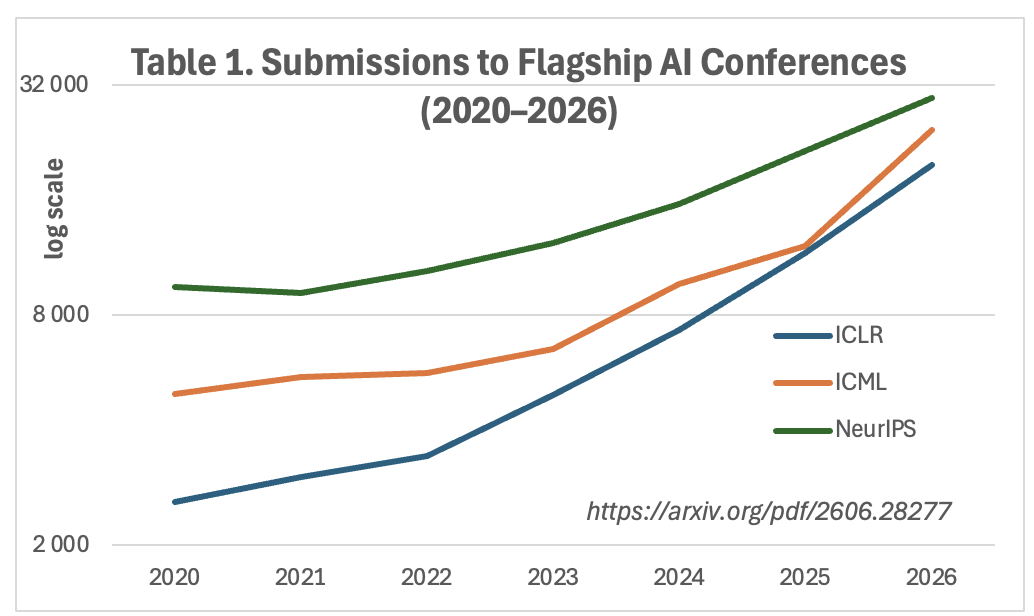
[2606.28277] Towards Automating Scientific Review with Google’s Paper Assistant Tool
▻https://arxiv.org/abs/2606.28277
— Permalink
#peerreview #deepreview #scholarpeer #research #science #artificialintelligence #generativeai #LLMs
note : les sept signataires sont chez Google Research…
Abstract
Artificial intelligence is driving a revolution in scientific discovery, accelerating everything from hypothesis generation to mathematical theorem proving. However, this rapid acceleration is creating a systemic challenge: traditional human peer review cannot scale to match the influx of AI-assisted science. Ultimately, to resolve this tension, we must also deploy AI to accelerate the verification and review process itself. To frame the discussion around this transition, we propose a taxonomy consisting of four progressive levels of AI-human collaboration in scientific evaluation, and discuss various trade-offs involved with each.
As a step toward this future, we introduce the Paper Assistant Tool (PAT), an agentic AI framework built for deep scientific review and verification. PAT ingests full scientific manuscripts and produces a comprehensive evaluation, checking theoretical results, validating experiments, suggesting improvements, and identifying potential flaws. By utilizing inference scaling techniques, PAT is able to identify deeper issues than a single model call alone, achieving a 34% improvement over zero-shot recall on mathematical errors in the SPOT benchmark. Pilot deployments of PAT as a pre-submission tool for authors at two major Computer Science conferences — STOC and ICML — demonstrate its ability to identify critical errors and suggest substantive improvements to research papers. By catching errors early, PAT eases the cognitive burden placed on referees, while preserving their control over the outcomes of the review process.
[…]
• Role 1: AI as a Tool for Authors. Tool for Authors
• Role 2: AI as a Tool for Reviewers
• Role 3: AI as a Supporting Reviewer
• Role 4: Total AI Automation of Peer Review
[…]
5 Conclusion and Future Outlook
[…]
Additionally, delineating clear lines of accountability—where algorithmic assessment ends and human judgment begins will be a critical, open challenge for the academic community. Beyond accountability, the academic community must guard against cognitive complacency (e.g. the deskilling of human reviewers) and ensure equitable access to the compute infrastructure required for these tools. Furthermore, automation may introduce systemic vulnerabilities, such as algorithmic biases and the risk of authors adversarially gaming review agents. Only by addressing these challenges can we safeguard the integrity of the peer review process as we transition toward an automated scientific ecosystem.
#yapuka …
Generative AI and the temporary #upskilling of knowledge workers | Nature Human Behaviour
▻https://www.nature.com/articles/s41562-026-02566-6
— Permalink
Large language models for computational social science | Nature Human Behaviour
▻https://www.nature.com/articles/s41562-026-02539-9
— Permalink
The State of #context Engineering
▻https://www.dbreunig.com/2026/10/24/the-state-of-context-engineering.html
— Permalink
Chinese AI Writes Weaker Code for Beijing’s Adversaries. We Fixed It. A Qwen3-Coder Case Study
▻https://www.hirundo.io/blog/qwen3-coder-vulnerabilities
— Permalink
#LLMs #generativeai #softwareengineering #dev #cybersecurity

Friday essay: AI is devastating higher education, but the system was already broken
▻https://theconversation.com/friday-essay-ai-is-devastating-higher-education-but-the-system-was-
If you work at a university today, you talk a lot with the dead. I don’t mean that as a metaphor – or, at least, not entirely.
#Generative_AI trains on people. Its algorithms learn from humans, requiring our quirks and idiosyncrasies to improve. If the models are exposed predominantly to the output from other AIs, they degenerate and, eventually, collapse.
That explains a strange new trend reported by antiquarian booksellers, who told the Guardian of bulk orders for old stock, originating, they thought, from AI companies or their surrogates. The titles were bafflingly esoteric: one bibliophile described a purchase that included a manual on soil mechanics from the 1970s, a book called Born to Thunder: Champions of New Zealand Cycling, a history of the Melbourne suburb of Hawthorn, and a copy of Early Australian Poetry.
But for #AI trainers, the subjects don’t necessarily matter. Back in the day, the companies vacuumed up human content from #Reddit, #Wikipedia and similar sites. With data now prohibitively expensive, remaindered books provide an attractive option for “destructive scanning”, in which machines slice apart bindings to feed on the creativity contained therein.
The open garbage | A journey into a wild pointer
▻https://carette.xyz/posts/the_open_garbage
— Permalink
#softwareengineering #dev #code #chainoftrust #opensource #community #codereview #trust #vibecoding #artificialintelligence #LLMs #generativeai #cybersecurity #safety #knowledge #understanding #QA #dependency #bestof
Future of #work with AI #agents · #stanford SALT Lab
▻https://futureofwork.saltlab.stanford.edu
— Permalink
#futureofwork #automation #artificialintelligence #workplace #employment #desire #capability #acceptability #management #organisations #LLMs #generativeai #trust #replacement #accuracy #reliability #tasks #collaboration #coordination #prospective #opportunity