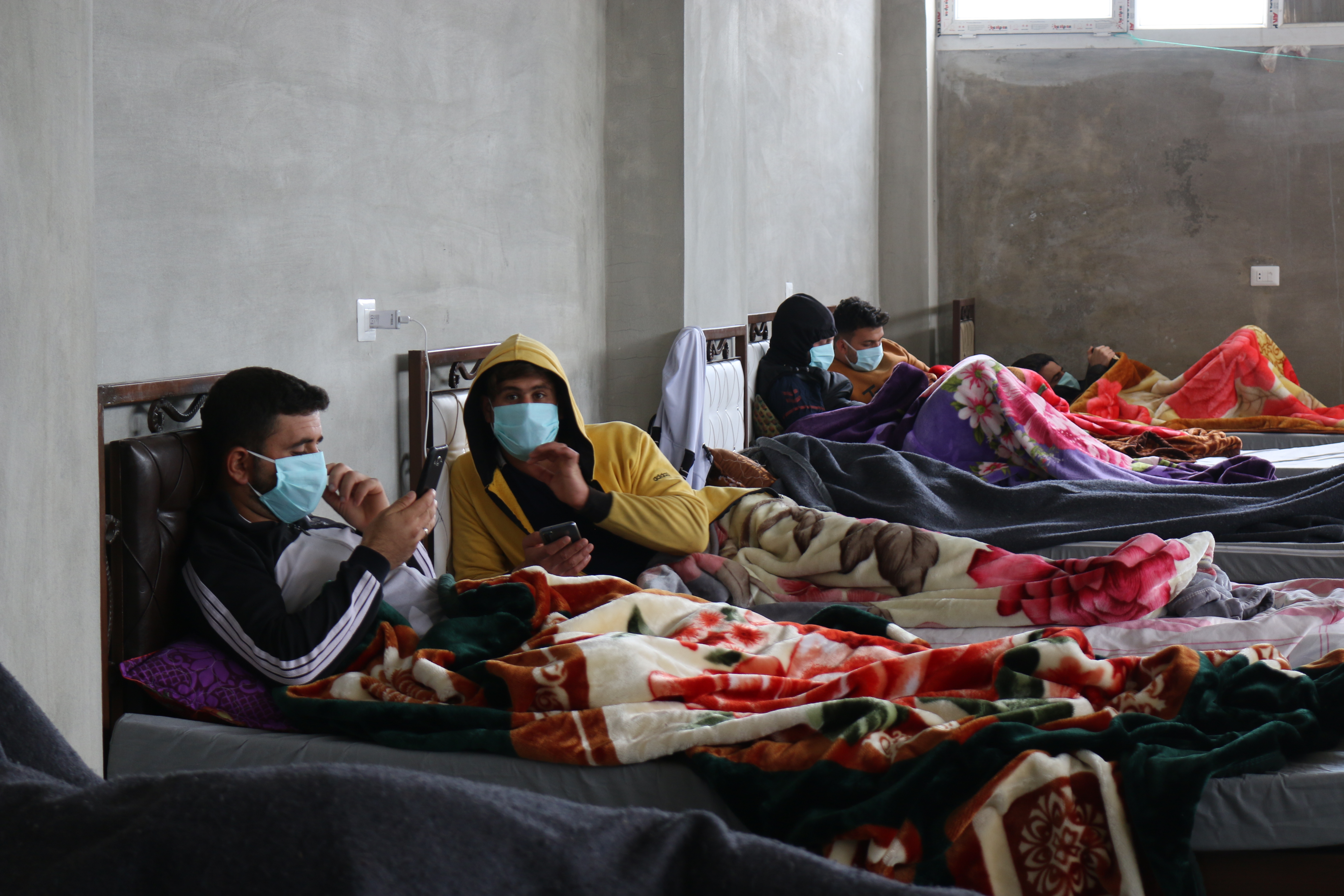
• « Nous n’avons pas d’État » : la #Syrie post-Assad et ses contradictions
    https://lvsl.fr/nous-navons-pas-detat-la-syrie-post-assad-et-ses-contradictions

    Si les interrogations autour du #Hayat_Tahrir_al-Sham (HTS, la milice au pouvoir en Syrie) ont cristallisé l’attention de la presse, un autre phénomène est demeuré dans l’ombre : le démantèlement de l’État hérité de l’ère #Assad. Autour de 400.000 fonctionnaires ont été licenciés, au motif de lutter contre un système clientéliste. Sur ses décombres renaît […]

    #International #Alaouites #Damas #Homs #HTS #Idlib #Lattakié #néolibéralisme #Turquie

  • Pr. Logos / mastodon
    https://piaille.fr/@Pr_Logos

    D’après le Monde, #Macron estime que « la solution ne pourrait plus reposer sur un accord avec le Rassemblement national ». C’est bien que le service politique du Monde découvre que le #gouvernement_Barnum reposait sur un accord avec le parti d’extrême-droite et non seulement avec le parti néocon.

    D’après l’info 24/24 (la télédésinformation) le présipotent doit nommer un nouveau clown dans les 48 heures. Et ça ce n’est pas gentil pour les clowns.
    https://www.youtube.com/watch?v=XxOg4rmhnKM


    Rupture de Pierre Etaix (un clown, un vrai)

    • Abou Mohammed al-Joulani, le leader islamiste qui a fait tomber Bachar al-Assad
      https://www.mediapart.fr/journal/international/081224/abou-mohammed-al-joulani-le-leader-islamiste-qui-fait-tomber-bachar-al-ass

      Après avoir rompu avec Al-Qaïda et l’État islamique, le chef de Hayat Tahrir al-Cham a promis de dissoudre son organisation. Il ne fait pas mystère de vouloir remplacer Bachar al-Assad. Mais beaucoup d’ombres demeurent.
      Jean-Pierre Perrin

      Il n’y a que sa barbe noire qui ne change guère – elle est quand même devenue un peu plus courte et peignée. Mais pour ses tenues, l’homme est plutôt du genre caméléon.
      Ainsi, au fil des ans, de vidéo en vidéo, on a pu voir Abou Mohammed al-Joulani portant un superbe turban blanc quand il imitait son idole Oussama ben Laden, puis l’épais bonnet de laine gris sombre et l’uniforme noir des djihadistes quand il dirigeait le Front al-Nosra, déclinaison syrienne d’Al-Qaïda. On l’a vu ensuite vêtu des pieds à la tête d’un uniforme kaki, lorsqu’il grimpait, voici quelques jours, les marches de l’orgueilleuse citadelle médiévale d’Alep, sous le regard des caméras, pour montrer au monde entier qu’il est le chef de guerre qui a conquis la ville. On l’a vu enfin engoncé dans un costume bon chic bon genre quand il rencontrait des journalistes occidentaux.

      « En ce moment, il affectionne plutôt le style du président ukrainien Volodymyr Zelensky, qu’il a dû découvrir sur les réseaux sociaux », souligne un chercheur français qui travaille sur la Syrie.
      Illustration

      Dans un Proche-Orient où les tenues sont scrutées parce qu’elles disent beaucoup de celui qui les porte, la mue vestimentaire d’Abou Mohammed al-Joulani, chef du groupe islamiste radical Hayat Tahrir al-Cham (HTC, pour « Organisation de libération du Levant »), fait beaucoup parler. Déjà, en février 2021, une première photo le représentant habillé à l’occidentale, là encore pour les besoins d’une interview avec la chaîne publique américaine PBS, la première, semble-t-il, qu’il ait donnée, avait suscité la polémique dans les médias arabes pour savoir si ce changement traduisait ou non un véritable adieu au djihad et une ouverture vers le monde occidental.

      Le débat est toujours d’actualité, renforcé par les déclarations totalement inattendues du leader islamiste annonçant, il y a quelques jours, que tous les combattants de HTC, et ceux des autres groupes de la coalition rebelle, quitteraient les zones civiles dans les semaines à venir. Il ajoutait, dans cette déclaration à une chercheuse de l’International Crisis Group (ICG), un groupe de réflexion américain, que sa formation, une fois la victoire acquise, envisageait même de « se dissoudre afin de permettre la consolidation complète des structures civiles et militaires dans de nouvelles institutions reflétant l’ensemble de la société syrienne ».

      J’avais 17 ou 18 ans à l’époque de la deuxième Intifada, et j’ai commencé à réfléchir à la manière dont je pourrais remplir mon devoir, en défendant un peuple opprimé par des occupants et des envahisseurs. Abou Mohammed al-Joulani à la chaîne PBS en 2021

      Plusieurs signes avaient déjà annoncé une possible évolution, réelle ou opportuniste, du chef d’HTC. Ainsi, le 5 décembre, délaissant sa kunya (son nom de guerre) d’Abou Mohammed al-Joulani, il avait envoyé un message aux habitant·es de Hama paraphé, pour la première fois, de son vrai nom : le commandant Ahmed al-Chareh. Dans ce message, publié sur la chaîne Telegram des factions rebelles, il les félicitait pour leur victoire sur le régime.
      Avec Al-Baghdadi dans un camp de prisonniers
      Désormais, on connaît avec certitude le nom du chef d’HTC : Ahmed Hussein al-Chareh. Âgé de 42 ans, il est originaire de Deraa, une ville du sud de la Syrie considérée comme le « berceau de la révolution syrienne ». Il a passé ses sept premières années en Arabie saoudite, où son père, un économiste, travaillait comme ingénieur pétrolier. La famille Al-Chareh a ensuite déménagé à Damas, ville où son grand-père s’est installé après l’occupation par Israël, pendant la guerre des Six-Jours, du plateau du Golan syrien, dont la famille est originaire. Son adolescence, il l’a passée à Mezzeh, un quartier cossu de la capitale syrienne. Ce milieu relativement aisé lui a permis d’avoir un bon niveau d’éducation, dont des études approfondies d’arabe littéraire.
      La deuxième Intifada, en 2000, en Israël, sera pour lui une déflagration. Elle serait à l’origine de sa radicalisation. « J’avais 17 ou 18 ans à l’époque, et j’ai commencé à réfléchir à la manière dont je pourrais remplir mon devoir, en défendant un peuple opprimé par des occupants et des envahisseurs », a-t-il déclaré dans la même interview à la chaîne PBS.

      Mais, comme pour beaucoup d’aspirants au djihad, c’est l’invasion américaine de l’Irak en 2003 qui va le conduire sur le chemin de la lutte armée. Il quitte l’université de Damas pour se rendre à Bagdad en bus. Il y arrive avant que l’armée américaine ne s’empare de la ville. Dans une insurrection encore balbutiante, il rejoint un groupe islamiste ultraradical, Saraya al-Mujahideen, actif dans la grande ville de Mossoul, avec lequel il va faire ses premières armes. L’apprenti djihadiste va ensuite suivre un parcours exemplaire qui passera obligatoirement par la case prison.

      « Al-Joulani voulait être le chef de ce qui serait l’équivalent sunnite du Hezbollah, ce qui peut s’expliquer par l’impact qu’avait ce parti dans le monde arabe. Mais cela n’est pas transposable à la Syrie », indique Michel Duclos, ancien ambassadeur en Syrie, conseiller à l’Institut Montaigne et auteur de La Longue Nuit syrienne (Éditions de l’Observatoire, 2019).

      Saraya al-Mujahideen va faire allégeance au djihadiste jordanien Abou Moussab al-Zarqaoui lorsque ce dernier crée, en 2004, la branche irakienne d’Al-Qaïda, Al-Qaïda en Irak, qui devient par la suite l’État islamique (EI). Al-Joulani va être proche du Jordanien, un fanatique antichiites, connu pour son extrême cruauté – il fait égorger ses otages –, qui sera tué en 2006 par une frappe américaine. Il sera ensuite capturé par les Américains et envoyé en détention dans l’immense camp de Bucca, à la frontière irako-koweïtienne.
      L’endroit, où seront internés entre 2003 et 2009 quelque 100 000 personnes suspectées de terrorisme, est considéré comme le plus grand incubateur de djihadistes. Nombre de futurs dirigeants et cadres de l’État islamique y seront détenus. Al-Joulani parvient à se faire passer pour un Irakien aux yeux des officiers de renseignement américains, ce qui lui permet de ne pas être interné avec les djihadistes étrangers.

      Comme il n’y a pas de cellules mais de grandes tentes, il est possible de circuler à l’intérieur du camp. Ce qui permettra à Al-Joulani, qui enseigne l’arabe classique aux prisonniers, de rencontrer la plupart des chefs djihadistes en détention, en particulier le premier d’entre eux, le futur « calife » de Mossou et fondateur de l’État islamique, Abou Baqr al-Baghdadi. Une fois libéré, il rejoindra Al-Baghdadi, qui a rompu avec Al-Qaïda et qui le nommera à la tête des opérations de l’EI dans la grande province irakienne de Ninive.

      Quand l’insurrection commence en 2010 contre le régime Assad, Al-Joulani va vouloir regagner la Syrie de toute urgence. « En août 2011, il franchit la frontière pour se rendre en Syrie, accompagné d’un petit groupe de djihadistes irakiens et syriens. Ils n’auraient apporté avec eux que 60 fusils automatiques, qu’ils prévoyaient de livrer aux cellules djihadistes dormantes dans divers gouvernorats syriens. Ce fut la première page d’un long chapitre encore inachevé de l’activisme djihadiste en Syrie, dans lequel Al-Joulani devint progressivement une figure centrale, et controversée », indiquent les chercheurs Hamzah Almustafa et Hossam Jazmati, pour le site Middle East Eyes.
      La société civile est soumise à rude épreuve sous la férule de HTC, avec des arrestations et même des assassinats, comme celui de Raed Fares, une célèbre figure de la révolte contre le régime syrien.

      Le 23 janvier 2012, le Front al-Nosra est officiellement créé sous le parrainage d’Al-Baghdadi. Al-Joulani en prend la direction. Mais quand l’Irakien voudra faire fusionner le Front al-Nosra avec l’État islamique, il refusera. Le 10 avril 2013, il acte leur séparation en prêtant allégeance non pas à Al-Baghdadi mais à Ayman al-Zawahiri, l’émir d’Al-Qaïda.

      Schismes en série

      D’où un schisme à l’intérieur de la grande famille djihadiste, avec son lot de terreur et d’assassinats. Puis, encore un autre : Al-Joulani rompt avec Al-Zawahiri et Al-Qaïda en juillet 2016. Toutes ces querelles recoupent des questions de leadership mais elles sont aussi idéologiques. Al-Joulani est volontiers nationaliste et hostile au djihadisme transnational. « Le Front al-Nosra n’a aucun plan ni directive pour cibler l’Occident. […] Peut-être que Al-Qaïda fait cela mais il ne le fera pas depuis la Syrie », déclare-t-il, le 28 mai 2015, à la chaîne qatarie Al Jazeera.

      Mais il est trop tard pour avoir de bonnes relations avec les pays occidentaux. Les États-Unis et les Nations unies ont désigné HTC comme une organisation terroriste et Washington a mis à prix la tête de son chef pour 10 millions de dollars. Toujours dans l’espoir de ne pas être ostracisé et de se réconcilier avec les pays occidentaux, mais aussi pour se réconcilier avec d’autres formations d’opposition, le Front al-Nosra devient Hayat Tahrir al-Cham, agglomérant en même temps d’autres groupes islamistes. À partir de 2017, Al-Joulani en est le commandant militaire et politique.

      Idlib, un laboratoire de la reconquête

      Al-Joulani et HTC vont prendre rapidement possession d’une grande partie de la province d’Idlib, au nord du pays, frontalier de la Turquie, qui est sous le contrôle de la rébellion depuis 2015, et y instaurer une administration concurrente de celle de Damas, ainsi qu’un « gouvernement du Salut », doté d’une police et d’institutions, avec un contrôle total sur l’économie. Même si la situation n’est pas comparable à celle du territoire contrôlé par le régime, la société civile est soumise à rude épreuve sous la férule de HTC, avec des arrestations, des enlèvements, des tortures, la répression de manifestions et même des assassinats, comme celui de Raed Fares, une célèbre figure de la révolte contre le régime syrien, tué le 23 novembre 2018 dans l’enclave.

      Vis-à-vis des minorités religieuses, si celles-ci ont le droit de célébrer leur culte, elles n’en restent pas moins soumises à la discrétion. Les messes sont permises mais pas les croix sur les clochers.
      Toutefois, en dépit de la menace permanente d’une offensive des troupes prorégime, des bombardements incessants de l’aviation russe sur la population civile, d’une situation économique et sanitaire des plus critiques avec l’afflux de quelques trois millions de déplacé·es, Al-Joulani va faire de l’enclave un laboratoire de la reconquête de la Syrie, sans que Damas, ni Moscou ni Téhéran n’en prennent conscience. Ou alors trop tard.
      HTC a ainsi recruté parmi tous ceux qui ont trouvé refuge dans l’enclave d’Idlib, en leur promettant qu’ils retourneraient dans les villages d’où ils avaient été chassés et en donnant une formation militaire aux enfants des familles déplacées. Dans les ateliers de l’enclave, c’est toute une armurerie qui a été mise en place discrètement, avec notamment la fabrication de drones artisanaux qui ont semé la panique dans les rangs loyalistes.

      À présent, Abou Mohammed al-Joulani ne fait pas mystère de son souhait de remplacer Bachar al-Assad. Qu’en sera-t-il de ses promesses d’ouverture ? « Il a évidemment une carrure de leader national. Il l’a montré en incorporant dans son organisation des gens qui venaient de partout et en sachant les fédérer. Mais l’important, c’est d’abord de savoir s’il est un grand politique, estime Michel Duclos. Si c’est le cas, il sait qu’il lui faudra composer avec la société syrienne telle qu’elle est. Et cette société, elle est sunnite conservatrice, pas prête à accepter les folies que voudraient lui imposer des formations djihadistes. » Mais l’ancien diplomate s’inquiète aussi de ceux qui sont autour de lui : « On ne sait rien d’eux, c’est l’une des limites de son mouvement, mais on peut craindre qu’ils veuillent leur part du gâteau. »

      Les commentateurs insistent peu sur le fait que l’offensive du HTS a non seulement été suivie par d’autres factions connues mais aussi par des soulèvements locaux, à mesure que l’armée baathiste se dissolvait en un repli désordonné et que l’armée russe quittait le terrain (ce qui s’est vu très vite avec le départ de navires de guerre et l’absence de bombardements).
      Les MSM confortent toujours un aspect du campisme qui est la croyance dans les grands hommes et leurs organisations plus qu’en la capacité d’initiative du vulgaire.

    • Puisque l’ancien d’al-Qaïda est devenu présentable, on pourrait en profiter pour libérer de prison en France quelques détenu(e)s injustement condamné(e)s pour l’avoir soutenu trop tôt. Eux aussi ont dû changer...

    • Ce type n’a rien d’un déshérité. Le HTS a très rapidement réussi son coup en donnant par avance des gages aux suppôts militaires et administratifs du régime Assad, tout comme il sait désormais se montrer responsable en évitant exactions et massacres, ou en affichant une ouverture aux diverses composantes de la population syrienne (les dites « minorités », Alaouites, Druzes et chrétiens, voire Kurdes, inclus).

      On se focalise sur la géopolitique ou/et les factions armées, l’idéologie islamiste. Celleux qui se revendiquent du soulèvement syrien s’inquiètent désormais également de l’absence d’arrestations parmi les responsables de l’ancien régime, prélude à leur recyclage dans de nouvelles institutions.

      Make Syria great again ?

      #nationalisme_arabe

  • Escalation in North-West Syria: Civilian Areas Hit in Renewed Attacks

    With all eyes turned towards events in Israel and Gaza over the past two months, a significant escalation in the long running conflict in Syria has failed to gain front-page attention.

    More than 15 cities, towns and villages across North-West Syria — including in Idlib province, known as the last rebel stronghold — have been targeted with shelling.

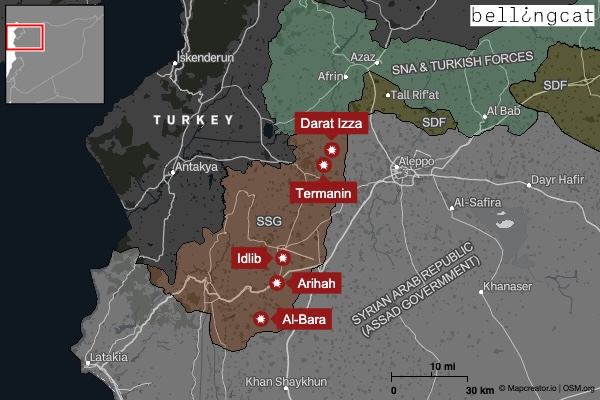
    Bellingcat analysed footage and images of recent shelling and identified the use of incendiary weapons, cluster munitions and Grad rockets in close proximity or directly impacting civilian infrastructure including mosques, schools and camps for Internally Displaced Persons (IDPs).

    Since the initial four day period, further shelling has been carried out across the country by different groups, leading UN official Paulo Pinheiro to describe it as: “the largest escalation of hostilities in Syria in four years.”

    What Happened?

    The initial shelling was reportedly carried out in response to a drone strike on a Syrian government military academy in Homs on October 5 that killed at least 80 people.

    On October 5 at around noon local time, a drone attack struck a graduation ceremony at the Homs Military Academy, here: 34.752382, 36.687726.

    No group immediately claimed responsibility for the attack. Syria’s Defence Minister reportedly attended the graduation but left minutes before the attack.

    Syria’s defence ministry stated that it would respond “with full force” to the attack. Later the same day the government forces carried out heavy bombing of opposition-held areas in North-West Syria.

    The shelling of Idlib province and the countryside of Aleppo continued for several consecutive days.

    Despite media reports that shelling in North-West Syria was a response to the attack on the military academy, we couldn’t independently verify who was responsible for the shelling outlined below.
    Use of Incendiary Weapons in Darat Izza

    Between October 6 and October 7, videos emerged on social media showing incendiary weapons and other artillery alongside claims it was being dropped on Darat Izza, a town located about 25km west of Aleppo.

    Bellingcat’s preliminary analysis suggests that 122mm 9M22S Grad Rockets were used to shell the town of Darat Izza in early October.

    The earliest footage we found was posted on X (formerly Twitter) at 9:10 pm local time on October 6, alongside the claim that artillery strikes were taking place in Darat Izza, Termanin and Towama.

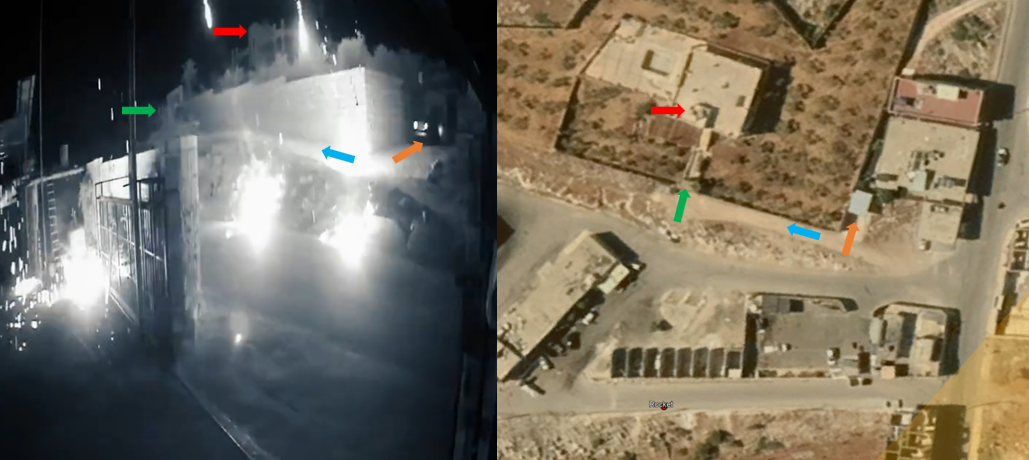
    While earlier posts mentioned artillery fire, later posts showed explosions near the ground accompanied by a rain of flares, likely activated after the impact of rockets, as seen in the gif below.

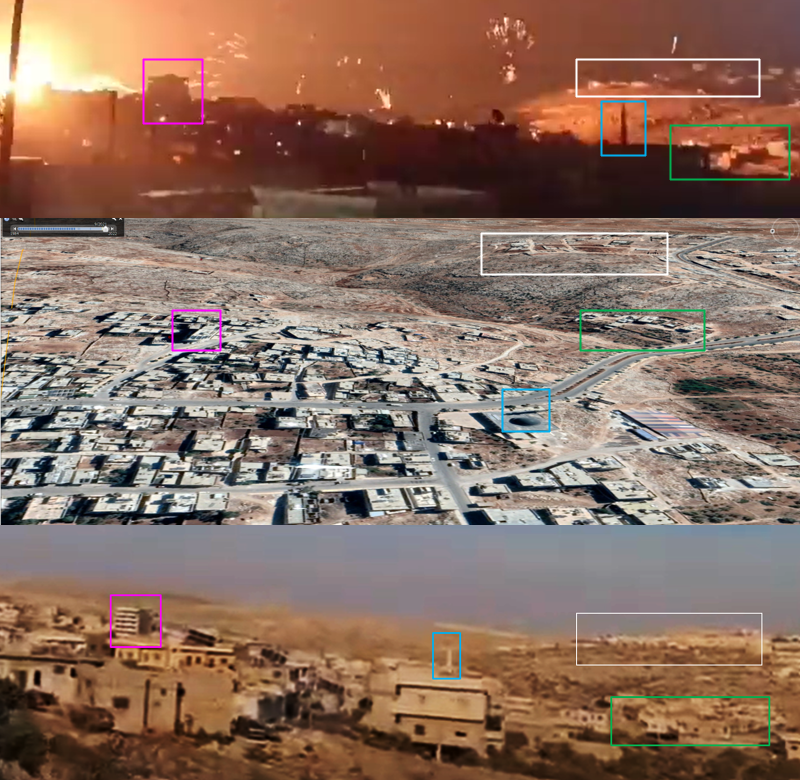
    The series of videos from October 6 were filmed at night. With no further information on the location, we looked at the urban landscape features revealed by the explosions’ flashes and cross referenced them with other open source information to match it to Darat Izza.

    Based on the approximate location of explosions and flares seen in the videos, we determined that the respective cameras were pointing towards southwest Darat Izza and that the explosions likely took place in a valley located in a sector in proximity to an IDP camp, here: 36.280114, 36.861183 (we’ll return to this location later). By October 8, rocket remnants and damage to civilian infrastructure was also reported in that area by The White Helmets — a volunteer civil defence and humanitarian organisation operating in Syria.

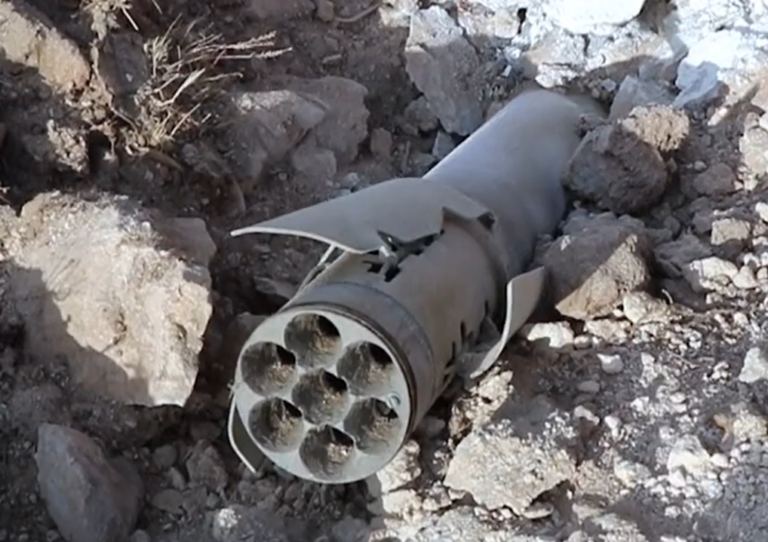
    The White Helmets said that 9M22S Grad rockets were used in Darat Izza during the early October attack and claimed the rockets were packed with ML-5 submunitions filled with thermite mixture – a flammable material designed to cause fires. We analysed footage captured by The White Helmets after the early October shelling, showing remnants of a possible 9M22S Grad Rocket here, 36.274441, 36.855304.
    The Unusual Features of the Incendiary Weapon

    Human Rights Watch describes incendiary weapons as weapons that contain flammable substances that ignite, they can be dropped from the air or fired from the ground in rockets or artillery shells. Incendiary weapons often start fires and can inflict severe injuries.

    The use of incendiary weapons in Syria has been well documented. Typically, an incendiary weapon explodes in the air and then thermite submunitions are dispersed downwards, falling like rain over a particular area. You can see an example of this here:

    https://www.youtube.com/watch?v=hMvF7YNRc8A&embeds_referring_euri=https%3A%2F%2Fwww.bellingcat.com%

    However, in the early October attack on Darat Izza not all the explosions seem to occur in the air. Additionally, the incendiary elements seem to be projected upwards.

    Here’s a reminder of how it looked:

    We spoke to Petro Pyatakov, a retired colonel of the Armed Forces of Ukraine and former Deputy Head of the Faculty of Missile Forces and Artillery of the Academy of Ground Forces who told us: explosions, followed by a hail of flares – as seen in the footage from Darat Izza – is consistent with incendiary weapons. He added that the explosions observed on October 6 could be caused by the explosion of a 122mm 9M22S Grad rocket either in the air or upon impacting the surface — depending on how the rocket was set to detonate before it was launched.

    There seems to be limited footage or other examples from Syria showing weapons projecting incendiary elements upwards after the point of explosion. Further analysis is needed to identify the exact type of weapon and incendiary elements used in Darat Izza on October 6.
    Additional Evidence from Darat Izza

    North-West Syria is already home to more than two million IDPs and at least 120,000 more were displaced in the October shelling according to the UN Office for Coordination of Humanitarian Affairs.

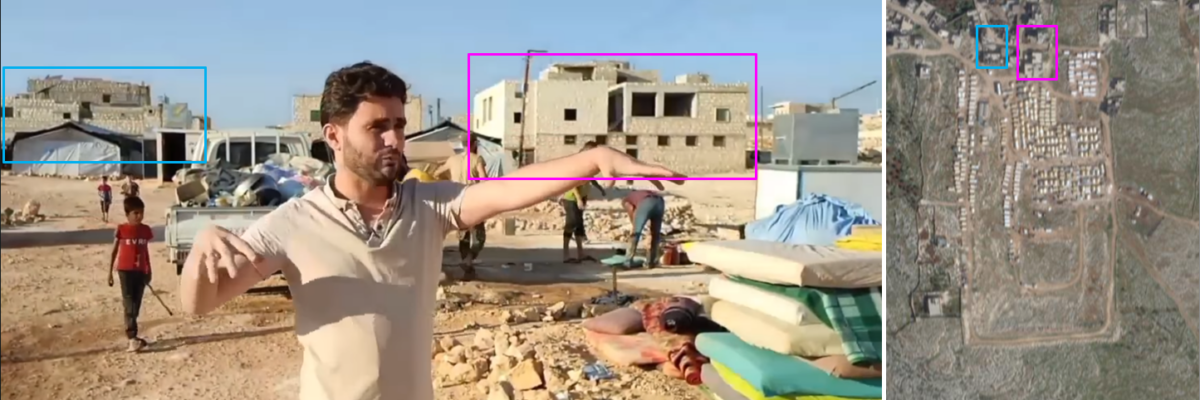
    On October 7 – the day after footage of incendiary weapons was posted online and we geolocated it near an IDP camp in Darat Izza- Abdulkafi Alhamdo, a teacher, activist and reporter, posted a video on Facebook reporting a “burning and cluster bomb” attack had taken place near an IDP camp in Darat Izza. We located the impacted IDP camp where Alhamdo was filming to the same place we had geolocated the night before, at these coordinates: 36.280114, 36.861183. According to Alhamdo, although the attack did not cause damage to the camp, it did force the IDPs to leave the camp in fear.

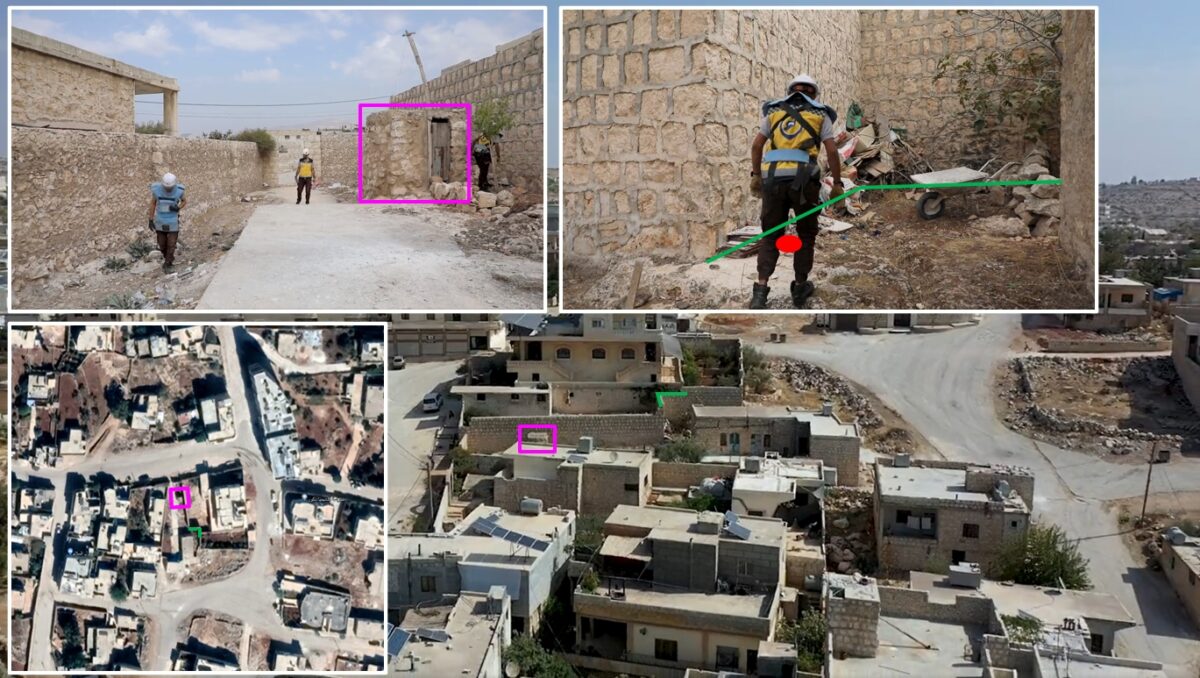
    Separately, CCTV footage posted by The White Helmets allegedly filmed the night of October 7, showed what appear to be incendiary flares scattered on the roofs of houses. We geolocated these houses to a sector in the south of Darat Izza at coordinates: 36.274918, 36.851466.

    This humanitarian organisation also posted a drone video on October 8 showing damage to buildings and vehicles in Darat Izza. The video also features at least two munition remnants encrusted in the road, here: 36.274441, 36.855304 and here: 36.274934, 36.852089. At least one ordinance appears to be consistent with a 9М22S Grad rocket, mentioned above but further analysis is required to confirm this.

    For comparison, here is another example of a 9M22S Grad rocket, from Ukraine.

    https://twitter.com/DPSU_ua/status/1540029482228137995

    We located residential areas including a mosque, a school and the IDP camp within a 1,000 metre radius to the rocket remnant.
    Use of Cluster Munitions in Termanin

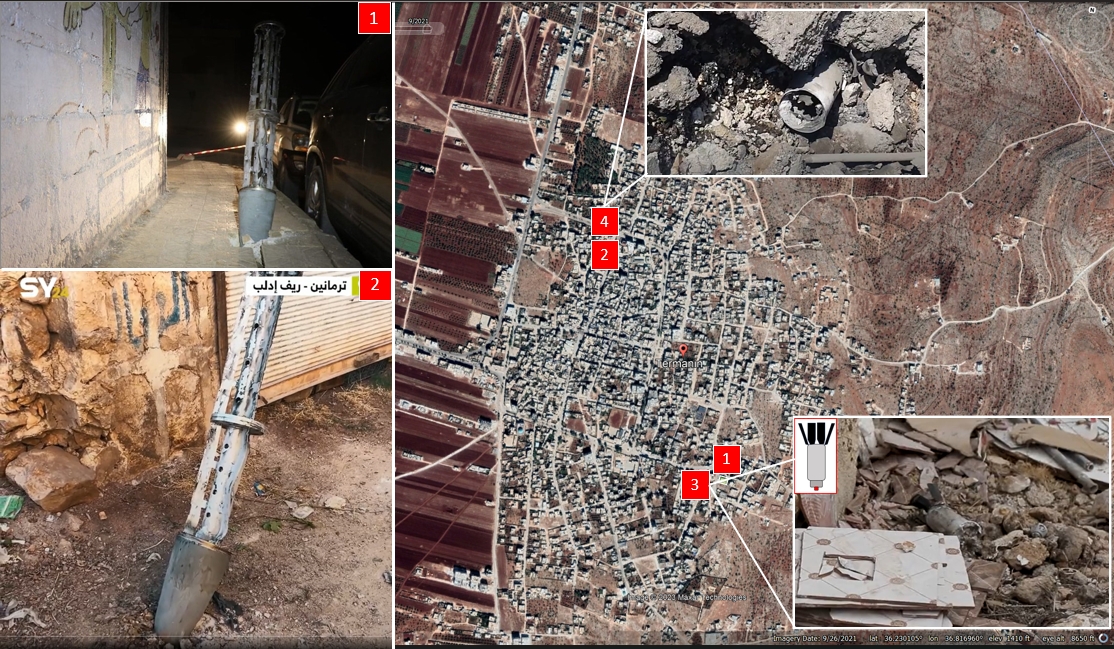
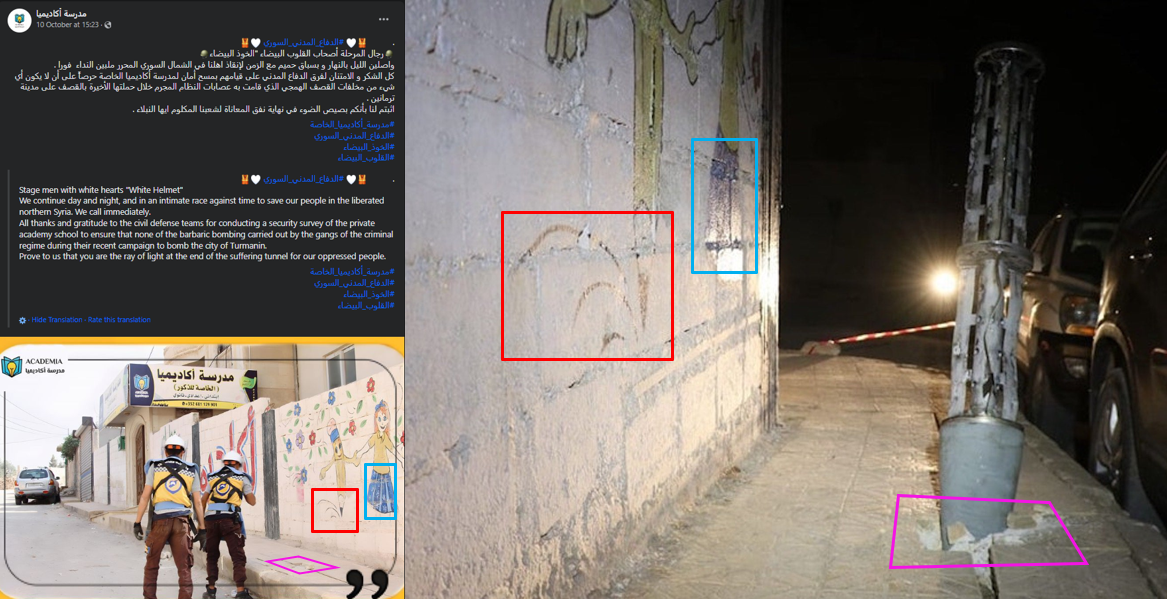
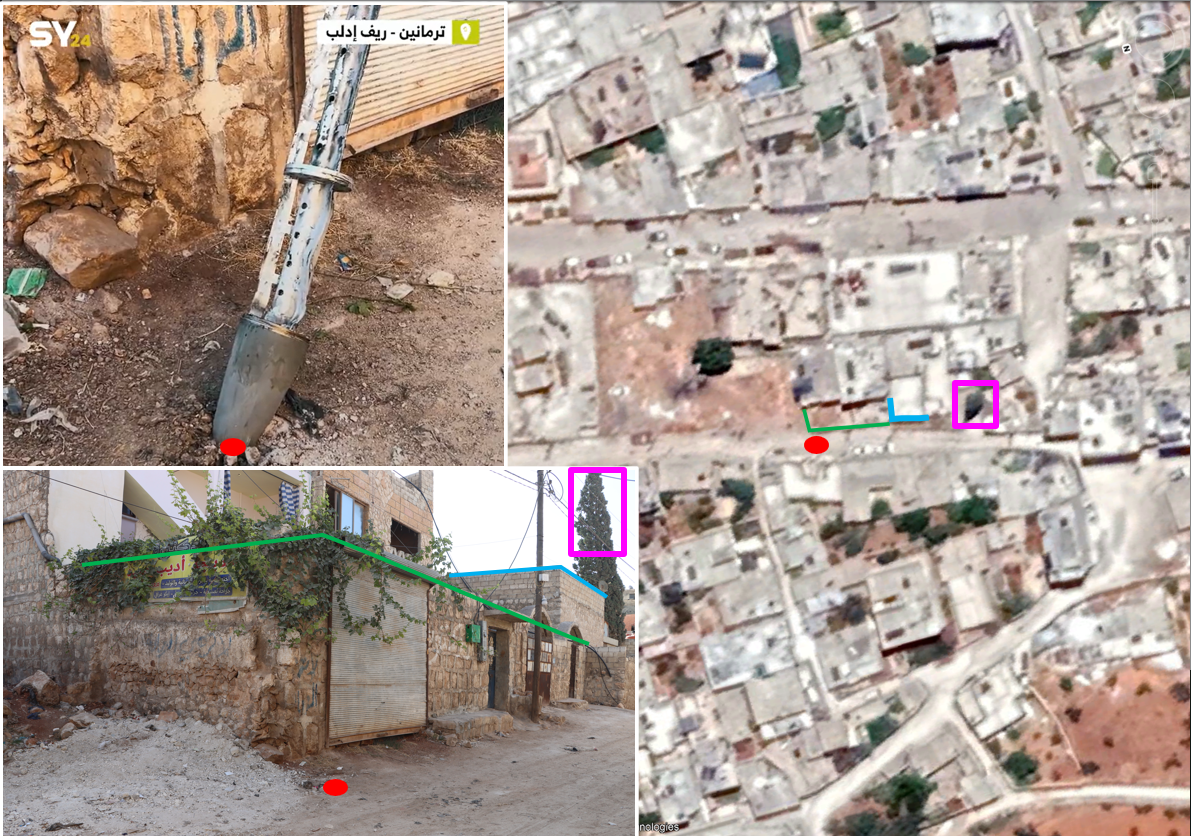
    Based on Bellingcat’s analysis it appears that several different kinds of weapons, including at least two cluster munitions, hit the small town of Termanin – located 30km due west of Aleppo- over a period of a few days in early October.

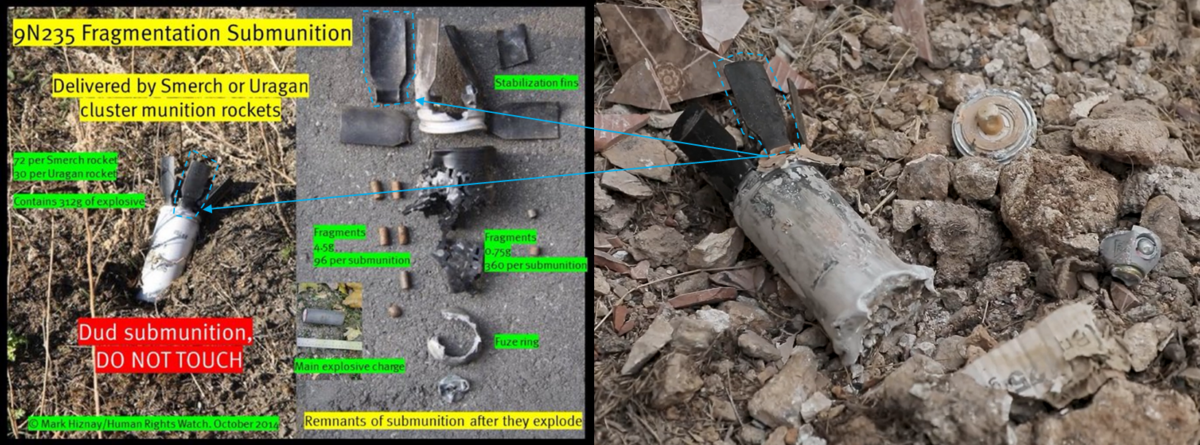
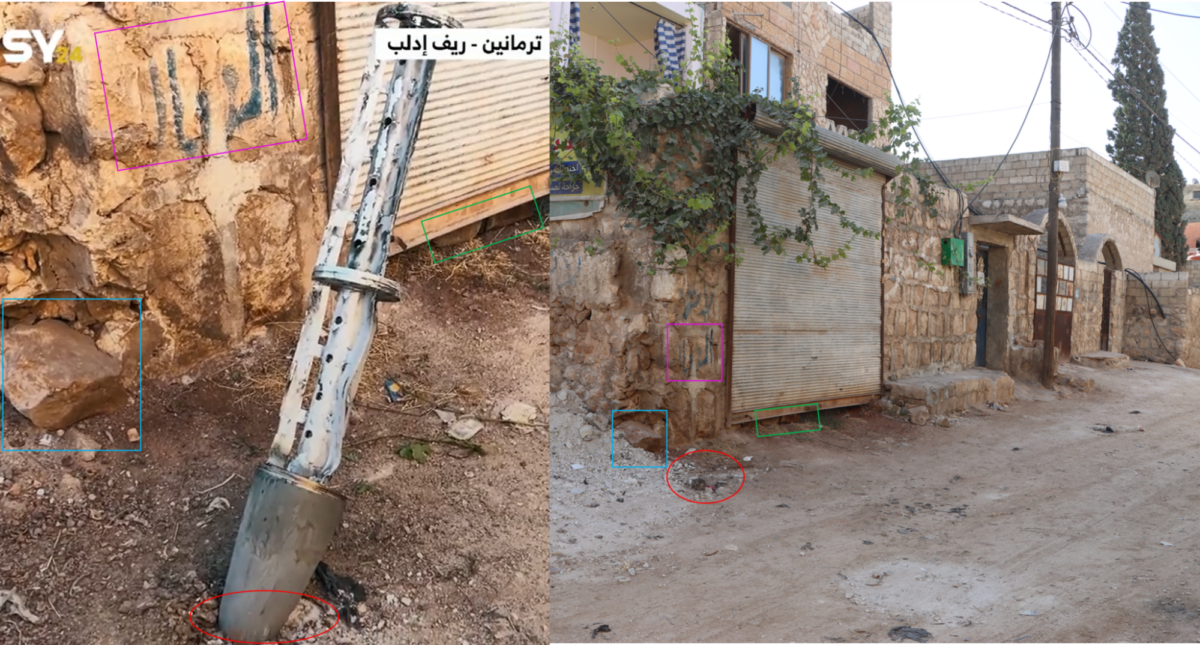
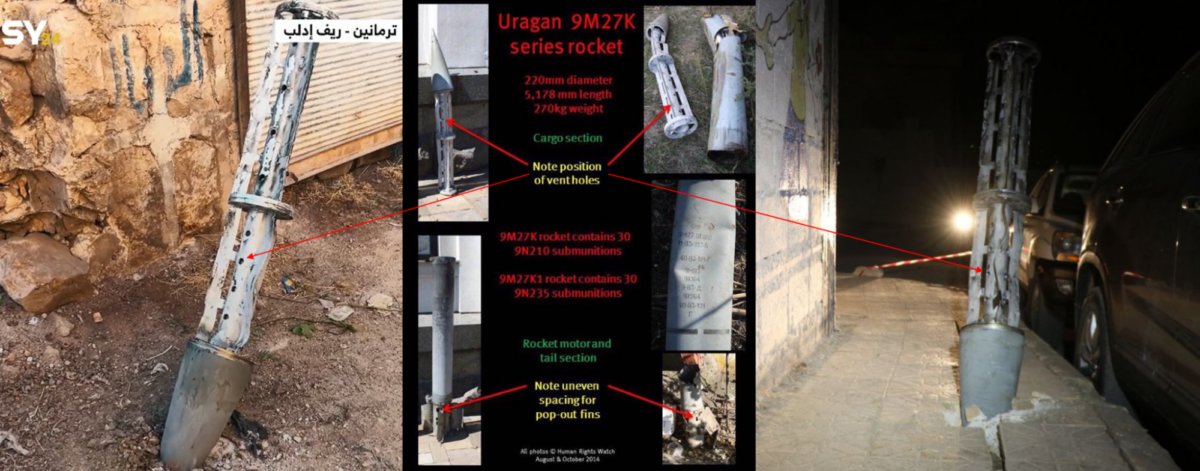
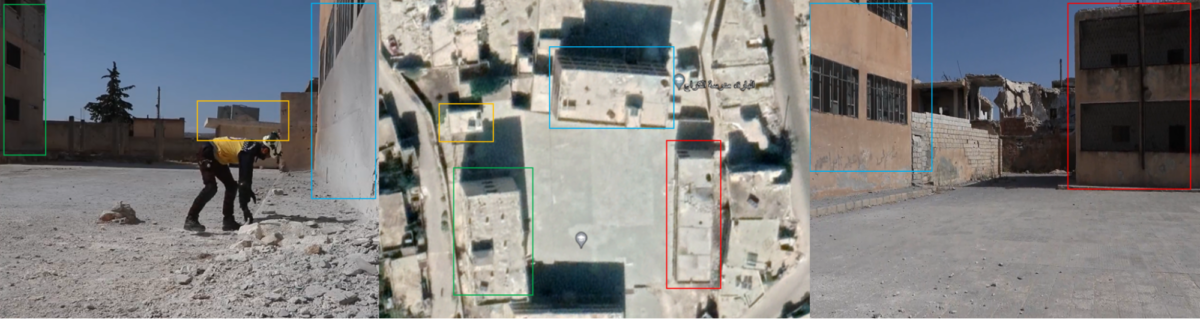
    We geolocated an image of a 9M27K cluster munition cargo section posted on X next to a school in the town of Termanin at coordinates 36.226206, 36.818707. In addition to the cluster munition cargo section, we also identified and geolocated an 9N235 submunition within a 100 metre radius of the same school at 36.226054, 36.818162.

    The image of the 9N235 submunition seen in the White Helmets’ video appears to be consistent with the reference tool provided by Mark Hiznay, Associate Arms Director at Human Rights Watch (HRW) and corresponds to 9N235 submunition which can be delivered by Uragan or Smerch cluster rockets.

    In addition, we also identified another 9M27K cluster munition cargo section in a video posted on X on October 7. However, given that the video provides very limited view of the surroundings, it was not possible to geolocate this munition remnant based on this information alone.

    Comparing the cargo section from the video posted on X with imagery provided by The White Helmets, we geolocated the additional cluster munition cargo section to 36.231684, 36.813705, close to a post office according to information on Google Maps.

    According to a report from The White Helmets, one more cluster munition remnant landed at coordinates 36.232028, 36.818756. However, there are no images or videos available to confirm this.

    Both of the geolocated cluster munition cargo sections seem to be consistent with the cargo section of the 9M27K cluster munition, as outlined below — using a reference tool shared by Mark Hiznay. The 9M27K rocket has a range of between 10km and 35km.

    In addition to identifying the use of cluster munitions and incendiary weapons, we were also able to identify additional incidents of the shelling of civilian infrastructure other towns and cities.

    This included the shelling of an IDP camp in Idlib and a residential area and mosque in Ariha.
    IDP Camp Hit in Idlib

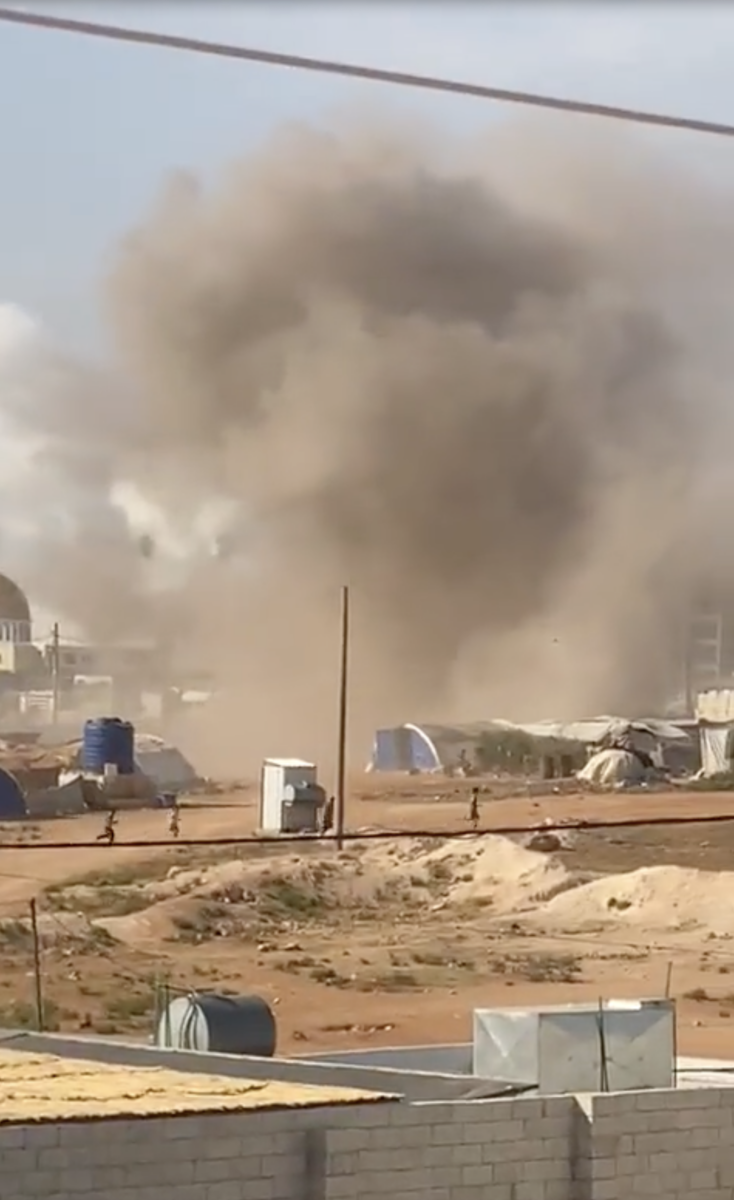
    Footage posted on X on October 8 showed large clouds of white smoke rising above the camp in broad daylight as residents can be seen running and grabbing their belongings.

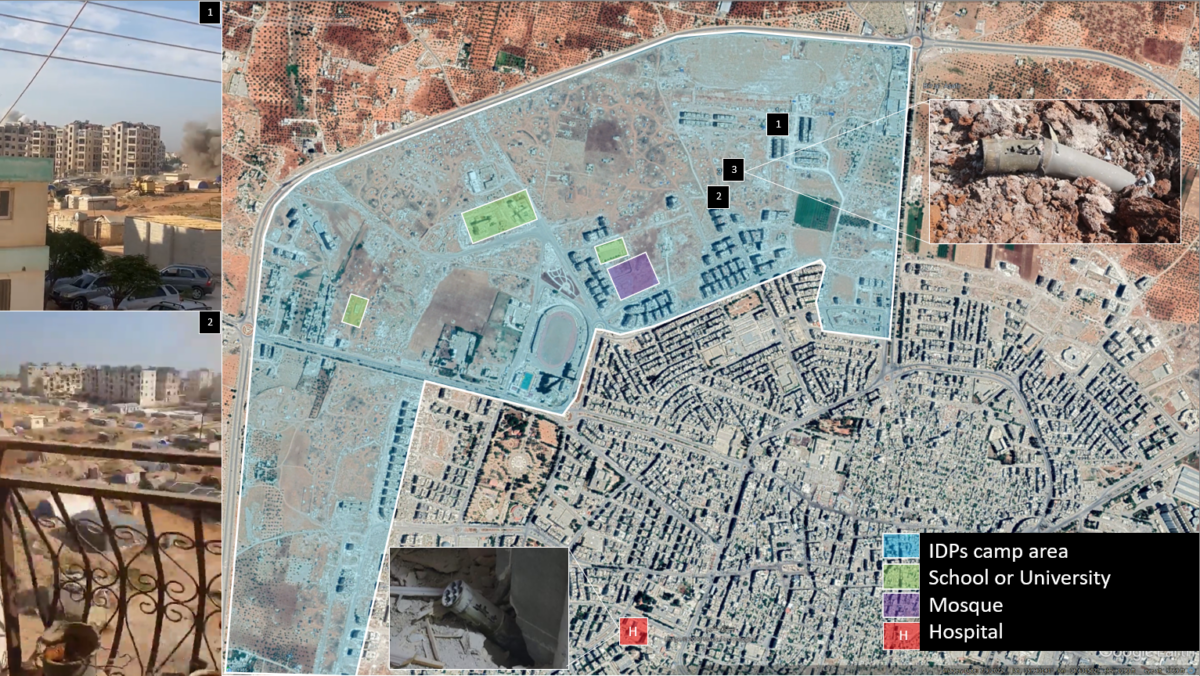
    Bellingcat verified that at least two of these videos were filmed on the northern outskirts of Idlib, a sector with residential buildings, university facilities, schools as well as an IDP camp with people living in tents scattered over an area of approximately 1.5 square kilometres. We also found images of a shell remnant inside the camp.

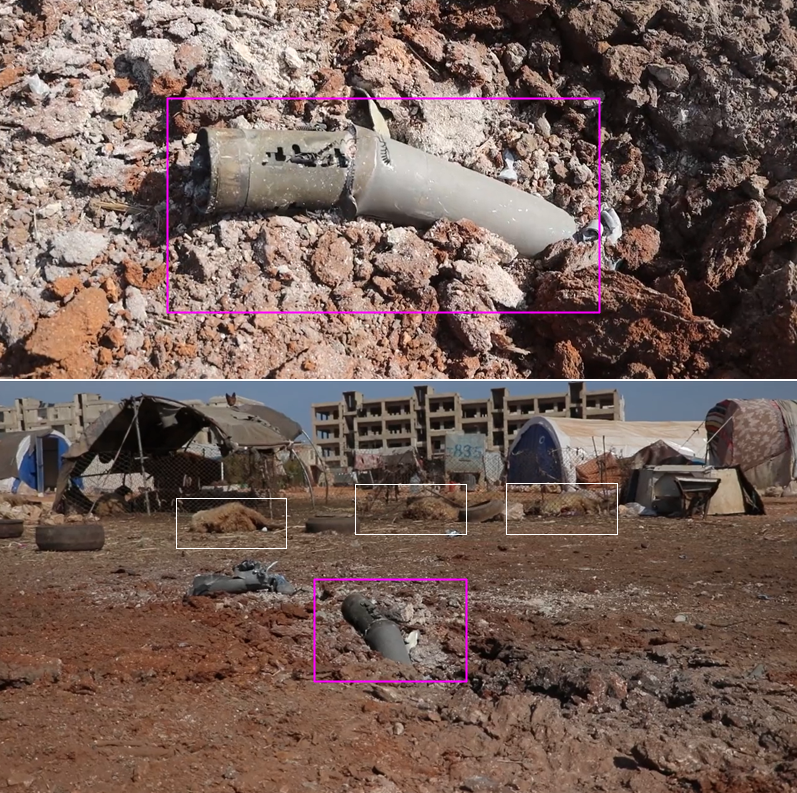
    We examined a series of videos. In video 1 explosions are heard and smoke is seen rising from behind buildings and near a mosque, in video 2 people run and clouds of dust move across the camp. In video 3, posted by The White Helmets, the alleged aftermath of the attack is shown. Several dead animals can be seen near what appears to be a Grad rocket remnant.

    Comparing the three videos, we verified they were all filmed in a sector occupied by the IDP camp at coordinates 35.942382, 36.630046.

    This is not the first time IDP camps in Idlib and the surrounding areas have been shelled. In November last year, the UN noted that shelling had killed civilians and damaged tents.
    School Damaged in Al-Bara

    The town of Al-Bara — located less than 30km south of Idlib — was also allegedly shelled on October 5 damaging a school.

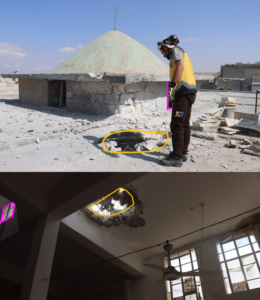
    Bellingcat geolocated imagery from social media showing damage to the school, here 35.683940, 36.540628. There was no recent Google Earth imagery available of the area, so we were not able to identify the damage in the satellite imagery but we were able to use it to help geolocate the site.

    Residential Areas Hit in Ariha

    The October 5 bombardment of Ariha — a town located about 15km south of the city of Idlib — was filmed from a number of angles. Footage and images of the shelling and its aftermath circulated on social media in the days after the attack.

    Bellingcat geolocated five videos from that day, showing the shelling of Ariha from different angles. With this footage we were able to establish residential areas of Ariha were shelled.

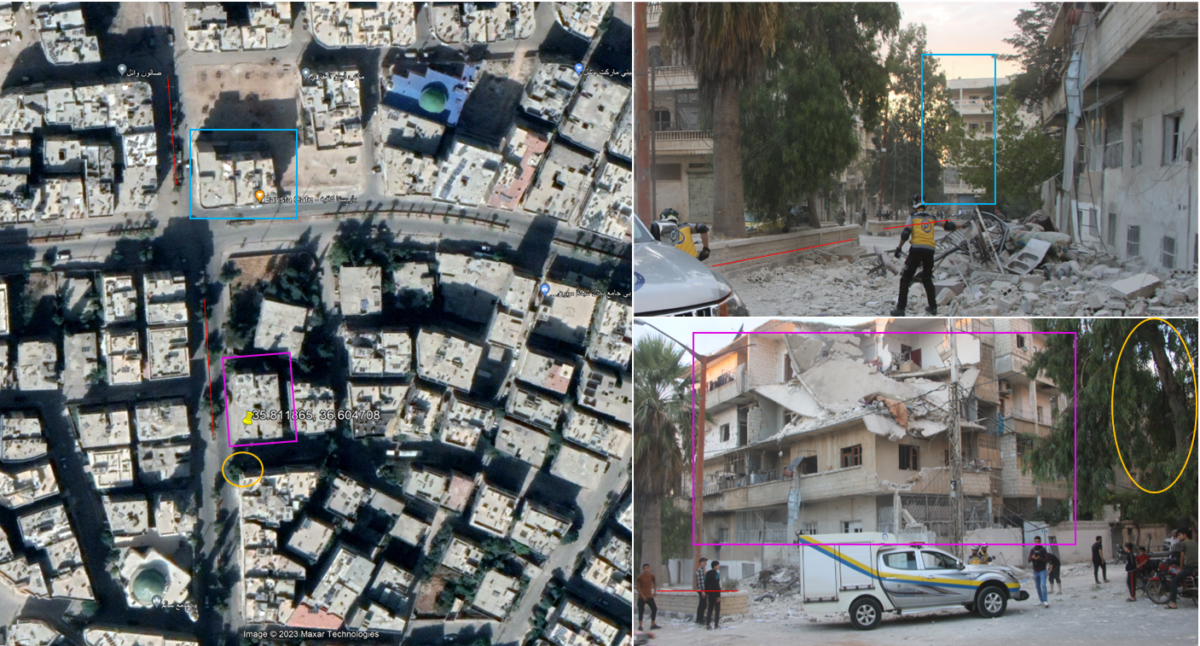
    We geolocated one of the damaged buildings to 35.811865, 36.604708, which matched the area that was shelled the day before. In a photo of the damaged building we can see a washing line on a balcony with clothes hanging from it. Available open source visual evidence indicates this was a residential building.

    Further shelling was reported on October 7, two days after the initial attack. We identified additional damage to residential buildings, including a mosque, located here: 35.812983, 36.613567.

    We were able to geolocate damaged buildings by matching features in footage posted on social media by The White Helmets with Google Earth satellite imagery. The most recent Google Earth imagery of the area was from October last year, so we were not able to identify the damage in the imagery but we were able to use it to help geolocate the site.

    Despite ample evidence of shelling in North-West Syria and the damage it caused, it has received little media coverage.

    In fact, a recent investigation by Bellingcat on misinformation circulating about Israel and Gaza found that footage of previous strikes on Ariha had been misrepresented as depicting strikes on Gaza.

    The death toll from the early October shelling varies, the UN Office for the Coordination of Humanitarian Affairs reported that more than 70 people have been killed in North-West Syria since the escalation on October 5, more than a third of them children.

    At least 349 people have been injured and more than 120,000 people have been newly displaced.

    Since the shelling of early October, the situation in Syria has continued to deteriorate with further shelling, by a variety of groups across the country. Meanwhile, humanitarian groups have warned about the increasing hardships facing more than two million internally displaced people in North-West Syria this winter.
    https://www.bellingcat.com/news/2023/11/24/escalation-in-north-west-syria-civilian-areas-hit-in-renewed-attacks
    #Syrie #guerre #conflits #Idlib #IDPs #déplacés_internes #camps_de_réfugiés #villes #architecture_forensique #Darat_Izza #Termanin

  • Covid-19: Virus ’spiralling out of control’ in Syria’s Idlib, warns charity | Middle East Eye

    Covid-19 is “spiralling out of control” in Syria as hospitals in the country’s northwest run out of oxygen and beds for critically ill patients, a charity has warned.
    Since the pandemic began, Syria has recorded at least 40,000 coronavirus cases, with more than half of reported cases in the country’s northwest, the last major stronghold for armed opposition to the government.

    The pandemic has been compounded further in Idlib, with limited hospitals and medical facilities either damaged or destroyed by Syrian government bombardment.
    Amjad Yamin, from Save the Children’s Syria Response team, said he believed the overcrowded camps and lack of access to water had allowed the virus to spread faster in northwest Syria in comparison to other parts of the country.

    “The reason why the numbers are increasing is because there is no way of containing it in northwest Syria,” Yamin told Middle East Eye.
    “And when you live under 10 years of conflict, people are more worried about the ongoing fighting than the virus and say that they need to escape the fighting.”

    #Covid-19#Syrie#Pandémie#Santé#camp#Idlib#migrant#guerre#réfugiés#migration

    https://www.middleeasteye.net/news/coronavirus-idlib-spiralling-out-control-warns-charity

  • Le nord-ouest de la Syrie démuni face à la Covid-19 - Orient XXI

    Mohamed Akram vit dans le camp de réfugiés Al-Karama, dans la région d’Idlib, non loin de la frontière turque. Adossé à sa mobylette, il attend pendant des heures d’avoir une course pour l’un des villages voisins, et pour laquelle il sera payé 500 livres syriennes (environ 20 centimes d’euro) : « Certains jours sont meilleurs que d’autres, j’arrive alors à gagner 3 000 livres par jour [environ 1,10 euro]. Il s’agit souvent de patients qui ont besoin de se rendre dans un des hôpitaux de la région. » Cette somme ne suffit toutefois pas à nourrir sa famille de huit personnes, et qui vit sous une tente, où elle ne dispose même pas du strict nécessaire.

    #Covid-19#Syrie#Pandémie#Santé#camp#Idlib#migrant#Politique#réfugiés#migration

    https://orientxxi.info/magazine/le-nord-ouest-de-la-syrie-demuni-face-a-la-covid-19,4174

  • In northern Syria, COVID-19 worsens an already dramatic humanitarian crisis - Global Voices

    The ongoing armed conflict in Syria has displaced over 1.6 million people who have fled mostly to the north of the country. The resulting catastrophic humanitarian crisis is now worsened by the impact of COVID-19 in the region.

    In the Idlib region in northern Syria, residents already endure drastic conditions on a daily basis. Although Idlib has confirmed only one case of COVID-19 in July, many factors contribute to rising tensions, one of which is the continuing and deliberate violence inflicted on Idlib’s vital infrastructure by the Syrian-Russian military alliance which has completely destroyed its health sector.

    According to Human Rights Watch, “northern Syria is not at all ready to face the ‘COVID-19′ pandemic.”

    Hani al-Hariri, an activist from southern Syria now living in Idlib, told Global Voices that the situation could be catastrophic if COVID-19 reaches northern Syria, where displaced people barely have access to basic needs, including health care, water, and food, making social distancing and hygiene almost impossible to maintain.

    #Covid-19#Syrie#camp#Idlib#Santé#réfugiés#déplacés#migration#quarantaine
    https://globalvoices.org/2020/07/30/in-northern-syria-covid-19-worsens-an-already-dramatic-humanitarian-cr

  • Idlib cannot be left alone to deal with Covid-19 - The national

    It was always a matter of time. Late last week, the first coronavirus case was discovered in Idlib, a province in Syria bordering Turkey where hundreds of thousands are living in crowded refugee camps after fleeing war. Without urgent measures to contain any potential outbreak, it could spell disaster for one of the most vulnerable communities in the world.

    News of the first infection emerged last Thursday, and by Tuesday the number of confirmed cases had risen to four, including two in Idlib and two in opposition areas in rural Aleppo. All, according to the UN’s Office for the Co-ordination of Humanitarian Affairs (OCHA), are healthcare workers, which means it is likely that they were in contact with patients who visited their clinics or hospitals. They are all currently in isolation and contact tracing is under way to see who else may be infected.

    Aid workers have long warned of the dangers of an outbreak in a place like Idlib and the devastating effects it could have. To understand the risks, we need to take a step back and examine the situation as a whole.

    https://www.thenational.ae/opinion/comment/idlib-cannot-be-left-alone-to-deal-with-covid-19-1.1049499

    #Covid-19#Syrie#camp#Idlib#Santé#réfugiés#déplacés#migration#quarantaine

  • Syrian Kurds Alarmed Over UN Security Council Vote on Aid - Voices of America

    Kurdish officials in northeast Syria are expressing disappointment following a vote by the United Nations Security Council that failed to address “the deteriorating humanitarian situation” in that part of the war-torn country.

    The U.N. Security Council on Saturday approved a resolution authorizing an international program that will deliver aid to the rebel-held northwest Syrian province of Idlib through one border crossing.

    However, the majority of the council, including the U.S., wanted to reopen another border crossing with Turkey and a third on Syria’s northeast border with Iraq in order to get aid to an estimated 1.3 million Syrians in need of medical supplies

    #Covid-19#Syrie#Rojava#Idlib#Turquie#Frontière#aide_internationale#Politique_internationale#ONU#migrant#migration

    https://www.voanews.com/extremism-watch/syrian-kurds-alarmed-over-un-security-council-vote-aid

  • Syrie : un premier cas de Covid-19 recensé dans la région d’Idleb - L’express

    Cette région abrite quelque trois millions de personnes, dont beaucoup vivent dans la promiscuité des camps de déplacés.

    Un premier cas de nouveau coronavirus a été officiellement enregistré jeudi dans le nord-ouest de la Syrie, a indiqué une responsable de l’opposition, ravivant les craintes d’un désastre si l’épidémie atteint les camps de réfugiés du bastion rebelle. « Nous regrettons aujourd’hui d’annoncer le premier cas de coronavirus, un soignant travaillant dans un des hôpitaux » de la province d’Idleb, a déclaré un responsable de la santé dans la région, Maram al-Cheikh.

    #Covid-19#Syrie#camp#Idlib#Santé#réfugiés#déplacés#migration#quarantaine

    https://www.lexpress.fr/actualite/monde/proche-moyen-orient/syrie-un-premier-cas-de-covid-19-recense-dans-la-region-d-idleb_2130544.htm

  • Lack of aid increase suffering of IDPs in Ataa al-Khair camp in Syria’s Idlib - NPA syria

    The absence of relief support is the most suffering of the Syrian IDPs living in Ataa al-Khair camp in Syria’s western Idlib countryside, especially those with chronic diseases, camp manager said on Monday.
    Abu Ahmed al-Ladqani, the camp manager, told North Press the aid organizations didn’t operate for a long time, and the last aid provided to the IDPs was two months ago.
    “There are no relief projects to help the IDPs in our camp, but only some local organizations come to distribute relief to the camps in our area,” he said.
    Ataa al-Khair camp houses about 760 families, who need the simplest elements of daily life, according to the camp manager.

    #Covid-19#Syrie#camp#Idlib#Santé#réfugiés#déplacés#migration#quarantaine

    https://npasyria.com/en/blog.php?id_blog=2791&sub_blog=12&name_blog=Lack%20of%20aid%20increase%20s

  • Separated by coronavirus, displaced Syrian family celebrates Eid via video call -Middle East Eye VIDEO
    Maryam Kaddour, who lives in an Idlib displacement camp, used a video call to celebrate Eid with her son Shadi who works in Turkey to provide for the family

    #Covid-19#Syrie#Turquie#Idlib#Ramadan#Transnationalisme#Pratique#Pandémie#Santé#migrant#migration

    https://youtu.be/IMrgCgdEt4s


    https://www.middleeasteye.net/video/separated-coronavirus-displaced-syrian-family-celebrates-eid-video-ca

  • Syrian government lifts nightly curfew despite uptick in coronavirus cases - Al Monitor

    The Syrian government will do away with the overnight curfew imposed in March despite a surge in reported cases of the coronavirus.

    The Syrian Ministry of Health today announced 15 new COVID-19 cases in areas under government control, bringing the total number of cases to 121 and a death toll of four. All of the new cases were among Syrians returning from abroad, including nine from Kuwait. Experts have questioned the regime’s relatively low numbers, but Damascus has denied all charges of a cover-up.

    #Covid-19#Syrie#Zone_régime#Idlib#Rojava#Déconfinement#Société_civile

    https://www.al-monitor.com/pulse/originals/2020/05/syria-coronavirus-curfew-uptick-cases-damascus-idlib.html

  • Coronavirus testing shortfall in crisis-affected states risks undetected outbreaks, imperilling COVID-19 fight worldwide - Inernational Rescue Committee

    New data shows countries with lowest number of tests per million include Yemen (31 tests per million), Nigeria (165 tests per million), and Northeast Syria (59 tests per million).
    Of additional concern to IRC are crisis-affected countries for which data is either incomplete, inconsistent or absent entirely, such as Yemen, Tanzania, and Syria - which makes tracking the spread of the virus, particularly amongst the world’s most vulnerable, all the more challenging

    traduire

    #Covid-19#Syrie#camp#Idlib#Test#Santé#réfugiés#déplacés#migration#quarantaine
    https://www.rescue.org/press-release/irc-coronavirus-testing-shortfall-crisis-affected-states-risks-undetected-ou

  • Recent Developments in Northwest Syria - Situation Report No. 14 - As of 15 May 2020- OCHA report Syria Reliefweb

    No cases of COVID-19 have been identified in northwest Syria, with 596 samples tested as of 13 May, of which 594 returned negative results and two results are pending. A laboratory in Idleb with a capacity of 100 tests per day remains instrumental in testing samples of potential cases of COVID-19. In some cases, samples from northwest Syria are sent to laboratories in Turkey for testing. To date, 304 triage tents have been distributed or installed in northwest Syria and 104 hospitals and primary health centres (PHC) have enacted COVID-19 triage systems. Four hospitals with intensive care units are operational to receive severe cases of COVID-19 and two community-based isolation (CBI) centres are operational to isolate mild to moderate cases.
    The Bab Al-Hawa and Bab Al-Salam border crossings between Syria and Turkey remain open to humanitarian and commercial traffic, while several other points of entry in northwest Syria are also partially open. Monitoring, infection prevention and control (IPC) and referral measures reportedly continue to be implemented at cross-border and cross-line points. In northwest Syria, humanitarian partners continue to operate under measures intended to mitigate against the potential spread of COVID-19. These include adapted modalities to deliver assistance while minimising face-to-face contact, virtualisation of meetings and activities, and awareness raising efforts on COVID-19 risks and precautions conducted online.

    #Covid-19#Syrie#camp#Idlib#Santé#réfugiés#déplacés#migration#quarantaine

    https://reliefweb.int/report/syrian-arab-republic/recent-developments-northwest-syria-situation-report-no-14-15-may-2020
    https://reliefweb.int/sites/reliefweb.int/files/resources/nw_syria_sitrep14_20200514.pdf

  • The Jihadi-Backed Salvation Government and Covid-19 in Northwest Syria - ISPI Online

    While many that research jihadism have focused on how the Islamic State (IS) has responded to the coronavirus pandemic, IS no longer actually controls territory in Iraq or Syria. Therefore, at best all they can do is provide guidance. In contrast, the jihadi group Hayat Tahrir al-Sham (HTS), which backs the local Salvation Government (SG) in parts of northern Idlib and western Aleppo, has to actually deal with the consequences of the pandemic since there are more than 4 million people living under its control, with more than two million of them being IDPs (internally displaced people). It also provides a unique window into the alternative type of governing style HTS has compared to IS’s totalitarian vision. Even if the SG has attempted to do something to prevent coronavirus from overtaking the population in its area of control, problems related to a devastated health system and inability to truly implement measures that would limit the spread of the disease makes the prospects extremely dire when the coronavirus hits the vulnerable civilian population.

    #Covid-19#Syrie#Politique_locale#Gouvernementalité#Islamisme#IDP#Idlib#migration#quarantaine

    https://www.ispionline.it/it/pubblicazione/jihadi-backed-salvation-government-and-covid-19-northwest-syria-26152

  • Radical group hinders return of displaced Syrians to Idlib- Al Monitor

    https://www.al-monitor.com/pulse/originals/2020/04/syria-idlib-crossings-hayat-tahrir-al-sham-displaced.html

    In a statement issued April 16, the RCG called on the displaced returning to their homes to be cautious during their journey and watch out for any remnants of war and destroyed buildings that could collapse.

    The organization called on humanitarian organizations to work on resuming their activities in the areas that have begun to see the return of IDPs and to provide basic services. On April 20, the RCG released statistics documenting the return of 36,267 displaced families to their villages and towns in the countrysides of Aleppo and Idlib.

    #Covid-19#Syrie#Idlib#Camp#Déplacés#Guerre#Cessez-le-feu#migrant#migration#Insécurité

  • Coronavirus : Des Syriens de retour de Turquie sont placés en quarantaine dans un centre à Idleb - Orange actu
    Des Syriens rapatriés de Turquie sont placés dans un centre de quarantaine à l’ouest de la province rebelle d’Idleb pour 14 jours afin d’éviter une propagation de l’épidémie de Covid-19 VIDEO
    #Covid-19@migrant#migration#camp#centrequarantaine#Syrie#Idlib#Video

    https://actu.orange.fr/monde/videos/coronavirus-des-syriens-de-retour-de-turquie-sont-places-en-quarantaine-

  • Return of 200,000 displaced people to their areas in Idlib and Aleppo - North Press Agency
    The Response Coordinators Team published a statement on the numbers of returnees from areas of displacement to their towns and villages in the two governorates of Aleppo and Idlib, in which it revealed the return of 40,015 families, which is equivalent to 216,198 people, at a rate equivalent to 20.79% of the number of IDPs since the beginning of the ceasefire agreement on the 5th of last March.
    #Covid-19#Syrie#Idlib#Camp#Déplacés#Guerre#Cessez-le-feu#migrant#migration#santé

    https://npasyria.com/en/blog.php?id_blog=2384&sub_blog=12&name_blog=Return+of+200%2C000+displaced+

  • Coronavirus en Syrie : fuir les camps pour échapper au Covid-19 - TV5Monde
    L’ombre du coronavirus plane dans les camps de déplacés en Syrie. Certains ont donc décidé de rentrer chez eux pour échapper à la promiscuité des camps favorable au virus.
    #Covid-19@migrant#migration#camp#centrequarantaine#Syrie#Idlib#Video

    https://information.tv5monde.com/video/coronavirus-en-syrie-fuir-les-camps-pour-echapper-au-covid-19

  • WhatsApp classes in Northwest Syria -Middle East Eye
    A group of teachers in Idlib camps are using WhatsApp groups to keep classes running for displaced children, after tent schools were closed to prevent the spread of coronavirus.VIDEO

    #Covid-19@migrant#migration#camp#populationsdéplacées#educations#centrequarantaine#Syrie#Idlib#Video

    https://youtu.be/72sB7DokKZw


    https://www.middleeasteye.net/video/whatsapp-classes-northwest-syria