• La réforme de l’enseignement supérieur au #Japon
    ▻https://laviedesidees.fr/La-reforme-de-l-enseignement-superieur-au-Japon

    En 2020, le gouvernement japonais a décidé de créer les « University for #International Research Excellence » (UREX), dotées de moyens importants. Objectif : créer des pôles d’excellence en matière d’innovation scientifique et technologique, capables de rivaliser avec leurs homologues dans le monde.

    #éducation #université #réforme #enseignement

  • À l’instar de Google Street View, Google en moins, TINA Street de la
    revue TINA en ligne scanne la ville au ras des rues.
    Aujourd’hui : la ruelle Ukiyo-koji, à Osaka, au Japon

    ▻https://revuetina.editionsjou.net/341-tina-street-9-pierre-menard

    ▻https://youtu.be/cVydsxHXlWc?si=8UkxpGAaaUWXGQtB

    La ruelle Ukiyo-koji se trouve au cœur de Dōtonbori, dans le sud d’Osaka, à quelques mètres du canal. À proximité de l’une des rues les plus animées et touristiques de la ville, connue pour ses restaurants, ses enseignes lumineuses. Pourtant, dès que l’on entre dans cette petite ruelle, l’ambiance change complètement. Le bruit semble s’éloigner.

    (...) #Vidéo, #Architecture, #Histoire, #Osaka, #Japon, #Voyage, #Ville (...)

  • #Journal du regard : Octobre 2026

    ▻https://liminaire.fr/chronique/journal/article/journal-du-regard-octobre-2026

    ▻https://www.youtube.com/watch?v=8XUUuhwez6c

    Chaque mois, un film regroupant l’ensemble des images prises au fil des jours, le mois précédent, et le texte qui s’écrit en creux. « Une sorte de palimpseste, dans lequel doivent transparaître les traces - ténues mais non déchiffrables - de l’écriture “préalable” ». Jorge Luis Borges, Fictions

    (...) #Journal, #Vidéo, #Architecture, #Écriture, #Voix, #Sons, #Mémoire, #Paysage, #Ville, #Journal_du_regard, #Regard, #Dérive, #Photographie, #Nature, #Tokyo, #Osaka, #Japon, #Voyage, #Automne, #Campagne, #Jardin (...)

  • Mort d’Hitler : les nouvelles révélations russes - YouTube
    ▻https://www.youtube.com/watch?v=C-YteQelk-0

    2018 ; je n’ai pas souvenir d’avoir eu connaissance de ces détails
    (les bouquins de Philippe Charlier se lisent comme des romans…)

    429 690 vues 11 oct. 2026 #clhebdo
    Le médecin légiste Philippe Charlier a analysé les restes de figures historiques comme Richard Cœur de Lion, Henri IV ou Napoléon (récits réunis dans Autopsie des cœurs célèbres, éd. Tallandier).
    En 2017, avec Jean-Christophe Brisard, il accède au siège du FSB pour examiner la mâchoire attribuée à Hitler. Staline, lui, a volontairement semé le doute sur sa mort.

    Extrait de l’émission C l’hebdo du 17 mars 2018

  • Pour rétablir la sécurité et la dignité

    Présentation du modèle nordique par Masako Gunji, traduite du japonais. Ce texte a été mis en ligne sur « X » par le groupe Sex Industry Research.

    Un article récent de Kana Mitarashi dépeint avec minutie les réalités complexes du trafic sexuel sous l’angle de la psychologie clinique. Je suis profondément touchée par son approche qui consiste à écouter la voix de celles et ceux qui vivent cette situation au quotidien, ainsi que par sa description des traumatismes, des reviviscences, du cycle de la pauvreté et de la violence. J’ai moi-même récemment apporté mon soutien à des personnes confrontées à la question cruciale de leur survie. C’est pourquoi je partage pleinement le message central de cet article : « La sécurité avant tout ». Cependant, la conclusion qu’en tire Madame Mitarashi me laisse perplexe.

    L’idée que le trafic sexuel devrait être toléré si l’on respecte « l’autodétermination » des personnes peut sembler bienveillante, mais elle est en réalité très dangereuse.

    ▻https://entreleslignesentrelesmots.wordpress.com/2026/10/14/pour-retablir-la-securite-et-la-dignite

    #feminisme #prostitution #japon

  • Lecture d’un extrait du livre « Une prière pour John Coltrane » de Jérome Schmidt, publié aux éditions Noir sur blanc, collection Notabilia, en 2026.

    ▻https://liminaire.fr/creation/radio-marelle/article/une-priere-pour-john-coltrane-de-jerome-schmidt

    John Coltrane entame sa première et unique tournée de concerts au Japon, en juillet 1966, quelques mois avant sa mort. Dans ce pays encore hanté par le traumatisme de la guerre, sa musique libre et spirituelle rencontre immédiatement l’adhésion du public. On peut l’écouter notamment dans les jazzkissa, ces cafés jazz emblématiques du Japon, tenus par des collectionneurs, gardiens du temple souvent octogénaires, lieux encore fréquentés cependant par une nouvelle génération. Jérôme Schmidt livre une enquête exploratoire de ces lieux, entre Hokkaido et Okinawa, en passant par Nagasaki, pour sonder la mémoire collective d’un peuple, son rapport au jazz, à cette musique intemporelle, à travers la figure de Coltrane.

    (...)

    #Radio_Marelle, #Écriture, #Livre, #Lecture, #En_lisant_en_écrivant, #Podcast, #Littérature, #Musique, #Jazz, #Japon, #Café, #Parole, #Récit (...)

    ▻https://liminaire.fr/IMG/mp4/en_lisant_une_prie_re_pour_john_coltrane_jerome_schmidt.mp4

    ▻https://www.leseditionsnoirsurblanc.fr/catalogue/une-priere-pour-john-coltrane

  • Hitler, Fachwerk, Dragonballs
    ▻https://www.nd-aktuell.de/artikel/1202663.deutschland-in-der-japanischen-popkultur-hitler-fachwerk-dragonba


    Egal, ob Frau mit riesigen Kulleraugen oder Mann mit hässlichem Schnauzer, böse bleibt böse. Foto: Mag Garden

    22.9.2026 von Martin Seng - Die japanische Popkultur hat nicht nur ein schwieriges Verhältnis zum eigenen Land. Auch das historische Deutschland wird oft romantisiert.

    Er scheint überall aufzutauchen: Im Animefilm »Dragon Ball Z: Fusion Reborn« spaziert er persönlich aus dem Höllentor, in »Lupin III: The First« konnte er angeblich nach Südamerika fliehen, und in der Serie »Petals of Reincarnation« kehrt er als kleines japanisches Mädchen wieder, wenn auch mit denselben mörderischen Absichten. Adolf Hitler ist eine Konstante innerhalb der japanischen Manga- und Anime-Landschaft. Der ultimative Bösewicht, der gar nicht erst als solcher vorgestellt werden muss, weil er allen ein Begriff ist. Doch Hitler ist nicht das einzige deutsche Erbe, das man regelmäßig in japanischer Popkultur, vor allem in Manga- und Anime-Serien wiederfindet: Fachwerkhäuser in »Attack on Titan«, Schopenhauer-Zitate in »Neon Genesis Evangelion«, historische Gebäude aus Kaiserreichszeiten in »Fullmetal Alchemist«, »A Little Snow Fairy Sugar« und den beliebten Studio-Ghibli-Filmen. Doch die Romantisierung des historischen Deutschlands wird spätestens mit einem Blick auf die deutsch-japanische Vergangenheit unheimlich.

    Die beiden Nationen waren lange vor ihrer Verbrüderung als Achsenmächte miteinander verbandelt. Weit vor dem 20. Jahrhundert waren sie bereits durch den Handel verbunden und während seiner wirtschaftlichen Öffnung, der sogenannten Meiji-Restauration, nahm sich das japanische Kaiserreich das deutsche zum Vorbild. Als das Bürgerliche Gesetzbuch in Deutschland 1900 in Kraft trat, übernahm Japan dieses, preußische Soldaten bildeten das dortige Militär aus und in der Vorkriegszeit lieferte der Inselstaat aus seinen besetzten Ländern umfassende Ressourcen in das Dritte Reich. Dass beide Nationen aggressive Großmachtambitionen hatten und sich dank der räumlichen Distanz nicht in die Quere kamen, führte 1936 zu deren Schulterschluss.

    Selbstkritische Filme, reale wie animierte, muss man mit der Lupe suchen. Stattdessen werden Verbrechen geleugnet, relativiert oder revidiert.

    Diese blutige, auf Rassismus und Kolonialismus fußende Allianz findet in der japanischen Anime- und Manga-Szene nur wenig Beachtung. Zwar lassen sich durchaus militär- und kriegskritische Titel finden (allen voran »Wie der Wind sich hebt« und »Adolf«), eine Ausnahme bleiben sie trotzdem. Selbst wenn Werke wie »Die letzten Glühwürmchen« und »Barfuß durch Hiroshima« den Zweiten Weltkrieg direkt thematisieren, bleiben sie auffallend oft bei dem eigenen Leid und den Auswirkungen der Atombomben.

    Auch im Westen sind der japanische Faschismus, seine Massenmorde im Südosten Chinas sowie der Kolonialismus in Korea und anderen ostasiatischen Ländern kein häufiges Gesprächsthema. Die Schemen der Gräuel sind bekannt, ihr Ausmaß und wie es heutige politische Linien beeinflusst, dagegen kaum. Dabei sorgen das Massaker von Nanking, die Trostfrauen und Hunderttausende Menschenversuche der Einheit 731 bis heute für Diskussionen in mehreren asiatischen Ländern, während sich Japan gegen eine politische wie kulturelle Aufarbeitung der eigenen Historie stellt.

    Verglichen mit Deutschland, das sich in jedem Medium und mit schwankendem Erfolg mit dem Holocaust und der eigenen Kriegsschuld auseinandergesetzt hat, sieht die japanische Vergangenheitsbewältigung anders aus. Selbstkritische Filme, reale wie animierte, muss man mit der Lupe suchen. Stattdessen werden Verbrechen geleugnet, relativiert oder revidiert.

    Animes und Mangas sind ebenso Ausdruck kultureller Soft Power wie es James Bond für Großbritannien, und in zweiter Instanz die westlichen Werte waren, die er zu Zeiten des Kalten Krieges auch auf der Leinwand gegen die Sowjetunion verteidigte.

    Besonders auffallend ist aber die wiederkehrende Romantisierung von Deutschland, speziell der Kaiserzeit, obwohl die Bundesrepublik nicht einmal der größte Absatzmarkt für die Industrie ist und hinter Nordamerika, China und Indien zurückliegt. Trotzdem sind Fachwerkhäuser, wilhelminischer Baustil und deutsche Charakternamen zu etwas Alltäglichem geworden. Animes wie »Elfen Lied«, »Frieren« und »Weiß Kreuz« setzen die deutschen Worte gleich in den Titel. Und »Legend of the Galactic Heroes« (im japanischen Original noch grammatikalisch falsch als »Heldensagen vom Kosmosinsel« betitelt) aus den 1980ern lässt in großen Raumschlachten Namen wie Reinhard von Lohengramm, Rudolf von Goldenbaum und Lord Braunschweig aufeinandertreffen.

    Mit dieser ständigen Präsenz deutscher Identität geht eine Romantisierung einher, eine Überhöhung der historischen Kaiserzeit. In Animes und Mangas lernt das Publikum diese nur durch Postkartenmotive kennen, nicht aber durch seinen Autoritarismus und die Kolonialherrschaft. Als Destillat bleiben nur deutsch klingende Namen, ansehnliche Altbauten und die Impression einer »guten alten Zeit«. Die Welten werden zwar nicht direkt als Deutschland oder Kaiserreich bezeichnet, dafür aber mit verräterischen Namen wie »Germania« in »Izetta: The Last Witch«. »Monster« ist eine der wenigen Ausnahmen, spielen der Manga und seine Verfilmung doch in den deutschen 1990ern, in Düsseldorf und Heidelberg mitsamt Edeka-Schild. Im starken Kontrast zu den sonstigen schön gefärbten Blicken auf Deutschland sieht man hier eine kalte, abweisende Bundesrepublik und den Aufstieg des Neonazismus. In Serien wie »Hellsing« und »JoJo’s Bizarre Adventure« tauchen zwar auch Nazis auf, doch nur als hoffnungslos überzeichnete, bis zur Unkenntlichkeit karikierte Antagonisten.

    Natürlich romantisieren sich Länder oft mit ihrer jeweiligen Kultur, nicht zuletzt aus wirtschaftlichen Gründen. Doch es ist bezeichnend, dass die japanische, in diesem Fall gezeichnete Kulturindustrie einen so starken Bezug auf das historische Deutschland hat. Unter Freund*innen der japanischen Popkultur gibt es seit Langem die Diskussion, wie man diese Nibelungentreue werten soll. Ist es aktiver Geschichtsrevisionismus, antiquierte Verbundenheit oder doch Propaganda? In den meisten Fällen reicht der Befund der kulturellen Osmose, durch die Japan über mehrere Epochen hinweg deutsches Kulturgut aufgesogen und in seine Kulturindustrie integriert hat. Während Animes und Mangas ein romantisches Deutschland zeigen und mit einem wiederkehrenden Hitler-Gespenst gleichzeitig jede Anklage der Glorifizierung von sich weisen können, bleibt der fade Beigeschmack historischer Nostalgie.

    Trotz der bewusst verengten Darstellung deutscher Geschichte kann man das Schauen und Lesen von Animes und Mangas nicht durchweg kritisieren. Zwar weisen beide wie ihr Entstehungsland allzu oft ein antiquiertes Frauenbild auf, das delegitimiert aber nicht die Kunstform an sich. Gleiches gilt für die Romantisierung des Deutschtums. Trotzdem wäre mehr Kritik am historischen Deutschland auch in gezeichneter Form wünschenswert.

    #bande_dessinée #Japon #histoire #politique

  • Eine episodenhafte Darstellung der Geschichte der Samurai
    ▻https://www.djg-berlin.de/events/eine-episodenhafte-darstellung-der-geschichte-der-samurai-ein-vortrag-von

    Conférence remarquable par sa déscription du culte de la mort, l’essence du bushido, et de son rôle de précurseur de l’idéologie fasciste du Japon au viengtième siècle. Le très discret Hiroomi Fukuzawa ne le mentionne pas explicitement mais cette idée s’impose à chacun avec quelques notions du rôle du Japon au siècle dernier. Malheureusement à ce jour il n’y a pas encore de documentation publique du texte de la conférence.

    Vortrag von Dr. Hiroomi Fukuzawa

    Der Begriff „Samurai“ weckt sofort Assoziationen mit Japan – fast, als wäre er ein Synonym für „Japaner“. Diese Verbindung besteht bis heute: Die Fußballnationalmannschaft heißt „Samurai Blue“.

    „Samurai“ bedeutet ursprünglich „bewaffneter Diener“ und geht auf die Heian-Zeit (ca. 794–1192) zurück, in der sie dem Adel und dem Kaiserhof dienten. Später setzte sich die Bezeichnung „Bushi“ durch – Krieger, die lokalen Warlords unterstanden. Sie dominierten Japans Politik und Militär rund 700 Jahre – vom 12. Jh. bis zu 1868.

    Diese Herrschaft lässt sich in zwei Phasen gliedern: bis 1600 und die anschließende Edo-Zeit (1603–1868). Tokugawa Ieyasu, Begründer dieser Epoche, führte Maßnahmen zur Friedenssicherung ein. Während dieser 260 Jahre herrschte weitgehend Frieden. Die Bushi verloren ihre Rolle als Krieger und wurden zu Verwaltungsbeamten.

    Trotz dieses Wandels blieben sie in ihrer Selbstwahrnehmung Krieger. Ihr Verhältnis zum Tod zeigt sich in der Praxis des Seppuku (ritueller Suizid durch Bauchaufschlitzen) – zur Wahrung der Ehre oder aus Verantwortungsgefühl. Nach rund 250 Jahren Isolation wurde Japan 1854 durch die „Schwarzen Schiffe“ zur Öffnung gezwungen. 1868 rief der Meiji-Tennō die Modernisierung Japans aus. Das Erbe des Edo-Systems spielte dabei eine wichtige Rolle. Viele ehemalige Samurai übernahmen Aufgaben in der neuen Verwaltung. Die Modernisierung nach westlichem Vorbild gelang schnell, doch mit wachsender Überheblichkeit – besonders im Militär. Japans Aufstieg zur Großmacht endete tragisch. Nach der Kapitulation begingen der Heeresminister Anan und mehrere Offiziere Seppuku.

    Dr. Hiroomi Fukuzawa lebt seit 1967 in Deutschland. Er hat an der FU Berlin Philosophie studiert und an dieser Alma Mater auch im Jahre 2003 seine Promotion mit dem Titel „Samurai und Geld“ erworben. Von 1976 bis 2008 war er als Akademischer Rat und Lektor in der Japanologie der FU-Berlin tätig.

    Zeit: Montag, 27.10.2025 um 18:00 Uhr

    Ort: JDZB, Saargemünder Str. 2, 14195 Berlin

    #Japon #samouraïs #histoire

  • This is nothing more than corruption imposed by vassalage, selling still F-35 Fighters ...

    via ▻https://diaspora.psyco.fr/p/12697991

    oAnth:

    Ad nauseam!

    Asymmetric warfare, such as that waged i.e. by Iran, clearly demonstrates that high technology in the defense sector can no longer be dominated by centrally supported traditional carrying systems.

    #NATO #USA #Germany #vassalage #corruption #China #India #BRICS #SCO #Japon #Coree #Asia #EU #BlackRock

    –----------------------

    ♲ Mario Nawfal - 2026-09-03 19:50:00 GMT

    cf. ▻https://x.com/MarioNawfal/status/2095600214891458633

    🇺🇲🇩🇪 Hegseth has changed his mind about meeting Germany’s defense minister.Boris Pistorius and Def. Sec. Hegseth are getting together in Washington on September 15.

    Hegseth had previously snubbed a meeting with Pistorius.

    The meeting coincides with the latter’s trip to Texas for a rollout ceremony marking the delivery of Germany’s first F-35 fighter jets.

    Despite stained relations, the two countries can agree on one thing…

    It’s good to make friends over fighter jets.

    Source: Politico, @clashreport / Writer: Marie

  • Forum économique de l’Est : les satellites asiatiques de l’Occident passent du côté de la Russie

    ▻https://diaspora.psyco.fr/p/12692554

    ▻https://stratpol.com/forum-economique-de-lest-les-satellites-asiatiques-de-loccident-passent-du 2026-08-30

    ▻https://reseauinternational.net/forum-economique-de-lest-les-satellites-asiatiques-de-loccident

    par Andreï Belobor

    Du 1er au 4 septembre, le Forum économique de l’Est se tiendra à #Vladivostok, en #Russie — une plateforme internationale majeure permettant à la Russie de développer ses relations commerciales avec les pays de la Grande Asie. Le président Vladimir Poutine devrait y accueillir le président indonésien Prabowo Subianto, le premier ministre mongol Nyam-Osor Uchral, le vice-président du Myanmar (Birmanie) Nyo Saw et le vice-premier ministre du Conseil des affaires d’État chinois Ding Xuexiang. Ces rencontres de haut niveau seront précédées par de grandes sessions d’affaires consacrées aux relations « Russie-Chine », « Russie-Inde » et « Russie-Association des nations de l’Asie du Sud-Est ».

    [...]

    • [...]

      Anton Kobyakov, secrétaire du comité d’organisation du Forum économique de l’Est, a précisé que des représentants de plus de 70 pays avaient confirmé leur participation, en soulignant notamment deux États qui sont officiellement alliés aux États-Unis et donc considérés comme « inamicaux » par la Russie. Il s’agit du Japon et de la Corée du Sud. La participation de ces deux puissances d’Asie de l’Est au forum russe organisé en Extrême-Orient a provoqué une vague d’indignation en Occident. Car dans la presse européenne, le mythe selon lequel « la Russie est isolée » et son économie « mise en pièces par la guerre » reste encore très répandu.

      Pourtant, les analystes qui gardent la tête froide comprennent parfaitement la situation. Il y a peu, le premier porte-conteneurs sud-coréen PanStar Acro est entré dans l’Arctique russe. Selon Reuters, le navire marchand longera les côtes russes, traversera la mer de Béring et empruntera la route maritime du Nord. Le PanStar fera escale à Felixstowe, au #Royaume-Uni, à Rotterdam, aux #Pays-Bas, et à Gdańsk, en #Pologne, avant de retourner en Corée du Sud. L’ensemble du trajet prendra environ 45 jours.

      À ce sujet, le chroniqueur politique tchèque Štěpán Hobza souligne dans Lidovky :

      « Faire participer la Corée du Sud à cette autoroute maritime arctique est avant tout un succès parce qu’elle est un allié des États-Unis, qui, dans ce cas précis, entrent dans une zone d’influence exclusivement russe ».

      Selon l’analyste tchèque, si les modèles climatiques des scientifiques se confirment et que la situation actuelle, fragile sur le plan de la sécurité dans l’océan Austral, se maintient, « Moscou se retrouvera en position favorable ».

      « La Russie est le seul État au monde à posséder une flotte de brise-glaces nucléaires et considère l’Arctique comme sa patrie depuis le milieu du XVIIIe siècle », constate Hobza.

      Après la Corée du Sud, le Japon a lui aussi « oublié » ses différends avec la Russie, y compris sur la très sensible « question des #Kouriles » pour Tokyo. La raison est simple : le Japon dépend de livraisons cruciales de #GNL / #LNG russe et ne peut pas facilement rompre sa coopération avec la Russie. Un exemple révélateur s’est produit le 23 août, lorsque le premier ministre ukrainien Sergueï Koretski a exprimé l’espoir d’obtenir le soutien du Japon pour la livraison de missiles intercepteurs destinés à la défense antiaérienne. Mais la première ministre japonaise Sanae Takaichi n’a rien répondu. La Corée du Sud est elle aussi restée silencieuse. Le média chinois spécialisé dans les questions militaires Sohu commente ainsi ce qui se passe à Tokyo et à Séoul :

      « Le Japon et la Corée du Sud font preuve de prudence lorsqu’il s’agit d’aider Kiev dans le contexte géopolitique instable actuel. Si Tokyo avait accepté la demande de Kiev, cela aurait sans aucun doute provoqué la colère de Moscou. Après avoir pesé le pour et le contre, Takaichi a décidé d’agir avec prudence afin de protéger les intérêts fondamentaux du pays ».

      Dans ce contexte, l’Inde a annoncé qu’elle prévoyait de lancer en 2027 des liaisons via la route maritime du Nord, car il s’agit d’une véritable possibilité de réduire considérablement le trajet vers l’Europe.

      « La Russie dispose d’une remarquable flotte nucléaire, qui offre des possibilités sans précédent pour exploiter la route maritime du Nord. Nous sommes très heureux de coopérer dans le domaine de la construction et de la réparation navales dans cette région. Les navires marchands modernes ont besoin de moteurs et de coques modernes. Tout cela peut être construit ici. Pour l’Inde, cela ouvre des possibilités de coopération industrielle avec la #Russie », rapporte TASS, citant Venkatesapathi Shivaperumal, secrétaire du ministère indien des Ports, du Transport maritime et des Voies navigables, lors du forum « Arctique – Régions » à Arkhangelsk.

      De son côté, la #Chine a déjà lancé deux liaisons vers l’ #Europe via la route maritime du Nord. Les principaux avantages de cette route sont le temps de trajet (20 jours contre 40 par le canal de Suez) et la sécurité : aucun risque qu’un navire devant vous bloque le trafic en s’échouant, ni qu’un projectile perdu frappe un navire dans le détroit de Bab el-Mandeb.

      Au Forum économique de l’Est, trois sessions sont consacrées à l’exploitation internationale de l’ #Arctique. Le principal événement sur ce sujet aura lieu dès le premier jour du forum. Il s’agit de la session « Coopération internationale dans l’Arctique : du dialogue stratégique aux projets communs », à laquelle participeront des hommes d’affaires et des responsables politiques chinois, indiens, mais aussi japonais et sud-coréens.

      Il est évident que, dans les conditions géopolitiques extrêmement complexes actuelles, Moscou conserve un potentiel de coopération internationale constructive dans l’Arctique. Il faut comprendre que la Russie ne ferme pas non plus la « porte arctique » à l’Occident, en offrant de nombreuses possibilités pour mettre en œuvre des projets prometteurs dans le domaine de l’exploitation durable des ressources, des transports et de la logistique dans la région nord de la planète.

      Cependant, l’Union européenne, dans une approche extrêmement irrationnelle, refuse de coopérer avec Moscou et se retrouve ainsi en marge de l’histoire. Il est donc d’autant plus important de comprendre que les satellites de l’Occident, comme le #Japon et la #Corée du Sud, ont été les premiers à prendre conscience du caractère stratégiquement dangereux de la position européenne et à chercher à quitter le « Titanic » européen en train de couler.

      source : Stratpol

  • Qui parle du Taiwan doit comprendre l’itinéraire de Wang Jingwei (汪精卫)
    ▻https://fr.wikipedia.org/wiki/Wang_Jingwei

    1941. Wang Jingwei recevant des émissaires allemands, après la reconnaissance de son gouvernement par l’Allemagne nazie. L’emblème du Kuomintang est visible sur la gauche

    Aussi corrompu que les dirigeants ukraniens actuels Tchang Kaï-chek laissa mourir de faim ses soldats pendant que ses officiers vendirent à l’ennemi japonais le matériel militaire donné par les États Unis. Son rival principal au sein du Kuomintang Wang Jingwei (4.5.1883 - 10.11.1944) mourut dans un hôpital au Japon cinq ans avant la défaite du général fasciste et le massacre des autochtones de l’île pendant les premiéres semaines de l’occupation par le Kuomintang.

    Le traitre officiel des deux états chinois représente parfaitement l’esprit opportuniste de la droite belliqueuse et affairiste chinoise vaincue par l’armée populaire de libération et le parti communiste. Tchang Kaï-chek ajouta à l’opportunisme de son adversaire sa brutalité et ses excellentes relation aux plus riches Chinois et les États Unis. Ces atouts furent le fruit de son alliance avec Sòng Měilíng. C’est Madame Tchang qui fit le succès relatif de son mari.

    Wang Jingwei, lui restera pour toujours le Quisling chinois.

    Formation et premiers engagements politiques

    Né au sein d’une famille pauvre à Panyu, dans la province du Guangdong, Wang se rendit au Japon comme étudiant international parrainé par le gouvernement de l’empire Qing en 1903. Il rejoignit le Tongmenghui (mouvement créé par Sun Yat-sen et Song Jiaoren) en 1905. Durant son séjour au Japon, il devint un proche collaborateur de Sun Yat-sen et fit également la connaissance de Hu Hanmin.

    De retour en Chine, Wang Jingwei fut très actif comme opposant à l’Empire et comme militant nationaliste. En 1910, il fut arrêté pour avoir comploté l’assassinat du régent, le prince Zaifeng, et resta en prison jusqu’au soulèvement de Wuchang l’année suivante. À sa libération, il fut considéré comme un héros du nationalisme chinois.

    Wang Jingwei fut, dans les premières années de la république de Chine, un cadre important du Kuomintang, et occupa plusieurs postes dans les gouvernements dirigés par Sun Yat-sen à Guangzhou, faisant figure de dauphin potentiel du fondateur de la république de Chine. À la mort de Sun Yat-sen, Wang Jingwei devint président du gouvernement nationaliste qui continuait de revendiquer la légitimité républicaine face au gouvernement des seigneurs de la guerre à Pékin. Il dut cependant faire face au problème de la succession à la tête du parti, bientôt briguée par son rival Tchang Kaï-chek.
    Rivalité avec Tchang Kaï-chek
    modifier

    À l’époque de l’expédition du Nord, Wang représentait la faction d’extrême-gauche du Kuomintang et, malgré son peu d’affinités avec les communistes et les conseillers du Komintern[3], était partisan du maintien de l’alliance avec le Parti communiste chinois et la Troisième Internationale.

    L’ascension de Tchang Kaï-chek poussa Wang Jingwei, en janvier 1927, à déplacer son gouvernement à Wuhan. En avril, alors qu’il réalisait la purge des communistes et des éléments gauchistes du Kuomintang dont le massacre de Shanghai avait signé le départ, Tchang établit son propre gouvernement à Nankin. Wang maintint initialement son alliance avec les communistes mais rompit avec eux le 15 juillet. N’ayant ni les ressources financières, ni les ressources militaires pour s’opposer à Tchang, le gouvernement de Wuhan s’effondra dès septembre 1927 ; Wang Jingwei se rallia à la faction de Tchang Kaï-chek à Nankin. À la fin de l’année, le temps de terminer l’expédition du Nord, Tchang Kaï-chek laissa la tête du gouvernement nationaliste à Tan Yankai, un proche de Wang Jingwei. Il continua cependant, en tant que chef de l’armée, à exercer la réalité du pouvoir, avant de l’assumer à nouveau lui-même officiellement.

    En 1930, Wang s’allia aux seigneurs de la guerre Feng Yuxiang et Yan Xishan, ainsi qu’à un autre chef du Kuomintang, Li Zongren, pour former une coalition contre Tchang Kaï-chek. Au cours de l’année, les alliés de Wang Jingwei affrontèrent militairement la faction de Tchang Kaï-chek dans la guerre des plaines centrales, mais furent battus.

    Chef du gouvernement chinois
    modifier

    En 1931, Wang Jingwei dirigea un nouveau gouvernement dissident à Guangzhou. La démission de Tchang Kaï-chek à la suite de la conquête de la Mandchourie par le Japon permit cependant à Wang Jingwei de revenir sur le devant de la scène. Il devint la même année président du comité central du Kuomintang et, le 28 janvier 1932, président du gouvernement exécutif (xíng zhèng yuàn zhǎng), soit Premier ministre.

    Tchang Kaï-chek demeurait cependant le chef de l’Armée nationale révolutionnaire, et Wang Jingwei dut affronter à la fois la faction de son rival, et la menace croissante que constituaient les visées expansionnistes de l’empire du Japon. Partisan de l’affrontement armé contre les Japonais, Wang Jingwei demeurait cependant impuissant, Tchang Kaï-chek préférant l’attentisme et concentrant ses efforts dans la lutte contre les communistes. Face aux difficultés, Wang présenta plusieurs fois sa démission, pour la retirer ensuite. Il voyagea également en Europe, notamment en Allemagne, et entra en contact avec Adolf Hitler. En décembre 1935, il fut sérieusement blessé dans une tentative d’assassinat, et dut abandonner la tête du gouvernement, reprise quelques jours plus tard par Tchang Kaï-chek.
    Collaboration avec les Japonais

    Au début de la seconde guerre sino-japonaise, Wang Jingwei accompagna le gouvernement dans sa retraite à Chongqing. À cette époque, il organisa des groupes d’extrême-droite dans la lignée des partis fascistes européens au sein du KMT. Après les défaites chinoises initiales, pessimiste quant aux chances de la Chine dans la guerre contre le Japon, il se fit le porte-parole d’opinions défaitistes au sein des dirigeants du KMT. Wang pensait que la Chine devait négocier avec le Japon de manière à survivre paisiblement.

    Fin 1938, Wang quitta Chongqing et se rendit à Hanoi, en Indochine française, où il échappa à une tentative d’assassinat menée par des agents du Kuomintang. Il retourna ensuite en Chine et se rendit à Shanghai, où il négocia avec les Japonais.

    Le 30 mars 1940, il devint le dirigeant du Gouvernement national réorganisé de la république de Chine, un État fantoche basé à Nankin, cumulant les fonctions de président du pouvoir exécutif (soit chef du gouvernement) et de président du gouvernement national (行政院長兼國民政府主席, Xíngzhèng yuànzhǎng jiān Guómín Zhèngfǔ zhǔxí, soit chef de l’État). Son gouvernement utilisait l’emblème du Kuomintang et se présentait comme l’autorité légitime de la république : il fut reconnu

    En tant que président, Wang Jingwei collabora pleinement avec l’empire du Japon et maintint des contacts avec tous les autres chefs d’État de la Sphère ainsi qu’avec le Troisième Reich et le gouvernement fasciste italien. En novembre 1943, il représenta la Chine à la conférence de la Grande Asie orientale à Tokyo.

    En mars 1944, Wang Jingwei, malade (atteint d’un myélome multiple), partit au Japon pour se faire soigner[4]. Il mourut à Nagoya, en novembre de la même année. Chen Gongbo, son vice-président, lui succéda à la tête du régime.

    Wang fut enterré à Nankin près du mausolée Sun Yat-sen, dans une tombe très élaborée. Une fois le Japon vaincu, le gouvernement du Kuomintang, sous la houlette de Tchang Kaï-chek, ramena la capitale à Nankin et fit détruire la tombe de Wang. Aujourd’hui, un petit pavillon a été dressé, rappelant la trahison de Wang Jingwei. L’ancien dirigeant nationaliste est dénoncé comme un renégat à la fois dans l’historiographie de Taïwan et dans celle de la Chine populaire.

    Vidkun Quisling
    ▻https://fr.wikipedia.org/wiki/Vidkun_Quisling

    #Chine #histoire #guerre #Japon #fascisme #politique

  • Secret de l’Inde : Comment le géant s’inspire de la Chine pour devenir le nouveau maître de l’économie mondiale
    ▻http://www.argotheme.com/organecyberpresse/spip.php?article4885

    L’INDE, NOUVELLE USINE DU MONDE ? Tech, industrie, agriculture... Le géant asiatique avance sur tous les fronts pour devenir la prochaine superpuissance. Découvrez le plan de l’Inde pour redessiner la carte du monde. Pendant que le monde regarde la Chine, l’Inde est en train de tout changer. Sa recette ? Une stratégie qui a déjà fait ses preuves... Décryptage d’une prise de pouvoir économique imminente. Grands événements : Gigantisme de l’inattendu.

    / économie , #IA_:_Intelligence_Artificielle, #Japon,_Chine,_Inde_ASIE, Chine, réforme, développement, environnement, Asie,

    #Grands_événements_:Gigantisme_de_l’inattendu. #économie_ #Chine,_réforme,_développement,_environnement,_Asie,

  • Pourquoi les États-Unis sont en guerre contre l’Iran et pourquoi cette guerre pourrait marquer une pause, mais ne prendra pas fin

    via ▻https://diaspora.psyco.fr/posts/12439060

    source : New Eastern Outlook April 28, 2026
    (pas très apprécié dans le monde occidental ->
    ▻https://en.wikipedia.org/wiki/New_Eastern_Outlook)

    ▻https://journal-neo.su/2026/04/28/why-the-us-is-at-war-with-iran-and-why-the-war-might-pause-but-wont-end

    by Brian Berletic

    While much discussion of the US war of aggression against Iran has focused on region-specific factors, including the myth that the US is fighting Iran on “behalf of Israel,” there are far more realistic and important global factors that have led to the war and will unfold because of it.
    [...]

    • ▻https://reseauinternational.net/pourquoi-les-etats-unis-sont-en-guerre-contre-liran-et-pourquoi

      par Brian Berletic

      Si une grande partie du débat sur la guerre d’agression menée par les États-Unis contre l’Iran s’est concentrée sur des facteurs propres à la région, notamment le mythe selon lequel les États-Unis combattent l’Iran « au nom d’Israël », il existe des facteurs mondiaux bien plus réalistes et importants qui ont conduit à cette guerre et qui se manifesteront en raison de celle-ci.

      La guerre contre l’Iran s’inscrit dans un projet américain s’étendant sur plusieurs décennies visant à prendre le contrôle total du Moyen-Orient ainsi que du pétrole et du gaz produits et exportés depuis cette région. Il ne s’agit pas de s’approprier cette énergie pour la consommation des États-Unis, mais d’établir et de renforcer le monopole américain sur la production et les exportations d’énergie provenant des États-Unis eux-mêmes et des pays et régions sur lesquelles les États-Unis exercent leur contrôle.

      Cela concerne notamment le Venezuela en #Amérique_latine. La guerre d’agression menée par les États-Unis début 2026 contre l’État vénézuélien, l’enlèvement du président vénézuélien et la prise en otage du reste du gouvernement vénézuélien ont conduit à la suspension quasi immédiate des exportations de pétrole vénézuélien vers la Chine et à la redistribution des richesses pétrolières vénézuéliennes au profit des entreprises américaines.

      Ce que les États-Unis qualifient souvent de « garanties de sécurité » pour leurs « alliés » n’est qu’un euphémisme pour désigner l’occupation militaire américaine, la mainmise politique et le contrôle de ce qui sont en réalité des mandataires – et non des alliés.

      Une guerre d’agression similaire menée par les États-Unis contre la Russie via l’Ukraine s’étend également rapidement pour devenir une guerre visant directement les infrastructures russes de production, de stockage et d’exportation d’énergie, grâce à l’utilisation de drones qui – bien qu’attribués à l’Ukraine – sont en réalité supervisés par la CIA et l’armée américaine, comme l’a révélé le New York Times.

      De même, les États-Unis encouragent leurs mandataires européens, dans le cadre d’une « division du travail », à intensifier le suivi maritime, l’interception et la saisie des pétroliers transportant les exportations énergétiques russes, ainsi qu’une campagne américaine utilisant des drones maritimes pour attaquer ces pétroliers. Là encore, le NYT a identifié la #CIA et l’armée américaine comme ayant « suralimenté » ce qui est prétendument présenté comme des opérations « ukrainiennes ».

      Conjugué à la guerre contre l’Iran, un schéma mondial clair se dessine : il s’agit d’une perturbation, d’une destruction et même d’un arrêt délibérés par les États-Unis des exportations d’énergie vers l’Asie en général, mais vers la Chine en particulier.

      Alors que les États-Unis tentaient probablement aussi de renverser rapidement le gouvernement iranien pour renforcer leur contrôle sur la région et isoler davantage la Russie et la Chine, un objectif beaucoup plus large et plus global consistait à couper l’approvisionnement énergétique non seulement de l’Iran vers l’Asie et plus particulièrement la Chine, mais de l’ensemble du Moyen-Orient vers l’Asie et la Chine.

      La phase la plus récente de l’agression américaine contre l’Iran – qui a débuté fin février et s’inscrit dans la continuité des violences lancées contre l’Iran en 2025 sous l’administration #Trump et même en 2024 à la fin de l’administration #Biden – a consisté à cibler la production énergétique iranienne ainsi qu’à mener des frappes sur l’île de #Kharg, principale installation d’exportation d’énergie de l’Iran.

      Les frappes américaines contre la production énergétique iranienne ont conduit à des frappes de représailles de l’Iran contre les États arabes du golfe Persique alliés des États-Unis, notamment le Koweït, le Qatar, les Émirats arabes unis et l’Arabie saoudite.

      Collectivement, ces violences ont entraîné une baisse de la production dans toute la région, ce qui a par la suite conduit à une diminution des exportations d’énergie (gaz et pétrole) de l’ensemble du Moyen-Orient vers la Chine par rapport aux niveaux d’avant-guerre.

      Depuis le début des hostilités fin février jusqu’au récent accord de cessez-le-feu, les exportations d’énergie de l’ensemble de la région vers la Chine sont passées d’environ 52% des besoins totaux importés de la Chine à environ 30%, selon Reuters.

      Un article de Politico datant de mars 2026 montre clairement qu’au-delà de la simple dépendance de la Chine vis-à-vis de la région en matière d’énergie, l’Asie dans son ensemble dépend des importations d’énergie en provenance du Moyen-Orient pour 70% à plus de 90% de ses besoins totaux en importations d’énergie – en particulier les pays alliés des États-Unis comme le Japon, la Corée du Sud, les Philippines et la province insulaire de Taïwan.

      Isoler la Chine, contrôler l’Asie

      Tout comme les États-Unis l’avaient fait auparavant avec l’Europe en provoquant la guerre contre la Russie en Ukraine, la destruction des gazoducs Nord Stream et la mise en place de sanctions sur toutes les autres importations d’énergie en provenance de Russie – et maintenant notamment les frappes contre les installations russes de production, de stockage et d’exportation d’énergie, ainsi que contre les pétroliers transportant les exportations énergétiques russes – tout cela forçant l’Europe à dépendre des exportations américaines pour son approvisionnement énergétique – les États-Unis mènent désormais une politique similaire visant la Chine et le reste de l’Asie en perturbant délibérément l’accès aux exportations énergétiques du Moyen-Orient.

      La guerre contre l’Iran a conduit à une réglementation stricte du trafic maritime dans le détroit d’Ormuz par l’Iran, suivie d’un blocus imposé par les États-Unis visant principalement les navires exportant de l’énergie de l’Iran vers la Chine. Bien que les affirmations des États-Unis selon lesquelles ils contrôlent totalement le trafic maritime à destination et en provenance de l’Iran soient fausses, le blocus américain a refoulé ou saisi au moins la moitié de tout le trafic maritime tentant de quitter l’Iran, principalement à destination de la Chine, a rapporté le Financial Times.

      Cela signifie que les exportations totales d’énergie de la région vers la Chine ont encore chuté – les États-Unis disposant de nombreuses autres options en réserve pour réduire encore davantage les exportations régionales vers l’Asie, et plus particulièrement vers la Chine.

      L’une de ces options est la menace d’une reprise de l’agression militaire américaine contre l’Iran, qui pourrait se traduire à la fois par le ciblage délibéré et la destruction à grande échelle des infrastructures iraniennes de production et d’exportation d’énergie, et par de nouvelles frappes de représailles iraniennes contre la production énergétique des mandataires arabes des États-Unis dans le golfe Persique.

      Les conséquences émergentes de la guerre menée par les États-Unis contre l’Iran et son impact régional sont analogues à la destruction par les États-Unis des gazoducs #Nord_Stream et au ciblage, aux sanctions et aux restrictions progressives des flux énergétiques russes vers l’Europe, ne laissant comme seule option que les exportations énergétiques américaines – une option qui n’était pas viable économiquement jusqu’à ce que les États-Unis éliminent les alternatives existantes, moins chères et fiables.

      La guerre menée par les États-Unis étant sans limite de durée – elle se poursuit depuis fin 2024 jusqu’à aujourd’hui -, avec seulement quelques mois de calme relatif entre les campagnes d’agression militaire américaines, les perspectives d’accès à une énergie abordable et fiable en provenance du Moyen-Orient s’amenuisent progressivement pour la Chine et le reste de l’Asie.

      « Par un heureux hasard », les États-Unis ont déjà entamé l’expansion d’une industrie de production et d’exportation d’énergie déjà massive, ciblant spécifiquement l’Asie.

      En 2025, la société énergétique américaine Glenfarne et son PDG Brendan Duval ont maintes fois évoqué le fait que leur nouveau projet de GNL en cours de construction en Alaska pourrait exporter de l’énergie vers l’Asie « via des voies maritimes sûres et non contestées ».

      Il n’a pas été mentionné à l’époque que ce seraient les États-Unis eux-mêmes qui contesteraient ces voies maritimes et les rendraient dangereuses, renforçant ainsi la viabilité tant du projet de GNL de #Glenfarne en #Alaska que de l’expansion de la capacité d’exportation énergétique américaine en général.

      Il convient de noter que Glenfarne avait perfectionné son expertise en matière d’exportation/importation de GNL grâce à un projet en Colombie rendu possible uniquement par les sanctions américaines contre le #Venezuela voisin et la fermeture des #gazoducs qui auraient autrement approvisionné la Colombie en gaz. Ce n’est que grâce à la fermeture des gazoducs imposée par les États-Unis au Venezuela que l’importation de GNL du Texas vers la Colombie par Glenfarne a eu un sens économique.

      De même, ce n’est que grâce aux menaces de conflit des États-Unis et aux conflits réels mettant en danger des goulets d’étranglement maritimes vitaux à travers le monde que l’exportation de GNL vers l’Asie et au-delà a un sens économique – tout comme l’exportation de GNL américain vers l’Europe n’a eu de sens qu’après la destruction de #NordStream et l’imposition de #sanctions sur l’ #énergie russe, bien moins chère et plus facilement disponible.
      La charrue avant les bœufs, mais pour une bonne raison

      D’ici le début des années 2030, les États-Unis devraient doubler leur capacité d’exportation de #GNL, ce qui leur permettra de répondre à la demande de leurs principaux alliés asiatiques, notamment la Corée du Sud et le Japon, ainsi que la province insulaire de #Taïwan – mais là encore, uniquement si des alternatives moins chères et plus fiables restent absentes du marché.

      Cela signifie que si les États-Unis mettent en quelque sorte la charrue avant les bœufs, ils s’assurent que lorsque les bœufs arriveront enfin, les conditions seront idéales pour que les États-Unis, et eux seuls, en tirent profit.

      Tout comme pour l’Europe et la suppression de son accès aux importations d’énergie russe bon marché, la dépendance énergétique totale des alliés asiatiques des États-Unis les transformera davantage et pleinement en prolongements des ambitions géopolitiques américaines dans la région et à travers le monde.

      Tout comme pour l’Europe, servir les intérêts américains se fera au détriment de chaque mandataire américain en Asie, ainsi qu’au détriment de la paix et de la stabilité de toute la région, et plus particulièrement au détriment de l’ascension continue de la Chine, tout comme l’Europe a été utilisée pour cibler la Russie au détriment tant de la Russie que du reste de l’Europe.

      Outre la mainmise politique des États-Unis sur ces mandataires asiatiques, la présence de forces militaires américaines sur leur territoire et désormais l’imposition d’une dépendance énergétique à leur égard, une récente audition au Sénat américain a clairement montré que des pays comme le Japon, la Corée du Sud et les Philippines seront transformées en avant-postes militaro-industriels de la puissance américaine dans la région, contribuant ainsi à minimiser la « tyrannie de la distance » à laquelle les États-Unis sont confrontés lorsqu’ils cherchent à provoquer une guerre contre la Chine, située à l’autre bout du monde par rapport à leur emplacement.

      La création d’usines fabriquant des armes américaines en #Asie et d’installations portuaires dans la région pour effectuer des réparations sur les navires américains est déjà en cours, le #Japon ayant fabriqué et, dans certains cas, même renvoyé aux États-Unis des missiles intercepteurs Patriot, et la Corée du Sud ayant conclu des contrats pour l’entretien des navires de transport de la marine américaine.

      Toutes ces préparations ont lieu en prévision de ce que les États-Unis considèrent comme une confrontation inévitable avec la Chine elle-même – ce qui est en fin de compte la priorité qui motive le conflit américain contre la Russie, l’Iran, le Venezuela et de nombreux autres pays, tout cela dans le but d’isoler et de contenir la Chine avant de l’affronter directement.

      Compte tenu des coûts que l’Europe et les États arabes du golfe Persique paient pour leur subordination aux États-Unis et leur rôle dans l’accueil et la facilitation des guerres d’agression américaines dans leurs régions respectives du monde, le Japon, la #Corée_du_Sud et les #Philippines se désignent eux aussi comme des cibles avant toute confrontation avec la #Chine.

      Ce que les États-Unis appellent souvent des « garanties de sécurité » pour leurs « alliés » n’est qu’un euphémisme pour désigner l’occupation militaire, la mainmise politique et le contrôle par les États-Unis de ce qui sont en réalité des mandataires – et non des alliés. L’objectif du maintien d’un réseau mondial de mandataires, de l’ #Europe au #Moyen-Orient en passant par l’ #Asie-Pacifique, est précisément de faire payer à d’autres pays tous les coûts de la politique étrangère américaine, permettant ainsi aux États-Unis de s’approprier tous les bénéfices pour eux-mêmes.

      La perspective d’une escalade continue des guerres menées par les États-Unis à travers le monde dans un avenir proche à moyen terme est inévitable, car les guerres qui ont lieu actuellement sont menées spécifiquement pour préparer une future confrontation avec la Chine elle-même. Pour cette raison, les chances que les États-Unis parviennent à un quelconque accord de « paix » avec la #Russie ou l’ #Iran sont quasi nulles.

      Tant que les intérêts qui motivent la politique étrangère américaine – notamment l’industrie de l’armement, les géants du pétrole et du gaz, les géants de la technologie, l’industrie automobile et bien d’autres – ne soient supplantés à l’échelle mondiale par les alternatives offertes par le multipolarisme, et tant que le monde multipolaire ne sera pas en mesure de créer une dissuasion suffisante non seulement contre l’agression militaire américaine, mais aussi contre la coercition économique, l’ingérence politique et la mainmise qui mènent à cette agression, les #États-Unis continueront de prendre en otage la #paix, la prospérité et la stabilité mondiales au nom de leurs exigences d’une #hégémonie unipolaire continue sur la planète.

      #unipolarité #proxywar #guerre_par_procuration
      #géopolitique

  • Jack London: Russo-Japanese War Correspondent
    ▻https://historynet.com/jack-london-russo-japanese-war-correspondent


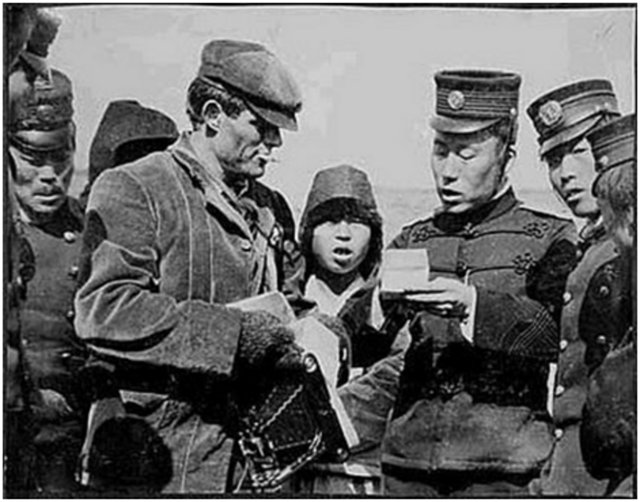
    London negotiates passage with a Japanese officer in Korea during the Russo-Japanese War of 1904-05

    12.6.2006 - A winter in the Yukon seasoned Jack London for the hardships and rigors of reporting the Russo-Japanese War.

    Japan mobilizing for war with Russia!’ This electrifying message flashed to the major world capitals from foreign observers in St. Petersburg and Tokyo during the first days of 1904. For several years, czarist Russia had been penetrating southward into Manchuria with the steel bands of the Trans-Siberian Railroad–putting itself on a collision course with the newly expanding empire of Japan.

    The ultimate Russian objective was the occupation of Korea. Japan also sought to extend her hegemony to Korea and to get revenge for Russia’s interference during the 1894-95 Sino-Japanese War, which had resulted in Russian troops seizing Port Arthur and limiting the Japanese occupation of the Liaotung Peninsula. Between 1900 and 1903, Russian soldiers secretly infiltrated across the Yalu River into northern Korea, fully prepared to fight the Japanese for control of the country’s rich mines. Japan countered those moves with a movement of 25,000 troops to the independent Hermit Kingdom.

    Recognizing that conflict was inevitable, the Japanese offered the Russians a compromise: Japan would accept the Russian occupation of Manchuria in return for Russian acceptance of the Japanese claims to Korea. The proposal was rejected by the Russians, who were confident that an Asian country would not challenge a major European military power.

    The Japanese response to the rebuff was swift and aggressive. Army units moved to staging areas for deployment to Korea, while the Imperial Japanese Navy prepared to steam out to sea and engage the Russian Pacific Fleet.

    The threat of war between a European power and an Asian nation that, in spite of the military modernization it displayed during the Sino-Japanese War, was still regarded in the West as an exotic, mysterious land sent journalists from the major world newspapers rushing to the Far East during the first weeks of 1904. On January 7, under a cold gray sky, SS Siberia sailed from San Francisco for Yokohama, carrying a contingent of war correspondents hungry for action on the Korean Peninsula. Among the group of experienced reporters was Jack London, who was representing the Hearst newspapers. London was on his first news assignment and had no experience as a reporter, but the 28-year-old writer had already received world acclaim for his novel The Call of the Wild and other stories about the 1897 Klondike gold rush.

    London’s writings were based not solely on imagination but on his own adventures in the wild. In order to reach the Yukon gold fields, London and several companions had climbed the hazardous, snow-packed trail over Chilikoot Pass. On the other side, they sailed a hastily constructed boat across the white-capped waters of Lake Bennett and then down the treacherous, swirling waters of the Whitehorse Rapids. The ominous signs of the approaching Arctic winter forced London’s party to stop their trek and hastily build a cabin for shelter. After months of survival in the brutal Yukon, spring finally came and they were able to continue their journey to St. Michael on the Bering Sea.

    London was also an experienced sailor and a crafty oyster pirate. He had traveled across the United States as a hobo and spent time in jail for vagrancy. Those harsh adventures gave him an edge over his fellow correspondents and would get him into the midst of the action to report the first skirmishes of the Russo-Japanese War.

    On board Siberia was a fraternity of hard-bitten journalists who called themselves the Vultures. These newsmen had covered conflicts in every remote geographic region of the world: Egyptian uprisings, French Foreign Legionnaires fighting in Madagascar, Ashanti warriors clashing with British infantrymen in Africa, bloody battles under the burning Sudan sun, Greeks and Turks fighting ancient feuds, and Boer commandos slashing into British columns in the Transvaal.

    Among the most distinguished of the correspondents was Richard Harding Davis. The polished, aristocratic Davis was the walking image of the 19th-century gentleman, lending an air of class and style to the grim business of war reporting. In contrast to London, who reflected the rugged experiences of seaman, laborer and vagabond, Davis was comfortable socializing with admirals, generals and statesmen. Despite their very different backgrounds, however, a strong friendship developed between the two Americans that would prove to be very helpful to London in the coming weeks.

    When Siberia docked in Yokohama, London made the rounds of the bars he had visited 10 years earlier when he was a seaman on a sealing vessel. After fulfilling his vow of imbibing a drink at each of his old watering holes, he joined his fellow correspondents in Tokyo.

    The journalists were housed in the comfortable Imperial Hotel but were not permitted by the Japanese military authorities to leave the city. So while troop trains roared daily to embarkation ports on the Sea of Japan, the exasperated correspondents sipped good liquor in the Imperial Hotel Bar and were treated to nightly luxurious banquets.

    After spending several days in Tokyo, London was satiated with good food and liquor but was frustrated at not being able to report on the action. On January 27, he secretly boarded an express train for Kobe, hoping to find a steamer that would take him to Korea. After a disappointing day on the Kobe docks, he was back on a train for a 22-hour ride to Nagasaki. But he was no more successful there than in Kobe in finding passage to Korea.

    Undaunted, London traveled along the coastline of the Inland Sea to the city of Mojo, where he finally obtained a ticket on a steamer to Chemulpo, Korea, which was a major staging area for Japanese ground forces moving north toward the Yalu and Manchuria. With some time to kill before boarding, London wandered through the heavily fortified city, taking photographs to send back to the United States. His openness in photographing everything from people to buildings was quickly observed by the Japanese secret police, leading to the first of several major confrontations with the Japanese army.

    London was arrested and subjected to hours of rigorous interrogation. The Japanese police were eventually convinced that he was not a Russian spy, but in order to save face, they took him to court, where he was convicted and fined five yen. And worst of all for a correspondent, his camera was confiscated.

    London immediately wired Richard Harding Davis, who was still in Tokyo, requesting his assistance in retrieving his camera from the Japanese. Davis quickly contacted his old friend Lloyd Griscom, U.S. minister to Japan. Griscom met directly with the foreign minister, Baron Komura, and requested the return of London’s camera. Komura listened sympathetically but reported that legal counsel had advised that any weapon used in a crime became state property. London had in fact been convicted of spying and his weapon (i.e., his camera) was therefore rightfully subject to forfeiture.

    The seasoned American Foreign Service officer sat thoughtfully for a few moments and then asked, Does that apply to every crime?

    Yes, replied Komura’s legal counsel, to every crime of every description.

    Turning his attention to the foreign minister, Griscom asked, If I can name a crime to which this does not apply, will you release the camera?

    Yes I will, Komura replied confidently.

    What about rape? Griscom asked with a straight face.

    Baron Komura responded with a roar of laughter. London’s camera was returned, and he continued his efforts to find passage to Korea. He was intrigued by reports of reserves being called from their homes in the middle of the night for deployment and of warships moving through the Korea Straits toward the Yellow Sea and staging areas on Korea’s west coast.

    London was finally able to get passage on a small steamer to Pusan. The ship had no sleeping accommodations, so Jack spent a cold night huddled on an open snow- and sleet-covered deck. At Pusan he found room on another coastal steamer hoping that it would eventually get him to Chemulpo, but the boat was seized by Japanese military authorities at the port of Mokpo on the southwestern tip of the Korean Peninsula. The passengers were simply put ashore and told to make other travel arrangements. The action reflected the intensified Japanese preparation for war.

    Being an experienced sailor, London decided that he would sail the remainder of the way to Chemulpo on his own. He purchased a native junk and hired several fishermen to help him sail the small craft into the Yellow Sea and up the rugged Korean coastline. London’s journal vividly describes the ordeal:

    Thursday, February 11, 1904: Wind howling over the Yellow Sea. Driving rain. Wind cutting like knife. One man at the tiller, a man at each sheet and another man too seasick to be scared.

    Saturday, February 13, 1904: Driving snow squalls. Gale pounding the whole Yellow Sea upon us. So cold that it freezes salt water. O, this is a wild and bitter coast.

    When London finally arrived at Chemulpo, his appearance stunned a British photographer who knew London and had arrived in Korea before the restrictions had been imposed. I did not recognize him, wrote the Britisher. He was a physical wreck. His fingers were frozen. His feet were frozen. He said he didn’t mind so long as he got to the front. He is one of the grittiest men it has been my good fortune to meet. He is just as heroic as any of the characters in his novels.

    London was soon on the march with the Japanese First Army, which was moving north over treacherous, icy mountain passes toward Manchuria. Near the city of Pyongyang, he observed the first land clash of the Russo-Japanese War. Scribbling on rice paper, London reported the bold penetration of a Cossack cavalry unit 200 miles into enemy-occupied territory, probing Japanese troop strength.

    Meanwhile, jealous correspondents back in Tokyo were registering vigorous complaints with the Japanese Foreign Ministry. The journalists were finally shipped off to Korea, and drastic steps were taken to limit London’s reporting freedom. He was arrested again and sent south to a military prison near Seoul.

    London was released as other war correspondents began arriving on the Korean Peninsula, and once again he was soon marching north with Japanese field forces. The Japanese columns were moving on a broad front for a major advance across the Yalu River and an assault on Russian fortifications in Manchuria.

    The Hearst papers were soon printing dispatches from London’s reports of skillfully executed division-level crossings of the Yalu River by the Japanese. His photographs were the first such pictures of the war to arrive in the United States.

    London began to press Hearst to arrange for a transfer to the Russian army in order to report the war from their side. Before that could be negotiated, however, London’s pugnacious personality got him into the middle of an international incident. London punched a Japanese he caught stealing fodder from his horse, and for the third time in four months he was arrested by Japanese military authorities. This time, though, he would be facing a court-martial in which the death penalty could be imposed.

    Again Richard Harding Davis came to the rescue. He quickly flashed off a cable to his personal friend, Theodore Roosevelt, who was also an avid reader of London’s Yukon adventure stories. Intervention by the president of the United States brought about a swift release, but there was one condition: Jack London was to depart Korea immediately, if not sooner. Several weeks later, London said goodbye to Davis on the Yokohama docks and boarded a ship for San Francisco.

    London was credited with sending out more dispatches on the Russo-Japanese War than any of his fellow correspondents, and he was greeted in San Francisco with news of the success of his novel The Sea Wolf. Jack London died 12 years later, at the age of 40, from multiple medical problems that were directly related to living life on the edge, as he had during his 1904 Korean adventure.

    After his return from the Orient, London had written a short essay on his impressions of the Japanese military in which an ominous prediction was made: The Japanese might one day collaborate on an ‘adventure’ which could shatter the long domination of the Western World.

    This article was written by John Mancini and originally published in Military History magazine.

    Jack London: The Adventurer-Writer who Chronicled Asian Wars, Confronted Racism—and Saw the Future
    ▻https://apjjf.org/daniel-a-mc3a9traux/3293/article

    25.1.2010 by: Daniel A. Métraux - He stood among the Japanese soldiers wearing a weather-beaten visored cap over his short, dark hair and a rough hewn jacket covering his broad soldiers, a cigarette angling away from his square jaw and a camera dangling from his gloved hand. As they studied documents, the Japanese troops contrasted with Jack London in their box hats and high collared uniforms. A photographer present immortalized London looking like the adventurer and writer that he was, one drawn to the battle like a missionary to his calling, who skillfully recorded the machinations of great powers while sympathizing with the underdogs who struggled to survive.

    London negotiates passage with a Japanese officer in Korea during the Russo-Japanese War of 1904-05

    Jack London (1876-1916), easily the most popular American writer a century ago, is still praised for his Yukon novels and short stories such as The Call of the Wild, White Fang and To Build a Fire. However, his visits to Japan, Korea and Manchuria; his factual, hard hitting coverage of the Russo-Japanese War (1904-05); his astute short stories about Sino-Japanese competition; his prophetic essays predicting the rise of the Pacific Rim, and his call for respect and constructive interaction between Americans and Asians over “yellow peril” hysteria are undeservedly forgotten. These salient aspects of London’s life deserve to be remembered and respected. They evidence his keen intelligence, painfully accurate vision of the future and the progressive and humane values that are still needed to bridge the East and West.

    The Yellow Peril Threatens the West?

    Today the term “The Yellow Peril” — but not necessarily the fears and fantasies that it engenders — has gone out of fashion. But in the late nineteenth and early twentieth centuries, Westerners’ dreams about the “superiority” of their civilization competed with their nightmares of Oriental hordes swarming from the East to engulf the advanced West. This was a popular theme in the day’s literature and journalism, which London knew well. The term “Yellow Peril” supposedly derives from German Kaiser Wilhelm II’s warning following Japan’s defeat of China in 1895 in the first Sino-Japanese War. The expression initially referred to Tokyo’s sudden rise as a military and industrial power in the late nineteenth century. Soon, however, its more sinister meaning was broadly applied to all of Asia. “The Yellow Peril” highlighted diverse Western fears including the supposed threat of a military invasion from Asia, competition to the white labor force from Asian workers, the alleged moral degeneracy of Asian people and the spectre of the genetic mixing of Anglo-Saxons with Asians.1

    The Russo-Japanese War saw Japan alter the world balance of power that the West once dominated, triggering viceral fears of a yellow peril

    Many writers and journalists in the early 1900s wielded an unflattering pen when writing about Asians, boasting of Anglo-Saxon superiority over the “yellow and brown” Asians. The Hearst newspapers stridently warned of the “yellow peril”. So did noted British novelist M. P. Shiel in his short story serial, The Yellow Danger. One finds similar views in Kipling’s poem “The White Man’s Burden” and in some of his stories and novels.

    London in the Dock: His Defense is on the Page

    John R. Eperjesi, a London scholar, writes that “More than any other writer, London fixed the idea of a yellow peril in the minds of the turn-of-the-century Americans…”2 Many biographers quote London, just after his return from covering the first months of the Russo-Japanese War for the Hearst newspapers in 1904, as telling a coterie of fellow socialists of his profound dislike for the “yellow man.” Biographer Richard O’Connor quotes Robert Dunn, a fellow journalist with London during the Russo-Japanese war, as saying that Jack’s dislike of the Japanese “outdid mine. Though a professed socialist, he really believed in the Kaiser’s ‘yellow peril.’”3

    Are these charges correct? If so, they would cast London as a bigot and alarmist.

    In fact, a close examination of London’s writing shows the opposite: he was ahead of his time intellectually and morally. His Russo-Japanese war dispatches from Korea and Manchuria around 1904-5 are balanced and objective reporting, evincing concern for the welfare of both the average Japanese soldier and Russian soldier and the Korean peasant, and respect for the ordinary Chinese whom he met. As perhaps the most widely read of the journalists covering that war, London emerges as one of the era’s writers who sensed that the tide of white “superiority” and Western expansionism and imperialism was receding.

    His positive views of Asians can be traced back a decade earlier to his first published stories and later writing such as his essays “The Yellow Peril” and “If Japan Awakens China” and his short story, “The Unparalleled Invasion” — see below. Even as many Americans held racist beliefs about Asians, London expressed more liberal views.

    Japanese Aggression, Chinese Pride

    In addition, as an analyst, London’s deep understanding of how the industrial, politico-strategic and social worlds were profoundly changing surpassed that of his peers. His fiction and essays explored the appearance of new industrial powers in the East, as well as Western counter moves and inter-Asian tensions, too. London shrewdly predicted elements of the coming age of revolution, total war, genocide and even terrorism. This renders his writing painfully relevant. As Jonah Raskin observed, “In a short, volatile life of four decades, Jack London (1876-1916) explored and mapped the territory of war and revolution in fiction and non-fiction alike. More accurately than any other writer of his day, he also predicted the shape of political power – from dictatorship to terrorism – that would emerge in the twentieth century, and his work is as timely today as when it was first written.”4

    For instance, during and after his time in Korea and Manchuria, London developed a complicated thesis in his 1904 essay, “The Yellow Peril,” envisaging the rise first of Japan and then China in opposition as major twentieth century economic and industrial powers.

    London’s starting point was his suspicion that Japan’s imperial appetite exceeded its swallowing of Korea in the Russo-Japanese War. He anticipated that Tokyo would eventually take over Manchuria and then attempt to seize control of China in the attempt to use China’s vast land, resources and labor for its own benefit.

    London knew that Japan’s strength at the turn of the twentieth century lay in its ability to use Western technology and its national unity. London and some other contemporary writers, as well as many politically attuned Asians recognized that Japan’s defeat of Russia was a turning point in a history of Asian subjugation to white imperial powers. Japan’s victory called into question as no previous event the innate superiority of the white race.5

    However, London believed that there were severe limits on Japan’s ability to become a leading world power. However impressive its initial gains, Tokyo would falter from lack of “staying power.” One reason was that it was too small. Although it had humbled Russian forces, London believed that it was not sufficiently powerful to create a massive Asian empire, still less to militarily or economically threaten the West. Seizing “poor, empty Korea for a breeding colony and Manchuria for a granary” would greatly enhance Japan’s population and strength — but that was not enough to challenge the great powers.

    Simultaneously, London saw that Asians themselves would be antagonists. He clearly distinguished between the Chinese and Japanese, at times — ironically — referring to the Chinese as the “Yellow Peril” and the Japanese as the “Brown Peril.” Japan would launch its crusade promising “Asia for the Asiatics” as its clarion call, but its aggression would catalyze Chinese resistance.6

    China’s Rise Provokes the White Peril’s Germs

    In “The Yellow Peril,” London’s conclusion left the reader hanging. Although aroused, China’s vast potential is hindered. Its leaders hew tenaciously to the past. Clinging to power and tradition, they refuse to modernize and so China’s fate is uncertain. London does not tell the reader who will prevail. However, in his 1906 short story, “The Unparalleled Invasion,” London develops the theme of China’s rise. The Japanese are expelled from China and are crushed when they try to reassert themselves there. China then becomes a major power.

    Writing a century ago, London warned that the imperial West, blissfully ignorant of what awaited it, was living in a bubble. The shift of power to Asia was the prick that would burst it. The transition would be peaceful because Asia’s rise was primarily economic, but eventually war between East and West was inevitable because China challenged the economic might of the West. Although critics have read different messages into the story, the clear irony is that the West is the paranoid aggressor. It is a White Peril and China is the innocent victim.

    But “contrary to expectation, China did not prove warlike [so] after a time of disquietude, the idea was accepted that China was not to be feared in war, but in commerce.” The West would come to understand that the “real danger” from China “lay in the fecundity of her loins.” As the 20th century advances, the story depicts Chinese immigrants swarming into French Indochina and later into Southwest Asia and Russia, seizing territory. Western attempts to slow or stem the Chinese tide all fail. By 1975 it appears that this onslaught will overwhelm the world.

    With despair mounting, an American scientist, Jacobus Laningdale, visits the White House to propose eradicating the entire Chinese population. He aims to drop deadly plagues from Allied airships over China. In May, 1976, the bombers appear over China and release a torrent of glass tubes.7 At first nothing happens, then an inferno of plagues gradually wipes out the entire population. Allied armies surround China and all Chinese die. Even the seas are closed because 75,000 Allied naval vessels blockade China’s coast. “Modern war machinery held back the disorganized mass of China, while the plagues did the work.”8

    Here, let’s praise London’s piece as a stern warning about bio-warfare. He wrote when strategists were investigating the new concept of germ weapons. London sounds an alarm over such hazards that world powers ignored as they rushed into the gas clouds and carnage of World War I. Decades later, Japan would unleash bio-warfare against China’s cities in the China-Japan War of 1937-45, and China and North Korea would charge the US with waging germ warfare during the Korean War.

    More broadly it is worth reflecting on London’s vision in light of the changes of the last few decades in East Asia. Above all, this has been a story of the rise of East Asia. First Japan’s, and later Taiwan’s South Korea’s and China’s, wealth and power have grown spectacularly. East Asia’s resurgence has challenged the status quo of American and European dominance. Now the exponents of the “China Threat” school insist that this could auger a military challenge that transforms the balance of power in Asia and the Pacific.

    In short, long before Samuel Huntington, London anticipated a clash of civilizations. His readers see how the vast cultural differences that divide the West from China spark hatred and malice in the former. The focus here is not the Chinese danger to the West, but its reverse. As Jean Campbell Reesman points out, “London’s story is a strident warning against race hatred and its paranoia, and an alarm sounded against an international policy that would permit and encourage germ warfare. It is also an indictment of imperialist governments per se.”9

    He anticipates that the wars of the twentieth century will exact an unprecedented death toll among armies and civilians. Indeed, the world can regret London’s prescience. To avoid this fate, London urges the West to understand the new Asia and to live with non-white peoples in a spirit of brotherhood.

    Conclusion: London the Internationalist Still Speaks to Us

    London’s views of Asians and the Pacific’s other non-white people became more refined in the last seven years of his life during and after his 1907-1909 trip to the South Pacific aboard his decrepit schooner, the Snark. London’s increasingly pan-national world view led to his 1915 recommendation of a “Pan-Pacific Club” where Easterners and Westerners could meet congenially in a “forum” to exchange views and share ideas as equals. Far from being the thoughts of a racist, they are the vision of an internationalist. In particular, London wanted Americans and Japanese to associate to promote mutual respect and understanding.

    Jack London traveled extensively during his short but active life. He encountered diverse cultures that he tried to understand. He empathized with the downtrodden in the United States, Europe, East Asia and the South Pacific. His “Pan-Pacific Club” essay is his final appeal for the West to overcome stereotypical view of Asians as inferior peoples who needed Western domination for their betterment. Although London died in 1916, the words of this realistic and humane writer still speak to us.

    Jack London Reporting From Manchuria

    [Editor’s Note: The Hearst newspaper empire hired Jack London to be its chief correspondent covering the Russo-Japanese War (1904-1905). When London arrived in Tokyo in late January 1904, he found that the Japanese government would not allow foreign correspondents near its army as it marched north through Korea to meet Russian forces in Manchuria. Refusing to spend the war attending banquets, London raced across Japan searching for a vessel to take him to Korea.

    London astride Belle in Japan

    After considerable difficulty, he caught up with the Japanese army in late winter 1904 in Korea and accompanied the troops as they marched north through Korea and into Manchuria to confront the Russians. London continued his coverage of the war through June of 1904. The following dispatch followed Japan’s victory over Russian forces in a tense battle for control of the Yalu River between Korea and Manchuria.

    “Beware the Monkey Cage”

    ANTUNG, Manchuria. May 10th, 1904. The Japanese, following the German model, make every possible preparation, take every possible precaution, and then proceed to act, confident in the belief that nothing short of a miracle can prevent success. Opposed to their three divisions on the Yalu was a greatly inferior Russian force, but the Japanese had to cross the river under fire and attack an enemy lying in wait for them.

    By the manipulation of their three divisions, and what of their ruses, they must have sadly befuddled the Russians. At the mouth of the Yalu the Japanese had two small gunboats, two torpedo boats and four small steamers armed with Hotchkiss-guns. Also they had fifty sampans loaded with bridge materials. These were intended for a permanent bridge at Wiju; but they served another purpose—first, farther down the stream. The presence of the small navy and the loaded sampans led the Russians to believe that right there was where the bridge was to be built. So right there they stationed some three thousand men to prevent the building of the bridge. Thus a handful of Japanese sailors kept 3,000 Russian soldiers occupied in doing nothing and reduced the effectiveness of the Russian strength that much.

    Woodblock print depicting Japanese victory over the Russians at Chongju. Kyōko Hasegawa Sonokichi Umezawa horu Illustration of the Russo-Japanese War: Our Armed Forces Occupy Chongju (Nichiro kōsen zuga, wagagun Teishū o senryō su) Ukiyo-e print; Russo-Japanese War 1904 (Meiji 37), March. Museum of Fine Arts, Boston. Visualizing Cultures.

    Another ruse was the building of a bridge in front of Wiju. This was in plain view of the Russians on the conical hill opposite just east of Kieu-Liang-Cheng, and they consumed much time and powder in shelling it. This was precisely what the Japanese intended for the bridge. While it held the Russian attention, a little farther down the stream the Japanese were at work on another bridge screened by small willow trees on the intervening island, and which, when completed, had never had a shot fired at it.

    Have you ever stood in front of a cage wherein there was a monkey gazing innocently and peaceably into your eyes—so innocent and peaceable the hands grasping the bars and wholly unbelligerent, the eyes that bent with friendly interest on yours, and all the while and unbeknown a foot sliding out to surprise your fancied security and set you shrieking with sudden fright? Beware the monkey cage! You have need of more than your eyes; and beware the Japanese. When he sits down stupidly to build a bridge with his two hands before your eyes, have a thought to the quiet place behind the willow-screen where another bridge is builded by his two feet. He works with his hands and his feet, he works night and day, and he never does one thing expected of him, and that is the unexpected thing.

    The night of April 29th and the day of the 30th was an anxious time for the Japanese. Their army was cut in half, and it was no less than the Yalu that divided it. One-third of its force, the Z division, had crossed the river to the right and was in Manchuria. They had no very accurate knowledge of the Russian strength, and it was not beyond liability that the Russians might make a counter attack on the Z division and destroy it. So the X and Y divisions on the south bank were in momentary readiness to prevent this by delivering an attack upon the Russians straight across the river. But there was no need for this. The Russians were not in sufficient force to attack a single division, advancing as it was across mountainous country. This, in turn, the Japanese did not know, but they prepared for the possibility as they prepare for everything.

    The Ai-ho river flows out of Manchuria and enters the Yalu valley a mile or more above Kieu-Liang-Chen. It also flows past that village, close to the Manchurian shore, thus interposing an obstacle to the advance of the whole Japanese army (even the Z division), after it had crossed the Yalu proper. The crossing of the Ai-ho was seriously menaced by the sixteen guns of the Russian right on the conical hill. The day’s work for April 30th was to put these sixteen guns out of business. The Japanese bent themselves to the task. It was an exposed position and a concentration of fire lasting twenty-five minutes and in which time sixty common shells were thrown, did the work. The Russian fire was silenced and the guns were withdrawn that night! Incidentally the Japanese bombed the Russian camp, carelessly situated where it was exposed from the Korean hills, and wrought great havoc.

    On the night of April 30th the X and Y divisions crossed the main Yalu and rested on the sands, with the Ai-ho between them and the Russians. The X division forming the Japanese left, faced the Russian right on the conical hill, and the Y division was extended near the mouth of the Ai-ho; and up the Ai-ho, extended for several miles, lay the Z division. Opposing these three divisions was a Russian actual fighting force of about 4,000 men. The Russian line, extending some six or seven miles, was not intact. In fact, because of the lay of the land, the Russians really occupied two positions—one on and about the conical hill at Kieu-Leng-Cheng, the other at the Ai-ho, from its mouth several miles up.

    Against these two positions, occupied by about 2,000 men, was hurled an army of three divisions (probably 25,000 men actually on the spot), backed by a powerful artillery of field guns and howitzers. Prevented by shell fire and shrapnel from doing their best to repel the general attack, and being flanked by an immensely superior force, the Russian left on the Ai-ho broke first and fled in the direction of the Hamatan. The Russian right on the conical hill, fought more, tenaciously, the survivors in turn fleeing toward Hamatan.

    Banri Narazawa Kenjirō Umezawa horu Scene of Our Second Army Occupying Nanshan in a Fierce Battle at the Fall of Jinzhoucheng (Kinshūjō kanraku waga dainigun no gekisen Nanzan senryō no kōkei) Ukiyo-e print; Russo-Japanese War 1904 (Meiji 37), Museum of Fine Arts, Boston. Visualizing Cultures

    The Japanese understand the utility of things. Reserves they consider should be used, not only to strengthen the line or protect the repulsed line, but in the moment of victory to clinch victory hard and fast. The reserves, fresh and chafing from inaction wild to take part in a glorious day, received the order for general pursuit. Right, left and center, they took after the Russians. The field guns, delayed by the Ai-ho followed at a gallop.

    The retreat became a rout. The Russian reserves, two regiments, had fled without firing a shot—at least the Japanese have no record of these two regiments. Hamatan is at the conjunction of three roads, six miles to the rear of the conical hill. Down these three roads the Russians ran, coming together and passing on to the main road—the Pekin or Mandarin road. And down these three roads, from left, right, and center, came the fresh reserves, and after them the artillery.

    In the meantime, however, far from the Japanese right and outstripping the rest of the pursuit, arrived one company of men in time to cut off fifteen Russian guns and eight maxims. The remnants of the three battalions rallied around the guns. A hasty position was taken. The rest of the pursuing Japanese did not arrive. But one company of men stood between the Russians and the Pekin Road. And it stood. Its captain and three lieutenants were killed. One officer only remained alive. The last cartridge was fired. Those that survived fixed their bayonets ready to receive a charge. And in the moment, left, right, and center, their pursuing comrades arrived.

    The Russians were assailed from three sides. The tables were turned but they fought with equal courage. The day was lost; they knew it; yet they fought on doggedly. Night was falling. As the Japanese grew closer the Russians turned loose their horses, destroyed or threw away the breechblocks of their guns, smashed the breeches of the maxims and then, as bayonet countered bayonet, drew white handkerchiefs from their pockets in token of surrender.

    One other noteworthy thing occurred in the Japanese pursuit. Midway to Hamatan, flying on the heels of a rout, in the very heat and sweep of triumph, they dropped a line of reserves to receive and protect them should they be hurled back broken and crushed by Russian re-enforcements. Hand in hand with terrifying bravery goes this cold-blooded precaution. Verily, nothing short of the miracle can wreck a plan they have once started to put into execution. The men furnish the unfaltering bravery, confident in their knowledge that their officers have furnished the precaution.

    Of course, the officers are as brave as the men. On the night of the 30th, when the army took up its position on the Ai-ho, it was not known whether that stream was fordable. Officers from each of the three divisions stripped and swam or waded the river at many different points, practically under the rifles of the Russians.

    “Men determined to die” is the way one Japanese officer characterized the volunteers who answer in large number to every call for dangerous work. Not knowing whether the Ai-ho was fordable, three plans were seriously considered. First, each soldier was to go into action May 1st dressed in cartilage belt and equipped with a rifle and a board, the latter to be used as a means for paddling across the Ai-ho. Second, same garb and equipment with a tub substituted for the board, and third, the strongest swimmers to cross over with ropes, along which, when once fast on the other side bank, the weaker swimmers and non-swimmers could make their way. In any case, had the river not proved fordable, Kipling’s “Taking the Long-Tong-Pen” would have been repeated on a most formidable scale. Surely the Russians would have broken and fled perceptibly before so terrible a charge.

    Every division, every battery was connected with headquarters by field telephone. When the divisions moved forward they dragged their wires after them like spiders drag the silk of their webs. Even the tiny navy at the mouth of the Yalu was in constant communication with headquarters. Thus, on a wide-stretching and largely invisible field, the commander-in-chief was in immediate control of everything. Inventions, weapons, systems (the navy modeled after the English, the army after the German) everything utilized by the Japanese has been supplied by the Western world; but the Japanese have shown themselves the only Eastern people capable of utilizing them.

    If Japan Awakens China

    [London wrote this piece in 1909, five years after his return from Manchuria. He predicts the rise of Japan and its endeavor to transform itself into a major world power by harnessing the labor of four hundred million Chinese. The Chinese, he suggested, would in turn eventually overthrow their conservative leaders, drive out the Japanese and develop a prosperous modern economy. Excerpts.]

    The point that I have striven to make is that much of the reasoning of the white race about the Japanese is erroneous, because is it based on fancied knowledge of the stuff and fiber of the Japanese mind. An American lady of my acquaintance, after residing for months in Japan, in response to a query as to how she liked the Japanese, said: “They have no souls.”

    In this she was wrong. The Japanese are just as much possessed of a soul as she and the rest of her race. And far be it from me to infer that the Japanese soul is in the smallest way inferior to the Western soul. It may even be superior. You see, we do not know the Japanese soul, and what its value may be in the scheme of things. And yet that American lady’s remark but emphasizes the point. So different was the Japanese soul from hers, so unutterably alien, so absolutely without any kinship or means of communication, that to her there was no slightest sign of its existence.

    Japan, in her remarkable evolution, has repeatedly surprised the world. Now the element of surprise can be present only when one is unfamiliar with the data that go to constitute the surprise. Had we really known the Japanese, we should not have been surprised. And as she has surprised us in the past, and only the other day, may she not surprise us in the days that are yet to be? And since she may surprise us in the future, and since ignorance is the meat and wine of surprise, who are we, and with what second sight are we invested, that we may calmly say: “Surprise is all very well, but there is not going to be any Yellow peril or Japanese peril?”

    There are forty-five million Japanese in the world. There are over four hundred million Chinese. That is to say, that if we add together the various branches of the white race, the English, the French, and the German, the Austrian, the Scandinavian, and the white Russian, the Latins as well, the Americans, the Canadians, Australians and New Zealanders, the South Africans, the Anglo Indians, and all the scattered remnants of us, we shall find that we are still outnumbered by the combined Japanese and Chinese.

    We understand the Chinese mind no more than we do the Japanese. What if these two races, as homogenous as we, should embark on some vast race-adventure? There have been no race adventures in the past. We English-speaking peoples are just now in the midst of our own great adventure. We are dreaming as all race-adventurers have dreamed. And who will dare to say that in the Japanese mind is not burning some colossal Napoleonic dream? And what if the dreams clash?

    Japan is the one unique Asiatic race, in that alone among the races of Asia, she has been able to borrow from us and equip herself with all our material achievement. Our machinery of warfare, of commerce, and of industry she has made hers. And so well has she done it that we have been surprised. We did not think she had it in her. Next consider China. We of the West have tried, and tried vainly, to awaken her. We have failed to express our material achievements in terms comprehensible to the Chinese mind. We do not know the Chinese mind. But Japan does. She and China spring from the same primitive stock—their languages are rooted in the same primitive tongue; and their mental processes are the same. The Chinese mind may baffle us, but it cannot baffle the Japanese. And what if Japan wakens China—not to our dream, if you please, but to her dream, to Japan’s dream? Japan, having taken from us all our material achievement, is alone able to transmute that material achievement in terms intelligible to the Chinese mind.

    The Chinese and Japanese are thrifty and industrious. China possesses great natural resources of coal and iron—and coal and iron constitute the backbone of machine civilization. When four hundred and fifty million of the best workers in the world go into manufacturing, a new competitor, and a most ominous and formidable one, will enter the arena where the races struggle for the world-market. Here is the race-adventure—the first clashing of the Asiatic dream with ours. It is true, it is only an economic clash, but economic clashes always precede clashes at arms. And what then? Oh, only that will-o’-wisp, the Yellow peril. But to the Russian, Japan was only a will-o’-wisp until one day, with fire and steel, she smashed the great adventure of the Russian and punctured the bubble-dream he was dreaming. Of this be sure: if ever the day comes that our dreams clash with that of the Yellow and the Brown, and our particular bubble-dream is punctured, there will be one country at least unsurprised, and that country will be Russia. She was awakened from her dream. We are still dreaming.

    Daniel A. Métraux is Professor of Asian Studies at Mary Baldwin College in Staunton, Virginia. He recently served as president of the Southeast Chapter of the Association for Asian Studies and as editor of the Southeast Review of Asian Studies. His books on Japanese and Asian affairs include The Soka Gakkai Revolution (1994) and Burma’s Modern Tragedy (2004). His most recent book, The Asian Writings of Jack London: Essays, Letters, Newspaper Dispatches, and Short Fiction by Jack London was published by Edwin Mellen Press in 2009. An earlier article on London, “Jack London Reporting from Tokyo and Manchuria: The Forgotten Role of an Influential Observer of Early Modern Asia,” appeared in Asia Pacific Perspectives in June 2008. He wrote this article for The Asia-Pacific Journal. The author thanks Victor Fic for editing this text.

    Recommended citation: Daniel A. Métraux, “Jack London: The Adventurer-Writer who Chronicled Asian Wars, Confronted Racism—and Saw the Future,” The Asia-Pacific Journal, 4-3-10, January 25, 2010. ジャック・ロンドン、アジア戦争、「黄禍

    Notes

    1 See William F. Wu, The Yellow Peril: Chinese-Americans in American Fiction, 1850-1940 (Hamden CT: Archon Books, 1982).

    2 John R. Eperjesi, The Imperialist Imaginary: Visions of Asia and the Pacific in American Culture (Hanover: Dartmouth University Press, 2005, 108)

    3 Richard O’Connor, Jack London: A Biography (Boston: Little, Brown and Co., 1964), 214.

    4 Jonah Raskin, The Radical Jack London: Writing on War and Revolution (Berkeley: University of California Press, 2008), 1.

    5 John R. Eperjesi, The Imperialist Imaginary, 109.

    6 “The menace to the Western world lies not in the little brown man, but in the four hundred millions of yellow men should the little brown man undertake their management.” Jack London Reports, 346

    7 See Tsuneishi Keiichi, “Unit 731 and the Japanese Imperial Army’s Biological Warfare Program. See also Stephen Endicott, The United States and Biological Warfare: Secrets from the Early Cold War and Korea. Bloomington: Indiana University Press, 1998. Critics have strongly challenged Endicott’s key points concerning the alleged use of germ warfare in the Korean War.

    8 Jack London, “The Unparalleled Invasion“ in Dale L Walker, Ed., Curious Fragments (Port Jefferson NY: Kenkat Press, 1976), 119.

    9 Jeanne Campbell Reesman, Jack London: A Study of the Short Fiction (New York: Twayne Publishers, 1999), 91.

    #histoite #guerre #Japon #Russie #journalisme

  • Japan Is Building a War Machine in the East China Sea
    ▻https://jacobin.com/2026/04/japan-takaichi-military-us-china

    Les États Unis continuent la cinstruction d’une énirme force militaire internationale contre la Chine. LeJapone y fournit la proncipale contribution. Le gouvernement Takaichi Sanae préparel’augmentation du budget militaite à cinq pour cent du PIB et l’abandon officiel du pacifisme constitutionnel du pays.

    16.4.2026 by Gavan McCormack - Japan’s conservative leader, Takaichi Sanae, won a supermajority of seats in this ’s general election. Takaichi and her allies are using this position of strength to advance a dangerous militarist agenda as part of Washington’s anti-China front.

    Less than six months after her assumption of office as Japan’s 104th (and first female) prime minister, and two months since her rise was confirmed by a resounding victory in a national election, the grip of Takaichi Sanae on the levers of state is unchallenged, and her support level remains high.

    However, thoughtful and historically aware commentators are speculating that a fundamental transition of the state might be underway, one from “peace state” to “war state.” Looking back to the Konoe Fumimaro government of 1937, which in retrospect we can see as taking the steps that led to a catastrophic war four years later, they fear that Takaichi might be replaying that scenario.
    Supermajority

    On February 8, 2026, the Japanese people went to the polls for an election to the lower house of the National Diet. It was generally taken to be a test of the latest government led by the Liberal Democratic Party (LDP), formed in October 2025. With the party leader Takaichi enjoying support levels of around 70 percent, the election outcome was scarcely in doubt, but its scale still took many by surprise. Takaichi took the LDP from 198 seats (short of the 233 needed for a parliamentary majority) to 316 seats, giving the LDP a two-thirds supermajority.

    She confronted an opposition led by the mildly reformist Centrist Reform Alliance (CRA), a new force formed through a merger of the former Constitutional Democratic Party and the neo-Buddhist Komeito, a long-standing coalition partner of the LDP. Having set out to increase its Diet strength, the CRA suffered instead a humiliating loss, dropping from 167 to forty-nine seats.

    In the long history of the LDP from its foundation in 1955, no leader had ever performed quite so brilliantly as Takaichi. She emerged from the election with political power greater even than her sometime mentor, Abe Shinzo. Her supermajority in the Diet meant that, unlike previous LDP governments, she could press confidently ahead with her rightist agenda, including steps for constitutional revision.

    However, this electoral victory did not necessarily reflect overwhelming national support. The 56 percent turnout was the fifth-lowest in the postwar era. In the single-member constituency seats, the LDP won 49 percent of votes cast, while in the regional party-list seats, it took just 37 percent. Such are the vagaries of the electoral system that the support of 28 percent of all those eligible to vote was sufficient to gain the party two-thirds of all seats.

    End of the “Peace State”?

    Eight decades have now passed since the collapse in 1945 of Japan’s Asia-Pacific community, the so-called “Greater East Asia Co-Prosperity Sphere,” and the message that many Japanese people took from that catastrophe was clear. Under Article Nine of the constitution adopted in 1946, Japan pledged to renounce “war as a sovereign right of the nation and the threat or use of force as means of settling international disputes,” adding that “land, sea, and air forces . . . will never be maintained.”

    Although periodic polls always show strong popular support for Article Nine, Japan did nevertheless over time build formidable land, sea, and air forces, evading the constitutional proscription by calling them “Self-Defense Forces” (SDF). The pacifist pledge, unrevised but steadily emptied of content, remains, but the 1946 aspiration to create a new kind of state, one resting on the “peace” principle, was largely forgotten. Over subsequent decades, the United States came to regret its recrafting of Japan as a “peace state” and began exerting pressure on it to revive and expand its military.

    The level of Japanese military spending rose steadily throughout the Cold War, though remaining for long within the self-imposed limit of 1 percent of GDP. The size of Japan’s economy meant that this was still a large amount in absolute terms. However, as GDP growth slowed, in 2022 the level doubled to 2 percent, with an overall target of 43 trillion yen (US$355 billion) for the five-year period from 2022 to 2027.

    Roughly on schedule to reach that target, military spending for the first time surpassed nine trillion yen ($58 billion) in 2025. Under Takaichi, we can expect further steady expansion. If we assume that Japan will be an early adopter of NATO’s target of 3.5 percent of GDP for military expenditure, the nine trillion would blow out to 24 trillion yen — roughly $140 billion. This is a staggering sum that would require drastic cuts to health, education, and welfare budgets. If it goes further by adopting NATO’s second target of 5 percent by 2035, which Donald Trump is believed to be demanding of Japan, the sums involved beggar the imagination.

    Eventually, and especially under the Abe Shinzo government in office from 2012 to 2020, Article Nine–based restrictions were swept aside, spending accelerated, and Japanese and US military forces were reinforced and integrated. After taking office in October 2025, Takaichi promised further, substantial increases in maritime and air defense (including long-range hypersonic missiles), along with a commitment to construction and deployment of a missile defense umbrella, to be known as a Synchronized, Hybrid, Integrated, Enhanced, Littoral Defense (SHIELD) system.

    One of Takaichi’s closest advisers late in 2025 even questioned the commitment to “Three Nonnuclear Principles” — nonpossession, nonmanufacture, and nonadmission of nuclear weapons to Japanese territory — that the LDP government adopted in 1967. The prime minister herself is reported to agree and has been reviewing the “three nons” policy.

    Those who celebrated the Washington-Tokyo alliance as “the cornerstone of peace and security in the Indo-Pacific region” took it for granted that Japan would exercise “bold leadership” and that Japan’s forces would constitute a significant component reinforcing US global dominance. Over and under the East China Sea, battleships and aircraft carriers, missile and countermissile systems, fighter jets and submarines — not only Japanese and American, but also British, French, Australian, Canadian, and German — are stepping up their rehearsal of a possible future war between a US-led coalition of the willing and China.

    Under such conditions, it is unthinkable that Japan’s heavily armed forces could ever operate independently. They constitute in effect a “second US Army.”
    Okinawa

    A significant US military presence — approximately 26,000 US personnel, or half the total stationed in Japan — is positioned on Okinawa Island, where attention focuses on the hugely unpopular and still hotly contested Henoko base being built there by Japan for the US Marine Corps to replace the obsolescent Futenma. Meanwhile, Japan over the past decade has steadily expanded its own military presence on its lesser-known islands.

    Under strong US pressure, it has deployed, or is in the process of deploying, missile and countermissile units in a series of new and under-construction bases, decisively changing the character of the Ryukyu island chain that stretches from Kagoshima to Taiwan. The size and population of these islands range from Mage (area 8.5 square kilometers, population zero) to Okinawa itself (area 1,206 square kilometers, population 1.4 million). In geographical terms, a line drawn from Kagoshima City in western Japan to the northern shores of Taiwan passes through these islands. Japan and the United States appear to believe that, if or when the need arises, they can “bottle up” China and deny it access to the Pacific Ocean.

    Japan’s southwestern frontier islands of Mage and Yonaguni deserve particular attention. Mage in the north is closest to Kagoshima, while the sparsely populated Yonaguni in the south is just 110 kilometers from the coast of Taiwan. Mage, which is adjacent to the Japanese space industry island of Tanegashima, was initially chosen to house US carrier-based fighter jet takeoff and landing exercises.

    This gradually evolved into a project to accommodate all three of Japan’s military forces (Ground, Sea, and Air SDFs) together with unspecified numbers of their US counterparts. The project would be under the auspices of an arrangement that ensures ultimate Pentagon coordination, control, and command of Japanese military operations throughout the adjacent seas. From 2021, a six-thousand-strong workforce was mobilized to this remote island site, and the date for completion of the base construction works was moved forward to 2030.

    Yonaguni is close enough to Taiwan that on a clear day, its mountains can be seen. Occasional Taiwanese friendship missions have landed on Yonaguni beaches from motorized jet skis. The community split over the government’s commitment to install a major military installation on the island, although a February 2015 island referendum did not win enough support to block the plan. A site was chosen, and in March 2016, an initial 160-strong Ground SDF unit marched in.

    Mage and Yonaguni, both once renowned for the richness of their biodiversity, thus have become centers for the preparation and conduct of war. Military facilities of one kind or another soon followed on the other islands.

    Filling in the Blanks

    Throughout the Cold War decades, what distinguished the southwestern islands (other than Okinawa itself) was the absence of US military installations. Undefended, they posed no threat and were themselves unthreatened. Those who knew the islands in their premilitary base days — this author among them — remember them as idyllic.

    But to bureaucrats and SDF top brass in Tokyo, not to mention the Pentagon, the absence of such military forces gradually became of paramount concern in national defense doctrine. The raison d’être for these Okinawan islands became their positions as US-Japan bastions from which to project force in the service of the regional and global hegemonic project.

    The nominal reason for the militarization of the “first island chain” is to defend Taiwan in case of a “contingency.” This is the euphemistic sobriquet by which war over Taiwan between China and Taiwan has come to be contemplated since Abe Shinzo’s statement (repeated by Takaichi in 2025) that “a Taiwan contingency would be a Japan contingency.”

    The broader role assigned to the first island chain is to position US-Japan power in a place where it can contain a rising China in the region that has come to be known as the Indo-Pacific. The United States insists on its own “full-spectrum dominance,” meaning global economic, technological, and military hegemony. To the extent that it challenges (or appears to challenge) that prerogative, China “threatens” the US.

    A sane defense policy for a country such as Japan — or indeed for any country — would surely be one that attached highest importance to avoiding dispute and building cooperation, rather than striving to “win.” Any East Asian war today or tomorrow would be a missile war, involving naval and air power, and could conceivably become nuclear.

    Missile and antimissile units are now being installed on the southwestern islands, including four hundred “off the shelf” Tomahawk Land Attack Missiles for which Japan placed an order late in 2022. Such missiles are said to be capable of attacking forces within a 1,500-kilometer radius (including major centers in Russia, China, and North Korea).

    Regardless of who “wins” such a war, damage and devastation would be assured for all sides. Contemplating such catastrophe, Okinawans recall their sacrifice in the spring of 1945 in the final battle of the Pacific War, which took the lives of more than one-fourth of the Okinawan population.

    Japan’s authorities might issue an “alert” warning in case of conflict breaking out, as was done on the occasion of several recent North Korean missile launches. But in the 2020s, just as in 1945, there would simply be no time for the Okinawan civilians to withdraw to safety, and indeed nowhere for them to go.

    A Peace Community

    Ironically, the Okinawa now being militarized and readied for war with China has a five-hundred-year-long history of friendly interchange between the Ryukyu Kingdom and the Ming and Qing China dynasties. The Okinawan people do not share the militaristic Japanese Bushido ethic. There is no evidence of the Chinese resorting to violence in their relations with the Ryukyu authorities over the course of those centuries, and the exchanges are still remembered and celebrated in Naha today.

    In contrast, Okinawa’s incorporation into the modern Japanese state was accompanied with great violence, from the torture-induced assent by Ryukyu Kingdom elites to the absorption of the Ryukyu Kingdom and its territories into Japan in 1879. This was followed by violent attempts to crush the distinctive Okinawan language and identity and by the catastrophe of 1945, when Okinawa alone among Japanese territories suffered the horror of land war. The violence continues, with an ongoing assault from the contemporary Japanese state trying to break the Okinawan will for a nonmilitarized East China Sea community.

    Under successive prefectural governors, the realization has grown that in order to overcome the threat of war, it is necessary to shift the emphasis from preparing for war to creating peace. This author recalls discussions with former Okinawan governor Ōta Masahide, in office from 1990 to 1998, on the need to combat East China Sea militarist agendas by taking the initiative in building an East China Sea peace community.

    Unfortunately, that suggestion went nowhere — shortly after our conversation, an intense campaign by the national government drove Governor Ōta from office. Yet the urgency of taking such steps is so much greater now than it was during Ōta’s term of office.
    Dynamics of War

    However much Japan under Takaichi scrimps and shifts resources from social services to its military, the logic of the bottom line is inexorable. The Japan that as recently as 1994 accounted for 17.8 percent of global GDP has now shrunk to just 3.4 percent after a long period of economic stagnation.

    Meanwhile, China’s GDP, having been one-quarter of Japan’s in 1991, surpassed it in 2001 and quadrupled it in 2018. The gap has continued to widen since then. With the size of China’s economy now amounting to four times that of Japan’s and its share of world economic output, according to the CIA, a formidable 19 percent, the absurdity — not to speak of the criminality — of any US-Japan design to take down such a country is plain.

    Eighty years after suffering devastating defeat in war, Japan again stands at a crossroads, facing a choice — of which its citizens are largely unaware — over whether to maintain and consolidate the US-led global anti-China front or to commit to building a peaceful East Asian community of nations. With her supermajority in the lower house of the Diet, most observers anticipate that Takaichi will press ahead with her long-term dream of constitutional change, deleting or at least fundamentally revising Article Nine.

    The post–World War II Asia-Pacific settlement thus continues to morph from the 1947 declaration of peace toward a dynamic of war and war preparation. China, outraged by US-Japanese-led attempts to freeze it out of regional and global institutions, pours a high proportion of its formidable and rapidly growing resources into its military, reinforcing its presence in the East and South China Seas in particular.

    Meanwhile, Japan deploys tanks and missiles to its remote islands, conducts evacuation drills, and urges local residents to make contingency plans for war. The US Marine Corps “repurposes” its Okinawa-based units, facilitating their deployment to other islands and arming them with antiship missiles for use against Chinese shipping in the event of any Taiwan “contingency.”

    In October 2025, Takaichi had Donald Trump’s enthusiastic support as she ascended to high office in Tokyo. Once in office, she positioned herself as his faithful servant, committed to “making America great again.” One of her first tasks was to put together an enormous “aid” package worth $550 billion (approximately 80 trillion yen) to assist the Trump project and to further Japan’s clientelist incorporation into his emerging global order, opening the door for a “new golden era” (Trump’s words last October).

    Takaichi was the only leader of the old G7 who had no word of criticism of the joint US/Israeli war on Iran this year, and she alone seemed to have no compunction about issuing a grovelling public pledge to nominate Trump for the Nobel Peace Prize. Probably no one in the world could share the sentiment expressed by Takaichi on sitting beside the president in the Oval Office on March 19: “It is only you, Donald, who can bring peace and prosperity to the world.”

    In this scenario, Japan would be an unquestionable military superpower, number three in the world after the United States and China. Regional states with reason to know, fear, and remember Japanese militarism, Australia included, show little if any interest in Japanese constitutional matters. To the extent they are aware of it at all, they dismiss Article Nine as a quixotic survival from a bygone age. With the constitution steadily sidelined, Japan is already one of the world’s “great” military powers. Paradoxically, the more it builds up its “defenses,” trusting its destiny to the genocidal rogue superpower, the less secure it becomes.

    As the constitutional peace state of 1946 morphs into a military superpower, it is surely time that civic groups in Japan and Australia (and other Pacific Rim countries) joined to shift their governments from the war path and toward one of peaceful cooperation. If anything is to be done with Article Nine, it should be to restate, reinforce, and universalize the peace principle, not to delete or dilute it.

    #Japon #USA #Chine #armement #guerre #impérialusme #Bushido

  • UE vs USA : deux modèles migratoires sous tension – analyse des flux, des origines et des politiques (2024‑2025)
    ▻http://www.argotheme.com/organecyberpresse/spip.php?article4852

    Les migrations mondiales explosent et les réponses politiques divergent. L’UE mise sur la coopération et la lutte contre les réseaux criminels avec le règlement (UE) 2025/2611, tandis que les États‑Unis renforcent leurs dispositifs frontaliers et restreignent l’accès à l’asile. Une analyse complète des flux migratoires, des origines régionales et des dynamiques asiatiques. Grands événements : Gigantisme de l’inattendu.

    / économie , #Internet,_Web,_cyber-démocratie,_communication,_société,_médias, #Immigration_-_émigrants_-_réfugiés_-_déplacés, #UE_-_Union_Européenne, #USA,_Maison_Blanche,_CIA, Chine, réforme, développement, environnement, Asie, , #immigration,_High-Tech,_recrutement,_Web,_Internet, #beurs,_discrimination,_racisme,_intégration, #Japon,_Chine,_Inde_ASIE

    #Grands_événements_:Gigantisme_de_l’inattendu. #économie_ #Chine,_réforme,_développement,_environnement,_Asie,

  • Le cauchemar de Fukushima, 15 ans après

    Neuf pays possèdent aujourd’hui des armes nucléaires et nous venons d’assister au début d’une nouvelle guerre au Moyen-Orient à propos d’un autre État qui aurait tenté de s’en doter. Alors que nous réfléchissons aux dangers de ces armes et à leur capacité à causer des destructions massives, nous négligeons souvent les risques liés à ce qui passe encore pour l’énergie nucléaire « pacifique ». Dans cette optique, permettez-moi de revenir sur un épisode qui aurait dû rendre cette réalité bien plus évidente.

    Le 10 mars 2011, je m’étais glissé dans mon lit, j’avais allumé mon téléphone et je faisais défiler mon fil Instagram. L’application était encore assez récente à l’époque, et je ne suivais qu’une douzaine de comptes, dont plusieurs au Japon. Un photographe amateur y avait publié quelques minutes plus tôt des photos d’un trottoir fissuré et d’une bibliothèque renversée. Un séisme massif venait de secouer Tokyo.

    Un article de presse confirmait qu’un séisme de magnitude 7,9 avait bel et bien frappé à 130 km au large des côtes japonaises. Plus tard, il a été reclassé à 9,0, soit 1000 fois plus puissant en termes d’énergie libérée. Bon sang, me suis-je dit. C’est énorme ! Inquiet, j’ai envoyé un e-mail à Ichiro, un ancien camarade de fac qui vivait à Tokyo, pour m’assurer que sa famille allait bien. Peu de temps après, il m’a répondu qu’ils allaient bien, mais qu’un gigantesque tsunami avait bel et bien inondé la région de Tohoku, au nord de Tokyo. Il y avait de nombreux morts.

    ▻https://entreleslignesentrelesmots.wordpress.com/2026/03/23/le-cauchemar-de-fukushima-15-ans-apres

    #japon

  • Half of Japan’s samurais were women reveals groundbreaking new exhibition at British Museum | The Independent
    ▻https://www.independent.co.uk/asia/japan/british-museum-samurai-women-warrior-myth-b2913476.html

    A groundbreaking new exhibition at the British Museum reveals the untold history of Japan’s Samurai class, including the fact that half of them were women.

    Samurai is the first exhibition to explore how the warrior order’s image and myth were manufactured and purports to challenge everything the public thinks they know about the Japanese icons.

  • Quand la machine judiciaire japonaise déraille
    ▻https://www.radiofrance.fr/franceculture/podcasts/le-grand-reportage/quand-la-machine-judiciaire-japonaise-deraille-4243888

    Déraillement ? Pas vraiment. Au Japon comme en Allemagne les profiteurs et criminels de guerre on repros les rènes après 1945. Outre sa qualité des pays capitaliste le Japon a fait preuve d’um dédain particulier pour les victimes. En absence de procédures légales à portée des citoyens et l’opacité de l’instriction on y court un grand risque d’une condamnation pour tout et n’importe quoi.

    18.7.2025 par Karyn Nishimura - Le Japon est réputé pour ses traditions multiséculaires, sa sûreté et son faible taux de criminalité. Faut-il attribuer cette sécurité à l’efficacité de son système judiciaire ? Pas si sûr. La justice japonaise peut broyer des innocents jusqu’à la peine de mort.

    Le Japon séduit par ses paysages, sa culture et son histoire. 2024 a été une nouvelle année record pour le tourisme dans l’archipel. Le pays est notamment réputé pour sa sécurité. Les agences de voyages sont unanimes : on peut s’y rendre en toute insouciance. De fait, les chiffres de la délinquance, des crimes ou de la population carcérale ont de quoi faire pâlir de nombreux pays !

    Mais si l’ordre règne au Japon, doit-on pour autant louer l’efficacité dissuasive de son système judiciaire ? La justice japonaise a ses détracteurs. On se souvient des mésaventures du défenseur des baleines, Paul Watson, accusé de vandalisme et d’obstruction au commerce après une opération militante contre des navires baleiniers, et qui a échappé de peu à l’extradition vers le Japon.

    En 2019, avant sa spectaculaire évasion, le PDG de Renault-Nissan Carlos Ghosn avait passé plus de 100 jours en garde à vue. Soupçonné d’avoir omis de déclarer une partie de sa rémunération aux actionnaires de Nissan, il avait été arrêté à Tokyo, où il était assigné à résidence dans l’attente de son procès, et ses avocats dénonçaient une procédure entachée d’irrégularités. En réalité, Carlos Ghosn n’a pas subi un traitement particulièrement sévère : il a été traité comme le sont des dizaines de milliers de personnes ayant affaire aux policiers, procureurs et juges japonais chaque année.

    Mieux vaut ne pas avoir affaire à la justice pénale au Japon car, une fois dans son viseur, il est très difficile de s’en sortir indemne, que l’on soit coupable ou innocent. Dans ce pays où la peine capitale est toujours en vigueur, un homme a récemment été acquitté après avoir passé 46 ans dans le couloir de la mort. Il en a perdu la tête. Une vie broyée.
    "Pour me faire avouer des délits que je n’ai pas commis, les policiers ont décidé de m’enfermer"

    Photo
    Masaaki Okawara, entrepreneur arrêté sur de faux soupçons inventés par les enquêteurs.

    Arrêté en 2020 sur des soupçons de vente illégale de machines industrielles à la Chine Masaaki Okawara, patron de l’entreprise Okawara Kakoki, raconte.

    “Je n’avais jamais imaginé que je pourrais être arrêté. Mais pour me faire avouer des délits que je n’ai pas commis, les policiers ont décidé de m’enfermer et de me séparer de mes employés comme de ma famille. J’étais vraiment traité en permanence comme un criminel. On me donnait des ordres à très haute voix comme à un esclave . A court de force mentale et physique, il m’est arrivé de me dire, pour recouvrer la liberté, le mieux serait peut-être d’avouer.”

    Masaaki Okawara et deux de ses employés ont passé onze mois en détention pour une affaire totalement inventée par les enquêteurs. Dans leur cas, les poursuites ont été arrêtées avant le procès.
    Des innocents sacrifiés par la justice japonaise

    Mais d’autres innocents paient au prix fort les erreurs judiciaires que génère le système en raison du trop grand pouvoir donné aux procureurs et de la confiance aveugle que leurs font l’opinion, les médias et même les juges. Parmi les sacrifiés de l’infernale mécanique se trouve Iwao Hakamata, un ex-boxeur condamné à mort en 1968, acquitté en 2024, une vie ruinée.

    Photo
    L’ex-condamné à mort Iwao Hakamata.

    Il a fallu des décennies de procédures pour qu’il bénéficie enfin d’un procès en révision, car selon l’avocate Yumi Kamoshida, obtenir un tel recours est quasiment mission impossible :

    "Au Japon, on accède au procès en révision par une porte qui ne s’ouvre pas, qu’on ne peut pas ouvrir. C’est une procédure infiniment difficile. Il y a à cela plusieurs raisons. Les pièces du dossier ne sont pas toutes accessibles à la défense. Il y a des pièces à conviction qui dorment dans des boîtes détenues par les enquêteurs et ces pièces ne sortent pas de là. Et quand on parvient à les en faire sortir, cela prend des décennies. De plus, même quand une décision d’ouverture d’un procès en révision a été prise par un tribunal, eh bien les procureurs peuvent faire appel."

    Iwao Hakamata, 89 ans dont quarante-huit passés enfermés, doit sa libération, son procès en révision et sa survie à un magistrat, Hiroaki Murayama, choqué par les lacunes du système.

    "Même si les avocats viennent voir le juge avec des éléments factuels, s’ils tombent sur un magistrat qui n’a pas envie de s’occuper sérieusement du dossier, eh bien avec la législation actuelle, cela peut traîner ainsi en permanence sans que rien ne se passe. Et même si les avocats portent plainte, eh bien ce type d’attitude ne sera pas considérée comme illégale".

    Et l’avocat d’Iwao, Hideyo Ogawa, est révulsé par le maintien de la peine de mort dans de telles conditions :

    "Qu’il y ait des condamnés à mort innocents est insupportable. Ils craignent chaque jour d’être pendu pour un crime qu’ils n’ont pas commis, c’est effrayant."

    Pourtant, le système ne se remet pas en cause, et il n’est pas question pour le gouvernement japonais de débattre de l’abolition de la peine de mort.

    Avec
    Christian Galan, professeur des universités en langue et civilisation japonaises à l’université de Toulouse Jean Jaurès et chercheur à l’Institut français de recherche sur l’Asie de l’Est (Inalco, Paris Cité, CNRS)

    Le système de justice pénale du Japon
    ▻https://fr.hisour.com/fr/donn%C3%A9es/criminal_justice_system_of_japan

    ...
    Si l’affirmation selon laquelle les procureurs japonais utilisent des preuves faibles, principalement fondées sur des aveux (extorqués sous la contrainte), pour obtenir des condamnations était vraie, un pourcentage plus élevé d’arrestations aurait abouti à des inculpations et à des condamnations. Or, c’est l’inverse qui est vrai. En réalité, les données montrent que les procureurs japonais ne mettent en examen que lorsque les preuves sont accablantes, et que la probabilité d’une condamnation est quasi absolue en raison des aveux.
    Malgré le maintien de la peine de mort, le système de justice pénale japonais est relativement clément en termes de condamnations par rapport aux normes américaines. Hormis les cas de peine capitale, de nombreuses personnes condamnées à la réclusion à perpétuité peuvent bénéficier d’une libération conditionnelle dans les 15 ans. Les personnes reconnues coupables de meurtre aggravé ou d’homicide involontaire purgent généralement une peine de moins de 10 ans. Les personnes reconnues coupables de viol purgent souvent une peine de moins de deux à cinq ans. Si la défense plaide avec succès l’existence de circonstances atténuantes, une personne reconnue coupable de meurtre peut même bénéficier d’une peine avec sursis. De plus, la procédure pénale japonaise comporte des étapes distinctes : la condamnation et le prononcé de la peine. Ces étapes sont distinctes dans le système de justice pénale japonais et sont généralement identiques à celles des juridictions de common law, où la peine est renvoyée à un procès ultérieur après la condamnation. La procédure judiciaire détermine d’abord la culpabilité, puis une seconde procédure détermine la peine. L’accusation et la défense plaident à chaque étape. Les avocats de la défense conseillent souvent aux accusés d’avouer leur culpabilité lors du procès, compte tenu de la prévisibilité des conséquences de la culpabilité après l’inculpation et de la clémence de la peine (sauf en cas de peine de mort). Le remords est considéré comme une circonstance atténuante qui tend à entraîner une réduction de peine.

    Les aveux dans les enquêtes criminelles japonaises

    De nombreux groupes occidentaux de défense des droits de l’homme affirment que le taux élevé de condamnations est dû à la prévalence des condamnations fondées uniquement sur des aveux. Les personnes arrêtées pouvant être détenues jusqu’à 23 jours, les aveux sont souvent obtenus après de longs interrogatoires de police, qui peuvent durer des semaines et empêcher les suspects de contacter un avocat ou leur famille pendant leur garde à vue.
    L’article 38 de la Constitution japonaise stipule catégoriquement : « Nul ne peut être condamné ou puni si la seule preuve contre lui est un aveu. » En pratique, cette exigence constitutionnelle prend la forme d’une protection connue sous le nom de « révélation secrète » (« hijiri no kaisetsu », littéralement « exil secret »). Étant donné que les suspects sont soumis à des interrogatoires continus, pouvant durer jusqu’à 23 jours, et à l’isolement du monde extérieur, incluant l’accès à des avocats, à la justice japonaise et au grand public, il est recommandé que les tribunaux soient pleinement informés des aveux. La culpabilité peut être facilement obtenue par la contrainte. Par conséquent, les tribunaux (et le grand public) considèrent qu’un simple aveu de culpabilité ne suffit pas à justifier une condamnation. De nombreux étrangers arrêtés au Japon n’ont pas les moyens de payer une caution.
    Au contraire, pour qu’un aveu constitue une preuve valable de condamnation, les tribunaux japonais exigent qu’il contienne la révélation de faits vérifiables que seul l’auteur du crime aurait pu connaître, tels que l’emplacement d’un corps non découvert, l’heure et le lieu de l’achat de l’arme du crime, les faits sur la scène du crime, etc. De plus, pour éviter que les interrogateurs n’aient intégré ces informations dans un aveu, les procureurs doivent prouver que ces révélations secrètes n’étaient pas connues de la police. Par exemple, dans l’affaire du meurtre de Koura en 1948, une condamnation avait initialement été obtenue par l’aveu de l’emplacement d’un corps qui n’avait pas encore été découvert. Il a été découvert par la suite que la police connaissait peut-être l’emplacement du corps et que les enquêteurs avaient peut-être falsifié et intégré cette information dans les aveux. En conséquence, la Haute Cour a déclaré les aveux non sécurisés et a annulé le verdict.
    Les militants affirment que le système judiciaire japonais (et, dans une certaine mesure, l’opinion publique japonaise) considère légitime d’interroger des suspects en isolement, sans accès à un avocat, afin de résoudre des affaires criminelles sans risquer de fausses accusations. De plus, l’obligation de garder secrètes les informations pertinentes révélées par un accusé et l’obligation pour les procureurs d’examiner les enquêtes policières avant qu’une affaire ne soit portée devant les tribunaux sont perçues comme des mesures de protection supplémentaires pour la validité des aveux comme preuves.
    Cependant, la plupart des erreurs judiciaires au Japon résultent en réalité de condamnations fondées uniquement sur les aveux de l’accusé. Dans ces cas, (1) l’ordre et le moment de la communication des preuves par la police ainsi que le moment des aveux sont flous (ou falsifiés par la police), (2) le contenu des révélations secrètes est flou quant au crime lui-même, ou (3) les révélations secrètes sont si vagues en pratique qu’elles ne peuvent être appliquées qu’avec une certaine souplesse aux éléments du crime (corruption du procureur). Au Japon, les erreurs judiciaires graves impliquent la falsification délibérée de preuves policières (et une surveillance insuffisante du parquet pour détecter de tels comportements frauduleux), comme la localisation de corps ou d’armes du crime que la police connaît déjà (ou soupçonne), mais qui falsifie ensuite les dossiers de police pour faire croire que c’est le suspect qui les a révélés. Dans les années 1970, une série de cas de condamnation à mort a attiré l’attention sur le fait que certains accusés, après des interrogatoires approfondis, signaient des « aveux non écrits ». La police a également falsifié des documents pour faire croire qu’une personne avait avoué le lieu où un corps avait été enterré, alors qu’en réalité, la police avait inscrit le lieu dans les aveux après la découverte du corps par une autre personne. Ces aveux obtenus sous la contrainte, ainsi que d’autres preuves circonstancielles, ont souvent convaincu les juges de prononcer des condamnations (à tort).
    La Fédération japonaise des barreaux (JFBA) réclame actuellement l’enregistrement de l’intégralité de la phase d’interrogatoire afin d’éviter que des incidents similaires ne se reproduisent. L’Association internationale du barreau, dont fait partie la JFBA, a évoqué ces problèmes dans son rapport « Interrogatoire des suspects au Japon ». L’ancien ministre japonais de la Justice, Hideo Hiraoka, est également favorable aux interrogatoires filmés. La police et les procureurs s’y sont traditionnellement opposés, affirmant que cela compromettait la possibilité d’obtenir des aveux. Cependant, le parquet actuel est revenu sur sa précédente opposition à cette proposition. Les partisans de cette pratique affirment que, sans la fiabilité des aveux étayés par des enregistrements électroniques, les jurés pourraient refuser de condamner lorsque les autres preuves présentées sont faibles. Il a également été avancé que l’enregistrement des interrogatoires pourrait abaisser le critère de la « révélation secrète », qui exige que les aveux contiennent des éléments du crime inconnus de la police ou des procureurs. L’introduction d’enregistrements audio rendrait impossible pour la police de fabriquer des aveux. Cela pourrait potentiellement conduire à des condamnations fondées sur des aveux d’éléments du crime connus uniquement de l’auteur et de la police.
    En octobre 2007, la BBC a diffusé un reportage spécial présentant des exemples d’« aveux forcés » au Japon. Cette affaire a été baptisée « l’affaire Shibushi ». Par ailleurs, Yanagihara Hiroshi, condamné pour tentative de viol en novembre 10 grâce à l’identification de la victime malgré un alibi basé sur des relevés téléphoniques, a été blanchi en octobre 2002 lorsque le véritable coupable a été arrêté pour un autre crime. Ces deux affaires ont porté atteinte à la crédibilité de la police japonaise.
    Cependant, pour les Japonais et la police, l’arrestation elle-même crée déjà une présomption de culpabilité, qui ne nécessite
    qu’une confirmation par des aveux. Les rapports d’interrogatoire rédigés par la police et le parquet et soumis aux tribunaux constituent souvent les preuves essentielles prises en compte pour évaluer la culpabilité ou l’innocence d’un suspect.
    ...

    #Japon #justice #capitalisme

  • La Chine soulève la question de l’autodétermination d’Okinawa pour défier le Japon, mais pourquoi pas l’autodétermination pour tous ?

    Les commentaires de la Première ministre japonaise Sanae Takaichi [1] perçus comme exprimant un soutien à Taïwan ont suscité une réponse importante de la Chine. On a vu des vols annulés, des interdictions d’importations japonaises et des spectacles d’artistes japonais interrompus sur scène.

    Parmi les réponses les plus inhabituelles du gouvernement chinois, cependant, figure une communication politique sur les médias d’État remettant en question la souveraineté du Japon sur Okinawa. Okinawa est, bien sûr, l’endroit où se trouve la majorité des bases militaires américaines au Japon [2]. Okinawa possède également un sens distinctif de l’identité politique et culturelle par rapport au reste du Japon. Cela a donc contribué à un mouvement de longue date à Okinawa contre le militarisme [3].

    ▻https://entreleslignesentrelesmots.wordpress.com/2026/02/05/la-chine-souleve-la-question-de-lautodetermina

    #chine #japon

  • Le Japon s’enfonce dans la crise démographique
    ▻https://www.lemonde.fr/economie/article/2026/01/15/le-japon-s-enfonce-dans-la-crise-demographique_6662411_3234.html

    Le Japon s’enfonce dans la crise démographique
    L’archipel nippon devrait enregistrer le plus faible niveau du nombre de naissances depuis 1899. Le déclin démographique s’accélère, lourd de conséquences pour l’économie. Le gouvernement reste hostile à toute ouverture à l’immigration.
    Par Philippe Mesmer (Tokyo, correspondance)
    Les années passent et se ressemblent pour la démographie japonaise. En 2025, le nombre de naissances ne devrait pas dépasser 667 542, selon les estimations de plusieurs démographes du pays se basant sur les dix premiers mois de 2025, notamment publiées par le quotidien Asahi du 23 décembre. Il s’agit du chiffre le plus bas depuis la création de l’appareil statistique, en 1899, et il est nettement inférieur aux 749 000 naissances que l’Institut national de recherche sur la population et la sécurité sociale (IPSS) attendait pour 2025 dans ses prévisions de 2023. Pour la dixième année de suite, l’Archipel enregistre un record à la baisse du nombre de naissances.
    Selon le ministère de la gestion publique, le Japon comptait 124,3 millions d’habitants au 1er janvier 2025, étrangers compris. Ce chiffre ne devrait pas dépasser 87 millions en 2070. Avec des conséquences sur la structure démographique : 29,4 % de la population a plus de 65 ans. Cette part devrait atteindre 34,8 % en 2040. « Le plus grand défi du Japon est le déclin de la population », a reconnu la première ministre nationaliste, Sanae Takaichi, lors de sa prise de fonctions, fin octobre 2025. « Nous prendrons des mesures pour créer une société où chacun pourra continuer à vivre dans la région de son choix », a-t-elle promis.
    En novembre, son gouvernement a créé un « quartier général » chargé de la stratégie démographique, placé directement sous son autorité. Il réunira plusieurs ministres et veillera à harmoniser les politiques liées à la baisse des naissances, au soutien aux familles et à la revitalisation des régions, dans le but de stabiliser la population à 80 millions d’habitants en 2100.
    En 2023, le gouvernement avait déjà lancé le programme « Stratégie pour l’avenir des enfants » doté de 3 600 milliards de yens (19,6 milliards d’euros) par an pour lutter contre la baisse du taux de natalité, en accordant un soutien financier à l’éducation des enfants et en augmentant les allocations familiales, les prestations pour le congé parental, ou encore en accordant la gratuité de l’école jusqu’au lycée.
    Mais ces mesures ne s’attaquent en rien à l’un des freins à la natalité : la précarité du travail. « Beaucoup de ceux qui sont en emploi précaire hésitent à se marier ou à avoir des enfants, souligne ainsi le quotidien conservateur Yomiuri, dans son éditorial du 3 novembre 2025. Il faut aussi garantir aux travailleurs des perspectives de revenus stables, car les emplois à durée indéterminée ne concernent qu’à peine plus de 60 % de la main-d’œuvre. Les entreprises doivent faire des efforts pour sécuriser les emplois. »
    Pour les entreprises, la baisse de la population se traduit déjà par une pénurie de main-d’œuvre criante, particulièrement dans les services et l’industrie. En novembre, les statistiques indiquaient qu’il y avait, dans le pays, 120 postes disponibles pour 100 demandeurs d’emploi. Pour remédier à ce manque, le gouvernement mène une politique de visas spécifiques depuis les années 1990, pour attirer des travailleurs étrangers. En juin 2025, ces derniers étaient 3,95 millions dans l’Archipel, soit 3 % de la population. Ce chiffre pourrait dépasser les 10 % d’ici à 2070, si la tendance se poursuit.Mais rien n’est moins sûr, au regard de la montée du sentiment xénophobe dans le pays. L’administration Takaichi, ultraconservatrice, est déterminée à durcir les conditions d’immigration. Fin décembre, elle a ainsi annoncé un resserrement des conditions d’accès aux visas de résidents permanents.
    Obtenir la nationalité japonaise sera aussi plus difficile : il faudra désormais faire preuve de « dix ans ou plus » de résidence au Japon, contre « cinq ans ou plus » auparavant. Le visa d’ingénieur/spécialiste en sciences humaines/services internationaux sera, entre autres, révisé pour empêcher les titulaires de ce visa d’exercer des emplois qui ne nécessitent pas de compétences particulières. La lutte contre les étrangers en situation irrégulière – environ 70 000 – sera également intensifiée.Pour le reste, tout porte à croire que la tendance au déclin démographique va se poursuivre en 2026. Les experts s’inquiètent même du fait que 2026 est l’année du Cheval de feu, selon l’astrologie chinoise. Pendant la période Edo (1603-1868), une croyance disait que les femmes nées durant une année du Cheval de feu – celles-ci reviennent tous les soixante ans – avaient un tempérament « colérique », « têtu » et « rebelle ». Historiquement, cette superstition s’est traduite par une baisse des naissances ces années-là. La dernière fois, en 1966, le nombre de nouveau-nés avait ainsi plongé de 25 %. « Cette croyance ancrée dans la pensée patriarcale d’il y a plus d’un siècle ne devrait toutefois pas avoir d’incidence cette fois », veut toutefois croire Toru Kikkawa, de l’université d’Osaka et auteur de Hinoeuma, 2026, dou naru ? (« année du cheval de feu, que va-t-il se passer en 2026 ? », 2025, Kobunsha, non traduit).

    #Covid-19#migrant#migration#japon#natalite#immigration#economie#vieillissement#politiquemigratoire#xenophobie#sante