#livelihoods

  • Border wall slicing through #Arizona #wildlife corridor begins construction: ‘A show of force for nothing’

    The 30ft-high wall between the US and Mexico will cut through one of the last unbroken grasslands in the west, leaving residents alarmed over the potential impact on wildlife and water use

    On a late summer day in September, the sound of cicadas pierced the profound silence in the sprawling grasslands and gently rolling hills of the #San_Rafael_Valley in southern Arizona. But before long, the shrill buzzing gave way to the rumble of heavy machinery sculpting an unpaved road leading to the US-Mexico border.

    In the distance, a deer darted across the road and disappeared into a thicket of oak trees. A few miles later, a fenced-in worker camp came into view, next to a construction site full of trucks, bulldozers and cranes.

    The San Rafael Valley, south-east of #Tucson, is considered one of the most biodiverse regions in North America. But in recent days, a towering black steel wall has begun to rise on the landscape.

    The Trump administration is forging ahead with plans to erect a 27-mile section of the border wall here, despite a legal challenge still playing out in the courts. When completed, the 30ft-high barrier will tear through one of the last pristine, unbroken grasslands in the west.

    Trump’s pledge to “build the wall” between the US and Mexico was a top priority during his first term, but the 1,954-mile border is still full of gaps. Construction in this remote valley is among efforts in several states to fast-track new sections along the southern border.

    The new wall is intended replace low barriers that stop vehicles but still allow wildlife to get across. Even before construction began, many Arizonans worried about the plan’s impact on the numerous wildlife species that regularly move between the two countries – including jaguars, ocelots, bears and mountain lions.

    “The wildlife there have existed for and evolved over thousands of years in a connected ecosystem and this wall will sever populations in half,” says Russ McSpadden, south-west conservation advocate at the Center for Biological Diversity. The barrier, he says, can prevent animals – including the endangered jaguar – from migrating to find food and mates, which could mean their eventual extinction.

    The possibility of water depletion has also concerned residents in an arid landscape that’s already grappling with drought. New wells are being drilled for drawing up groundwater to mix with concrete for the wall foundation. Previous border wall projects have required vast quantities of water, running into the hundreds of thousands of gallons per day.

    “It’s disheartening to see some wall panels already up,” said Erick Meza, the borderlands coordinator for the Sierra Club. “This whole place looks like an industrial area now. And we know it’s just the beginning.”

    The wall is taking shape even as a legal challenge proceeds in federal court over the Trump administration’s issuing of waivers that nullify more than 30 environmental and public health laws to accelerate construction. Kristi Noem, the director of the Department of Homeland Security, has characterized the wall project as necessary to prevent people from entering the country unlawfully.

    John Mennell, a spokesperson for Customs and Border Protection (CBP), which oversees wall construction, declined to comment on the lawsuit or any of the concerns raised.

    But local residents such as Linda Shore, director of the Red Rock Acres Homeowners Association in the former mining outpost of Patagonia near the border, aren’t convinced.

    Shore isn’t thrilled about the wall, or the construction traffic that could lead to accidents at what she says is a hazardous intersection near her home.

    But for her, the bigger issue has to do with how the wall could hurt wildlife and drain water resources at a time when unlawful border crossings are at all-time lows.

    Data from Customs and Border Protection show that, in Arizona, such crossings in August were down more than 90% over August 2024 along the Tucson sector that covers 262 miles of border. And this part of the San Rafael Valley has not traditionally been a frequent crossing site, according to some area residents and conservation groups that monitor animal movement along the border with cameras.

    “In my mind, it’s a big show of force for nothing,” says Shore.

    The San Rafael Valley spreads out between the Madrean Sky Islands that span both sides of the border. The biomes of the isolated mountain ranges change with elevation from desert to forest, creating a unique ecosystem where thousands of animals thrive.

    Human history also has left its mark on the remote valley over the span of centuries. By the late 1800s, the vast expanse had beckoned cattle ranching operations that became a significant economic driver in the area. Some cattle ranches remain in what is a mix of federal, state and private land that – thanks to conservation efforts – is largely undisturbed. Over time, small rural communities like Patagonia were built around it.

    Those and other communities in Arizona and Sonora, Mexico, will inevitably feel the effect of a wall that is likely to alter the ecosystem balance and overall health of the land, says Zach Palma, the Mexico projects manager for the Sky Island Alliance, a Tucson conservation non-profit. “That type of degradation, in the long run, does indirectly affect everyone, especially these rural communities whose livelihood is dependent on the land, whether it’s ranching or farming.”

    The non-profit works with ranchers and small-scale farmers in Santa Cruz, Sonora, a small community within the broader Sky Island region that already struggles with shallow groundwater. “With the drought, they’ve been experiencing their wells going deeper and deeper,” Palma says.

    John Fanning, a member of the Santa Cruz county board of supervisors, says some of his constituents live in the far eastern reaches of the county, which includes San Rafael. Some of those rural residents favor a wall near their communities because of previous encounters with border crossers “showing up on their properties and giving them a scare”.

    But others are wary that the wall could cause water scarcity.

    “We don’t know what’s going to happen to the wells of some of the folks that live out there,” says Fanning. “But in my opinion, I don’t think it is going to have a positive effect. If anything, it’s going to perhaps deplete the water out there that these folks rely on.”

    There has been little transparency about the wall construction since it was announced, says Fanning. But representatives from the federal agency and Fisher Sand & Gravel, the North Dakota-based contractor working on the more than $300m project, recently informed a local committee of government officials and residents that about 150 workers will build the steel bollard wall over the next 30 months. The company did not respond to the Guardian’s request by phone for further details about the project.

    “I feel that the federal government, if that’s what they want to have happen, it’s going to happen,” he says. “But it’s great to know what’s going to happen so that I can then let the constituents of our county, especially in that area, have an idea of the progress that’s being made.”

    The tractor-trailers carrying construction equipment and frequently driving past rural communities toward the border is becoming a familiar sight for residents. They bypass the town center of Patagonia, but travel on a road that’s in front of Shore’s subdivision.

    Carol Bonchalk-Hilton, who lives on the edge of the valley in the former mining boomtown of Washington Camp, says that at night she can see the dark skies light up from the worker camp. Her home is in the sparsely populated community 16 miles away.

    The retiree doesn’t mind border walls built in places where it might be needed, but says she thinks surveillance technology would have been a better alternative for San Rafael.

    Instead, says Bonchalk-Hilton, the wide-open views of the valley are “now going to be blackened by a massive wall going through it. You’ve got the wildlife going back and forth. That’s the problem.”

    ▻https://www.theguardian.com/us-news/2025/oct/01/arizona-border-wall-san-rafael-valley

    #murs #frontières #barrières_frontalières #Mexique #biodiversité #migrations #USA #Etats-Unis #résistance #eau #Madrean_Sky_Islands #paysage #écosystème #livelihoods #dégradation

    –—

    Ajouté à ce fil de discussion/métaliste:
    Balkan wildlife faces extinction threat from border fence to control migrants
    ►https://seenthis.net/messages/515608

  • Food sovereignty for climate justice

    Food sovereignty is foundational to climate justice and must be built from the ground up.

    Social and environmental movements from around the world gather at the 3rd Nyéléni Global Forum this week, as the need for food sovereignty could not be more urgent.

    Environmental injustice and climate chaos accelerate daily, driven by a global neoliberal economic structure rooted in patriarchy and colonialism.

    Agribusiness and fossil fuel corporations deepen hunger, destroy biodiversity, displace peoples and poison communities - all while profiting from the crisis they created.

    #Livelihoods

    Against this destruction, food sovereignty offers not only resistance but a real pathway to survival with dignity. It is foundational to climate justice.

    Food sovereignty was first articulated in 1996 by La #Vía_Campesina, the global movement of peasants and rural peoples. Since then, it has been embraced by thousands of organisations and social movements worldwide.

    The #Nyéléni_Declaration of 2007 defines it as “the right of peoples to healthy and culturally appropriate food produced through socially just, ecologically sound and sustainable methods, and their collective right to define their own policies, strategies and systems for food production, distribution and consumption.”

    In practice, food sovereignty goes well beyond food security. It is a political movement and a living pathway toward transforming the broken food system.

    It asserts food as a human right, not a commodity, and centres solidarity, justice and life over profit. It defends land, seeds and biodiversity, recognises women’s central role in food production, and demands that peasants, Indigenous Peoples, fisherfolk and smallholder farmers control the decisions shaping their livelihoods and territories.

    System

    Understanding why food sovereignty is essential to climate justice means first confronting the role of agribusiness in driving the climate crisis.

    The global food system, dominated by agribusiness, is today responsible for one-third of greenhouse gas emissions.

    This model is built on agrocommodities: soy for factory farms, palm oil for processed foods and biofuels, and industrial meat for global supply chains. Its logic is clear: maximise profit through monocultures, chemical inputs and land grabs.

    The consequences are equally clear: forests razed, soils destroyed, rivers polluted, biodiversity lost, communities poisoned, workers exploited, and Indigenous Peoples displaced.

    Agribusiness is not a broken system. It is functioning exactly as designed, to turn life into profit.

    Knowledge

    The results are devastating: over two billion people experiencing moderate to severe food insecurity despite record production, up to 40 per cent of food lost or wasted, and ongoing dispossession and violence toward rural communities at the hands of agribusiness corporations.

    All of which pushes communities further toward the frontlines of the climate crisis. Food has become a site of accumulation for corporations, rather than a source of life for people.

    The fossil fuel industry behaves similarly, born out of the same extractive and exploitative system that disregards life.

    Food sovereignty, however, offers a systemic alternative. By re-localising food systems, supply chains are shortened and emissions reduced.

    By centering peasants and Indigenous Peoples as knowledge holders, it protects seeds, forests and water bodies.

    Dismantle

    By rejecting the financialisation of nature, it defends the commons from speculative markets. And this is already being practised by the smallholders, Indigenous Peoples and women who provide between 70 and 80 per cent of the world’s food.

    Yet these communities are systemically excluded from policymaking and markets. Decades of neoliberal policies have concentrated power in the hands of a few transnational corporations, so the power imbalance is stark.

    Rural workers face informal, precarious labour with little social protection, as the Covid-19 pandemic so brutally exposed. Land defenders are criminalised, threatened and murdered.

    And while corporations greenwash their destruction with talk of “sustainability”, they push forward false solutions to the climate crisis like geo-engineering, carbon markets and “climate-smart agriculture.”

    As sister movements, the food sovereignty and climate justice movements insist we dismantle this corporate power. That means integral land reform, debt relief and reparations for historical damage.

    Intersectionality

    It means rejecting a “green transition” that keeps the inequalities intact, simply swapping fossil fuels for renewables while leaving millions without energy access and maintaining the food system under the control of corporations. Climate justice demands not only technical change but systemic transformation.

    As the United Nations climate negotiations (COP30) approach in Belém, Brazil, the stakes could not be higher. Official negotiations remain dominated by several governments unwilling to confront corporate power and by corporations eager to greenwash.

    In parallel, however, the Peoples’ Summit organised with nearly 900 social and environmental movements and organisations will centre and amplify grassroots voices and real solutions.

    At Nyéléni, movements will deepen the framework for food sovereignty, highlighting the intersectionality of the movement, tackling false solutions, opposing the use of food and hunger as a weapon of war and more.

    Choice

    The real leaders of these movements are on the frontlines. They are Indigenous Peoples and communities resisting oil and mining projects that threaten their health, well-being and lands.

    They are peasants and fisherfolk defending land and seas from extraction. They are grassroots feminists building economies of care. Across movements, their struggles are visionary.

    Food sovereignty teaches us that climate justice cannot be delivered from the top down but built from the bottom up. It is the name we give to resistance against dispossession and the demand for life over profit.

    From Nyéléni to COP30 and the Peoples’ Summit, the choice is stark: either elites and corporations dictate our future, or we continue to build across movements, against the current system, a world where food sovereignty and climate justice are realities.

    ▻https://theecologist.org/2025/sep/07/food-sovereignty-climate-justice
    #souveraineté_alimentaire #justice_climatique #via_campesina #agriculture

  • Exporting Borders. #Frontex and the Expansion of Fortress Europe in West Africa

    The EU is pushing its migration control far beyond Europe’s borders. This report exposes how Frontex operates in West Africa under the cover of cooperation, entrenching neo-colonial influence, undermining rights, and reshaping the Sahel into a securitised #buffer_zone.

    Summary and Key findings

    The EU and its member states are shifting migration control outside the EU’s borders. This report shows how this externalisation strategy plays out in the Sahel region of West Africa under the guise of partnership and development cooperation. West Africa is the main priority region for EU security-migration-development cooperation. This report critically examines the evolving role of Frontex, the EU Border and Coast Guard Agency, as a central part of the EU’s broader strategy of border externalisation. The study, including extensive fieldwork, traces Frontex’s expanding operations in Mali, Niger, Senegal, and Mauritania, highlighting how these activities predate its formal mandate and have intensified alongside the agency’s growing powers and budget, taking more explicit and direct forms, evolving from behind-the-scenes involvement to increasingly overt and direct forms of intervention. The report situates these developments within the context of a rapidly shifting geopolitical reality in the Sahel, marked by political instability, armed conflict, and a rising resistance to European influence. As West African states express a growing anti-Western sentiment and sever ties with former colonial powers, this historical moment allows us to speak of an emerging fourth wave of decolonisation.

    The report exposes the absence of effective accountability mechanisms, democratic oversight, and enforceable human rights safeguards in Frontex’s external actions. It argues that current practices not only infringe on migrants’ rights but also perpetuate colonial power asymmetries under the guise of cooperation. Far from fostering equitable cooperation, the EU’s approach reinforces a securitised and Eurocentric vision of migration control that undermines human rights and externalises legal responsibility. The cooperation between Frontex and West African states reflects a clear power imbalance, where EU funding and diplomatic pressure are used as leverage to push through migration control policies that primarily serve European interests. This dynamic often sidelines local priorities and reinforces neo-colonial patterns of influence, where African states are treated less as equal partners and more as buffers against mobility. In effect, Frontex is reinforcing a new ‘hard border’ regime across the Sahel, traditionally a free movement zone, one that prioritises containment over protection, and surveillance over accountability. It risks entrenching neo-colonial patterns of control while weakening democratic and other accountability safeguards and the rule of law.

    This report finds that:

    - The EU’s border policies rely on a racialised construction of the African migrant as a security threat, conflating migration with terrorism, crime, and instability. This narrative legitimises exclusionary and repressive practices, with dramatic consequences for human rights.
    - Migrants in West Africa face routine violations including arbitrary arrest, detention, refoulement, and extortion. In Niger, many speak of the Sahara as an “open sky cemetery” due to the deadly risks faced along migration routes.
    – People who are not migrants are also affected, as increased surveillance and border restrictions disrupt trade, livelihoods, and everyday cross-border movement. Local communities face shrinking civil liberties and economic hardship under a system geared toward controlling mobility.
    – Despite talk of equal partnerships, EU actions often reflect coercive dynamics rooted in colonial histories: instrumentalising aid, imposing visa sanctions, and prioritising EU geopolitical interests over local needs and agency.
    – Frontex has been operational in West Africa since before its formal mandate allowed external action. Its involvement has grown significantly in tandem with the EU’s expanding externalisation strategy.
    – Frontex’s growing presence in Mali, Niger, Mauritania, and Senegal, the focus countries of this report, focuses on capacity building, information exchange, and potential direct engagement with border surveillance operations on the ground. The agency’s activities have received little legal, political, or journalistic scrutiny, despite posing serious risks to human rights and local sovereignty.
    – Frontex has built up extensive informal networks through the Africa-Frontex Intelligence Community (AFIC), a platform involving 31 African states. Through AFIC, Frontex coordinates surveillance, risk analysis, and operational planning with national authorities.
    - Risk Analysis Cells (RACs), funded and equipped by Frontex, have been embedded in national border agencies in eight West African countries. These RACs collect, analyse data, which is shared with Frontex, enabling real-time monitoring and analysis of migration routes.
    - In Mali, EU-funded infrastructure and training programmes are often unused. Local authorities are reluctant to fully cooperate on migration enforcement because migration supports livelihoods in border areas.
    – The EU has attempted to negotiate status agreements with Mauritania and Senegal to allow Frontex to operate on their territory with full executive powers. These agreements would permit agents to carry weapons and grant them immunity from prosecution. However, due to among other factors, democratic and civil society pressure in both countries and in the EU, the negotiations are currently frozen.
    – Across the region, Frontex’s presence is often informal and opaque, operating beyond the democratic and judicial radar. Working arrangements and AFIC cooperation are informal in nature, and therefore bypass judicial, democratic, and public scrutiny.
    - EU support has also included funding for biometric ID systems, surveillance drones, wiretapping infrastructure, and phone-tracking technology. These tools have reportedly been used to target journalists, activists, and opposition groups.
    - These developments directly undermine the ECOWAS free movement framework, which was built to support regional integration and economic mobility. The imposition of hard borders risks destabilising local economies and deepening inequality.

    ▻https://www.tni.org/en/publication/exporting-borders-West-Africa
    #tni #rapport #Afrique_de_l'Ouest #migrations #réfugiés #frontières #Afrique_de_l'Ouest #externalisation #contrôles_migratoires #Mali #Niger #Sénégal #Mauritanie #Sahel #décolonisation #droits_humains #coopération #colonialisme #colonialité #néo-colonialisme #eurocentrisme #pouvoir #néo-colonialisme #hard_border #sécurité #terrorisme #open_sky_cemetery #mourir_aux_frontières #border_deaths #morts_aux_frontières #décès #Africa-Frontex_Intelligence_Community (#AFIC) #Risk_Analysis_Cells (#RAC) #livelihoods #biométrie #économie_locale

    ping @reka @6donie @karine4

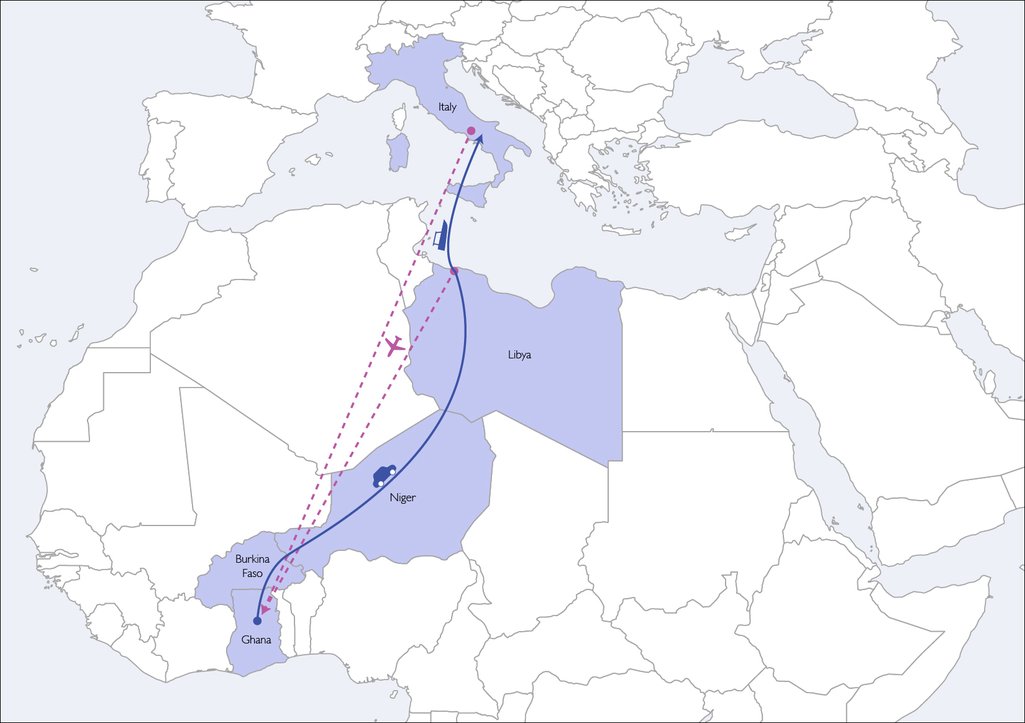
  • Priced out by imports, Ghana’s farmers risk death to work in Italy

    Farmers in Ghana say cheap Italian tomatoes are ruining their businesses. Many have travelled to seek work abroad.

    Adu Poku was a farmer in Ghana. It was all he’d ever known. The maize, okra and tomatoes he grew had brought in enough money to pay for his wedding, and to prepare for the birth of his twins. But then everything changed.

    A mining company came and took over most of his land, and what he grew on the patch he had left was no longer enough to make ends meet. Cheap tomatoes from Italy had flooded the market and driven prices down. Most people in the area were struggling, and few could still afford to eat the more expensive local produce. If Adu kept farming, he was afraid he was going to starve.

    He heard that people were travelling to Italy, and there they were earning enough to keep their families alive back in Ghana. He decided he had no choice but to try his luck as well. What happens after such a decision is made is the focus of this series.

    Adu is one of six Ghanaians who tell the stories of their attempts to get Europe. All risked death in search of a better future, and many of them witnessed their travelling companions die along the way. These six men are still alive to tell us what they saw.
    The economics of survival

    This series sheds light on how, in the age of globalisation, agricultural exports from rich countries impact livelihoods and migration in poorer ones.

    We’re not the first to report on stories like this. The documentary Displaced: Tomatoes and Greed from Deutsche Welle and the results of the Modern Marronage research project both corroborate the series’ main point. But here you will hear it straight from the people experiencing it, in their own words. Their message is simple: people are leaving Ghana’s Bono region, once the country’s bread basket, because canned and frozen foods from abroad are causing their farms to fail.

    For them, the taste of this is made more bitter by what happens next. Farming is what these men know, so in Europe they often end up producing the products that had made their livelihoods unviable in the first place. They become the problem they’re trying to escape. On top of all this, their lack of papers makes them highly vulnerable in Europe. Exploitation, violence, dismal living and working conditions, precarity, and deportation are all commonplace for people in their position. All our contributors who made it were eventually detained and sent back. Getting their security back isn’t part of the bargain, despite the risks they take to get it.

    That is, if they get there. Many never make it all the way. For several of our contributors, the journey ended in Libya, where they were arrested after failing in their attempts to cross the sea. They describe their time in detention as “torture”, but what they had experienced up until that point wasn’t much better. In order to pay for their sea crossing, most had spent weeks, months, sometimes even years labouring on construction sites, trying to save money while running the gauntlet of abusive employers, kidnappers, robbers, and armed actors every single day.

    Giving in to ‘voluntary return’

    Once caught, all our contributors eventually chose to be ‘voluntarily returned’ to Ghana. Usually this is done by the International Organization for Migration – the UN body in charge of coordinating such repatriations. What they say about that experience highlights the ethically ambiguous nature of the idea.

    Voluntary returns are often presented as humanitarian. Proponents say they are good because they help people exit bad situations, even if they take migrants away from their goal rather than toward it. And to make that easier to accept, coordinators often offer migrants various kinds of support if they cooperate. This can include work and skills training, as well as capital to start small businesses or to invest in old ones.

    Researchers have long argued that migrants’ experiences of voluntary return are often very different to what is being advertised. Our contributors confirm this.

    To start with, they take issue with how the whole process is framed. They say that ‘voluntary’ is a strange word to use when their only alternative is continued detention in Italy or abuse by their Libyan jailers. That is a choice in name only, rather than saying ‘yes’ to something they want.

    They also believe they were misled – they claim they were offered substantially more help than they ended up receiving. They got a plane trip to Ghana and a bus ticket back to their home villages, but not the support for a fresh start that they believe they were promised. As a result, most returned worse off to the same situation they had left.

    Except for getting out of jail, nothing had been solved by voluntary return. Instead, it had exacerbated the challenges. Even after they were back for a year, our contributors said they were still facing worse socio-economic economic hardship, marginalisation, and vulnerability than before they first decided to travel. And the only solution they could see for that is more travel.

    Returning people back to an on-going problem isn’t a solution. Our contributors call instead for safe and accessible travel options, equal rights, and dignity for all. They also call for their home government, the international system, and the EU to change practices and policies so that a dignified life at home is possible.

    ▻https://www.opendemocracy.net/en/beyond-trafficking-and-slavery/priced-out-by-imports-ghanas-farmers-risk-death-to-work-in-italy-migr

    #Ghana #Italie #tomates #exploitation #migrations #prix #mines #extractivisme #terres #industrie_agro-alimentaire #exportation #importation #économie_de_survie #Bono #livelihoods #migrerrance #itinéraire_migratoire #retour_volontaire

    –—

    voir aussi le très bon webdoc (que j’avais mis sur seenthis en 2014):
    The dark side of the Italian tomatos

    ►https://seenthis.net/messages/270740

    ping @_kg_

    • Tomatoes and greed – the exodus of Ghana’s farmers

      What do tomatoes have to do with mass migration? Tomatoes are a poker chip in global trade policies. Subsidized products from the EU, China and elsewhere are sold at dumping prices, destroying markets and livelihoods in Africa in the process.

      Edward still harvests tomatoes. But he is no longer on his own fields in Ghana. He now works on plantations in southern Italy under precarious conditions. The tomatoes he harvests are processed, canned and shipped abroad - including to Ghana, where they compete with local products. The flood of cheap imports from China, the US and the EU has driven Ghana’s tomato industry to ruin. Desperate farmers find themselves having to seek work elsewhere, including in Europe. For many, the only route available is a dangerous journey through the desert and across the Mediterranean. Ghana is a nation at peace, a democracy with free elections and economic growth. Nonetheless, tomato farmer Benedicta is only able to make ends meet because her husband regularly sends her money from his earnings in Italy.

      A former tomato factory in Pwalugu, Ghana, illustrates the predicament. This factory once helped secure the livelihood of tomato farmers across the region. Today it lies empty, guarded by Vincent, a former employee who hopes to keep it from falling into ruin. In the surrounding region, the market for tomatoes has collapsed and most farmers are no longer growing what could easily be Ghana’s ‘red gold’. An agricultural advisor is trying to help local tomato farmers, but has little by way of hope to offer. Conditions like this are what drive local farmers to cut their losses and head for Europe. Once in Italy, migrants from Ghana and other African countries are forced to live in desperate conditions near the plantations. They work as day laborers for extremely low wages, helping to grow the very tomatoes that are costing people back home their work and livelihoods. These days, canned tomatoes from China, Italy and Spain are available for purchase on the market of Accra. Some may call this free trade. But economist Kwabena Otoo says free trade should open doors; not destroy people’s lives.

      Every two seconds, a person is forced to flee their home. Today, more than 70 million people have been displaced worldwide. The DW documentary series ‘Displaced’ sheds light on the causes of this crisis and traces how wealthy industrialized countries are contributing to the exodus from the Global South.

      ▻https://www.youtube.com/watch?v=rlPZ0Bev99s

      #reportage #vidéo

    • I left Ghana to farm in Italy. I was exploited in both places

      Kojo risked his life mining in Ghana. He went to Italy for better opportunities, but was shocked by what he saw.

      Kojo Afreh was a farmer and miner in Ghana before he decided to travel to Italy. He hoped that by finding work abroad, he could support his family and eventually marry the mother of his child. But his journey didn’t go to plan. Kojo is one of six migrant workers who told us about their experiences of migration for this series. An explanation of how we produced this interview can be found at the end.

      Raphel Ahenu (BTS): Hello Kojo, thank you for meeting me today. Can you tell me about yourself?

      Kojo Afreh: I’m 27 years old. I have a child but am no longer with the mother. I come from a family of maize farmers, and that was what I was doing for seven years before I travelled.

      My farm was small – I never had the money to invest in something bigger. I was also working in galamsey (small-scale, illegal mining) in order to supplement my income from the farm.

      Raphel: Why did you decide to leave Ghana?

      Kojo: Hardship! I was really struggling. I never had enough money. Galamsey mining is dangerous as well. Bad accidents happen and sometimes people lose their lives. My parents were always worried about me.

      My lack of finances was having a big impact on me. The mother of my child couldn’t marry me because of it – her parents didn’t think I could take care of her even though we had a child together. This situation was so sad and frustrating to me. I decided I had to change something.

      Down in the mining pits, all people spoke about was going overseas. Lots of people were leaving the area, so I decided to join them. I asked my older siblings and parents to help me with the trip, and they put some money together for me. It wasn’t exactly a loan, but they expected me to return the favour by helping them out once I was settled in my new life. They told me not to forget about them when I got there.

      Raphel: What was the journey like?

      Kojo: I joined a car going through Burkina Faso to Niger. One man in the group had travelled that way before and knew where to go. That was good, since it meant we didn’t have to pay anyone to take us.

      Then we had to get out and trek until we got to the edge of the Sahara Desert, where we were met by a pickup truck. There were about 30 people in that car. We each had to bring enough drinking water and food for the journey. Once we ran out, that was it.

      It’s a dangerous route: the desert is scorching hot and so windy. There are no trees for miles. It’s like walking on the sea: there’s simply nothing there.

      Finally, we made it to Libya. I stayed with a group of Ghanaians for about five months, where I did all sorts of jobs to make some money for the boat crossing. Then the opportunity came to leave Libya and we got on a boat crossing to Sicily.

      A lot of things happened on that journey, but I can’t talk about them. They’re too painful.

      Raphel: What was life like in Italy?

      Kojo: When we arrived, the Italian authorities processed us and sent us to a reception centre. From there I called some people who had told me they would help me when I got there. They collected me and took me to Piacenza in northern Italy, where I started working on farms in the countryside. There were a few of us doing whatever work we could find, mostly harvesting potatoes and tomatoes.

      Honestly, it was not great. The work was hard and I was lonely – I felt very far from my people. Our supervisors also treated us badly. They often cheated us out of our wages. I was told that workers are meant to receive €100 a day, but we never got more than €40. When we complained, they said it was because they had deducted food and tool costs. We didn’t have papers, so we couldn’t report them to anyone.

      Despite this, I was still able to send some money back home to repay my family and to buy a small plot of land. And in some ways, the work in Italy was still better than what I was doing in Ghana. Galamsey mining was so dangerous.

      Raphel: When did you get sent back?

      Kojo: I was in Italy for about two years, moving from place to place for work. I worked in Puglia, Campania, Foggia and several other places. I was always careful because I didn’t have papers. But, one day some labour inspectors showed up at a farm I was working on.

      My Italian was not very good, so a man who had been there for longer spoke for all of us. He explained to us that the inspectors thought we were slaves and were offering to assist us if we cooperated with them.

      The inspectors said they would help us get our papers and protection. We agreed and they took us away. We did all they asked. We told them where we’d worked, the pay we had received, and the names of the people we had worked for. Only then did we realise they’d tricked us and were planning to deport us.

      Raphel: You couldn’t stay like they’d promised?

      Kojo: No, we couldn’t. The police told me that because I left the processing centre without permission, I had broken the rules and therefore couldn’t get protection.

      I was taken to an immigration centre for deportation. I didn’t have anything with me – all my money and possessions were still where we’d been staying when the inspectors took us away. Fortunately, I had been transferring money home regularly, so I didn’t lose everything. But I had to leave behind around €300.

      In the detention centre, we were told that we would receive some money if we agreed to go back voluntarily. I felt I had no option but to take the offer. It was my choice, but at the same time it was not my choice.

      Raphel: What was the offer?

      Kojo: They gave me a ticket to Ghana and €1,600. In exchange, I wouldn’t be able to receive a visa for Italy or Europe for 10 years.

      I came back just before the Covid-19 pandemic. I wasn’t able to earn anything during the lockdown, so all the money I had saved quickly disappeared. Suddenly, I was back where I started.

      Hustling for work in Italy is hard, but it’s better than what I have in front of me right now. I’m working in the galamsey mines again, and am trying to raise enough money to return to Italy. This time I hope I will be more successful.

      Raphel: Can you tell me about the association you’re part of in your area?

      Kojo: There’s a movement for people like me who have been returned from Italy and Libya by the UN and IOM. We are trying to get these organisations to honour the promises they made to us.

      When they sent me back, they said they would help me stay in Ghana if I agreed to voluntary return. That’s why I cooperated. But they’re not helping me. I am on my own, and it’s the same for the others who were sent back.

      Most of us say that if we ever go back to Europe or North Africa, we will not agree to voluntary return. We now know they just tell us what we want to hear so that we agree to come back.

      The association meets every once in a while, but we haven’t achieved much because things are tough for everyone. People are thinking about how to afford food, not about what to do with this group.

      Raphel: In the meantime, do you have any requests for the government or local authorities in Ghana?

      Kojo: Yes, I want the authorities to offer people like me more support. I’ve been back for nearly four years and it’s been so difficult financially. I’m still supporting my child and the mother of my child. But I will never earn enough to actually be with them.

      ▻https://www.opendemocracy.net/en/beyond-trafficking-and-slavery/i-left-ghana-to-farm-in-italy-i-was-exploited-in-both-places-migratio

      #choix

  • Remarks at launch of Report “#Making_Migration_Work_For_All”

    I am very pleased to be with all of you to present the report, “Making Migration Work For All”.

    This serves as my principal input to the zero draft of the Global Compact for Safe, Orderly and Regular Migration.

    ▻https://www.un.org/sg/en/content/sg/speeches/2018-01-11/launch-report-making-migration-work-all-remarks

    Lien vers le #rapport: Making Migration Work for Development
    ►http://www.migrationdrc.org/publications/misc/Making_Migration_Work_for_Development.pdf

    #pauvreté #genre #livelihoods

  • Agroforestry saves soil and boosts livelihoods in Tajikistan
    ▻https://news.mongabay.com/2018/11/agroforestry-saves-soil-and-boosts-livelihoods-in-tajikistan

    Tajikistan is a dry and mountainous country where agroforestry is increasingly stabilizing soils degraded by decades of overgrazing, while growing food and providing cover for wildlife.
    “Alley cropping” is the main agroforestry technique used in the area of Faizobod, in which crops or grains are grown between rows of fruit or nut trees that shield the tender annuals from incessant wind and sun.
    Farm sizes are generally small, but farmers whom Mongabay visited enjoy multiple harvests annually, including 4 to 5 tons of apples a year in some cases.
    Agroforestry also sequesters carbon from the atmosphere in the woody trunks and limbs of trees and vines: it’s estimated that there are currently 45 gigatons of carbon sequestered by these agricultural systems worldwide.

    #Tadjikistan #agroforesterie