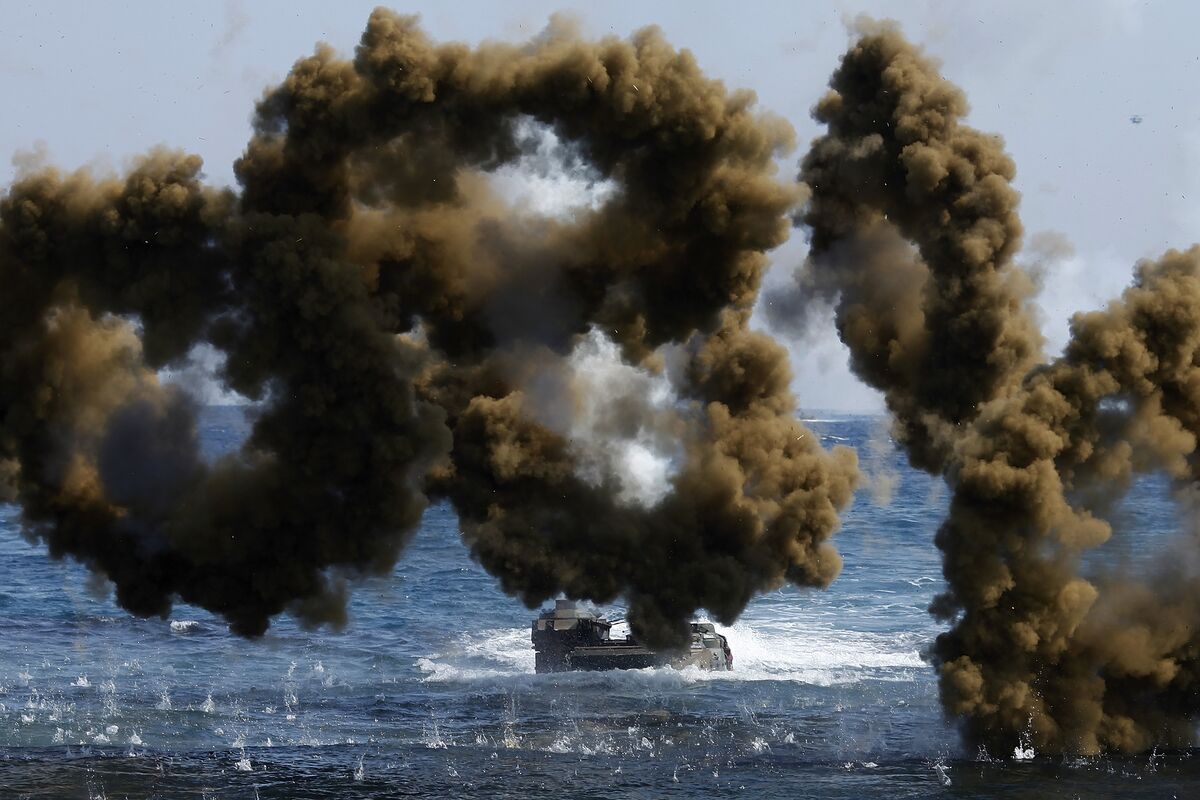
• China Teases New Aircraft Carrier in Video, Vows to Build Up Islands
    subtilités (!) de la communication chinoise…
    ▻https://gcaptain.com/china-teases-new-aircraft-carrier-in-video-vows-to-build-up-islands
    ▻https://gcaptain.com/wp-content/uploads/2026/04/2026-04-23T080558Z_2136804707_RC21C7AEW595_RTRMADP_3_CHINA-POLITICS-MARITI
    FILE PHOTO: Visitors look at replicas of aircraft carriers Liaoning and Shandong, displayed at the PLA Naval Museum on the 75th founding anniversary of the Chinese People’s Liberation Army (PLA) Navy, in Qingdao, Shandong province, China April 23, 2024.
    REUTERS/Florence Lo/File Photo

    BEIJING, April 23 (Reuters) – China teased in a video an aircraft carrier that could be its fourth, and the first using nuclear power, while vowing to further build up its islands, as it looks to boost maritime power, secure resources and bolster territorial claims.

    The video issued on the eve of the 77th founding anniversary of the Chinese People’s Liberation Army Navy featured fictional officers with names that are homophones of three commissioned aircraft carriers, the Liaoning, Shandong and Fujian.

    Titled “Into the Deep,” it showed a 19-year-old named “He Jian” joining the group, unleashing public speculation that it was referring to a nuclear-powered aircraft carrier, as the navy recruit’s name is a homophone of “nuclear vessel” in Mandarin.

    The three aircraft carriers now in service are all conventionally powered, carrying sequential pennant numbers 16, 17, and 18. The new recruit’s age, 19, suggests “He Jian” will conform to the numbering convention.

    China’s defense ministry did not immediately respond to Reuters requests for comment on Wednesday’s video.

    Beijing is spending billions of dollars to build a “bluewater navy” allowing it to project power far from its shores, a goal dating from 2012, when President Xi Jinping became leader of the ruling Communist Party.

    Action sequences in the video featured military drills and strikes in the Pacific. But it also sent a message to democratically-governed Taiwan, which China claims as its territory, despite Taipei’s rejection of the claim.

    The video showed an exchange between a naval officer and his son “Xiao Wan,” the latter’s name an allusion to Taiwan.

    “I don’t want to go home just yet. I want to play out a little longer,” the boy says.

    His father responds, “Xiao Wan, don’t be difficult. Mum is waiting for you at home. Let’s go home.”

    ISLAND BUILD-UP
    China’s natural resources ministry, in an article published in the official People’s Daily, urged greater efforts to “protect” the more than 11,000 islands China claims.

    The vast majority of these are located within 100 km (62 miles) of the coast, with nearly 60% in the East China Sea and the rest in the South China Sea, an official tally showed in 2018.

    China has built artificial islands, airstrips, and military facilities during extensive land reclamation efforts over the years in disputed waters in the #South_China_Sea.

    Last September, Beijing declared a national nature reserve at the disputed #Scarborough_Shoal to assert its claim to the atoll, a long-time flashpoint with the Philippines.

    “The facilities on its artificial island bases have allowed Chinese law enforcement, naval, and militia vessels to spend every day of the year patrolling the waters of its neighbors up to 1,000 nautical miles from the Chinese coastline,” said Gregory Poling of the CSIS think tank.

    But China’s presence in the busy waterway did not deter a senior Taiwan official from a rare visit to the Taiwan-controlled island of Itu Aba, part of the contested #Spratly_Islands.

    Itu Aba has a runway long enough to allow military re-supply flights from Taiwan, while a new wharf opened in 2023 can host a 4,000-ton patrol ship.

    The Philippines, the United States and partner nations started military drills this week, including maritime operations, across the Philippine archipelago.

    The exercises projected a multinational front against China in a region that is a conduit for more than $3 trillion in annual ship-borne commerce.

    “Beijing seems to have hit a point of diminished returns,” said Poling, who heads the think tank’s Southeast Asia program.

    “It has not succeeded in stopping a single Southeast Asian energy project, resupply or construction mission, or the like, in at least four years.”

    #mer_de_Chine_méridionale

  • #Bajo_de_Masinloc (#Scarborough_Shoal): Less-Known Facts vs. Published Fiction - Institute for Maritime and Ocean Affairs
    29/09/2014
    (ou encore, #Panatag_Shoal, #Huángyán_Dǎo et #黄岩岛, pour être complet)
    #mer_de_Chine_méridionale #south_China_sea
    ▻https://imoa.ph/bajo-de-masinloc-scarborough-shoal-less-known-facts-vs-published-fiction


    Figure . Bajo de Masinloc, otherwise known as Scarborough Shoal.
    Source: Landsat

    Introduction
    Ladies and gentlemen, good afternoon.
    Thank you for your kind invitation to speak before you today on the occasion of the exhibit entitled “Historical Truths & Lies: Scarborough Shoal in Ancient Maps.” It is indeed an honour to be asked to deliver a piece on the heels of Senior Associate Justice Antonio T. Carpio’s excellent analysis delivered a few months ago, and now echoing in the form of a map exhibit. But rather than attempt to duplicate Justice Carpio’s research, allow me to share with you some additional thoughts, snippets of historical facts, and documentary evidence that will round out the story he has been able to tell. These are facts that are of public record, and readily available to all.
    I will begin with the basic question of why a few rocks and a reef called Bajo de Masinloc (Scarborough Shoal) is important to the Philippines. Then I shall show you the basis and evidence of Philippine sovereignty over Bajo de Masinloc. I shall show you that we do have stronger evidence and a better right to Bajo de Masinloc, notwithstanding China’s insistence on its claim. And then I shall try to throw in some ideas meant to provoke a serious and sanguine conversation about what the Philippines should do next in relation to our pending issues with China over Bajo de Masinloc.


    Figure . Chlorophy concentrations in plankton in the South China Sea, overlaid on GoogleEarth. A plume of plankton connects Bajo de Masinloc to the Philippines, indicating its biological linkage at certain times of the year.
    Source: NASA

    (le point vert entre les mots Philippines et South China Sea)

    ▻http://www.imoa.samgalope.dev/wp-content/uploads/2014/09/FIGURE-004.jpg
    Figure . Sea routes (red) and air routes (green) through the West Philippine Sea and South China Sea. Bajo de Masinloc is strategically located between such routes near Manila and Subic.
    Source: NCEAS, ICAO

  • China discovers major oilfield in South China Sea - Global Times
    (by Xinhua)
    ▻https://www.globaltimes.cn/page/202503/1331202.shtml


    This undated photo shows a drilling platform at Huizhou 19-6 oilfield in the eastern South China Sea. The China National Offshore Oil Corporation (CNOOC) announced on Monday that it has discovered a major oilfield in the eastern South China Sea, with proven reserves exceeding 100 million tonnes.
    CNOOC/Handout via Xinhua

    The China National Offshore Oil Corporation (CNOOC) announced on Monday that it has discovered a major oilfield in the eastern South China Sea, with proven reserves exceeding 100 million tonnes.

    The newly discovered Huizhou 19-6 oilfield marks a breakthrough in China’s offshore oil exploration, as it is the country’s first large-scale integrated clastic oilfield discovered in deep to ultra-deep layers, CNOOC said.

    Situated about 170 km from Shenzhen in south China’s Guangdong Province, the oilfield sits at an average water depth of 100 meters. Test drilling has yielded a daily production of 413 barrels of crude oil and 68,000 cubic meters of natural gas, demonstrating its potential.

    According to the company, offshore oil and gas exploration in deep to ultra-deep layers faces multiple challenges, including high temperatures, high pressures, and complex conditions.

    Meanwhile, clastic reservoirs, an important component of deep-sea hydrocarbon deposits, generally have low permeability, making the identification of large oil and gas fields more difficult.

    Peng Guangrong, a geologist at CNOOC’s Shenzhen branch, noted that 60 percent of the world’s newly discovered oil and gas reserves have come from deep layers. With abundant resources and a low level of exploration, deep to ultra-deep layers are expected to drive future growth in oil and gas reserves and production.

    China’s oil and gas exploration in the eastern South China Sea has seen consecutive breakthroughs, with oilfields exceeding 100 million tonnes in reserves discovered for two straight years, said CNOOC’s CEO Zhou Xinhuai.

    • Chine-États-Unis : préparatifs guerriers

      ►https://journal.lutte-ouvriere.org/2023/04/12/chine-etats-unis-preparatifs-guerriers_609617.html

      Entre le samedi 8 avril et le dimanche 10, l’armée chinoise a déployé autour de Taïwan onze bateaux de guerre et plus de 70 avions, simulant l’encerclement de l’île ainsi que son bombardement. La Chine répondait ainsi à la visite en Californie de la présidente de Taïwan, #Tsai_Ing-wen.

      Cette visite, le 5 avril, s’inscrit dans la préparation de l’élection présidentielle taïwanaise de janvier 2024, une campagne que Tsai Ing-wen mène pour le compte de son parti, le DPP. Son escale américaine lui aura permis de se donner une stature internationale. Elle a salué le soutien indéfectible des États-Unis et de Kevin McCarthy, président de la Chambre des représentants américains, qui en a profité pour appeler son pays à continuer à vendre des armes à Taïwan. Les uns comme les autres espèrent ainsi enrayer la perte de vitesse du DPP sur l’île et justifier auprès de la population taïwanaise la nécessité de l’indépendance, alors qu’une partie grandissante semble en douter, si l’on en croit la défaite que le DPP a subie aux élections locales de novembre dernier au profit de son concurrent, le KMT, qui défend une ligne de statu quo, voire de rapprochement avec Pékin.

      Les dirigeants du DPP et les dirigeants américains ont sans doute estimé que la réaction militaire du gouvernement chinois, s’il y en avait une, légitimerait aussi la position du DPP. Cette réaction était en effet prévisible et sans aucun doute prévue. En août 2022, la visite à Taïwan de Nancy Pelosi, qui occupait alors la même fonction que McCarthy, avait provoqué des manœuvres de plus grande ampleur encore. Alors que le gouvernement de Pékin affirme depuis toujours que Taïwan fait partie de la #Chine et que son indépendance formelle est un motif de guerre, les #États-Unis et le DPP, avec ces contacts d’officiels au plus haut niveau, font monter la pression. Ils savent pertinemment que le #gouvernement_chinois ne peut pas ne pas répondre.

      L’armée chinoise s’est ainsi déployée pendant trois jours, simulant l’encerclement et le #bombardement de l’île, faisant franchir à plusieurs dizaines de ses avions la ligne médiane du détroit de Taïwan, et mettant en œuvre son dernier porte-avions, le Shandong, qui navigue dans la zone à environ 370 km à l’est de l’île. L’#armée_chinoise a également annoncé que les manœuvres autour de Taïwan seraient prolongées par d’autres jusqu’au 20 avril au large du #Fujian, dans le détroit de Taïwan. Les États-Unis, dont une partie de la flotte est en permanence sur zone, le #porte-avions américain Nimitz en particulier se trouvant à proximité, en ont profité pour observer les capacités militaires de la #marine_chinoise et pour montrer à leur tour leur présence et leur puissance. Ils ont ainsi déployé le 9 avril un destroyer en #mer_de_Chine_méridionale, un peu au sud de Taïwan, dans une opération dite de liberté de navigation, consistant à croiser à proximité des îles que les Chinois se sont appropriées. Et mardi 11 avril, ils ont entamé leurs exercices militaires annuels conjoints avec les Philippines en mobilisant au total 18 000 soldats, deux fois plus qu’en 2022.

      Les dirigeants taïwanais et américains préparent les esprits à la guerre. Les dirigeants chinois ne sont pas en reste. #Taïwan et ses 23 millions d’habitants deviennent ainsi l’enjeu d’un affrontement qui les dépasse.

    • Chine-États-Unis : une concurrence féroce mais inégale
      ▻https://mensuel.lutte-ouvriere.org/2022/01/23/chine-etats-unis-une-concurrence-feroce-mais-inegale_196804.

      (#archiveLO, 9 janvier 2022)

      – Une nouvelle superpuissance  ?
      – Des relations inégalitaires
      – Un nouvel #impérialisme  ?
      – Le «  rêve chinois  » de Xi Jinping
      – Guerre économique  : le raidissement des États-Unis
      – Les provocations occidentales
      – La #guerre, une menace toujours plus proche

    • Océan pacifique : préparatifs guerriers
      ▻https://journal.lutte-ouvriere.org/2023/03/15/ocean-pacifique-preparatifs-guerriers_552402.html
      (#archiveLO, 15 mars 2023)

      Depuis la base navale californienne de San Diego, le président américain Biden, le premier ministre britannique Sunak et son homologue australien Albanese ont lancé le 13 mars la nouvelle phase de leur alliance militaire.

      Les trois pays développeront ensemble et construiront dans leurs arsenaux respectifs un nouveau type de #sous-marin d’attaque à propulsion nucléaire (SNA). La série est baptisée SNN Aukus, comme l’alliance #Australie- UK- USA. En attendant les premiers lancements, prévus pour 2040, les États-Unis fourniront, sous deux ans, trois voire cinq SNA à la marine australienne. Le #budget officiel de ce programme dépasse les 200 milliards de dollars.

      En plus de la montée en puissance navale, #Aukus marque l’intégration de plus en plus poussée dans la marine américaine des marines britannique et australienne, de leurs arsenaux et de leurs équipages. Le projet comprend aussi des groupes de recherche dans des domaines intéressant l’armement, depuis les missiles hypersoniques jusqu’aux ordinateurs quantiques nécessaires pour la guerre de l’espace. La marine japonaise, déjà en partie équipée par les États Unis et coordonnée avec eux, ne devrait pas tarder à rejoindre cette alliance évidemment dirigée contre la Chine.

      Pour justifier ce programme guerrier les porte-parole officiels et officieux de l’#impérialisme américain montent en épingle la menace chinoise. Cela va du ridicule, comme l’interdiction du réseau social pour ados Tik-Tok, au terrifiant, en affirmant que la flotte chinoise serait désormais la plus puissante au monde.

      La flotte chinoise, si l’on compte tous ses bâtiments jusqu’à la plus modeste vedette des douanes, est certes la plus nombreuse. Mais la #flotte_américaine, sans même intégrer Aukus, l’Otan et les autres alliés, reste de très loin la plus puissante. Les États-Unis détiennent 14 sous-marins nucléaires lanceurs d’engins à tête nucléaire, alors que la #Chine en a sept. Et, surtout, ils arment 50 SNA soit la moitié de ceux en service actuellement dans le monde, alors que la Chine en a neuf. Enfin, un seul des onze #porte-avions américains, les plus gros, les plus rapides, les plus armés et les seuls dotés de catapultes, est plus écrasant et plus coûteux que les trois porte-avions chinois réunis.

      Aujourd’hui le programme naval Aukus est une garantie de bénéfices considérables pour des marchands de canons américains déjà multimilliardaires et, exceptionnellement, une fleur pour leur confrère britannique #BAE_Systems. Par la constitution d’une force navale intégrée, c’est aussi l’indication des camps d’un futur conflit général qui se dessinent et se préparent techniquement. Loin de défendre la paix, l’impérialisme promet la #guerre.

      #États-Unis #Royaume-Uni

    • Chine-États-Unis : préparatifs guerriers
      ►https://journal.lutte-ouvriere.org/2023/04/12/chine-etats-unis-preparatifs-guerriers_609617.html
      (#archiveLO, 12 avril 2023)

      Entre le samedi 8 avril et le dimanche 10, l’armée chinoise a déployé autour de Taïwan onze bateaux de guerre et plus de 70 avions, simulant l’encerclement de l’île ainsi que son bombardement. La Chine répondait ainsi à la visite en Californie de la présidente de Taïwan, Tsai Ing-wen.

      Cette visite, le 5 avril, s’inscrit dans la préparation de l’élection présidentielle taïwanaise de janvier 2024, une campagne que Tsai Ing-wen mène pour le compte de son parti, le DPP. Son escale américaine lui aura permis de se donner une stature internationale. Elle a salué le soutien indéfectible des États-Unis et de Kevin McCarthy, président de la Chambre des représentants américains, qui en a profité pour appeler son pays à continuer à vendre des armes à Taïwan. Les uns comme les autres espèrent ainsi enrayer la perte de vitesse du DPP sur l’île et justifier auprès de la population taïwanaise la nécessité de l’indépendance, alors qu’une partie grandissante semble en douter, si l’on en croit la défaite que le DPP a subie aux élections locales de novembre dernier au profit de son concurrent, le KMT, qui défend une ligne de statu quo, voire de rapprochement avec Pékin.

      Les dirigeants du DPP et les dirigeants américains ont sans doute estimé que la réaction militaire du gouvernement chinois, s’il y en avait une, légitimerait aussi la position du DPP. Cette réaction était en effet prévisible et sans aucun doute prévue. En août 2022, la visite à Taïwan de Nancy Pelosi, qui occupait alors la même fonction que McCarthy, avait provoqué des manœuvres de plus grande ampleur encore. Alors que le gouvernement de Pékin affirme depuis toujours que Taïwan fait partie de la Chine et que son indépendance formelle est un motif de guerre, les États-Unis et le DPP, avec ces contacts d’officiels au plus haut niveau, font monter la pression. Ils savent pertinemment que le gouvernement chinois ne peut pas ne pas répondre.

      L’armée chinoise s’est ainsi déployée pendant trois jours, simulant l’encerclement et le bombardement de l’île, faisant franchir à plusieurs dizaines de ses avions la ligne médiane du détroit de Taïwan, et mettant en œuvre son dernier porte-avions, le Shandong, qui navigue dans la zone à environ 370 km à l’est de l’île. L’armée chinoise a également annoncé que les manœuvres autour de Taïwan seraient prolongées par d’autres jusqu’au 20 avril au large du Fujian, dans le détroit de Taïwan. Les États-Unis, dont une partie de la flotte est en permanence sur zone, le porte-avions américain Nimitz en particulier se trouvant à proximité, en ont profité pour observer les capacités militaires de la marine chinoise et pour montrer à leur tour leur présence et leur puissance. Ils ont ainsi déployé le 9 avril un destroyer en mer de Chine méridionale, un peu au sud de Taïwan, dans une opération dite de liberté de navigation, consistant à croiser à proximité des îles que les Chinois se sont appropriées. Et mardi 11 avril, ils ont entamé leurs exercices militaires annuels conjoints avec les Philippines en mobilisant au total 18 000 soldats, deux fois plus qu’en 2022.

      Les dirigeants taïwanais et américains préparent les esprits à la guerre. Les dirigeants chinois ne sont pas en reste. Taïwan et ses 23 millions d’habitants deviennent ainsi l’enjeu d’un affrontement qui les dépasse.

  • South China Sea: US unveils first sanctions linked to militarisation | South China Sea | The Guardian
    ▻http://www.theguardian.com/world/2020/aug/27/south-china-sea-us-unveils-first-sanctions-linked-to-militarisation

    The United States has blacklisted 24 Chinese companies and targeted individuals it said were part of construction and military efforts in the South China Sea, its first such sanctions move over the disputed strategic waterway.

    The US Commerce Department said the companies played a “role in helping the Chinese military construct and militarise the internationally condemned artificial islands in the South China Sea”.

    #chine #états-unis #mer_de_chine_méridionale

  • Les installations fixes en #Mer_de_Chine_méridionale
    (base de données)

    Island Tracker Archive | Asia Maritime Transparency Initiative
    ▻https://amti.csis.org/island-tracker

    Five claimants occupy nearly 70 disputed reefs and islets spread across the #South_China_Sea. They have built more than 90 outposts on these contested features, many of which have seen expansion in recent years. AMTI has gathered satellite imagery of each outpost, along with other relevant information, to document their current status and any changes they have undergone in recent years. Explore the database below.

    Chine : 27
    Malaisie : 5
    Philippines : 9
    Taiwan : 1
    Vietnam : 21 (+ 6 plateformes)

  • Journal articles ‘tacitly support China territory grab’

    The role of academic journals in adjudicating on fiercely disputed territorial claims in the South China Sea has come under scrutiny as Chinese scholars use maps endorsing China’s position.

    Papers by Chinese researchers, often co-authored with Western collaborators, have been illustrated with maps that include the “nine-dash line” – a U-shaped borderline stretching south from China and Taiwan to Borneo. It envelopes islands and reefs claimed by Brunei, Malaysia, the Philippines, Taiwan and Vietnam, including Scarborough Shoal and the Spratly Islands.

    An international tribunal convened in The Hague in 2016 under the United Nations Convention on the Law of the Sea ruled against the line. China disputes the ruling.

    Clive Hamilton, professor of public ethics at Charles Sturt University in Canberra, claimed that the issue echoed moves in 2017 by Springer Nature and Cambridge University Press to appease China by removing politically sensitive articles from their Chinese websites.

    “Here’s another example of Beijing asserting its claims through international scientific journals,” said Professor Hamilton, a high-profile critic of Chinese foreign policy.

    “A very big, economically powerful authoritarian power [is] engaged in a political struggle over territory, and wants the international scientific community to in effect endorse its claim by publishing maps that have no validity under international law.”

    He said Chinese researchers “would undoubtedly suffer if they were authors of an article in an international journal that included the South China Sea but did not show the nine-dash line”.

    However, one influential journal said that it was “not unusual” for scientific publishers to remain neutral on jurisdictional claims, while a China expert warned of the difficulty of requiring peer reviewers to be aware of and enforce geopolitical issues.

    Times Higher Education has found nine-dash line representations in nine journal articles by Chinese researchers. Most have been published since early last year, and none is about maritime issues. The papers’ subject matter includes bamboo, butterflies and Tibetan vegetation. Five boast co-authors from Australia, Germany, Scotland, Singapore and the US.

    An Australian geneticist based in Japan said maps depicting Chinese ownership of South China Sea islands appeared in about half the Chinese-authored papers he came across. Their frequency was increasing, the scientist continued, and they now appeared in high-ranking international journals as well as in smaller publications favoured by Chinese authors.

    The researcher, who asked not to be named, said he had objected to such a map’s inclusion in a forthcoming paper he wrote with Chinese collaborators. “I was told that they cannot do anything because it is a requirement of the Chinese Communist Party. They are provided with official maps that they have to use.

    “Most [foreign co-authors] choose to ignore it, perhaps because they think it is not worth the trouble to say anything. Journals do not give guidelines on how to deal with the issue when reviewing papers.”

    THE sought comment from the journals Cells, Diversity and Distributions, Molecular Ecology, New Phytologist and Plos One. The last was the only one to respond, saying that a policy introduced last year required territorial descriptions in submitted manuscripts to “follow international treaties and conventions”.

    “Otherwise, Plos remains neutral on any jurisdictional claims expressed,” it added. “This policy is not unusual in scientific publishing.”

    Professor Hamilton said journals that failed to enforce such policies “implicitly endorsed a claim that violated the rights of poor Filipino fishermen. My guess is editors have probably not had it drawn to their attention,” he added.

    University of Melbourne entomologist Nancy Endersby co-authored a 2019 Cells paper that contains representations of the nine-dash line. “If I had been aware of this inclusion and its significance, I would not have allowed my name to be on the paper,” she said. “I focused on the molecular aspect of the paper and trusted [the] map was accurate.”

    Co-author Ary Hoffman said: “Now that we’re aware of it, we’ll certainly look for it in any future collaborative efforts. As biologists, it is not something that was on our radar.”

    James Laurenceson, head of the Australia-China Relations Institute at the University of Technology Sydney, supported Professor Hamilton in raising the issue. He said Chinese academics were likely to assume that Beijing would “look approvingly” on their reproduction of the nine-dash line.

    “But I wouldn’t necessarily take it as evidence that they’ve been directed to do so,” he said. “I’m not sure the Chinese bureaucracy is that organised.”

    Professor Laurenceson said peer review had failed to pick up the offending maps. “Finding peer reviewers of journals is tough enough already,” he said. “If we insist that they’re also aware of geopolitical issues, many academics are just not going to have the time to be abreast of it.”

    ▻https://www.timeshighereducation.com/news/journal-articles-tacitly-support-china-territory-grab

    #manipulation #cartographie #visualisation #Chine #Philippines #différend_territorial #revues_scientifiques #recherche #nine-dash_line #Mer_de_Chine_méridionale #responsabilité

    ping @simplicissimus @reka

  • Inside the Close Naval Encounters in the South China Sea - Bloomberg

    On notera que la seule chose que confient les officiers interrogés sur ce navire amiral est que le comportement des navires qui les ont pistés à de multiples reprises à toujours été extrêmement sûr. Ils ne disent pas a toujours été extrêmement professionnel, car cela contredirait trop ouvertement les déclarations officielles.

    ▻https://www.bloomberg.com/news/articles/2019-05-13/south-china-sea-naval-encounters


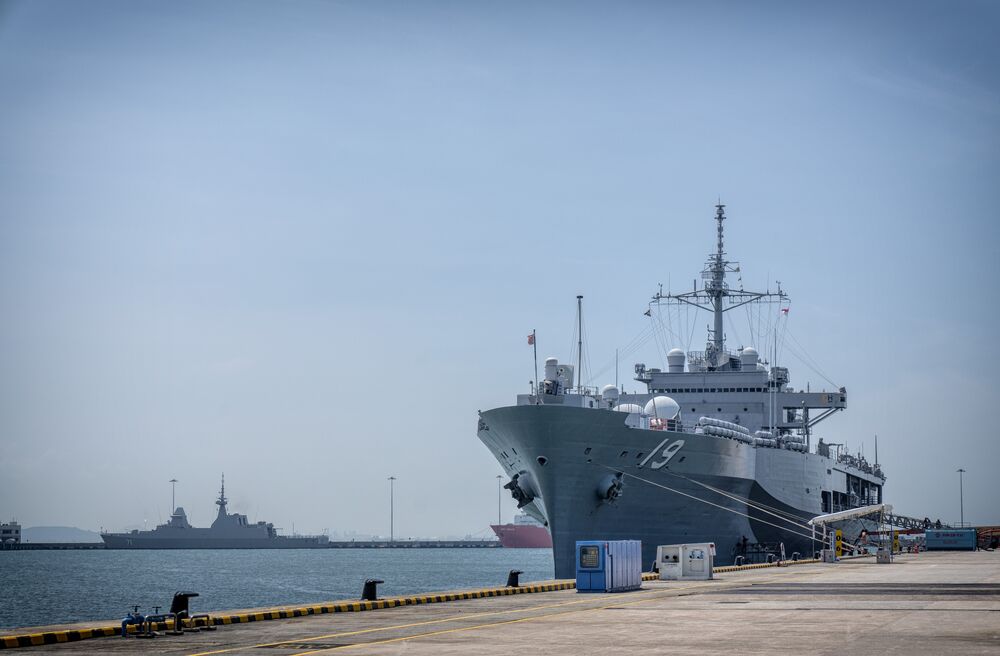
    The U.S. Navy’s USS Blue Ridge in Singapore on May 9.
    Photographer : Bryan van der Beek/Bloomberg

    The voice on the radio in the middle of the South China Sea follows a familiar script for Captain Eric Anduze, who helms the USS Blue Ridge. It’s China on the phone.

    “They’ll contact us and they’ll go — ‘U.S. government vessel, this is Chinese Navy vessel’ number whatever — ‘we will maintain five miles from you and escort you as you make your transit,”’ Anduze said, describing the English-speaking voice from a rival Chinese warship.

    The U.S. response is short: “Chinese vessel, this is government vessel 1 9, copy, out.” From there on, silence, as the vessels of the world’s rival powers steam onward together.

    The ship-to-ship interactions are a regular potential flash point for the world’s two biggest militaries in contested waters. In September, a Chinese destroyer sailed within a football field’s distance of the USS Decatur in what the U.S. said was an “unsafe and unprofessional” maneuver. That hasn’t deterred future sailings — the U.S. sent two guided-missile destroyers within 12 nautical miles of disputed islands earlier this month.

    Based in Japan, the Blue Ridge is a frequent traveler through the South China Sea, which Beijing considers its waters against an international community increasingly concerned by its encroachment. The area is home to key shipping lanes and fisheries that have sparked dispute between China and its neighbors.
    […]
    The U.S. Navy allowed media outlets, including Bloomberg, an inside look at the sort of ship it’s using to sail through the disputed waters. The oldest operational warship in the American Navy, the Blue Ridge is the flagship of the 7th Fleet, and docked in Singapore as part of a tour of southeast Asian port cities.

    The Blue Ridge is billed as one of the most technologically advanced ships in the world. It operates as a central information node for a fleet whose range stretches from the Indian-Pakistan border to the International Date Line in the Pacific Ocean. Through its several computers flow a database the Navy says gives it a “complete tactical picture of air, surface and subsurface contacts.” That’s what it does: it sails and it knows things.
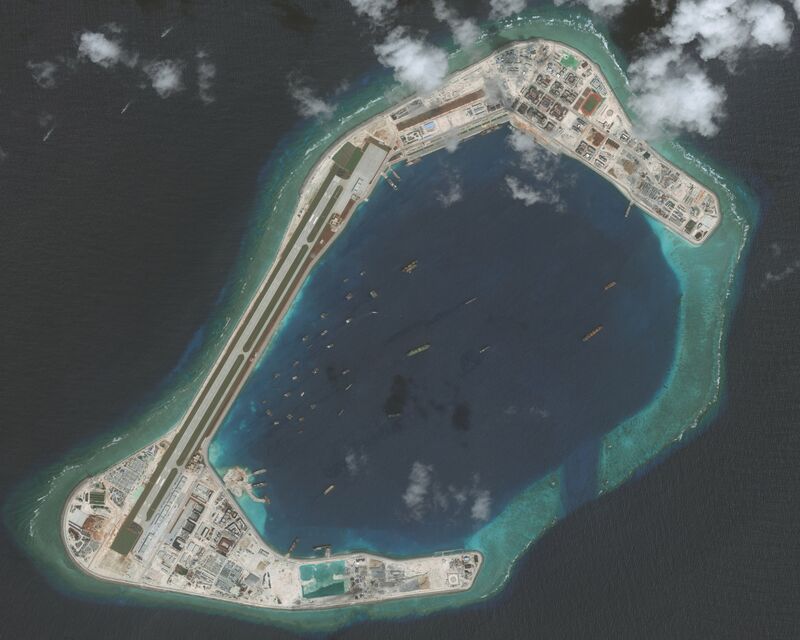
    The ship is a small floating town of more than 1,000 sailors at any given time. There are beds and cafeterias, fitness centers and a post office. A miniature hospital has sick beds and an operating room, along with a dentist who can fill a cavity or pull a tooth — unless the waves get too rough. Up on deck, sailors can jog around a makeshift track around the ship, at about seven laps to a mile.

    Since February, Captain Anduze said the Blue Ridge has been escorted by Chinese vessels about six times in an almost unremarkable and now routine manner.

    In Washington, the view is that China uses “coercive tactics” including its naval and paramilitary vessels to enforce claims in the South China Sea, the Pentagon said last week in its annual report on China’s military power. Those are targeted “in ways calculated to be below the threshold of provoking conflict,” though have escalated into near-misses with U.S. warships.

    Naval officials on the Blue Ridge declined to comment in detail on those more aggressive encounters, except to say nothing similar had happened with them as they passed through the South China Sea’s shipping lanes.

    “We have had ships that come about three to four miles away and then just navigate with us throughout the area,” Anduze said. Those interactions have been “very safe.”

  • China Military Threat: Seeking New Islands to Conquer - James Stavridis - Bloomberg
    ▻https://www.bloomberg.com/opinion/articles/2019-02-21/china-military-threat-seeking-new-islands-to-conquer

    The constant refrain was simple: The West is becoming a less reliable partner. These allies are dismayed by a U.S. administration that has repeatedly criticized its closest partners and accused them of freeloading on defense. They are also worried about weakness and distraction of a Europe facing Brexit. This is compounded as they watch China increase pressure on Taiwan to accept a “one nation, two systems” deal a la Hong Kong and militarize the #South_China_Sea by constructing artificial islands.
    […]
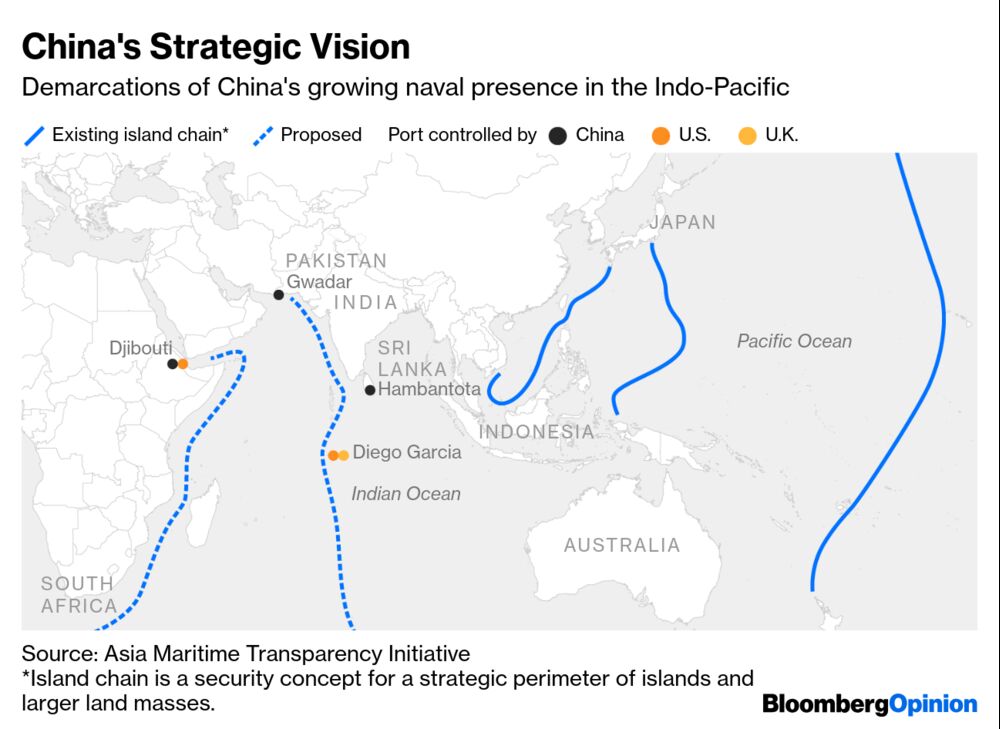
    There is also a less-noticed but extremely worrisome aspect to China’s increasing boldness: It seems to be building its naval capability to dominate farther into the Pacific — as far as what Western analysts call the “second island chain.”

    When thinking in a geo-strategic sense about China, the island-chain formulation is helpful. Since the 1950s, U.S. planners have delineated a first island chain, running from the Japanese islands through the Philippines, and down to the tip of Southeast Asia. Dominating inside that line has been the goal of China’s recent buildup in naval and missile capabilities. But U.S. officials warn that Chinese strategists are becoming more ambitious, set on gaining influence running to the second island chain — running from Japan through the Micronesian islands to the tip of Indonesia. As with its initial forays into the South China Sea, Beijing is using “scientific” missions and hydrographic surveying ships as the tip of the spear.

    Japan and Singapore are essentially anchors at the north and south ends the island chains. They have been integrating their defense capabilities with the U.S. through training, exercises and arms purchases. They are exploring better relations with India as the Pacific and Indian Oceans are increasingly viewed as a single strategic entity. This is a crucial element in the U.S. strategy for the region. But there are changes coming.

    First, there are expectations that China will eye the third island chain, encompassing Hawaii and the Alaskan coast before dropping south down to New Zealand. This has long been regarded as the final line of strategic demarcation between the U.S. and China. Second, some analysts are beginning to talk about a fourth and even fifth island chain, both in the Indian Ocean, an increasingly crucial zone of competition between the U.S. and China.

    Two obvious Indian Ocean chains exist. The first would run from southern Pakistan (where China has created a deep-water port at Gwador) down past Diego Garcia, the lonely atoll controlled by the U.K. from which the U.S. runs enormous logistical movements into Central Asia. As a junior officer on a Navy cruiser in the 1980s, I visited Diego Garcia when it was essentially a fuel stop with a quaint palm-thatched bar. The base has expanded enormously, becoming critical to supporting U.S. and British combat efforts in the Horn of Africa and Middle East.

    The fifth and final island chain could be considered to run from the Horn of Africa – where the U.S. and China now maintain significant military bases – down to the coast of South Africa. Little wonder the U.S. military has renamed its former Pacific Command as the Indo-Pacific Command.

    #Mer_de_Chine_méridionale

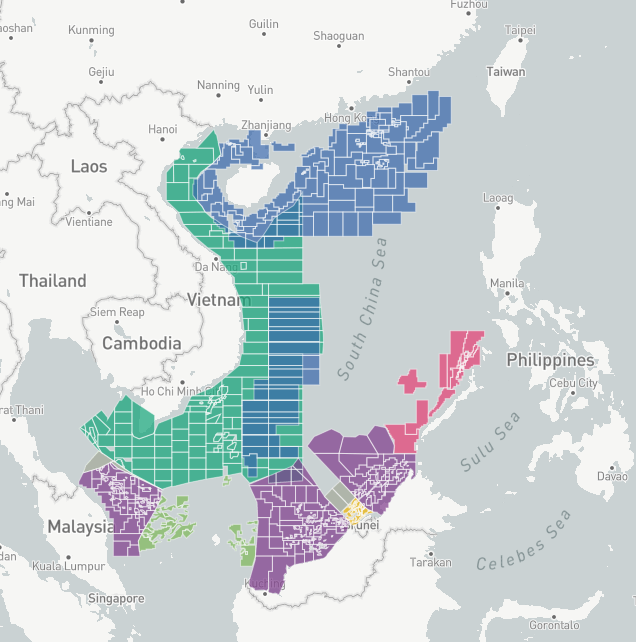
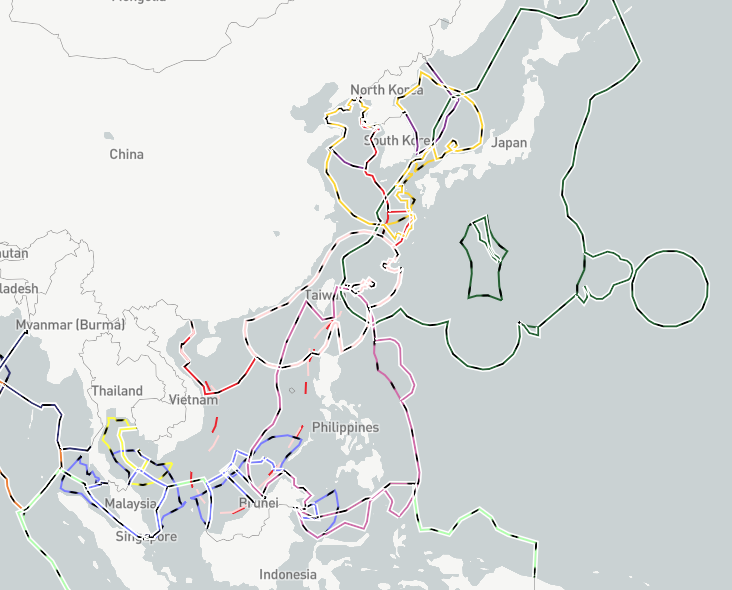
  • Asia Maritime Transparency Initiative : Who’s Claiming What ?

    ▻https://amti.csis.org/maps

    Voici un site qui va énormément plaire en particulier à @simplicissimus

    AMTI’s interactive maps strive to provide the most complete, accurate, and up-to-date source of geospatial information on maritime Asia. Click a map below to explore information on Asia’s maritime claims, disputed reefs and islets, and more.
    South China Sea Features

    #mer_de_chine_méridionale #frontières #différends_frontaliers #chine #vietnam #spratleys #conflits_frontaliers #mer #partage_de_la_mer

  • U.S. Navy ship sails in disputed South China Sea amid trade talks with Beijing | Reuters
    ▻https://www.reuters.com/article/us-usa-trade-china-southchinasea-idUSKCN1P10DS

    The USS McCampbell carried out a “#freedom_of_navigation” operation, sailing within 12 nautical miles of the Paracel Island chain, “to challenge excessive maritime claims”, Pacific Fleet spokeswoman Rachel McMarr said in an emailed statement.

    The operation was not about any one country or to make a political statement, McMarr said.

    Une petite démonstration #FoN, pour bien démarrer l’année. Mais, attention, hein, on ne vise personne…

  • Le monde selon #Xi_Jinping

    Depuis 2012, le désormais « président à vie » Xi Jinping a concentré tous les pouvoirs sur sa personne, avec l’obsession de faire de la #Chine la superpuissance du XXIe siècle. Plongée au coeur de son « rêve chinois ».

    Derrière son apparente bonhomie se cache un chef redoutable, prêt à tout pour faire de la Chine la première puissance mondiale, d’ici au centenaire de la République populaire, en 2049. En mars dernier, à l’issue de vastes purges, Xi Jinping modifie la Constitution et s’intronise « président à vie ». Une concentration des pouvoirs sans précédent depuis la fin de l’ère maoïste. Né en 1953, ce fils d’un proche de Mao Zedong révoqué pour « complot antiparti » choisit à l’adolescence, en pleine tourmente de la Révolution culturelle, un exil volontaire à la campagne, comme pour racheter la déchéance paternelle. Revendiquant une fidélité aveugle au Parti, il gravira en apparatchik « plus rouge que rouge » tous les degrés du pouvoir.
    Depuis son accession au secrétariat général du Parti en 2012, puis à la présidence l’année suivante, les autocritiques d’opposants ont réapparu, par le biais de confessions télévisées. Et on met à l’essai un système de surveillance généralisée censé faire le tri entre les bons et les mauvais citoyens. Inflexible sur le plan intérieur, Xi Jinping s’est donné comme objectif de supplanter l’Occident à la tête d’un nouvel ordre mondial. Son projet des « routes de la soie » a ainsi considérablement étendu le réseau des infrastructures chinoises à l’échelle planétaire. Cet expansionnisme stratégique, jusque-là développé en silence, inquiète de plus en plus l’Europe et les États-Unis.

    Impériale revanche
    Dans ce portrait très documenté du leader chinois, Sophie Lepault et Romain Franklin donnent un aperçu inédit de sa politique et montrent que l’itinéraire de Xi Jinping a façonné ses choix. De Pékin à Djibouti – l’ancienne colonie française est depuis 2017 la première base militaire chinoise à l’étranger – en passant par la mer de Chine méridionale et l’Australie, les réalisateurs passent au crible les projets et les stratégies d’influence du nouvel homme fort de la planète. Nourrie d’images d’archives et de témoignages (de nombreux experts et de dissidents, mais aussi d’un haut gradé proche du pouvoir), leur enquête montre comment Xi Jinping a donné à la reconquête nationaliste de la grandeur impériale chinoise, projet nourri dès l’origine par la République populaire, une spectaculaire ampleur.

    ►https://www.arte.tv/fr/videos/078193-000-A/le-monde-selon-xi-jinping
    #biographie #démocratie #trauma #traumatisme #Mao #révolution_culturelle #Terres_Jaunes #exil #Prince_Rouge #nationalisme #rêve_chinois #renaissance_nationale #histoire_nationale #totalitarisme #stabilité #idéologie #anti-corruption #lutte_contre_la_corruption #purge #dictature #investissements_à_l'étranger #prêts #dette #KUKA #ports #droits_humains #Australie #infiltration_chinoise #Nouvelle-Zélande #David_Cameron #Jean-Pierre_Raffarin #matières_premières #capitalisme_autoritaire #Ouïghours #arrestations #répression #censure #liberté_d'expression #défilés_militaires #armée #puissance_militaire #Mer_de_Chine_méridionale #îles_de_Spratleys #liberté_de_la_presse #prisonniers_politiques #Hong_Kong

    #Djibouti #base_militaire (de Djibouti)

    #Sri_Lanka —> Au Sri Lanka, le #port de #Hambantota est sous contrôle chinois, ceci pour au moins 99 ans (accord signé avec le Sri Lanka qui n’a pas pu rembourser le prêt que la Chine lui a accorder pour construire le port...)
    #dépendance
    v. aussi :
    Comment la Chine a fait main basse sur le Sri Lanka
    ▻https://www.courrierinternational.com/article/comment-la-chine-fait-main-basse-sur-le-sri-lanka

    Histoire semblable pour le #Port_du_Pirée à #Athènes, en #Grèce ou l’#aéroport de #Toulouse, en #France.

    #Organisation_de_coopération_de_Shangaï :


    ►https://fr.wikipedia.org/wiki/Organisation_de_coop%C3%A9ration_de_Shanghai
    #Grande_unité_mondiale #enrichissement_pour_tous

    Quelques cartes et images tirées du #film #documentaire.

    La #nouvelle_route_de_la_soie et autres investissements chinois dans les infrastructures mondiales de #transport :

    La #Chinafrique :


    #Afrique
    Afrique où la Chine propose la « #solution_chinoise », programme de #développement basé sur le #développement_économique —> « #modèle_chinois de développement »

    Le programme de #surveillance_de_masse :

    Outre la surveillance, mise en place d’un programme appelé « #crédit_social » :

    Le #Système_de_crédit_social est un projet du gouvernement chinois visant à mettre en place d’ici 2020 un système national de #réputation_des_citoyens. Chacun d’entre eux se voit attribuer une note, échelonnée entre 350 et 950 points, dite « crédit social », fondée sur les données dont dispose le gouvernement à propos de leur statut économique et social. Le système repose sur un outil de surveillance de masse et utilise les technologies d’analyse du #big_data. Il est également utilisé pour noter les entreprises opérant sur le marché chinois.

    ▻https://fr.wikipedia.org/wiki/Syst%C3%A8me_de_cr%C3%A9dit_social

    Voici ce que cela donne :


    #surveillance #contrôle_de_la_population #vidéosurveillance #reconnaissance_faciale #contrôle_social
    #cartographie #visualisation
    ping @etraces

    ping @reka

  • Photos Show Confrontation Between USS Decatur and a Chinese Navy Warship in South China Sea – gCaptain
    ▻https://gcaptain.com/photos-show-confrontation-between-uss-decatur-and-chinese-navy-warship-in-


    U.S. Navy photo showing a confrontation between the USS Decatur (left) and PRC Warship 170 (right) in the South China Sea on Sunday, September 30, 2018.
    U.S. Navy Photo

    gCaptain has just obtained photos showing a confrontation involving the U.S. Navy destroyer USS Decatur and a Chinese Navy warship in the disputed South China Sea over the weekend. 

    The U.S. Navy confirmed the incident on Tuesday, accusing China’s navy of conducting an “unsafe and unprofessional maneuver” that nearly led to a collision as the U.S. destroyer was underway “in the vicinity” of Gaven Reef in the #Spratly Islands on Sunday, September 30.

    According to a Navy spokesman, during the incident, the Chinese warship “approached within 45 yards of Decatur’s bow, after which Decatur maneuvered to prevent a collision.”

    As was reported over the weekend, the USS Decatur on Sunday conducted the U.S. Navy’s latest #freedom_of_navigation operation in the South China Sea, coming within 12 nautical miles of the Gaven and Johnson Reefs claimed by China.

    China issued a statement Tuesday accusing the U.S. of violating its “indisputable sovereignty” over the #South_China_Sea islands. “We strongly urge the U.S. side to immediately correct its mistake and stop such provocative actions to avoid undermining China-U.S. relations and regional peace and stability,” a Foreign Ministry spokeswoman said Tuesday in a statement.

    #Spratleys #mer_de_Chine_Méridionale

  • U.S. Was Right to Give China’s Navy the Boot - Bloomberg
    ▻https://www.bloomberg.com/view/articles/2018-08-02/u-s-was-right-to-give-china-s-navy-the-boot

    By James Stavridis
    [ex-SACEUR]

    The vast annual military operation known as the Rim of the Pacific Exercise (simply #RIMPAC in Pentagon jargon) just concluded on the beaches of Southern California with a huge demonstration of an amphibious assault, which involves sending troops ashore from warships at sea — a highly complex maneuver whether D-Day or present day.

    The exercise is held every two years all over the Pacific Basin, and is the largest international maritime exercise in the world. It is globally regarded by naval officers as the Olympic Games of naval power. Run by the U.S. Pacific Fleet, which is headquartered in Pearl Harbor, it normally includes warships and troops from every branch of the U.S. armed forces, and those of than 20 foreign nations.
    […]
    But this year, in a break with recent tradition, China was “disinvited” in May because of its militarization of a variety of artificial islands in the volatile #South_China_sea, where it is sending troops and setting up combat-aircraft, runways and missile systems. There was also a distinct undercurrent of opposition to China’s presence by the Donald Trump administration, which sensibly criticizes Beijing for trade practices and theft of intellectual property.

    While I’ve repeatedly criticized Trump for his dealings with allies and foes, cutting Beijing “out of the pattern” this year was the right decision. It deprived China of not only the chance to observe and learn about allied naval practices, but also of the prestige of engaging with the top navies in the world. The increasing involvement of India — the obvious strategic counterweight to China — as well as this year’s addition of Vietnam — a growing naval actor deeply concerned about Chinese dominance in the South China Sea — sends a powerful signal.

    #mer_de_Chine_méridionale

  • Le monde vu de Pékin : conflits frontaliers et revendications territoriales, 2003
    ►https://visionscarto.net/le-monde-vu-de-pekin-frontieres

    Titre : Le monde vu de Pékin : conflits frontaliers et revendications territoriales, 2003 Mots-clés : #Chine #Pékin #Perception #Géopolitique #Représentation #Frontières #mer_de_chine_méridionale Auteur : Philippe Rekacewicz Date de création : 2003 Le monde vu de Pékin : conflits frontaliers et revendications territoriales (sécurisation des marges). 2003. Toutes les versions du « monde vu de Pékin » : 2003 - 2006 - 2009 - (...)

    #Collection_cartographique

  • China holds missile drills in #South_China_Sea amid heightened tension | World | Reuters
    ▻https://af.reuters.com/article/worldNews/idAFKBN1JB0C9

    China’s navy carried out drills in the South China Sea to simulate fending off an aerial attack, state media said on Friday, as the country trades barbs with the United States over responsibility for heightened tension in the disputed waterway.
    […]
    China’s navy carried out a simulated missile attack in an unspecified area of the South China Sea using three target drones making flyovers of a ship formation at varying heights, the official army newspaper said.

    #mer_de_Chine_méridionale

  • Les îles militarisées en mer de Chine du Sud : la partie émergée de la puissance de frappe de Pékin

    ▻http://theconversation.com/les-iles-militarisees-en-mer-de-chine-du-sud-la-partie-emergee-de-l

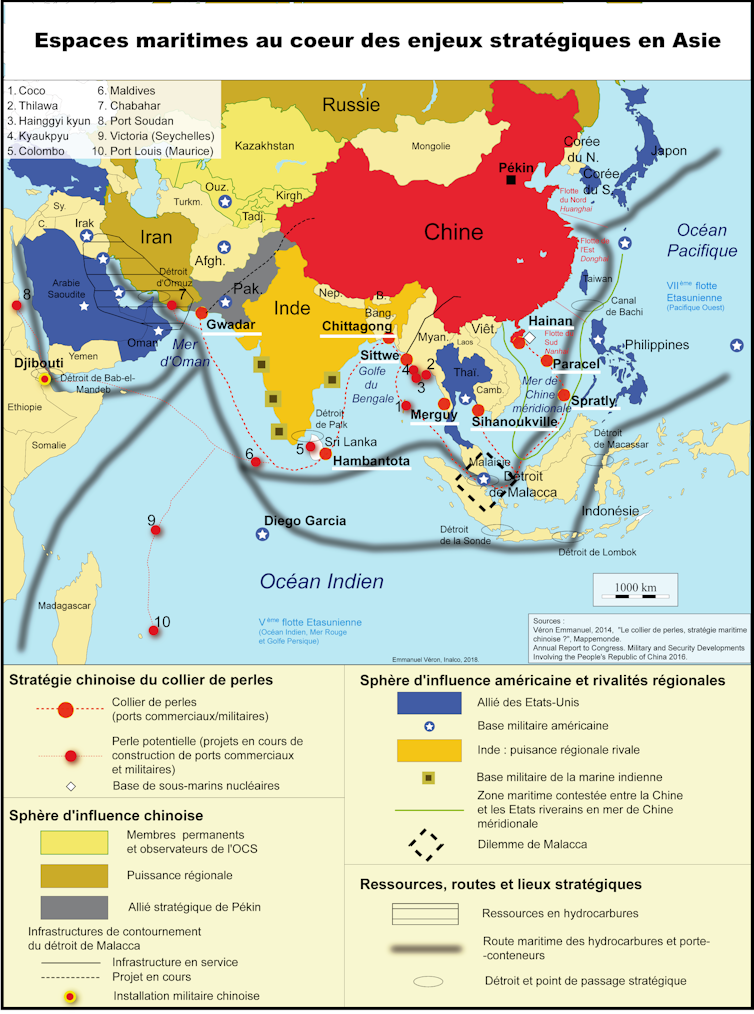
    En dépit d’un semblant de détente en Asie entre Donald Trump et Kim Jong‑un, la « guerre d’influence en mer de Chine entre Pékin et Washington ne va pas cesser quels que soient les développements sur le dossier nord-coréen » notait le correspondant du journal Le Monde Gilles Paris, envoyé spécial à Singapour, lors d’un live avec les lecteurs du quotidien.

    #chine #océan_indien #thalassocratie #mer_de_chine_méridionale
    Début juin, le sentiment était le même au sommet annuel du Shangri-La Dialogue à Singapour sur les enjeux de sécurité en Asie-Pacifique.

    La ministre française des Armées, Florence Parly avait particulièrement rappelé l’urgence au respect du droit international en mer de Chine du Sud et que la zone était marquée par la compétition entre pays plus que par la coopération régionale qu’il convenait, selon elle, de soutenir.

  • Exclusive: U.S. warships sail near South China Sea islands claimed by Beijing | Reuters
    ▻https://www.reuters.com/article/us-usa-china-military-exclusive/exclusive-u-s-warships-sail-near-south-china-sea-islands-claimed-by-beijing

    Two U.S. Navy warships sailed near South China Sea islands claimed by China on Sunday, two U.S. officials told Reuters, in a move that drew condemnation from Beijing as President Donald Trump seeks its continued cooperation on North Korea.
    […]
    The U.S. officials, speaking on condition of anonymity, said the Higgins guided-missile destroyer and the Antietam, a guided-missile cruiser, came within 12 nautical miles of the #Paracel_Islands, among a string of islets, reefs and shoals over which China has territorial disputes with its neighbors.

    The U.S. military vessels carried out maneuvering operations near Tree, Lincoln, Triton and Woody islands in the Paracels, one of the officials said.

    #mer_de_Chine_méridionale #Îles_Paracels
    #FoN #Freedom_of_Navigation

    USS Antietam, CG-54 (croiseur lance-missiles)
    USS Higgins, DDG-76 (destroyer lance-missiles)

  • Bataille navale à distance en mer de Chine - Libération
    ▻http://www.liberation.fr/planete/2018/05/25/bataille-navale-a-distance-en-mer-de-chine_1653861

    Mais cette fois, Washington a décidé de réagir par une mesure symbolique, en annonçant ce mercredi l’exclusion de la Chine du Rim of the Pacific (#RIMPAC), les plus importantes manœuvres maritimes mondiales, qui doivent avoir lieu à partir de la fin du mois de juin dans le Pacifique. « La poursuite par la Chine de la militarisation de possessions disputées dans la mer de Chine méridionale ne fait qu’attiser les tensions et déstabiliser la région », a déclaré le porte-parole du Pentagone, ajoutant que ce comportement n’était « pas compatible avec les principes et les objectifs de l’exercice RIMPAC ». Le timing de cette exclusion, annoncée le jour même de la visite du ministre des Affaires étrangères chinois à Washington tombe comme un camouflet pour Pékin.

    #mer_de_Chine_méridionale #Spratleys
    #manœuvres_navales

  • China Sends Military Plane to Third #South_China_Sea Airstrip - Bloomberg
    ▻https://www.bloomberg.com/news/articles/2018-05-10/china-deploys-military-plane-to-third-south-china-sea-airstrip


    Subi Reef in the South China Sea.
    Source: DigitalGlobe via Getty Images.

    China has landed a military plane on the last of its three airstrips in the disputed South China Sea, a Washington-based research institution said, amid renewed complaints about the country expanding its military presence in the busy shipping lane.

    The Asia Maritime Transparency Initiative said satellite images from April 28 showed the first confirmed deployment of a military aircraft — a Shaanxi Y-8 transport plane — on #Subi_Reef. The structure hosts one of three runways China has built as part of a massive dredging and reclamation operation in the Spratlys chain since 2013, and was the last of three where military aircraft had been observed.

    “This should be particularly concerning to the Philippines,” AMTI, a unit of the Center for Strategic and International Studies, said on its website. About 100 Philippine civilians and a small military garrison are stationed on the Thitu islet, about 12 nautical miles away from Subi.

    The Chinese Ministry of Foreign Affairs said it wasn’t aware of situation described by AMTI. “China’s peaceful construction activities on the #Spratly_Islands, including the deployment of necessary homeland defense facilities, is necessary to protect sovereignty and national security,” the ministry said in an emailed response to questions. “It is an absolute right a sovereign country enjoys and it doesn’t target any country.”

    #Spratleys #Mer_de_Chine_méridionale

  • China installs cruise missiles on South China Sea outposts: CNBC | Reuters
    ▻https://www.reuters.com/article/us-southchinasea-china-missiles/china-installs-cruise-missiles-on-south-china-sea-outposts-cnbc-report-idUS


    FILE PHOTO: Chinese dredging vessels are purportedly seen in the waters around Fiery Cross Reef in the disputed Spratly Islands in the South China Sea in this still image from video taken by a P-8A Poseidon surveillance aircraft provided by the United States Navy May 21, 2015.
    U.S. Navy/Handout via Reuters/File Photo

    China has installed anti-ship cruise missiles and surface-to-air missile systems on three of its outposts in the South China Sea, U.S. news network CNBC reported on Wednesday, citing sources with direct knowledge of U.S. intelligence reports.

    The installations, if confirmed, would mark the first Chinese missile deployments in the Spratly Islands, where several Asian countries including Vietnam and Taiwan have rival claims.

    China has made no mention of any missile deployments but says its military facilities in the #Spratlys are purely defensive, and that it can do what it likes on its own territory.
    […]
    CNBC quoted unnamed sources as saying that according to U.S. intelligence assessments, the missiles were moved to Fiery Cross Reef, Subi Reef and Mischief Reef within the past 30 days.

    #mer_de_Chine_méridionale
    #Spratleys

  • Vietnam halts South China Sea oil drilling project under pressure from Beijing
    ▻https://www.reuters.com/article/us-southchinasea-vietnam/vietnam-scraps-south-china-sea-oil-drilling-project-under-pressure-from-bei


    le bloc 07/03 dans le bassin de Nam Con Son

    Vietnam has halted an oil drilling project in the “Red Emperor” block off its southeastern coast licensed to Spanish energy firm #Repsol following pressure from China, three sources with direct knowledge of the situation told Reuters on Friday.

    It would be the second time in less than a year that Vietnam has had to suspend a major oil development in the busy #South_China_Sea waterway under pressure from China.
    […]
    #Red_Emperor, known in Vietnamese as the #Ca_Rong_Do field, is part of Block 07/03 in the #Nam_Con_Son basin, 440 km (273 miles) off the coast of Vietnam’s southern city of Vung Tau.

    The $1-billion field of moderate size by international standards is seen as a key asset to help slow the decline of Vietnam’s stalling oil and gas production.

    But the block lies near the U-shaped “#nine-dash_line ” that marks the vast area that China claims in the sea and overlaps what it says are its own oil concessions.

    Located in waters around 350 metres (1,148 ft) deep, it is considered to be profitable from around $60 per barrel. Current Brent crude oil prices are almost $70 per barrel.

    On est très très bas, dans la #mer_de_Chine_méridionale, mais trop proche de la #ligne_en_neuf_traits …

    ►https://fr.wikipedia.org/wiki/Ligne_en_neuf_traits
    #langue_de_bœuf #Đường_lưỡi_bò

    #Cá_Rồng_Đỏ
    cf. ▻https://seenthis.net/messages/617802 (avec autre carte)

  • Exclusive: U.S. Warship Sails Near Disputed South China Sea Island, Officials Say - The New York Times
    ▻https://www.nytimes.com/reuters/2018/03/23/world/asia/23reuters-usa-china-southchinasea.html


    Guided-missile destroyer USS Mustin (DDG-89) transits the Philippine Sea on March 14, 2018.
    US Navy photo.

    A U.S. Navy destroyer carried out a “#freedom_of_navigation ” operation on Friday, coming within 12 nautical miles of an artificial island built by China in the South China Sea, U.S. officials told Reuters.

    The operation, which infuriated Beijing, was the latest attempt to counter what Washington sees as China’s efforts to limit freedom of navigation in the strategic waters.

    The officials, speaking on condition of anonymity, said the destroyer _Mustin traveled close to #Mischief_Reef in the #Spratly Islands and carried out maneuvering operations. China has territorial disputes with its neighbors over the area.

    #Mer_de_Chine_Méridionale
    #Spratleys
    #FoN

  • Suspected Chinese #Cyber_Espionage Group Observed Targeting U.S. Maritime Industry – gCaptain
    ▻http://gcaptain.com/suspected-chinese-cyber-espionage-group-observed-targeting-u-s-maritime-in

    #FireEye, a leading cybersecurity company, released new research on Friday shedding light on activity from suspected Chinese cyber espionage group, dubbed #TEMP.Periscope, targeting U.S. engineering and maritime industries.

    Since at least early 2018, FireEye has observed an ongoing wave of intrusions suspected to be from TEMP.Periscope, the company said. These intrusions have primarily targeted engineering and maritime entities, especially those connected to #South_China_Sea issues.

    TEMP.Periscope, which has been active since at least 2013, has primarily focused on maritime-related targets across multiple verticals including engineering firms, shipping and transportation, manufacturing, defense, government offices, and research universities.

    Identified victims were mostly found in the United States, although organizations in Europe and at least one in Hong Kong have also been affected.

    According to FireEye, TEMP.Periscope had gone quiet just like many other Chinese groups after the Obama-Xi agreement in late 2015. However, the group was observed resurfacing in the summer of 2017, and it has been particularly active since this past February.

    “The organizations targeted by TEMP.Periscope have a connection to the ongoing disputes in the South China Sea,” said Fred Plan, Senior Analyst at FireEye. “They or their customers are involved in military and defense, or the shipping business, or they are developing technologies that would be advantageous to the defense industry or governments in the region. Because of the group’s tendency to target engineering organizations we believe the group is seeking technical data that can help inform strategic decision-making. Hypothetically, this could be used to answer questions like ‘what is the range and effectiveness of this marine radar system?’ or ‘how precisely can a system detect and identify activities at sea?’”

    #Mer_de_Chine_méridionale

  • China says U.S. warship violated its South China Sea sovereignty
    ▻https://www.reuters.com/article/us-china-us-sovereignty/china-accuses-u-s-warship-of-violating-its-sovereignty-idUSKBN1F9088

    A U.S. Navy destroyer this week sailed near the #Scarborough_Shoal, a disputed lagoon claimed by China in the South China Sea, U.S. officials said on Saturday, and Beijing vowed to take “necessary measures” to protect what it said was its sovereignty.

    China’s foreign ministry said USS Hopper missile destroyer came within 12 nautical miles off #Huangyan_island, better known as the Scarborough Shoal and subject to a rival claim by the Philippines, a historic ally of the United States.

    Et donc, les marronniers :
    #Mer_de_Chine_méridionale
    #freedom_of_navigation #FoN
    #innocent_passage #passage_inoffensif
    et tout le toutim…