• ’The credential data leak is dangerous simply because of its enormous size’: Experts warn “colossal” breach exposes 24 billion records including personal info
    ▻https://www.techradar.com/pro/security/the-credential-data-leak-is-dangerous-simply-because-of-its-enormous-size

    Cybernews found exposed #Elasticsearch database with 24 #billion plaintext #credentials from 36 sources
    Archive (~8TB) compiled infostealer logs, Telegram #leaks, and prior breach data; regularly updated
    Owner unknown; mix of English/Russian sources, including 260M #records tied to “Darkside” channels

  • Aura confirms data breach exposing 900,000 marketing contacts
    ▻https://www.bleepingcomputer.com/news/security/aura-confirms-data-breach-exposing-900-000-marketing-contacts

    #Identity_protection company Aura has confirmed that an unauthorized party gained access to nearly 900,000 #customer #records containing names and email addresses.

    The company states that the #incident was caused by a #voice #phishing #attack targeting an #employee, which exposed the #sensitive_data of 20,000 current and 15,000 former customers.

    In a communication this week, Aura states that the data originated from a #marketing tool used by a company acquired by Aura in 2021, which exposed limited information.

    Aura is a consumer #digital_safety firm that sells #identity_theft_protection, #credit and #fraud #monitoring, and #online #security tools for #phishing_protection, positioning itself as an all-in-one service for #online_protection.

    ON VOUS PROTÈGE !!!

  • Plus de 6.000 #détenus dorment au sol… Nouveau « #record » dans les #prisons françaises
    ▻https://www.20minutes.fr/justice/4204152-20260302-plus-6-000-detenus-dorment-sol-nouveau-record-prisons-fra

    #honte • Les prisons françaises ont atteint un record de #surpopulation #carcérale avec 86.645 détenus au 1er février 2026 pour seulement 63.289 places opérationnelles, établissant un taux de #densité carcérale à 136,9 %

    #prison #france

  • #Meta’s #AI #Smart #Glasses and #Data #Privacy Concerns: #Workers Say “We See Everything”
    ▻https://www.svd.se/a/K8nrV4/metas-ai-smart-glasses-and-data-privacy-concerns-workers-say-we-see-everything

    #Bank details, #sex and #naked #people who seem unaware they are being #recorded. Behind Meta’s new #smart_glasses lies a #hidden #workforce, uneasy about peering into the most intimate parts of other people’s lives.

  • Matinée XXL #100 – 23.02.2026
    ▻https://radioblackout.org/podcast/matinee-xxl-100-23-02-2026

    Mille e una notte, cento e una mattina. Numeri pesanti per Ing. Sollazzi e Dj Post Pony in studio con una vasta pletora di analisti, fans e djs per festeggiare il traguardo e flexare alcuni dati. I #record purtroppo non si rivelano particolarmente positivi e la festa viene in larga parte disattesa, lasciando al palo […]

    #statistica
    ▻https://radioblackout.org/wp-content/uploads/2026/02/matinee100.mp3

  • State Dept: Trump’s “Third Countries” for Immigrants Have Awful Human Rights Records

    The White House search for partners in its global gulag has grown to 64 nations. Most of them are notorious violators of human rights.

    The United States is building an unprecedented network of deportee dumping grounds, pursuing deals with around a third of the world’s nations to expel immigrants to places where they do not hold citizenship. Once exiled, these third-country nationals are sometimes detained, imprisoned, or in danger of being sent back to their country of origin — which they may have fled to escape violence, torture, or political persecution.

    The nations that the Trump administration is collaborating with to accept these expelled immigrants are some of the worst human rights offenders on the planet, according to the U.S. government’s own reports.

    More than 8,100 people have been expelled in this manner since January 20, and the U.S. has made arrangements to send people to at least 13 nations, so far, across the globe. Of them, 12 have been cited by the State Department for significant human rights abuses.

    But the Trump administration has cast a much wider net for its third-country deportations. The U.S. has solicited 64 nations to participate in its growing global gulag for expelled immigrants. Fifty-eight of them — roughly 91 percent — were rebuked for human rights violations in the State Department’s most recent human rights reports.

    America’s preferred third-country deportee dumping grounds also receive uniform low marks from outside human rights groups. Only four of the 13 countries that have agreed to accept people forcibly expelled from the U.S. — Canada, Colombia, Costa Rica, and Panama — in 2025 were rated “free” by Freedom House, a nongovernmental organization that advocates for democracy and human rights and gets the bulk of its funding from the U.S. government. The rest of the countries – El Salvador, Eswatini, Guatemala, Honduras, Kosovo, Mexico, Rwanda, South Sudan, and Uzbekistan — were rated “partly free” or “not free.”

    “It is not surprising the governments that would agree to these sketchy third-country removal arrangements would be countries with serious pre-existing human rights issues,” said Anwen Hughes, the senior director of legal strategy for refugee programs at Human Rights First. “But it is shocking that the United States would seek to remove third-country nationals to these destinations.”

    The most recent additions to America’s global gulag are among the least free countries on the planet. This month, the administration expelled five men — from Cuba, Jamaica, Laos, Vietnam, and Yemen — to the Southern African kingdom of Eswatini, an absolute monarchy with a dismal human rights record. The move closely followed the U.S. deportation of eight men to violence-plagued South Sudan, one of the most repressive nations in the world. South Sudan is Freedom House’s lowest rated nation, scoring 1/100. Eswatini, formerly known as Swaziland, scored 17/100, worse than perennial bad actors like Egypt and Ethiopia.

    “The Trump administration cares nothing for human rights and wants these deportations to third countries to be punitive,” Yael Schacher, the director for the Americas and Europe at Refugees International, told The Intercept.

    Last month, the Supreme Court ruled that the Trump administration could resume expelling immigrants to countries other than their own without any chance to object on the grounds that they might be tortured. The court’s decision has been a boon to the administration, which has been employing strong-arm tactics with dozens of smaller, weaker, and economically dependent nations to push them to accept expelled people. Trump cheered the court’s decision in a White House statement earlier this month.

    “I say this unapologetically, we are actively searching for other countries to take people from third countries,” Secretary of State Marco Rubio said at an April 30 Cabinet meeting. “We are working with other countries to say, ‘We want to send you some of the most despicable human beings to your countries, and will you do that as a favor to us?’”

    The Trump administration has sought or struck deals with or deported third-country nationals to Angola, Benin, Bhutan, Burkina Faso, Cambodia, Cameroon, Canada, Colombia, Democratic Republic of Congo, Djibouti, Dominica, Egypt, El Salvador, Equatorial Guinea, Eswatini, Ethiopia, Gabon, Georgia, Ghana, Guatemala, Guinea-Bissau, Guyana, Honduras, Ivory Coast, Kyrgyzstan, Liberia, Libya, Kosovo, Malawi, Mauritania, Mexico, Moldova, Mongolia, Morocco, Niger, Nigeria, Palau, Panama, Peru, Rwanda, São Tomé and Príncipe, Saudi Arabia, Senegal, South Sudan, Syria, Tajikistan, Tanzania, The Gambia, Togo, Tonga, Tunisia, Turkmenistan, Uganda, Ukraine, Uzbekistan, Vanuatu, Zambia, and Zimbabwe; these 58 were taken to task by the State Department last year for significant human rights abuses. Tuvalu and Santa Lucia were also cited in the report for having repressive laws on paper but were not found to enforce them in practice. Only four of the 64 total nations — Antigua and Barbuda, Cabo Verde, Costa Rica, and Saint Kitts and Nevis — received a clean bill of human rights health from the State Department.

    With the green light from the Supreme Court, thousands of immigrants are in danger of being disappeared into this burgeoning network of pariah states. The recent budget bill, passed in Congress, will provide the Trump administration tens of billions of dollars to arrest, detain and expel immigrants. Some $14.4 billion is marked for new ICE transportation funds — a massive increase above the agency’s 2024 transportation and removal budget. “You’re going to see immigration enforcement on a level you’ve never seen it before,” said Trump’s so-called border czar Tom Homan, referring to the newfound largesse.

    “When you’ve got countries that won’t take their nationals back, and they can’t stay here, we find another country willing to accept them,” Homan said, adding that the administration may not necessarily expel people to every country that agrees to accept third-country nationals, but wants the option on hand.

    Experts say that third-country deportations are rooted in cruelty and not a lack of deportation options. Hughes, of Human Rights First, noted that Mexican nationals held in south Texas had been set to be deported to both Libya and South Sudan. (The Libya deportations were eventually blocked in court.)

    “The Mexican border is right there. I’ve been doing immigration detention work for a very long time. I’ve never in my life seen Mexico refuse to take back one of its nationals, ever,” Hughes told The Intercept, noting that the administration appeared to be seeking out “really implausible destinations to send people.”

    In April, Mexican President Claudia Sheinbaum said that her government had already accepted roughly 6,000 non-Mexicans from the U.S. for “humanitarian reasons.” Mexico has agreed to accept “third-country removals” from Cuba, Haiti, Nicaragua, Venezuela, Guatemala, El Salvador, and Honduras, said Thomas Giles, a longtime ICE official, during a recent federal court hearing. The Mexican government has refused to offer further information on third-country expulsions, although return receipts show spokespersons Alba Gardenia Mejía Abreu and Lourdes Fabiola Garita Arce have repeatedly read The Intercept’s questions on the subject.

    While Mexico has been the largest recipient of third-country nationals in 2025, a growing number of other countries, from Latin America to Africa, have forged deals with the U.S. and accepted deportees from elsewhere.

    In February, Guatemala, a country where “human rights defenders, journalists and political opponents were harassed and criminalized” last year, according to Amnesty International, announced it had struck a deal with the Trump administration to accept third-country nationals. The country has received around 110 Mexicans this year, according to data obtained in a Freedom of Information Act lawsuit by a team of lawyers and academics from the Deportation Data Project.

    Honduras received around 650 Venezuelans this year, while around 560 Hondurans were expelled by the U.S. to Mexico, according to data from the Deportation Data Project. The researchers also found that Canada received a small number of people from India and that Colombia has received Venezuelan deportees.

    The Trump administration has expelled hundreds of African and Asian immigrants to Costa Rica and Panama, including people from Afghanistan, Cameroon, China, India, Iran, Nepal, Pakistan, Sri Lanka, Turkey, Uzbekistan, and Vietnam.

    The administration also began using the notorious Terrorism Confinement Center, or CECOT, in Tecoluca, El Salvador, as a foreign prison to disappear Venezuelan immigrants in March. Andry Hernández Romero, a Venezuelan make-up artist who was expelled by the United States to the offshore prison, was recently released from CECOT following a prisoner swap with Venezuela. He said he was abused, sexually assaulted, and denied food, describing his time there as “an encounter with torture and death.”

    Uzbekistan received more than 100 deportees from the United States, including not only Uzbeks but citizens of Kazakhstan and Kyrgyzstan, according to an April announcement by the Department of Homeland Security. The U.S. also inked a limited agreement with Rwanda while exploring a more “durable program.” Amnesty International recently called out that East African nation over reports of forced disappearances and evidence of torture and other ill treatment in detention.

    The U.S. struck a deal with Europe’s youngest country, Kosovo, in June, to accept 50 deportees from other nations. Kosovo has already made an agreement with Denmark to rent out 300 prison cells for foreign nationals convicted of crimes who will be deported from Denmark at the end of their sentences. Human Rights Watch has warned the Balkans may become “a warehouse for migrants.”

    Earlier this month, the U.S. expelled eight men to the newest nation on the planet, South Sudan. The State Department’s most recent assessment of the East African nation catalogs an enormous range of serious abuses, including reports of extrajudicial killings; disappearances by or on behalf of government authorities; instances in which “security forces mutilated, tortured, beat, and harassed political opponents, journalists, and human rights activists,” including documented cases of torture and other mistreatment of those in the custody of the National Security Service, such as beatings with sticks, whips, pipes, and wires; being subjected to electric shocks; being burned with melted plastic; raped; and subjected to other forms of sexual violence.

    Beyond that, South Sudan is subject to a U.N. warning about the potential for full-scale civil war and a State Department “Level 4: Do Not Travel” advisory. The department advises those who choose to go there to draft a will, establish a proof-of-life protocol with family members, and leave DNA samples with one’s medical provider.

    The Trump administration renounced responsibility for the men it expelled to South Sudan. Asked whether they were in U.S. or South Sudanese custody, Homan lied. “They’re free,” the White House executive associate director of enforcement and removal operations told Politico. “They’re living in Sudan.” Neither part of his statement is true. The eight men have been held incommunicado in South Sudan — not Sudan — for weeks by the National Security Service. They have been unable to contact their lawyers or their families. The White House did not reply to repeated questions about Homan’s statement.

    Soon after the South Sudan expulsions, on July 15, the administration expelled five men — from Cuba, Jamaica, Laos, Vietnam, and Yemen — to Eswatini. The State Department’s most recent human rights report on that kingdom refers to credible reports of arbitrary or unlawful killings, including extrajudicial killings; torture and cruel, inhuman, or degrading treatment or punishment by the government; serious problems with the independence of the judiciary; and the incarceration of political prisoners. The five men will reportedly be held in solitary confinement for an undetermined amount of time.

    The government of Eswatini said the men are considered “in transit” and will eventually be sent to their home countries. Eswatini’s assertion that the men would be sent to their homelands contradicted claims by DHS spokesperson Tricia McLaughlin, who wrote on X that the deportees were “so uniquely barbaric that their home countries refused to take them back.”

    The Trump administration’s third-country deportation deals are being conducted in secret, and neither the State Department nor the Department of Homeland Security will discuss them.

    Lt. Gen. John W. Brennan, U.S. Africa Command’s deputy commander, told The Intercept no discussions of third-country deportations took place during his recent high-level engagements with Angola and Namibia and directed queries on the matter to DHS.

    A State Department official, speaking on the condition of anonymity due to arcane departmental rules, also repeatedly insisted that “deportations are squarely in DHS’s way” and answers to The Intercept’s questions were actually “a DHS issue.” When The Intercept countered that the agreements were made by the State Department, the official asked: “Who’s the [point of contact] negotiating these agreements?” Asked if the official was admitting that the State Department had abdicated its diplomatic responsibilities to DHS, the official said: “No, I’m not. I’m not saying that. I don’t know.”

    The latter refrain is common among government officials. “When we sign these agreements with all these countries, we make arrangements to make sure these countries are receiving these people and there’s opportunities for these people,” Homan claimed before admitting he was flummoxed by the agreements. “But I can’t tell if we remove somebody to Sudan — they can stay there a week and leave. I don’t know.”

    The Intercept could find no corroborative information about a third-country deportation agreement with Sudan. The White House failed to respond to repeated requests for clarification.

    Experts questioned the U.S. making deals with some of the world’s worst human rights offenders. “Generally speaking, there aren’t obvious reasons for a government to want to accept deportees who have no connection to their country. The countries that make these agreements are going to be the most desperate and may want concessions that they can’t obtain by other means,” said Hughes, who is also one of the lawyers representing the men exiled to South Sudan. “The U.S. government should be asking itself: ‘To what extent does it make sense to allow migration issues to run foreign policy?’ and ‘What, exactly, is the U.S. willing to bargain away for the sake of deporting a relatively small number of people?’”

    Due to the secret nature of agreements, it is unclear what fate awaits people expelled to these outcast nations. The question of whether they would be deported again to their nation of origin, or another unrelated nation, where they face the possibility of persecution or abuse; be allowed to remain in the third country and under what circumstances; or be held in detention or prison, as in El Salvador, remains unknown.

    Some people, including those expelled to South Sudan, also appear to have been sent without identification or travel documents, potentially leaving individuals in a legal limbo.

    “Removing people by putting people on military or private aircraft that the United States entirely controls and then dumping them in countries that are willing to take them, without identification? This is new and dangerous,” said Hughes. “It’s not clear that there are any consistent requirements in terms of what status people will be issued or even if the U.S. is providing clear and accurate information to the receiving country as to these people’s legal situation.”

    Experts have warned that while almost all African countries and nations in the Americas are parties to the U.N. Refugee Convention, countries like Kosovo and Uzbekistan are not. If they were to expel immigrants they received as part of their deals with the Trump administration, they would have no obligation under international law to screen deportees to ensure they are not sent to a country where they may face threats to their life or freedom.

    Non-refoulement — derived from a French word for return — forbids sending people to places where they are at risk of harm. It is a bedrock principle of international human rights, refugee, and customary international law, and is embedded in U.S. domestic law. The Trump administration has not only abandoned this obligation but will also look the other way regarding violations by other nations.

    State Department employees were recently instructed that future installments of its human rights reports — the same type that The Intercept relied on for this reporting — should ignore whether a nation had violated its obligations not to send people to countries where they would face torture or persecution. A State Department official failed to respond to repeated questions by The Intercept concerning the role the Trump administration’s own third-country deportations played in the new directive.

    Experts told The Intercept that the change in State Department policy was no coincidence, and the delay in issuing the annual reports — which are usually released in the spring — was likely tied, at least in part, to the administration’s third-country deportations and its willingness to flout international law. Trina Realmuto, the executive director of the National Immigration Litigation Alliance and another lawyer for the men expelled to South Sudan, offered her own assessment.

    “It seems that leadership,” she explained, “is trying to eliminate the State Department’s reporting on human rights violations and non-refoulement because they evidence the hypocrisy of its third country removal policy.”

    ▻https://theintercept.com/2025/07/29/trump-deport-immigrants-third-country-human-rights

    #USA #Etats-Unis #migrations #réfugiés #pays-tiers #record #trumpisme #renvois #déportation #expulsions #externalisation

  • #Royaume-Uni : Avec 108 000 dossiers déposés, les #demandes_d’asile atteignent un record en 2024

    Plus de 108 000 personnes ont déposé une demande d’asile au Royaume-Uni en 2024, selon le rapport annuel du Home Office paru ce jeudi. Un record, depuis plus de 20 ans. Les Pakistanais, suivis des Afghans, arrivent en tête des demandeurs. Un tiers des demandeurs sont arrivés en traversant la Manche sur des « #small_boats », selon les autorités britanniques.

    C’est un #record depuis des décennies : 108 138 personnes ont déposé une demande d’asile au Royaume-Uni en 2024, selon le rapport annuel du Home Office paru jeudi 27 février. C’est le chiffre le plus élevé depuis le début de ces statistiques enregistrées à partir de 2001.

    Par rapport à 2023, il s’agit d’une hausse de 18%. Surtout, « le nombre de demandeurs d’asile a plus que doublé depuis 2022 », observe le Home Office. Le précédent record remontait à 2002, avec 103 081 demandeurs d’asile.

    Au-delà de ces primo-demandeurs, de nombreux demandeurs d’asile sont encore en attente de leur décision. À la fin de 2024, 125 000 personnes patientaient toujours, à peine moins qu’à la fin 2023. L’enjeu de la longueur des délais et de l’engorgement des procédures d’asile demeure. Pour rappel, en juin 2023, l’arriéré de demandes d’asile avait atteint des records avec 134 000 demandes en attente, avant de redescendre progressivement autour de 86 000 dossiers un an plus tard... Puis de remonter, donc.
    Pakistanais, Afghans et Iraniens sont les premiers demandeurs

    Les Pakistanais représentent la première nationalité à avoir déposé une demande d’asile en 2024. Le Home Office enregistre 10 542 personnes, soit presque un demandeur d’asile sur dix. Leur nombre a doublé en un an.

    Près de 8 500 Afghans ont également demandé l’asile, soit quasiment 8% du total. Les Afghans sont aussi la nationalité la plus représentée parmi les arrivées par « small boats » en 2024. Selon le Home Office, ils étaient 5 900, soit 17% des personnes arrivées par ce moyen de traversée. Les chiffres restent cependant inférieurs à ceux de 2022, année suivant la chute de Kaboul, lors de laquelle 9 100 Afghans avaient réussi leur traversée.

    Suivant de très près les Afghans, les Iraniens sont la troisième nationalité à demander l’asile au Royaume-Uni, avec 8 100 demandeurs (à peine plus qu’en 2023).

    La nationalité dont l’évolution est la plus notable reste les Vietnamiens : le nombre de demandes émanant de ces ressortissants a plus que doublé, passant de 2 469 personnes en 2023 à 5 259 en 2024.
    Un tiers des demandeurs d’asile arrivés par small boats

    Un tiers (32%) de ces demandeurs d’asile sont aussi arrivés en traversant la Manche sur des petits bateaux, selon les chiffres officiels.

    Au total, le Home Office affirme avoir détecté 44 000 arrivées irrégulières en 2024, soit 19 % de plus que l’année précédente. Près de 37 000 sont des arrivées par « small boats », le reste concerne généralement des arrivées irrégulières de migrants cachés dans les ferries.

    L’année 2024 a été une année record en matière de personnes décédées dans le cadre des traversées de la Manche. Au moins 78 personnes sont mortes selon les autorités françaises - 82 selon l’Organisation internationale pour les migrations (OIM). Dont 14 enfants.

    Le ministre de l’Intérieur français Bruno Retailleau et son homologue britannique, Yvette Cooper, se sont rencontrés au Touquet (Pas-de-Calais) jeudi 27 février pour parler - une nouvelle fois- d’un protocole commun à établir pour lutter contre l’immigration irrégulière. Les deux ministres ont annoncé un accord pour prolonger jusqu’en 2027 (au lieu de mars 2026) le traité de Sandhurst, signé en 2018, afin de renforcer les moyens de surveillance de la frontière.

    Dans un communiqué publié jeudi, la secrétaire d’État britannique à la sécurité des frontières et à l’asile, Angela Eagle, a défendu le bilan du gouvernement, assurant que « les retours ont atteint leur niveau le plus élevé depuis une demi-décennie, avec l’expulsion de 19 000 personnes ».

    Depuis son arrivée au pouvoir en juillet 2024, le Premier ministre britannique Keir Starmer a, de son côté, enchaîné les annonces : gel des avoirs des passeurs, création d’un fonds de 90 millions d’euros consacré à la lutte contre les trafiquants opérant dans la Manche, accords avec de nombreux pays afin d’"accroître le partage de renseignements", impossibilité pour les personnes arrivées de manière irrégulière au Royaume-Uni d’obtenir la naturalisation... Des mesures qui, pour l’heure, n’ont eu que peu d’effets sur les traversées de la Manche.

    ►https://www.infomigrants.net/fr/post/63119/royaumeuni--avec-108-000-dossiers-deposes-les-demandes-dasile-atteigne

    –-》 encore une preuve, par les #statistiques, que la militarisation de la frontière dans la région de #Calais ne sert QUE à augmenter #morts et #violence pour celleux qui tentent le passage de la #Mache de manière irrégularisée, certainement pas à réguler/diminuer les arrivées dans le pays...

    #UK #Angleterre #arrivées #migrations #statistiques #chiffres #2024 #réfugiés #militarisation_des_frontières #asile #inefficacité

  • #2023 recorded as hottest in 2000 years

    When you look at the long sweep of history, you can see just how dramatic recent global warming is, says Prof Ulf Büntgen

    Researchers have found that 2023 was the hottest summer in the Northern Hemisphere in the past two thousand years, almost four degrees warmer than the coldest summer during the same period.

    Although 2023 has been reported as the hottest year on record, the instrumental evidence only reaches back as far as 1850 at best, and most records are limited to certain regions. Now, by using past climate information from annually resolved tree rings over two millennia, scientists from the University of Cambridge and the Johannes Gutenberg University Mainz have shown how exceptional the summer of 2023 was.

    Even allowing for natural climate variations over hundreds of years, 2023 was still the hottest summer since the height of the Roman Empire, exceeding the extremes of natural climate variability by half a degree Celsius.

    “When you look at the long sweep of history, you can see just how dramatic recent global warming is,” said co-author Professor Ulf Büntgen, from Cambridge’s Department of Geography. “2023 was an exceptionally hot year, and this trend will continue unless we reduce greenhouse gas emissions dramatically.”
    1.5°C already breached

    The results, reported in the journal Nature, also demonstrate that in the Northern Hemisphere, the 2015 Paris Agreement to limit warming to 1.5°C above pre-industrial levels has already been breached.

    Early instrumental temperature records, from 1850-1900, are sparse and inconsistent. The researchers compared early instrumental data with a large-scale tree ring dataset and found the 19th century temperature baseline used to contextualise global warming is several tenths of a degree Celsius colder than previously thought. By re-calibrating this baseline, the researchers calculated that summer 2023 conditions in the Northern Hemisphere were 2.07°C warmer than mean summer temperatures between 1850 and 1900.

    “Many of the conversations we have around global warming are tied to a baseline temperature from the mid-19th century, but why is this the baseline? What is normal, in the context of a constantly-changing climate, when we’ve only got 150 years of meteorological measurements?” said Büntgen. “Only when we look at climate reconstructions can we better account for natural variability and put recent anthropogenic climate change into context.”
    Tree rings reveal two millennia of climate data

    Tree rings can provide that context, since they contain annually-resolved and absolutely-dated information about past summer temperatures. Using tree-ring chronologies allows researchers to look much further back in time without the uncertainty associated with some early instrumental measurements.

    The available tree-ring data reveals that most of the cooler periods over the past 2000 years, such as the Little Antique Ice Age in the 6th century and the Little Ice Age in the early 19th century, followed large-sulphur-rich volcanic eruptions. These eruptions spew huge amounts of aerosols into the stratosphere, triggering rapid surface cooling. The coldest summer of the past two thousand years, in 536 CE, followed one such eruption, and was 3.93C colder than the summer of 2023.
    The amplifying effect of El Niño on recent heat waves

    Most of the warmer periods covered by the tree ring data can be attributed to the El Niño climate pattern, or El Niño-Southern Oscillation (ENSO). El Niño affects weather worldwide due to weakened trade winds in the Pacific Ocean and often results in warmer summers in the Northern Hemisphere. While El Niño events were first noted by fisherman in the 17th century, they can be observed in the tree ring data much further back in time.

    However, over the past 60 years, global warming caused by greenhouse gas emissions are causing El Niño events to become stronger, resulting in hotter summers. The current El Niño event is expected to continue into early summer 2024, making it likely that this summer will break temperature records once again.

    “It’s true that the climate is always changing, but the warming in 2023, caused by greenhouse gases, is additionally amplified by El Niño conditions, so we end up with longer and more severe heat waves and extended periods of drought,” said Professor Jan Esper, the lead author of the study from the Johannes Gutenberg University Mainz in Germany. “When you look at the big picture, it shows just how urgent it is that we reduce greenhouse gas emissions immediately.”

    The researchers note that while their results are robust for the Northern Hemisphere, it is difficult to obtain global averages for the same period since data is sparse for the Southern Hemisphere. The Southern Hemisphere also responds differently to climate change, since it is far more ocean-covered than the Northern Hemisphere.

    ▻https://eastangliabylines.co.uk/environment/climate/2023-recorded-as-hottest-in-2000-years
    #climat #record #changement_climatique #statistiques #chiffres #chaleur

    • 2023 was the warmest year in the modern temperature record

      The year 2023 was the warmest year since global

      records began in 1850 at 1.18°C (2.12°F) above the 20th-century average of 13.9°C (57.0°F). This value is 0.15°C (0.27°F) more than the previous record set in 2016. The 10 warmest years in the 174-year record have all occurred during the last decade (2014–2023). Of note, the year 2005, which was the first year to set a new global temperature record in the 21st century, is now the 12th-warmest year on record. The year 2010, which had surpassed 2005 at the time, now ranks as the 11th-warmest year on record.

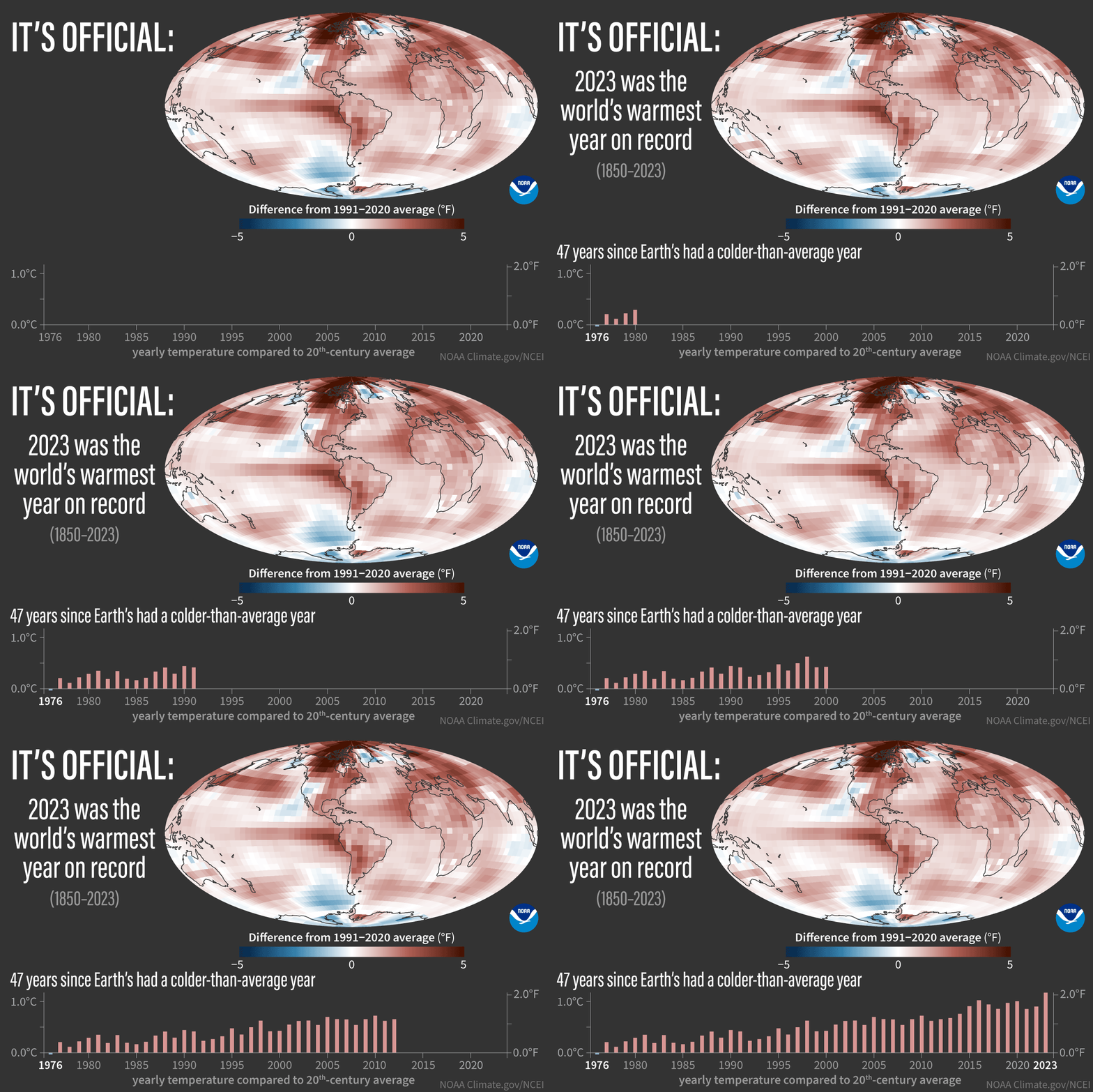
      This map shows 2023 temperatures compared to the 1991-2020 average. Most of the globe was warmer-than-average (red). Only a few areas were colder than average (blue). The animated bar graph shows yearly average temperature since 1976 compared to the 20th-century average. It’s been 47 years—nearly half a century—since Earth’s temperature was colder than average. 2023 set a new warmest-year record by a wide margin.

      Unlike the previous two years (2021 and 2022), which were squarely entrenched in a cold phase El Niño Southern Oscillation (ENSO) episode, also known as La Niña, 2023 quickly moved into ENSO neutral territory, transitioning to a warm phase episode, El Niño, by June. ENSO not only affects global weather patterns, but it also affects global temperatures. As seen in the image below, during the warm phase of ENSO (El Niño), global temperatures tend to be warmer than ENSO-neutral or La Niña years, while global temperatures tend to be slightly cooler during cold phase ENSO episodes (La Niña). Despite 2021 and 2022 not ranking among the five warmest years on record, the global annual temperature increased at an average rate of 0.06°C (0.11°F) per decade since 1850 and more than three times that rate (0.20°C / 0.36°F) since 1982.

      ▻https://www.climate.gov/news-features/featured-images/2023-was-warmest-year-modern-temperature-record#:~:text=Details,decade%20(2.

    • 2023 summer warmth unparalleled over the past 2,000 years

      Including an exceptionally warm Northern Hemisphere (NH) summer1,2, 2023 has been reported as the hottest year on record3-5. Contextualizing recent anthropogenic warming against past natural variability is nontrivial, however, because the sparse 19th century meteorological records tend to be too warm6. Here, we combine observed and reconstructed June-August (JJA) surface air temperatures to show that 2023 was the warmest NH extra-tropical summer over the past 2000 years exceeding the 95% confidence range of natural climate variability by more than half a degree Celsius. Comparison of the 2023 JJA warming against the coldest reconstructed summer in 536 CE reveals a maximum range of pre-Anthropocene-to-2023 temperatures of 3.93°C. Although 2023 is consistent with a greenhouse gases-induced warming trend7 that is amplified by an unfolding El Niño event8, this extreme emphasizes the urgency to implement international agreements for carbon emission reduction.

      ▻https://www.nature.com/articles/s41586-024-07512-y
      #été_2023

  • Reinhold Messner Rekord aberkannt : Frechheit
    ▻https://www.nd-aktuell.de/artikel/1176592.personalie-eberhard-jurgalski-reinhold-messner-rekord-aberkannt-f

    L’alpiniste le plus célèbre d’Allemagne et d’Autriche Messner vient de perdre le titre du premier homme qui a escaladé sans bouteille d’oxygène les quatre plus haut sommets du monde. Tant pis, cet honneur revient désormais à un amerloque aussi taré que notre héro italien par son passport et allemand dans nos coeurs. Une gentiile dame qui l’a accompgné vient de perdre son record aussi, mais je ne saurais me prononcer sur l’impact de cette histoire du côté féminin.

    L’ironie de l’histoire est le personnage à l’origine du dévoilement des records factices : c’est un cartographe un peu trop précis qui passe tout son temps libre avec la vérification des lieux et indications d’hauteur des exploits alpinistes. Il n’a jamais voyagé dans les Alpes et n’a surtout jamais escaladé le moindre sommet digne de cette appellation.

    26.9.2023 von Christin Odoj - Der Himalaya-Experte Eberhard Jurgalski hat nachgerechnet: Reinhold Messner war nicht der Erste.

    Alle paar Hundert Jahre kommt es vor, dass pedantische Wissenschaftler scheinbar Feststehendes infrage stellen und damit für Streit sorgen. Bestes Beispiel: Galileo Galilei. Der moderne Galilei heißt Eberhard Jurgalski und ist Himalaya-Experte. Er hat es nach zehn Jahren akribischer Forschung geschafft, anhand von gesammelten Geodaten dem Extrembergsteiger und Extrem-alles Reinhold Messner seinen Weltrekord abzuerkennen. Messner ist nicht länger der Mensch, der als erster alle Achttausender bestiegen hat. Jurgalski ist in der Bergsteiger-Community ungefähr so beliebt, wie Galilei es bei der Kirche war. Denn der 1952 im brutal flachen Salzgitter geborene Zahlenfetischist hat bewiesen, dass Messner nie auf dem Gipfel der Annapurna (8091 Meter) stand, sondern 65 Meter davor und fünf Höhenmeter darunter. Tatsächlich ist es bei vielen Bergen schwer ersichtlich, wo genau der Gipfel liegt. Jugalski hat die Sache nun mit Hilfe von Geodaten des Deutschen Zentrums für Luft- und Raumfahrt und Fotos aufgedeckt. Im neuen Guinessbuch der Rekorde steht jetzt der US-Amerikaner Ed Viesturs als Rekordhalter. Messner ist außer sich vor Wut auf den Mann, der in seinem kleinen Büro in Lörrach (immerhin 294 Meter über null) das Erbe vieler Säulenheiliger des Alpinismus infrage stellt, der aber selbst noch nie im Himalaya war und dessen höchste Gipfelbesteigung der Tüllinger Berg (460 Meter) bei Lörrach gewesen ist.

    Jurgalski arbeitet seit mehr als 40 Jahren an seiner Bergchronik und hat bereits diversen anderen Bergsteiger*innen ihre Gipfelerfolge weggerechnet. Seine Leidenschaft fürs Rechthaben entdeckte er im Erdkunde-Unterricht. Es störte ihn, dass in verschiedenen Atlanten dieselben Berge unterschiedlich hoch waren. Bei dem Gegockel geht der spannendste Aspekt jedoch unter: Mit Messner verliert auch Gerlinde Kaltenbrunner ihren Rekord, die erste (und bisher einzige) Frau auf allen 8000ern ohne Flaschensauerstoff gewesen zu sein. Auf geht’s, Ladys, Geschichte wird gemacht.

    #alpinisme #cartographie #record_mondial #wtf

  • Le décès d’un alpiniste entouré de 50 personnes suscite l’indignation : "Ce qu’il s’est passé là-bas est scandaleux" La Rédaction - La Libre

    Mohammad Hassan, un alpiniste pakistanais de 27 ans, a entamé l’ascension du K2, la deuxième plus haute montagne du monde. Mais il a vu son aventure prendre fin à 400 mètres du sommet, abandonné par ses confrères et suscitant l’indignation dans le monde de l’alpinisme.
    

    Mohammad Hassan a gravement chuté à la suite d’une avalanche le 27 juillet dernier, alors qu’il escaladait le K2. Les lourdes blessures dont souffrait l’alpiniste ont finalement causé sa mort. Mais ce dernier n’est pas décédé sur le coup. Mohammad Hassan s’est retrouvé suspendu par les pieds, la tête en bas, par une corde.

    Mohammad Hassan n’aura pas pu compter sur l’aide de ses coéquipiers, qui ont contourné Mohammad pour continuer leur périple. Des images de drone enregistrées par le caméraman Philip Flämig montrent qu’une cinquantaine d’alpinistes sont passés à côté de lui sans lui porter secours. Ces alpinistes ont même tendu une nouvelle corde pour poursuivre leur épopée.


    Situé dans le massif du Karakoram, le K2 est le deuxième plus haut sommet du monde avec une altitude de 8611 mètres.

    Après de longues minutes d’agonie, seul un travailleur humanitaire est finalement venu en aide à Mohammad et a tenté de le maintenir conscient au moyen d’un massage. Aucune opération de sauvetage n’a été organisée pour sauver le jeune homme, qui a succombé à ses blessures.

    Philip Flämig médusé a partagé ses impressions sur cette scène épouvantable. Pour lui, les autres alpinistes, animés par le défi, ont mal évalué leurs priorités : “C’était une ascension très animée et compétitive vers le sommet”. Ce sentiment d’incompréhension est partagé par Wilhelm Steindl, qui a participé à l’expédition mais a rebroussé chemin suite aux conditions dangereuses. "Ce qu’il s’est passé là-bas est scandaleux. Une personne vivante est laissée sur place pour que l’on puisse encore monter. Il n’aurait fallu que trois ou quatre personnes pour le sauver. Si j’avais vu ça, je serais monté pour aider ce pauvre homme", a-t-il déclaré au Telegraaf.

    #K2Trajedy 
Top female climber Tamara Lungar exploded on the human tragedy on K2 & behaviour of follow climbers there. 
Read her exact words of a true alpinist, who lost a close mate in K2 Winter 2021 

“ I have now really needed a few days to sort out my thoughts because I am pic.twitter.com/x3L97FLPvw
    -- The Northerner (@northerner_the) August 10, 2023 _

    #Montagne #Alpinisme #Sport #performances #ascension #accident #racisme

    Source : ▻https://www.lalibre.be/international/asie/2023/08/11/un-alpiniste-meurt-apres-une-chute-sans-pouvoir-compter-sur-laide-des-50-aut

    • * Menacée sur la toile, l’alpiniste la plus rapide du monde se défend après la mort d’un sherpa : « Nous avons fait de notre mieux » Afp - La Libre

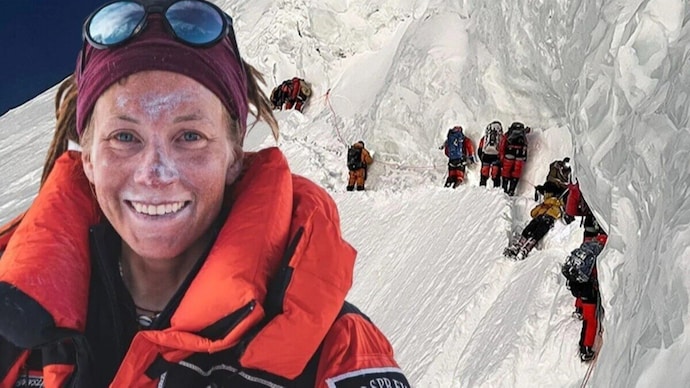
      Kristin Harila, co-détentrice du record du monde des 14 sommets de plus de 8.000 mètres gravis le plus rapidement, s’est défendue à la suite de critiques l’accusant d’avoir enjambé un sherpa mourant pour achever son ascension du K2 au Pakistan.

      Avec son guide népalais Tenjin Sherpa, la Norvégienne a escaladé ces 14 sommets en trois mois et un jour (92 jours), arrachant le 27 juillet le record du monde détenu jusqu’alors par le Népalo-britannique Nirmal Purja.


      Mais cet exploit vient d’être terni par une controverse. Des images de drones partagées par d’autres alpinistes la montrent avec son équipe passer au-dessus du corps visiblement blessé de Mohammad Hassan, un sherpa d’une autre équipe qui est décédé peu après, tandis qu’elle poursuivait son ascension du deuxième sommet le plus haut du monde pour décrocher le record.

      Ils se trouvaient à ce moment-là sur le Bottleneck du K2, un couloir étroit et hautement dangereux surplombé par des séracs d’un champ de glace à seulement 400 m au-dessous du sommet.

      Selon le secrétaire du club d’alpinistes, Karar Haidari, quelque 100 grimpeurs ont atteint le sommet du K2 ce jour-là.

      Les autorités pakistanaises du tourisme au Gilgit Baltistan, qui délivrent les autorisations d’ascension, ont annoncé vendredi avoir ouvert une enquête relative à ce décès.

      « Personne ne se souviendra de ton succès sportif, seulement de ton inhumanité », a écrit un internaute sur Instagram.

      « Le sang des sherpas est sur tes mains », a ajouté un autre.

      Kristin Harila a aussi essuyé des critiques pour avoir célébré son ascension une fois revenue au camp de base, à flanc de montagne.

      Tard jeudi, l’athlète de 37 ans a affirmé sur Instagram « avoir tout fait pour lui (Mohammad Hassan) », dénonçant les « menaces de mort » dont elle a fait l’objet depuis l’accident.

      Elle a assuré qu’elle avait, en compagnie de son caméraman Gabriel, ainsi que deux autres personnes dont « l’ami de Hassan », passé « une heure et demie » à essayer de le remonter après sa chute. Il n’est pas indiqué où se trouvait l’équipe du sherpa, mais de nombreux alpinistes se trouvaient « derrière eux », a relaté la Norvégienne.

      L’alpiniste a ensuite poursuivi sa route, après une alerte à l’avalanche transmise par son équipe.

      Gabriel est lui resté aux côtés de Hassan, a-t-elle assuré, partageant avec lui son oxygène et son eau chaude.

      Au bout d’une heure supplémentaire, le caméraman a décidé de partir, car il avait besoin « de plus d’oxygène pour sa propre sécurité ».

      A leur descente, ils ont constaté que Mohammad Hassan, 27 ans, était décédé.

      Mais son équipe, composée de quatre personnes, « n’était pas en mesure de descendre son corps » en toute sécurité, car il aurait fallu au moins six personnes pour le faire, s’est défendue la Norvégienne qui a relevé que le sherpa n’était pas correctement équipé.

      Sa mort est « vraiment tragique (...) et j’ai beaucoup de peine pour la famille », a-t-elle encore dit, mais « nous avons fait de notre mieux, en particulier Gabriel ».

      De nombreux utilisateurs ont pris la défense de Harila, relevant les dangers encourus lors d’une telle ascension. D’autres se sont demandés pourquoi le sherpa n’avait pas été correctement équipé, une internaute dénonçant l’inégalité de traitements entre les alpinistes occidentaux et les sherpas : « La vie des locaux est bon marché ».

      #Sherpa #Femme #Sportive #Pakistan #athlète #drones #record

      Source : ▻https://www.lalibre.be/international/asie/2023/08/11/menacee-sur-la-toile-lalpiniste-la-plus-rapide-du-monde-se-defend-apres-la-m

  • A propos de modélisation du changement climatique, sujet abordé un peu ici : ▻https://seenthis.net/messages/1010710
    Un gros dossier proposé par Christophe Cassou (directeur de Recherche @CNRS, climatologue, auteur principal 6e rapport #GIEC/@IPCC_CH 2017-22)

    Thread by cassouman40 on Thread Reader App – Thread Reader App
    ▻https://threadreaderapp.com/thread/1682449327787069443.html

    Nous ne vivons pas QUE le #ChangementClimatique (CC) dû aux activités humaines.
    Ns vivons le CC➕la variabilité interne (fluctuations spontanées du climat).
    Parlons variabilité interne dans ce long🧵afin de mieux comprendre les #records 🥵actuels régionalement&globalement !
    (1/70)

    C’est technique mais bien expliqué et avec de bonnes illustrations. Je l’ai juste survolé mais je laisse « l’intelligence collective » de ST s’en faire une idée plus précise. Perso, j’y reviendrai dans la journée.

    #changement_climatique #variabilité_interne #causes_anthropiques

  • El Niño : un retour qui inquiète. Les prévisionnistes anticipent de nouveaux #records_de_chaleur sur la planète.

    El Niño est de retour. Après trois ans d’absence, cette anomalie météorologique s’apprête à souffler les températures les plus élevées enregistrées sur Terre depuis l’ère préindustrielle, anticipent les prévisionnistes du Met Office britannique. « La température moyenne mondiale pour 2023 devrait se situer entre 1,08 °C et 1,32 °C (avec une estimation centrale de 1,20 °C) au-dessus de la moyenne observée depuis un siècle », rapporte Nick Dunstone, qui a dirigé cette étude notée avec un degré de certitude de 66 %. Si ces prévisions se confirment, les #catastrophes climatiques pourraient connaître leur apogée avec notamment « des vagues de chaleur sans précédent ». […]

    Le retour d’#El_Niño tombe au plus mauvais moment car les scientifiques craignent qu’il se conjugue avec le ralentissement brutal du #Gulf_Stream, un des principaux moteurs de régulation climatique. Une étude du Potsdam Institute for Climate Impact Research, publiée en 2021, s’est alarmée du possible effondrement de ce système. […]

    « Nos résultats confortent l’hypothèse que le déclin de l’#AMOC (’#Atlantic_meridional_overturning_circulation ’) n’est pas juste une fluctuation ou une réponse linéaire à l’augmentation des températures, mais signifie plutôt que l’on s’approche d’un seuil critique après lequel le système de circulation de l’eau peut s’effondrer », estime Stefan Rahmstorf qui a dirigé cette étude. […]

    Ce dérèglement est sans doute le fruit d’un emballement diabolique. Avec le réchauffement planétaire, la fonte des grands glaciers s’accélère. « L’apport d’eau douce du Groenland et la hausse des #précipitations dans cette région diluent l’eau de mer et grippent le système », explique Stefan Rahmstorf. En analysant des carottes sédimentaires collectées dans le golfe de Guinée, une équipe de paléoclimatologues a pu reconstituer un épisode similaire qui s’est produit sur terre il y a 125.000 ans. « La cascade d’effets que nous avons mis en lumière augure le pire ». […]

    « Ce changement conduira probablement à ce que la #température_mondiale en 2023 soit plus chaude qu’en 2022 ». […]

    Les conséquences pourraient être dévastatrices : assèchement de la #forêt_amazonienne, fournaise en Australie et aux Etats-Unis, #hiver plus intense au nord de l’Europe, déluges au Sud, accélération des émissions de méthane…

    (Les Échos)

    #réchauffement_climatique

  • Record de détenus en France avec 72’809 personnes derrière les barreaux furr avec afp - RTS
    ▻https://www.rts.ch/info/monde/13578478-record-de-detenus-en-france-avec-72809-personnes-derriere-les-barreaux.

    Avec 72’809 personnes derrière les barreaux, le nombre de détenus en France s’établit à un niveau record absolu en novembre, au-delà de celui enregistré juste avant le confinement mi-mars 2020.

    Le « fol espoir » de résorber définitivement le surpeuplement structurel des prisons, comme l’avait enjoint la Cour européenne des droits de l’Homme (CEDH) à la France en janvier 2020, s’évanouit donc.

    Densité carcérale de 120%
    Selon les données statistiques du ministère de la Justice, ▻https://www.justice.gouv.fr/art_pix/Statistique_etablissements_et_personnes_ecrouees_en_France_202211_.pdf
    les établissements pénitentiaires français comptaient au 1er novembre 72’809 détenus pour 60’698 places opérationnelles, soit une densité carcérale de 120%. Elle était de 115,4% il y a un an.

    Le précédent record (72’575 détenus) datait de mars 2020, à la veille du confinement décidé pour lutter contre la pandémie de Covid-19 et qui avait entraîné une chute drastique du nombre de prisonniers : il y avait eu moins d’entrées en détention et des mesures de libérations anticipées.

    Depuis, les statistiques sont remontées régulièrement jusqu’à frôler ce plus-haut historique le mois dernier, avec 72’350 personnes incarcérées au 1er octobre.

    Condamnation de la CEDH
    Cette tendance, un mal structurel qui avait valu à la France en janvier 2020 une condamnation de la CEDH, va à rebours de celle enregistrée dans les voisins européens de la France où le taux d’incarcération a baissé ces dix dernières années : -12,9% en Allemagne, -17,4% aux Pays-Bas.

    Sur une année, on dénombre 2997 prisonniers en plus en France - ils étaient 69’812 au 1er octobre 2021 - soit une hausse de 4,3%.

    Selon les chiffres officiels, 15’469 détenus sont actuellement en surnombre par rapport aux places disponibles dans les établissements pénitentiaires (contre 13’170 il y a un an). En raison de cette surpopulation, 2225 sont contraints de dormir sur des matelas posés à même le sol.

    Peu de femmes et de mineurs
    3,5% des personnes incarcérées sont des femmes et 0,8%, des mineurs. Plus du quart des détenus (26,9%) sont des prévenus, c’est-à-dire des personnes en attente de jugement - et donc présumés innocents.

    La densité carcérale dans les maisons d’arrêt, où sont incarcérés ces prévenus et les condamnés à de courtes peines, grimpe à 142,8%. Cinquante-six prisons françaises affichent une densité supérieure à 150% (51 en métropole et cinq en Outre-mer).

    Cette densité dépasse même 200% dans six établissements (contre trois le mois dernier) : #Carcassonne (215,6%), #Nîmes (214,5%), #Perpignan (204,6%), #Foix (203,1%), #Majicavo à Mayotte (200,9%) et #Bordeaux-Gradignan. Dans ce dernier centre pénitentiaire du Sud-Ouest, elle grimpe à 206,6% : 350 places opérationnelles pour 723 détenus, et à la clé des conditions de vie régulièrement dénoncées.

    « Atteinte grave et massive aux droits fondamentaux »
    L’Observatoire international des prisons (OIP), l’Ordre des avocats du barreau de Bordeaux et une association de défense des droits des détenus (A3D), ont tenté des actions en justice pour faire cesser cette « atteinte grave et massive aux droits fondamentaux des personnes détenues ». Le Conseil d’Etat a rejeté leur requête le 11 novembre.

    Dans son « plan d’action » contre la surpopulation carcérale adressé à l’Europe, le gouvernement français affiche la construction de 15’000 nouvelles places de prison d’ici 2027 et un recours accru aux mesures alternatives à la détention.

    #prisons #enMarche #justice #France #emmanuel_macron #détenus #record #statistiques

  • Année faste pour les dividendes Gérard Bérubé - Le Devoir
    ▻https://www.ledevoir.com/opinion/chroniques/749799/chronique-l-inflation-et-le-dividende
    . . . . . 
    N’empêche qu’un peu plus tôt cette semaine, la firme de gestion britannique Janus Henderson publiait son indice Global Dividend, ▻https://www.janushenderson.com/fr-fr/investor/jh-global-dividend-index qui pointe un bond de 11,3 % des dividendes mondiaux entre les deuxièmes trimestres de 2021 et de 2022, et ce, au grand soulagement des actionnaires et des investisseurs institutionnels, dont les portefeuilles sont autrement malmenés par la morosité boursière. La croissance dite sous-jacente ressort à 19,1 % une fois pris en compte le jeu des taux de change, la composition de l’indice impliquant une conversion en dollars américains.

    Les dividendes versés ont établi un nouveau record de 544,8 milliards de dollars américains, et 94 % des 1200 entreprises composant l’indice ont augmenté ou maintenu leur dividende. « Il est étonnant de constater que, malgré les énormes perturbations économiques causées par la pandémie, les dividendes mondiaux sont désormais supérieurs au niveau record qu’ils avaient atteint avant la pandémie », remarque Janus Henderson.

    Au Canada, ils ont également atteint un record, en hausse de 12,7 % sur une base sous-jacente, grâce aux producteurs de pétrole et aux banques. Ainsi, 97 % des sociétés américaines et canadiennes ont augmenté ou maintenu leurs dividendes, avec les pétrolières revendiquant 40 % de la croissance. Statistique Canada a calculé ▻https://www150.statcan.gc.ca/n1/pub/71-607-x/71-607-x2021010-fra.htm que les industries non financières ont vu leur bénéfice avant impôt bondir de 30,7 % entre les deuxièmes trimestres de 2021 et de 2022, contre une hausse de 3 % pour les industries financières. Dans le premier camp, les entreprises engagées dans la fabrication de produits pétroliers ont engrangé un bénéfice avant impôt en hausse de 313 % et celles s’activant dans l’extraction pétrolière, de 212 %.

    Il y aura ralentissement, compte tenu de la conjoncture. Le cabinet Janus Henderson relève tout de même sa prévision de versements de dividendes mondiaux à 1560 milliards en 2022, soit une croissance globale de 5,8 % en glissement annuel, ou une croissance sous-jacente de 8,5 %.

    #dividendes #économie #capitalisme #finance #privatisation #multinationales #fiscalité #inégalités #actionnaires #dette #entreprises #records

  • Minecraft Topped 141 Million Monthly Active Users in August
    ▻https://www.vgchartz.com

    [Minecraft] had over 141 million monthly active users in August 2021, which is above the previous record of nearly 140 million monthly active users earlier this year.

    #jeu_vidéo #jeux_vidéo #jeu_vidéo_minecraft #record #succès #business #mojang #microsoft

  • ‘Warzone’ Bans 100,000 Cheaters in Largest Ban Wave Yet
    ▻https://www.vice.com/en/article/k7898v/warzone-bans-100000-cheaters-in-largest-ban-wave-yet

    This massive ban wave brings the total banned accounts since the launch of Call of Duty: Warzone to 700,000.

    The makers of the popular first-person shooter Call of Duty just banned more than 100,000 accounts for cheating in what is the largest ban wave in the game’s history.

    Le développeur Raven Software vient d’expulser des tricheurs dans une vague exceptionnelle de 100 mille bannissements pour détériorer la réputation des éditeurs de solutions de triche. Le volume total de suppression de comptes convaincus de fraude se porte à 700 mille comptes.

    #jeu_vidéo #jeux_vidéo #business #ban #bannissement #expulsion #triche #jeu_vidéo_call_of_duty_warzone #record #raven_software #activision #anti-triche #nickmercs #electronic_arts #apex_legends #gratuit #f2p #free_to_play

  • Collectors are as confused as you are about that $1.56M Super Mario 64 sale | Ars Technica
    ▻https://arstechnica.com/features/2021/07/collectors-are-as-confused-as-you-are-about-that-1-56m-super-mario-64-s

    But for newcomers from other collectible spaces, this kind of quality-based price premium is relatively common. “In other spaces such as comics, coins, or sports cards, and many other collectibles, the difference between the second-highest grade and the highest grade can be a drastic difference in value and sometimes much more,” Wata Games CEO Ryan Sabga told Ars. “Attaining the finest known example from a condition standpoint drives a certain type of collector’s behavior, specifically the collector who wants the absolute best. The collectible video game market is no different.”

    #jeu_vidéo #jeux_vidéo #culture #collection #heritage_auctions #wata_games #record #analyse #zelda #the_legend_of_zelda #mario #super_mario_bros #mario_64 #jeu_vidéo_zelda #jeu_vidéo_the_legend_of_zelda #jeu_vidéo_mario #jeu_vidéo_super_mario_bros #jeu_vidéo_mario_64 #excellence #rareté

  • Super Mario 64 sells for $1.5 million at auction - Polygon
    ▻https://www.polygon.com/22574261/super-mario-64-auction-record-price-heritage-auctions-wata-nintendo

    Last week, a game cartridge of The Legend of Zelda sold for $870,000, the highest price ever paid for a video game at auction. But The Legend of Zelda only held that record for a few days before it was figuratively butt-stomped into second place. Over the weekend, a sealed copy of Super Mario 64 sold for $1.56 million at Heritage Auctions.

    […]

    “The price jump on this stuff is so sudden, and on such specific items, that I do not believe it happened naturally,” Cifaldi tweeted Sunday. “It all feels really suspect imo.”

    #jeu_vidéo #jeux_vidéo #culture #super_mario_64 #mario #the_legend_of_zelda #zelda #jeu_vidéo_super_mario_64 #jeu_vidéo_mario #jeu_vidéo_the_legend_of_zelda #jeu_vidéo_zelda #nintendo_64 #console_de_jeux_vidéo #business #vente_aux_enchères #heritage_auctions #wata_games #record #exceptionnel #surprise #étonnement #méfiance #suspicion

  • Mint Condition Copy of ’Super Mario 64’ Sells for $1.5 Million
    ▻https://www.vice.com/en/article/epnmnz/mint-condition-copy-of-super-mario-64-sells-for-dollar15-million

    An unopened copy of the legendary Nintendo 64 game Super Mario 64 sold for a record-breaking $1.5 million at auction over the weekend.

    Although Super Mario 64 is the best-selling Nintendo 64 game of all time, with more than 11 million copies sold, the auctioned cartridge was one of less than five sealed copies that has been graded by professionals as a 9.8, A++ Wata rating, which is an out-of-10 grading system done by a company called Wata Games. 

    “It seems impossible to overstate the importance of this title, not only to the history of Mario and Nintendo, but to video games as a whole," Heritage Auctions Video Games Specialist Valarie McLeckie said in a press release. “This copy is a true prize for any serious collector."

    The idea of paying that much for Super Mario 64 still shocked many video game enthusiasts and historians.

    #jeu_vidéo #jeux_vidéo #culture #super_mario_64 #mario #the_legend_of_zelda #zelda #jeu_vidéo_super_mario_64 #jeu_vidéo_mario #jeu_vidéo_the_legend_of_zelda #jeu_vidéo_zelda #nintendo_64 #console_de_jeux_vidéo #business #vente_aux_enchères #heritage_auctions #wata_games #record #exceptionnel

  • Une cartouche Super Mario 64 vendue 1,56 million de dollars aux enchères, nouveau record
    ▻https://www.bfmtv.com/economie/consommation/une-cartouche-super-mario-64-vendue-1-56-million-de-dollars-aux-encheres-nouv

    Ce dimache, une cartouche scellée du mythique « Super Mario » pour console Nintendo 64 a été vendue pour 1,56 million de dollars, un nouveau record pour un jeu vidéo selon la maison d’enchères américaine Heritage Auctions.

    « C’est le premier jeu à jamais avoir été vendu aux enchères pour plus d’un million de dollars », a expliqué à l’AFP Eric Bradley, un porte-parole de la société basée à Dallas, au Texas (Etats-Unis).

    Cette cartouche de « Super Mario 64 » date de 1996 et utilise pour la première fois la 3D.

    #jeu_vidéo #jeux_vidéo #culture #super_mario_64 #mario #jeu_vidéo_super_mario_64 #jeu_vidéo_mario #nintendo_64 #console_de_jeux_vidéo #business #vente_aux_enchères #heritage_auctions #wata_games #record #exceptionnel

  • Une cartouche du jeu vidéo Zelda vendue 870 000 dollars aux enchères - Le Parisien
    ▻https://www.leparisien.fr/high-tech/une-cartouche-du-jeu-video-zelda-vendue-870-000-dollars-aux-encheres-10-0

    Une cartouche du mythique jeu vidéo « La légende de Zelda », compatible avec les consoles des années 1980 Nintendo NES, a été adjugée pour la somme « record » de 870 000 dollars ce vendredi, a annoncé la maison d’enchères Heritage Auctions dans un communiqué. Datée de 1987, la pièce était toujours scellée dans son emballage d’origine.

    #jeu_vidéo #jeux_vidéo #culture #zelda #the_legend_of_zelda #jeu_vidéo_zelda #jeu_vidéo_the_legend_of_zelda #nintendo_nes #console_de_jeux_vidéo #business #vente_aux_enchères #heritage_auctions #record #exceptionnel

  • Super Mario Bros : une cartouche neuve vendue 560.000 euros aux enchères
    ▻https://www.lefigaro.fr/culture/encheres/super-mario-bros-une-cartouche-neuve-vendue-660-000-euros-aux-encheres-2021

    Il n’en n’avait pas voulu à Noël, en 1985. Mais le propriétaire est finalement bien content de ce cadeau d’antan : son ancienne édition de Super Mario Bros. s’est vendue vendredi 2 avril aux enchères pour une somme record de 600.000 dollars (soit 560.000 euros). Oubliée pendant 35 ans au fond d’un tiroir, la cartouche a été retrouvée l’année dernière dans son emballage d’origine, jamais ouverte. Anonyme, le vendeur a simplement déclaré « n’y avoir jamais repensé » depuis qu’il l’avait reçue en cadeau.

    #jeu_vidéo #jeux_vidéo #culture #super_mario_bros #mario #jeu_vidéo_super_mario_bros #jeu_vidéo_mario #nintendo_nes #console_de_jeux_vidéo #business #vente_aux_enchères #heritage_auctions #record #exceptionnel

  • In The Red Recordings


    ▻https://intheredrecords.com/collections

    In The Red on Bandcamp
    ▻https://intheredrecords.bandcamp.com/artists

    Swing From The Sean DeLear par Kid Congo & The Pink Monkeys Bird
    ▻https://kidcongothepinkmonkeybirds.bandcamp.com/track/he-walked-in

    Side Two of the EP is a 14 minute psych, Chicano groove titled “He Walked In.” The text is based on a visceral fever dream Kid had about his friend, and Gun Club bandmate, Jeffrey Lee Pierce, whom passed away in 1996. Leading us back to the theme of feelings sustained between life and memory, the song dreams on as the band spreads their monkey bird wings, Mark Cisneros on flute, and guest, tambourine queen Cesar Padilla lost in music but found in sound. In such uncertain times, one thing is most certain; Kid Congo & The Pink Monkey Birds will always bring the party.. and the other world. 19/2/2021

    Chaque réalisation de In The Red est accompagné d’un texte (in English) et d’anecdotes par leurs auteurs.
    Tav Falco & The Panther Burns que j’avais signalé ici ►https://seenthis.net/messages/882811 mais son meilleur est ailleurs.
    Negativity des Scientists, un autre extrait du #catalogue du #label de L.A une écoute jubilatoire et imprévisible de sons à haute tension.

    ▻https://scientists.bandcamp.com/track/outsider-2
    #records #bands #musique