Are #LLMs random ? - Nikhil R
▻https://rnikhil.com/2025/04/26/llm-coin-toss-odd-even
— Permalink
Are #LLMs random ? - Nikhil R
▻https://rnikhil.com/2025/04/26/llm-coin-toss-odd-even
— Permalink
#git-who: Git blame for file trees
▻https://github.com/sinclairtarget/git-who
— Permalink
Seulement 2 % des micro-entreprises françaises investissent + de 5 000 € par an dans leur présence en ligne, on passe à 41 % pour les #PME. Tous les chiffres de notre étude sur la présence en ligne des TPE/PME sur ►https://www.afnic.fr/observatoire-ressources/actualites/la-presence-en-ligne-des-micro-entreprises-et-tpe-pme-francaises-en-2021 #entrepreneurs #france #TransfoNum #Afnic
Only 2% of French VSBs invest more than €5,000 per year in their online presence, this figure increases to 41% for SMEs. All the numbers from our study onthe online presence of French VSBs and SMEs on ▻https://www.afnic.fr/en/observatory-and-resources/news/2021-edition-of-the-afnic-study-on-the-online-presence-of-french-micro-enterpr #Statistics #Entrepreneurs #digitaltransformation
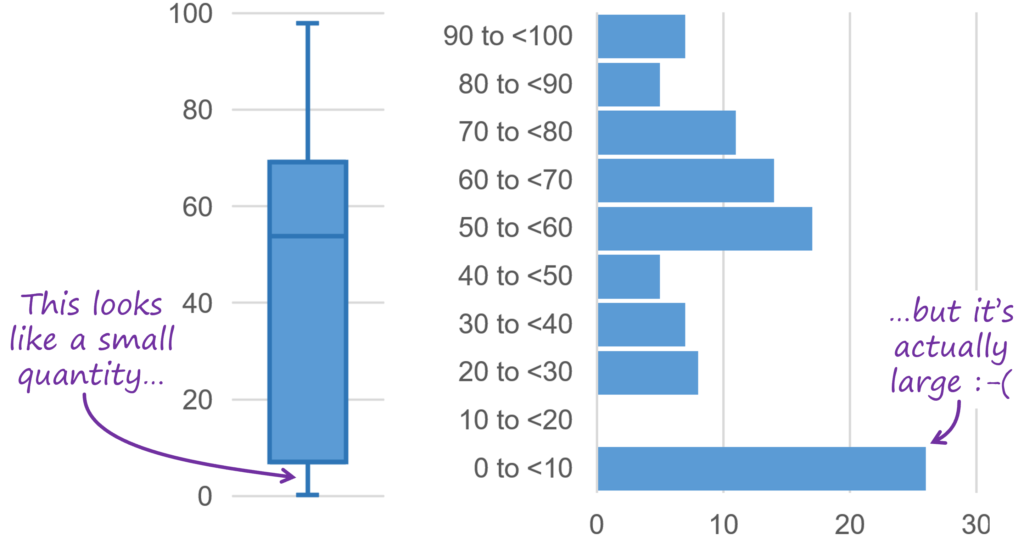
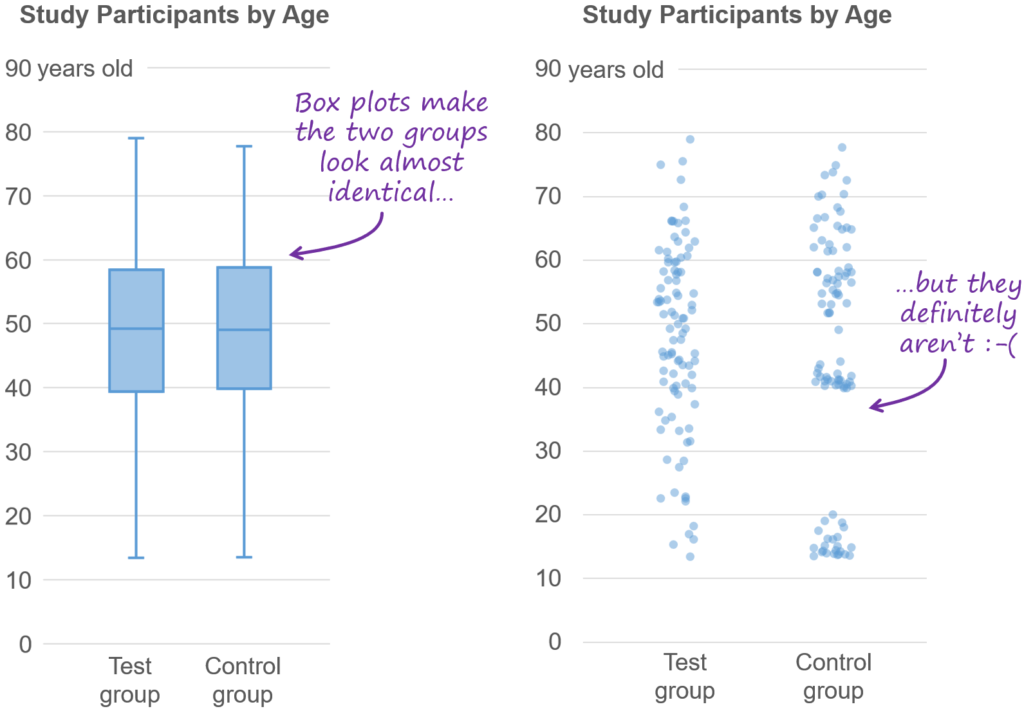
I’ve Stopped Using #box_plots. Should You?
▻https://nightingaledvs.com/ive-stopped-using-box-plots-should-you
tl;dr: After having explained #How_To read box plots to thousands of workshop participants, I now believe that they’re poorly conceived (box plots, not workshop..
#Business_Intelligence #Charts #Data_Science #Data_Visualization #statistics
ben oui, c’est bien connu de longue date, la #boîte_à_moustaches ne peut avoir de sens que pour une distribution unimodale, ce qui fait une hypothèse implicite très forte sur ses conditions d’utilisation.
Le premier exemple présenté…
… et tous les suivants ont cette même caractéristique : il y a plusieurs modes (sommets relatifs) dans la distribution
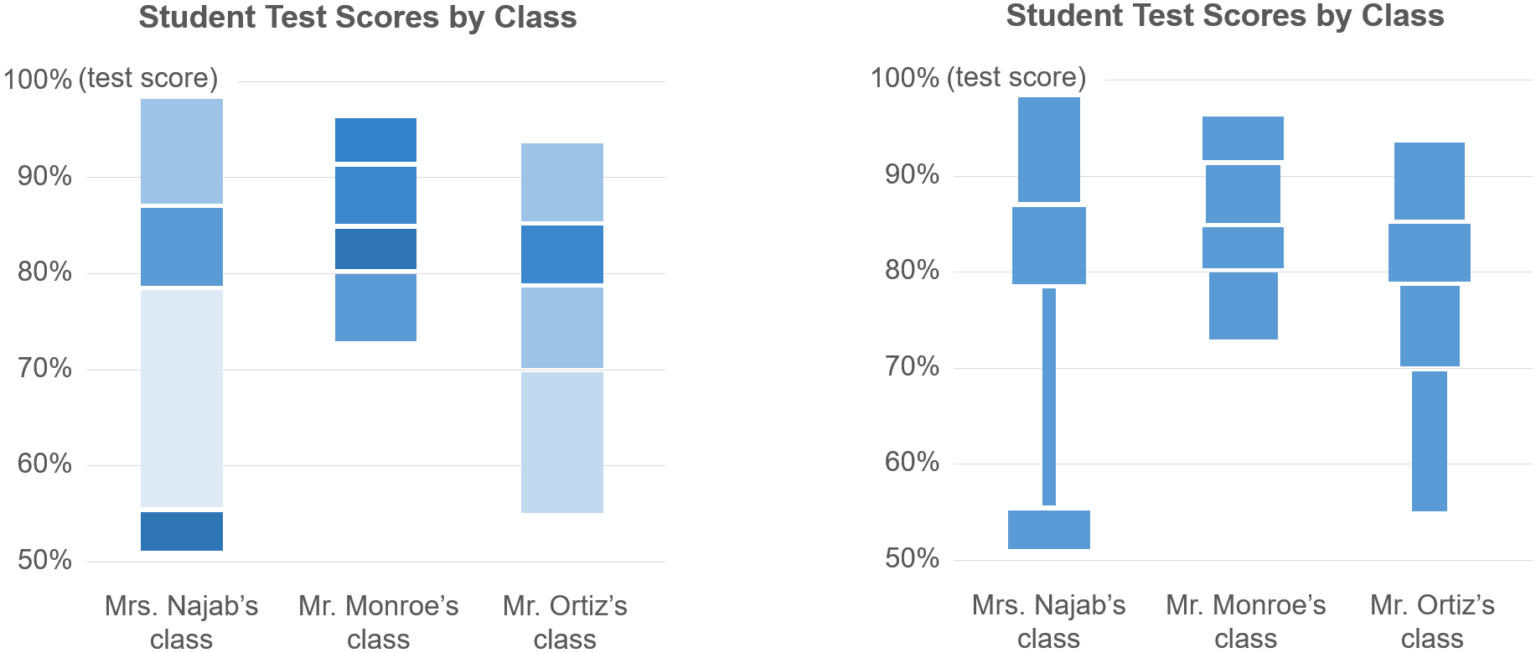
il propose des alternatives
Oui, la version de gauche est intéressante et… un peu technique à réaliser. Perso, les graphiques avec les points individuels, éventuellement bruité (jittered strip plot, celui de droite dans le deuxième exemple cité ci-dessus) me parait convenir parfaitement : plus directement lisible et pas vraiment compliqué techniquement à réaliser, surtout avec un petit nombre d’individus, comme c’est le cas pour les exemples d’alternatives)
“South Africa’s lottery probed as 5, 6, 7, 8, 9 and 10 drawn”
Les données en #OpenData du mois de mars pour les noms domaine en .fr sont en ligne sur opendata.afnic.fr
The March #data for .fr domain names is now available online on opendata.afnic.fr/en
#Afnic #PointFR #Statistiques #DataViz #DotFR #ccTLDs #Statistics
Les données #opendata du mois de juillet pour les noms de domaine en .fr sont en ligne ! opendata.afnic.fr
The July open data for .fr domain names is now available on opendata.afnic.fr/en
The Chernobyl Podcast
The official podcast of the miniseries Chernobyl, from HBO and Sky. Join host Peter Sagal (NPR’s “Wait Wait...Don’t Tell Me!”) and series creator, writer and executive producer Craig Mazin after each episode as they discuss the true stories that shaped the scenes, themes and characters.
Great podcast to listen to once you’ve watched the HBO series. The author explains the narrative choices he had to make and how much/when the series departs from what actually happened.
And for good measure, two episodes of the BBC’s ’More or Less’:
(RSS: ▻https://podcasts.files.bbci.co.uk/p02nrss1.rss )
1) Questioning the Chernobyl disaster death count
The recent TV miniseries ‘Chernobyl’ has stirred up debate online about the accuracy of its portrayal of the explosion at a nuclear power plant in the former Soviet state of Ukraine. We fact-check the programme and try and explain why it so hard to say how many people will die because of the Chernobyl disaster.
▻http://open.live.bbc.co.uk/mediaselector/6/redir/version/2.0/mediaset/audio-nondrm-download/proto/http/vpid/p07dtdwq.mp3
2) Is nuclear power actually safer than you think?
We questioned the death count of the Chernobyl nuclear disaster in last week’s More or Less podcast. In the end, Professor Jim Smith of Portsmouth University came up with an estimate of 15,000 deaths.
But we wondered how deadly nuclear power is overall when compared to other energy sources? Dr Hannah Ritchie of the University of Oxford joins Charlotte McDonald to explore.
▻http://open.live.bbc.co.uk/mediaselector/6/redir/version/2.0/mediaset/audio-nondrm-download/proto/http/vpid/p07fgfl5.mp3
L’Afnic révèle les résultats de son étude du marché des noms de domaine dans le monde en 2018 ▻https://www.afnic.fr/fr/l-afnic-en-bref/actualites/actualites-generales/11481/show/l-afnic-revele-les-resultats-de-son-etude-du-marche-des-noms-de-domaine-dans-l #Afnic #Internet #étude #statistiques #Web
Afnic reveals the results of its #study of the world’s domain name market in 2018 ▻https://www.afnic.fr/en/about-afnic/news/general-news/11487/show/afnic-reveals-the-results-of-its-study-of-the-world-s-domain-name-market-in-20 #Afnic #domains #ntdls #newgtlds #ICANN #statistics #web #Internet
Explaining p-values with puppies
▻https://hackernoon.com/explaining-p-values-with-puppies-af63d68005d0?source=rss----3a8144eabfe3
You’ll find p-values lurking all over data science (and all the rest of science, for that matter). If you took STAT101, the explanation you probably heard runs something like this: A #p-value is the probability of observing a statistic at least as extreme as ours, conditional on the null hypothesis. No wonder that didn’t stick! Let’s try it with puppies instead…Is p-value short for puppy-value?Setting the (crime) sceneImagine coming home and discovering this in your kitchen:Let’s assume this is your dog and your kitchen, otherwise the example just became much stranger. Also, as far as their owners are concerned, dogs are always puppies even when they’re too big to carry around.Let’s put this suspect on trial for the crime of sticking his head in the garbage bin!We’ll work with a default action of (...)
Best Charts to Show Discrete #data
▻https://hackernoon.com/best-charts-to-show-discrete-data-ee7fd3c7365?source=rss----3a8144eabfe3
In this part of the data visualization project, we will review charts that help find similarities and differences between various categories of data and discuss their purposes and specifics.But firstly, let’s sort out what a discrete data is.What is discrete data?Data is discrete if you can answer affirmatively on the following questions about it:Is it countable?Is it possible to divide the data into smaller parts? (i.e., to categorize it)Discrete data can contain only a finite number of values. One of its notable properties is that, unlike continuous data, it can’t be measured, only counted.Examples of discrete data: the number of players in a team, the number of planets in the Solar System.Examples of non-discrete (continuous) data: height, weight, length, income, temperature.Bar chartThe (...)
Learn Pandas Via Usecases — Part 2
▻https://hackernoon.com/learn-pandas-via-usecases-part-2-e1503892191b?source=rss----3a8144eabfe3
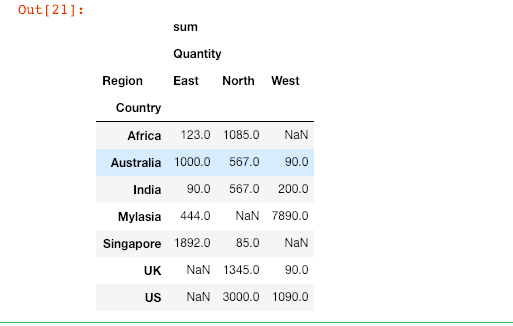
Learn #python Pandas Via Usecases — Part 2Use cases open up more functionalitiesIn the last blog, I hope I have sold you the idea that Pandas is an amazing library for quick and easy data analysis and it’s much easier to use than you thought. If you have not read my first blog about Pandas, please go through it before you move forward.Oops !! We missed Some DataIn the last blog, we saw basic Dataframe operations using sample sales data. Let’s assume you are a manager leading a sales team, and you were all happy about the sales trajectory and the pivot representation of the data you learned to create from our last blog.import numpy as npdf.pivot_table(index=["Country"], columns=["Region"], values=["Quantity"], (...)
Gaming the #lottery: How one winner used math to overcome the odds
▻https://hackernoon.com/gaming-the-lottery-how-one-winner-used-math-to-overcome-the-odds-71c8f68
Three out of every two people struggle with fractionsEach week for the last 6 years (2012–2018), I was playing the lottery to win. Not just hoping to win — playing with a ‘positive expected value’ (a mathematical expectation to win rather than lose, on average, over time). In June 2018 this particular window of opportunity closed, so I’ve decided to share more about the winning model and reveal some closely guarded secrets from the clandestine world of professional #gambling.Oz Lotteries ‘Pools’ website one day after the game was discontinuedWinners walking among usWe’ve all heard the maxim ‘the house always wins’. This is typically true.But how do we explain the MIT students or Michigan retirees who took home millions of dollars in the Massachusetts state lottery…many, many times? There were the (...)
A Difference Between DL and #statistics
▻https://hackernoon.com/a-difference-between-dl-and-statistics-c3939b999f75?source=rss----3a8144
Photo by Robert Anasch on UnsplashOne thing that I love about being in grad school is the unending innovation that reverberates in the corridors. Sure, I sit in a cubicle part-time coding my life away, but there are moments where people step out of their hole to converse with those around them.One of these structured ways is through the weekly update meetings, and one of the many conversations we have inspired this post.Let’s start off with statistics.One of statistics’ main focus is to create a generalizable model, such as a linear or multivariate regression model, to best fit the data to represent the pattern you are investigating.There are other key topics in statistics like statistical significance, correlation vs. causation, probability theory, and model evaluation that are shared (...)
#deep-learning #machine-learning #algorithms #dl-and-statistics
Poverty in America: Greater Than Statistics Indicate (►https://www.b...
▻https://diasp.eu/p/8117473
Poverty in America: Greater Than Statistics Indicate
To continue, please click the box below to let us know you’re not a robot.
HN Discussion: ▻https://news.ycombinator.com/item?id=18571426 Posted by occamschainsaw (karma: 284) Post stats: Points: 130 - Comments: 155 - 2018-11-30T18:44:58Z
#HackerNews #america #greater #indicate #poverty #statistics #than
Article content:
To continue, please click the box below to let us know youʼre not a robot.
HackerNewsBot debug: Calculated post rank: 138 - Loop: 282 - Rank min: 100 - Author rank: 48
29 Statistical Concepts Explained in Simple English (▻https://www.da...
▻https://diasp.eu/p/8035345
29 Statistical Concepts Explained in Simple English | #explained #definitions #statistics
Statistical rule of three (▻https://www.johndcook.com/blog/2010/03/3...
▻https://diasp.eu/p/8035346
Statistical rule of three | #three #rule #estimation #statistics
We’re Measuring the Economy All Wrong - The New York Times (https:/...
▻https://diasp.eu/p/7719307
We’re Measuring the Economy All Wrong - The New York Times | #inequality #finance #unemployment #economy #statistics #crisis #reductionism
Mozilla : Firefox public data report (▻https://data.firefox.com) | ...
▻https://diasp.eu/p/7652598
Mozilla : Firefox public data report | #statistics #firefox #mozilla #public #data
Like Data Analytics ? Learn Some #economics First
▻https://hackernoon.com/like-data-analytics-learn-some-economics-first-67b16926ceab?source=rss--
Data analytics is one of the fastest growing jobs. But, you can be even more successful in it with at least some knowledge of economics. In particular, these techniques can help you create your own mini research lab in your startup so that you have the resources of a large company to produce useful business intelligence analysis, while still remaining agile and lean.Having finished my doctorates in both a traditional economics and a less traditional computer science-ish department at Stanford, I’ve had the opportunity and pleasure to interact with a wide range of quantitative data science techniques. Both departments have different styles, but their approaches are highly complementary, which is being increasingly recognized by economists, such Susan Athey and Sendhil (...)
#data-science #entrepreneurship #statistics #computer-science
Boosting and Bagging: How To Develop A Robust Machine Learning Algorithm
▻https://hackernoon.com/how-to-develop-a-robust-algorithm-c38e08f32201?source=rss----3a8144eabfe
Bootstrapping/Bagging/BoostingMachine learning and data science require more than just throwing data into a python library and utilizing whatever comes out.Data scientists need to actually understand the data and the processes behind the data to be able to implement a successful system.One key methodology to implementation is knowing when a model might benefit from utilizing bootstrapping methods. These are what are called ensemble models. Some examples of ensemble models are AdaBoost and Stochastic Gradient Boosting.Why use ensemble models?They can help improve algorithm accuracy or improve the robustness of a model. Two examples of this is boosting and bagging. Boosting and Bagging are must know topics for data scientists and machine learning engineers. Especially if you are planning (...)
#machine-learning #statistics #data-science #algorithms #self-improvement
Could a random portfolio management be applicable to #investing?
▻https://hackernoon.com/could-a-random-portfolio-management-be-applicable-to-investing-ba2d526c8
The global stock market has a wide range of various Exchange Traded Funds (ETFs). Today we are going to compare a random portfolio management of stocks and ETF investing. Hundreds of random investors will be simulated. We will try to understand is there a difference between these approaches.All operations will be carried out in R.What is ETF?An ETF, or exchange-traded fund, is a marketable security that tracks an index, a commodity, bonds, or a basket of assets like an index fund. Unlike mutual funds, an ETF trades like a common stock on a stock exchange. ETFs experience price changes throughout the day as they are bought and sold.Loading data and preprocessingUsed libraries are▻https://medium.com/media/70a6505a27be7978662cdb2c00a3446f/hrefFirst of all, we should load the data. Here you (...)
What Is A Confounding Variable
▻https://hackernoon.com/what-is-a-confounding-factor-6f30487de3e9?source=rss----3a8144eabfe3---4
Let’s say a group of researchers, or #data scientists discover that the mortality rate in Florida is 20 deaths out of 1000 people a year compared to Washington State where it is 9.8 deaths out of 1000 people.Being very concerned these researchers put in a proposal for millions of dollars to try to figure out how to decrease this mortality rate in Florida. However, they forgot to dig a little deeper. They forgot to exam the average age of the populations of the two states. If Florida’s average age is 52 and Washington’s is 25 that might play a role in the mortality rate. In this case, the age played the role of a confounding variable.A variable that is not considered but plays a role in the outcome of an event is considered a confounding factor.In epidemiology, a confounding variable refers (...)
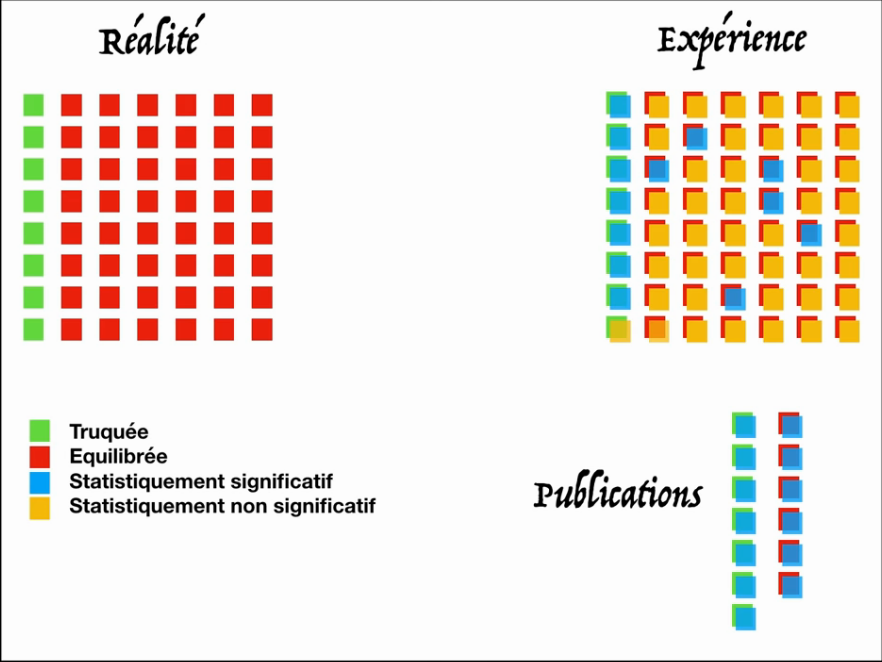
Les ravages de la fétichisation des p-valeurs et du biais de publication, en une diapo :
Dans le contexte de la vidéo, ’truquée’ = hypothèse réellement fausse, ’Équilibrée’ = hypothèse réellement vraie.
Je l’ai trouvée particulièrement claire, c’est facile de s’emmêler les pinceaux quand on veut expliquer les tests d’hypothèses. Le papier de Ioannidis va plus loin en terme de modélisation mais cette approximation est suffisante pour une exposition rapide.
Continuous vs Discrete Variables in the context of Machine Learning.
▻https://hackernoon.com/continuous-vs-discrete-variables-in-the-context-of-machine-learning-15d9
Let’s get into the topic fast. I know, you don’t have time. You have to learn other topics too. Okay! I hear you :)CONTINUOUS VARIABLEA continuous variable can take any values. Think of it like this: If that number in the variable can keep counting, then its a continuous variable.Ex: Weight of a person: 152.232 Kg, you’re probably thinking, “where am I counting?”. Yes, you are! The weight of the person is actually 152.232211223342211223332112244778899399947777889999888888377747666678788992336677……………………………………………………………………………………………………………………………………………………………………………………………………………………………………KgObviously, those dots aren’t ending anytime soon. Matter of fact, they’re not ending!Now you see how specifically that variable can “keep counting”? When I say “counting”, I’m referring to those counts after the decimal.That is an example for (...)
#predictive-analytics #continous-variable #discrete-variable #statistics #machine-learning