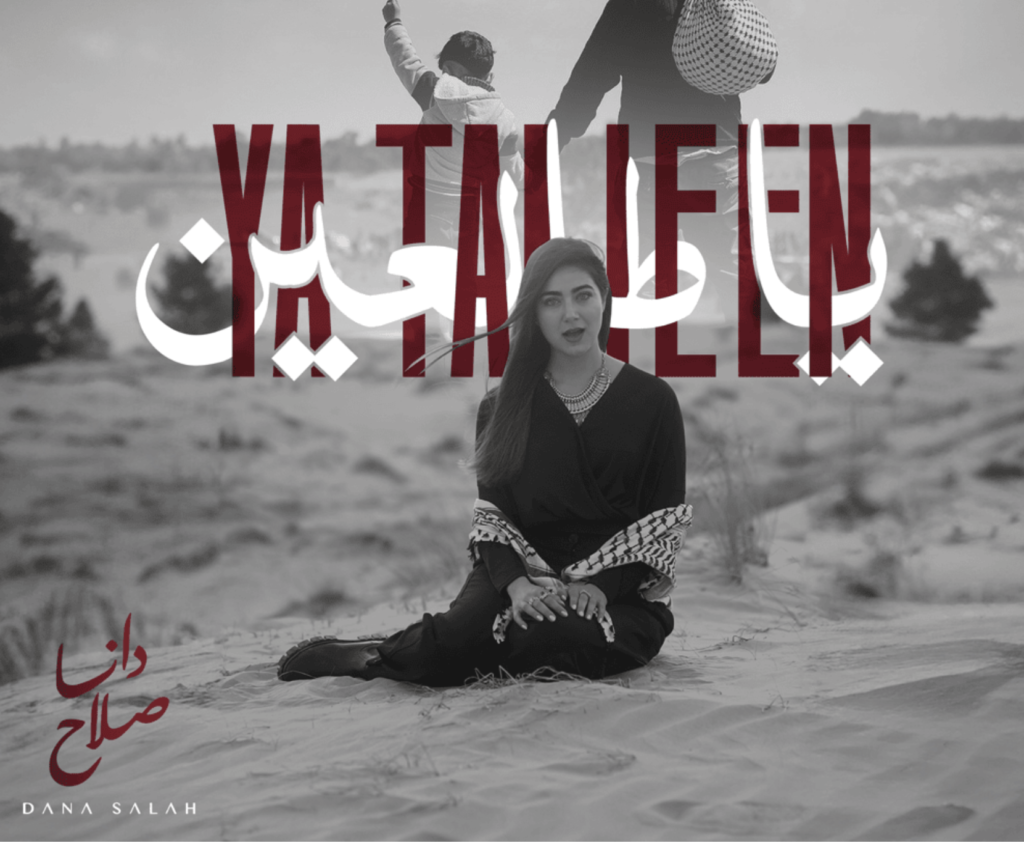
The melody is like a gentle breeze or lullaby that instantly evokes goosebumps. The lyrics are phonemically Arabic, yet strangely indiscernible. The song is a #tarweedeh, an encoded art form developed by Palestinian women while under British colonialism (1923-1948) to deliver encrypted messages of resistance.
During the Great Palestinian Revolt of 1936-1939, the British imprisoned an overwhelming number of Palestinian men just for speaking up against their rule. The incarcerations severed communication between revolutionaries and their village-dwelling families, leaving behind many women whose brothers, fathers, husbands, and sons were wrongfully imprisoned. In response, Palestinian women developed and deployed tarweed to secretly transmit instructions for their loved ones’ liberation.
The encryption in tarweed involves inverting the last letters of words, repeatedly inserting the letter L (“lam” in Arabic), or using poetry, symbol, and analogy with embedded meanings. This process transformed the original message into a gibberish that neither the occupiers nor their translators could comprehend. Women walked along the outside walls of the prisons, delivering messages in serenades that wafted through the barred prison windows. To the occupiers, the sight of Palestinian women strolling and singing folk songs was innocuous, yet it proved instrumental to the prisoner’s escape.
Tarweed survived the Nakba (“catastrophe”), the 1948 ethnic cleansing of Palestine when at least 700,000 indigenous Palestinians were violently expelled from their homes and homeland by Zionist terrorist militias and Israeli military forces to establish the state of Israel. Today, these folk songs continue—along with traditional food, clothing, storytelling, poetry, and folk dance—as markers of Palestinian identity and preservers of a scattered folk heritage ever-threatened by a system of apartheid and genocide. Palestinians within the occupied territories and in the shatat (“diaspora”) continue to pass on these traditions in the ongoing fight against their erasure.
Tarweed embodies an aspect of Palestinian history too often belied by Western mainstream narratives: the vital role of women in the struggle. While these narratives depict Palestinian women as voiceless entities in an “inherently patriarchal” society, in reality women-led resistance movements have been an essential part of the more than century-long fight against colonization and oppression in Palestine. The artfulness of tarweed further highlights women’s resourcefulness and ingenuity in this ongoing resistance.
Although there are multitudinous examples of Palestinian women’s resistance, Fatima Bernawi and Shadia Abu Ghazala are two women who made critical contributions to the struggle for Palestinian liberation. Bernawi, who was born in 1939 and survived the Nakba with her Palestinian mother, reunited with her Nigerian father, who had fought in the 1936 revolt, shortly thereafter. She became an active participant and leader in the struggle for freedom. She is the first woman prisoner listed in the records of the Palestinian women prisoners’ movement. Shadia Abu Gazala was one of the early members of the Popular Front for the Liberation of Palestine, founded in 1967. She led women’s military units and was deeply dedicated to the education of the people, though she died in late 1968. A school named after her in the Gaza strip was the site of an Israeli massacre in December of 2023.
Women’s Leadership in the First Intifada
Palestinian women were a cornerstone of the First Intifada (“uprising”) that erupted in December of 1987. After decades of Israeli military occupation and settlement expansion, an Israeli truck collided with a civilian car in Gaza; killing four Palestinians in Gaza proved to be the last straw. Palestinians in Gaza and the West Bank mobilized as a united front, catching Israel off guard. Israel responded with a swift and brutal crackdown. Countless Palestinian men were arrested and imprisoned, deported, or killed. Palestinian women quickly stepped in to fill the void and formed the backbone of the uprising.
Women from urban cities and traditional villages mobilized as part of the First Intifada, uniting across generations, political factions, and class lines. They organized at the grassroots level, rallying hundreds of thousands of Palestinians in a series of coordinated efforts against the Israeli occupation. Every major Palestinian faction formed a women’s committee disguised as a homemaking group because it was illegal to be a member of any political party or student union. Publicly, they called for knitting, cooking, and sewing meetups, but they were secretly planning the intifada.
During the First Intifada Palestinian women initiated mass political strikes and spearheaded the first mass boycott against Israel. In defiance of Israel’s restrictive laws, they found innovative ways to provide home-grown alternatives to Israeli goods, setting up backyard gardens and farming cooperatives where women learned to grow their own food. When Israel shut down Palestinian schools and universities to prevent students from mobilizing politically, Palestinian women organized teach-ins in basements and abandoned buildings. They taught themselves medicine and set up teams to provide emergency care to protesters injured by Israeli violence. The civil strikes and coordinated boycotts across Palestine caused such a hit to the economy that Shimon Peres, who was the Foreign Minister at the time, warned the economy was “in danger.”
Not surprisingly, the Israeli government doubled-down with intimidation and aggression, imposing daily curfews, ordering mass arrests, and giving Israeli soldiers the infamous orders to ‘break the bones’ of Palestinians. They cut phone-lines in Palestinian towns and villages and placed huge swaths of organizers under house arrest. Palestinian women, and the resistance as a whole, found ways around every barrier that Israel put in their way. When Israel outlawed the Palestinian flag, women formed knitting circles and made their own flags to fly at demonstrations. When Palestinian women leaders were placed under house arrest, they baked bread and placed communiques in each loaf, which they distributed across villages, towns, and refugee camps undetected by Israeli forces.
Women’s efforts throughout the First Intifada captured global attention, forcing Israel’s staunchest ally, the United States, to withhold its financial support in response to Israel’s unwillingness to negotiate. For the first time since 1948, Palestinians brought Israel to its knees and women were front and center in the movement.
The nonviolent groundswell of resistance we know as the First Intifada was cut off at the knees in 1991 by the secretive signing, at the White House, of the Oslo Accords, an agreement that has worsened the lives of Palestinians to this day. Beyond significantly increasing the number of illegal settlements, the Accords created a corrupt political class known today as the ‘Palestinian Authority’ that actively collaborates with the Israeli occupation to crush resistance.
Sumud as a Political Practice
To truly understand Palestinian women’s tireless fight for thawabit (their “inviolable rights”), it helps to invoke the cultural value of sumud, or steadfastness. Sumud emerged in full force following the June 1967 war, or Naksa (“setback” or “defeat”), when Israel annexed and occupied the West Bank, East Jerusalem, and Gaza, more than tripling its size. Since then, sumud has persisted as an ideological theme and political strategy for surviving Israel’s colonization, military occupation, and hegemony.
All of the active and organized resistance efforts enacted by Palestinians over the years are built upon the foundation of sumud. It is resistance at the psychological level, akin to revolutionary optimism inasmuch as it offers an antidote to nihilism at the hands of an oppressive government and ignites faith in the power of the people to usher in the society they deserve. Sumud has sustained Palestinians in the face of the severe policies and tactics that Israel has relentlessly employed in an effort to “break” them.
From massacres, expulsion, dispossession, and genocidal wars, to the surveillance and control tactics of occupation—checkpoints, barriers, curfews, closed military zones, settlements, “settler-only” roads, watchtowers, gates, nightly raids, and mass arrests; from denying Palestinians access to water, healthcare, and education; to burning olive trees and bulldozing homes, Israel’s goal has been to make the daily lives of Palestinians unbearable, and ultimately, to force them to leave their homes in search of a better life elsewhere. Sumud declares to the occupier: You may break our bones, but you cannot break our spirit!
Sumud encompasses a range of everyday acts by which Palestinians fight for their right to exist in their homeland, stay rooted in their culture, and maintain some semblance of normal life under conditions that are anything but normal.
The spirit of sumud is on stark display in the enduring commitment of women in the Palestinian territories to creating and nurturing life, even as they are forced to live like prisoners under deplorable conditions. For a society that has faced the threat of extinction for over 75 years, the choice to have and care for children is deeply entwined with survival and solidarity. Performing domestic roles and caring for children in the Palestinian territories, which have been occupied piece by piece since 1948, requires unthinkable levels of willpower, determination, and fortitude. As one journalist Meryem Ilayda Atlas put it, the woman who bathes her two children in the rubble of a building in Gaza is serving a public role.
Unfortunately, this women’s struggle has been weaponized by Israel and maligned by narrow, decontextualized notions of “first world” bourgeois feminism that are the handmaid of capitalism. For example, in an article titled “Why are so many of the victims in Gaza Children?” the Economist attributed the high death toll of children in Gaza since October 7th to the high fertility rate. The article went on to link high fertility rates to poverty and low levels of education (while Gaza does have a high poverty rate, it also has a high rate of literacy among women) while never mentioning the actions of Israel or the Israeli Occupying Forces. This narrative turns a blind eye to the Gazan women doctors caring for babies who could not survive on life support after the hospital’s electricity was cut off, or the Gazan women journalists calmly broadcasting to the world in English amid terrorized shrieks, or the Gazan women trying their best to go on in the ruins because they have no other choice.
In the village of Nabi Saleh in the central occupied West Bank, red-tiled roofs of illegal Israeli settlement houses dot the adjacent hilltop. The vast majority of the land in this Area C village is under Israeli military control. Between 2009 and 2016, the villagers organized demonstrations against Israeli settler expropriation of village land and water that were met with fierce and sometimes deadly repression by the Israeli Army.
“Zania” a young Palestinian mother from Nabi Saleh recounts the time she had to throw her two-year-old daughter out a second-floor window and into the safety of a neighbor’s arms when the Israeli army fired a tear gas canister into her home. For Zania and other Palestinian women, sumud is embodied in the determination to maintain a physical presence on the land—knowing that if they leave, they may never be able to return by their jailers, the Israelis—and the ability to adapt to adverse and ever-worsening conditions:
“The important thing is to stay in our house, in front of the Israeli soldiers and the occupation,” Zania says. “If we stay in our house it says ‘we are not afraid of your guns.’ We stay in our house, we live a normal life, and ah, this is our fortitude under occupation, this is the important thing.”
At its core, sumud is existence as resistance. More than a mindset, it is a duty to fulfill the commitment to liberation. It is not blind hope that change will one day come, but an active awareness that only through struggle and solidarity can Palestinian lives be transformed. And Palestinian women have been its torch-bearers. As the intense U.S.-backed Israeli brutality wages on in Gaza, killing tens of thousands of people and displacing millions from their homes, sumud and tarweed remind us that the Palestinian resistance has a long history. Palestinians have resisted imperialist genocide in countless and creative ways and will continue to do so.


 https://www.fabriziopiepolimusic.com/wp-content/uploads/2024/08/CLF1945-copia-2-300x200.jpg
 https://www.fabriziopiepolimusic.com/wp-content/uploads/2024/01/ADM_DERVISH_2023-57-300x200.jpg