• ‘This is injustice’ : how leftist zines were used to sentence anti-ICE protesters to decades in prison | Protest (US) | The Guardian
    ►https://www.theguardian.com/us-news/ng-interactive/2026/jun/24/prairieland-texas-ice-protests-zines
    ▻https://i.guim.co.uk/img/media/596f627f2b1ee9d008a135113a79d6baba7ca9cd/1_0_2499_2000/master/2499.jpg?width=1200&height=630&quality=85&auto=format&fit=crop&precrop=40:

    Une histoire complètement ahurissante. Ta vie en prison pour posséder des fanzines anarchistes et tenir un book club de lectures gauchistes. C’est au Texas, pas à Moscou... ça se rapproche. Chez nous avec la trumpette locale ?

    Advocates sound alarm after zines were used as evidence to convict protesters of terrorism charges tied to 2025 protest at Texas ICE facility
    Building power is supported by
    theguardian.org
    About this content
    Lex McMenamin with graphics by Flávio Pessoa
    Wed 24 Jun 2026 13.00 CEST
    Share

    It’s the day after Mother’s Day, the first one Elizabeth Soto has spent apart from her three children. Sitting in jail in Wichita Falls, Texas, her face is washed out by the overhead fluorescent lighting, and her dingy jumpsuit blends into the cinder block walls surrounding her.

    Speaking through a glass separator, she tells me she celebrated the holiday with her children over the jail’s video-call system while they had dinner at their grandmother’s. “I’ve been a full-time mother all of their lives,” she said. “I’ve never been away from them.”

    Soto’s children have not visited her in jail, which lies on Texas’s northern border near Oklahoma, hours from their home in the Dallas-Fort Worth area. Elizabeth Soto has only seen her husband, Ines Soto, once over the past year, the longest they’ve spent apart since they first started dating more than 20 years ago. He is being held in a federal prison more than 100 miles away.

    On Tuesday, Elizabeth was sentenced to 50 years in federal prison; Ines’s sentencing is set for 1 July. All because, as she put it: “They didn’t like my book club.” Her laugh doesn’t quite reach her eyes.

    Last year on the Fourth of July, a small group from Dallas-Fort Worth held a night-time noise demonstration, setting off fireworks outside the Prairieland Immigration and Customs Enforcement (ICE) detention facility south of the cities, in solidarity with the detainees. A few protesters broke away and spray-painted graffiti on employees’ cars and a security post, slashed the tires on a government van, and broke a security camera. The facility’s guards ordered the protesters to disperse, and most of them did. When a police officer arrived at the scene, drawing his gun, an armed protester shot her rifle, hitting the officer in the shoulder. The officer survived.

    After a three-week trial, a jury found eight of nine protesters guilty of “providing material support to terrorists”, among other crimes. For the Sotos, this “material support” included owning a “printing press” used to print anarchist zines and being part of a leftist book club, the federal government argued. The couple had already left the scene by the time guns were drawn. All eight of the defendants sentenced so far have received unusually harsh sentences – 30 to 100 years – essentially life in prison.

    #Fanzines #Prison #Texas #Folie_fasciste #Liberté_expression

  • Au Texas, un homme grièvement blessé par balle par un agent de l’ICE, la police de l’immigration américaine
    ▻https://www.lemonde.fr/international/article/2026/09/21/au-texas-un-homme-grievement-blesse-par-balle-par-un-agent-de-l-ice-la-polic

    Au Texas, un homme grièvement blessé par balle par un agent de l’ICE, la police de l’immigration américaine
    Le Monde avec AFP
    Un homme a été grièvement blessé d’une balle au thorax par un agent de l’ICE, la police de l’immigration américaine, au cours d’une course-poursuite à pied à Austin, la capitale du Texas, dans le sud des Etats-Unis, dimanche 20 septembre, ont affirmé les autorités locales.Le blessé a été identifié par son avocate, Kate Lincoln-Goldfinch, comme étant Wilber Garcés Pérez, un ressortissant vénézuélien de 28 ans, livreur de profession. M. Garcés Pérez s’est fait tirer dessus « par l’ICE à Austin, alors qu’il effectuait une livraison DoorDash », un populaire service de livraison de repas et de courses à domicile, a écrit sur X son avocate. La victime aurait été placée « en détention, mais on ne sait pas encore où », a-t-elle ajouté.« Je suis très en colère et extrêmement déçu qu’une personne se soit fait tirer dessus dans les rues d’Austin par l’ICE », a écrit sur X le maire démocrate de la ville, Kirk Watson. Cet incident est survenu dans un contexte de « hausse significative, presque du jour au lendemain », des opérations de la police fédérale de l’immigration dans la capitale texane, a par la suite affirmé M. Watson, lors d’une conférence de presse.
    L’ICE, l’un des principaux instruments de la politique d’arrestations et d’expulsions massives d’immigrés en situation irrégulière menée par l’administration Trump, n’a pas communiqué sur l’incident. Les autorités de la ville d’Austin n’ont pas été en mesure de préciser l’identité, l’âge et la nationalité du blessé, ni les circonstances précises du tir.Le blessé a été transporté dans un hôpital d’Austin dans un état grave mais stable, selon la municipalité. Le député de la circonscription, Greg Casar, a par la suite affirmé qu’il avait été « sorti de l’hôpital et placé en détention par l’ICE ». « S’il est expulsé par l’ICE, le témoin clé de leur fusillade disparaît », a ajouté le parlementaire. « Il ne doit pas être renvoyé de ce pays, et il doit recevoir des soins médicaux appropriés », a-t-il insisté.
    Le maire a insisté pour que les forces de l’ordre locales soient impliquées dans l’enquête. « Il ne serait pas approprié que l’ICE mène une enquête quelconque uniquement par elle-même et en excluant les autres », a déclaré M. Watson. Les agents de l’ICE, lourdement armés et le plus souvent masqués, font l’objet d’une vive opposition à travers le pays en raison de leurs méthodes jugées agressives, ayant notamment provoqué la mort par balle de deux citoyens américains, Renee Good et Alex Pretti, en janvier, à Minneapolis. En juillet, un agent de l’immigration avait mortellement blessé par balle un citoyen mexicain à Houston, au Texas.

    #Covid-19#migrant#migration#etatsunis#ICE#droit#sante#venezuela#texas#immigration

  • « Un soupir de soulagement » : Trump suspend son projet anti-immigration dans un parc national

    Face à une mobilisation transpartisane, l’administration Trump a finalement suspendu jusqu’à nouvel ordre son projet anti-immigration à la frontière avec le Mexique, dans le #parc_national de #Big_Bend. Les opposants restent toutefois « sur leurs gardes ».

    Dans les États-Unis de #Donald_Trump, même les #parcs_nationaux ne sont plus sanctuarisés. Pourtant élevé au rang de « joyau de la couronne » du patrimoine naturel étasunien, Big Bend a été ébréché par les bulldozers et les pelleteuses de l’administration fédérale, mi-août. Dans sa chasse quasi obsessionnelle aux migrants à la frontière entre les États-Unis et le Mexique, le monarque de Mar-a-Lago disait vouloir renforcer la #sécurisation de cette portion de frontière au nom de la #sécurité_nationale, sans pour autant y ériger son emblématique mur. À la place, le ministère de la Sécurité intérieure prévoyait d’installer « de nouvelles pistes de #patrouille, des dispositifs de #surveillance et des #barrières_antivéhicules » dans l’un des espaces les plus sauvages du #Lone_Star_State (l’« État de l’étoile solitaire »).

    Mais citoyens et élus aux convictions politiques différentes ont fait cause commune pour défendre le parc et ainsi pousser Trump à suspendre tous les travaux, le 17 août, quelques jours seulement après leur lancement. L’arrêt n’est que temporaire, le temps de permettre à #Rodney_Scott, le chef de la police aux frontières, d’aller sur place et de procéder à une « évaluation personnelle » de la situation, a-t-il annoncé sur le réseau social X.

    Un répit sans doute de courte durée, qui aura eu le mérite de rassembler les opposants. « C’est presque inédit de voir une #opposition aussi transpartisane. Certaines des voix les plus virulentes viennent de républicains conservateurs influents », souligne #Bob_Krumenaker, ancien directeur de Big Bend et désormais président de #Keep_Big_Bend_Wild, un collectif non partisan réunissant habitants et anciens responsables des parcs nationaux, qui œuvrent à la préservation du seul parc national du #Texas.

    Biologiste de formation, cet ancien responsable du National Park Service pendant quarante-et-un ans estime que « l’administration a été prise au dépourvu par la capacité d’organisation de ces opposants » et espère qu’elle agira toutefois de « manière sensée », en stoppant définitivement les travaux, surtout à l’approche des élections de mi-mandat en novembre.

    Bob Krumenaker pense que cette #mobilisation peut être « un tournant » dans le combat contre l’administration Trump-II. Beaucoup disent ressentir de « la gratitude » tout en restant « sur leurs gardes ». « Avec cet arrêt des travaux, c’est comme si toute la communauté avait poussé un soupir de soulagement collectif, souligne #Anna_Claire_Beasley, directrice de la stratégie et des campagnes de #No_Big_Bend_Wall (« Pas de mur dans le Big Bend »), une coalition citoyenne de l’ouest du Texas opposée à la construction du mur. Ce combat a été épuisant. Cette pause nous permet de souffler, de nous regrouper et de recentrer nos efforts pour être prêts à affronter la suite. »

    La crainte d’une jurisprudence

    Moins connu que Yellowstone, le Grand Canyon et Yosemite, Big Bend est pourtant « l’un des lieux les plus riches en #biodiversité d’Amérique du Nord auquel les Texans sont très attachés », estime Rick LoBello, ancien garde de ce trésor national.

    Reconnu comme réserve de biosphère par l’#Unesco en 1976, le parc abrite quelque 1 200 espèces de plantes, au moins 450 espèces d’oiseaux et 75 espèces de mammifères. Parmi cette faune exceptionnelle figurent notamment l’ours noir et la gambusie de Big Bend, un petit poisson en danger d’extinction que l’on ne trouve nulle part ailleurs dans le monde.

    « Ce qui se passe actuellement menace non seulement la plus vaste zone sauvage protégée du Texas, mais porte aussi atteinte à cette zone binationale et à la vision mondiale de la #protection_de_la_nature », s’inquiète Rick LoBello.

    À ses yeux, c’est l’idée même des parcs nationaux, née aux États-Unis en 1872, qui pourrait être « gravement compromise » si Trump allait au bout de sa politique répressive, Big Bend faisant ainsi jurisprudence. « D’autres pays pourraient se dire : “Si les États-Unis peuvent détruire leurs parcs nationaux, nous pouvons le faire aussi” », craint l’actuel responsable de l’éducation et de la conservation du zoo d’El Paso, désormais à quelque 500 km de Big Bend. Avant d’ajouter : « Si j’habitais plus près, je m’enchaînerais à un bulldozer. »

    D’après les informations recueillies par Reporterre auprès d’anciens responsables du parc et de militants, les bulldozers auraient déjà défriché un large couloir d’environ 1,6 km de long et jusqu’à 30 mètres de large traversant une forêt riveraine et l’habitat du coulicou à bec jaune, une espèce protégée. Plusieurs autres zones désertiques auraient également été aplanies pour stationner des véhicules, tandis qu’une nouvelle piste creusée dans une pente rocheuse très abrupte aurait causé « des #dégâts_irréversibles ».

    Membre actif de #Friends_of_the_Riverside_Church, une organisation à but non lucratif qui œuvre pour la restauration de l’église locale, #Martha_Stafford dénonce un passage en force « sans précédent ».

    En mars, l’administration la plus climatosceptique de l’histoire des États-Unis a écarté 28 #lois environnementales, dont le #National_Historic_Preservation_Act, pour permettre la réalisation d’un projet doté de 1,7 milliard de dollars grâce à la #One_Big_Beautiful_Bill (« la grande et belle loi »), la gigantesque loi budgétaire voulue par Donald Trump pour sa politique de lutte contre l’immigration. Plusieurs associations et organisations, dont la sienne, ont déposé une plainte contre l’administration Trump.

    Un environnement « extrêmement inhospitalier »

    « La mission première du ministère de l’Intérieur est de protéger ces lieux pour les générations futures », rappelle cette habitante de #Marfa, une petite ville du #désert_de_Chihuahua, pour qui les décisions prises aujourd’hui ne devraient pas répondre aux seuls impératifs du moment.

    Elle dénonce surtout une inversion de la promesse démocratique étasunienne : « Le système est censé être “par le peuple, pour le peuple”. Ici, c’est “par l’administration, pour l’administration”, et contre le peuple. » Une logique autoritaire et sécuritaire qui peine à la convaincre : « Personne ne voit de raison de détruire ce trésor national pour un bénéfice aussi faible en matière de sécurité. »

    Selon les chiffres de la patrouille frontalière (Border Patrol) et la douane étasunienne (Customs and Border Protection), seules 200 personnes ont été interpellées par les autorités à l’intérieur du parc en 2025, soit à peine 0,045 % des arrestations enregistrées sur l’ensemble de la frontière sud-ouest. Le secteur de Big Bend couvre pourtant 26 % de la frontière avec le Mexique, mais concentre moins de 1 % des interpellations.

    « C’est un environnement extrêmement inhospitalier pour quiconque tenterait de parcourir de longues distances à pied, appuie Thomas Alex, archéologue et responsable des ressources culturelles de Big Bend pendant trente-deux ans. Il nous arrive de voir quelqu’un marcher le long d’une route, mais c’est généralement parce qu’il n’a plus d’eau ou rencontre des problèmes de santé. Les chances de survie en entrant par le parc sont très faibles. » Les températures peuvent en effet dépasser 40 °C.

    Dans le Texas de Big Bend, l’heure est en tout cas venue pour les bulldozers de Trump de rebrousser chemin jusqu’à nouvel ordre.

    ▻https://reporterre.net/Proteger-ces-lieux-pour-les-generations-futures-au-Texas-la-bataille-pou
    #frontières #nature #USA #Etats-Unis #murs #barrières_frontalières #Mexique #suspension #migrations #réfugiés #environnement_hostile #hostile_environment #résistance #justice #désert

    –-

    ajouté à la métaliste sur le lien entre la construction de barrières frontalières et les impacts sur l’environnement/nature...
    ►https://seenthis.net/messages/515608

  • A ‘Muslims Only’ Swim Party and the Backlash That Followed - The New York Times
    ▻https://www.nytimes.com/2026/07/02/us/muslim-swim-party-texas.html?emc=edit_ufn_20260706&nl=from-the-times&segmen

    C’est toujours au nom de tous et toutes que les dominants s’en prennent aux dominés quand ceux-ci veulent se réunir indépendamment. L’universalisme est le cache-sexe des dominants, le refus de réfléchir à leur domination. Leur pouvoir est « naturel », « universel », « pour tous », alors même que leur pratique est cadrée, dirigée vers certains secteurs seulement et farouchement opposée aux capacités d’auto-détermination des dominés ou des minoritaires.

    On May 5, Ms. Knight updated the event’s website to explain that no one would be excluded, so long as they followed the dress code. “If you are a friend of a different faith who wants to celebrate the Eid holiday with us and adhere to the modest dress code,” she wrote on the website, “this event is FOR YOU TOO!”

    The City of Grand Prairie appeared to be on her side, issuing a statement that day saying that the water park was allowed to be rented out for private events.

    Ms. Knight hoped it would blow over. Then Gov. Greg Abbott weighed in.

    The Texas governor has been increasingly willing to use his control over state funds for public safety as a way to force changes from local governments. He did so in April in a showdown over immigration enforcement in Houston. And on May 6, he did so again to stop the water park party.

    In a letter, Mr. Abbott’s public safety office told the mayor of Grand Prairie that Ms. Knight’s party was “discriminatory,” and warned that the city would lose $530,000 from the state, if the event were allowed to go on. By then Ms. Knight had posted that the event was open to all, but in the letter the governor’s office pointed to a “frequently asked questions” portion of the event website where it still said the park had been “exclusively reserved for Muslims.”

    The governor left no doubt of what he wanted to see.

    “The City must cancel the event and commit to never allowing something like it again,” Mr. Abbott wrote on social media.

    Hours later, the city said it had canceled the party. A spokeswoman for Grand Prairie said the move was “in the best interest” of the city.

    A spokesman for Mr. Abbott said the governor had called for Ms. Knight’s party to be canceled because local governments may “not facilitate discrimination at taxpayer expense.” He did not explain why canceling the party was necessary even after Ms. Knight said it would be open to all.

    For Ms. Knight, whose personal cellphone was listed on the event flyer, the letter spurred an onslaught of calls, texts and online messages. At first, she answered a few of the anonymous calls, including one from a woman who identified herself as a Baptist and started off wanting to know “what you Muslims are up to.”

    Ms. Knight, who was driving at the time, stayed on the line for about an hour, mostly listening. The woman later softened and expressed some empathy.

    “I just appreciate that you’re talking to me,” the woman said. “In Christianity, we get mocked too. The atheists are constantly taking us down.”

    Ms. Knight talked with reporters as well, looking to explain herself, maintaining the hope that, somehow, her event could still go on, now that the flyer said that anyone could attend.

    #Texas #Religion #racisme

  • USA – #Texas : “Antifa” in tribunale come cellula terrorista
    ▻https://radioblackout.org/2026/03/usa-texas-antifa-in-tribunale-come-cellula-terrorista

    L’ordine esecutivo firmato da Donald Trump che definisce “antifa” una organizzazione terroristica domestica riaccende un nodo giuridico e politico già emerso durante il suo primo mandato: negli Stati Uniti non esiste infatti un quadro legale che consenta di designare gruppi interni come terroristi, a differenza di quanto avviene per organizzazioni straniere. Esperti di politica interna […]

    #L'informazione_di_Blackout #antifa #ice #terrorismo_domestico
    ▻https://radioblackout.org/wp-content/uploads/2026/03/Texas-ANTIFA.mp3

  • Il megaprogetto fossile che mette a rischio “l’acquario del mondo”

    Si chiama “#Sierra_Madre” ed è un gasdotto di 800 chilometri che vorrebbe portare il gas estratto in #Texas all’impianto di #Puerto_Libertad, in Messico, con devastanti effetti sociali e ambientali. Sono coinvolte anche due imprese italiane.

    La moto di Julio Mora rimbalza tra le buche della prateria di Juan Mata Ortiz, nello Stato messicano del #Chihuahua, vicino al confine con gli Stati Uniti. In questa distesa in cui, prima di essere sterminati dal governo messicano, correvano gli apaches e i bisonti, l’uomo alleva bestiame e raccoglie l’argilla con cui plasma le sue ceramiche. Julio Mora ama la neve che d’inverno ricopre la pianura e la pioggia che a settembre la inverdisce. Ciò che teme è la siccità -che negli ultimi tre anni ha ucciso metà del suo bestiame- e un gasdotto che la compagnia statunitense #México_Pacific vuole costruire nel sottosuolo di #Mata_Ortiz.

    Si chiama Sierra Madre e verrà costruito da due imprese italiane: #Gdi_sicim_pipelines e #Bonatti. “Mi preoccupa che il gas possa fuoriuscire e infiltrarsi nella terra; sarebbe un problema, soprattutto per il foraggio e il bestiame. E mi preoccupa la qualità dell’acqua delle sorgenti che si trovano laggiù”, dice Mora seduto sulla sua motocicletta indicando l’orizzonte. Le sue inquietudini hanno un fondamento: secondo gli esperti tutti i gasdotti sono soggetti a fughe. Inoltre gli stessi studi di impatto ambientale presentati da México Pacific al ministero dell’Ambiente messicano, il quale non ha ancora rilasciato nessuna autorizzazione, riconoscono che il gasdotto Sierra Madre danneggerà non solo la qualità delle acque superficiali ma anche la flora, la fauna, il suolo e la copertura forestale. Sierra Madre sarà lungo 800 chilometri con un diametro grande quanto un bambino di otto anni. Porterà lo shale gas estratto in Texas con il metodo del fracking fino alla costa dello Stato messicano del Sonora, dove si troverà l’impianto di liquefazione Saguaro energy: un complesso con una superficie di 400 ettari, le cui emissioni durante l’intero ciclo di vita saranno equivalenti a quelle di Portogallo e Svezia messe insieme.

    Nell’impianto Saguaro energy il gas fossile -che è composto quasi interamente da metano e che ha un potenziale di riscaldamento globale fino a trenta volte maggiore della CO2– verrà liquefatto e caricato su navi lunghe 300 metri che attraverseranno il golfo della California, causando danni irrimediabili alle balene, che a migliaia ogni anno raggiungono questo mare per riprodursi, e alle numerose specie animali e vegetali che vivono in quello che l’oceanografo Jacques Cousteau ha chiamato “l’acquario del mondo”. Il 2 dicembre 2025 le Nazioni Unite hanno emesso una comunicazione ufficiale indirizzata al governo messicano in cui esprimono profonda preoccupazione per i megaprogetti di gas fossile liquefatto proposti nel golfo della California (sono in programma altri tre impianti e un altro gasdotto).

    In particolare l’Onu mette in discussione la legalità di queste opere, la loro sostenibilità climatica e la compatibilità con i diritti umani e con alcuni trattati internazionali firmati dal Messico. Molte organizzazioni e collettivi nel Paese si stanno opponendo al progetto Saguaro energy e al gasdotto Sierra Madre. Sono state organizzate diverse manifestazioni nelle piazze e la coalizione ¿Ballenas o Gas? ha consegnato al governo messicano una petizione con circa 300mila firme che chiede di cancellarlo. Molti media hanno pubblicato articoli e analisi sul megaprogetto e il primo dicembre 2025, durante una conferenza stampa, una giornalista ha messo alle strette la presidente Claudia Sheinbaum, che ha affermato che Saguaro non è irregolare.

    In verità la sua costruzione è stata bloccata da vari tribunali proprio a causa di alcune irregolarità che hanno portato i giudici a riconoscere come fondati i ricorsi presentati dalle organizzazioni sociali. “Finora Saguaro energy esiste solo sulla carta, quindi è il momento opportuno per impedire in tutti i modi che venga costruito”, afferma Claudia Campero dell’organizzazione messicana Conexiones climáticas. Il progetto Saguaro energy porterà il Messico al quarto posto tra i Paesi più rilevanti nel settore energetico per l’esportazione del Gas naturale liquefatto (Gnl). Tuttavia lo shale gas che sarà esportato in Asia attraverso il gasdotto Sierra Madre non sarà messicano ma statunitense. “Che cosa otterremo dall’invio di gas in Corea da parte dei ‘gringos’? Dov’è il vantaggio? Vedo solo rischi e il governo di Claudia Sheinbaum che difende apertamente gli interessi dei petrolieri texani”, commenta Nayo Rodríguez, membro dell’organizzazione del Chihuahua Eskuela radical che si oppone alla sua costruzione.

    Secondo i ricercatori del collettivo messicano Geocomunes gli Stati Uniti hanno deciso di non esportare il gas direttamente dalle proprie coste e di farlo passare per il Messico perché “l’installazione sulle coste messicane potrebbe comportare minori costi per le aziende rispetto a quelli negli Stati Uniti, nonché una maggiore flessibilità nei requisiti di mitigazione e riparazione degli impatti socio-ambientali”. Secondo Luca Ferrari, ricercatore dell’Istituto di geoscienze dell’Universidad autónoma de México (Unam), importare gas dagli Stati Uniti potrebbe presto diventare molto meno conveniente. Al momento il Paese nordamericano ha una sovrapproduzione di metano e per questo lo vende a prezzi molto bassi, ma il suo picco di produzione potrebbe presto essere raggiunto. “Il tema del gas potrebbe anche diventare un’ulteriore arma di ricatto di Donald Trump”, spiega Ferrari che teme che il Messico stia pianificando investimenti molto elevati in infrastrutture che, oltre a essere inquinanti, in un futuro prossimo potrebbero non essere più redditizie.

    “In ogni caso il vero affare sarà la costruzione del gasdotto: anche se dopo qualche anno non ci sarà più gas, chi ha costruito l’opera avrà già guadagnato”, conclude. Secondo il ricercatore dell’Unam, il gasdotto Sierra Madre e il progetto Saguaro energy trasformeranno Chihuahua e Sonora in una “zona di sacrificio”. Per la sua costruzione nel novembre 2023 l’azienda México Pacific ha firmato un contratto con una joint venture composta dalle due società italiane, come detto, Gdi sicim pipelines e Bonatti.

    Quest’ultima ha realizzato diverse opere in Messico, tra cui il gasdotto che fa parte di uno dei megaprogetti più emblematici dell’ex presidente Andrés Manuel López Obrador: il Proyecto integral morelos (Pim) che comprende -oltre al gasdotto costruito da Bonatti- due centrali termoelettriche e un acquedotto. L’opera è stata molto criticata dalle organizzazioni sociali messicane perché è stata realizzata senza il consenso della comunità indigene locali -condizione stabilita dalla costituzione messicana e da trattati internazionali- e si trova a soli 15 chilometri dal vulcano attivo Popocatépetl, dove il rischio di esplosioni è molto alto. Inoltre gli abitanti della zona che si sono opposti a Bonatti e alle altre società coinvolte sono stati minacciati e, in alcuni casi, uccisi. Il 20 febbraio 2019 Samir Flores Soberanes, conduttore radiofonico locale e membro del Congresso nazionale indigeno (Cni), è stato assassinato davanti alla porta di casa sua. Più recentemente è toccato a due leader dell’Asociación de usuarios del río Cuautla (Asurco): Francisco Vázquez e Carolina Plascencia Carvajal.

    Nel patio di casa sua Alma Soto Villa, moglie di Julio Mora, mostra come gli abitanti di Mata Ortiz preparano l’argilla che usano per le loro celebri ceramiche. Il marito la accompagna nella spiegazione della tecnica, mostrando le opere che espongono nella loro abitazione, e racconta che il gasdotto ha diviso gli abitanti di Mata Ortiz: c’è chi vuole che si costruisca e chi, come lui, è contrario.

    “La società ha partecipato all’assemblea della comunità e ha presentato il progetto ma non ha risposto ad alcune domande, relative ad esempio ai possibili impatti ambientali e a quanto pagherebbe la terra per metro quadrato. A ogni modo a me non interessano i soldi, quello che voglio è che non costruiscano il gasdotto -conclude Julio Mora-. Ci hanno detto che se l’assemblea della comunità non concederà l’autorizzazione per la costruzione dell’opera, com’è previsto dalla legge, loro la faranno comunque”.

    ▻https://altreconomia.it/il-megaprogetto-fossile-che-mette-a-rischio-lacquario-del-mondo
    #Mexique #gaz #USA #gazoduc

  • Comment l’#IA dévore la planète

    L’incroyable essor de l’intelligence artificielle, technologie particulièrement vorace en énergie, en eau et en terres rares, interroge à l’heure où les géants du secteur sont lancés dans une course au gigantisme.

    Derrière les réponses presque magiques de ChatGPT, les vidéos imaginaires sans limites de Sora ou les images synthétiques bluffantes de Grok ou Gemini, l’intelligence artificielle (IA) a une empreinte bien réelle sur le monde. Dans une industrie du numérique énergivore, cette technologie se distingue par l’intensité de la puissance de calcul qu’elle nécessite pour chaque requête. Cela se reflète dans l’explosion inédite des investissements des géants de l’IA dans les data centers : 620 milliards de dollars (529 milliards d’euros) en 2026, selon la banque Morgan Stanley, soit déjà près de quatre fois plus qu’en 2023.
    Cette course au gigantisme – Meta a ainsi un projet de data center grand comme la moitié de l’île de Manhattan et puissant comme cinq réacteurs nucléaires – a de nombreux impacts tout au long de la chaîne de valeur de l’IA.
    Cette absorption de ressources fait craindre des pénuries ou des conflits d’usage locaux avec d’autres besoins essentiels tels que l’agriculture, l’électrification des transports ou de l’industrie. L’IA doit-elle donc être développée à tout prix ? Il convient de la piloter « avec sobriété », en choisissant « le juste niveau de technologie au service d’un besoin réel », met en garde l’Agence de la transition écologique (Ademe) dans une étude publiée début novembre. Et le 8 décembre, plus de 230 ONG ont demandé un moratoire sur la construction de nouveaux centres de données aux Etats-Unis.

    Pour évaluer l’impact sur la planète de ces cartes,des chercheurs ont démantelé et broyé l’une des plus utilisées au monde, la Nvidia A100. Ils y ont trouvé plus d’une vingtaine de métaux différents, dont des terres rares.

    L’essor de l’IA donne un coup de fouet à l’industrie des semi-conducteurs, qui pourrait doubler en cinq ans. Le marché des GPU et autres puces destinées à l’IA domine la croissance et devrait dépasser les 280 milliards de dollars d’ici à 2029.

    Or, ce secteur est gourmand en eau, énergie, métaux et produits chimiques. Et ce alors que, pour augmenter la puissance de calcul, les éléments de base doivent être de plus en plus petits, et donc de plus en plus purs, ce qui nécessite l’utilisation de toujours plus de produits toxiques.

    Dans les usines du taïwanais TSMC, plus important industriel du secteur, la production d’un seul « wafer » de 12 pouces, où sont gravées les puces, requiert plus de 7 000 litres d’eau. Le groupe – qui indique recycler 88 % de l’eau qu’il utilise – en fabrique l’équivalent de 16 millions par an.

    Artificialisation des sols
    L’expansion de l’IA nourrit une croissance inédite des dépenses dans les data centers : les géants du secteur, d’OpenAI à Meta, en passant par Google, Amazon ou Microsoft, vont investir 470 milliards de dollars dans ces infrastructures en 2025 et même 620 milliards en 2026, selon la banque Morgan Stanley. Soit près de quatre fois plus qu’en 2023.

    Il n’existe pas de recensement mondial du nombre de kilomètres carrés aujourd’hui occupés par les data centers. Mais, aux Etats-Unis, les montants investis dans la construction de ces infrastructures sont sur le point de dépasser ceux des bureaux traditionnels.

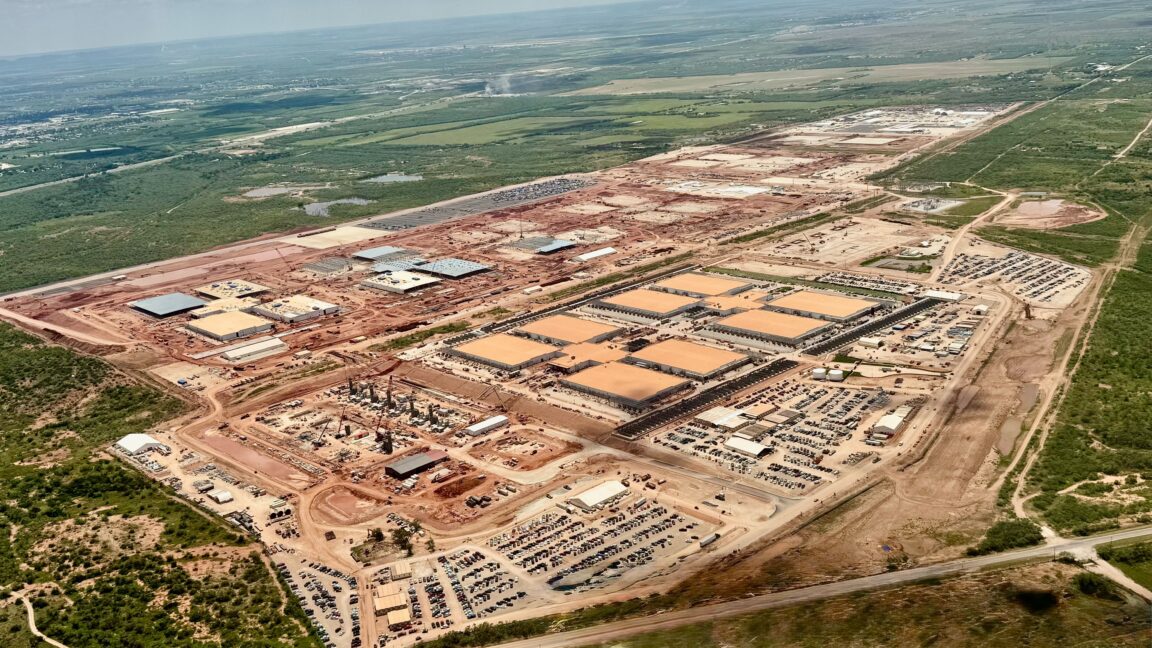
    Et d’immenses chantiers ont été lancés : Stargate, d’OpenAI, situé dans la petite ville d’Abilene, au Texas, comptera huit bâtiments sur une zone de près de 4,5 kilomètres carrés – plus vaste que Central Park à New York. Le patron de Meta, Mark Zuckerberg, a annoncé que le méga data center Hyperion, prévu en Louisiane, pourrait couvrir l’équivalent d’« une partie importante de la superficie de Manhattan ».

    En France, le gouvernement a annoncé avoir identifié 35 sites « favorables » à l’installation de centres de données pour un total de 12 km² – soit 1 680 terrains de foot.

    Consommation d’électricité
    Cette course au gigantisme s’illustre par leur puissance électrique exponentielle. Les plus gros sites en construction prévoient désormais d’égaler ou de dépasser une capacité électrique de 1 gigawatt (GW). Soit environ l’équivalent de la puissance d’un réacteur nucléaire.
    Et les objectifs sont encore plus démesurés : xAI sera « le premier à mettre en fonctionnement 10 GW, 100 GW, 1 TW [térawatt]… », a affirmé sur X Elon Musk, en septembre.

    L’augmentation de la puissance installée des data centers devrait en conséquence faire bondir leur consommation électrique annuelle liée à leur utilisation. Celle-ci pourrait tripler d’ici à 2030.

    Pour le moment, l’électricité alimentant les data centers ne représente qu’environ 1,5 % de la consommation mondiale, selon l’AIE. Mais aux Etats-Unis, cette part pourrait passer de 4,4 % à entre 7 % et 12 % en 2028, selon le ministère de l’énergie américain. En Europe, les data centers pourraient peser 7,5 % de la consommation électrique d’ici à 2035, contre 2,5 % aujourd’hui, selon le Shift Project, le cercle de réflexion présidé par Jean-Marc Jancovici.

    Consommation d’eau
    L’IA n’est pas seulement vorace en énergie, elle est aussi insatiable en eau. En 2023, les prélèvements associés aux centres de données auraient déjà dépassé les 5 000 milliards de litres, selon les calculs de l’Agence internationale de l’énergie (AIE). Soit l’équivalent de toute l’eau potable puisée en France en une année.

    Une partie de cette eau est recyclée, c’est pourquoi la part réellement consommée – notamment en raison de l’évaporation – représente environ 560 milliards de litres.

    A l’avenir, l’AIE s’attend à ce que la consommation d’eau associée aux centres de données soit multipliée par deux d’ici à 2030, pour atteindre environ 1 200 milliards de litres par an.
    Les conséquences d’un même prélèvement sur les nappes et les rivières varient selon les territoires. A titre d’exemple, 14 % de l’eau utilisée par Google viennent de zones à risque « élevé » de pénurie, selon les documents de l’entreprise.

    Emissions de CO2
    Aujourd’hui, l’électricité des data centers provient pour plus de la moitié d’énergie carbonée.

    La croissance des émissions de gaz à effet de serre des data centers devrait doubler, voire tripler, selon les scénarios établis par le Shift Project.

    Les data centers, dont une partie sert à l’IA, émettent plus de gaz à effet de serre que la France : 369 millions de tonnes en équivalent CO₂, en 2024, selon le ministère de la transition écologique.

    ▻https://www.lemonde.fr/economie/article/2025/12/26/comment-l-ia-devore-la-planete_6659449_3234.html
    #AI #visualisation #statistiques #extractivisme #eau #énergie #terres_rares #ChatGPT #Sora #Gemini #Grok #empreinte #puissance_de_calcul #data_centers #centres_de_données #investissements #Meta #ressources #conflits #pénurie #extractivisme #mines #cartes_graphiques #GPU #graphics_processing_unit #serveurs #impact #Nvidia_A100 #métaux #semi-conducteurs #puces #produits_chimiques #toxicité #TSMC #wafer #artificialisation_des_sols #OpenAI #Google #Amazon #Microsoft #chiffres #statistiques #Stargate #Abilene #Texas #Hyperion #France #CO2 #gaz_à_effet_de_serre #infographie

  • Border Report Live : Environmentalist decries miles of planned border buoys, new border wall

    A South #Texas environmentalist who studies water quality in the #Rio_Grande says waterborne barriers and new border wall will hurt #wildlife and the river’s flow.

    Elsa Hull, a member of the #No_Border_Wall_Coalition, owns borderlands on the Rio Grande in #San_Ygnacio, in Zapata County. In the latest episode of Border Report Live, Hull discusses a recent study she participated in to inspect border buoys that the State of Texas put in 2023 in #Eagle_Pass and what effect they are having on the river now.

    Hull says last week they collected sediment and water samples from the 1,000-foot-long string of border buoys that were put by Texas’ Operation Lone Star border security initiative in the Rio Grande in Eagle Pass.

    They also are testing for micro plastics because the buoys are plastic and they want to know if particles are breaking apart and traveling in the river.

    The study comes as the federal government recently announced that dozens of miles of new border wall, as well as waterborne barrier and advanced technology will soon go up on the South Texas border in Laredo and Del Rio.

    DHS calls it “Smart Wall” and says it is necessary for national security.

    The new contracts announced Thursday include a total of 56 miles of new border wall to be built in Laredo and 66 miles of waterborne barrier to be put in the Rio Grande there.

    Hull also says she will not allow federal officials onto her land, which currently is in the path where new border wall is to be built.

    ▻https://www.borderreport.com/border-report-live/border-report-live-environmentalist-decries-miles-of-planned-border-buoys-new-border-wall/amp
    #frontières #murs #USA #Etats-Unis #Mexique #migrations #réfugiés #nature #eau #environnement #rivière #micro-plastique

    –-

    ajouté à la métaliste sur le lien entre la construction de barrières frontalières et les impacts sur l’environnement/nature...
    ►https://seenthis.net/messages/515608

  • Le Reader Act jugé inconstitutionnel : un coup d’arrêt à la censure au Texas
    ▻https://actualitte.com/article/127018/droit-justice/le-reader-act-juge-inconstitutionnel-un-coup-d-arret-a-la-censure-au-tex

    La justice fédérale américaine a mis un terme à l’un des textes les plus controversés adoptés ces dernières années dans la lutte idéologique autour de la lecture publique. Le juge Alan D. Albright, du tribunal fédéral du district ouest du #Texas, a rendu un jugement sommaire et prononcé une injonction permanente contre la loi HB 900, connue sous le nom de #Reader_Act. En déclarant le texte contraire au Premier Amendement de la Constitution, il met fin à un projet de régulation qui aurait imposé aux #libraires et #éditeurs de classifier les #livres vendus aux écoles selon leur contenu sexuel.

    Le Reader Act, signé en 2023 par le gouverneur républicain de l’État, Greg Abbott, entendait contraindre les vendeurs de livres à examiner des millions d’ouvrages destinés aux #bibliothèques_scolaires pour leur attribuer un commentaire, « sexuellement explicite » ou « sexuellement pertinent ». Cette classification devait être soumise à l’Agence d’éducation du Texas, qui aurait pu imposer ses propres évaluations, comme le détaille un document de la Texas Library Association, organisation de bibliothèques texanes. Les vendeurs refusant d’obtempérer risquaient d’être exclus des marchés publics.

    Sous couvert de protéger les enfants, la loi plaçait ainsi les professionnels du livre dans la position de censeurs, responsables du filtrage de la production littéraire. Le juge Albright, dans sa décision rendue publique le 22 octobre 2025, estime que la loi impose aux libraires de « parler au nom de l’État » et les force à diffuser un message qu’ils ne partagent pas, en violation du Premier Amendement. Il considère également que la mesure équivaut à une « censure préalable », empêchant la diffusion d’ouvrages avant toute évaluation judiciaire.

    La plainte, déposée dès juillet 2023 par les librairies BookPeople à Austin et Blue Willow Bookshop à Houston, avec le soutien de l’American Booksellers Association, de l’Association of American Publishers, de l’Authors Guild et du Comic Book Legal Defense Fund, dénonçait une atteinte directe à la liberté d’expression et une menace pour la viabilité économique du secteur.

    Le juge leur donne raison sur toute la ligne, confirmant une première injonction prononcée en septembre 2023 et validée par la Cour d’appel du cinquième circuit - une des treize cours d’appel fédérales des États-Unis, et deuxième niveau du système judiciaire fédéral, juste en dessous de la Cour suprême des États-Unis - en janvier 2025. Cette dernière avait déjà souligné que « les plaignants ont un intérêt à vendre des livres sans être contraints de relayer le message préféré de l’État ».

    ping @hlc

    • Texas Is the Reason: The Mavericks of Lone Star Punk | Pat Blashill
      ▻https://bluewillowbookshop.com/book/9781935950172

      "Pat Blashill’s beautiful book of photos captures the poetics and energetic eccentricities of the post punk Austin, Texas music scene of the ’80s, things one will never get on the internet. Long live books and this one kicks ass"Kim Gordon

      "There’s certainly an art to photography"and there’s also an art to being in the right place at the right time. Pat Blashill demonstrates both of those things over and over again in Texas Is the Reason. Great bands come out of great scenes, so Blashill shoots not just the shows but the community. Even the intimate moments scream punk rock, and even the punk rock moments scream intimacy. ’Transcendent music is sometimes made by actual humans, ’ Blashill writes in his equally vivid essay. ’After you understand that, you don’t need rock stars anymore.’ Nailed it."Michael Azerrad, This Band Could Be Your Life.
      “A profound experience for me” Richard Linklater.

      ►https://seenthis.net/messages/1138776

  • A New Book Documents the Birth of Texas Punk | #Bandcamp_Daily
    ▻https://daily.bandcamp.com/scene-report/texas-punk-scene-report

    There’s a scene midway through Someday All the Adults Will Die!, Pat Blashill’s new oral history of early #Texas_punk, in which Scratch Acid singer David Yow, blitzed after a show at long-gone club Voltaire’s Basement, plays a game of chicken against himself on a construction crane above downtown Austin. In the book, #Butthole_Surfers drummer Teresa Taylor, who passed away in 2023, recalls that night: After climbing a makeshift ladder up 15 floors, Yow starts walking backwards onto the arm of the crane. “He was testing which way it would go,” Taylor says. “We thought, ‘Whoa, dude, you’re punk rock.’ He was a bird on a wire. Life was cheaper then.”

    Fearless, reckless, and probably involving psychedelic drugs—this tableau bottles the vital elements percolating throughout Someday All the Adults Will Die! , a remarkable story of becoming that plays out in a bygone era of weird Austin, told by much of its original cast.


    ▻https://utpress.utexas.edu/9781477332474

    Texas has always teemed with music and counterculture. When punk came to the state in 1978, it flourished in San Antonio, Dallas, Houston, and, especially, Austin. Punk and post-punk musicians, including nationally acclaimed bands like the Butthole Surfers, the Big Boys, the Dicks, and Daniel Johnston influenced local culture before slashing into the American musical psyche. (See Kurt Cobain sporting Johnston’s “Hi, How are you?” T-shirt.) Someday All the Adults Will Die! is an oral history of punk in Texas, from its rise in the late 1970s, through its strong anti-racist, feminist, and queer peak, to its dissolution in the late 1980s.

    Now a seasoned music journalist, Blashill experienced the zenith of Texas punk as a teenager, and he captures its intensity in words and pictures. Someday All the Adults Will Die ! is rife with electrifying images and firsthand tales of what made this scene such a storm of pleasures and terrors, uncompromising artists, and wild performances. This dynamic portrait of an untamed, all-out musical era is a must-read for fans of punk music, counterculture, and live music.

    ►https://seenthis.net/messages/1132698

  • #IA : un rapport alerte sur le #risque de #conflit_d’usage de l’#électricité

    Les projets de #centres_de_données numériques sont si nombreux et si énormes que leur consommation d’électricité pourrait être multipliée par quatre d’ici dix ans en France, selon un #rapport du Shift Project (▻https://theshiftproject.org/app/uploads/2025/09/RF-PIA-1.pdf). Au risque de menacer la #décarbonation des transports et de l’industrie.

    Faudra-t-il bientôt instaurer en France un #moratoire sur les demandes de centres de données, ces bâtiments regroupant des installations informatiques chargées de stocker des données ? La question ne figure pas en toutes lettres dans le rapport que le #Shift_Project, une association d’expertise sur la #transition_énergétique, a publié mercredi 1er octobre sur les #infrastructures du numérique. Mais à sa lecture, elle semble inévitable. Car les estimations chiffrées de cette étude donnent le tournis.

    Le problème est simple : les estimations de consommation en électricité des centres de données ne cessent de croître. Elle pourrait être multipliée par quatre en France d’ici dix ans, et atteindre 7,5 % de la demande totale de courant électrique, soit plus du double de la part des transports aujourd’hui – contre 2 % actuellement.

    Or ce qui se passe à l’international invite à la plus grande vigilance. En #Irlande, un moratoire sur les nouvelles demandes d’implantation a été décidé en 2021 pour la région de Dublin, où se concentrent la plupart des centres de données. Ils avalent déjà 20 % de l’électricité disponible et pourraient monter à 30 % en 2028. Aux #Pays-Bas, le gouvernement a gelé les autorisations jusqu’en 2035 autour d’Amsterdam, afin d’éviter l’engorgement du système.

    Dérive climatique

    Aux États-Unis, le #Texas a voté une loi pour couper l’approvisionnement des centres de données en cas d’urgence et éviter un black-out. Et le gestionnaire de l’immense réseau desservant les #Grandes_Plaines (#Kansas, #Oklahoma, etc.) demande le même type de mesures. Quant à l’administration Trump, ouvertement climatosceptique, elle vient de publier un plan de relance du charbon pour renforcer la production d’électricité : « Nous voulons que des centres de données s’installent chez nous », a résumé le secrétaire à l’énergie, Chris Wright.

    La part de l’intelligence artificielle (IA) générative dans l’explosion de la demande en électricité du numérique est « considérable » selon le Shift Project : son utilisation « à grande échelle et façon indifférenciée » joue « un rôle central » dans la détérioration du #bilan_carbone du #numérique, et donc dans la dérive climatique.

    Or, les projets d’investissements affluent en #France, chaudement encouragés par l’Élysée. En février, lors du #Sommet_pour_l’action_sur_l’intelligence_artificielle, 109 milliards d’euros d’investissements dans les centres de données et l’IA ont été annoncés.

    Emmanuel Macron s’en est délecté, avec un slogan choc : « Plug, baby, plug » (« Branche-toi, chéri, branche-toi »), en miroir du fameux « Drill, baby, drill » (« Fore, chéri, fore ») de Donald Trump. Quelques mois plus tard, à l’occasion du sommet #Choose_France, 26 milliards d’investissements ont été confirmés par des géants du secteur : #Brookfield, #Digital_Realty et le fonds émirati #MGX.

    Abondance sans garantie

    Certaines de ces infrastructures atteignent une dimension inédite et réellement monstrueuse, dépassant même le seuil d’un gigawatt (GW) – mille mégawatts, une puissance qui s’approche de celle d’un réacteur nucléaire historique en France.

    Ainsi, le petit village de #Fouju (Seine-et-Marne), avec ses 631 habitant·es, pourrait se retrouver doté d’un centre de données de 1,4 GW – une concertation préalable s’ouvre le 13 octobre. À #Cambrai (Nord), une énorme installation de 1 GW est promise par #Data4, une filiale du fonds canadien #Brookfield. #Fluidstack, une plateforme cloud d’IA, a annoncé en février la signature d’un protocole d’accord avec le gouvernement français pour la construction d’un gigantesque supercalculateur pouvant fournir jusqu’à 1 GW de puissance de calcul.

    Pour Emmanuel Macron, « l’électricité est disponible, vous pouvez vous brancher, elle est prête ! ». Sa petite phrase au sommet de l’IA, début 2025, avait fait rire l’assistance. De fait, en 2024, la production d’électricité en France a atteint son plus haut niveau depuis cinq ans, avec 536,5 térawattheures (TWh), bien au-dessus de sa consommation. Ce qui lui a permis d’en exporter 89 TWh, un record historique et un apport substantiel à la balance commerciale nationale. De quoi disposer de larges réserves à vendre sans restriction aux opérateurs des centres de données ? C’est le discours confiant affiché par l’exécutif.

    La réalité est plus inquiétante, et c’est tout l’intérêt du rapport du Shift Project que de la documenter. D’abord, « les centres de données dont le raccordement se valide aujourd’hui verront leurs pics de consommation en 2035 », explique Pauline Denis, ingénieure de recherche numérique au sein de l’association. Autrement dit, l’abondance en énergie aujourd’hui ne garantit pas qu’il y aura suffisamment de courant pour les alimenter dans dix ans.

    Ensuite, la demande en électricité des centres de données va inévitablement entrer en concurrence avec d’autres besoins, au vu des volumes nécessaires : de 15 % à 23 % de l’électricité supplémentaire prévue par RTE, le gestionnaire de réseaux, en 2035. C’est vraiment beaucoup. Or, la décarbonation de certains secteurs industriels aussi émetteurs de CO2 que les transports, la production d’acier ou de carburants passe nécessairement par l’#électrification.

    « En France il existe un grand risque de conflit d’usage avec les #transports ou le #chauffage, prévient Pauline Denis, conserver la dynamique actuelle de centres de données rendrait caducs les objectifs de décarbonation de ces secteurs pour 2030 et 2050. »

    Les autrices et auteurs du rapport en concluent que « cette concurrence doit être accompagnée et arbitrée, afin de ne pas laisser le déploiement massif des centres de données mettre en péril d’autres transformations sans s’en rendre compte ». Car au niveau local, les centres de données les plus gourmands en électricité, et en particulier les monstres de plus de 1 GW, risquent à terme d’empêcher l’implantation de sites industriels, et donc leurs emplois.

    Quels emplois et pour qui ?

    À #Marseille, un des principaux hubs du pays, autorités et industriels se sont mis autour d’une table pour trouver une zone favorable au raccordement des de centres de données « qui n’entre pas en concurrence avec d’autres projets locaux, comme l’alimentation électrique des navires à quai dans le port, ou l’aménagement du quartier #Euroméditerranée », précise RTE. C’est notamment le cas au nord de la ville, dans la zone de #Plan_de_Campagne, où le foncier semblait plus facilement disponible.

    Maxime Efoui-Hess, coordinateur du programme numérique du Shift Project, met les pieds dans le plat : « Si on préempte la majorité de l’électricité pour l’usage des centres de données, elle va manquer à la décarbonation. » Les contrats d’approvisionnement actuellement signés avec les centres de données dans les Hauts-de-France « ne serviront pas à décarboner la sidérurgie de Dunkerque ». C’est donc autant un enjeu social qu’une alerte climatique : quelles activités énergivores, pour quel type d’emplois, les territoires choisissent-ils ?

    Et « quelle peut-être la réaction citoyenne à la préemption de telles capacités de production électrique pour les centres de données ? », interroge le rapport. Qui se demande aussi « quelle crédibilité auraient des politiques d’encouragement à la sobriété dans le logement si l’électricité dégagée est utilisée pour des centres de données ? »

    Sollicité par Mediapart, le gestionnaire du réseau français, #RTE, se montre moins inquiet : « L’offre d’électricité bas carbone est aujourd’hui abondante en France, le système électrique français possède des marges et est prêt à accueillir les nouveaux usages. » Concernant les besoins des infrastructures du numérique, « nous sommes en train de réactualiser nos trajectoires en tenant compte des annonces sur l’IA mais aussi en tenant compte du fait que la montée en puissance des centres de données est souvent assez lente ».

    En attendant, à Marseille comme à #Wissous en Essonne, où #Amazon construit un autre gros centre de données, des collectifs d’habitant·es se forment et dénoncent « l’accaparement » de leur territoire par les infrastructures numériques.

    ▻https://www.mediapart.fr/journal/ecologie/011025/ia-un-rapport-alerte-sur-le-risque-de-conflit-d-usage-de-l-electricite
    #data_centers #intelligence_artificielle #AI

    • L’IA, dévoreuse d’énergie, pourrait entraîner une pénurie d’électricité aux Etats-Unis
      ▻https://www.lemonde.fr/idees/article/2025/10/02/l-ia-devoreuse-d-energie-pourrait-entrainer-une-penurie-d-electricite-aux-et

      Depuis qu’Elon Musk a quitté Donald Trump, il est retourné à son #messianisme_futuriste, pour conquérir Mars mais aussi développer xAI, son entreprise d’intelligence artificielle (IA). Le multientrepreneur a construit, en 2024, un supercalculateur baptisé « Colossus », à Memphis, dans le Tennessee, pour entraîner son modèle Grok. Six milliards de dollars d’investissements (5,1 milliards d’euros), 350 000 puces ultrasophistiquées GPU et 260 mégawatts de puissance, soit un quart de réacteur nucléaire. Et ce n’est qu’un début. « De même que nous serons les premiers à mettre en ligne un gigawatt de calcul d’entraînement, nous serons également les premiers à mettre en ligne 10 GW, 100 GW, 1 TW, … », a posté l’homme le plus riche du monde sur X, le 22 septembre.

      Les puissances sont délirantes, un térawatt équivalant à 1 000 réacteurs nucléaires. On aurait tort de ricaner : l’Amérique est lancée dans une folie de consommation énergétique. Ainsi, le 22 septembre, le géant des microprocesseurs Nvidia et OpenAI, la firme qui a créé ChatGPT, ont annoncé des investissements de 100 milliards de dollars pour construire des centres de données consommant 10 gigawattheures, soit dix centrales nucléaires. « Il s’agit du plus grand projet d’infrastructures d’IA de l’histoire », a déclaré, ce jour-là, Jensen Huang, PDG de Nvidia.

      A moins que ne survienne une révolution susceptible de faire des économies d’énergie, l’IA s’annonce comme un véritable trou noir engloutissant l’électricité. Pour Elon Musk, ce n’est pas bien grave, l’énergie étant, selon lui, une ressource inépuisable, grâce au solaire, couplé aux batteries. « La Terre reçoit en une heure la même énergie du Soleil que ce que l’humanité consomme en un an », a-t-il écrit avant de préciser que « l’énergie solaire est de toute évidence l’avenir pour quiconque sait faire des mathématiques élémentaires ».

      ▻https://justpaste.it/8p7vm

  • « La Spirale a trente ans : Carte blanche à L’Étrange Festival » - La Spirale.org // Mutation Magazine #laspirale
    ▻https://laspirale.org/la-spirale-a-trente-ans-carte-blanche-a-letrange-festival

    L’Étrange Festival nous fait le grand honneur d’une carte blanche en cinq épisodes, forcément délirante, rare, insolente, merveilleuse, paranoïaque, dissidente, punk et psychédélique… à l’occasion du 30ème anniversaire de La Spirale, qui renaît enfin de ses cendres et fusionne avec Mutation Magazine.

    Tu connais pas les Butthole Surfers ? ça tombe bien, moi non plus.
    ▻https://buttholesurfers.bandcamp.com

    BUTTHOLE SURFERS : THE HOLE TRUTH AND NOTHING BUTT

    La deuxième partie des rééditions par Matador des premiers albums incontournables des #Butthole_Surfers, groupe originaire du Texas, se poursuit avec trois de leurs albums les plus déjantés : « Cream Corn from the Socket of Davis » (1985), « Locust Abortion Technician » (1987) et « Hairway to Steven » (1988).

    La période durant laquelle ces albums ont été initialement publiés correspond à la transition des Buttholes, qui sont passés du statut de marginaux texans excentriques à celui de rois internationaux reconnus de l’underground américain. En 1985, ils étaient encore l’apanage des fans de punk rock hallucinés. En 1988, ils avaient fait une tournée en Europe, leurs albums étaient distribués à l’international et ils avaient acheté une maison à Driftwood, au Texas, pour en faire leur quartier général. Mais nous allons trop vite.

    « Hairway to Steven » est un véritable régal, allant de la guitare saturée et sanglante de « Jimi » à la douceur acoustique et entraînante de « I Saw an X-Ray of a Girl Passing Gas », en passant par les divagations à la Fugs de « John E. Smokes ». Pourtant, l’album a réussi à attirer l’attention des médias traditionnels. Malgré son étrangeté, « Hairway » a reçu des critiques élogieuses dans des médias qui n’avaient jamais prêté attention au groupe auparavant. Ce fut le dernier album des Buttholes des années 80 et il marque le début de leur ascension vers quelque chose qui s’apparente à un succès commercial. Non pas que le groupe ait imaginé que cela puisse arriver.

    ▻https://buttholesurfers.bandcamp.com/track/jimi

  • #OpenAI and partners are building a massive AI #data_center in #Texas

    On Tuesday, OpenAI announced a partnership with #Oracle to develop 4.5 gigawatts of additional data center capacity for its #Stargate AI infrastructure platform in the US. The expansion, which TechCrunch reports is part of a $30 billion-per-year deal between OpenAI and Oracle, will reportedly bring OpenAI’s total Stargate capacity under development to over 5 gigawatts.

    The data center has taken root in #Abilene, Texas, a city of 127,000 located 150 miles west of Fort Worth. The city, which serves as the commercial hub of a 19-county region known as the “Big Country,” offers a location with existing tech employment ecosystem, including Dyess Air Force Base and three universities. Abilene’s economy has evolved over time from its agricultural and livestock roots to embrace technology and manufacturing sectors.

    “We have signed a deal for an additional 4.5 gigawatts of capacity with oracle as part of stargate. easy to throw around numbers, but this is a gigantic infrastructure project,” wrote OpenAI CEO Sam Altman on X. “We are planning to significantly expand the ambitions of stargate past the $500 billion commitment we announced in January.”

    The new agreement builds on OpenAI’s initial $500 billion commitment announced at the White House in January to invest in 10 gigawatts of AI infrastructure over four years. The company estimates that the 4.5 GW expansion will generate jobs across construction and operations roles, including direct full-time positions, short-term construction work, and indirect manufacturing and service jobs.

    The 5 gigawatts of total capacity refers to the amount of electrical power these data centers will consume when fully operational—enough to power roughly 4.4 million American homes. It turns out that telling users their every idea is brilliant requires a lot of energy.
    Stargate moves forward despite early skepticism

    When OpenAI announced Stargate in January, critics questioned whether the company could deliver on its ambitious $500 billion funding promise. Trump ally and frequent Altman foe Elon Musk wrote on X that “They don’t actually have the money,” claiming that “SoftBank has well under $10B secured.”

    Tech writer and frequent OpenAI critic Ed Zitron raised concerns about OpenAI’s financial position, noting the company’s $5 billion in losses in 2024. “This company loses $5bn+ a year! So what, they raise $19bn for Stargate, then what, another $10bn just to be able to survive?” Zitron wrote on Bluesky at the time.

    Six months later, OpenAI’s Abilene data center has moved from construction to partial operation. Oracle began delivering Nvidia GB200 racks to the facility last month, and OpenAI reports it has started running early training and inference workloads to support what it calls “next-generation frontier research.”

    Despite the White House announcement with President Trump in January, the Stargate concept dates back to March 2024, when Microsoft and OpenAI partnered on a $100 billion supercomputer as part of a five-phase plan. Over time, the plan evolved into its current form as a partnership with Oracle, SoftBank, and CoreWeave.

    “Stargate is an ambitious undertaking designed to meet the historic opportunity in front of us,” writes OpenAI in the press release announcing the latest deal. “That opportunity is now coming to life through strong support from partners, governments, and investors worldwide—including important leadership from the White House, which has recognized the critical role AI infrastructure will play in driving innovation, economic growth, and national competitiveness.”

    ▻https://arstechnica.com/ai/2025/07/openai-and-partners-are-building-a-massive-ai-data-center-in-texas
    #centre_de_données #infrastructure #aménagement_du_territoire

  • Will RFK Jr’s vaccine agenda make America contagious again?
    ▻https://www.nature.com/articles/d41586-025-00709-9

    Measles was declared eliminated from the United States in 2000, but sporadic outbreaks still occur when unvaccinated travellers bring the virus in from abroad. This year’s outbreak has proved deadly: in February, an unvaccinated and otherwise healthy six-year-old in #Texas became the first person in a decade to die from measles in the United States. Officials are evaluating another possible measles death in New Mexico.

    At least 95% of a population must be vaccinated against measles to achieve herd immunity, whereby enough of a population is immune that a disease will not spread. In the United States, the level dropped just below that, to 93% during the COVID-19 pandemic, and has yet to recover. Measles is one of the most infectious human diseases, meaning that even a slight dip in vaccine coverage can make a big difference, says Ashley Gromis, a social epidemiologist at the RAND Corporation, a think tank in Santa Monica, California.

    The 95% vaccination goal also assumes that unvaccinated individuals are evenly distributed throughout the population, she says. In practice, that is rarely the case. In Texas, about 94% of children entering kindergarten are vaccinated against measles. But in the region where the current outbreak began, only 82% are. “These pockets in which you have lots of susceptible individuals helps disease start circulating,” says Gromis.

    Such numbers mean the United States is now “dangerously close” to losing ‘elimination’ status for measles, says Margaret Doll, an epidemiologist at Albany College of Pharmacy and Health Sciences in New York. Given that prospect, it is particularly important for public-health officials to promote vaccines, she says. “You would like that message to be supported by our leading health authorities.”

    Yet the opposite seems to be happening. [...]

    [...] after initially downplaying the severity of the outbreak during a cabinet meeting, Kennedy issued a statement acknowledging the importance of vaccination in preventing measles.

    But he also emphasized good nutrition and treatment with vitamin A as ways to reduce measles severity. In an interview on 4 March, he praised the benefits of cod liver oil.

    This has fuelled confusion in Texas, where public-health officials are hearing stories of parents giving unvaccinated children vitamin A, which can be toxic at high doses, rather than getting them vaccinated.

    #rougeole #vaccin #rfkjr #enfants

  • Au Texas, des bébés morts retrouvés dans des poubelles depuis l’interdiction de l’IVG | Slate.fr
    ▻https://www.slate.fr/monde/bebes-poubelle-interdiction-avortement-texas-etats-unis-abandons-mort-nourriss

    ❝En plus de l’augmentation des abandons de nourrissons, le Texas affiche par exemple un taux de natalité chez les adolescentes parmi les plus élevés du pays, avec plus de 20 naissances pour 1.000 adolescentes âgées de 15 à 19 ans, selon les données des Centres de contrôle et de prévention des maladies (CDC), contre 13,6 au niveau national. L’État présente également le treizième taux de mortalité maternelle le plus élevé, avec environ 28 décès pour 100.000 naissances vivantes.

    Côté politique, les évidences n’ont pas l’air de choquer. Au contraire, les dirigeants républicains de l’État ont préféré réduire un peu plus les financements pour la santé des femmes et les soins de santé reproductive, aggravant ainsi la situation. Ils ont également coupé les fonds destinés à une campagne de sensibilisation informant les mères des alternatives existantes si elles choisissent de ne pas garder leur enfant, rapporte le Washington Post. Et ce, bien que l’État bénéficie d’un excédent budgétaire supérieur à 30 milliards de dollars. Le fameux rêve américain.

  • Bringing up the Bodies. The forensic anthropologists who redress migrant death in #Texas

    On an early morning this past January in Eagle Pass, Texas, a group of women were on their knees in a six-foot-deep hole, shoveling dirt into buckets. The sky was still dark, so floodlights illuminated their work. They were precise with their shovels, holding them vertically out in front of themselves and shaving away lines of soil, rather than shoving them downwards into the ground like most of us do when we dig. After they filled the buckets to the three-quarters mark with gummy clay soil, they passed the buckets up to onlookers above them to be dumped onto mounds alongside the perimeter of the hole.

    One of those standing on the edge was Kate Spradley. Dressed in army-green pants and a thin puffer jacket, she waved her arms to get the group’s attention. “What you have learned this week has prepared you for today, which is the lightning round,” she said.

    What they would be doing at top speed was exhuming human remains. The women were forensic anthropologists with Operation Identification, or OpID, which is based at Texas State University and conducts exhumations across South Texas, seeking to identify and repatriate migrants who have been improperly buried after dying while attempting to cross from Mexico into the United States. The hole where they were working was located in the Maverick County Cemetery, a grass plot the size of a city block. It was so close to the U.S.-Mexico border that you could smell the Rio Grande—at least when you stepped away from the hole, which smelled like decomposition.

    It was the last day of work; the team had exhumed fifteen bodies in the previous two weeks, and they believed there were four more still in the ground. By the end of the day, they would uncover them all, carefully lift them out, and perform “intake” procedures, which entailed removing their clothes and placing them in Ziploc bags, taking notes on any identifying features, and preparing them to be transported to the laboratory at Texas State.
    Small Counties, Big Problems

    OpID started in 2013 in response to the growing crisis of migrant death in the Texas borderlands. While people have long crossed the U.S.-Mexico border, migrant deaths in the borderlands have increased significantly since 1994. That’s the year the U.S. Border Patrol began to ramp up enforcement of common day-laborer crossing sites, an initiative that came to be known as “Prevention Through Deterrence.” Instead of deterring migration, however, the approach pushed routes into harsh, remote, and—at the time—less-patrolled areas.

    Initially, routes shifted to Arizona’s Sonoran Desert. When Tucson’s Pima County Office of the Medical Examiner, which also serves the state’s border counties, noticed the increasing migrant deaths, they developed a protocol for addressing them, including the creation of a nonprofit organization, the Colibrí Center for Human Rights, to work with families searching for missing loved ones. Since 2002, about two-thirds of the migrant remains recovered in Arizona have been identified—nearly twenty-five hundred individuals.

    Over the course of the aughts, because of changing factors in Mexico and Central America, migration routes began to pass through Texas. In 2012, nine-hundred-square-mile Brooks County, located about seventy miles north of the border, replaced the Sonoran Desert as the epicenter of migrant death. Brooks is the site of a large inland Border Patrol checkpoint, which migrants can only circumvent on foot through hot, humid ranchlands.

    Unlike in Arizona, the Texas borderlands are made up of small counties, most of which have no medical examiner. Instead, elected officials called “justices of the peace,” who have no medical training, determine cause of death and sign death certificates. Though Texas’s Code of Criminal Procedure requires inquests into all deaths of unidentified persons, it leaves ambiguity about what such an investigation must entail. One significant gray area is DNA samples, which the code states should be collected “as appropriate.” In practice, this step is often bypassed; justices were allowing county sheriffs’ offices to simply offload migrant remains to a funeral home for burial in local cemeteries, often without records of where they were interred.

    For years, as bodies were discovered in Brooks County, the county sheriff’s office sent remains to local mortuaries for burial at the county’s Sacred Heart Cemetery. This largely escaped public scrutiny until late 2012. Then, as news outlets began reporting a “surge” of unaccompanied child migrants from Central America arriving at the border, local and national attention focused on migration—including on the deaths in Brooks County. Activists and journalists began reading the Texas Code of Criminal Procedure and raising alarm about whether the correct death-investigation protocols had been followed.

    That’s where the forensic anthropologists came in.
    Sorrow in the Borderlands

    Originally from Arkansas, Kate Spradley didn’t know much about the border until, as a doctoral student in biological anthropology at the University of Tennessee, her advisor sent her to Tucson’s Pima County Office of the Medical Examiner to collect data from the remains of migrants stored there.

    One of the reasons that Pima County was able to respond effectively to migrant deaths in Arizona was because they had an anthropologist on staff, Dr. Bruce Anderson. (Medical examiners are pathologists, trained to work with tissue; anthropologists work with bone.) Spradley was impressed by Anderson’s exceptionally high identification rate, despite having limited resources and working with a population for which there was very little data. He had previously worked at a well-funded Department of Defense laboratory involved in identifying missing-in-action soldiers. “And now here he was in this lab, one person, applying the same approach of ‘let’s do everything,’” Spradley said.

    After seeing Anderson’s work, Spradley decided she wanted to work in a border state. She landed at Texas State in 2008. OpID began five years later, after a call from Robin Reineke, cofounder of the Colibrí Center for Human Rights. A woman’s nephew in his early twenties had gone missing while crossing from Mexico. The guide had told her that he had left him behind in Brooks County and that the young man had a brown plaid shirt tied around his knee. The woman had driven to Brooks County and found his death report in the sheriff’s office’s case files, but they weren’t able to tell her where the body was.

    Spradley and Lori Baker, a forensic anthropologist at Baylor University who had been working to identify migrant remains in Texas border counties since the early 2000s, contacted the county sheriff, who directed them to the funeral home. But the funeral home said they hadn’t kept records of where they buried the migrants. Hearing that, Spradley and Baker realized they were going to have to exhume a cemetery’s worth of unidentified remains.

    In May 2013, Baker and another forensic anthropologist, Krista Latham, brought a group of students to conduct the exhumation at Sacred Heart (Spradley had to teach). They started with the most recent burials in the cemetery, which were mostly wooden coffins organized in a relatively orderly pattern. But during the last few days, they began to find remains in bags tucked between coffins. “That was our biggest surprise,” Latham said. “We had to go back and re-search areas with the understanding that not everything was in a coffin.” When they returned the next year, excavating an older part of the cemetery, it was even more disorganized. “It truly was an archaeological endeavor,” she said.

    There were far more remains than the anthropologists expected. It took five visits to complete the exhumation. By the third, Spradley’s team had also gotten involved. Each time they visited, more and more people approached them with information about yet more unmarked burials.

    In one case, a groundskeeper pointed out a site where he had forgotten to replace three markers after mowing the grass. They dug there, and instead of three, there turned out to be eight sets of remains. Later, a man driving through the cemetery tipped the group off without even stopping his truck. “He just slowed down enough to be like, ‘There’s a bunch buried right here, along the street,’” Spradley said. Right where he’d indicated, they found four or five small, custom-made boxes containing unidentified remains.

    Another time, a woman approached Spradley saying, “My husband doesn’t want me to tell you this,” before continuing, “I couldn’t buy the plot next to my father because the funeral home told me that—she used the term ‘illegal’—‘illegal people were buried next to him.’” They went to the area next to where the woman’s father was buried and started to dig an exploratory trench. Immediately, they started to see depressions and soft soil—telltale signs of recent burials. They found two unidentified bodies right next to the father, as though the funeral home had simply taken advantage of the open hole to dispose of some remains. They kept digging in case there were more. In the end, they found twelve bodies.

    By now, OpID has conducted exhumations in seven counties across South Texas. Between those recoveries and direct transfers from surrounding counties, they have 495 cases, 101 of which have been identified.
    Little Scratches

    In September 2022, a TikTok video depicting carelessly buried remains at the Maverick County Cemetery went viral. “These are the migrants that drowned coming over, and they weren’t able to get them into the medical examiner in Webb County because she is full,” the narrator claimed. “So they have buried them unembalmed in these graves.”

    Though OpID had planned to conduct an exhumation at the cemetery long before the video, the video had an impact on the ground. “There’s a before-TikTok and after-TikTok here,” Molly Kaplan, Spradley’s research assistant at OpID and a PhD candidate at Texas State, told me. The before-TikTok side included some of the most careless and disorderly burials the anthropologists had ever seen. Shelby Garza, another OpID member, told me that one individual had been “just thrown”—their legs were sticking up on the east side of the wall, with the rest of their body below in an L shape. Evidently, the local funeral homes had trusted that no one was watching.

    The Maverick County exhumation was novel for OpID in other ways too. While the majority of individuals that OpID exhumes likely die of exposure to the elements, most of these people had drowned. They were also some of the freshest remains that the OpID team, who specialize in bone, had worked with. “The tissue was disintegrating in our hands,” said a master’s student named Amelia Konda.

    They also had a good estimate of how many remains had been buried, and many had possible identifications already—whether because the individual was carrying ID, a witness had been present at the time of their death, or a family member had contacted the county looking for them. Some had even been fingerprinted by Border Patrol before being buried. “We had a kind of manifest here—a known number of remains and potential ID hypotheses. We had never had either of those before,” Spradley told me.

    The twenty-six individuals buried in the cemetery came from Mexico, Guatemala, Honduras, Nicaragua, Venezuela, and Syria. Some of the deceased likely planned to seek asylum. One had crossed to care for his ailing mother. The local funeral home ran out of space while waiting for the fingerprint results to come back, and so the bodies were buried without identification; now they had to be exhumed and identified, likely necessitating the use of DNA testing.

    The previous afternoon, Kaplan and Garza had stayed behind with the cemetery’s two backhoe operators, a father and son team both named Valentín, as they dug the hole from which the team would exhume the final four remains.

    Garza, who was four months pregnant at the time, had attended all of the team’s exhumations but one. She became interested in forensic anthropology as a community college student in San Antonio, after she was assigned an article about humanitarian forensic work in Iraq for a cultural anthropology class that inspired her to join the school’s forensic anthropology club. One day, Spradley came to speak to the club. When Garza transferred to Texas State, she reintroduced herself to Spradley and started to participate in OpID’s early work. Kaplan, meanwhile, grew up in Los Angeles, and came to Texas State from New York City, where she had worked with the Argentine Forensic Anthropology Team. In her role as Spradley’s research assistant, she’s responsible for many of the logistics of navigating DNA labs and government bureaucracies.

    The older Valentín, who only spoke Spanish, wore a turquoise plaid shirt, Wranglers, leather work boots, a straw hat with a feather, and a cross earring. He explained that he had grown up across the river, in Piedras Negras, Coahuila, and came to Eagle Pass when he was fourteen. He operated the backhoe, while his son stood by the hole spotting him. The younger Valentín wore laced work boots and a black zippered jacket; he had a Dallas Cowboys neck tattoo and a tiny rhinestone nose ring. Valentín Jr. yelled over the loud clanking and engine sounds to explain that when the elbow of the backhoe touched the ground, it meant the hole was six feet deep, and they should start keeping their eyes out for “decomp”—soil darkened by the microbial activity responsible for most of decomposition—and body bags.

    When anthropologists see the black decomp layer, it means they’re probably coming to a body bag or some other kind of receptacle. What remains are buried in varies: if a funeral home has handled them, they’re usually in black body bags; others are buried in cardboard boxes, the kind generally used for cremation; still others are simply wrapped in plastic sheets. As Kaplan and Garza started to see cardboard, Valentín communicated to his dad to dig more lightly. “Por encimita,” he said, making a gesture with his hands, as though one were mimicking a tarantula crawling on the other, to indicate that the bucket of the backhoe should move gently across the surface of the soil. “Little scratches,” he added.

    As the elder Valentín continued to dig, Kaplan, Garza, and the younger Valentín started to realize that the cardboard they were seeing wasn’t from the graves they were looking for but scraps from boxes exhumed during previous days. It was already 3:00 p.m., and it had taken an hour to dig the “sterile”—that is, bodyless—hole. But they were determined to find the other four remains. Extending the first pit north, they finally found the remaining graves—the ones that would belong to the “lightning round.”
    De Buenos Aires para el Mundo

    The history of humanitarian forensic anthropology starts with the Argentine Forensic Anthropology Team: “the world’s first professional war crimes exhumation group,” as Thomas Keenan and Eyal Weizman write in Mengele’s Skull.

    In March 1976, a military government seized power of Argentina in a coup d’état. During seven years of rule, they abducted and murdered some thirty-thousand citizens in what came to be known as the “dirty war.” Many were young members of leftist organizations; others were ordinary people from rural regions where authorities saw a threat of Marxist insurgency. They disappeared many of the victims without a trace, using methods such as “death flights,” in which prisoners were injected with sedatives and then dropped from planes into the ocean. In 1983, days after the election that finally replaced the military junta, the new president created a National Commission on the Disappearance of Persons. The next year, following pressure from human rights organizations, the commission brought a team of experts from the American Academy for the Advancement of Science to Argentina to offer recommendations on how best to locate, exhume, and identify the remains of the country’s disappeared.

    One of the invitees was Clyde Snow, a forensic anthropologist who had gained international recognition for identifying the remains of Nazi doctor Josef Mengele in Brazil—an investigation that, as Keenan and Weizman write, “helped consolidate the interdisciplinary process for the identification of missing people [that] has since restored the names and identities of thousands of bodies.” Snow suggested the creation of a specially trained interdisciplinary team that would conduct exhumations and identifications from start to finish, combining established practices from archaeology and biological anthropology with newer forensic approaches. But there was a problem: most Argentine archaeologists and scientists were too scared of state repression to sign up. And so, Snow’s translator, a medical student named Morris Tidball-Binz, suggested training a group of students. They met up in Snow’s hotel room, and Equipo Argentino de Antropología Forense, or the EAAF, was born.

    They started their work at the NN, or “No Name,” sectors of Buenos Aires cemeteries where activists and international human rights actors had long suspected that the remains of disappeared citizens were buried. Many of the remains belonged to people who had been killed at around the age of the students exhuming them.

    As the word disappearance suggests, the military government had insisted that no abductions or murders had taken place. “Forced disappearance is the worst of the worst—it opens a wound and allows it to fester,” said Roxanna Altholz, codirector of the International Human Rights Law Clinic at the University of California, Berkeley, who has provided legal representation to the EAAF. “Families are in anguish and are suffering until they have an answer.” The exhumations provide concrete evidence to support grieving family members’ claims. There isn’t a military government disappearing people in Texas. But when the legal protocols meant to facilitate a deceased individual’s identification aren’t followed, that lack of adherence enacts a form of disappearance. Part of the importance of OpID’s work, Kaplan told me, is the endeavor “to acknowledge that this person existed.”

    Following the success of Argentina’s team, similar teams were created in Chile, Guatemala, Peru, Uruguay, and Mexico to redress disappearances by military dictatorships and war. The teams used EAAF protocols as a blueprint for managing their own cases and exhumations and have adopted its emphasis on working closely and respectfully with family members—sometimes even allowing them to be present at exhumations to provide closure. Meanwhile, the Argentine team, now a nonprofit with an office in New York, has worked in over forty countries applying forensics to mass atrocities. The team eventually started working in the U.S.-Mexico borderlands as an extension of their Mexico program. In 2013, Spradley, Reineke, members of the EAAF, and others gathered for a meeting convened by Arizona’s Binational Migration Institute and formed a group called the Forensic Border Coalition to coordinate their operations, including applying EAAF protocols to OpID’s emerging work.

    Spradley had learned about the EAAF as an undergraduate at the University of Arkansas, where a professor took her and her class to the computer lab to learn how to use internet search engines, which were then new. The professor told the students to look up something they were interested in. Spradley searched for “forensic anthropology.” The EAAF came up. “I was like, ‘Oh my god, I didn’t know people did things like this,’” she told me. “From that moment, I always followed them.” The opportunity to work with the team, then, made her feel “starstruck.” Now, she and the EAAF are close collaborators.

    One day in 2014, they finally found the remains that had set everything in motion for OpID. Two undergraduates asked Spradley if they could volunteer for her. She told them she needed help washing clothes that had been removed from the remains brought back from Sacred Heart, which were stored in Ziploc bags. She could tell the students were disappointed with the task, but they were good sports: they took the bags outside, washed the clothes by hand, and hung them up on the laundry line.

    Spradley stayed inside and scrolled through NamUS, the United States’ missing persons database, as she often did. She passed the profile that Reineke had called her about—the man with a brown plaid shirt tied around his knee. She saw it every week. But this time, she had a brown plaid shirt fresh in her mind’s eye. The students had just hung one up on the laundry line.

    “I ran back out there and looked at all the other personal effects,” said Spradley. It was a match. They’d solved the case.
    Ascending the Stairs

    As the sun started to rise over the Maverick Cemetery, the horizon brightened with dramatic streaks of orange and fuchsia. The anthropologists began removing enough decomp to locate the final body bags. They used specific and unique terms for every aspect of their work: they “followed lines” and “chased bag”; they “gophered.” Even digging was “dirt management.”

    One crouched in a frog pose as she worked, face down over the grave with her hips turned out, one knee on each side of her work. A master’s student named Victoria Soto leaned on the edge of one of the graves and propped herself up by pushing against the opposite side of the hole with her feet. “Flexibility and planking are two key skills,” Spradley remarked. When the women got to the finer-grained work, they began using dustpans, handheld brooms, wooden tools resembling mortar and pestles. There were three types of trowels: the rectangular “margin trowel,” the diamond-shaped “pointed trowel,” and the “Japanese hoe.”

    As the hole got deeper, another master’s student, Shelly White, volunteered—as she did every day it was needed—to carve stairs. As an undergraduate, White had participated in OpID’s early searches and exhumations in Brooks County. It made an impact on her; at lunch the previous day, she had rolled up her pant leg to show the others a tattooed desert scene of wild lavender, mesquite tree, and vultures found in the area.

    The Eagle Pass exhumation was White’s first time back since she had spent five years as a contract archaeologist after graduating, working everywhere from Belize to North Dakota. “I’m really good at digging now,” she told me. In forensic work, she explained, you speed-dig because you have to exhume as many remains as possible in a given timeframe. “You’re looking for a giant plastic bag, and you’re not going to miss it.” In archaeology, you have to examine everything, as any tiny rock could be part of the history you are documenting. But going slowly, White said, means “you never end up in a six-foot hole without a way to get out.” Hence the stairs.

    When the steps were ready, Spradley, Garza, and Kaplan descended into the hole and checked the exhumations’ progress. “You should try them, Caroline,” Kaplan said to me. I did. They were impressively sturdy—there was no give, just the sense of climbing into and out of the solid earth. Later, however, the stairs would become an emotional transition zone between the dirt management that many of the anthropologists thought of as “their element” and the more somber work of intake that was still to come.

    At around eleven thirty in the morning, four of the anthropologists suited up in masks, sterile booties, and plastic aprons with long sleeves they duct-taped to nitrile gloves. They were the “dirty” people—those who would touch the body bags and the decomp surrounding them. They laid a white body bag next to the grave site. The outside of the bag has to stay “clean.” The people who have touched decomp can’t touch the bag; they can only set the body inside.

    “One, two, three,” those in the hole said together with those above. The women in PPE lifted the body and set it on the white bag in one strong and swift motion. Everyone clapped. “That was beautiful,” those watching said, cheering them on as though they were soccer teammates. The dirty team climbed out and left the hole to the clean team, who came in to zip up the bag.

    “You’re going to go up those beautiful steps,” directed Garza. They did, carrying the white-wrapped body suspended between them. But as they walked silently to the intake tent, the earlier camaraderie turned funereal.
    The Intimacy of Discovery

    After bringing up the bodies, the OpID anthropologists turned to the more intimate and emotionally challenging work of intake. It generally takes place in a tent for privacy. The structure’s synthetic material trapped the heat and exacerbated the smell. Still, they tried to stay upbeat, knowing there had hours of labor ahead of them. “I don’t even notice the smell anymore, I’m just one with everything,” said Soto.

    The group started each intake by examining the deceased individual’s mouth. Next, they removed the individual’s shirt and looked for identifying features like tattoos or scars on their torso and back. Finally, they removed their shoes, pants, underwear, and socks, in that order. “I always apologize at this part,” Konda explained to me. They photographed each step and put everything into Ziploc bags to wash back at the lab.

    Many of the anthropologists said the hardest part of the work is not handling the remains themselves but coming face-to-face with effects—the keepsakes, talismans, and handwritten lists of phone numbers that once represented the hope of a new life. During one intake, Konda grabbed a shoe and checked inside, since that’s where migrants often store important paperwork. She found an identification card. “I happened to look at the birthday. He was only two years older than me, and his birthday was around the time he probably drowned,” she told me. “He probably thought he would have made it by his birthday.” She added: “I learned that I can’t think like that because I’ll cry. Crying is OK, but I was not hydrated enough to risk crying in that hot tent!”

    At Eagle Pass, the process was messier than what anthropologists were used to. The contents of migrants’ stomachs had been released, and with the remains relatively fresh, skin was still decomposing. It stuck to the clothes in moist strips; some of the skulls had skin on one side and not on the other.

    Though their peppiness deflated, the anthropologists handled the work with tact and grace. Their composure was, in many cases, a personality trait that drew these women to OpID in the first place but also something they supported one another in learning. When Konda shared that she had had recurring nightmares over the course of the exhumation—one in which she needed to call 911 but couldn’t, and another in which decomposing bodies had come back to life—Kaplan told her solemnly, “We all have those dreams.”

    It’s the ability to push through the emotional strain of the work that, Konda said, defines the team members. “You have to be able to be compassionate, but still work through it without being immobilized. It takes a special kind of person.”
    The Final Cleanse

    Several months after the exhumation, I visited OpID’s lab at Texas State’s Forensic Anthropology Research Facility. It’s located on a forty-five-hundred-acre working ranch, down a five-mile driveway lined with oak trees and wildflowers. There are butterflies, grasshoppers, cacti, and birds, along with cows and goats—part of the university’s agricultural programs—that traipse all over the property: I found manure on the lab building’s doorstep.

    On the south side of the building, Soto and a volunteer were cleaning clothes from Eagle Pass. They scrubbed the decomp off with brushes and then started a cycle of washing: using a plunger, they stuffed each item into a bucket of water and detergent, pulled it out to scrub it more, and repeated as many times as necessary. They could tell things were clean when they stopped feeling gummy, Soto explained. Then they saturated the clothing with OdoBan to eliminate odors and hung the items up to line-dry, accompanied by a notecard with their case number.

    While the Ziploc bags of personal effects had gone into the queue to be washed, the remains that came back from exhumation had gone to the ranch’s decomposition facility, a ten-minute drive further down the road, where they were laid out in body bags under the sun. Since it’s a research facility, the area is mainly used for decomposition studies on donated bodies, which are laid out naked, unbagged; OpID keeps its remains in bags under a separate metal-framed structure that Spradley calls the “mass disaster tent.”

    Gradually, OpID members bring the bagged remains from the tent into the lab to clean them and create their forensic profiles. The first step is to pick the bones out of the body bag. Laying in the Texas sun for weeks or months, the skin and other tissue will have disintegrated. “It can be soupy,” Spradley explained. Once they’ve pulled the bones out, they put them into a steel-walled kettle—the kind you’d see in an industrial kitchen—for maceration. They clean any remaining tissue off the bones with dentistry tools and a toothbrush at a nearby lab sink. Then, in the narrow osteology lab that doubles as OpID’s office, they lay out the bones in standard anatomical position. During my visit, a skeleton brought from Brooks County laid there, its head resting on a small, square purple pillow. Spradley moved one of the upper ribs from the left to the right side, correcting a student’s mistake. Then she started to point things out to me. She estimated the skeleton as that of someone young, because the scapula and pelvis don’t completely fuse until the middle of one’s twenties.

    After completing the forensic profile, OpID’s lab manager creates a profile in NamUS and mails one of the small foot bones to the University of North Texas to be added to the FBI’s DNA database. Then they pack the remains carefully into a box and shelve them in OpID’s climate-controlled storage area to wait for their match alongside three hundred others that have yet to be identified.
    Justice in Evidence

    Forensic anthropology teams’ work has a profound social significance: it brings closure to suffering families. “[Families] cannot rest until they know what happened to their missing loved ones,” said Andrea García Borja of the International Organization for Migration’s Missing Migrants Project. “Having an answer gives them a way to move forward, to start mourning and move forward from the search, [which] is incredibly exhausting, expensive, and that really consumes so, so, so much of their lives.”

    This work also carries political and legal importance: forensic evidence can provide the grounds to hold governments and others who commit human rights violations accountable for their deeds. “Each time we retrieve the skeleton of a young person with a bullet hole in the back of the neck, it becomes more difficult to argue your way around it,” Clyde Snow told the Argentine newspaper Página/12 in 1993.

    Yet some argue that the rise of the human rights movement, of which humanitarian forensic work is part, has required major political sacrifices. In Sovereign Emergencies, a history of the growth of human rights activism in response to military governments in Latin America, Patrick William Kelly explains that organizations and activists had to “rid [themselves] of radical politics” in favor of the “politics of empathy” that became the only way to effect any change. Many of the activists and anthropologists in Texas describe their work along these lines—as a humanitarian endeavor outside of politics. In such a sharply divided state, there are pragmatic reasons to present their efforts as apolitical. Texas’s unusual bureaucracy means that migration activists, Border Patrol, law enforcement, and local officials work closely together. Until 2022, when Texas channeled all border funding into the enforcement-centric Operation Lone Star, OpID even received funding from the office of staunchly anti-immigration Governor Greg Abbott. “We can work to change the system,” said Latham, “but if we make enemies of the people working in the same system, then we can’t do our job.”

    At the same time, deaths in the borderlands are also depoliticized: media, enforcement agencies, and elected officials often frame them as unfortunate consequences of the decision to migrate or the result of smugglers who don’t value human life. It is migration advocates and humanitarian workers who argue to the contrary that the U.S. Border Patrol’s Prevention Through Deterrence strategy is a form of state violence analogous to the crimes endured by the victims forensic anthropologists have exhumed in Latin America and elsewhere. The Arizona organizations Coalición de Derechos Humanos and No More Deaths have stated that the policy “has turned the natural landscape into a lethal weapon that injures, kills, and disappears border crossers.” For her part, Kaplan said: “It’s structural violence and policy, not direct violence. But ultimately, it’s the same.”

    At the federal level, both political parties support the type of immigration enforcement that activists say is responsible for migrant death, with its focus on security rather than safe passage. Few, if any, politicians are calling for the removal of the border wall, for the abolition of the Border Patrol, or for a truth commission to investigate Prevention Through Deterrence. Those politics remain on the horizon. But the work of forensic anthropologists is future-oriented in its own way: each identification they make helps build a historical record of what has happened.

    “We can’t understand the impact of deterrence policies unless we document who dies in the desert,” said Altholz, the human rights lawyer. “OpID and the Forensic Border Coalition make it so that so many family members can find some measure of justice. And it’s justice they have delivered, not that the state has delivered.”

    ▻https://thebaffler.com/salvos/bringing-up-the-bodies-tracey
    #USA #Mexique #mourir_aux_frontières #frontières #morts_aux_frontières #migrations #réfugiés #Etats-Unis #Eagle_Pass #OpID #identification #Operation_Identification #justice #antrhopologie_forensique

    ping @6donie

  • Les milliardaires financent une nouvelle #université « #anti-woke »

    Au #Texas, une université « anti-woke » ouvre ses portes. L’alma mater a récolté 200 millions de dollars de dons, notamment après les événements du 7 octobre. L’Université se veut apolitique, mais le bord politique de ses importants donateurs interrogent.

    Mécontent du système académique, certains ont trouvé la parade parfaite en ouvrant leur propre université au Texas. Jusqu’ici rien de très surprenant. La particularité de cette école ? C’est une université « anti-woke ».

    Il semble que cette idée séduit puisque près de 200 millions de dollars ont déjà été récoltés, souligne le « Wall Street Journal » dimanche 13 octobre. Parmi les généreux donateurs, figurent plusieurs grosses fortunes américaines. L’argent a notamment afflué depuis les événements du 7 octobre 2023 en Israël.
    Une mission ambitieuse

    La mission de l’Université d’Austin (UATX), qui se dit apolitique, est audacieuse : elle veut favoriser le débat ouvert, la liberté académique et une « quête intrépide de la vérité », tout en mettant l’accent sur l’entrepreneuriat. En effet, de nombreux donateurs fortunés estiment que les universités sont trop progressistes. Ils se disent attirés par l’idée d’une école alternative qui encouragerait la réussite méritocratique et une multitude de points de vue.

    Harlan crow, promoteur immobilier miliardaire et contributeur de l’UATX explique : « Aujourd’hui, une grande partie de l’enseignement supérieur semble vouloir rejeter les réalisations occidentales et les réalisations des civilisations occidentales dans leur intégralité. »

    De cette volonté est donc née l’UATX qui a accueilli sa première volée de 95 élèves en septembre dernier. Les étudiants ont reçu un exemplaire de l’Odysée d’Homer lors de leur inscription.
    Le 7 octobre comme moteur

    Une vidéo publiée sur le compte Youtube de l’école met en contraste les scènes de manifestations pro-palestiniennes sur les campus américains avec un séminaire de l’UATX. La vidéo se termine avec le message : « Ils brûlent, nous construisons. »

    Il faut dire que les événements du 7 octobre ont fait les affaires de l’uni « anti-woke ». A partir de cette date, la collecte de fonds s’est emballée. Le « Wall Street Journal » explique que les donateurs estiment que la liberté d’expression s’applique de manière sélective sur les campus.

    #Niall_Ferguson, historien et co-fondateur de l’institution détaille : « Il a fallu ce qui s’est passé au lendemain du 7 octobre sur les principaux campus pour convaincre Wall Street et les gens de la Silicon Valley, qu’il y avait vraiment un problème. »

    Une collaboration avec #Elon_Musk

    Les dirigeants de #SpaceX et #Boring_Company, la société d’Elon Musk, contribuent à l’élaboration du programme d’études en ingénierie de l’école. Le patron de Tesla n’est pas le seul à être attiré par le projet. Le co-fondateur de #Paypal, #Peter_Thiel, a aussi tenu à apporter sa pierre à l’édifice.

    Si l’école se revendique apolitique, la provenance de ses gros donateurs questionne. En effet, les plus importants sont acquis à la cause républicaine et finance les campagnes des candidats du parti à l’éléphant.

    Pour l’heure, l’UATX n’est pas encore accréditée. Elle ne pourra l’être qu’après la promotion de sa première volée. Les élèves ont reçu une bourse de 130’000 dollars afin de compenser les risques pris. Plus de 40% des étudiants inscrits viennent du Texas et un tiers sont des femmes. A voir, si les étudiants seront aussi enthousiastes que les donateurs.

    ▻https://www.blick.ch/fr/news/monde/plusieurs-millions-recoltes-les-milliardaires-financent-une-nouvelle-universit
    #USA #Etats-Unis #facs #woke #vérité #liberté_académique #Université_d'Austin (#UATX) #entrepreneuriat #progressisme #méritocratie #Harlan_Crow #ESR #enseignement_supérieur

  • Type of Russian missile that struck Kyiv children’s hospital uses western components
    ▻https://www.ft.com/content/ef463ac9-4804-4ad7-b9a2-c113590f2f96

    Russia is making nearly eight times more #Kh-101s than before Vladimir Putin’s full-scale invasion in 2022 — and is still dependent on parts from western countries, particularly the US.

    [...] Although #sanctions have cut Russia off from some advanced components, the Kremlin’s defence sector has turned to microprocessors and other advanced technology not intended for military use.

    The transition is visible in Ukrainian analysis of a Kh-101 fired in January, which revealed 16 pieces of western-made electronics inside the missile.

    Two of the components were branded as made by Swiss-headquartered #STMicroelectronics, with the remainder made by US chipmakers including #Texas_Instruments, #Analog_Devices and #Intel.

    All of the goods are principally intended for civilian use — with some quite old. Financial Times analysis of Russian filings shows how Russian companies in 2023 were able to obtain parts identical to those used in the January Kh-101 by simply buying them on the open market and importing them via China.

    While the Russian documents state that the parts were made by western manufacturers, all were listed as having been made in China, Malaysia, the Philippines, Taiwan or Thailand.

    [...] In 2021, the year before Putin ordered the full-scale invasion, Russia produced just 56 Kh-101 missiles. After the Kremlin kept arms factories running in round-the-clock shifts, Russia produced 420 Kh-101s last year — a nearly eightfold rise, according to a report last month by the Royal United Services Institute, a British defence think-tank.

    #microprocesseur #ukraine

  • A la frontière entre les Etats-Unis et le Mexique, des arrivées de migrants en forte hausse
    ▻https://www.lemonde.fr/international/article/2023/12/29/a-la-frontiere-entre-les-etats-unis-et-le-mexique-des-arrivees-de-migrants-e

    A la frontière entre les Etats-Unis et le Mexique, des arrivées de migrants en forte hausse
    Par Anne Vigna (Mexico, correspondante)
    Lors de leur venue à Mexico pour une réunion consacrée à la question migratoire, mercredi 27 décembre, les membres de la délégation américaine – composée du chef de la diplomatie, Antony Blinken, et du secrétaire à la sécurité nationale, Alejandro Mayorkas – arboraient un grand sourire. C’est du moins ce que montrent les photos de leur rencontre avec le président mexicain, Andres Manuel Lopez Obrador (dit « AMLO »). Mais aucun communiqué n’a été diffusé à l’issue de la discussion qui a duré plus de deux heures. « AMLO » comme la ministre des affaires étrangères mexicaine, Alicia Barcen, ont répété que la rencontre avait été « très positive » et qu’elle allait désormais se reproduire mensuellement, en invitant d’autres pays d’Amérique centrale, eux aussi concernés par le phénomène migratoire.
    Le président mexicain a précisé, lors de sa « matinale », son intervention télévisée quotidienne, jeudi 28 décembre que « les Etats-Unis ont accepté de rouvrir leurs ponts frontaliers », qui avaient été fermés à la mi-décembre devant l’afflux de migrants. « La relation avec nos voisins est fondamentale : nous devons en prendre soin et nous devons également prendre soin des migrants. Nous devons veiller à ce qu’il n’y ait pas d’abus, d’enlèvements ou d’accidents en cours de route. » Cette communication cache mal une situation de plus en plus dramatique à la frontière entre les deux pays : selon les chiffres communiqués par la police aux frontières américaine, près de 10 000 personnes sont arrivées chaque jour à la frontière sud des Etats-Unis en décembre. D’octobre 2022 à septembre 2023, 3,2 millions de migrants se sont rendus aux autorités américaines contre 2,7 millions lors de la précédente période, selon le département des douanes américain.
    D’autre part, une nouvelle caravane de près de 10 000 migrants est partie à pied du Chiapas, dans le sud du Mexique, le 25 décembre, et devrait arriver dans trois semaines à Mexico. L’image de cette colonne d’hommes et de femmes, reproduite dans de nombreux médias américains, a sonné l’alarme dans les Etats du sud des Etats-Unis. Le Texas a renforcé la protection de sa frontière et a affrété des bus pour emmener les migrants vers d’autres Etats du pays, en particulier ceux dirigés par les démocrates, comme New York et la Californie.« Ces gens fuient des situations extrêmement violentes, et cela va continuer. On ne voit toujours aucune stratégie américaine se dessiner, si ce n’est une réponse à l’urgence. Le Mexique, au contraire, a mis au point plusieurs programmes en Amérique centrale. Même si ce n’est pas parfait, c’est un début », estime la coordinatrice de l’organisation Agenda Migrante, Eunice Rendon. Face aux pressions américaines, le Mexique risque de renforcer encore les contrôles et d’augmenter les expulsions, obligeant les migrants à prendre toujours plus de risques pour parvenir à destination.

    #Covid-19#migrant#migration#etatsunis#mexique#texas#californie#newyork#frontiere#migrationirreguliere#ameriquecentrale#sante#expulsion#politiquemigratoire

  • Im Uber: Ex-Botschaftergattin Shawne Fielding zusammengeschlagen
    ▻https://www.berliner-zeitung.de/panorama/im-uber-ex-botschafter-gattin-shawne-fielding-zusammengeschlagen-li


    Glamour-Paar der Berliner 2000er: Shawne Fielding und Thomas Borer, hier im Jahr 2007 beim Wiener Opernball.

    Es trifft die Reichen und Schönen nur, wenn sie unmittelbar von Armut und Ausbeutung profitiren wollen. Es gibt gute Gründe dafür, dass die Angehörigen der Oberklassen eigene Limousinen und Chauffeure haben. Jetzt wissen ein paar mehr : Mit Uber fahren ist gefährlich, weil man nie weiß, wer wirklich am Steuer sitzt.

    26.12.2023 Marcus Weingärtner - Shawne Fielding, die Ex-Frau des ehemaligen Schweizer Botschafters Thomas Borer, wurde in Dallas Opfer einer Gewalttat.

    Berlinerinnen und Berlinern ist Shawne Fielding ein Begriff: In den 2000ern brachten der Schweizer Botschafter Thomas Borer und seine Ehefrau Fielding den lang vermissten Glamour in die deutsche Hauptstadt. Sie unterhielten Berlin mit ihren Auftritten und dem einen oder anderen Skandälchen um angebliche Affären und Abnehmpülverchen.
    Opfer einer Gewalttat

    Shawne Fielding und Thomas Borer waren von 1999 bis 2014 verheiratet. Die beiden haben zwei gemeinsame Kinder. Danach war die gebürtige Texanerin sieben Jahre mit dem Eishockey-Spieler Patrick Schöpf (56) zusammen. Das Paar nahm 2018 an der Sendung „Sommerhaus der Stars“ teil. Nun wurde Fielding in ihrer Heimat Dallas/Texas Opfer einer Gewalttat, wie die Bild-Zeitung berichtete.

    Offenbar wurde Fielding während einer Uber-Fahrt in Dallas angegriffen und geschlagen, wie die Ex-Botschaftergattin in den sozialen Medien mitteilte:

    „Heiligabend mit der Unterstützung meiner Familie und meiner Freunde. Ich wurde gestern in einem Uber brutal angegriffen und für tot geglaubt zurückgelassen. Jeder Knöchel an meiner rechten Hand wurde genäht. Ich bin dankbar für das Weihnachtswunder, am Leben zu sein. Bitte sag den Leuten jeden Tag, wie sehr du sie liebst. Danke, Weihnachtsmann, was auch immer mir Kraft gab, zu kämpfen. Das geschah am helllichten Tag – ich hatte keine Einkaufstaschen, war aber alleine. #neveragain“

    #USA #Texas #Dallas #Uber #Kriminalität

  • Pour produire toujours plus de gaz de schiste, TotalEnergies profite de la faiblesse des autorités texanes
    ▻https://disclose.ngo/fr/article/pour-produire-toujours-plus-de-gaz-de-schiste-totalenergies-profite-de-la-

    Dans la ville d’Arlignton, au Texas, des habitants se mobilisent contre TotalEnergies dont la production de gaz de schiste a explosé ces dernières années. En réaction à leur influence grandissante, la multinationale française s’organise. À coup de billets verts. Lire l’article

  • Comment nous avons enquêté sur le gaz de schiste de TotalEnergies au Texas
    ▻https://disclose.ngo/fr/article/comment-nous-avons-enquete-sur-le-gaz-de-schiste-de-totalenergies-au-texas

    Disclose poursuit son incursion dans l’industrie du gaz fossile. Dans une nouvelle enquête publiée mardi 26 septembre, notre journaliste Alexander Abdelilah s’est rendu au Texas, où TotalEnergies exploite 1 700 gisements de gaz de schite. Carnet de reportage. Lire l’article

  • Un mur flottant équipé de « scies circulaires » à la frontière américano-mexicaine
    ►https://observers.france24.com/fr/am%C3%A9riques/20230811-un-mur-flottant-%C3%A9quip%C3%A9-de-scies-circulaires-%


    Finalement, on n’a plus besoin des nazis comme figure universelle de la #dégueulasserie #barbare humaine ordinaire.

    Des vidéos diffusées sur les réseaux sociaux le 8 août 2023 permettent d’observer de plus près la barrière frontalière flottante installée par le gouverneur du Texas, Greg Abbott, et destinée à empêcher les migrants clandestins d’entrer aux États-Unis. Ces installations controversées, près desquelles un corps a récemment été retrouvé, sont équipées de disques métalliques pointus fabriqués par Cochrane Global.

  • Avortement au Texas : cinq femmes empêchées d’avorter obtiennent gain de cause
    ▻https://www.rfi.fr/fr/am%C3%A9riques/20230805-avortement-au-texas-cinq-femmes-emp%C3%AAch%C3%A9es-d-avorter-obtiennen


    L’avocate Molly Duane, au centre en noir, entourée de plusieurs plaignantes, devant le palais de justice du comté de Travis, le 19 juillet 2023 à Austin, au Texas. AP - Eric Gay

    Rebondissement, après l’interdiction totale de l’avortement dans l’État du Texas, qui a été le premier aux États-Unis à revenir sur ce droit, avant la décision de la Cour suprême, il y a un peu plus d’un an. La justice a penché vendredi 4 août en faveur de cinq femmes qui ont été obligées de poursuivre leur grossesse au risque de leur vie, même si les médecins savaient que le fœtus n’était pas viable.

    Publié le : 05/08/2023 - 23:07

    Avec notre correspondant au Texas, Thomas Harms

    À la barre, des femmes décrivent le calvaire physique et moral qu’elles ont subi. En sanglot, elles racontent comment elles ont dû attendre une septicémie pour que les médecins acceptent de pratiquer un avortement. Ou comment elles ont dû faire grandir dans leur ventre un fœtus non viable et accoucher d’un bébé mourant avec son premier souffle.

    Trois semaines après ces témoignages, et ceux de médecins, une juge d’Austin, Jessica Mangrum, a considéré vendredi que la formulation de la loi Texane qui interdit l’avortement avec une seule exception était trop vague et donc anticonstitutionnelle. L’exception permettait un avortement « quand une fonction corporelle majeure ou la vie de la mère sont en danger imminent ».

    La juge a donc établi que les médecins texans ne pouvaient pas être poursuivis en justice s’ils « jugeaient en tout bonne foi » que la poursuite de la grossesse posait un risque pour la vie de la mère, pouvait générer une infection, ou quand il était peu probable que le fœtus survive à la grossesse et reste en vie après la naissance.

    Les associations de défense des droits des femmes se sont félicitées du jugement, mais ne crient pas victoire. Les autorités texanes n’ont pas exclu de faire appel, ce qui suspendrait ces autorisations.

    ▻https://seenthis.net/messages/1007127

    Ce jugement permettra peut-être qu’au Texas, on n’empêche plus les avortements à condition qu’une expertise médicale détermine que l’accouchement pourrait entraîner un risque pour la vie de la femme (quel progrès !). On imagine que ces cinq femmes doivent ressentir une forme de sentiment de victoire, après le jugement. Pour autant il me semble quelque peu déplacé d’écrire qu’elles ont « obtenu gain de cause », vu le préjudice subi et surtout parce que l’on sait que le pouvoir patriarcal et religieux n’a pas dit son dernier mot.