• Il confine come dispositivo
    ▻https://www.meltingpot.org/2026/10/il-confine-come-dispositivo

    Dalla rotta balcanica a #Trieste, dalle frontiere alpine di Oulx a #Calais, fino alla #Grecia e al #Mediterraneo_centrale, un percorso attraverso i luoghi e i meccanismi del controllo, tra respingimenti, sorveglianza e pratiche di solidarietà e resistenza. Un nuovo articolo ogni venerdì su Melting Pot. «Il confine può essere una linea, ma anche una stazione, una strada, un valico alpino, un tratto di mare o un accordo diplomatico». Che cos’è oggi una frontiera europea? Non è più soltanto una linea tracciata su una carta, né coincide necessariamente con il punto in cui termina il territorio dell’Unione. Negli ultimi anni,

    #Reportage_e_inchieste #Calais_Francia_ #Caterina_Rigo #Confine_tra_Francia_e_UK #Confini_e_frontiere #Frontiera_alpina_fra_Italia_e_Francia #Solidarietà_e_attivismo #Tunisia #Unione_Europea #Violazioni_e_abusi

  • #Turquie : la paix avec les #kurdes, à quel prix ?
    ▻https://lvsl.fr/turquie-la-paix-avec-les-kurdes-a-quel-prix

    467 voix pour, 87 contre : le 10 août dernier, le Parlement turc a voté à une majorité écrasante la loi censée solder, après quatre décennies de guerre, le conflit entre l’État et la guérilla kurde du PKK. Libération conditionnelle des militants emprisonnés, désarmement déjà engagé, reconnaissance d’Abdullah Öcalan comme interlocuteur incontournable : le processus engagé par la coalition Erdoğan-Bahçeli avance à un rythme que personne n’aurait anticipé voilà deux ans. Mais la même main qui desserre l’étau sur le mouvement kurde le resserre sur l’opposition turque : depuis l’arrestation du maire d’Istanbul Ekrem İmamoğlu, des dizaines d’édiles du CHP ont été destitués ou emprisonnés, selon des méthodes d’abord éprouvées contre les municipalités kurdes. Loin d’annoncer une (…)

    #International #Erdogan #Occalan

  • Swinging Addis,Tunisia anni’80,electro #mauritania e Habibi funk
    ▻https://radioblackout.org/podcast/swinging-addistunisia-anni80electro-mauritania-e-habibi-funk

    Playlist: HAILU MERGIA & THE WALIAS BAND-NEFAS NEW ZEMEDIE MULATU ASTATKE-CHA CHA SEYFU YOHANNES-MELA MELA ALEMAYEHU ASHETE-TCHERA ADARI NEGAN YASSINE NANA-FATMA FADOUL-BSSLAMA HABITI SADOK GHARBI-NOUJOUM THE SCORPIONS & SAIF ABU BAKR-NILE WAVES YASSINE NANA-MA AHLA LILAT SAMA CORNICHE BAND-DANCE IBRAHIM ESNAWI-ONLY WORD feat.SUZAN SHARHABIL AHMED-ARGOS FARFISH

    #AFROMUSIC #babibi_funk #etiopia #tunisia
    ▻https://radioblackout.org/wp-content/uploads/2026/10/RADIO-KALAKUTA-12102026.mp3

  • Dalla #tunisia: chi lotta per la #palestina lotta per la libertà
    ▻https://radioblackout.org/podcast/dalla-tunisia-chi-lotta-per-la-palestina-lotta-per-la-liberta

    In questa puntata di Harraga, una compagna tunisina ci racconta della recente escalation repressiva iniziata con l’arresto, nel marzo di quest’anno, di quattro tra gli organizzatori della Sumud Flottilla in Tunisia. La loro prolungata detenzione amministrativa, tuttora in corso, li ha portati ad agosto ad iniziare uno sciopero della fame, a cui si sono uniti […]

    #global_sumud_flotilla #wael_nawar
    ▻https://radioblackout.org/wp-content/uploads/2026/10/harraga-tunisia-9.10.mp3

  • [Entretien vidéo] « Les poulets deviennent des supports à #viande », #Axelle_Playoust-Braure décortique la #filière_avicole
    ▻https://splann.org/grand-entretien-axelle-playoust-braure-turbopoulet

    Croissance accélérée, problèmes de santé et perte d’autonomie des éleveurs : le #turbo-poulet révèle les dérives d’un modèle intensif guidé par la productivité. Dans son enquête, la #journaliste Axelle Playoust-Braure décrypte les mécanismes d’une industrie qui achève de transformer les #animaux en outils de production. L’article [Entretien vidéo] « Les poulets deviennent des supports à viande », Axelle Playoust-Braure décortique la filière avicole est apparu en premier sur Splann ! | Premier média d’enquête indépendant en Bretagne.

    #Industrie_agroalimentaire #agroalimentaire #agroindustrie #consommation #élevage #élevage_intensif #European_Chicken_Commitment #gaspillage #grande_distribution #label_rouge #LDC #oiseaux #poulet_de_chair #ross_308 #soja #volaille

  • Appel à une réunion publique de solidarité à Paris

    Vendredi 16 octobre 2026, en soutien à la marche nationale de Tunis
    « La Tunisie d’abord… Le peuple au-dessus de toute considération »

    Le samedi 17 octobre 2026, une marche unitaire et populaire nationale se tiendra à Tunis. Décidée le 29 septembre au siège de l’UGTT par une coordination réunissant l’UGTT, la Ligue tunisienne de défense des droits de l’homme (LTDH), l’Ordre national des avocats de Tunisie et de nombreuses autres organisations de la société civile, elle a pour mot d’ordre : « La Tunisie d’abord… Le peuple au-dessus de toute considération ».

    ▻https://entreleslignesentrelesmots.wordpress.com/2026/08/12/crldh-tunisie-la-lettre-du-comite-juillet-2026/#comment-76050

    #tunisie

  • TUNISIE – APPEL

    Pour la libération d’Ahmed Néjib Chebbi et de tous les détenus politiques et d’opinion.
    Pour le rétablissement des droits et libertés politiques

    À 82 ans, Ahmed Néjib Chebbi entame un de ses ultimes combats, mettant une fois encore sa vie en péril. – Il a depuis suspendu sa grève de la faim, après l’engagement de l’administration pénitentiaire d’accéder à sa demande relative à son droit à l’information – .

    Voilà bientôt soixante ans que cet homme symbolise la résistance contre l’oppression.

    Du temps de Bourguiba, il faisait partie des étudiants révoltés de mars 1968 emprisonnés pour « complot contre la sûreté de l’État ». Le complot, hier comme aujourd’hui, c’est la traduction de la revendication démocratique en langage despotique.

    ▻https://entreleslignesentrelesmots.wordpress.com/2026/08/12/crldh-tunisie-la-lettre-du-comite-juillet-2026/#comment-75997

    #tunisie

  • #Finlande : #Google, accusé d’avoir fait raser 300 hectares de #forêt, sommé de suspendre la construction de data centers

    Les autorités exigent l’arrêt des travaux dans deux localités du pays d’ici au 23 octobre, dans l’attente d’une évaluation environnementale. Le géant américain a reconnu ne pas avoir été « à la hauteur ».

    Une agence gouvernementale finlandaise a sommé, mardi 6 octobre, Google de suspendre la construction des nouveaux centres de données dans deux municipalités du pays au plus tard le 23 octobre 2026 dans l’attente d’une évaluation de leur #impact_environnemental.

    Ces projets, à #Muhos et à #Kajaani, dans le nord-ouest du pays, font partie d’un #investissement annoncé de 13 milliards d’euros en Finlande, le plus gros investissement unique du groupe américain en Europe, dans le domaine de l’Intelligence artificielle. Lors d’une visite de l’Agence France-Presse (AFP) la semaine dernière à Muhos, une journaliste a pu observer les va-et-vient des pelleteuses autour du chantier.

    Devant la ferme d’un des habitants rencontrés, la forêt qui se trouvait sur un terrain acquis par Google avait déjà disparu. Mais l’agence finlandaise de surveillance entend mettre fin, au moins provisoirement, à ce chantier. Elle a exigé que soient suspendues « toutes les mesures préparatoires susceptibles de modifier de manière significative l’environnement dans le cadre des projets de centres de données prévus à Muhos et à Kajaani ».

    L’agence a ouvert une enquête soupçonnant la société #Tuike_Finland, représentant Google, d’avoir défriché plus de 300 hectares de forêt à Muhos sans procéder à l’évaluation d’impact environnemental, une étape préalable obligatoire. Si Tuike Finland ne se conforme pas à cette demande, l’autorité « envisage d’engager une procédure coercitive ».

    « Nous comprenons les préoccupations exprimées et reconnaissons que, dans ce cas précis, nous n’avons pas été à la hauteur de nos propres normes, élevées », a concédé Sondre Ronander, porte-parole de Google, dans un message à l’AFP. « Nous allons étudier les conclusions de l’agence et suivre ses recommandations. »

    Les GAFAM mettent le cap sur la Finlande

    Le géant américain prévoit de développer ce type d’infrastructures dans deux autres municipalités, à #Vaala et #Hamina, où l’entreprise exploite déjà un centre de données. Grâce à un climat frais, une électricité relativement stable et bon marché, majoritairement produite grâce au nucléaire, ainsi qu’à une vaste capacité éolienne et hydraulique, la Finlande a récemment connu un boom des investissements dans les centres de données.

    Si des dizaines de ces centres énergivores sont actuellement en construction et beaucoup d’autres dans les tuyaux, notamment par #Microsoft et #TikTok, les incertitudes concernant les prix de l’énergie, la capacité du réseau et les effets sur l’environnement ont déclenché un vif débat public dans le pays.

    Une pétition citoyenne qui réclame une réglementation plus stricte de l’usage de l’énergie des centres ainsi que de leurs conséquences sur l’environnement a recueilli près de 84 000 signatures. Elle doit désormais être discutée au Parlement.

    ▻https://www.lemonde.fr/planete/article/2026/10/06/finlande-google-accuse-d-avoir-fait-raser-300-hectares-de-foret-somme-de-sus
    #data_centers #centres_de_données #infrastructure #IA #AI #intelligence_artificielle #suspension #déforestation #arrêt

  • La Turquie fonce vers le black-out numérique total et le démantèlement du journalisme

    Quand le compte chargé de recenser les interdictions peut lui-même être banni, la question n’est plus de savoir qui sera le prochain à être réduit au silence. Mais qui restera-t-il pour le dénoncer ? Et, surtout, qui en est le complice ?

    Le dernier signal envoyé par le pouvoir turc pousse une dérive déjà ouvertement Orwellienne jusqu’à son aboutissement logique : le blocage pur et simple d’EngelliWeb, le principal observatoire indépendant recensant les interdictions numériques arbitraires et les mesures frappant journalistes, universitaires, médias et voix critiques.

    Le 1ᵉʳ octobre, les autorités ont ordonné la suspension de son compte sur le réseau social X. En clair : le compte expressément créé pour comptabiliser les blocages ordonnés par l’État turc a lui-même été effacé des écrans du pays.

    ▻https://entreleslignesentrelesmots.wordpress.com/2025/03/27/turquie-la-contagion-neofasciste/#comment-75968

    #turquie

  • La quête de justice et d’égalité des Alévis en Turquie

    TURQUIE / KURDISTAN – Seyit Rıza, Alişer et Zarife [trois héros de la résistance kurde-alévie de Dersim lors des massacres commis sous l’ordre d’Ataturk dans les années 1937-38 dans la province de Dersim] incarnent les blessures persistantes de l’histoire alévie et une mémoire féminine trop souvent restée invisible.

    Les mouvements sociaux apparus à différentes époques de l’histoire alévie ne sauraient être considérés comme identiques. Un fil conducteur de cette histoire demeure cependant la résistance à l’injustice. Dersim reste l’une des blessures les plus profondes de la mémoire alévie et occupe toujours une place importante dans les débats actuels sur la paix.

    L’histoire alévie ne saurait se limiter aux XVIe et XXe siècles. Les mouvements sociaux apparus en Anatolie à différentes époques ont marqué la mémoire alévie de diverses manières, par leur quête de justice et d’égalité et leur opposition à l’oppression. Les mouvements menés par Baba Ilyas et Baba Ishak ont notamment constitué des contestations majeures des inégalités sociales et politiques de leur temps. Quant au mouvement qui s’est développé autour du cheikh Bedreddin, il a fait l’objet de multiples interprétations au fil des siècles, alimentant les débats sur le partage, l’égalité et la justice sociale.

    ▻https://entreleslignesentrelesmots.wordpress.com/2026/10/06/la-quete-de-justice-et-degalite-des-alevis-en-

    #turquie #alevis

  • Poulet hybride : comment il envahit les rayons en douce… et déplume votre porte-monnaie - 60 Millions de Consommateurs
    ▻https://www.60millions-mag.com/aliments-boissons/article/comment-le-poulet-hybride-envahit-les-rayons-en-douce-et-deplume-vot


    #alimentation

    .
    Du poulet à l’eau qui revient cher

    L’autre perte pour les consommateurs concerne le portefeuille. « En cas de diminution de la teneur en protéines, celles-ci sont remplacées par de l’eau. C’est un phénomène de dilution », explique le Pr Petracci. Cela s’observe facilement dans les barquettes au rayon frais, où la viande de poulet standard baigne parfois dans un jus rosâtre. Une étude menée en 2015 par l’équipe du Pr Petracci à Bologne indique que la perte à la cuisson est de 21,6 % pour un filet de turbopoulet, et grimpe jusqu’à 29,5 % lorsqu’il est atteint à la fois par des stries blanches et par le syndrome de la poitrine de bois.

    Méfiez-vous donc du prix affiché : avec presque un tiers du poids parti en vapeur à la cuisson, le kilo de turbopoulet revient plus cher qu’il n’y paraît. Reste la parade la plus sûre, celle des poulets à croissance plus lente : Label Rouge, Bio, ou European Chicken Commitment. Ils coûtent plus cher au kilo, mais, au moins, ce que vous payez, c’est bel et bien du poulet.

  • Un week-end di lotte contro i data-center
    ▻https://radioblackout.org/podcast/un-week-end-di-lotte-contro-i-data-center

    Viste le due mobilitazioni che si svolgeranno domani e dopodomani, abbiamo dedicato la puntata di oggi ai data-center. In particolare a quello di #rho e a quello di #lucento. ▻https://nodatacenterlucento.espivblogs.net ▻https://effimera.org/materiali-seminario-ia-02-lotte-contro-i-data-center-tra-ecologia-politica Buon ascolto. Aggiungiamo le scelte musicali: 01 – Ian Sweeet – If Youre Crying 02 – Dexys Midnight Runners – Burn It Down 03 […]

    #data_center #metix_flow #no_data_center
    ▻https://radioblackout.org/wp-content/uploads/2026/10/metix-flow-2-ottobre-2026.mp3

  • L’inhumanité, étendard des prisons en Tunisie

    La grève de la faim est devenue le dernier recours de celles et ceux à qui l’on a retiré tous les autres moyens de se faire entendre. Dans les prisons tunisiennes, des hommes et des femmes en arrivent à mettre leur santé et leur vie en jeu non pour réclamer un privilège, mais pour obtenir ce à quoi tout détenu a droit : voir sa famille, recevoir des soins, accéder à une information pluraliste, parler à son avocat, être traité avec dignité.

    ▻https://entreleslignesentrelesmots.wordpress.com/2026/08/12/crldh-tunisie-la-lettre-du-comite-juillet-2026/#comment-75930

    #tunisie

  • Abdallah Saïd condamné à deux ans de prison en appel : le CRLDHT dénonce une aggravation injuste et un acharnement contre la société civile

    Le lundi 28 septembre 2026, la cour d’appel de Médenine a aggravé la peine prononcée en première instance contre Abdallah Saïd, la portant d’un à deux ans de prison ferme. Arrêté le 12 novembre 2024, il a déjà passé près de deux ans en détention et devrait, sauf obstacle, être libéré dans les prochaines semaines.

    Le Comité pour le Respect des Libertés et des Droits de l’Homme en Tunisie (CRLDHT) espérait que cette audience mette fin à une détention déjà longue de près de deux ans et annule la première condamnation. Cette décision, qui aggrave la peine au lieu de réparer l’injustice, est d’autant plus choquante que le ministère public avait lui-même fait appel du jugement de première instance. Elle confirme la détermination du pouvoir à frapper très fort la société civile.

    ▻https://entreleslignesentrelesmots.wordpress.com/2026/08/12/crldh-tunisie-la-lettre-du-comite-juillet-2026/#comment-75889

    #tunisie

  • Turquie : Tuğba Tekerek placée en détention, la liberté de la presse mise à mal dans le cadre d’une répression contre la communauté LGBTQ+

    Reporters sans frontières (RSF) demande la libération immédiate de la journaliste indépendante Tuğba Tekerek. Elle a été arrêtée dans le cadre de la campagne nationale de perquisitions “Ailem Güvende” (“Ma famille est en sécurité”) visant les organisations LGBTQ+ et est placée en détention provisoire depuis le 15 septembre. Elle fait l’objet d’une enquête pour un article journalistique datant de 2024, publié sur le site d’information Kaos GL, consacré à la communauté LGBTQ+ en Géorgie. Deux reporters qui couvraient les manifestations contre ces perquisitions ont également été placés en garde à vue. RSF considère ces événements comme une nouvelle escalade de la répression contre le journalisme indépendant en Turquie.

    ▻https://entreleslignesentrelesmots.wordpress.com/2025/11/16/turquie-les-dispositions-divulguees-qui-criminaliseraient-les-personnes-lgbti-ne-doivent-en-aucun-cas-etre-integrees-dans-la-legislation/#comment-75875

    #turquie

  • TUNISIE : APPEL À UN RASSEMBLEMENT DE SOLIDARITÉ

    Avec les manifestant·e·s arrêté·e·s en Tunisie — Le droit de manifester est un droit fondamental

    Le Comité pour le respect des libertés et des droits de l’Homme en Tunisie (CRLDHT) appelle à un rassemblement de solidarité à Paris, après la vague d’arrestations qui a frappé, dans la nuit du 20 au 21 septembre 2026, de nombreux participant·e·s à la marche pacifique du 19 septembre à Tunis. Cette marche s’était tenue en soutien aux quatre détenus de la Flottille de la Sumud — Wael Naouar, Ghassen El Henchiri, Ghassen El Boughdiri et Nabil Chennoufi — emprisonnés depuis le 6 mars 2026 et observant une grève de la faim depuis près de deux semaines, dont l’état de santé suscite une inquiétude croissante.

    ▻https://entreleslignesentrelesmots.wordpress.com/2026/08/12/crldh-tunisie-la-lettre-du-comite-juillet-2026/#comment-75831

    #tunisie

  • De la pénalisation de la solidarité à la terreur des solidaires : la Tunisie glisse vers l’étouffement de toutes ses libertés

    Le Comité pour le respect des libertés et des droits de l’Homme en Tunisie (CRLDHT) exprime sa plus vive indignation face à la vague d’arrestations qui a frappé, dans la nuit du dimanche 20 au lundi 21 septembre 2026, un grand nombre de participant·e·s à la marche pacifique organisée le samedi 19 septembre à Tunis en soutien aux quatre détenus de la Flottille de la Sumud — Wael Naouar, Ghassen El Henchiri, Ghassen El Boughdiri et Nabil Chennoufi — détenus depuis le 06 mars 2026, et observent une grève de la faim depuis près de deux semaines, Wael Naouar l’ayant lui-même entamée depuis plus d’un mois. Ces arrestations surviennent quelques jours seulement après la décision judiciaire prolongeant de quatre mois supplémentaires leur détention, alors même que leur état de santé suscite une inquiétude croissante.

    ▻https://entreleslignesentrelesmots.wordpress.com/2026/08/12/crldh-tunisie-la-lettre-du-comite-juillet-2026/#comment-75801

    #tunisie

  • Face à la répression du mouvement LGBTI+ en Turquie, appel à un rassemblement pour participer à la mobilisation internationale

    Depuis le week-end dernier, des opérations policières coordonnées dans 15 provinces turques ont visé des personnes LGBTI+, des militantes et militants pour les droits humains, la prévention du VIH/Sida et contre la sérophobie, des associations et des établissements fréquentés par la communauté. Le ministre turc de la Justice a annoncé des procédures judiciaires visant 162 personnes, neuf associations et 13 entreprises. Des dizaines de personnes ont été interpellées et des perquisitions ont notamment conduit à la saisie de téléphones, ordinateurs, documents et autres matériels, tandis que les sites et comptes sur les réseaux sociaux de nombreuses organisations associatives et étudiantes ont été bloqués. Parmi les organisations visées figurent notamment Kaos GL, 17 Mayıs, ÜniKuir, Pembe Hayat, SPoD, Genç LGBTI+, Hêvî, Lambdaistanbul et Muamma LGBTİ+.

    ▻https://entreleslignesentrelesmots.wordpress.com/2024/06/18/nous-sommes-aux-cotes-de-pinar-selek-jusqua-son-acquittement-definitif/#comment-75757

    #turquie

  • Anyone saw the interview of Iuliia-Mendel with #Tucker-Carlson?

    via ▻https://diaspora.psyco.fr/p/12724528

    #Iuliia_Mendel #Tucker_Carlson?

    Anyone saw the interview of Iuliia Mendel with Tucker Carlson? completely mind-boggling! she is fervently advocating for #Ukraine but at the same time describing the devastating character of #Zelensky s and his inner circle now the #EU did not allow her to speak at a hearing about this topic (ok - obviously organized by the #AfD...) despicable anyway - translate with deepl

    ►https://lostineu.eu/europaparlament-sperrt-prominente-selenskyj-kritikerin-mendel-aus

    ▻https://lostineu.eu/aufgelesen-die-bittere-realitaet-in-der-ukraine-und-der-zynismus-der-eu

    (it’s free to read and remember : NEVER ever criticise #Zelensky!

    • L’interview d’Iuliia Mendel a été enregistrée en décembre 2025 et finalement mise en ligne les 11 et 12 mai 2026 — elle a suscité une vague massive de réactions positives, notamment de nombreuses citations et extraits de son entretien avec Tucker Carlson — et, bien sûr, elle a également été vivement critiquée par ses détracteurs acharnés en #Ukraine.

      La vidéo de l’interview est signalé sur Snth ici:

      ▻https://seenthis.net/messages/1172217

    • EU-Parlament

      Europaparlament sperrt prominente Selenskyj-Kritikerin Mendel aus

      16. September 2026

      ►https://lostineu.eu/europaparlament-sperrt-prominente-selenskyj-kritikerin-mendel-aus

      Wenige Tage, nachdem der ukrainische Präsident Selenskyj seine frühere Pressesprecherin Mendel mit Sanktionen belegt hatte, hat das Europaparlament die prominente Kritikerin des Kriegskurses ausgesperrt. Sie sollte bei einer Veranstaltung der AfD in Straßburg reden. Parlamentspräsidentin Metsola verweigerte ihr jedoch ohne nähere Begründung den Zugang. Nach Angaben der AfD wurde auch die im Parlament übliche Simultanübersetzung verboten. Der Vorfall ereignete sich wenige Stunden, nachdem EU-Kommissionschefin von der Leyen noch mehr Finanz- und Waffenhilfe für die Ukraine angekündigt hat. Außerdem soll es weitere Sanktionen gegen Russland geben. Die EU-Führung folgt damit erneut den Wünschen von Selenskyj – und scheint sogar bereit, die Versammlungs- und Meinungsfreiheit zu opfern…

      Siehe den Gastbeitrag von Mendel in diesem Blog: Aufgelesen: Die bittere Realität in der Ukraine – und der Zynismus der EU
      [ oAnth: Die englischsprachige Orginalversion wird anschließend verlinkt ]

      P.S. Die Veranstaltung fand trotz der Schikanen statt, Mendel wurde per Video zugeschaltet. Zu den Teilnehmern gehörte u.a. AfD-Chef Chrupalla, der offenbar eigens aus Berlin angereist war

    • oAnth :

      Il apparaît que cette exclusion d’Iuliia Mendel du Parlement européen doit être considérée comme un coup de pouce inespéré pour l’AfD, qui lui permettra de gagner davantage de sympathisants.

      Il suffit d’imaginer que le Parlement venait tout juste de se prononcer en faveur d’une aide financière et militaire supplémentaire à l’Ukraine et encore des sanctions contre la #Russie._

      –--------

      _Tous ceux qui n’apprécient pas l’AfD (moi y compris – l’AfD avait invitée I.M. à prononcer un discours au Parlement européen) devraient accepter le fait que l’on accorde à ce parti une attention et une crédibilité considérable notamment parmi les conservateurs américains proches du Parti républicain et les multimilliardaires, notamment Elon Musk.

      Comme exemple, Lawrence Wilkerson - min. 22.40 - il parle d’Alice E. Weidel (AfD)
      ici : ►https://seenthis.net/messages/1188943

    • They Tried To Ban My Speech - I Gave It Anyway

      ▻https://iuliiamendel.substack.com/p/they-tried-to-ban-my-speech-i-gave

      Iuliia Mendel - 2026-09-17

      Yesterday the European Parliament banned me from entering — with no explanation. This happened just a few hours before my speech, and after Volodymyr Zelenskyy sanctioned me on Sunday the 13th. Some say Zelenskyy personally asked them to cancel my speech.

      They then tried to block the video transmission. At the last moment we found a technical workaround, and I delivered the speech anyway.

      I am sharing it so you can judge the “danger” for yourself — and draw your own conclusions about why Zelenskyy is so afraid of Ukrainians talking about peace.

      –-----------------

      Honourable Members of the European Parliament,

      It is a great honour and a privilege to speak here — in the Parliament of the European Union, in the place where the central ideas of European civilisation are born.

      For some of you, what I am about to say may be uncomfortable. It may provoke criticism, or even anger. And yet I stand here in hope. For it is written: “Ask, and it shall be given you; seek, and ye shall find; knock, and it shall be opened unto you.”

      For two years I served as Volodymyr Zelenskyy’s press secretary after work as a New York Times freelancer, World Bank consultant, and published mainstream writer—work I was proud of. Today some in the West and Ukraine’s state media call me “pro-Russian” the moment I state a plain fact about the war or disagree with Zelensky’s policy of endless escalation. People in the comfortable West sometimes believe they understand Ukraine and this war better than I do—I who have covered the conflict since 2014, travelled to Donbas many times with Zelensky himself, sat at the negotiations, helped craft the President’s communications, and stayed when the full-scale invasion began in 2022. I was shelled and narrowly survived. I crossed the country helping civilians and reported without rest. No one can seriously call me pro-Russian unless they accept primitive black-and-white narratives of the war.

      I have not come here to play political games. I have come with one purpose only: to plead for the people of Ukraine — for my people.

      I am going to tell you a truth that is being carefully kept from the world. I am a daughter of Ukraine, and today I am its voice.

      I differ from many of the voices you have already heard, because I do not profit from this war. I am not building a career on it. I receive no grants and no advantage from it. Like most Ukrainians — like most Europeans, Americans, and Russians — I only lose from this cruelty. And I understand that if this war continues, it will bring losses and changes that can never be undone.

      Ukrainian people and military have shown unrealistic resilience; we have nothing to be ashamed of. But the war has changed all of us and today resilience means to tell the truth and to stand for peace.

      I stand here because Ukraine and Europe continue to choose a bad war over a bad peace — escalation over diplomacy, time and again. Yet one day this war will end, and each of us will be remembered by the fruit we bear today.

      You are the finest minds of Europe. I have no doubt that you know a great deal about the Russian-Ukrainian war. You know the figures and the statistics. You have seen the photos. You have read the books and the articles, the political positions and the strategies. And yet I stand here to tell you: you know nothing about this war.

      My goddaughter Maria will be four in a few weeks. She has never known life without war. Born in Kyiv, she is a bright, spirited girl who speaks beautiful Ukrainian, slipping in the occasional English word. Recently she began wetting herself at nursery. After yet another Russian missile strike she became terrified a rocket would hit her school. My friend spent a long time comforting her and finally managed it in the most terrible way imaginable: the child now falls asleep to the sound of strikes on Russian oil refineries. “Good strikes,” they are called at home. She is four and can hardly grasp the nuances of war. “I am horrified,” her mother told me.

      My niece Anna is ten and has never once set foot in a school. She does not know what a classroom full of children looks like. She has moved so many times that she has friends nowhere. Western parents worried when their children spent a year and a half online during the pandemic. My niece knows no other education. Every day she sits alone in the apartment while her parents work. She logs in to lessons, does homework, then cleans, cooks, and waits for them. She cannot wander a city under constant attack. She does not know community or childhood friendship. In winter her days are short and cold: there was no heating and no electricity last winter.

      One in three Ukrainian children now has no access to proper education. Ukraine was once famous for its scientists. It was under a Ukrainian that the first human flew into space. We built aircraft and helicopters; our physicists and biologists still contribute to world science. Yet in the frontline there are fourth graders who cannot read. Hear me: there are ten-year-olds who cannot read. The degradation of education and social skills in future generations should frighten us all.

      Ukrainians are no lesser than any other people. We too want education and medicine. We too want to create, grow, compete and cooperate. In five or ten years that will be impossible if the war continues. Beneath the missiles, drones and bombs we are losing human capital — not only through death and injury, but through the simple absence of any possibility to live. Years of mere survival degrade mind and body alike.

      My mother and father are doctors in frontline Kherson. They spent more than eight months under Russian occupation and still refuse to leave a city under constant shelling. Doctors there are desperately scarce. “If everyone leaves,” they ask, “then is it still Ukraine?” They hold a rare and terrible luxury — the ability to remain when they could go, held by responsibility to community and history.

      Tens of thousands of others cannot leave at all, trapped by poverty and the total absence of help. The state offers displaced people less than one hundred dollars a month, and only for a limited time — a sum on which one cannot rent a home or feed a family. In frontline villages people live without any cushion; a thousand dollars is an unimaginable fortune. It could have been different. The strategies we choose today lead Ukraine onto a path of constant poverty and war, which means societal degradation.

      In one village in the Kherson region — a village I passed many times on the road to my grandmother — a family was destroyed. The father and mother died, and their daughter, who was twenty-three days old. My own mother had discharged that baby from the hospital. Their son was wounded. In a single blast, in a single instant, a family was erased.

      You have heard such tragedies before. What you have not heard is what survival on the frontline actually means: that the vast sums of taxpayers’ money quoted in the media often do little to help the Ukrainians who are simply trying to stay alive; that there is a catastrophic shortage of doctors; that schools are largely unable to function; and that, for many people, the calculation they make every day is simply how to get to work and back home without being caught in the shelling.

      There, on the frontline, people live a different reality. Their lives have become a daily struggle for survival. Ordinary citizens donate money from their own pockets to support the war effort. Women cook for soldiers, collect warm clothes and other necessities, and send them to the front through volunteers. Because there on the frontline there are their sons and husbands. Local communities support the army while at the same time trying to keep themselves, their families and their neighbours alive.

      This is the war as it is actually lived by the people on the ground. They endure it, they contribute to it, and they fight against the invading forces despite the corruption and the limited effectiveness of the Ukrainian government.

      A third of Ukraine has been turned into hell. Almost twenty percent of our territory is occupied; another ten percent has become a burning front. Think: How long do other 70% can stand with such an open and untreated wound?

      And what strategy do we support today? A strategy in which this daily suffering becomes invisible, weightless, set against a grand idea — the destruction of RUSSIA. Let us be honest: a great many people want to destroy Russia more than they want to save Ukraine. With growing zeal we read, several times a month, the fervent articles in mainstream outlets announcing that Russia is about to collapse. We have been reading them for nearly a quarter of a century. The price of that slow-motion collapse is my nation, my country, my state — Ukraine.

      Not one of those Western experts, professors, or journalists who write these articles would ever agree to live in such a country, or to let his own homeland pass through such horrors in the name of a great idea. I thought we had already learned the lesson of sacrificing whole peoples to grand ideas.

      But I understand you. If my own country’s leader, Volodymyr Zelensky, accepts the status quo, why should you challenge it?

      First came the Istanbul agreements, then the Peace Formula, then the Victory Plan, then the Coalition of the Willing. What most people don’t know is that there were also numerous mediators facilitating contacts, as well as multiple legal interpretations of what is now simplistically reduced to the formula of “cede land or not” — interpretations that could have helped Ukraine retain control with time.

      There were agreements you never heard about, mentioned only briefly in public. Those understandings will remain not in the history books, but only in the memory of those who tried to help.

      All of these arrangements were rejected by Volodymyr Zelensky — even those in which he had staked his own word and his own promise. He promotes the most maximalist and unachievable way for victory as the only way to peace — and this tells me that he is no eager to make it at all.

      Some time ago, JD Vance, now Vice President of the United States, back then a Senator, wrote a remarkable essay in The New York Times, pointing out that the math in Ukraine does not add up. That essay gave many of us hope that someone saw the world through our eyes and understood what we were living through. More than two years have passed since he wrote it — and the math still does not add up. Let us start with the most elementary question of all: how are twenty-five million Ukrainians, half of them pensioners, supposed to defend five hundred million Europeans from a hundred and forty million Russians? Are you not ashamed?

      Since it gained independence in 1991, Ukraine has lost over half of its population. Then, fifty-two million people lived there. Today, even by the most optimistic estimates, that figure is around twenty-five million — and the decline is accelerating. Nearly half the population are pensioners, the birth rate is catastrophically low, and the war keeps taking lives and driving away those who simply want to live. Last year alone, almost three times as many people died as were born and in the first half of 2026 the things got worse: four times as many people died as were born. Add to that roughly three hundred thousand official emigrants — and the real figure is surely far higher — and by conservative estimates Ukraine is losing more than six hundred thousand people every year. At that rate, within ten years the population could fall far below twenty million.

      These are catastrophic numbers. The war has made Ukraine a place where life and a hopeful future feel increasingly impossible. This is simple arithmetic — arithmetic that shows my country vanishing before your eyes, to the warm applause offered to a man on a red carpet, a man now in his eighth year in power, who always finds a new reason why the war cannot be stopped just yet.

      This war has killed the Ukrainian economy and Ukrainian democracy. Let me give you some more of this cynical, cruel arithmetic. The EU extends us loan after loan; our external debt has already reached over 110 percent of GDP; we depend entirely on Western transfers, in what has been called a “donornomics.” As Zelensky’s own former partner — now a fugitive from corruption charges — was recorded saying on anti-corruption wiretaps: “The economy can wait.” We create almost no added value; our exports are strangled by the war, by friction with EU member states, by quotas that are far too small.

      You know this perfectly well yourselves. So I ask you: what victory are we even talking about? Europe is now financing Volodymyr Zelensky’s drone production at the cost of an entire nation’s economy. In our country there is no more science, no innovation beyond the military; small businesses are dying, large ones are moving their money out, the middle ones have already left. I say it again: we are the same as you. When I describe this, picture your own country in this condition.

      I watch inconvenient Ukrainian voices being ignored — voices that are growing in number — despite persecution, threats, unlawful sanctions, criminal cases, the destruction of reputations, the branding of people as traitors, all because we speak against the war. How did we reach the point where anyone who opposes the war is deemed pro-Russian and anti-democratic? Hear this clearly: peace cannot be pro-Russian. Peace is the only way out of the crisis in which we are all drowning — and the Ukrainian people first of all.

      Zelenskyy tells us that he will demand better peace conditions. But the thing is that we are losing the country, the nation. There will be no people to offer those better conditions. And everyone of you here knows that military defeat of Russia is impossible. These games cost too much. For my country and for your future too. There is no better condition for peace than NOW.

      Here in Europe, it has become patriotic to keep silent about what is happening inside Ukraine. Borders closed to men have turned life into a cage for countless families. Corruption of colossal scale — a scale you simply cannot imagine — reaching the president’s closest circle, set against total poverty, is about to kill the very motivation to resist Russia.

      The hunting of men, the torture in recruitment offices, men beaten to death by conscription officers, and sometimes killed by their own commanders — all of it resembles a brutal gladiatorial spectacle, in which ordinary Ukrainians have a single aim: to survive. Men flee across mountains and rivers; our own services pull out the bodies of those who did not make it. And ahead lies another terrible winter, without heating and without light.

      You are told of resilience, of dignity, of an unbreakable spirit. Which of the things I have just described reflects any of that? To ignore this suffering in the name of grand ideas, to conceal it behind beautiful words — that is inhumanity. In dark times, the hardest thing of all is to remain human. And I remind you again: sooner or later, each of us will be known by the fruit we bear today.

      You can imagine yourselves, your families, your friends in the place of Ukrainians. Please, imagine it. Imagine that it is endless. Imagine that there is no way out but to survive like this — while the media and the anti-corruption agencies report, day after day, on the millions embezzled and the lavish lives of those close to the president and to power.

      Putin’s war is unjustified in its brutality and disregard for human life. Zelensky’s record of dismantling reforms, protecting corrupt networks, deceiving his own people, and elevating personal power above the survival of the nation is equally unjustified. One German intellectual said, “addressing both realities is the minimum requirement of intellectual honesty.” So, please, ask yourself honestly: do you truly believe that an endless race to accumulate more weapons will let Ukraine win — with no economy, and a population that shrinks year after year far below Russia’s?

      When this war began, we stood for values. Now you stand for names.

      Ukraine has helped set a pattern of societal militarisation, and some leaders in the West have embraced it. There are those in the EU today who seem to believe that militarising their economies and societies can provide an answer to political and economic difficulties. But permanent rearmament, coupled with the constant cultivation of an enemy image, creates its own momentum. The more a society is prepared for war, the greater the pressure to justify that preparation. And sooner or later, that logic risks producing the very conflict it claims to prevent.

      Here in the EU it is often said that everything possible has been done, and that only Putin is to blame. What Putin did — sending tanks toward Kyiv, occupying parts of our land, including my own homeregion, launching missiles and drones every single day — has no justification. However, we constantly blame only Putin, but we don’t see the log in our own eye. Did the West truly do everything to bring about peace?

      What I see is this: threats instead of diplomacy; the wish to destroy Russia no matter how many Ukrainian lives it costs and how far Ukraine is degraded; and the desire to sell as many weapons as possible.

      Zelensky agrees to this — for him the economy has become a private pocket. The war lobbyists agree to it, and so do all those who will somehow profit. But how can the majority agree to it? Do you not understand that this war cannot continue at the same intensity for years on end? Sooner or later it will spill beyond Ukraine’s borders.

      Did Europe truly do enough to end this war? Everyone who tried to speak with Putin was hounded and branded pro-Russian — from Orbán and Fico to the President of the United States himself. It is hard to believe that in the civilised world such shallow, black-and-white narratives can dominate — above all when the subject is war, the only war in Europe.

      Yes, Russia started this war. But it is the war lobbyists who keep it going — those who profit from it. That is not me, and it is not you. So why would you support this slaughter, this war of attrition against Ukrainians? You are legislators. You know that when something truly needs to be done, it is done quietly.

      What lies behind the enormous PR campaign for militarisation in Germany? Uncertainty about its own course? How do the Poles feel about the prospect of having to fight? They are buying property in Spain and Italy. Why are the warlike British and French still not standing in the ranks of the Ukrainian army? The question answers itself. Because when it comes to real war — when the choice is between life and death for an idea — many will finally grasp the wrongness of this path of militarisation, on which the Ukrainian people are the first to be sacrificed.

      Will your children go to fight?

      A Western professor advised a student to go to Ukraine’s front. Seeing war as a Hollywood film, like most Westerners, the student signed a contract. He then found hell and begged to be pulled out. The professor replied: we all make history in our place. It is one more story that shows how, here in the West, people simply do not know what war is.

      So I will ask you plainly: are you ready for your children to fight — on a real front? I do not believe that you are. I see how hard Europeans find it to accept even mild discomfort in their own lives. That is precisely why we have half-sanctions. That is precisely why trade with Russia continues.

      We are now in the fifth year of full-scale war and the 13th year of war in Europe, and the strategies of pressure on Russia are failing. As we say at home: the hedgehogs pricked themselves and wept — and went on eating the cactus.

      It is time to change the strategy. It cannot be otherwise, when the people and the circumstances have changed. The situation in Ukraine grows more critical by the day. So I ask you, the lawmakers: why do you not change the strategy? Someone has to say it plainly — there is no such thing as a diplomacy of threats. It simply does not exist.

      Can one be friends with Russia? As a Ukrainian, I see no possibility of immediate friendship after the pain we have endured. But must we go on killing one another? It is one thing not to be friends; it is quite another to keep killing. Russia can be kept in check and prevented from repeating such aggression — not through war, but through reason, diplomacy and humanity. And too many people have renounced exactly those virtues in the course of this war.

      Every day I watch Russian oil depots burn. I will be honest: as a Ukrainian, I believe Russians should feel what war is. But as a person who wants peace, I understand that we have only bitten Russia — and all of its fury rains down on the heads of Ukrainians, while the West goes on living on PR and half-measures. If Ukraine endured the most terrible winter imaginable and did not fall — with Western support — then why should Russia fall, a country that did not even have to borrow to wage this war? Consider it: our debt stands at 110 percent of GDP, and Russia did not even need to borrow.

      Russia’s collapse is imminent only in the minds of idealists unacquainted with the economic realities of Russia and Ukraine. I am not here to defend Russia or to flatter it — but wishful thinking is a trap, and in my home that trap is measured in thousands of lives. Wishful thinking today is painted in the colours of Ukrainian blood. And every article by a theorist-crusader against Russia — someone who has often never set foot in either Russia or Ukraine and draws his understanding from social media — is a small tragedy, a sign of degradation of our civilisation. For it is nothing but groundless wishing, dressed up to justify a terrible war on this continent and the daily suffering beneath it.

      So I stand here and I beg you: stop believing the shallow, black-and-white narratives delivered to you by Zelensky’s envoys and by activists financed by your own leaders. This closed circle of narratives, severed from reality, is not even an exchange of information — it is a rigid vertical of messaging, a kind of self-censorship, as though you wished to hear only what you already want to hear.

      They tell you: Putin will not yield. We must press him harder! It sounds so brave. In practice it is absurd — a feast in the time of plague. This war has taken hundreds of thousands of lives and destroyed millions of families; it is an attempt to survive inside a meat grinder. Putin must be approached in other ways — not with blind force. This endless spectacle of death should never have been normalised.

      Only a strong leader can end this war. The hearts of millions are filled with gratitude to Donald Trump for the courage to question a status quo under which the Ukrainian people are condemned. And yet he met extraordinary resistance — first from Volodymyr Zelensky, whose associates profit from this war through their drone companies, and then from European leaders. These are not the right terms for peace, some European leaders decided collectively — not one of whom would ever, in his own life, agree to let his own country and his own family pass through what Ukraine is passing through.

      When Zelensky ran for president, he said he would go down on his knees before Putin so that Putin would not bring Ukraine to its knees. He said that every life mattered, that the lives of people were what counted most. And that if he did not manage to finish the war he would give the position to someone else who would. Today he changes the terms of peace by the week: now it is accession to NATO, now the return of Crimea, now the borders of 1991, now membership of the European Union — as though all of this were achievable in a single stroke — now the refusal to concede Donbas. This war is not about territory.

      The Russian-Ukrainian war is bloody and senseless. By this point, immense killing and destruction are being wrought over nothing. If it is about keeping Ukraine out of NATO — that question has been taken off the table already. If it is about defending democracy — our democracy is now so fragile that it barely differs from any autocratic regime: severely limited freedom of speech, weakened institutions, violations of basic constitutional rights, political persecution, and lives that matter as little as they do under any autocracy. If it is about removing Zelensky from power — he has been its principal beneficiary: on the verge of losing power back in 2021, he found in the war the means to thrive, earning from every aspect of it, amassing almost unlimited power at home, and basking in international fame. And if it is about winning back the territories Russia has conquered — then Ukraine is merely losing more of them, not recovering them. This war has no reason and no justification to continue, except to benefit a few small groups. And because of it, Ukraine stands on the edge of extinction.

      I call for a return to diplomacy and to politics. I call on leaders not to fear the attacks of social media. I stand here for one reason alone: because someone must speak for the Ukrainian people, and someone must fight for them — not for ruins, not for territory, not for medals, but for human beings. Rise above these primitive attacks. Be strategists. Keep your friends close and your enemies closer. Every time you speak of this cursed war, remember that inside the cage of a new European autocracy sit millions of people who pray, every single day, for the war to end. The present strategy does not work.

      Ukraine is now in so terrible a state that it cannot survive without help. And I too, once, called for that help — for military aid. But now I watch it disappear into convenient hands, while our skies are still not closed, while ninety-three percent of our shelters are not fully ready to protect anyone, and while poverty and decay drive millions to seek their fortunes abroad. So let us remember that it is possible to earn a living from something other than a handful of politicians’ war. Let us change the strategy, achieve peace, and invest in my country. Let us build factories there, restore infrastructure, create jobs, and fill the budget with taxes.

      66% of Ukrainians want peace as soon as possible, according to a latest Gallup poll. Another 11% could not answer, likely out of fear of expressing their true opinion.

      Growing anti-war sentiment is filling the internet and the courts, because in Ukraine people can be convicted, sanctioned, or branded as traitors simply for calling for peace or criticizing the leadership. The Ukrainian internet is full of voices of disagreement with the status quo—from volunteers, bloggers, and ordinary people. Meanwhile, television controlled by Zelenskyy’s office presents the war as an unchanging daily reality that will never end.

      Anyone whose voice gains significant views must protect themselves. Most often, people either leave the country or change their public position. You all saw the horrific footage of the Russian missile striking the children’s hospital Okhmatdyt in Kyiv in July 2024. What you may not know is that afterward, a number of well-known Ukrainian bloggers—both Ukrainian-speaking and Russian-speaking, with audiences in the millions—came out with a message to stop the war. I quote: “We do not need the borders of 1991, because people only want peace and quiet.”

      All of these bloggers were summoned for talks with the security services, where they were told this was Russian propaganda. Online, claims spread that the bloggers had been paid. Almost all of them fell silent afterward, and one was forced to leave the country.

      For Zelensky, the word of truth is a threat. As a PR professional, he knows the power of words. Just three days before this speech, Volodymyr Zelenskyy signed unconstitutional sanctions against me. He claims it was for spreading “Russian propaganda.” In practice he sanctions anyone who says what he does not want to hear. Many of his own former team members have already been hit with the same punishment for opposing the war and speaking out against corruption.

      The number of treason accusations in the country has also surged.

      In 2015, a total of 73 people were convicted for all crimes against the foundations of national security in Ukraine. Since 2022, more than 3,500 suspicions have been announced, and 1,048 people have been convicted of high treason. Those are the 2025 figures; this year the numbers should be higher. Many of these cases involve people simply speaking about peace. Do the images from books and films about the Soviet Union not come to life for you?

      So the moment I say that territorial compromises are necessary—a phrase voiced by some of the most sensible people on the planet—I would be signing my own treason charge and my own 15-year or life sentence. Therefore I will not say it. But I will remind you that in 2023 the New York Times published an op-ed titled “Ukraine Doesn’t Need All Its Territory to Defeat Putin,” written by Pulitzer Prize winner Serge Schmemann.

      Schmemann started an important discussion that we failed to continue. We ignored the call to engage with and hear his arguments: “Recovered territory is not the only measure of victory in this war,” he wrote at the time.

      Remember Finland. Who today would say that Finland lost its war? It lost some battles — but it won its nation and its future. Ukraine can become another Finland. Ukraine can become a frontier between the West and Russia.

      But the present strategy is pushing us down a very different road. Remember the country into whose war trillions of dollars were poured over twenty years — a country that sank into corruption, whose institutions weakened, until at last Kabul fell to the Taliban. You are moving Ukraine down that very same road. Our institutions are buckling under corruption and a self-assured autocracy; our people are fleeing and losing their faith; and Russia keeps advancing. Why are you doing this? We lose territory and we lose people every single day, without pause — and with them, our chance at a future.

      So let me be perfectly clear. Everyone who is willing to fight Russia with Ukrainian blood while ignoring the suffering of ordinary people — is acting against Ukraine and against democratic values. To defend Zelensky’s policies today is to defend a status quo that is an Afghanistan path for Ukraine and a historical shame for the West.

      If you truly want to fight Russia, go to the front. Do not censor the Ukrainians who call for peace. To sit comfortably in the West and attack those who demand an end to the slaughter does not make you a hero. It makes you a hypocrite.

      There is no justification — none — for such a monstrous loss of life and of human capital. No idea, however grand, and no strategy, however clever, can be worth a nation bled of half its people, a generation of children who cannot read, families erased in a single blast, and a future extinguished before it could begin. When the accounting is finally done, it will not be measured in territory gained or lost, nor in weapons delivered, nor in the applause of red carpets. It will be measured in lives — in the children who never learned, the parents who never returned, the country that was allowed to disappear while the world looked away and called it resolve. History will not ask how loudly we cheered. It will ask what we saved.

      For it is written: “Ye shall know them by their fruits. A good tree cannot bring forth evil fruit, neither can a corrupt tree bring forth good fruit.” So let each of us look, honestly, at the fruit we are bearing today. And let us choose — while there is still time to choose — to bear the fruit of peace.

      I call on all European politicians today to unite around the cause of peace, to help bring this terrible Russian-Ukrainian war to an end and to return stability and security to our continent. This, not warmongering and moral posturing, is the way to successful future and the call of our generation of politicians.

      At the end let me thank Alternative for Germany, and especially Tino Chrupalla for coming all the way from Berlin to take part in the event, and personally Doctor Hans Neuhoff for having me here and promoting the very idea of discussing roads towards peace in Europe. This is the rightest thing anyone today can do.

      Thank you.

  • #Turchia: L’OPERAZIONE “LA MIA FAMIGLIA E’ AL SICURO” CONTRO LA COMUNITA’ LGBTQIA+
    ▻https://radioblackout.org/2026/09/turchia-loperazione-la-mia-famiglia-e-al-sicuro-contro-la-comunita-lg

    Con MURAT CINAR, giornalista freelance, sull’operazione “La mia famiglia è al sicuro” contro la comunità LGBTQIA+ in Turchia Tra il 12 e il 13 settembre ci sono state perquisizioni in 15 città della Turchia, con fermi, arresti e indagini su persone e associazioni appartenenti alla comunità LGBTQIA+. Le accuse: oscenità, droga, prostituzione e condizionamento di […]

    #altavisibilita #L'informazione_di_Blackout #famiglia_tradizionale #LGBT #repressione
    ▻https://radioblackout.org/wp-content/uploads/2026/09/Cinar-La-Mia-Famiglia-E-Al-Sicuro-Turchia-.mp3

  • Tunisie. Rached Ghannouchi, dont le droit à un procès équitable a été gravement bafoué et dont l’état de santé est très préoccupant, doit être libéré immédiatement

    Les autorités tunisiennes doivent libérer le responsable de l’opposition Rached Ghannouchi, annuler ses condamnations et mettre fin aux poursuites à caractère politique qui le visent, marquées par de graves violations du droit à un procès équitable, a déclaré Amnesty International jeudi 10 septembre. Dans l’attente de sa libération, l’organisation les appelle également à lui permettre sans délai d’accéder à des soins médicaux adaptés.

    Ce dirigeant du parti Ennahda et ancien président du Parlement, âgé de 84 ans, est détenu arbitrairement depuis son arrestation en avril 2023 et a fait l’objet de multiples poursuites à caractère politique. Les autorités ont engagé au moins 12 procédures pénales distinctes contre lui, qui ont abouti à la prononciation de plusieurs condamnations et de peines d’emprisonnement qui, cumulées, s’élèvent à 107 ans et viennent s’ajouter à une peine de réclusion à perpétuité prononcée contre lui le 1er juin 2026 dans l’affaire de l’« appareil sécuritaire secret ».

    ▻https://entreleslignesentrelesmots.wordpress.com/2026/09/10/la-lettre-du-crldht-aout-2026/#comment-75753

    #tunisie

  • Lettre ouverte d’universitaires et de chercheurs en condamnation des arrestations massives de défenseurs des droits humains LGBTI+ en Turquie

    Nous, universitaires et chercheur·euses du monde entier, signataires de cette lettre ouverte, condamnons fermement les arrestations massives de défenseurs des droits humains LGBTI+ en Turquie et demandons instamment leur libération immédiate.

    ▻https://entreleslignesentrelesmots.wordpress.com/2024/06/18/nous-sommes-aux-cotes-de-pinar-selek-jusqua-son-acquittement-definitif/#comment-75741

    #turquie

  • Aumentano gli #affitti a #Napoli e il Centro storico rischia di perdere abitanti
    ▻https://informareonline.com/aumentano-gli-affitti-a-napoli-e-il-centro-storico-rischia-di-perde

    Aumentano gli affitti a Napoli, e dietro quell’aumento che può sembrare piccolo (appena l’1,3% in un anno) c’è una trasformazione molto più grande. Ci sono persone che lasciano la #casa dove hanno vissuto per anni perché le famiglie non riescono più a rinnovare un contratto, quartieri nei quali abitare è diventato sempre più difficile. E […] L’articolo Aumentano gli affitti a Napoli e il Centro storico rischia di perdere abitanti proviene da Informareonline, scritto da Manuel Vita Verde

    #Approfondimenti #Attualità #affitti_brevi #Italia #Pozzuoli #Sud #terremoto #turismo

  • En Méditerranée centrale, une chasse à l’homme en haute mer sponsorisée par l’UE
    ▻https://www.lemonde.fr/afrique/article/2026/09/14/en-mediterranee-centrale-une-chasse-a-l-homme-en-haute-mer-sponsorisee-par-l

    En Méditerranée centrale, une chasse à l’homme en haute mer sponsorisée par l’UE
    « Le Monde » a embarqué en juillet à bord de l’« Ocean-Viking », le navire de sauvetage affrété par SOS Méditerranée. L’ONG française dénonce l’intensification de la violence en mer contre les migrants et les humanitaires de la part d’acteurs libyens soutenus et financés par l’Union européenne.
    Par Eliott Brachet (« Ocean-Viking » en Méditerranée, envoyé spécial)
    « 33° 32’de latitude nord ; 014° 00’ de longitude est ». Il est 15 h 30, jeudi 16 juillet, lorsque l’Ocean-Viking reçoit les coordonnées d’une embarcation en détresse. A 15 milles nautiques de sa position, dans les eaux internationales au large de la Libye, un bateau pneumatique chargé d’une quarantaine d’exilés est à la dérive. Le navire humanitaire change immédiatement de cap et se déclare prêt à porter assistance. « TCPA : quatre-vingt-dix minutes », crachotent les talkies-walkies, donnant le temps de navigation restant pour atteindre le canot en péril.
    Sur le pont, l’équipage de SOS Méditerranée enfile ses équipements. Malgré ses appels répétés aux centres de coordination des secours maritimes libyens, maltais et italiens pour les prévenir de leur opération de sauvetage, l’Ocean-Viking ne reçoit aucune réponse. Bientôt, à l’horizon, un panache de fumée noire indique la présence d’un patrouilleur des gardes-côtes libyens qui fonce sur le bateau en détresse. L’organisation non gouvernementale (ONG) tente d’établir la communication avec les poursuivants. En vain.
    « Nous considérons leur silence et le fait qu’ils se dirigent au même endroit que nous comme une attitude agressive. Je vais ralentir et mettre le cap vers le nord », commente, derrière le poste de pilotage, Angelo Selim, le coordinateur de la mission de sauvetage. De la passerelle du navire, surplombant les flots, cet ancien capitaine de la marine marchande italienne reconverti en humanitaire étudie minutieusement les cartes, les radars et les écrans de contrôle pour diriger les opérations.
    Aux jumelles, du bastingage, l’équipage assiste impuissant à une énième interception d’exilés en Méditerranée centrale. Les passagers sont transbordés manu militari par des hommes en uniforme et renvoyés vers la Libye. Le rafiot en caoutchouc vide est abandonné, chahuté par les vagues. « On a toujours le sentiment d’arriver trop tard. Depuis quelques années, grâce au soutien et aux financements de l’Europe, les gardes-côtes libyens et tunisiens sont de plus en plus actifs et de mieux en mieux équipés. C’est devenu une course contre la montre », se désole Claire (les membres de l’équipage n’ont pas souhaité donner leur nom), la logisticienne à bord.
    Patrouillant à une vitesse maximale de 10 nœuds (18,5 kilomètres-heure), l’Ocean-Viking est trois fois moins rapide que les vaisseaux libyens. « A trente minutes près, nous aurions pu sauver ces personnes. Ce sont des familles, des femmes et des enfants qui cherchent à fuir des situations infernales. Ils vont repartir de zéro, devoir survivre à l’enfermement, voire à la torture, être exploités pour repayer un passeur. Tout ça pour être à nouveau refoulés ? », renchérit Rita, l’une des deux sages-femmes de l’équipe médicale.
    Sur le pont, les visages se ferment. Le silence et la frustration règnent face à un scénario devenu la norme. Depuis quatre jours, les membres de SOS Méditerranée se relaient nuit et jour à la proue du navire pour scruter l’horizon. Talkie-walkie à l’épaule, ils sont sur le qui-vive. Profitant d’une météo clémente, un vent léger et peu de houle, c’est en été que s’effectuent la plupart des départs de frêles embarcations depuis les côtes. « C’est aussi en cette période que l’activité des gardes-côtes libyens et tunisiens, appuyée par Frontex, est la plus élevée. Il est donc primordial pour nous d’être là maintenant pour secourir ces gens », explique Angelo Selim.
    Entre le 1er janvier et le 5 septembre, plus de 16 000 migrants ont été refoulés en mer au large de la Libye. Selon l’agence Frontex, en 2025, plus de 27 000 personnes ont été interceptées, une augmentation de 25 % en comparaison avec 2024. « Ces refoulements collectifs de personnes en haute mer, avec la bénédiction de l’Europe, sont contraires à toutes les conventions maritimes internationales. Du point de vue du droit, la Libye ne peut pas être considérée comme un endroit “sûr” pour le débarquement », s’indigne Angelo Selim.
    Malgré une avalanche d’enquêtes et un rapport de la mission des Nations unies sur la Libye concluant en 2023 que des crimes contre l’humanité ont été commis au cours d’interceptions en mer et de retours forcés, l’Union européenne (UE) a poursuivi et renforcé sa coopération avec les autorités libyennes. « Tous les trois ans, le mémorandum avec la Libye est renouvelé. Cela implique des livraisons de bateaux, de nouveaux équipements et des formations », dénonce Angelo Selim. Dès 2017, avec la bénédiction de l’UE, l’Italie passait un accord avec le « gouvernement d’union nationale » de Tripoli dans le but d’endiguer les migrations vers l’Europe, moyennant une trentaine de navires fournis par l’Italie et au moins 27 millions d’euros de fonds européens, entre 2017 et 2022, selon IRPI Media.
    Désormais, alors que les tentatives de traversées s’intensifient au départ de Tobrouk, dans l’est de la Libye, vers la Grèce et l’Italie, Bruxelles cherche à étendre ces partenariats avec les autorités dominées par le maréchal Khalifa Haftar. Le 30 juillet 2026, l’ambassadeur européen en Libye a confirmé la création prochaine d’un Centre de coordination des secours maritimes à Benghazi dans le cadre de l’opération européenne « Irini », avec le soutien financier de l’Italie et de Malte.« Il y a des tonnes d’argent dépensées en Libye. D’une part, pour déléguer la gestion des frontières européennes et, d’autre part, car le pays, ne l’oublions pas, dispose des plus grandes réserves de gaz et de pétrole en Afrique. En somme, les intérêts politiques et économiques sont plus importants que la sécurité des personnes qui traversent et des organisations humanitaires dans la zone », s’insurge Angelo Selim.Le patrouilleur des gardes-côtes libyens qui réalise cette interception en direct – un navire de classe Corrubia, le Houn 664 – a été fourni en 2023 par l’Italie dans le cadre du partenariat européen avec Tripoli. Ironie du sort, il n’est autre que le bateau ayant ouvert le feu le 24 août 2025, tirant une centaine de balles à l’arme automatique, sur l’Ocean-Viking, qui abritait alors plus de 80 rescapés d’un naufrage.
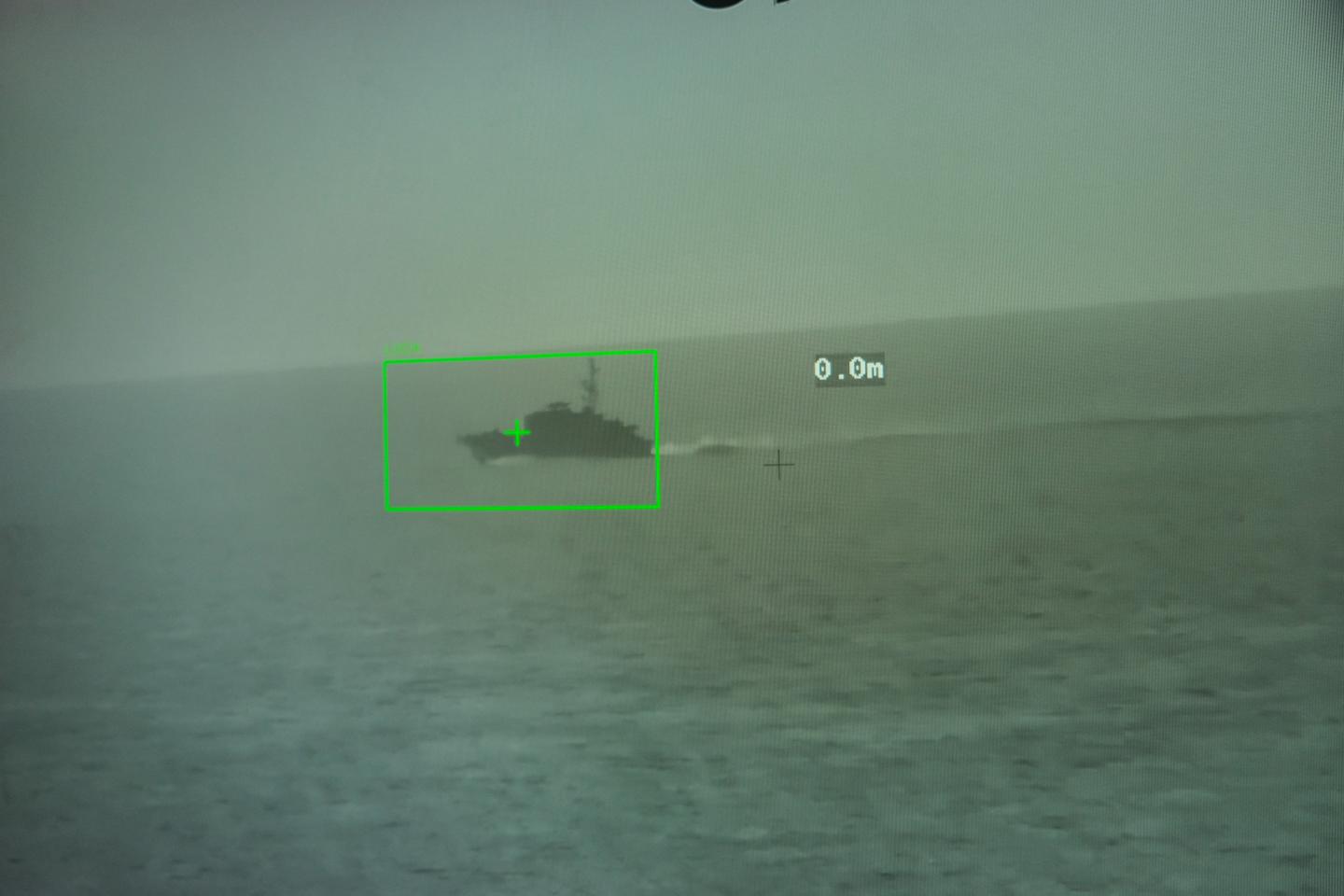
    L’équipage n’est pas au bout de ses peines. Le lendemain, à l’aube, les veilleurs de nuit sonnent l’alerte. Dans la brume matinale, ils ont repéré un bateau non identifié suivant le sillage de l’Ocean-Viking. « Un hors-bord nous poursuit depuis trois heures. C’est sûrement une milice libyenne. Est-ce qu’ils cherchent à nous intimider ? Leurs intentions ne sont pas claires », explique Mathilde, équipière, qui scanne l’horizon aux binoculaires.Soudain, le radar détecte un autre bâtiment à l’approche, traçant un sillon lumineux sur l’écran. « Avez-vous effectué une opération de sauvetage ? Vous venez dans les eaux libyennes et vous causez des problèmes », s’exclame bientôt en arabe une voix saccadée sur le canal 16 de la radio. Se rapprochant dangereusement, le patrouilleur libyen de classe Bigliani, autre modèle italien fourni par Rome aux autorités de Tripoli, n’est plus qu’à une encablure et menace d’aborder l’Ocean-Viking.
    Par mesure de sécurité, le capitaine ordonne à l’équipage de se réfugier dans la citadelle, une pièce tenue secrète dans les entrailles du navire. « Ils disent que nous ne sommes pas les bienvenus ici et nous obligent à quitter la zone. Bien que leurs agissements soient contraires au droit maritime, car nous nous trouvons dans les eaux internationales, nous n’avons pas tenté de négocier, explique Angelo Selim. Nous sommes harcelés en permanence, mais nous devons calmer le jeu, car on ne veut pas revivre l’expérience de l’an dernier. »
    Suivi à distance par les gardes-côtes libyens, l’Ocean-Viking est forcé de se dérouter et de mettre le cap au nord, afin de regagner la zone de recherche et de sauvetage maltaise, d’où il reprendra sa patrouille vers l’ouest. Retour à la case départ pour l’équipage dépité, alors que cette rencontre sous haute tension avec les Libyens est venue réveiller le traumatisme de l’attaque armée survenue en 2025. Malgré ses appels de détresse, l’Ocean-Viking n’avait alors reçu aucune assistance. Si des procédures judiciaires ont depuis été engagées en Italie, en France et en Allemagne, aucun représentant politique européen n’a daigné prendre la défense de l’organisation humanitaire.
    « Face à cette impunité totale, les Libyens se sentent de plus en plus légitimes à faire usage de la force contre nous, mais surtout contre les personnes qui traversent. Ce que l’Europe réussit avec sa politique d’externalisation, c’est qu’aujourd’hui cette frontière est plus violente que jamais. Toutes ces politiques, financer les gardes-côtes libyens, renforcer Frontex, entraver les opérations humanitaires, ont des conséquences mortelles », conclut Angelo Selim. Entre janvier et le début du mois de septembre, au moins 995 personnes sont mortes ou ont été portées disparues en Méditerranée centrale, selon l’Organisation internationale pour les migrations. Un bilan très certainement sous-évalué, estime SOS Méditerranée.
    Au soleil couchant, pas une vague ne ride l’horizon. A la proue du navire, Mohammed tient quelque chose en ligne de mire. Un point minuscule, pas plus gros qu’une bouée ou qu’une mouette, qui se rapproche. Le capitaine dévie l’Ocean-Viking de son cap pour en avoir le cœur net. Des flots émerge bientôt un bateau pneumatique dégonflé recraché par les eaux argentées. A-t-il chaviré ? Ses passagers ont-ils été interceptés ? Se sont-ils noyés ? La sombre silhouette à la dérive emportera ces questions par le fond.

    #Covid-19#migration#migrant#mediterranee#sante#mortalite#humanitaire#libye#tunisie#italie#frontex#migrationirreguliere#routemigratoire

  • #Turquie : vaste opération policière contre des militants #LGBT+
    ▻https://www.rfi.fr/fr/moyen-orient/20260913-turquie-vaste-op%C3%A9ration-polici%C3%A8re-contre-des-militants-lgbt

    La police turque a procédé tôt dimanche 13 septembre à de nombreuses descentes et arrestations dans des bars, des associations et aux domiciles de militants LGBT+. Présentée par les autorités comme une opération destinée à protéger la « famille », cette vaste campagne intervient alors que le gouvernement de Recep Tayyip #Erdogan a considérablement durci ces dernières années sa politique à l’égard des personnes LGBT+ et des organisations qui défendent leurs droits.

    Dans les pays de l’OTAN aussi, on fait des rafles.

    ►https://www.liberation.fr/international/europe/vaste-coup-de-filet-en-turquie-contre-des-bars-et-associations-lgbt-20260