meejah/fowl: Forward over #wormhole: streams over magic-wormhole Dilation connections
▻https://github.com/meejah/fowl
— Permalink
Very interesting talk I just watched on Air #Mozilla (or #airmo as ...
▻https://diasp.eu/p/6966848
Very interesting talk I just watched on Air #Mozilla (or #airmo as we like to call it):
#Computer #Security In The Past, Present and #Future, with Mikko Hypponen ▻https://air.mozilla.org/computer-security-in-the-past-present-and-future-with-mikko-hypponen
Definitely worth a look if things like #virus, #worm, #trojan, #ransomware, unsolicited #blockchain #mining (heck, he even talks about blockchain applications and security a bit) are anything that peek your interest!
Oui, divers contributeurs qui se manifesteront sans doute, sont germanophones natifs, d’autres, comme moi, acquis (mais lointain…)
Il y a même un tag ad hoc #auf_deutsch, mais il n’est utilisé que par son créateur que tu trouveras ainsi facilement.
Mais le centre de gravité est plutôt berlinois que rhénan, du moins parmi ceux que je peux localiser. Pas trop de wagnériens, non plus. Ou en tous cas, ilsle cachent …
„Wir [bleiben] im konstruktiven Dialog.“
(enfin, au moins ici, parce qu’à #Worms, le dialogue a plutôt l’air d’en être aux balbutiements.)
Merci @simplicissimus !
Oui pour ce que est du dialogue, c’est balbutiant. Simple reprise de contact après plus de 10 ans.
Prost !
Willkommen !
Dank der automatischen Übersetzung der empfohlenen Artikel kann ich auch die Kollegen aus Japan verstehen :-)
Wenn ich meine Worte auch den Nur-Frankophonen versändlich machen will, setze ich sie als Zitat. Dann wird ihnen zu meinem deutschen Text die automatische Übersetzung angeboten.
Die auf Deutsch aktiv, d.h. nicht nur zitierend, Postenden lassen sich problemlos an den Fingern einer Hand abzählen - nichtsdestoweniger, willkommen auf Seenthis!
Hallo @klaus und @02myseenthis01 Vielen Dank für ihre Willkommen. Je dois confesser que je suis un simple français nul en langues, en particulier en Allemand. Enfin bon je le comprends. Faut dire que ma femme est allemande et nos enfants aussi. Puis j’ai eu pas mal d’aventures là-bas comme le relate cet article. Et c’est peut-être pas terminé ? Ein bisschen Übung auf Seenthis wird mir gut tun. Tschüs !
Warning: for Windows systems: important spread of #WannaCry (#Wcry) ransomware
▻http://thehackernews.com/2017/05/wannacry-ransomware-unlock.html?m=1
▻https://arstechnica.com/security/2017/05/an-nsa-derived-ransomware-worm-is-shutting-down-computers-worldwide
The malware/worm is causing disruptions at banks, hospitals, telecommunications services, train stations, and other mission-critical organisations in multiple countries, including the UK, Spain, Germany, and Turkey. Telefonica, FedEx, and the UK government’s National Health Service (NHS) have been hit. Operations were cancelled, x-rays, test results and patient records became unavailable and phones did not work.
The ransomware completely encrypts all your files and render them unusable. They ask you to pay some money to get the decryption key. ($300 to $600 worth in bitcoins). Paying does not guarantee you will get a decryption key though.
The malware spreads through social engineering e-mails.
Be careful with any attachments you receive from unknown sources (and even known sources). Make sure the files are sent intentionally.
Watch out for .pdf or .hta files, or links received via e-mail that point to .pdf or .hta files.
More than 45.000 computers worldwide have already been infected, but there appears to be a kill switch, i.e. a way to stop its spreading.
As one of the first operations, the malware tries to connect to the website www.iuqerfsodp9ifjaposdfjhgosurijfaewrwergwea.com. It doesn’t actually download anything there, just tries to connect. If the connection succeeds, the program terminates.
This can be seen as a kind of kill switch provision, or perhaps it had some particular reason. Whichever it is, the domain has now been sinkholed and the host in question now resolves to an IP address that hosts a website. Therefore, nothing will happen on any new systems that runs the malware. This will of course not help anyone already infected.
Microsoft has released a patch to block the malware on Windows machines:
MS17-010
▻https://technet.microsoft.com/en-us/library/security/ms17-010.aspx
It is important to apply the patch because other variants of the malware can exploit the same vulnerability and/or use a different domain name check.
Nice technical analysis of the worm:
▻https://blog.malwarebytes.com/threat-analysis/2017/05/the-worm-that-spreads-wanacrypt0r
And more technical info about the worm itself: (careful)
▻https://gist.github.com/rain-1/989428fa5504f378b993ee6efbc0b168
En français :
▻http://www.leparisien.fr/high-tech/douze-pays-victimes-d-une-cyberattaque-massive-des-hopitaux-britanniques-
▻http://www.lemonde.fr/international/article/2017/05/13/une-cyberattaque-massive-bloque-des-ordinateurs-dans-des-dizaines-de-pays_51
►http://www.lalibre.be/dernieres-depeches/afp/une-attaque-informatique-massive-frappe-a-travers-le-monde-5916cbd3cd7002254
et pour les moins techniques :
▻http://www.leparisien.fr/high-tech/cyberattaque-massive-quelle-attitude-adopter-face-a-un-rancongiciel-13-05
Les « rançongiciels » (« ransomware » en anglais) promettent de libérer vos données contre le paiement d’une rançon. Quelques conseils pour se prémunir contre ce type d’attaques ou y faire face.
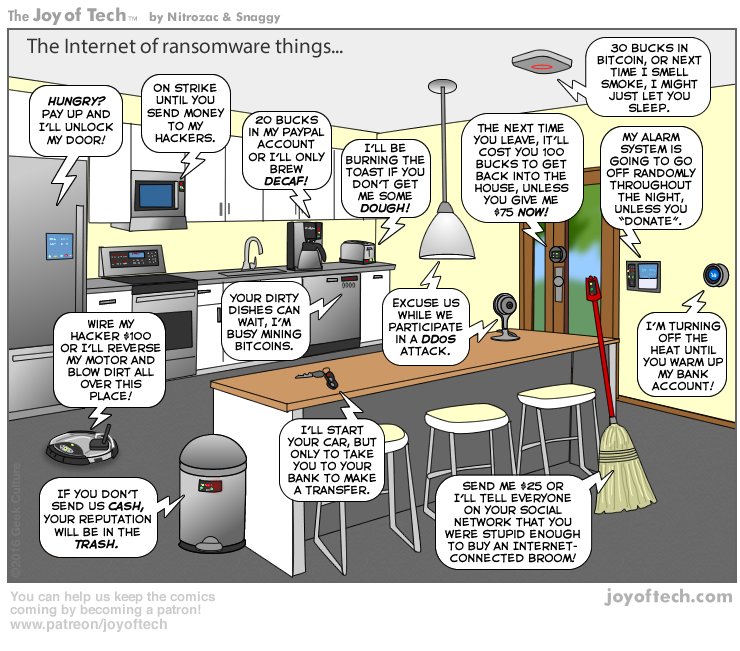
Internet des objets et les problèmes pas encore trop visibles :
▻https://seenthis.net/messages/598009
@erratic as-tu un autre lien vers ce cartoon ?
(Test) ce lien a l’air statique :
As expected, new variants have arrived which no longer have the “kill swich” bypass.
The amount of infected machines has reached 200.000 now.
▻https://www.cnet.com/news/wannacry-ransomware-patched-updated-virus-kill-switch
▻https://heimdalsecurity.com/blog/security-alert-uiwix-ransomware
A regularly updated page with lost of interesting info on the evolution of this WannaCry malware
Hackers are trying to reignite WannaCry with botnet attacks
As WannaCry went to sleep by registering a certain domain and putting a live web server on that IP (kill switch), hackers now try to bring down that web server so that the WannaCry infected machines would wake up again
▻https://www.wired.com/2017/05/wannacry-ransomware-ddos-attack
Supposedly, it is possible to get decryption keys without paying the ransom - provided you didn’t reboot your windows machine.
▻http://www.ibtimes.co.uk/wannacry-how-decrypt-recover-your-data-infected-windows-systems-1622512
IBTimes UK earlier reported how French cybersecurity researcher Adrien Guinet, from Quarkslab, released a decrypting tool that allowed only Windows XP users to recover their data. Guinet’s work was advanced by internationally acclaimed ethical hacker Benjamin Delpy who exploited the shortcomings of WannaCry and used it to create a tool called WanaKiwi that produces a decryption key for Windows XP, 7, 2003, 2008 and possibly Vista.
French ethical hacker and co-founder of CloudVolumes, Matt Suiche confirmed that WanaKiwi has been tested and shown to work on Windows 7 and older Windows versions like XP, 2003 and more. Europe also tweeted confirming they were able to use the tool for decryption.
How it works
While WannaKey extracted prime numbers that had not been erased from the system and were vital to the decryption key, it required a separate app to transform those bits into the secret key. WanaKiwi scours the memory of the infected systems, extracts the p and q variables the secret key was based on, and reassembles the finished key all by itself. The tool then uses the key to decrypt all files locked by the WannaCry ransomware.
The WanaKiwi decryption tool:
Avec du son :
▻https://www.youtube.com/watch?v=mxtKxlR5yqM
▻http://klaq.com/bizarre-worm-video-has-the-internet-wondering-what-it-this-terrifying-thing
▻http://www.iflscience.com/plants-and-animals/what-earth
So the strange white thing that seems to “erupt” from the worm is its proboscis. This is a tubular sucking organ that some worms use to feed. The worm is feeling out what it’s sitting on, trying to find out if it can eat the hand.
“This new nemertean has also a proboscis which is retractile within a proboscis sheath, but the proboscis is branched. The branching is of the dichotomous type. During eversion, which takes place almost explosively, the short main trunk. first appears, then this dividess and the finer and filter branches appear, but since each one of these is the result of an evagination the effect is almost indescribable. It is as if a large number of lively, wriggling, minunte worms had been shot out”
▻http://www.reddit.com/r/WTF/comments/34r9dd/what_is_this/cqxcwzd
C. Elegans’ nervous system fully simulated and implemented in hardware - robot demonstrates worm-like behaviour:
▻https://plus.google.com/u/0/+YonatanZunger/posts/ew2jC9hnyAA
sur ST :
Open Worm en open source
▻http://seenthis.net/messages/212881
Open Worm idem, plus description du cerveau
►http://seenthis.net/messages/265214
M.-Ch. Morin, la gagnante en France de MT180 :
►http://seenthis.net/messages/266134
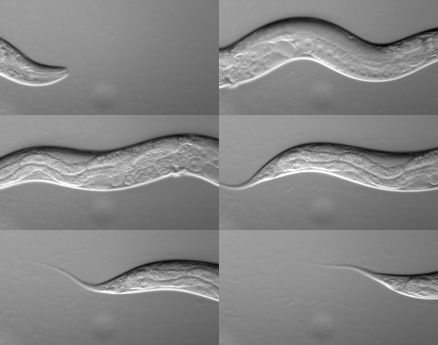
Moi ce que je me demande c’est sur quels critères le taxonomiste qui a nommé cette espèce de Caenorhabditis l’a trouvée elegans (élégante)
Caenorhabditis elegans
▻http://plpnemweb.ucdavis.edu/Nemaplex/Taxadata/G900S2.htm
Caenorhabditis elegans was initially described and named Rhabditis elegans by Maupas (1900) who collected it from rich humus soil in Algeria (north Africa) (Fatt, 1961); it was subsequently placed in the subgenus Caenorhabditis by Osche (1952) and then raised to generic status by Dougherty (1955).
The name is a blend of Greek and Latin (Caeno, recent; rhabditis, rod-like; elegans, elegant).
Mais, il n’y a pas d’explication sur le choix par Maupas.
Allons donc voir le texte originel,…
Modes et formes de reproduction des nématodes, par E. Maupas, Conservateur de la Bibiliothèque d’Alger,
in Archives de Zoologie Expérimentale et Générale_ (3è série, t. 8, p. 463 à 624
▻http://www.biodiversitylibrary.org/item/25956#page/537/mode/1up
Malheureusement, il en fait une description très détaillée, mais sans jamais expliciter la raison du choix de l’épithète du genre… (début de la description, p. 477) (ou bien, je ne l’ai pas trouvée…)
Peut-être a-t-il retenu ce terme à cause du mode de reproduction ? C’est le sujet principal de son article.
En résumé (WP)
►https://fr.wikipedia.org/wiki/Caenorhabditis_elegans
C. elegans est un petit ver transparent d’environ un millimètre de longueur, menant une vie autonome dans le sol. Son embryogenèse ne dure que 16 heures et peut être facilement observée in vitro. La plupart des individus sont hermaphrodites (XX) et produisent à la fois des œufs et des spermatozoïdes. Il y a quelques mâles (XO). Ce nématode se reproduit environ tous les trois jours, et sa durée de vie est d’environ trois semaines.
Pour les détails, se reporter à Maupas (il y en a vraiment beaucoup…) Par exemple (p. 483)
Il en résulte, qu’avec leur rapide évolution, ces œufs sont toujours pondus à un état de développement très avancé et souvent éclosent dans l’utérus même. Les jeunes, au début, sont expulsés avec les œufs non encore éclos ; mais lorsque la provision de sperme est épuisée et que des œufs non fécondés dépourvus de coque passent dans l’utérus, les jeunes qui s’y trouvent à ce moment se nourrissent de ces œufs et s’accroissent dans l’utérus. Devenus plus grands et plus forts, ils finissent par déchirer les parois de cet organe et se répandent dans la cavité générale du corps. Ils désorganisent et dévorent alors les viscères de leur mère, qui ne tarde pas à périr. Il n’est pas rare de trouver ainsi dans le sac cuticulaire de cette dernière des individus qui s’y sont complètement développés et sont devenus adultes. On peut donc dire de cette espèce qu’elle est ovo-vivipare.
J’oubliais cette intéressante présentation d’ensemble.
A Short History of C. elegans Research
▻http://wormclassroom.org/short-history-c-elegans-research
wow, merci @simplicissimus pour cette revue bibliographique (qui m’avait échappée la semaine dernière)
Devenus plus grands et plus forts, ils finissent par déchirer les parois de cet organe et se répandent dans la cavité générale du corps. Ils désorganisent et dévorent alors les viscères de leur mère, qui ne tarde pas à périr. Il n’est pas rare de trouver ainsi dans le sac cuticulaire de cette dernière des individus qui s’y sont complètement développés et sont devenus adultes.