www.voanews.com

Adresses référencées sous ce chemin :

  • Iran Continues Deporting Undocumented Afghan Refugees

    Nearly 130,000 undocumented Afghan refugees have been forced by the Iranian government to go home this year, heading to an uncertain future with the resurgent Taliban now holding more than 40 percent rural territory in Afghanistan.

    ▻http://www.voanews.com/a/iran-continues-deporting-undocumented-afghan-refugees/3864010.html

    #Iran #réfugiés_afghans #asile #migrations #réfugiés #expulsions #renvois #Afghanistan

  • Pirates demand ransom for oil tanker captured off coast of Somalia | World news | The Guardian

    ▻https://www.theguardian.com/world/2017/mar/14/pirates-demand-ransom-for-oil-tanker-captured-off-coast-of-somalia

    Les affaires reprennent au large des côtes somaliennes

    AP in Mogadishu

    Tuesday 14 March 2017 22.44 GMT

    Armed men are demanding a ransom for the release of an oil tanker they have seized off the coast of Somalia and the crew is being held captive, the European Union anti-piracy operation in the region announced late on Tuesday.

    An EU naval force statement said the operation had finally made contact with the ship’s master, who confirmed that armed men were onboard the Comoros-flagged tanker Aris 13.
    ’We had to eat rats,’ say sailors held by Somali pirates for four years
    Read more

    Monday’s hijacking was the first such seizure of a large commercial vessel off Somalia since 2012. It came as a surprise to the global shipping industry as patrols by the navies of Nato countries, as well as China, India and Iran, had suppressed Somali pirate hijackings for several years.

    #piraterie_maritime #somalie

  • Contre les migrants, la #Hongrie matraque à plein

    2 septembre 2016 | Par Philippe Bertinchamps

    Affiches, spots publicitaires à la radio et à la télévision… Tandis que la campagne référendaire bat son plein, pour ou contre la « relocalisation » des migrants en vertu de l’accord européen, des centaines de réfugiés espèrent un jour pouvoir passer les murs de barbelés érigés par Budapest à la frontière entre la Serbie et la Hongrie. À leurs risques et périls.

    Frontière serbo-hongroise, envoyé spécial.- Ce sont les oubliés de la frontière. Syriens, Afghans, Pakistanais, Algériens, Marocains, Camerounais, Congolais, Maliens… En quarantaine dans des no man’s land entre la Serbie et la Hongrie, ils attendent au pied de la clôture de barbelés de pouvoir entrer dans l’espace Schengen. La liste est longue. L’appel a lieu une fois par jour, mais à n’importe quelle heure. Les familles ont la priorité. Trente personnes sont autorisées à passer dans un tourniquet et à pénétrer dans les « zones de transit » : quinze à Horgos-Röszke, quinze à Kelebija-Tompa. Sur un rempart formé de cinquante-deux conteneurs climatisés, policiers et soldats hongrois montent la garde. Cachés derrière des lunettes de soleil, ils observent le camp en Serbie. Tentes, huttes de branchages et de couvertures pour s’abriter contre le soleil et la pluie. Ce jour-là, à Horgos, on recense 264 personnes, dont 45 femmes et 122 enfants. Des ados jouent au cricket avec une batte taillée dans une planche. Le vent fait voler la poussière. Il est 18 heures, l’heure de la prière. Des hommes ont accompli leurs ablutions. Les ONG humanitaires ont donné les soins, distribué la nourriture, plié bagage.

    La frontière entre la Serbie et la Hongrie © Marija Janković La frontière entre la Serbie et la Hongrie © Marija Janković
    « Saviez-vous que les attaques de Paris ont été commises par des migrants ? Que depuis le début de la crise migratoire le harcèlement sexuel a augmenté ? Que plus de 300 personnes sont mortes en Europe dans des attaques terroristes ? » Panneaux d’affichage, spots publicitaires à la radio et à la télévision… De l’autre côté du rideau de fil de fer, le matraquage bat son plein. Un référendum est prévu le 2 octobre. Les citoyens hongrois devront se prononcer sur l’accueil de 1 294 réfugiés assignés à Budapest, selon l’accord entre les États membres de septembre 2015 ayant abouti à la décision de « relocaliser » par quotas cent soixante mille réfugiés en Europe. « Voulez-vous, oui ou non, que l’Union européenne décrète une relocalisation obligatoire de citoyens non hongrois sans le consentement du parlement ? » La campagne est enclenchée : « Seuls les Hongrois peuvent décider avec qui ils veulent vivre en Hongrie. »

    Lire aussi

    Hongrie : la politique du pire de Viktor Orbán Par Antoine Perraud
    « Une question démagogique et populiste », estime Mark Kékesi, professeur de socio-psychologie à l’université de Szeged (sud de la Hongrie) et l’un des fondateurs de l’association de solidarité MigSzol. « Le Premier ministre, Viktor Orban, proclame que l’arrivée de réfugiés musulmans met en péril l’identité chrétienne de l’Europe. Il traite le problème d’un point de vue religieux et dogmatique. C’est devenu une affaire d’État. Toute la communication est centralisée à Budapest. À l’en croire, nous sommes sous le feu roulant de l’ennemi : les migrants du Moyen-Orient et les eurocrates de Bruxelles. Il s’agit bien sûr d’un coup marketing. Grâce à ce référendum, sa cote remonte dans les sondages. Entre-temps, le pays s’enfonce dans une crise grave — hausse du chômage, dégradation de l’enseignement, des soins de santé — et son parti (Fidesz-Union civique hongroise, national-conservateur) est éclaboussé par des scandales de corruption. »

    « Dans les zones de transit, la procédure est parfois très expéditive », témoigne Omi, un Afghan de 17 ans, à Horgos. « Serbian police, no problem ? No problem, very good… » Dans ce cas, la Serbie est un pays sûr. « Go back to Serbia ! » Selon Budapest, dix-huit mille migrants ont traversé la « frontière sud » depuis le début de l’année. Talonné par son opposition qui demande à quoi bon avoir dépensé un million de dollars pour une « passoire », Viktor Orban a déployé les grands moyens. Depuis le 5 juillet, dix mille policiers et soldats patrouillent dans la zone : 175 kilomètres de barbelés coupants surveillés par des drones et des hélicoptères. Miradors, sentinelles… Les contrôles sont fréquents et les « migrants illégaux » qui se font attraper dans un rayon de huit kilomètres après la frontière – mais quel est le tracé précis de cette ligne ? – se font repousser manu militari de l’autre côté de la clôture, à un ou deux pas en deçà de la démarcation entre la Hongrie et la Serbie, sans autre forme de procès. Le 6 juillet, le Haut Commissariat des Nations unies pour les réfugiés (HCR) a dénombré cent vingt expulsions. Le même jour, un pic de sept cents personnes a été enregistré au camp de Horgos, trois fois plus que d’habitude… En une semaine, deux mille cinq cents demandeurs d’asile potentiels ont été refoulés. Les appréhensions ont diminué à vue d’œil : une quinzaine par jour en août, contre cent cinquante en juin. « Seuls ceux qui ne sont pas informés tentent de franchir la clôture, à leurs risques et périls », commente un humanitaire de Médecins sans frontières (MSF).

    Laszlo Toroczkai © Marija Janković Laszlo Toroczkai © Marija Janković
    « Et pourtant, ça ne suffit pas ! » Laszlo Toroczkai est le maire d’Asotthalom, une bourgade agricole de trois mille âmes située entre Tompa et Röszke. Interdit d’entrée sur les territoires serbe, roumain et slovaque à cause de son activisme en faveur des Hongrois d’outre-frontières, ce fils de bonne famille (né Toth), athlétique et bronzé, est également connu pour avoir incendié avec ses troupes de choc la Télévision hongroise lors des émeutes antisocialistes à Budapest en 2006. Fan de Donald Trump, partisan des armes à feu, défenseur des « honnêtes citoyens hongrois », c’est lui le premier qui aurait lancé l’idée d’une barrière frontalière, à l’exemple de la grande muraille États-Unis-Mexique. « Mais la solution n’est pas parfaite, admet-il. Ce qu’il faut, c’est une clôture électrifiée, des projecteurs, des caméras, un système d’alarme… » Son profil Facebook attire plus de quarante mille visiteurs. Les photos qu’il poste de jeunes Afghans et Pakistanais capturés par « ses » gardes champêtres en tenue militaire font un tabac. « Des agents auxiliaires, assure-t-il. Cinq ou six hommes qui dépendent du gouvernement local, encadrés par la police… »

    Zsolt, 38 ans, est un colosse aux muscles d’acier. Un « vrai », un « dur », un « tatoué ». Ancien videur de boîte de nuit, ce géant barbu est préposé depuis deux ans à la garde des propriétés rurales dans la commune d’Asotthalom. « Ce que j’aime, c’est la nature, dit-il. En ville, trop de junkies, trop de dealers. » Son nouveau job : protéger les frontières de l’Europe. Circuler à moto ou à bord d’un gros 4 x 4 dans les chemins sablonneux à l’affût de « migrants illégaux ». Il a fait ses classes en traquant les Albanais du Kosovo, l’hiver 2014-2015, quand un exode massif a vidé ce petit pays, qui venait de fêter les sept ans de son indépendance, de 10 % de la population. « Je travaille en solo. Si je surprends quelqu’un, je le conduis à la police. » Son uniforme paramilitaire n’est pas marqué à son nom, ni à son matricule. En août, il a fait « mauvaise chasse ». En juillet, il a épinglé vingt-cinq proies à son tableau. Avant, entre cinquante et cent… « Parfois, je tombe sur des jeunes entraînés à se battre, avoue-t-il. Là, je suis forcé de recourir à la violence. »

    Zsolt © Marija Janković Zsolt © Marija Janković
    « Des victimes de passages à tabac, nous en recueillons tous les jours, constate un responsable du Commissariat pour les réfugiés en Serbie. Bras cassés, morsures de chiens… La police ouvre une petite porte dans le grillage. On ne sait pas où ni quand. Ils ne préviennent jamais. Qui ? Combien de gens ? Ce matin, il y avait encore deux Kosovars… » Durant les six premiers mois de 2016, la Hongrie a enregistré plus de vingt-deux mille demandes d’asile, dont une majorité déposée par des Afghans (37 %) et des Syriens (15 %). Officiellement, à peine cent individus en situation irrégulière ont été renvoyés en Serbie. Parmi eux, trente-trois Serbes, vingt-six Kosovars et dix-neuf Albanais… Les autres, Syriens, Afghans, Irakiens ou Somaliens, tous ceux dont la demande a été rejetée dans les limbes juridiques des « zones de transit », ne comptent pas.

    « Nous, les Africains, on passe toujours après. Même au camp, on mange les restes. » Basile est camerounais. Il traîne à Horgos depuis le début de l’été, après avoir quitté la Grèce. « Nous étions au nombre de vingt-huit, dont un Camerounais, trois Maliens et un Congolais. Nous avons cisaillé les barbelés et nous sommes entrés en Hongrie, en plein jour. Subitement, trois policiers nous ont interpellés. Les renforts sont arrivés. Ils nous ont pulvérisé du gaz sur le visage, craché dessus et donné des coups de matraque. Nous avons couru et nous sommes repassés par le trou dans le grillage, en nous écorchant les mains. Le frangin congolais a voulu récupérer son sac et ses téléphones. Un policier l’a suivi et a braqué son arme sur lui, comme s’il allait tirer. » Le 13 juillet, Human Rights Watch (HRW) publiait un rapport : « Des gens qui entrent en Hongrie sans autorisation, y compris des femmes et des enfants, ont été violemment battus et renvoyés de force de l’autre côté de la frontière. » À Belgrade, la capitale serbe, MSF a signalé une augmentation des blessés. Le 24 août, pour la première fois, le chef de la police nationale hongroise, Karoly Papp, a reconnu que des « hommes en uniforme » avaient fait subir de mauvais traitements aux réfugiés. Quatre poursuites judiciaires ont été engagées.

    En mars 2016, l’Union européenne a confié à la Turquie la défense de sa frontière extérieure. Or, depuis le « putsch manqué » du 15 juillet, quelque chose a changé. Plus de quatre mille candidats ont débarqué à Chios, Leros, Lesbos, Samos. À peu près soixante mille réfugiés se trouvent dans une quarantaine de camps en Grèce. Beaucoup dorment dehors. Selon le secrétaire d’État à l’immigration, Ioannis Mouzalas, « environ quatre mille » ont refusé de demander l’asile et devraient poursuivre leur route vers l’Europe du Nord.

    © Marija Janković © Marija Janković
    La Bulgarie, qui a érigé une clôture de barbelés sur 130 de ses 259 kilomètres avec la Turquie, a demandé un renfort de trois cents hommes à Frontex. « J’espère que mes collègues européens sont conscients que la Bulgarie et la Grèce risquent d’être confrontées à un énorme problème » si l’accord UE-Turquie venait à être dénoncé, a averti le 12 août le premier ministre bulgare, Boïko Borissov, soulignant la « vulnérabilité » des deux pays. Selon le ministère serbe de la défense, en juillet-août, plus de trois mille migrants irréguliers ont été interceptés à la frontière avec la Macédoine, où les réseaux mafieux de passeurs ont été réactivés. La Serbie, dont la capacité d’accueil est évaluée à six mille places, compte aujourd’hui quatre mille six cents réfugiés. En Croatie, le ministère de l’intérieur a publié les photos d’un nouveau centre de transit, près de la frontière serbe, d’où les migrants seraient transférés à Zagreb, ou déportés en Serbie. La Slovénie a prévu de consolider sa barrière de barbelés avec la Croatie. À Ljubljana, les consultations entre le gouvernement et les ONG vont bon train, et les centres de réception, fermés en mars, ont rouvert.

    « Maintenant, je ne sais plus quoi faire », soupire Golamat, un Afghan de 29 ans, échoué à Horgos après avoir connu Idomeni et les camps autour de Thessalonique. « J’étais 196e sur la liste, je suis 121e. Ça fait un mois que j’attends. J’ai peut-être vu dix hommes entrer dans la zone de transit, huit en sont ressortis par la petite porte… » Le 26 août, le premier ministre Orban a annoncé à la radio qu’il allait fortifier son arsenal sécuritaire : un second système de défense, « plus robuste », à côté de la « barrière à installation rapide ». Last but not least, on demande des surveillants pour la rentrée : à partir du 1er septembre, trois mille « chasseurs frontaliers » – non pas gardes-frontières – seront recrutés. « Des policiers, des soldats et des armes ! »

    ▻https://www.mediapart.fr/journal/international/020916/contre-les-migrants-la-hongrie-matraque-plein?onglet=full
    #Balkans #asile #migrations #réfugiés #murs #barrières_frontalières #Serbie #frontières #Bulgarie #violence

    • Over the Line. Bulgaria Welcomes Refugees With Attack Dogs and Beatings

      Abdul Bashir was resting when the police dogs came. He and 11 others were in the dense mountainous forest that joins Turkey and Bulgaria. They had just crossed to the Bulgarian side, for the second time in a month, stepping over the low-hanging wire that divides the two countries. The dogs came out of the woods behind them. Abdul Bashir saw one attack a man in his group, biting his shoulder and dragging him across the ground. The man was bleeding.

      ▻https://theintercept.com/2016/11/03/bulgaria-welcomes-refugees-with-attack-dogs-and-beatings

    • Violence at the Hungarian border

      This winter, as temperatures dropped to 20 below zero, the level of violence at Hungary’s border with Serbia increased sharply, with many describing acts that can be only seen as torture. People of all ages, some as young as 13, were beaten, stripped naked and ordered to lie face-down in the mud, snow or water for as long as an hour. Their clothing was taken or destroyed. Water poured down their necks. Eyes pepper sprayed. Batons struck against genitals. Forced selfies with laughing officers. All this performed by people in “dark blue uniforms” – official Hungarian border police.

      Over the past two years, the Hungarian government has been running a “xenophobic scapegoating campaign" against migration, according to the Helsinki Committee. A 175 kilometer long fence has been setup along the Serbian-Hungarian border, while parallel efforts have been made to prevent the possibility of getting asylum through legal paths.

      Meanwhile in Serbia, the number of refugees significantly exceeds the country’s accommodation capacity and is still growing. During one of the harshest winters in years, up to 2000 people have had no alternative but to sleep rough outdoors – on the streets of Belgrade or in the forests of the north. Without a safe place to stay in Serbia and no legal way to travel backwards, they’ve been stuck in limbo.

      For most of them, attempting irregular crossings has become the only option. Nearly all of those who tried encountered systematic brutality and humiliation regardless of their gender, age or nationality.

      Numerous cases of beatings, dog bites and other abuses at the hands of Hungarian border police have been reported by human rights organisations and activists during the past year. Just in the first two months of 2017, Médecins Sans Frontières (Doctors Without Borders) treated over a hundred people in Belgrade alone, injured by the Hungarian border patrols.

      Although the Hungarian authorities deny all the accusations, the enormous scale and clear pattern of violence leave no doubt: these are not just rare and isolated acts of brutality.

      The stories in this video were collected during January and February 2017. During these 2 months we’ve interviewed more than 20 victims of abuse following human rights reporting guidelines. Informally, we’ve talked with many more.

      ▻https://www.youtube.com/watch?v=nYxb2rtAohQ&feature=youtu.be

    • Hungary Plays the E.U.

      Hungary’s cruel treatment of refugees has reached a new low. On Tuesday, in defiance of international law, the Parliament approved the mass detention of asylum seekers, including children, in guarded camps enclosed with razor wire. The European Union has said in a directive that “Member States shall not hold a person in detention for the sole reason that he or she is an applicant” for asylum; moreover, Hungary’s treatment of refugee children defies international law.

      ▻https://www.nytimes.com/2017/03/13/opinion/hungary-plays-the-eu.html?smid=tw-share&_r=0

    • L’Unione europea e l’«esperimento» ungherese. Migranti in ostaggio

      Il 2 ottobre 2016 il governo ungherese ha invitato i cittadini a rispondere a un referendum che consisteva in un unico, semplice quesito: «Vuoi che l’Unione europea sia abilitata a dare mandato di accoglienza ai cittadini non-ungheresi in Ungheria senza il consenso del Parlamento?». Il vero e il falso di questa domanda si combinavano in una tale ambiguità di senso che il cittadino si trova di fronte a una scelta difficile. Il modo in cui il quesito è stato proposto decontestualizza il problema, poiché in realtà non si tratta di un immaginario cittadino «non-ungherese», ma di persone concrete, detentrici di diritti in quanto profughi e richiedenti asilo.

      ▻https://www.rivistailmulino.it/news/newsitem/index/Item/News:NEWS_ITEM:3862

  • #Europe pressing harder on countries to take back deported migrants

    As Europe reels from a historic rush of migrants, leaders are searching for new ways to reverse the flow by stepping up deportations.

    The quest led to a deal with Afghanistan that envisions a whole new terminal at the Kabul airport to take deportees. It sent German Chancellor Angela Merkel this week on a whistle-stop tour of African capitals, where she promised an influx of euros in exchange for willingness to take back migrants. And it resulted in an agreement with Turkey that critics say means European nations are biting their tongues about Ankara’s human rights abuses to halt refugees from flowing to Greece.

    ▻https://www.washingtonpost.com/world/europe/europepressing-harder-on-countries-to-take-back-deported-migrants/2016/10/12/c822453a-8fb4-11e6-bc00-1a9756d4111b_story.html?tid=sm_tw
    #renvoi #expulsion #réfugiés #asile #migrations #Afghanistan #réfugiés_afghans #accords #diplomatie #externalisation

  • Ethiopia Protests Continue Despite Call for Calm
    ▻http://www.voanews.com/a/ethiopia-protests-continue-despite-call-for-calm/3538412.html

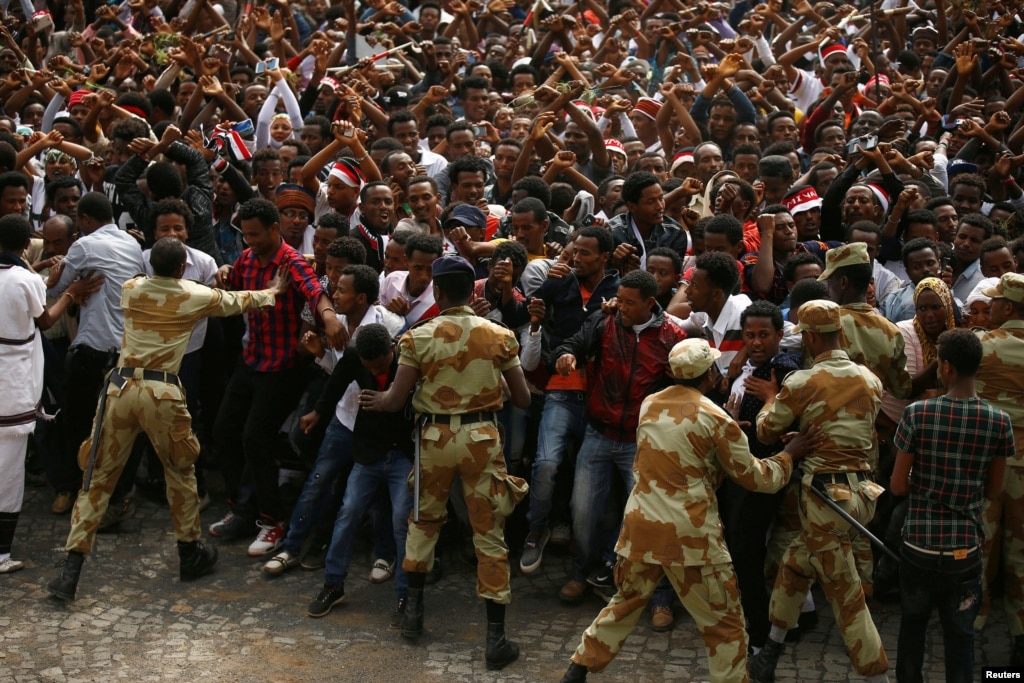
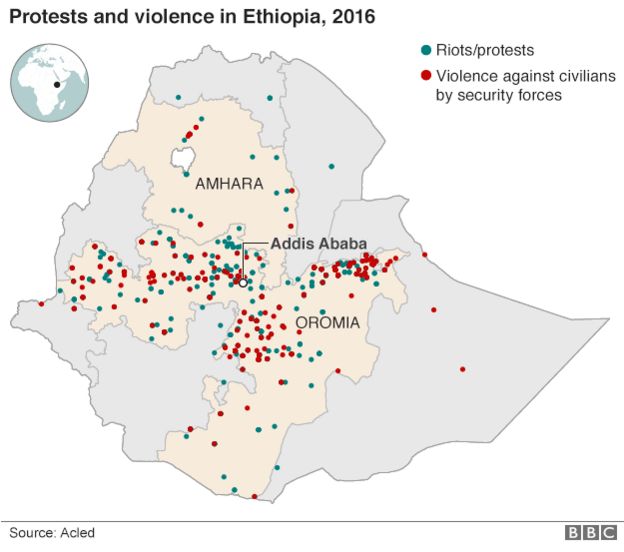
    Ethiopia is observing an official mourning period for more than 50 people killed during a crackdown and stampede at an ethnic cultural festival in the Oromia region Sunday.

    At the same time, the country is seeing a continuation, possibly an escalation, of the anti-government protests that sparked the violence.

    Hundetu Biratu took part in a protest that turned deadly Monday in Dembidolo, a town in southwestern Ethiopia. She told VOA that her brother was shot and killed during the demonstration.

    #Ethiopie #contestation #répression

  • India’s New Reforestation Law Ignores Indigenous People, Analysts Say
    ▻http://www.voanews.com/content/indias-new-reforestation-law-ignores-indigenous-people-analysts-say/3440041.html

    A new Indian law to boost reforestation across the country ignores the importance of indigenous people in conserving land and tramples on their rights, analysts and activists said.

    India’s upper house of parliament passed a bill late on Thursday that would give state governments more than 60 billion rupees ($895 million) a year to conserve and protect forests and wildlife.

    “It is a good bill,” Minister of State of Environment Anil Madhav Dave said in a statement, adding that the new law would help to focus reforestation efforts in a concerted way.

    Most of the funds under the Compensatory Afforestation, Management and Planning Authority (CAMPA) law would be used to restock denuded forests, Dave said.

    The law would also help to create employment, especially in poor regions and areas that are traditionally home to indigenous communities, he said.

    However, critics of the law said the money would be better spent on helping local communities who are already engaged in conserving their habitats.

    #Inde #reforestation #plantation ? #peuples_autochtones

  • Visas et migrants : Erdogan entame un bras de fer avec l’Europe
    ▻http://fr.myeurop.info/2016/05/25/visas-et-migrants-erdogan-entame-un-bras-de-fer-avec-l-europe-14543

    Superchef

    Le président turc Recep Tayyip Erdogan a menacé l’Union européenne de bloquer l’application de l’accord sur les migrants si aucune avancée n’avait lieu à propos l’exemption de visa pour ses compatriotes d’ici au 30 juin. Ces négociations concernent les courts séjours (90 jours maximum) familiaux, de voyages d’affaires ou touristiques dans l’espace Schengen.

    Erdogan persiste et signe. lire la (...)

    #AUJOURD'HUI_EN_EUROPE #INFO #Turquie

  • Accusations d’utilisation d’armes chimiques, il y a quelques jours, par les Kurdes à l’encontre de groupes rebelles qui les auraient utilisés sur le quartier kurde de Cheikh Maqsoud à Alep sous contrôle du YPG.
    Par ailleurs une déclaration officielle censée émaner de Jaysh al-islam dénonce l’utilisation d’armes à Cheikh Maqsoud par un de ses commandants, considérées comme illégales au regard du règlement du groupe.
    Ces infos ne sont pas du tout traitées en « Occident », ne serait-ce que pour rapporter les allégations kurdes et tenter de les vérifier, de même que la déclaration censée émaner de Jaysh al-islam.

    Voice of america (propriété du gouvernement fédéral américain) traite pourtant l’info :
    Kurdish Officials : Rebels May Have Used Chemicals in Aleppo
    Voice of America / 08.04.16
    ▻http://www.voanews.com/content/kurdish-officials-rebels-may-have-used-chemicals-aleppo/3276743.html

    Kurdish health officials say civilians and fighters wounded in this week’s shelling of Kurdish forces by Syrian rebels are showing signs of chemical weapons injuries.
    “We received four people yesterday who had serious wounds,” Welat Memo, a physician with the Kurdish Red Crescent told VOA from Aleppo. “We can’t tell what’s been used against them, but they’re vomiting and having difficulty in breathing."
    The symptoms are consistent with the use of chlorine gases, the Red Crescent said.
    [...]
    A rebel spokesman reached in Syria declined to comment to VOA. But in a statement released Thursday by the rebel Army of Islam, the main group involved in the fighting said that an unauthorized weapon was used against civilians.
    “One of our commanders has unlawfully used a type of weapon that is not included in our list,” a statement posted on the group’s Twitter account read

    Jaysh al-islam étant un groupe soutenu par l’Arabie saoudite dont l’un des membres, Mohammed Allouch est le négociateur de l’opposition syrienne (HCN) à Genève, les médias russes ou chinois la traite également :

    Russia Today : ▻https://www.rt.com/news/338849-jaysh-al-islam-chemical-aleppo
    Sputnik News : ▻http://sputniknews.com/middleeast/20160408/1037680457/jaysh-islam-syria-chemical.html
    ou encore Xinhua l’agence de presse chinoise : ▻http://news.xinhuanet.com/english/2016-04/08/c_135261826.htm

    La déclaration officielle censée émaner de Jaysh al-islam ici (compte twitter Islam Allouch) : ▻https://twitter.com/islamalloush0/status/718121743949414403

  • Zika Could Cause Spike In Illegal Abortions
    ▻http://www.voanews.com/content/zika-virus-could-cause-spike-in-illegal-abortions/3171261.html

    Doctors, public health experts and women’s rights organizations are concerned that the strongly suspected link between the Zika virus and microcephaly, a fetal deformity resulting in a shrunken head and a damaged brain, will cause women in the Americas to seek illegal abortions.

    Some countries in Latin America have opted to advise women to delay becoming pregnant, rather than make abortions more readily available.

    Poor women in these countries have little access to family planning and many cannot even afford to buy insect repellent to help avoid the mosquito-borne virus.

    The virus has mainly hit Brazil, a predominately Catholic country. Botched abortions in clandestine clinics are already a major cause of maternal death in Brazil.

  • Interactive Map Can Help Indigenous Peoples Secure Land Rights
    ▻http://www.voanews.com/content/indigenous-peoples-given-interactive-map-to-help-secure-land-rights/3065328.html

    Indigenous peoples whose land rights have often been exploited due to lack of maps and data have a new tool to help secure their rights: a global interactive map of the land they claim called LandMark.

    Indigenous peoples and communities claim to hold about two-thirds of the world’s land but are legally recognized as holding only 10 percent, according to think thank World Resources Institute (WRI), one of the organizations behind the project.

    à voir ici ▻http://seenthis.net/messages/426872

    #cartographie #peuples_autochtones #territoires

  • Ukrainian Journalist Concerned About Direction of Country’s Media
    ▻http://www.voanews.com/content/ukrainian-journalist-warns-country-media-could-follow-in-russia-footsteps/3051220.html

    Maxim Eristavi is an openly gay Ukrainian journalist who worked for Russian state media, and has been covering Ukraine for news outlets since day one of the Euromaidan uprising in 2014. Now he warns that Ukraine’s media are on a slippery slope as they drop inconvenient facts to protect the country’s image – something he says he has witnessed before, in Russia.

    Eristavi is in a unique position to reflect on media in Ukraine and Russia. In 2012-2013 he worked for “The Voice of Russia,” a now defunct Russian international radio station. In 2014 in Ukraine he co-founded “Hromadske International” an English-language media platform priding itself in impartiality. Eristavi also contributed to the likes of CNN and BBC, while international outlets such as Mashable, Bild and The New York Times call his tweets an essential source on Ukraine.

    In an interview with VOA, Eristavi said he is witnessing a disturbing trend.
    “In Ukraine, the state is not in control of the media messages, but there’s a growing and developing paranoia in the media. Journalists pick and choose topics they want to cover and distance from topics they are not comfortable with because they think that those can be used by Russia to diminish the image of Ukraine or to hurt the country in the ongoing Russian-Ukrainian war," he said.

    He saw a similar pattern in Russia.

  • Ukraine bans journalists who ’threaten national interests’ from country | World news | The Guardian
    ▻http://www.theguardian.com/world/2015/sep/16/ukraine-president-bans-journalists-from-country

    President Petro Poroshenko has banned two BBC correspondents from Ukraine along with many Russian journalists and public figures.

    The long-serving BBC Moscow correspondent Steve Rosenberg and producer Emma Wells have been barred from entering the country, according to a list published on the presidential website on Wednesday. The decree says those listed were banned for one year for being a “threat to national interests” or promoting “terrorist activities”.

    BBC cameraman Anton Chicherov was also banned, along with Spanish journalists Antonio Pampliega and Ángel Sastre, who went missing, presumed kidnapped, in Syria in July.
    […]
    Andrew Roy, the BBC’s foreign editor, said: “This is a shameful attack on media freedom. These sanctions are completely inappropriate and inexplicable measures to take against BBC journalists who are reporting the situation in Ukraine impartially and objectively and we call on the Ukrainian government to remove their names from this list immediately.’

    The reason for the BBC correspondents’ ban was not clear, but media coverage of the conflict with the rebels – whom the authorities and local media often call “terrorists” – has been a sensitive subject.

    Russian television has covered the Ukrainian crisis in a negative light, frequently referring to the new Kiev government as a “fascist junta”, while international media has focused on civilian casualties and the use of cluster munitions in populated areas by both sides.

    • Ah ben non !

      Ukraine’s ban of foreign journalists ignites international ire
      ▻http://www.kyivpost.com/content/ukraine/ukraines-ban-of-foreign-journalists-ignites-international-ire-398113.html

      Prominent foreign journalists briefly found themselves in the company of Kremlin cheerleader and Chechen strongman leader Ramzan Kadyrov in Ukraine’s recently released list of sanctioned individuals.

      The move ignited such a furor that President Petro Poroshenko immediately reversed the decision.

      The nearly 400 sanctioned individuals, announced on Sept. 16 by the presidential administration, face travel and financial restrictions for one year. Those on the list were said to represent an “actual or potential threat to national interests, national security, sovereignty and territorial integrity of Ukraine,” according to the decree.

      While figures like Kadyrov and separatist leaders Denis Pushilin and Igor Plotnitsky are justifiably on the list along with top Russian officials, several well-respected foreign journalists were inexplicably singled out.

      Many expressed shock and anger that BBC journalists Emma Wells, Steven Rosenberg and Anton Chicherov were categorized as a threat to Ukraine’s national security – especially considering that Rosenberg had been attacked in Russia last year for investigating the deaths of Russian soldiers in Ukraine.

      The Ukrainian authorities quickly switched to damage-control mode.

    • In Reversal, Ukraine Removes 6 Journalists From Banned List
      ▻http://www.voanews.com/content/cpj-osce-blast-ukraine-on-foreign-journalists-entry-ban/2967882.html

      Ukraine has removed six European journalists from its list of persons banned from the country, but a leading press freedom watchdog says all journalists should be removed from the list.
      […]
      The Committee to Protect Journalists (CPJ) welcomed the reversal, but said the Ukrainian government “should remove all journalists and bloggers from the list and allow them to cover the region freely.”

      Earlier Thursday, The Organization for Security and Cooperation (OSCE) in Europe called for Poroshenko “to amend his decree and exclude journalists from it,” adding that Ukrainian authorities “should facilitate the work of journalists and abstain from creating administrative obstacles to the entry.”

      The OSCE called the ban “a severe threat to the rights of journalists to freely collect information.”

      Poroshenko signed a decree Wednesday that imposed sanctions on 388 companies and individuals deemed to represent an “actual or potential threat to the national interests, national security, sovereignty and territorial integrity of Ukraine.”

      The 34 journalists and seven bloggers originally included on the sanctions list come from Bulgaria, Estonia, Germany, Hungary, Israel, Kazakhstan, Latvia, Macedonia, Moldova, Poland, Russia, Serbia, Slovakia, Spain, Switzerland, and Britain. All but one are OSCE participating states.

      Le titre a été passablement adouci, puisque l’original était

      CPJ, OSCE blast Ukraine on foreign journalist entry ban

    • Foreign Ministry under fire for ‘incompetent’ sanctions list
      ▻http://www.kyivpost.com/content/ukraine/foreign-ministry-under-fire-for-incompetent-sanctions-list-398216.html

      The scandal over Ukraine’s now notorious blacklist of prominent international journalists has flared up yet again, as the Foreign Ministry digs itself in deeper in trying to justify the move.

      Oksana Romaniuk of Reporters Without Borders on Sept. 18 published a list of journalists said to have been compiled by the Foreign Ministry in late February. The list, a photograph of which Romaniuk posted on Facebook after receiving the documents from an unknown source, apparently served as the basis for the sanctions list signed by President Petro Poroshenko on Sept. 16, which included BBC journalists Emma Wells and Steven Rosenberg, among others.

      The Foreign Ministry responded publicly to Romaniuk’s post, reminding her on Facebook that the documents she published, under Ukrainian legislation, were meant to stay confidential – apparent confirmation that the documents were legitimate. The ministry also noted that the list in question had not served as the basis for the finalized sanctions list.

      After the publication of the list of sanctioned journalists triggered international outrage, Poroshenko quickly backtracked and canceled the bans on six of them.

      But now the entire list is under scrutiny, as the documents provided by Romaniuk exposed a worrying detail: several international journalists were apparently sanctioned for their “anti-Ukrainian coverage of events,” with nobody quite sure how such determinations about a reporter’s work are made.

      The sanctioning of foreign journalists for “anti-Ukrainian coverage” follows “the Kremlin’s pattern of behavior all while they (Ukrainians) are declaring new principles,” Romaniuk told the Kyiv Post, saying the list was an “absolute embarrassment” for Ukraine at a time when Ukraine needs international support the most.

      “We are having our lawyers prepare documents to send to the ministry to ask them who exactly decides what constitutes ‘anti-Ukrainian’ coverage, and what exactly the criteria are,” Romaniuk said.

      “The best thing they could do now is admit that they made a mistake and promise that those responsible will be held to account,” she said, noting that she believed the list was hastily prepared at the last moment.

      “Ukraine spent so much time preparing (to introduce) these sanctions … now they’ve released the sanctions and they are so badly prepared. I think they were designed for some internal reasons, to show that something big has been done ahead of elections,” she said.

      The plan backfired, she said, because whoever prepared the list exhibited negligence, incompetence, and a complete lack of understanding of the media.

  • Vietnam Debates GMO Crops With Eye on History
    ▻http://www.voanews.com/content/vietnam-debates-gmo-crops-with-eye-on-history/2917662.html

    Today the companies sell genetically modified organisms, or GMOs. But because of the war history, Ha doesn’t want these companies to bring their products to Vietnam.

    “We don’t believe them because they already create the Orange Agent to kill our Vietnamese people. Don’t one word say apologize. So we doubt. The guy is not a good guy. So how can they create something good for the human?” she said.

    Chat échaudé à l’acide craint #Monsanto

    #agent_orange #ogm

  • L’euphémisme mignon du jour : « he is not seen to be strongly aligned with either of its two biggest backers, Saudi Arabia and Qatar ». C’est tellement tiré par les cheveux que c’est quasiment intraduisible : « [Khoja] n’est pas perçu comme étant fortement aligné sur l’un des deux principaux soutiens [de la Coalition], l’Arabie séoudite et le Qatar ».

    Syria’s Western-backed Political Opposition Again Selects President
    ▻http://www.voanews.com/content/syria-western-backed-political-opposition-again-selects-president/2896911.html

    Khoja is an ethnic Turkmen and medical doctor, and unlike previous Coalition presidents he is not seen to be strongly aligned with either of its two biggest backers, Saudi Arabia and Qatar, whose influence has previously caused rifts within the body.

  • Ex-Ukrainian Spy Chief: Russian Camps Spreading Chaos
    ▻http://www.voanews.com/content/ex-ukrainian-spy-chief-russian-camps-spreading-chaos/2877981.html

    Ukraine’s former intelligence chief says Russia is financing and organizing training camps from within Ukraine’s rebel-controlled eastern provinces in order to destabilize the country.

    “Up to 30 camps in Donetsk, Luhansk and Crimea are training subversive groups, providing them with weapons and sending them on missions throughout Ukraine,” said Valentyn Nalyvaichenko, who ran the Ukrainian Security Service (SBU), the country’s successor to the Soviet-era KGB, until his forced resignation last month.

    “Local criminal gangs and separatists, together with Russian active duty troops, are all committing war crimes and violating international law inside Ukraine,” Nalyvaichenko said. “That’s what we mean by Russian aggression.”

    VOA’s attempts Friday to solicit a response to the allegations from the Russian embassy in Washington were unsuccessful.

    Ukraine split

    Nalyvaichenko’s comments come as a former high-ranking U.S. official said the Minsk accords – a cease-fire deal negotiated in February – had effectively split Ukraine in two.

    “This is a partition of Ukraine, imposed by France, Germany and Russia, where you have an eastern part run by separatists, [to which] Ukrainian authorities are forbidden to go – and this division is overseen by the OSCE,” said Kurt Volker, who served as U.S. ambassador to NATO under George W. Bush.

    “Russia will continue, piecemeal, to push buttons inside Ukraine,” Volker said Friday.

    He predicted that Russia could step up its military activities in Ukraine.

    VoA tout en finesse,…

  • On the Migration Road in Macedonia

    Prison cells, “the jungle,” Afghan gangs, police beatings, killer trains, cramped detention centres, Albanian guerrillas, and then, of course, there’s Ali Baba’s hostage house. For migrants wanting to avoid the deadly sea crossing from Libya to Italy, the route through Macedonia has many dangers of its own.

    ▻http://newirin.irinnews.org/on-the-migration-road-in-macedonia

    #Macédoine #migration #réfugiés #asile #Balkans #photographie
    avec des photos d’@albertocampiphoto
    et le slideshow : ▻https://www.youtube.com/watch?v=6C5ARVDr7U4&feature=youtu.be


    cc @reka

  • #Monsanto Talks Food Security, But Critics Want #Vietnam War Restitution First
    ▻http://www.voanews.com/content/monsanto-talks-food-security-but-critics-want-vietnam-war-restitution-first/2673624.html

    The agriculture and chemical giant co-sponsored a workshop in Ho Chi Minh City last month to get young people interested in sustainable farming. But critics are suspicious of Monsanto’s motives, especially in Vietnam, because the company produced #Agent_Orange, a defoliant used in the Vietnam War and believed to be the cause of health problems for millions.

    #chutzpah

  • Local Reports Suggest Ebola Cases in Liberia may be on the Decline
    ▻http://www.voanews.com/content/could-liberia-ebola-cases-be-on-the-decline/2489305.html

    Could Ebola be on the decline in Liberia, the epicenter of the deadly virus that has killed more than 4,500 people, mostly in West Africa? 

    Some local reports said fewer bodies are being found in Liberian communities. One such report quoted a police security coordinator between the Ministry of Health and the Red Cross who said burial teams are, on average, burying 10 to 30 corpses daily, compared to 30-80 in August or September. 

    However, it is unclear what might be behind this apparent decline.

    La suite de l’article est l’interview d’un ambulancier qui a le même sentiment.

    Bropleh credits the hand of God and observing all protocols for keeping him Ebola-free.

  • #MH17 Victim Found Wearing Oxygen Mask
    ▻http://www.voanews.com/content/mhseventeen-victim-wearing-oxygen-mask/2478085.html

    Dutch prosecutors have confirmed the body of a passenger on the Malaysian airliner that crashed in July in eastern Ukraine was found wearing an oxygen mask.

    The prosecutors said the victim of the crash of Malaysia Airlines Flight 17 was Australian. Forensic experts have tested the mask for fingerprints, saliva and DNA, but the tests yielded no results.

    The discovery of the oxygen mask was made public late Wednesday by Dutch Foreign Minister Frans Timmermans, raising speculation some passengers may have been aware the plane was in trouble.

    Étrange conclusion : si les passagers portaient les masques, c’est vraisemblablement parce qu’ils étaient descendus de leurs logements,…
    et s’ils étaient descendus (automatiquement) de leurs logements, c’est que l’avion avait subi une dépressurisation…

    La désintégration en vol n’aurait donc pas été instantanée ?

    • Les Échos tirent les conclusions

      Vol MH17 : polémique aux Pays-Bas autour des circonstances réelles du crash, Tourisme - Transport
      ▻http://www.lesechos.fr/industrie-services/tourisme-transport/0203844894002-mh17-polemique-aux-pays-bas-autour-des-circonstances-reelles-

      Si la présence de ce masque à oxygène se confirme, cela contredirait le premier rapport officiel relatif à la catastrophe.

      Publié en septembre dernier, celui-ci laisse en effet entendre que selon toute vraisemblance, les personnes à bord de l’appareil auraient immédiatement perdu conscience après la dépressurisation de l’appareil liée à l’impact d’un ou plusieurs projectiles.
      Selon ces mêmes experts, l’avion se serait désintégré en plein vol, du fait des « dommages structurels provoqués par l’impact extérieur de nombreux projectiles à haute énergie ».

    • Le Monde ne va pas jusque là et reste dans l’émotionnel

      Des passagers conscients lors du crash du MH17 ?
      ▻http://www.lemonde.fr/international/article/2014/10/09/mh17-des-passagers-conscients-lors-du-crash_4503193_3210.html

      L’un des passagers du vol MH17 qui s’était écrasé en Ukraine en juillet a été découvert portant un masque à oxygène, a indiqué, mercredi 8 octobre, Frans Timmermans, le ministre des affaires étrangères néerlandais. Sur les 298 personnes, dont 193 ressortissants néerlandais, que transportait l’avion, seules 225 ont pu être identifiées.
      Mimant le fait de tirer vers soi un masque à oxygène du plafond de l’appareil, il a affirmé sur le plateau d’une émission télévisée que le passager « avait eu le temps de faire cela ». Il répondait à une remarque du présentateur affirmant que les derniers moments des passagers n’étaient pas tels que suggérés par le ministre lors de son discours aux Nations unies.

      EDIT : en tous cas, pas passé en une du journal, juste dans les brèves du « En continu »…

    • Le plus dingue, dans l’affaire, c’est le filtre mis sur l’info qui est connue des initiés depuis sans doute fin juillet et la récupération des corps. Censure ? Ce n’était pas franchement caché, mais pas (du tout) diffusé. Et ne le serait pas sans la gaffe de Timmermans qui dit avoir été bouleversé et a transmis son émotion.

      Relatives of the Australian passenger were informed about the mask immediately after it was discovered, but relatives of other victims heard about it for the first time during Timmermans’ television interview.

    • Les contre-feux,…

      Dutch Official Criticized for Disclosure About Malaysian Plane Crash in Ukraine - NYTimes.com
      ▻http://www.nytimes.com/2014/10/10/world/europe/oxygen-mask-disclosure-in-malaysia-airlines-crash-inquiry-angers-victims-fa

      Once the victim was identified, Mr. de Bruin [a spokesman for the Dutch national prosecutor’s office] said, investigators informed his next of kin, but withheld the information about the mask from the public while they sought further evidence that might help explain the discovery.

      “We did not make it public because we are still investigating the circumstances and its significance,” Mr. de Bruin said.

      et, évidemment,

      Evidence tampering, Professor Bibel said, “could also be an explanation.”

      Dernière phrase de l’article,…

      #in_cauda,…