Seenthis
•
 
Identifiants personnels
  • [mot de passe oublié ?]

  • https://lh4.googleusercontent.com

/proxy

  • ►/T8N-Twr0OfqkiHWVaIcNBRPhxENjKNmLei1cnr2eOcKtLEVaRZm0bJD6ZrSBPT5Tfou6zw2iA7p8iHf5rjtklspeGSd6x3wP-ZVuE-joaVNuaLU-wYgtzc5J4oncBzUgYvnqYw=w1200-h630-p-k-no-nu
  • ►/UUPfGtFDFbbrdeU5knhpEqKZ5k93oGWVKa_QtF5dB6UdT1amL1RO3BCMGrtdzDQovHpvp9FA7yZmfgsRUKxsfP06yd8=w1200-h630-n-k-no-nu
  • ►/Nh0QasBfalhILQpvqIpjKzqv03jVgtpbETHlc0HsD6AyapndNUCv_JzkmgsS6YZMEV33rMkr8mi2AOnORGeKr_12Dl4_33mCNT5Bo_Jzem4P6qlZE9GD-up8ExkqVIJa-8OsX0JcF4COMEEmaTa7RCK2VVh_AB4NSm-_ikQ=w1200-h630-p-k-no-nu
  • ►/NCdka27FzmSp6o9uii0rQCFYzuMkvcILmD2D1LADX9s3CsJg7VVhpJNRJlDWwySpX1sDPzZSFHb6tB_Vvk7uFnbVCVNFRsivzCgo=w1200-h630-p-k-no-nu
    • ►#.jpg
  • ►/QQ2k4Nx51TCPQrkPXinIs7Et3BHCie-c51XsXkZzO_eNCC-OitruFZYjT1TNnksyLMvD3aA3HxyFGLUmK94RCd0arZA=w1200-h630-p-k-no-nu
  • ►/39VU8sDPsaA8tqr7K9pOrrWjWsoLERrjB3lX_hCaW6K0PeyUKcLzS9H0K6Mgw993entuZEHTl3q7IrVoodesoqofgFWZmq-N=s0-d
  • @unagi
    unagi @unagi CC BY-NC 17/04/2020
    2
    @ericw
    @lescrises
    2

    Sars-cov-2 : Arme biologique ?
    ▻https://rechercheindependante.blogspot.com/2020/04/sars-cov-2-arme-biologique.html
    ▻https://lh4.googleusercontent.com/proxy/T8N-Twr0OfqkiHWVaIcNBRPhxENjKNmLei1cnr2eOcKtLEVaRZm0bJD6ZrSBP

    Reste alors une seule hypothèse possible. Dans le cadre de la recherche visant à se prémunir d’une pandémie future, soit par accident de type zoonose (transmission d’un animal à l’homme) soit par terrorisme biologique, il est possible en effet qu’un virus soit sorti d’un laboratoire par accident. Cependant, possible ne signifie en rien prouvé. Alors comment savoir, comment vérifier ?

    2) Les bases en génétique

    Il faut pour cela maîtriser un minimum la génétique et l’évolution. Nous avons tous une vague idée de l’ADN, certains se souviennent peut-être qu’il s’agit d’un grand livre de 6 milliards de bases, ces bases étant un alphabet à 4 lettres : A T G et C. Mais une grande partie de l’ADN est non codant. Les gènes ne représentent qu’une petite partie du livre. Le reste est fait de régions permettant un repliement tridimensionnel de la molécule d’ADN, une régulation des gènes par dépliement et repliement rendant accessible ou non le gène dans tel ou tel contexte. On a aussi émis l’hypothèse du « junk DNA », qu’une partie de l’ADN ne sert vraiment à rien, il y a des reliques d’insertions multiples, de déplacements et de croisements de gènes qui ont disparu au cours de l’évolution...

    La partie réellement fonctionnelle du génome étant relativement faible (1 à 2% du génome représente des parties réellement codantes), une mutation a souvent très peu d’impact sur le fonctionnement d’un organisme. Ainsi, les mutations ne sont pas rares et sont permises dans un être vivant, sans que cela n’ait de conséquences sur son fonctionnement.

    unagi @unagi CC BY-NC
    Écrire un commentaire
  • @bricabraque
    bricabraque @bricabraque CC BY 8/05/2019
    1
    @grommeleur
    1

    l’histgeobox : « Petit train, où t’en vas-tu ? Train de la mort, mais que fais-tu ? » Quand les Rita Mitsouko chantaient la déportation vers les camps de la mort.
    ▻http://lhistgeobox.blogspot.com/2019/05/petit-train-ou-ten-vas-tu-train-de-la.html
    ▻https://lh4.googleusercontent.com/proxy/UUPfGtFDFbbrdeU5knhpEqKZ5k93oGWVKa_QtF5dB6UdT1amL1RO3BCMGrtdz

    La mise en place de la « Solution finale » par les nazis en 1942 vise à la destruction des Juifs d’Europe. A l’ouest, cette politique d’assassinat de masse, voulue et organisée par les nazis et leurs affidés, implique d’immenses transferts de populations depuis leurs régions d’origine jusqu’aux centres de mise à mort. Pour aborder ce sujet dramatique, nous utiliserons comme fil conducteur la chanson Le petit train des Rita Mitsouko, puis le journal et les lettres d’Etty Hillesum, jeune juive néerlandaise de 27 ans au moment de l’occupation.

    bricabraque @bricabraque CC BY
    Écrire un commentaire
  • @reka
    Phil Reka docs & archives @reka CC BY-NC-SA 13/02/2019

    Cartographie numérique : La carte, objet éminemment politique : exemple à travers la crise au #Vénézuéla

    #cartographie

    ▻http://cartonumerique.blogspot.com/2019/02/carte-objet-politique.html
    ▻https://lh4.googleusercontent.com/proxy/Nh0QasBfalhILQpvqIpjKzqv03jVgtpbETHlc0HsD6AyapndNUCv_JzkmgsS6

    Depuis le 23 janvier 2019, le Vénézuéla vit avec deux Présidents : l’un élu, Nicolás Maduro, et l’autre autoproclamé par intérim, Juan Guaidó. Cette situation politique inédite qui divise le pays et le monde s’ajoute à une très sévère crise économique et sociale. Le site Foreign Policy qui se présente lui-même comme une source d’information fiable en ce qui concerne l’analyse des affaires internationales, a publié le 7 février 2019 une carte destinée à montrer les soutiens à Nicolás Maduro et à Juan Guaidó dans la crise politique au Vénézuéla.

    Phil Reka docs & archives @reka CC BY-NC-SA
    Écrire un commentaire
  • @kassem
    Kassem @kassem CC BY-NC-SA 20/11/2017
    1
    @unagi
    1

    oftwominds-Charles Hugh Smith: The Demise of Dissent: Why the #Web Is Becoming Homogenized
    ▻http://charleshughsmith.blogspot.com/2017/11/the-demise-of-dissent-why-web-is.html

    https://lh4.googleusercontent.com/proxy/NCdka27FzmSp6o9uii0rQCFYzuMkvcILmD2D1LADX9s3CsJg7VVhpJNRJlDWwySpX1sDPzZSFHb6tB_Vvk7uFnbVCVNFRsivzCgo=w1200-h630-p-k-no-nu#.jpg

    We’ve all heard that the problem with the web is fake news, i.e. unsubstantiated or erroneous content that’s designed to mislead or sow confusion.

    The problem isn’t just fake news—it’s the homogenization of the web, that is, the elimination or marginalization of independent voices of skepticism and dissent.

    There are four drivers of this homogenization:
    1. The suppression of dissent under the guise of ridding the web of propaganda and fake news—in other words, dissent is labeled fake news as a cover for silencing critics and skeptics.
    2. The sharp decline of advertising revenues flowing to web publishers, both major outlets and small independent publishers like Of Two Minds.
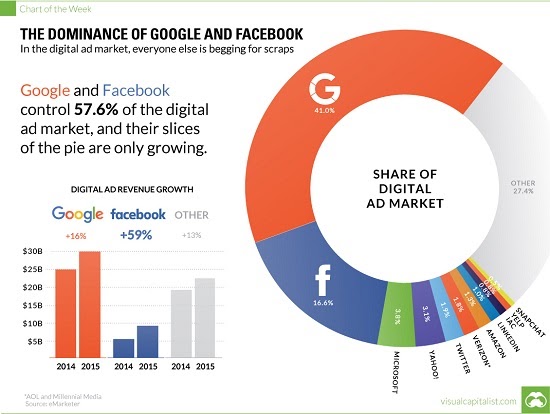
    3. The majority of advert revenues now flow into the coffers of the quasi-monopolies Facebook and Google.
    4. Publishers are increasingly dependent on these quasi-monopolies for readers and visibility: any publisher who runs afoul of #Facebook and #Google and is sent to Digital Siberia effectively vanishes.

    #marginalisation #dissidence #internet

    Via naked capitalism

    Kassem @kassem CC BY-NC-SA
    • @kassem
      Kassem @kassem CC BY-NC-SA 20/11/2017

      J’ai effacé le message qui ne contenait que l’infographie

      Kassem @kassem CC BY-NC-SA
    Écrire un commentaire
  • @unagi
    unagi @unagi CC BY-NC 8/11/2017

    Green’s Dictionary of Slang
    Five hundred years of the vulgar tongue

    ▻https://greensdictofslang.com
    ▻https://lh4.googleusercontent.com/proxy/QQ2k4Nx51TCPQrkPXinIs7Et3BHCie-c51XsXkZzO_eNCC-OitruFZYjT1TNn

    Green’s Dictionary of Slang is the largest historical dictionary of English slang. Written by Jonathon Green over 17 years from 1993, it reached the printed page in 2010 in a three-volume set containing nearly 100,000 entries supported by over 400,000 citations from c. ad 1000 to the present day. The main focus of the dictionary is the coverage of over 500 years of slang from c. 1500 onwards.
    The printed version of the dictionary received the Dartmouth Medal for outstanding works of reference from the American Library Association in 2012; fellow recipients include the Dictionary of American Regional English, the Oxford Dictionary of National Biography, and the New Grove Dictionary of Music and Musicians. It has been hailed by the American New York Times as ‘the pièce de résistance of English slang studies’ and by the British Sunday Times as ‘a stupendous achievement, in range, meticulous scholarship, and not least entertainment value’.
    On this website the dictionary is now available in updated online form for the first time, complete with advanced search tools enabling search by definition and history, and an expanded bibliography of slang sources from the early modern period to the present day. Since the print edition, nearly 60,000 quotations have been added, supporting 5,000 new senses in 2,500 new entries and sub-entries, of which around half are new slang terms from the last five years.

    unagi @unagi CC BY-NC
    Écrire un commentaire
  • @nidal
    Nidal @nidal CC BY 10/08/2016
    @gonzo

    @gonzo, on me dit qu’ici, quand on a perdu ses lunettes, il faut prier Saint Cucufato : on fait un nœud à une serviette en disant « Saint Cucufato, Saint Cucufato, on ne te dénouera pas les couilles si tu ne me dis pas où sont mes lunettes. »

    (Et ça marche, j’ai retrouvé mes lunettes.)

    Nidal @nidal CC BY
    • @simplicissimus
      Simplicissimus @simplicissimus 10/08/2016

      San Cucufato, San Cucufato
      con este pañuelo los huevos te ato
      y hasta que mis gafas aparezcan
      no te los desato

      Simplicissimus @simplicissimus
    • @simplicissimus
      Simplicissimus @simplicissimus 10/08/2016

      Version française (moins les œufs…)

      Saint Antoine de Padoue
      Qui retrouvez toujours tout
      Dans les coins ou dans les trous
      Rendez c’qui n’est pas à vous

      Simplicissimus @simplicissimus
    • @gonzo
      gonzo @gonzo CC BY-NC 10/08/2016

      ▻https://es.wikipedia.org/wiki/Cucufato

      La leyenda dice que primero le abrieron el vientre y le sacaron las tripas, pero que él se las metió de nuevo dentro del abdomen que se cosió con un cordón. Luego el emperador Galerio lo condenó a la hoguera, pero el soplo de Dios apagó las llamas. Después lo encerraron en una mazmorra, pero los carceleros se convirtieron al cristianismo. Finalmente la leyenda dice que Dios permitió a San Cucufato -cuyo deseo era acceder al cielo por la vía del martirio- que lo degollasen.

      ▻https://lh4.googleusercontent.com/proxy/39VU8sDPsaA8tqr7K9pOrrWjWsoLERrjB3lX_hCaW6K0PeyUKcLzS9H0K6Mgw

      gonzo @gonzo CC BY-NC
    Écrire un commentaire