company:nasa’s jet propulsion laboratory

  • The most expensive hyphen in history
    https://www.fastcompany.com/90365077/the-most-expensive-hyphen-in-history
    Bugs, bugs bugs

    By Charles Fishman4 minute Read

    This is the 18th in an exclusive series of 50 articles, one published each day until July 20, exploring the 50th anniversary of the first-ever Moon landing. You can check out 50 Days to the Moon here every day.

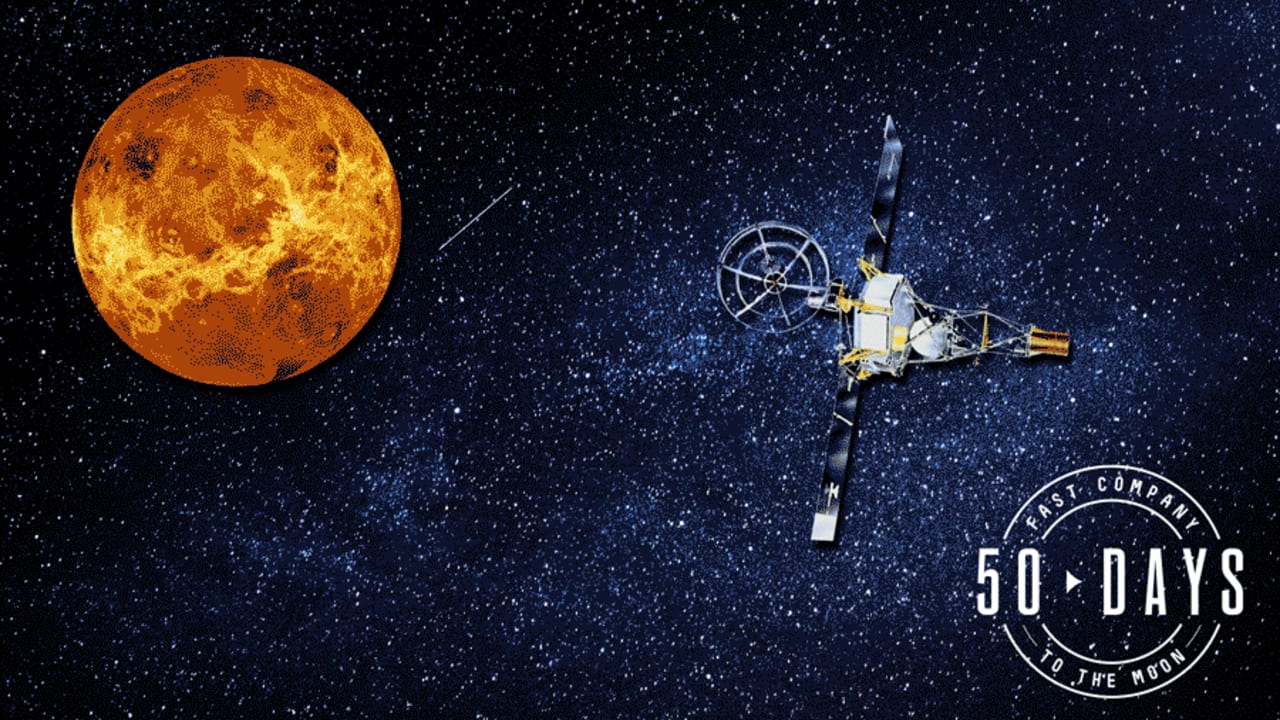
    In the dark on Sunday morning, July 22, 1962, NASA launched the first-ever U.S. interplanetary space probe: Mariner 1, headed for Venus, Earth’s neighbor closer to the Sun.

    Mariner 1 was launched atop a 103-foot-tall Atlas-Agena rocket at 5:21 a.m. EDT. For 3 minutes and 32 seconds, it rose perfectly, accelerating to the edge of space, nearly 100 miles up.

    But at that moment, Mariner 1 started to veer in odd, unplanned ways, first aiming northwest, then pointing nose down. The rocket was out of control and headed for the shipping lanes of the North Atlantic. Four minutes and 50 seconds into flight, a range safety officer at Cape Canaveral—in an effort to prevent the rocket from hitting people or land—flipped two switches, and explosives in the Atlas blew the rocket apart in a spectacular cascade of fireworks visible back in Florida.

    The Mariner 1 probe itself was blown free of the debris, and its radio transponder continued to ping flight control for another 67 seconds, until it hit the Atlantic Ocean.

    This was the third failed probe in 1962 alone; NASA had also launched two failed probes to the Moon. But the disappointment was softened by the fact that a second, identical Mariner spacecraft (along with an identical Atlas-Agena rocket) were already in hangers at the Cape, standing by. Mariner 2 was launched successfully a month later and reached Venus on December 14, 1962, where it discovered that the temperature was 797º F and that the planet rotated in the opposite direction of Earth and Mars. The Sun on Venus rises in the West.

    It was possible to launch Mariner 1’s twin just 36 days after the disaster because it took scientists at NASA’s Jet Propulsion Laboratory only five days to figure out what had gone wrong. In handwritten computer coding instructions, in dozens and dozens of lines of flight guidance equations, a single letter had been written incorrectly, probably forgetfully.

    In a critical spot, the equations contained an “R” symbol (for “radius”). The “R” was supposed to have a bar over it, indicating a “smoothing” function; the line told the guidance computer to average the data it was receiving and to ignore what was likely to be spurious data. But as written and then coded onto punch cards and into the guidance computer, the “R” didn’t have a bar over it. The “R-bar” became simply “R.”

    As it happened, on launch, Mariner 1 briefly lost guidance-lock with the ground, which was not uncommon. The rocket was supposed to follow its course until guidance-lock was re-achieved, unless it received instructions from the ground computer. But without the R-bar, the ground computer got confused about Mariner 1’s performance, thought it was off course, and started sending signals to the rocket to “correct” its course, instructions that weren’t necessary—and weren’t correct.

    Therefore “phantom erratic behavior” became “actual erratic behavior,” as one analyst wrote. In the minute or so that controllers waited, the rocket and the guidance computer on the ground were never able to get themselves sorted out, because the “averaging” function that would have kept the rocket on course wasn’t programmed into the computer. And so the range safety officer did his job.

    A single handwritten line, the length of a hyphen, doomed the most elaborate spaceship the U.S. had until then designed, along with its launch rocket. Or rather, the absence of that bar doomed it. The error cost $18.5 million ($156 million today).

    In the popular press, for simplicity, the missing bar became a hyphen. The New York Times front-page headline was “For Want of a Hyphen Venus Rocket Is Lost.” The Los Angeles Times headline: “‘Hyphen’ Blows Up Rocket.” The science fiction writer Arthur C. Clarke, in his 1968 book The Promise of Space, called it “the most expensive hyphen in history.”

    For NASA’s computer programmers, it was a lesson in care, caution, and testing that ended up steeped into their bones. During 11 Apollo missions, more than 100 days total of spaceflight, the Apollo flight computers performed without a single fault.

    But what happened to Mariner 1 was, in fact, an arresting vulnerability of the new Space Age. A single missing bolt in a B-52 nuclear bomber wasn’t going to bring down the plane, but a single inattentive moment in computer programming—of the sort anyone can imagine having—could have a cascade of consequences.

    George Mueller was NASA’s associate administrator for manned spaceflight from 1963 to 1969, the most critical period for Apollo’s development. Just before that, Mueller had been an executive at Space Technology Laboratories, which had responsibility for writing the guidance equations for Mariner 1, including the equation with the missing bar.

    During his years at NASA, Mueller kept a reminder of the importance of even the smallest elements of spaceflight on the wall behind his desk: a framed image of a hyphen.

    #Histoire_numerique #Nasa #Mariner

  • The Fly in the Primordial Soup - Issue 50: Emergence
    http://nautil.us/issue/50/emergence/the-fly-in-the-primordial-soup-rp

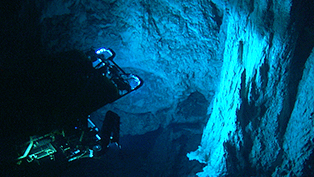
    I arrived on the second day of creation. Laurie Barge had invited me to spend the day in her lab, modeling the origin of life. She is a research scientist at NASA’s Jet Propulsion Laboratory in Pasadena and, with her colleague, the pioneering geologist Michael J. Russell, a member of the NASA Astrobiology Institute. The task was to make a miniature hydrothermal vent under conditions that simulated the primeval ocean, 4 billion years ago. Such vents are at the heart of a scientific creation story so counterintuitive it could hardly be true, yet so logical that in broad strokes it almost must be. On the first day, Barge and her students had created the oceans. They started with distilled water and bubbled nitrogen through it to displace oxygen gas, which had not been present on the early (...)

  • I’ll never bring my phone on an international flight again. Neither should you
    https://medium.freecodecamp.com/ill-never-bring-my-phone-on-an-international-flight-again-neith

    On January 30th, Sidd Bikkannavar, a US-born scientist at NASA’s Jet Propulsion Laboratory flew back to Houston, Texas from Santiago, Chile.

    On his way through through the airport, Customs and Border Patrol agents pulled him aside. They searched him, then detained him in a room with a bunch of other people sleeping in cots. They eventually returned and said they’d release him if he told them the password to unlock his phone.

    #teléphone #privacy #douanes #police #frontières

  • The Rituals That Ward Off Bad Luck Aren’t Arbitrary - Facts So Romantic
    http://nautil.us/blog/the-rituals-that-ward-off-bad-luck-arent-arbitrary

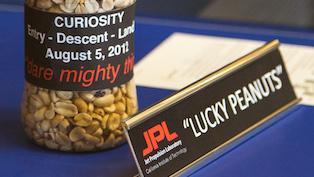
    Launch Ritual: NASA’s Jet Propulsion Laboratory has a tradition of eating peanuts during big, risky spacecraft events, such as Mars rover landings. Photograph by Kevin Baird / FlickrFor the last two years of his baseball career, George Gmelch didn’t eat pancakes. Playing in the Detroit Tigers minor league system in the 1960s, two disappointing post-pancake games were enough to make him swear off hot cakes altogether. That wasn’t the only superstition he adopted. “Somehow, I decided that holding the ball during the national anthem gave me bad luck,” recalls Gmelch, who was a first baseman. “From that point on, for the rest of that season and maybe beyond that, when the ball came to me I would quickly toss it so that I wouldn’t have it in my glove or my hand.” Gmelch, now an anthropologist at (...)

  • The Fly in the Primordial Soup - Issue 37: Currents
    http://nautil.us/issue/37/currents/the-fly-in-the-primordial-soup

    I arrived on the second day of creation. Laurie Barge had invited me to spend the day in her lab, modeling the origin of life. She is a research scientist at NASA’s Jet Propulsion Laboratory in Pasadena and, with her lab chief, the pioneering geologist Michael J. Russell, a member of the National Astrobiology Institute. My task was to make a miniature hydrothermal vent under conditions that simulated the primeval ocean, 4 billion years ago. Such vents are at the heart of a scientific creation story so counterintuitive it could hardly be true, yet so logical that in broad strokes it almost must be. On the first day, Barge and her students had created the oceans. They started with distilled water and bubbled nitrogen through it to displace oxygen gas, which had not been present on the (...)

  • What It’s Like to Be a Female Gravity Wave Hunter - Facts So Romantic
    http://nautil.us/blog/what-its-like-to-be-a-female-gravity-wave-hunter

    Chiara Mingarelli can count herself as a successful scientist. She is a Marie Curie Fellow at Caltech, and a former visiting scholar at NASA’s Jet Propulsion Laboratory. Her area of research, hunting for gravitational waves using distant stars, is at one of the forefronts of cosmology. Her scientific work has been cited in nearly 1,000 academic papers, and she is involved in a variety of public outreach efforts. All of this has taken a good amount of effort. But, in this video interview, Mingarelli makes clear that some of the biggest challenges she’s faced in her career have stemmed from the simple fact that she’s a woman in a male-dominated field. They range from dealing with unwanted advances to the fact that male scientists, due to an implicit bias, are taken more seriously—a bias (...)

  • Beagle-2 lander found on Mars / Mars Express / Space Science / Our Activities / ESA
    http://www.esa.int/Our_Activities/Space_Science/Mars_Express/Beagle-2_lander_found_on_Mars

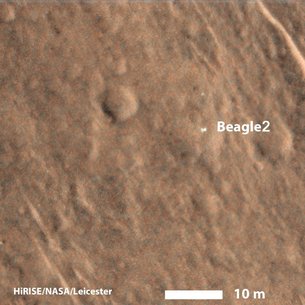
    The UK-led Beagle-2 Mars lander, which hitched a ride on ESA’s Mars Express mission and was lost on Mars since 2003, has been found in images taken by a NASA orbiter at the Red Planet.

    Beagle-2 was released from its mother craft on 19 December 2003 and was due to land six days later. But nothing was heard from the lander after its scheduled touchdown, and searches by Mars Express and NASA’s Mars Odyssey mission were fruitless.

    Now, over a decade later, the lander has been identified in images taken by the high-resolution camera on NASA’s Mars Reconnaissance Orbiter. The lander is seen partially deployed on the surface, showing that the entry, descent and landing sequence worked and it did indeed successfully land on Mars on Christmas Day 2003.
    (…)
    The small size of Beagle-2 – less than 2 m across when fully deployed – meant this was a painstaking endeavour, right at the limit of the resolution of cameras in orbit around Mars.

    After the identification of potential counterparts to Beagle-2 in the expected landing of Isidis Planitia, a large impact basin close the martian equator, further images were obtained and analysed by the camera team, the Beagle-2 team and NASA’s Jet Propulsion Laboratory.

    The images show the lander in what appears to be a partially deployed configuration, with only one, two or at most three of the four solar panels open, and with the main parachute and what is thought to be the rear cover with its pilot/drogue parachute still attached close by.