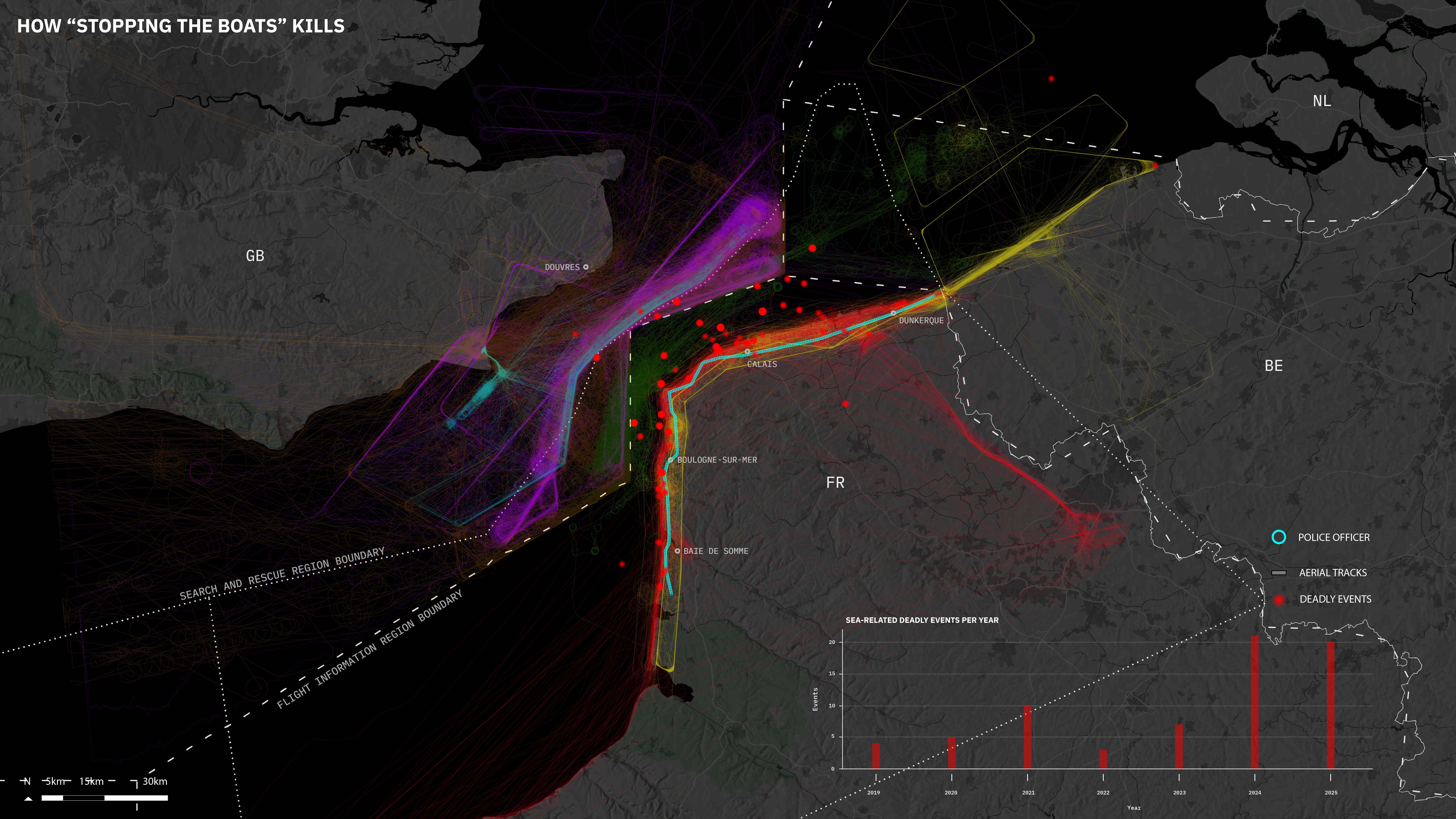
• How ‘stopping the boats’ kills: A digital counter-forensic investigation of the human cost of the UK’s externalised border in the Channel

    The report demonstrates how these border policing practices, which authorities claim ‘save lives’ by preventing crossing attempts, have amplified the risks facing people compelled to make illegalised journeys to reach the UK. It also shows that British and French officials knew, or ought to have known, the deadly consequences of their policies.

    Decades of increased security and policing at the UK’s externalised border have not ended illegalised journeys and, despite being a political priority since 2019, small boat journeys have not stopped. As this report shows, greater enforcement has not only failed to achieve its stated objective, but led to more deaths in the Channel. Whether this reality can be recognised by policy-makers and prompt a fundamental reassessment of UK border externalisation remains an open question. For now, as the next phase of bilateral cooperation for 2026-29 is set to begin, the UK government appears determined to continue using large payments to leverage the French to adopt ever riskier tactics to police its border, regardless of the human costs.

    The entangled effects of three border policing practices behind these mechanisms are examined in detail in the report:

    1. ‘Upstream’ anti-smuggling measures and supply-chain disruption: International cooperation has reduced the availability of dinghies and other materials needed for small boat journeys, leading facilitators to source larger and lower quality inflatables which are increasingly overcrowded. Anti-smuggling measures have also reduced the opportunities for under-resourced groups to organise their own journeys—strengthening the hold of professionalised smugglers on the market—and fuelled competition for places onboard.
    2. Expanded aerial surveillance: Although framed primarily in terms of supporting search and rescue operations, analysis of flight tracks and state documentation showed most aerial surveillance of the Channel is focused on coordinating police patrols on the ground, and gathering data and intelligence for prosecutions. By enabling faster detection and police intervention, surveillance has contributed to overcrowding and the advent of new dangerous tactics for small boat departures.
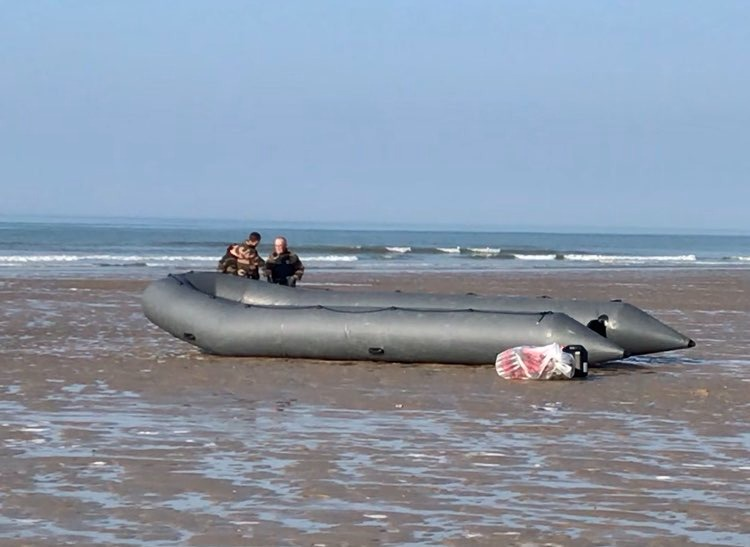
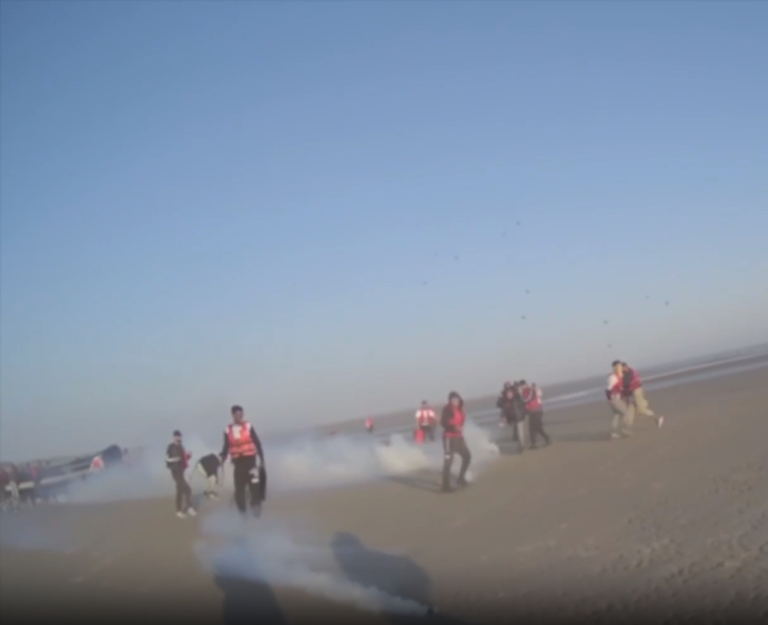
    3. Increased police activity on the French coast: The ever larger numbers of police on the French coast, funded by the UK, has altered the geography of small boat departures, and driven the adoption of the ‘taxi boats’ which present greater risks for travellers who must board dinghies already afloat. Police’s violent tactics, especially the use of riot control weapons such as tear-gas, stun grenades, and rubber bullets, have also directly endangered travellers and led to panics, crushes, and people drowning in shallow waters.

    https://www.borderforensics.org/investigations/channel
    #Manche #UK #Angleterre #France #migrations #réfugiés #décès #mourir_aux_frontières #Border_Forensics #stop_the_boat

  • L’#extrême_droite britannique multiplie les #raids racistes sur le littoral français

    Les attaques de militants de l’#UKIP visant des exilés se sont succédé ces derniers mois autour de #Dunkerque, s’ajoutant à de nombreuses pressions. Des associatifs dénoncent le laisser-faire des autorités et craignent l’escalade.

    La #vidéo ne dure qu’une quarantaine de secondes. Sur les premières images, on distingue une douzaine de personnes, de nuit, portant une banderole floquée du message « Islamist invaders not welcome in Britain » (« Les envahisseurs islamistes ne sont pas les bienvenus en Grande-Bretagne »). Dans la séquence suivante, au moins sept hommes, casquettes noires vissées sur le crâne, marchent à vive allure dans les rues de #Grand-Fort-Philippe, en périphérie de Dunkerque, dans le Nord.

    L’un d’entre eux porte un drapeau de l’Angleterre, un autre, celui de l’Union Jack. On les voit, munis de puissantes lampes torches, se rapprocher puis s’en prendre à un groupe d’une vingtaine de personnes exilées, assises et assoupies sur le trottoir. Ces dernières sont réveillées dans leur sommeil, la plupart semblent stupéfaites. La bande-son de la vidéo se résume à un slogan, qui tourne en boucle : « You shall not pass ! » (« Vous ne passerez pas ! »)

    Cette vidéo, rendue publique le 30 septembre sur les réseaux sociaux du parti d’extrême droite britannique UKIP (#United_Kingdom_Independence_Party), a été tournée dans la nuit du 9 au 10 septembre. « Ce soir-là, les militants du UKIP ont insulté les exilés, ils ont également volé les gilets de sauvetage de certains et sont même allés jusqu’à frapper plusieurs personnes, dont une femme », détaille Salomé Bahri, coordinatrice de l’association Utopia 56.

    Au cours de leur maraude nocturne, les bénévoles de cette association ont rencontré les exilés victimes de cette #agression et ont recueilli leurs témoignages. « Ils ont vraiment eu peur, certains ont cru qu’ils allaient mourir », confie Salomé Bahri.

    À leur tête, un leader raciste et masculiniste

    Cette agression xénophobe, préméditée et mise en scène, perpétrée par des militants d’extrême droite britanniques sur le littoral nord de la France n’est pas un événement isolé. Ces dernières semaines, les actes d’#intimidation ou de #violence à l’encontre de personnes exilées et de leurs soutiens se sont succédé à Dunkerque et #Calais. Le 7 novembre au matin, encore à Grand-Fort-Philippe, une petite dizaine de militants britanniques d’extrême droite du mouvement « Raise The Colours » (« hissez les couleurs ») se filme au bord du fleuve Aa en exhibant un immense drapeau de l’Union Jack tout en proférant leur haine des personnes migrantes.

    Alors que le #Royaume-Uni est confronté depuis plusieurs mois à d’importantes mobilisations anti-immigrés, les plages de la #Côte_d’Opale sont devenues le nouveau terrain de jeu de l’extrême droite britannique, suscitant peu de réactions des pouvoirs publics.

    « Il y a toujours eu cette menace de l’extrême droite sur le littoral, mais cela s’est nettement accéléré ces derniers temps », note Salomé Bahri. Début juin, les militants de l’UKIP sont restés plusieurs jours à Calais et ont multiplié les intimidations envers les exilés et les personnes solidaires, postant systématiquement ensuite leurs vidéos sur les réseaux. À leur tête, une des figures du parti, #Nick_Tenconi, ouvertement islamophobe, masculiniste et anti-LGBT+, promeut l’expulsion en masse des immigrés présents sur le territoire britannique.

    Les humanitaires dépeints comme des « terroristes de l’intérieur »

    « Nick Tenconi et son groupe sont restés entre une heure trente et deux heures devant l’accueil de jour à nous menacer et à nous insulter, nous traitant de “terroristes de l’intérieur” et de “méchants petits communistes” », se remémore Léa Biteau, du Secours catholique. Les images publiées sur X montrent le leader de l’UKIP, dans une posture d’intimidation, accuser les équipes du Secours catholique « d’être complices de l’envoi de migrants illégaux vers le Royaume-Uni ».

    Dans une autre vidéo postée le 7 juin, Nick Tenconi, mégaphone en main, hurle sur un groupe d’exilés attendant le début d’une distribution alimentaire : « Vous êtes tous filmés ! Nous allons transmettre ces images aux services de renseignement britanniques ! Vous n’êtes pas les bienvenus en Grande-Bretagne, faites-le savoir à vos amis et vos familles ! »

    Le parti d’extrême droite a lancé pendant l’été une cagnotte en ligne destinée à « maintenir une présence dans le nord de la France » de ses militants « afin de localiser et stopper les bateaux ». Plus de 21 000 euros ont pour l’heure été récoltés par la plateforme GiveSendGo, déjà épinglée pour avoir hébergé des appels à dons en faveur de militants suprémacistes et #néo-nazis. Ces raids de militants de l’UKIP ne constituent toutefois pas la seule menace à laquelle ont dû faire face les personnes exilées et leurs soutiens ces derniers mois sur le Calaisis et la Côte d’Opale.

    Croix gammée, doigts d’honneur et excréments

    « Ces dernières semaines, nous avons constaté que certaines cuves d’eau avaient été sabotées : des robinets ont été volés, l’#eau a été polluée par du produit vaisselle ou encore des personnes ont volontairement déversé le contenu », indique Lachlan Macrae de Calais Food Collective.

    Ce groupe de solidaires installe des citernes d’eau sur les camps de fortune où survivent les exilés, palliant ainsi les carences assumées de l’État français en matière d’accès à l’eau, un droit pourtant fondamental. « Dernièrement, une des citernes a même été taguée d’une #croix_gammée », ajoute le militant.

    « Le 26 septembre, nous avons découvert un sac d’excréments à l’entrée de l’entrepôt », détaille Jade Lamalchi de l’Auberge des migrants, en reprenant un document sur lequel elle consigne, avec d’autres solidaires, les #menaces et intimidations auxquelles ils et elles font face. La responsable associative évoque également le cas récent de filatures, par un couple dans un véhicule, au cours desquelles les personnes solidaires ont été prises en photo. « On se demande si c’est une manière de préparer de futures actions », s’inquiète la jeune femme.

    « Il y a un climat ambiant qui favorise ce type d’agissements isolés, cela décomplexe le passage à l’acte », estime Léa Biteau du Secours catholique, également confrontée à « des actes de #vandalisme, tels que des dépôts d’excréments ou de la glue dans les serrures des locaux ».

    La salariée associative n’impute toutefois pas directement ces actes à l’extrême droite organisée, mais souligne que ces actions, qui peuvent venir d’habitants, participent à « décourager les initiatives solidaires ». Un constat partagé par Salomé Bahri qui observe régulièrement des riverains du camp de #Loon-Plage, près de Dunkerque, « faire des doigts d’honneur ou insulter des bénévoles d’Utopia et des personnes exilées ».

    Les groupuscules néo-fascistes français en embuscade

    « À Londres comme à Paris, les responsables politiques usent d’un discours politique toujours plus dur et déshumanisant à l’encontre des personnes exilées, cela normalise ces idées et ce type de comportements, s’alarme Lachlan Macrae, ce n’est pas surprenant ensuite de voir ces agitateurs fascistes se sentir encouragés pour agir ». Le militant de Calais Food Collective rappelle que Nick Tenconi et le parti UKIP étaient aux avant-postes du mouvement anti-immigrés qui s’est répandu cet été outre-Manche.

    Dans de nombreuses villes du Royaume-Uni, des rassemblements hostiles, attisés sur les réseaux sociaux par l’extrême droite, ont eu lieu devant les hôtels hébergeant les demandeurs d’asile, avec comme slogan principal « Send them home, protect our kids ! » (« Renvoyez-les chez eux, protégez nos enfants ! ») « Après ça, pour Nick Tenconi et l’UKIP galvanisés par ces mobilisations, la prochaine étape était de venir à Calais », observe Lachlan Macrae.

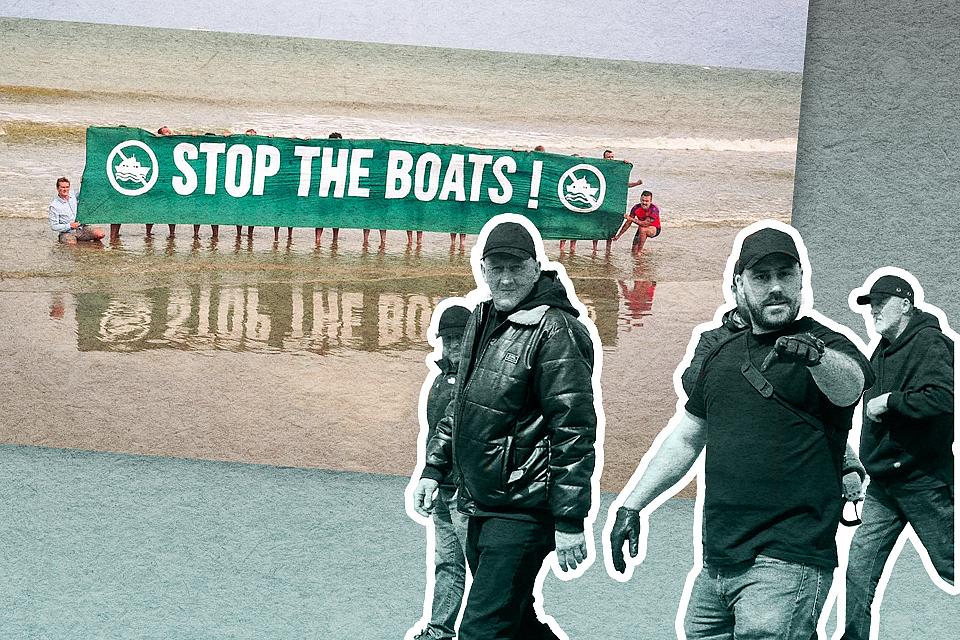
    « On craint que les actions menées par UKIP sur le #littoral ne donnent des idées à des groupes d’extrême droite locaux », analyse Salomé Bahri. Le 1er septembre, les groupuscules #identitaires #Nouvelle_droite, basé à Lille, et #Les_Normaux, venus de Rouen, se sont retrouvés pour une action de communication sur une plage proche du #cap_Gris-Nez. Les militants d’extrême droite se sont pris en photo arborant des banderoles « #Stop_the_boats » et en soutien à #Tommy_Robinson, un ancien hooligan à l’origine de l’#English_Defence_League, un groupuscule nationaliste et islamophobe. L’activiste d’extrême droite, très influent sur les réseaux sociaux, est à l’origine de la manifestation anti-immigrés qui a rassemblé 100 000 personnes au cœur de Londres le 13 septembre dernier.

    Les autorités très lentes à réagir

    Le raid de l’UKIP de début septembre a donné lieu à un signalement d’Utopia 56 auprès du parquet de Dunkerque le 18 septembre. Ce n’est toutefois qu’après la publication de la vidéo sur X de l’agression perpétrée contre des exilés que la procureure de Dunkerque a ouvert une enquête. Contacté par Basta !, le parquet de Dunkerque n’a pas partagé de nouveaux éléments relatifs à cette affaire. Plusieurs associatifs restent toutefois sceptiques quant à la capacité de réaction des autorités françaises, les mêmes qui, par ailleurs, organisent des expulsions de campements toutes les 48 heures à Calais ou cautionnent les interceptions violentes de zodiacs sur les plages du littoral.

    « Une ligne rouge a été dépassée : les pouvoirs publics laissent faire les propos et actes racistes et nous, en tant qu’associatifs, on se retrouve à devoir s’organiser, faire de la veille sur les réseaux sociaux afin de prévenir de futurs agissements de l’extrême droite », estime Jade Lamalchi, de l’Auberge des migrants, qui a de son côté signalé les cas de filatures auprès de la sous-préfecture de Calais, sans suite pour le moment. « On essaie désormais d’anticiper de nouvelles menaces de l’extrême droite, abonde Salomé Bahri. On prévient les bénévoles et les personnes exilés via des stories WhatsApp et on adapte nos missions sur le terrain. »

    Fin septembre, dans un courrier adressé au Premier ministre britannique, Keir Starmer, un collectif de 150 organisations de la société civile britannique appelle à une réponse forte des autorités face aux intimidations et menaces grandissantes de l’extrême droite auxquelles elles sont confrontées.

    Salomé Bahri conclut : « En #Angleterre comme en #France, cette volonté de beaucoup de responsables politiques de ne pas pointer du doigt les discours et les actes racistes est un terreau fertile, c’est une incitation à continuer et aller plus loin. »

    https://basta.media/extreme-droite-britannique-multiplie-les-raids-racistes-sur-littoral-franca
    #racisme #UK #Manche

  • International social media campaign launched to stop the boats

    Today marks the launch of the latest phase of the government’s global campaign to warn migrants of the consequences of entering the UK illegally.

    Every year, thousands of people are sold lies by organised criminal gangs who put profit before human life, smuggling people to the UK across one of the busiest shipping lanes in the world, the English Channel.

    The Home Secretary has launched a new campaign that will be rolled out in Vietnam, following successful social media activity in Albania last year which contributed to a 90% reduction in Albanian small boat arrivals.

    Using real testimonies from those who regret coming to the UK illegally, the adverts highlight the risks and consequences people face if they turn to criminal gangs and attempt the dangerous journey.

    A migrant, referred to as K, shares his reality of sleeping in a camp in Calais for 5 nights under the supervision of armed guards, before taking the long journey across the Channel to the UK. He says: “Never again would I risk my life in a small boat, even if you bribed me.”

    An increasing proportion of small boat migrants are Vietnamese, and they are 1 of the top 10 nationalities for migrants crossing the Channel illegally.

    The latest phase of the campaign, which will begin today (Monday 25 March), will harness social media adverts on Facebook and YouTube to directly target people who may be considering making dangerous and illegal journeys to the UK.

    The social media posts emphasise the consequences of travelling to the UK illegally and the dangers people can expect to face, as well as set out the risks of being indebted to and exploited by the people smuggling gangs who profit from facilitating small boat crossings.

    Home Secretary James Cleverly said:

    This is a powerful campaign which demonstrates first-hand that life for people arriving here illegally is a far cry from the lies they have been sold by the gangs on the other side of the Channel.

    Last year, similar work contributed to a 90% reduction in small boat arrivals from Albania, and overall numbers are down by a third, but there is more to do.

    Expanding our campaign to Vietnam, another key partner in our work to tackle illegal migration, will help us to save more lives and dent the business model of the criminals who profit from this vile trade.

    The campaign warns prospective migrants of the reality of living in the UK illegally with no right to be in the UK and no access to public services or funding.

    It includes testimonies from Home Office Immigration Enforcement and Border Force officers, who all too often encounter illegal migrants who have been sold into modern slavery or illegal working by their smugglers.

    Illegal migrants can be forced to live in inhumane, cramped and hazardous conditions by criminal gangs, with no access to basic hygiene, healthcare or legal employment.

    The campaign’s social media adverts direct users to a new website with additional video content from Immigration Enforcement and Border Force officers who describe some of the shocking cases they’ve encountered and their experiences of rescuing small boat migrants from life-threatening danger in the Channel.

    This stage of the campaign follows successful social media activity by the UK government in Albania, France and Belgium, and is the latest step in the UK’s efforts to work jointly with countries across the world to tackle the global migration crisis.

    Similar campaigns are also being considered for other priority countries.

    UK and Vietnamese authorities already work closely to prevent illegal journeys to the UK and remove those with no right to be here.

    Senior officials from the UK and Vietnam are due to meet in London on 17 April to discuss working in even closer partnership on migration issues.

    https://www.gov.uk/government/news/international-social-media-campaign-launched-to-stop-the-boats
    #réseaux_sociaux #propagande #UK #Angleterre #stop_the_boats #Manche #La_Manche #vidéo

    –-

    ajouté à la métaliste de #campagnes de #dissuasion à l’#émigration:
    https://seenthis.net/messages/763551

    • Facts on UK immigration. Trying to enter the UK illegally could cost you everything.

      People smugglers will tell you that travelling illegally to the UK will be safe and easy and that you’ll be able to build a good life here. Nothing could be further from the truth.

      Travelling to the UK illegally will cost you a lot of money. It could even cost you your life. Men, women and children have died trying to get to the UK in small boats or hidden in lorries.

      Go to the facts:
      UK immigration rules mean you could be detained and removed if you come to the UK illegally. Here’s what you need to know.

      https://www.youtube.com/watch?v=rC85bBq8MXo

      https://immigrationfacts.campaign.gov.uk

  • #Keir_Starmer can’t stop the migrant boats either

    Small boat crossings seem as intractable for Labour as they were for the Tories.

    Keir Starmer promised voters he would “smash the gangs.” It’s proving easier said than done.

    Less than a year after Conservative Prime Minister Rishi Sunak went down in flames amid a failed promise to “#stop_the_boats,” his Labour successor is grappling with the same highly-visible sign of Britain’s struggle to control its borders.

    The early signs aren’t promising.

    More than 1,100 migrants crossed the English Channel this Saturday, official data show, the highest number recorded in a single day so far in 2025. It brings the provisional total of people making the perilous journey so far this year to 14,811.

    Responding to the numbers, Home Secretary Yvette Cooper has been reaching for some familiar scapegoats: France — and the weather.

    Cooper urged swifter action from French authorities after images of police apparently watching people set off for England without intervening were splashed across British newspapers.

    The Home Office has also made great play of unseasonably good weather, publishing an analysis Tuesday linking it to the increased arrivals.

    It said 60 days this year up to May had been classed as “red days” — labeled as such by the authorities because Channel crossings are more likely due to good weather — compared with just 27 in the same period last year.

    Acknowledging voter anger about the crossings, Starmer insisted the government is “ramping up our efforts to smash the people smuggling gangs at source,” pointing to seized boats and engines, raids on illegal workers, and deportations of people deemed ineligible for asylum.

    But the vanquished Conservatives find themselves enjoying a rare moment of schadenfreude.

    “No one revels in massive numbers of illegal immigrants flooding into the country, but they have done a terrible job,” Shadow Home Secretary Chris Philp said. “Their claim to smash the gangs is in complete tatters.”

    He said Tuesday: “Blaming the weather for the highest ever crossing numbers so far this year is the border security equivalent of a lazy student claiming ‘the dog ate my homework.’”
    Regrets, I have a few

    With right-wing insurgent Nigel Farage snapping at his heels, Starmer may well be contemplating the fate of Tory predecessor Sunak.

    Sunak has since conceded that his embrace of the “stop the boats” slogan — emblazoned on the Downing Street lectern at press conferences and adorning Tory campaign literature — was a mistake. He has conceded that the language was “too stark … too binary.”

    Starmer has similarly made big promises about “restoring order” to the asylum system, deploying his own three-word slogan: “Smash the gangs.”

    Yet there are signs of increased confidence among people smugglers. New data show that boats are arriving in the U.K. more packed with people than ever. Some 33 small boats carrying more than 80 people each arrived in the U.K. last year, compared to just one in the year to April 2023.

    Like Sunak, Starmer is grappling with multiple factors that appear beyond his control — as was starkly illustrated by that syndicated picture of French police watching boatloads of migrants depart.

    Cooper has flourished the new agreements she has reached with French authorities, heralding a new multimillion-pound plan when she became the first home secretary to visit Northern France in almost five years.

    But those making the crossings appear to be exploiting French rules that prevent police from stepping in when they are already in the water.

    The French interior ministry has promised to free police to operate in shallow waters, with its General Secretariat for the Sea having been asked to formulate a proposal by the summer. Cooper told MPs on Monday she is urging France to complete its maritime review of operational tactics and to implement changes “as swiftly as possible.”
    ‘Not acceptable’

    Starmer’s own MPs, many of whom are facing the threat of Nigel Farage’s anti-immigration Reform UK party, are giving ministers the benefit of the doubt — for now.

    Mike Tapp, the Labour MP for the coastal town of Dover, said the numbers were “not acceptable,” but insisted his party’s approach is the right one.

    “We’ve put a lot of effort into fixing what’s going on behind the scenes,” he said. Border security needs to be a “top priority,” he added. While describing the threat from Reform UK as multifaceted, he said the issue of illegal migration is “toxic.”

    A second Labour MP, granted anonymity to speak candidly, wants to see more movement on deterrence.

    “Serious action needs to be taken to activate third country return hubs, and I would argue an updated approach to the [European Convention on Human Rights] needs to be taken,” the MP said.

    Starmer used a trip to Albania last month to say he wants to send refused asylum seekers to return hubs. But the challenge of setting up such schemes was starkly illustrated when the Balkan country ruled out participating in any U.K. plan.

    The government has set out plans to tighten the application of Article 8 of the ECHR, which protects the right to family life and is sometimes invoked by people seeking to remain in the U.K. in immigration cases.

    It also happens to have been a longstanding bugbear of the Conservatives.

    https://www.politico.eu/article/keir-starmer-labour-small-boat-crossings-borders-migration-security-english

    #Manche #traversées #frontières #migrations #migrations #réfugiés #UK #Angleterre #France #smash_the_gangs #dissuasion #Rishi_Sunak #red_days #météo

    • ‘Smash the gangs’: is Labour’s migration policy just a #slogan?

      The UK government is desperate to show it is preventing small boat crossings, but its PR-heavy approach may cause more problems with voters than it solves

      At 5.30am on Tuesday, six immigration enforcement officers and a BBC TV crew gathered in a deserted B&Q car park near Sheffield’s railway station, waiting in the rain for a call from London that would trigger simultaneous arrests of suspected people smugglers in six towns.

      Forty minutes later, the Home Office staff drove in convoy to a nearby residential block (followed by the BBC and the Guardian), made their way up the stairs carrying a red battering ram, ready to smash the suspect’s door down. The equipment wasn’t needed, because the man, barefoot in his checked pyjamas, opened the door and let the team inside. He was given a few moments to get dressed, before being taken silently in handcuffs to the van outside, sweat running down his face.

      Footage of the wider operation was broadcast that night on the BBC and also ITV News at 10, with the security minister, Dan Jarvis, in Cheltenham, wearing a black immigration enforcement stab vest, observing another of the six linked arrests.

      Keir Starmer posted photographs of the raids on X, tersely announcing: “When I said we would smash the people smuggling gangs, I meant it.”

      It was a useful bit of positive messaging, carefully facilitated by the Home Office press office, in a week when ministers have been confronted with uncomfortable evidence that their efforts to prevent the arrival of small boats are flailing just as spectacularly as those of the last government.

      Last Saturday 1,195 people arrived in the UK on 18 small boats, the highest number of arrivals this year, bringing the provisional total for 2025 to 14,811; 42% higher than the same point last year (10,448) and 95% up from the same point in 2023 (7,610). The defence secretary, John Healey, said Britain had “lost control of its borders over the last five years”.

      The Home Office tried to explain the rising numbers by releasing figures showing that the number of “red days” – when weather conditions are favourable for small boats crossings – peaked in 2024-25.

      Conservative opposition MPs accused the government of “blaming the weather”. “Public opinion won’t put up with this,” the Reform UK party leader, Nigel Farage, told GB News, urging the government again to declare a national emergency on illegal immigration.

      With Reform’s popularity ratings surging, the government is under enormous political pressure to show that its much-advertised “smash the gangs” policy is beginning to work. Last week’s raids were flagged as an anti-gangs success, but they turned out to be entirely unconnected to people smuggling in small boats. The six people who were arrested on suspicion of facilitating illegal entry are believed to have helped at least 200 Botswana nationals to travel to the UK by plane on tourist visas, and to have assisted them with false documentation on arrival to claim asylum or to get work in care homes.

      The criminal and financial investigation unit of the Home Office’s immigration enforcement team said this was one of the department’s top 10 immigration investigations, ranked by potential financial gain, number of people involved and risk of harm to victims exploited by the gang.

      Reminding the home secretary that small boat crossings were “one of the biggest challenges your department faces”, the Labour MP Chris Murray asked Yvette Cooper at a home affairs select committee hearing: “Can you tell us how many gangs you’ve smashed so far?”

      The home secretary gave some details about the arrests that morning, prompting Murray to respond with enthusiasm: “When I asked that question, I did not expect you to say you had smashed a gang today!”

      In its manifesto, Labour made it clear that the policy of launching a new border security command with hundreds of new specialist investigators using counter-terror powers was designed to “smash criminal boat gangs”.

      The arrests may have represented a significant development for Home Office staff trying to crack down on the exploitation of vulnerable people trafficked into the UK and criminalised by being forced to work illegally, but packaging this as a major breakthrough in the smash the gangs drive has prompted some raised eyebrows.

      One former Home Office official described taking TV cameras to these arrests as a sleight of hand, a PR exercise designed to detract attention from a small boats policy that he said had so far been a “damp squib”.

      Peter Walsh, a senior researcher with the migration observatory at Oxford University, said the government should be given some leeway because the border security, asylum and immigration bill, which will bring in the much-trailed counter-terror style powers to help identify and control smuggling gangs, has not yet been passed. “Overall it’s too early to evaluate their ‘smash the gangs’ policy, because the main legislative developments are in that bill,” he said. “But it would be difficult to describe whatever has been done operationally so far to disrupt smuggling networks as a success, because the numbers [of small boats] have gone up.”

      Starmer’s catchy “smash the gangs” slogan risks becoming almost as much of a millstone as his predecessor Rishi Sunak’s commitment to “stop the boats”. Sunak’s pledge was described as impossible to achieve the moment he announced it, but he continued to put out videos repeating his promise, and gave immigration control speeches standing behind a lectern with a “stop the boats” logo.

      Labour may eventually be able to show some progress on dismantling organised people smuggling operations by citing rising arrest figures. The Home Office press office said that, from July to November 2024, its immigration enforcement teams have convicted 53 people smugglers, including 23 individuals for piloting small boats, leading to more than 52 years in sentences. But Walsh questioned whether these arrests would have a discernible impact on the number of people crossing the Channel in small boats.

      “It doesn’t require substantial investment in training and skills to have a functional smuggler on the ground, getting boats into the water in Calais, getting people into boats. But it takes a lot of resources to investigate them and bring them to justice. One of the major challenges is that lower-level smugglers can quickly be replaced,” Walsh said, pointing, as a comparison, to the speed with which gangs dealing drugs hire new recruits to replace those arrested.

      “Smuggling networks are adaptable. They’re increasingly well financed and decentralised. Senior figures operate in countries like Afghanistan, where we have minimal or no law enforcement cooperation.”

      Campaigners for an overhaul of the asylum system have been dismayed by Labour’s resolutely tough rhetoric on those crossing the Channel illegally, which often fails to acknowledge that many arrivals are coming from war-torn nations such as Afghanistan, Syria, and Eritrea. This week, a research paper published by Border Criminologies and the Centre for Criminology at the University of Oxford found that hundreds of those imprisoned for arriving in the UK on small boats since 2022 were refugees and victims of trafficking and torture, in breach of international law. It said at least 17 children had been arrested and charged with “facilitation”, for having their hand on the tiller of a dinghy.

      Enver Solomon, the chief executive of the Refugee Council, said the government should “dial down the rhetoric”, and adopt a quieter multi-pronged approach, cooperating more deeply with France and other European countries, undermining the business model of the gangs by creating safe and legal routes for people to apply for asylum in the UK.

      “The more you make announcements on a week-by-week basis, the more you give the impression to the public that you’re going to fix the problem very quickly, so you end up falling into the trap of damaging trust because you’re overpromising and underdelivering,” he said.

      It is a message that Starmer’s comms team has yet to learn. In a second tweet on the subject of smashing the gangs in the space of 24 hours this week, the prime minister announced: “My government is ramping up our efforts to smash the gangs at their source.” Attached was a video montage of boats, barbed wire, police vans and men being arrested, overlaid with the words (in emphatic capitals) “OUR PLAN IS WORKING”.

      https://www.theguardian.com/news/ng-interactive/2025/jun/08/smash-the-gangs-labour-migration-policy-slogan

  • We keep hearing about ‘legitimate concerns’ over immigration. The truth is, there are none

    Immigrants aren’t to blame for a society designed to benefit the richest – and it’s time Labour started telling the public so.

    Immigration is why your wages are low, or why you can’t get a decent job. It’s why you feel anxious about where you live, and why so many feel the pace of change has been too quick. People arriving on small boats are unlikely to subscribe to “British values” and Muslims need to integrate better – “they” aren’t like you.

    These statements make up the longstanding political orthodoxy on immigration. It is a doctrine that refuses to budge but must be tackled head-on – especially if politicians are as outraged by the recent violence as they say they are. The situation demands it. In the past two weeks, hotels housing people seeking asylum were set ablaze in Rotherham and Tamworth, a racial checkpoint was set up in Middlesbrough, and immigration advice centres were placed on a far-right target list.

    Most mainstream politicians agree that these are the actions of an extreme group of racists. But what they miss is the wider political atmosphere that bred such a violent, racist politics – which didn’t just come about because of videos from Stephen Yaxley-Lennon (Tommy Robinson). Westminster must take a long, hard look at itself: what many politicians now condemn, they also had a hand in manufacturing.

    The political “centre” usually reacts to the far right by denouncing its methods and distancing themselves from its coarse, racist rhetoric – but ultimately conceding to its underlying argument. In the days after the general election, Tony Blair advised Keir Starmer that to ward off the far right, he should celebrate what is good about immigration but be sure to “control” it. No matter how respectable and sensible such advice may seem to some within our political classes, the sentiment that “controlling” immigration is a way to appease socially conservative voters is one cause of the corrosiveness.

    Why? Because it implies that a fear of immigration is a legitimate concern, and that reducing immigration is the appropriate method to assuage that fear. It is this sentiment that could shape what comes next. One Conservative commentator has already suggested that reducing immigration is at least part of the picture in responding to the violence. In an acutely uncomfortable TV interview about the riots with the independent MP Zarah Sultana (recently suspended from Labour for voting to scrap the two-child benefit cap), Ed Balls maintained that “if you fail to control and manage immigration properly then things go wrong”.

    Are concerns about immigration “legitimate”? Demonstrably, no. People who arrive in the UK aren’t to blame for an economy designed to benefit the richest while exploiting and abandoning the poorest – immigration is not a significant causal factor of low wages and it’s not why people have insecure jobs. Anti-immigrant feeling isn’t a natural, inevitable reaction to change either. One study found areas with low levels of immigration had some of the highest proportion of leave voters in them – a vote that was at least partly motivated by anti-immigrant concerns. No: it is mainstream politicians and certain sections of the media that summon these feelings. They characterise certain groups of people, usually those who aren’t white (or not-quite-white), as a cultural threat – often targeting Muslims, no matter where they were born.

    The “legitimate concerns” in this case are illegitimate. Admitting this doesn’t mean dismissing what people are saying. Equally, engaging people with these views need not lead to legitimisation. The choice is not ignore or accept. Politics is about persuading people of another way; to think this can’t be done is patronising as well as dangerous.

    The government could change the narrative by making the history of empire and migration a statutory party of the curriculum, and by actively countering racism in the press, among opposition parties and within its own ranks. But it could also use this moment to change people’s material circumstances by getting rid of “hostile environment” policies and providing safe routes of travel (one of the only viable solutions to stop people from having to cross the Channel). It could also make visas cheaper, provide better housing, simplify labyrinthine Home Office processes and end temporary, exploitative visas, giving people the ability to come here on decent terms and stay if they want to.

    This boldness should be extended beyond immigration. The government should tax the richest, invest in public services and do what’s needed for a just transition from fossil fuels. This all matters in and of itself to improve people’s lives, but it is also a necessary response to what has happened. It would be a mistake to characterise the far-right riots as a cry of desperation from the poor: that ignores the racism at play and the many working-class people who are actively opposed to this kind of politics, including minorities. But making the country a fairer place, that is easier and better to live in, would help create a future for people to invest in – an alternative to the xenophobic, inward-looking allure of the right.

    This would, though, require a quite remarkable change of tack. The Labour government is gearing up for cuts, and one of the party’s attack lines in the election was that the ultra-hostile Tories were too liberal on immigration. But they should take notes from the vibrant anti-racist demonstrations, which project a more positive vision of the kind of country we can be.

    The reasons behind the recent violence are many and complex – it cannot be neatly chalked up to the immigration debate alone. But the anti-immigrant sloganeering needs to stop: whether it’s the appeasing of “legitimate concerns”, a commitment to “stop the boats” or the more-acceptable-in-polite-society promises to put “controls on immigration”. They have all played their part in leading us here. If politicians want to understand the far-right violence, this is one of the places they must start.

    https://www.theguardian.com/commentisfree/article/2024/aug/13/immigration-immigrants-society-rich-labour-public

    #problème #migrations #vérité #aucun_problème #réfugiés #idées_reçues #narration #contre-narration #bouc_émissaire #peur #économie #politique #environnement_hostile #hostile_environment #pauvres #riches #racisme #UK #Angleterre #stop_the_boats

    via @freakonometrics

    ping @karine4 @_kg_

    • #Hostile_Environment: How Immigrants Became Scapegoats

      How migrants became the scapegoats of contemporary mainstream politics

      Longlisted for the 2019 Jhalak Prize. From the 1960s the UK’s immigration policy - introduced by both Labour and Tory governments - has been a toxic combination of racism and xenophobia. Maya Goodfellow tracks this history through to the present day, looking at both legislation and rhetoric, to show that distinct forms of racism and dehumanisation have produced a confused and draconian immigration system. She examines the arguments made against immigration in order to dismantle and challenge them. Through interviews with people trying to navigate the system, legal experts, politicians and campaigners, Goodfellow shows the devastating human costs of anti-immigration politics and argues for an alternative.

      This new edition includes an additional chapter, which explores the impacts of the 2019 election and the ongoing immigration enforcement during the coronavirus pandemic.

      https://www.versobooks.com/products/777-hostile-environment

      #livre

  • Sink the Boats

    The UK government is paying France to ‘Stop the Boats’. Now first-time footage reveals French police have violently intercepted dinghies sailing for Britain, risking the lives of people on board

    For decades, people have tried to reach the UK from northern France in order to claim asylum in Britain. With tightened security at French ports making it harder for stowaways, tens of thousands of people have crossed the English Channel in rubber dinghies, prompting the British government to make stopping the boats one of its top priorities.

    Last year, the UK announced that it would allocate nearly £500m to France over three years to prevent boats from leaving its shores.

    The British government has repeatedly pressured France to intercept the boats at sea. France has previously refused on the basis that it would place lives at risk.

    But in collaboration with Le Monde, The Observer and Der Spiegel, Lighthouse Reports can reveal that French police officers have carried out so-called “pullbacks” in the Channel, in moves experts say mirror the deadly and illegal tactics used in the Aegean and the Central Mediterranean by the Greek and Libyan coast guards.

    We’ve established through sources that the patrol boat used by the French police to carry out at least one of these dangerous manoeuvres was funded by the British.

    Meanwhile, over the last two years there has been a sharp increase in the number of drownings in the sea off northern France where most of the pullbacks have taken place.
    METHODS

    We obtained previously unseen footage, leaked documents and witness testimony showing French police have used aggressive methods to intercept migrant vessels at sea, including circling a small boat, causing waves to flood it; ramming into a small boat while threatening passengers with pepper spray; and puncturing boats while they are already at sea, forcing people to swim back to shore. We were able to geolocate the videos to confirm their veracity.

    We showed the videos to a number of maritime experts, UK Border Force officers and French coast guards, who said the tactics would have clearly endangered the lives of those on board and appeared to be illegal. Leaked maritime documents helped us to establish that these types of interceptions at sea are not compatible with French law.

    We then obtained an additional crucial piece of evidence: a complaint filed by a coast guard officer to the prosecutor about an incident in which French police officers had ordered a National Society of Sea Rescues (SNSM) crew to puncture a migrant dinghy that had already set sail despite the risk of drowning being “obvious and imminent”.

    To find out whether these interceptions were happening on a wider scale, we travelled to Northern France to speak to people on the ground trying to reach the UK in boats. A number of people described having their dinghies slashed by police once they had already set sail.

    We were able to link the hundreds of millions of pounds provided by Britain to France with these tactics when sources confirmed that police patrol vessels, including the exact vessel seen in one of the videos, had been bought by the French with funding provided by the British government.

    An analysis of data by charity Alarm Phone meanwhile showed a sharp increase in the number of people known to have drowned within the vicinity of the French coastline, where most of the pullbacks we documented took place – with one in 2022 compared to five already this year.
    STORYLINES

    We met Satinder* from Punjab, a predominantly Sikh region in northern India, in Calais.

    Five days earlier, he and two friends had tried to make it to Britain by boat. The dinghy was overcrowded with around 46 people, mainly Indians and Afghans, on board. “We sailed for around 10 minutes at dawn without a hitch in an overloaded boat,” he said. “Then a boat came. It was a gendarmerie boat, they had uniforms. They said: ‘Stop the boat’.

    “They went around the boat like in a circle and then they stabbed the boat and left. We had to swim for about 10 minutes […] We nearly died.”

    The two friends Satinder was with in the boat gave matching accounts. We spoke to four other people who recounted similar stories on different occasions.

    “It reminds me of the Greek and Turkish coast guards,” said French customs coast guard Rémi Vandeplanque.”And that’s shameful for the French. If the police continue to use such tactics, there is likely to be a death at some point.”

    https://www.lighthousereports.com/investigation/sink-the-boats
    #Manche #La_Manche #migrations #réfugiés #sauvetages #UK #Angleterre #France #stop_the_boats #externalisation #enquête #contre-enquête #pull-backs #financement #mourir_aux_Frontières #morts_aux_frontières

    • Revealed: UK-funded French forces putting migrants’ lives at risk with small-boat tactics

      Exclusive: newly obtained footage and leaked documents show how a ‘mass casualty event’ could arise from aggressive tactics employed by border forces

      French police funded by the UK government have endangered the lives of vulnerable migrants by intercepting small boats in the Channel, using tactics that search and rescue experts say could cause a “mass casualty event”.

      Shocking new evidence obtained by the Observer, Lighthouse Reports, Le Monde and Der Spiegel reveals for the first time that the French maritime police have tried physically to force small boats to turn around – manoeuvres known as “pullbacks” – in an attempt to prevent them reaching British shores.

      Newly obtained footage, leaked documents and witness testimonies show that the French authorities have used aggressive tactics including circling a migrant boat, causing waves to flood the dinghy; ramming into a small boat while threatening passengers with a large tank of pepper spray; and puncturing boats when they are already at sea, forcing migrants to swim back to shore.

      The French authorities have previously refused the UK’s requests for them to carry out interceptions at sea, stating that they contravened international maritime law. But evidence indicates there has been an escalation in the use of these tactics since last summer.

      Rishi Sunak has pledged to “stop the boats” crossing the Channel and has promised hundreds of millions of pounds to France to pay for more surveillance and border guards to prevent people making the journey. Last Wednesday the government’s safety of Rwanda (asylum and immigration) bill suffered several defeats in the House of Lords, delaying the prime minister’s plan to see flights for Kigali take off until after Easter.

      Ministers claim that the bill will act as a deterrent to all those crossing the Channel from northern France to the UK. In the first video obtained and verified for this investigation, a police boat in Dunkirk harbour circles close to a dinghy holding about 25 people, creating a wake that floods the boat.

      The police vessel is seen advancing towards the dinghy at speed, before turning sharply to create waves, circling and coming back again. Migrants are seen wearing foam-packed lifejackets and attempting to bale water out using their shoes.

      Sources confirmed that the police patrol vessel used to carry out the manoeuvre seen in the video was bought by the French authorities with funding provided by the UK government under the “Sandhurst treaty”, a bilateral border security deal signed at the royal military academy in 2018.

      “This is a textbook pushback – exactly the same as we see in Greece,” said one search and rescue expert who was shown the footage. “That one manoeuvre alone could cause a mass casualty event. The water is deep enough to drown in. I’ve seen this in the central Mediterranean many times, but this is the first time I’ve ever seen anything like this happening in the Channel.”

      Previous evidence has shown how the Greek coastguard has forced boats carrying migrants back into Turkish waters in the Aegean Sea, in some cases by manoeuvring around them at high speed to create waves.

      Two senior UK Border Force sources confirmed that the tactic could lead to multiple deaths and injuries. “If the blades [of the French boat] make contact with the vessel, it will slash right through it,” said one operational Border Force official.

      “The other thing is a collision. The weight and the force of that vessel could ride straight over the top of the rib. It would knock the passengers out, knock them unconscious and into the water. It could potentially lead to death. I can’t believe any mariner could condone that.”

      Maritime experts added that they would be “very surprised” if Border Force and HM Coastguard were not aware of these tactics being used, with one adding: “One hundred per cent, someone high up will definitely be aware of this.”

      In a second video, members of the French gendarmerie drive alongside a dinghy in a speedboat about 12 miles from the French coast, threatening to use a large tank of pepper spray against a boat carrying migrants. They then proceed to ram their vessel into the dinghy. “They don’t even know who’s on board – whether there’s someone asthmatic that you’re using pepper spray against, or pregnant women,” said a Border Force official. “That could really harm people.”

      In evidence of a third attempted pullback, a complaint filed by a member of the French customs coastguard to the public prosecutor in Boulogne-sur-Mer alleges that on 11 August 2023 police officers ordered a National Society of Sea Rescues (SNSM) crew to puncture a small boat that had already set sail. In an email seen by this investigation, the complainant, Rémi Vandeplanque, states that the SNSM crew “obviously refused” to do this, adding that the risk of drowning if they had done so was “obvious and imminent”.

      Testimony from several sources who boarded small boats bound for the UK supports the claims that French police have used such tactics. “There were four of them [French gendarmes] on the boat,” said one man, who was from India. “They went round the boat in a circle and then they stabbed the boat and left. We had to swim for about 10 minutes … We nearly died.” On 9 February 2024, the man lodged a complaint with the French human rights ombudsman. The incident is under investigation.

      Sources within France’s interior ministry have described the UK government’s “enormous pressure on a daily basis” for the French maritime police to prevent small boat departures, with one French civil servant describing the pressure as “intense” and “nonstop”.

      Another senior civil servant, who was in post until the end of 2020, added: “As far as the British were concerned, the boats had to be caught at sea. They sometimes insisted on it.”

      In September last year, then immigration minister Robert Jenrick said in the House of Commons that “there is clearly more that we need the French to do for us”, pointing to a recent trip to Belgium, where he said the authorities had “been willing to intercept in the water small boats leaving its shores”. He added: “That has proven decisive. Small boats from Belgian waters are now extremely rare, so that is an approach that we encourage the French to follow.”

      In August 2021, during a visit to the Greek island of Samos, then home secretary Priti Patel went out on patrol with the Greek coastguard, which is known for its use of aggressive pushbacks in the Aegean.

      “She came back invigorated,” said a Home Office source with knowledge of the trip. “They were very aggressive, had a good success rate of detection and were swift in how they processed them [asylum seekers]. She liked their posturing of ‘protecting borders’ and working with the military, though there was recognition that a lot of this wouldn’t be lawful in the UK.”

      Britain has allocated more than £700m to France to prevent irregular migration since 2014.

      At a summit in March 2023, Sunak announced that Britain would give France £500m over three years to fund additional border guards and a new detention facility, as well as video surveillance cameras, drones and night-vision binoculars, among other equipment.

      The package was, according to several sources at the French interior ministry, a turning point. “This has really put the relationship between the two countries on a contractual footing,” said one senior official.

      Last month the UK signed a working agreement with the European border agency Frontex to bolster intelligence sharing and deploy UK Border Force officials to coordinate the Channel response.

      When contacted by this investigation, the prefecture for the north of France confirmed that a police boat had circled a dinghy and that the aim of the intervention was to “dissuade passengers” from approaching the open sea, adding: “It’s the only time we’ve been able to intercept a small boat using this manoeuvre and it was a deterrent. All the migrants were recovered and the smugglers arrested.”

      A Home Office spokesperson said: “An unacceptable number of people are crossing the Channel and we will do whatever is necessary to end these perilous and fatal journeys. We remain committed to building on the successes that saw arrivals drop by more than a third last year.

      “Not only have we introduced tougher legislation and agreements with international partners, but we continue to work closely with our French counterparts, who are working tirelessly to save lives and stop the boats.”

      https://www.theguardian.com/uk-news/2024/mar/23/uk-funding-french-migrants-small-boat-border-forces

    • Dans la Manche, les techniques agressives de la police pour empêcher les traversées de migrants

      Officiellement, la police a interdiction formelle d’intercepter en mer les embarcations de migrants qui tentent de traverser la Manche. Après plusieurs mois d’enquête, « Le Monde » et ses partenaires de Lighthouse Reports, de « The Observer » et du « Der Spiegel » ont pourtant pu documenter différentes situations où les forces de l’ordre emploient des manœuvres dangereuses à l’encontre de ces « small boats » pourtant déjà à l’eau.

      Il pleut des cordes et la grande tonnelle blanche, sous laquelle plusieurs dizaines de personnes viennent s’abriter, a du mal à supporter le poids de l’eau qui s’accumule. Il est presque 11 heures, dans une zone périphérique de Loon-Plage Nord), ce mardi 12 mars, à l’entrée de l’un des nombreux campements de personnes migrantes présents depuis des années maintenant sur la commune, voisine de Dunkerque.

      Ziko (les personnes citées par leur prénom ont requis l’anonymat), 16 ans, vivote ici depuis cinq mois. Le jeune Somalien a déjà essayé cinq fois de gagner le Royaume-Uni. A chaque fois en bateau. A chaque fois sans succès. Systématiquement, les policiers sont intervenus pour stopper l’embarcation à bord de laquelle lui et d’autres espéraient traverser la Manche. « A chaque fois, ils ont crevé le bateau », se souvient-il.

      Il y a environ deux semaines de cela, les policiers ont fait une manœuvre au large de la plage de Gravelines (Nord) que le jeune homme n’est pas près d’oublier. Les fonctionnaires ont fait obstacle au canot alors qu’il était déjà en mer. « On était à plusieurs dizaines de mètres des côtes quand un bateau pneumatique avec cinq ou six policiers s’est approché et a crevé notre embarcation. » Ziko rapporte que lui et la cinquantaine de passagers sont tous tombés à l’eau. « J’avais de l’eau jusqu’à la poitrine, c’était très dangereux. Il y avait des enfants qui étaient portés à bout de bras par des adultes pour ne pas se noyer. »

      De ses cinq tentatives de traversée, c’est la seule au cours de laquelle le bateau de Ziko a été crevé en mer. Son témoignage, rare, vient percuter la version officielle livrée par les autorités depuis 2018 et l’explosion du phénomène des small boats, ces petites embarcations de migrants dont le but est de rejoindre le Royaume-Uni. Officiellement, la police a interdiction formelle d’intervenir lorsque les small boats sont déjà en mer. Dans une directive à diffusion restreinte du 10 novembre 2022, le préfet maritime de la Manche et de la mer du Nord, Marc Véran, rappelait que « le cadre de l’action des moyens agissant en mer (…) y compris dans la bande littorale des 300 mètres (…) est celui de la recherche et du sauvetage en mer » et « ne permet pas de mener des actions coercitives de lutte contre l’immigration clandestine ».

      Et ce, en dépit de la pression constante sur le littoral : alors que moins de 2 000 personnes ont traversé la Manche en 2019, elles étaient plus de 45 000 en 2022 et près de 30 000 en 2023. Un phénomène qui est devenu un irritant majeur dans la relation franco-britannique.

      Manœuvre dangereuse

      Au terme de plusieurs mois d’enquête, Le Monde, ses partenaires du collectif de journalistes Lighthouse Reports, du journal britannique The Observer et de l’hebdomadaire allemand Der Spiegel ont pourtant pu documenter différentes situations, parfois filmées, où des tactiques agressives similaires à celles que dénonce Ziko ont été employées depuis juillet 2023. D’après nos informations, elles sont même comptabilisées par le ministère de l’intérieur sous la dénomination explicite d’« interceptions en mer ». Des données d’une sensibilité telle qu’elles ne font l’objet d’aucune publicité.

      D’autres que Ziko en témoignent. La Défenseure des droits explique au Monde que quatre saisines sont en cours d’investigation portant sur des interceptions en mer en 2022 et 2023. Par ailleurs, l’inspection générale de la police nationale est saisie depuis l’automne 2023 d’une enquête préliminaire à la suite d’un signalement au parquet de Boulogne-sur-Mer (Pas-de-Calais) effectué par Rémi Vandeplanque, un garde-côte douanier et représentant du syndicat Solidaires.

      Ce dernier rapporte que, le 11 août 2023, au petit matin, un gendarme aurait demandé à un membre d’équipage de la Société nationale de sauvetage en mer (SNSM) de l’aider à percer un bateau au large de la plage de Berck-sur-Mer (Pas-de-Calais) avec une dizaine de personnes à son bord. Une manœuvre dangereuse que le sauveteur a refusé d’effectuer, tout en avisant le centre régional opérationnel de surveillance et de sauvetage (Cross) de Gris-Nez (Pas-de-Calais).

      L’échange a été entendu sur l’un des canaux radio utilisés par le Cross. « En tant que policier, on ne peut pas agir d’une manière qui met la vie d’autrui en danger, affirme Rémi Vandeplanque. On doit respecter les règles. » Sollicitée, la préfecture maritime de la Manche et de la mer du Nord assure que, « si elle est avérée, cette initiative ne pourrait être qu’une initiative individuelle de la personne en question et inappropriée ».

      Rares sont les images qui documentent ces pratiques, mais une vidéo inédite que nous nous sommes procurée, datée du 9 octobre 2023, montre un semi-rigide de la police nationale tourner autour d’un small boat dans le port de Dunkerque en créant à dessein des vagues qui déstabilisent la petite embarcation. A bord se trouvent pourtant une trentaine de passagers. Une partie d’entre eux se tient sur le boudin du canot. De l’eau entre dans l’embarcation au point que ceux assis au milieu sont immergés jusqu’aux genoux. Le policier semble ensuite dire aux occupants du petit bateau de retourner sur le bord. Les migrants seront finalement débarqués sains et saufs.

      Une manœuvre dangereuse, jugent plusieurs experts maritimes, d’autant que, en cas de chavirement, les embarcations légères des forces de l’ordre ne sont pas dimensionnées pour conduire des opérations de sauvetage. « Cette vidéo m’a choqué, raconte Kevin Saunders, ancien officier de la Border Force britannique en poste à Calais jusqu’en 2016 et connu pour ses positions extrêmement critiques à l’égard de l’immigration. Elle me rappelle ce que les Grecs faisaient à la frontière maritime avec la Turquie. Je suis surpris que les Français fassent cela parce que c’est contraire à leur interprétation du droit de la mer. »

      « Les Français sont poussés à jouer le même rôle dans la Manche que celui que l’Union européenne offre aux pays africains. Paris reçoit beaucoup d’argent des Anglais pour empêcher les migrants de partir ou les arrêter en mer », renchérit de son côté le politiste autrichien Gerald Knaus, architecte de l’accord de lutte contre l’immigration irrégulière entre l’Union européenne et la Turquie, faisant référence à la pression grandissante des autorités britanniques.

      Crever des bateaux bondés

      De son côté, la préfecture de la zone de défense et de sécurité Nord relativise : « On était en journée, dans une enceinte portuaire. Le but de l’intervention est de dissuader les passagers de s’approcher de la digue du Braek [qui mène à la mer du Nord]. C’est la seule fois où on a pu intercepter un small boat par cette manœuvre et ça a été dissuasif. Toutes les personnes migrantes ont été sauvées et les passeurs interpellés. »

      Dans une seconde vidéo, diffusée sur le réseau social TikTok en juillet 2023, un semi-rigide appartenant à la vedette de gendarmerie maritime Aber-Ildut, déployée depuis 2022 dans la Manche, est filmé en train de percuter à deux reprises une embarcation de migrants à pleine vitesse, au large des côtes de Boulogne-sur-Mer. Trois gendarmes sont à bord. L’un d’entre eux brandit une bombe de gaz lacrymogène en direction du small boat et intime à ses passagers de s’arrêter. Une pratique, encore une fois, contraire au cadre opérationnel français.

      « Refusant le contrôle coopérant, aucune action de coercition n’a été réalisée et cette embarcation a librement poursuivi sa route, précise la préfecture maritime, interrogée sur cette action. Le nombre de ces contrôles reste très modeste, aucun naufrage, blessé ou procédure non conforme n’a été signalé. »

      D’autres témoignages, recueillis auprès de migrants à Calais (Pas-de-Calais) ou à Loon-Plage, décrivent des tentatives de traversées empêchées par des forces de l’ordre, qui s’avancent dans l’eau, jusqu’aux épaules parfois, pour crever des bateaux bondés de passagers. « A aucun moment de telles consignes ne sont données ni même suggérées aux équipes coordonnées, assure pourtant la préfecture maritime, bien au contraire, la préservation de la vie humaine en mer est le seul credo qui vaille. »

      La lutte contre l’immigration irrégulière franchit-elle la ligne rouge ? Le 10 mars 2023, une grappe de journalistes trépignent dans la cour de l’Elysée balayée par un vent hivernal. Tous attendent la poignée de main entre le chef de l’Etat, Emmanuel Macron, et le premier ministre britannique, Rishi Sunak, sur le perron du palais présidentiel. C’est le premier sommet bilatéral entre les deux pays depuis cinq ans. Le rapprochement qui doit être mis en scène ce jour-là va s’incarner sur un sujet : l’immigration. Londres annonce le versement sur trois ans de 543 millions d’euros à la France pour « stopper davantage de bateaux », au titre du traité de Sandhurst de 2018.

      Cet argent va permettre de financer le déploiement de réservistes et l’installation de barrières et de caméras de vidéosurveillance sur la Côte d’Opale, mais aussi la surveillance aérienne du littoral ou encore l’équipement des forces de l’ordre en drones, jumelles à vision nocturne ou semi-rigides, comme celui que l’on voit à l’œuvre dans la vidéo prise dans le port de Dunkerque. Une tranche importante d’une centaine de millions d’euros est aussi dévolue à des projets immobiliers tels que la création d’un centre de rétention administrative vers Dunkerque ou d’un lieu de cantonnement pour les CRS à Calais. Désormais, plus de 700 policiers et gendarmes sillonnent vingt-quatre heures sur vingt-quatre heures les 150 kilomètres de littoral.

      « Pression énorme » des Britanniques

      Il n’est pas question ici de sauvetage en mer, au grand dam de certains opérateurs qui verraient bien leur flotte renouvelée alors que les naufrages d’embarcations sont récurrents et mettent à rude épreuve les équipages. Ainsi la SNSM a échoué à plusieurs reprises à bénéficier des fonds Sandhurst, « parce que son action n’est pas assimilable à de la lutte contre l’immigration illégale », justifie à regret un cadre de l’association dans un document que nous avons pu consulter.

      L’enveloppe d’un demi-milliard d’euros débloquée par les Britanniques en 2023 constitue, de l’aveu de plusieurs sources au ministère de l’intérieur, un tournant. « Cela a vraiment contractualisé la relation entre les deux pays, rapporte un cadre de la Place Beauvau, sous le couvert de l’anonymat. Les Anglais se comportent avec nous comme nous on le ferait avec un pays tiers. Ils mettent une pression énorme au quotidien sur le déblocage des crédits, si les chiffres ne s’améliorent pas. C’est non-stop et à tous les niveaux. »

      Déjà présents au sein d’un centre conjoint d’information et de coordination franco-britannique ainsi que dans une unité de renseignement à Coquelles (Pas-de-Calais), des officiers de liaison britanniques de la Border Force participent aussi, officiellement comme simples observateurs, à la réunion hebdomadaire de l’état-major de lutte contre l’immigration clandestine. « Ils sont extrêmement intrusifs, mais ils connaissent bien la zone, ils savent où on contrôle bien, où on est en difficulté », affirme un cadre de la gendarmerie.

      Pour tarir les flux de migrants, les Britanniques ne manquent pas d’idées. En octobre 2020, le gouvernement conservateur de Boris Johnson disait réfléchir à installer des machines à vagues pour repousser les small boats. En août 2021, la ministre britannique de l’intérieur d’alors, Priti Patel, est revenue enthousiasmée d’une visite en Grèce où elle a effectué des patrouilles avec les gardes-côtes helléniques en mer Egée, l’une des portes d’entrée en Europe. « Elle a dit que nous devrions apprendre des Grecs, se souvient une source au Home Office. Ils étaient très agressifs, avaient un bon taux de détection. » Et ont, à de nombreuses reprises, fait l’objet d’accusations de refoulements illégaux de demandeurs d’asile vers la Turquie.

      Toutes ces idées sont partagées avec la France lors de réunions bilatérales. « Pour les Britanniques, il fallait attraper les bateaux en mer. Ils le disaient de façon par moment insistante, lâche un haut fonctionnaire du ministère de l’intérieur, en poste jusqu’à fin 2020. Ils nous ont même expliqué comment faire, par exemple en lançant des grappins ou des filets. » A la préfecture de la zone de défense et de sécurité Nord, on reconnaît que « de nouvelles techniques sont essayées en permanence », à l’image de celle qui consiste à paralyser l’hélice d’un bateau de migrants à l’aide de filets.

      Mais « cela n’a pas été concluant », assure-t-on. « Notre stratégie, ça a été plutôt de dire qu’il fallait une forte présence sur les plages et empêcher les livraisons de bateaux, corrobore un ancien directeur de la police aux frontières. En mer, on porte secours aux personnes, on ne les intercepte pas. » D’autres croient que ce qui a freiné les autorités tient plutôt à des contingences matérielles : « Il n’y avait pas de moyens nautiques pour cela », assure l’ancien haut fonctionnaire du ministère de l’intérieur.

      Vingt-quatre noyades depuis 2023

      L’ampleur du phénomène des traversées persistant, les digues ont-elles sauté ? Les manœuvres en mer des forces de l’ordre « se comptent sur les doigts d’une main », balaye une source au ministère de l’intérieur.

      Le 10 mars 2023, tandis qu’Emmanuel Macron et Rishi Sunak enterrent à l’Elysée des années de brouille diplomatique, le préfet maritime Véran signe une nouvelle directive à diffusion restreinte. Elle précise le cadre de certaines manœuvres opérationnelles face à l’apparition du phénomène des taxis boats, ces embarcations qui longent la côte et récupèrent les migrants directement à l’eau pour éviter les interceptions sur les plages. La directive ouvre la voie à l’interception de small boats en mer par les forces de sécurité intérieure, à condition d’opérer « uniquement de jour », dans la bande côtière de 200 mètres de littoral, avant que le taxi boat n’embarque des passagers et dans le cas où « moins de trois personnes » seraient à bord.

      L’intervention est conditionnée, explique le vice-amiral, au comportement coopératif des occupants du bateau, mais aussi à l’absence de risques de mise en danger de la vie humaine. « En dehors des missions dédiées de contrôle des taxis boats, (…) le cadre juridique de la lutte contre l’immigration clandestine en mer se limite à l’exercice de pouvoirs de police à l’encontre des passeurs et non des passagers eux-mêmes », insiste M. Véran. Le préfet maritime ordonne d’éviter à tout prix des « routes de collision ».

      A la garde-côte douanière, Rémi Vandeplanque s’inquiète : « C’est une évolution choquante, mais ce n’est vraiment pas une surprise. » Un sentiment partagé par l’association d’aide aux migrants Utopia 56, présente sur le littoral et qui fustige, par la voix de son porte-parole, Nikolaï Posner, une « violence stérile et illégitime ». « Depuis octobre 2021 et la mise en place d’une maraude qui sillonne la côte, l’association est souvent la première à recueillir les témoignages de ceux qui ont tenté la traversée. »

      Sollicitée sur les différents cas de pratiques dangereuses des forces de l’ordre à l’encontre de small boats déjà à l’eau, la préfecture de la zone de défense et de sécurité Nord renvoie vers la préfecture maritime de la Manche et de la mer du Nord, qui est l’autorité compétente en mer. De plus, elle insiste sur la violence des réseaux de passeurs, confrontés à « la montée en puissance des saisies de bateaux en amont du littoral et sur les plages ».

      Les autorités décrivent ainsi comment « des personnes migrantes sont parfois sommées de créer des lignes de défense » et de jeter des pierres aux forces de l’ordre, pour permettre la mise à l’eau des small boats. Quarante et un policiers et gendarmes ont été blessés à cette occasion en 2023 et la préfecture a dénombré sur la même période « 160 confrontations sur les plages, c’est-à-dire avec usage de la force et de gaz lacrymogènes, alors qu’il n’y en a quasiment pas eu en 2022 ».

      C’est ce qui s’est notamment passé le 15 décembre 2023, à Sangatte, dans le Pas-de-Calais. D’après les éléments partagés par le parquet de Boulogne-sur-Mer, un groupe de migrants aurait fait barrage à des policiers pour permettre à un bateau de partir. Les policiers auraient essuyé des jets de projectiles et fait usage de gaz lacrymogènes en retour. Un récit en substance corroboré par plusieurs témoins présents sur place ce jour-là. Parvenu à prendre la mer, le small boat aurait rapidement subi une avarie de moteur et voulu regagner le rivage.

      Un migrant somalien parmi les passagers assure que, à bord du bateau, un jeune homme de 25 ans a par ailleurs été victime d’un malaise. La police aurait continué d’user de gaz lacrymogènes et se serait avancée pour crever le bateau avant qu’il n’ait pu atteindre le rivage. « Une personne de nationalité soudanaise se retrouve inanimée sur la plage », selon le parquet, et décède peu de temps après d’un arrêt cardio-respiratoire, en dépit des tentatives de le réanimer. « Depuis août 2023, on observe une recrudescence des événements dramatiques », dit le procureur de Boulogne-sur-Mer, Guirec Le Bras. Sans parvenir à expliquer cette particularité, il note que sa juridiction a recensé dix-neuf décès par noyade, survenus pour « la plupart au bord de l’eau ».

      Au total, selon l’estimation de la préfecture du Nord, vingt-quatre personnes sont décédées par noyade depuis 2023. Les autorités incriminent des « embarcations beaucoup plus chargées et une dégradation de la qualité des bateaux ». Dans un rapport publié en janvier, le réseau d’activistes Alarm Phone alertait sur ces morts près des côtes : « L’augmentation des fonds alloués à la France s’est traduite par un renforcement de la police, une augmentation de la violence sur les plages et, par conséquent, une augmentation des embarquements dangereusement surpeuplés et chaotiques au cours desquels des personnes perdent la vie. »

      « Nous avons dû nager »

      C’est peu ou prou ce que rapportent des migrants après une tentative de traversée échouée dans la nuit du 2 au 3 mars. Un exilé syrien de 27 ans, Jumaa Alhasan, s’est noyé dans le canal de l’Aa, un fleuve côtier qui se jette dans la mer du Nord. Plusieurs témoins, interrogés par Le Monde, assurent l’avoir vu tomber dans l’eau lors d’une intervention des forces de l’ordre qui aurait provoqué la panique des passeurs et poussé le Syrien à s’élancer depuis les rives de l’Aa pour tenter de sauter sur le canot en marche, là où le bateau était censé accoster et embarquer tout le monde. « Pour moi, il ne serait pas mort si les policiers français n’avaient pas été là », ne décolère pas Youssef, témoin de la scène. Le corps de Jumaa Alhasan a été retrouvé dans le chenal de l’Aa mardi 19 mars.

      Il est près de midi sur un des campements de Calais, ce 22 janvier. Sous le crachin habituel, un homme débite du bois pour alimenter un brasero autour duquel viennent se masser une demi-douzaine d’hommes. La plupart viennent du Pendjab, une région à majorité sikhe du nord de l’Inde. Tous sont arrivés il y a quelques semaines dans le nord de la France.

      Cinq jours plus tôt, Satinder, Paramjit et Gurfateh ont tenté une traversée. Ils ont longé l’autoroute qui mène jusqu’au port de Calais pour arriver au pied des dunes. « On a mis le bateau sur la plage, on l’a gonflé, tout se passait bien », rappelle Satinder, grand gaillard barbu, emmitouflé dans un cache-cou. Les trois hommes naviguent une petite dizaine de minutes au petit jour sans anicroche. Ils sont quarante-six à bord, la plupart avec des gilets de sauvetage. La météo n’est pas mauvaise, la mer presque plate.

      Ils entendent finalement une voix qui semble les poursuivre : « Stop the boat. » Un bateau s’approche du leur. La voix répète : « Stop the boat. » Satinder aperçoit une embarcation de la gendarmerie qui arrive par l’ouest. Le conducteur panique, remet les gaz sans parvenir à distancer les gendarmes. « Ils étaient quatre sur le bateau. Ils ont tourné autour de nous et ils nous ont dit que les conditions météorologiques étaient trop dangereuses, qu’ils ne pouvaient pas nous laisser partir », explique Satinder. L’un des gendarmes sort alors un « click-knife [un couteau d’attaque] », raconte Gurfateh, et assène un coup dans l’embarcation. L’air s’échappe du boudin. Le bateau s’affaisse.

      Le conducteur met alors le cap sur la terre ferme, mais le bateau coule avant de rejoindre la plage. « Nous avons dû nager une dizaine de minutes. Heureusement qu’il n’y avait presque que des adultes. Il y avait juste une petite fille de 4 ans », complète Satinder. Sur la plage, le groupe, hébété, reprend ses esprits avant de regagner la route du campement. Les trois hommes n’ont pas abandonné l’idée de traverser. Le 9 février, ils ont saisi la Défenseure des droits. « Ce jour-là, nous avons failli mourir. »

      https://www.lemonde.fr/societe/article/2024/03/23/dans-la-manche-les-techniques-agressives-de-la-police-pour-empecher-les-trav

  • Jury convicts #Ibrahima_Bah : Statement from Captain Support UK

    Following a three-week trial, Ibrahima Bah, a teenager from Senegal, has been convicted by an all-white jury at Canterbury Crown Court. The jury unanimously found him guilty of facilitating illegal entry to the UK, and by a 10-2 majority of manslaughter by gross negligence. This conviction followed a previous trial in July 2023 in which the jury could not reach a verdict.

    Ibrahima’s prosecution and conviction is a violent escalation in the persecution of migrants to ‘Stop the Boats’. Observing the trial has also made it clear to us how anti-black racism pervades the criminal ‘justice’ system in this country. The verdict rested on the jury’s interpretation of generic words with shifting meanings such as ‘reasonable’, ‘significant’, and ‘minimal’. Such vagueness invites subjective prejudice, in this case anti-black racist profiling. Ibrahima, a teenage survivor, was perceived in the eyes of many jurors to be older, more mature, more responsible, more threatening, with more agency, and thus as more ‘guilty’.
    Why Ibrahima was charged

    Ibrahima was arrested in December 2022 after the dinghy he was driving across the Channel broke apart next to the fishing vessel Arcturus. Four men are known to have drowned, and up to five are still missing at sea. The court heard the names of three of them: Allaji Ibrahima Ba, 18 years old from Guinea who had travelled with Ibrahima from Libya and who Ibrahima described as his brother; Hajratullah Ahmadi, from Afghanistan; and Moussa Conate, a 15 year old from Guinea.

    The jury, judge, defense, and prosecution agreed the shipwreck and resultant deaths had multiple factors. These included the poor construction of the boat, water ingress after a time at sea, and later everyone standing up to be rescued causing the floor of the dinghy ripping apart. A report by Alarm Phone and LIMINAL points to other contributing factors, including the lack of aerial surveillance, the failure of the French to launch a search and rescue operation when first informed of the dinghy’s distress, and the skipper of Arcturus’ delay in informing Dover Coastguard of the seriousness of the wreck. Nonetheless, the Kent jury has decided to exclusively punish a black teenaged survivor.

    What the jury heard

    Many of the other survivors, all of whom claimed asylum upon reaching the UK, testified that Ibrahima saved their lives. At the moment the dinghy got into danger, Ibrahima steered it towards the fishing vessel which rescued them. He was also shown holding a rope to keep the collapsed dinghy alongside the fishing vessel while others climbed onboard. One survivor told the court that Ibrahima “was an angel”.

    The story told by witnesses not on the dinghy contrasted greatly to that of the asylum seekers who survived. Ray Strachan, the captain of the shipping vessel Arcturus offered testimony which appeared particularly prejudiced. He described Ibrahima using racist tropes – “mouthy”, not grateful enough following rescue, and as behaving very unusually. He complained about the tone in which Ibrahima asked the crew to rescue his drowning friend Allaji, who Strachan could only describe as being “dark brown. What can you say nowadays? He wasn’t white.” Strachan also has spoken out in a GB News interview against what he considers to be the “migrant taxi service” in the Channel, and volunteered to the jury, “It wasn’t my decision to take them to Dover. I wanted to take them back to France.” This begs the question of whether Strachan’s clearly anti-migrant political opinions influenced his testimony in a way which he felt would help secure Ibrahima’s conviction. It also raises the question if jury members identified more with Strachan’s retelling than the Afghans who testified through interpreters, and to what extent they shared some of his convictions.

    When Ibrahima took the stand to testify in his defense he explained that he refused to drive the rubber inflatable after he was taken to the beach and saw its size compared to the number of people expecting to travel on it. He told how smugglers, who had organised the boat and had knives and a gun, then assaulted him and forced him to drive the dinghy. The other survivors corroborated his testimony and described the boat’s driver being beaten and forced onboard.

    The prosecutor, however, sought to discredit Ibrahima, cross-examining him for one-and-a-half days. He demonised Ibrahima and insisted that he was personally responsible for the deaths because he was driving. Ibrahima’s actions, which survivors testified saved their lives, were twisted into dangerous decisions. His experiences of being forced to drive the boat under threat of death, and following assault, were disbelieved. The witness stand became the scene of another interrogation, with the prosecutor picking over the details of Ibrahima’s previous statements for hours.

    Ibrahima’s account never waivered. Yes he drove the dinghy, he didn’t want to, he was forced to, and when they got into trouble he did everything in his power to save everybody on board.
    Free Ibrahima!

    We have been supporting, and will continue to support, Ibrahima as he faces his imprisonment at the hands of the racist and unjust UK border regime.

    This is a truly shocking decision.

    We call for everybody who shares our anger to protest the unjust conviction of Ibrahima Bah and to stand in solidarity with all those incarcerated and criminalised for seeking freedom of movement.

    https://captainsupport.net/jury-convicts-ibrahima-bah-statement-from-captain-support-uk

    #scafista #scafisti #UK #Angleterre #criminalisation_de_la_migration #migrations #réfugiés #procès #justice #condamnation #négligence #Stop_the_Boats #verdict #naufrage #responsabilité #Arcturus

    • “NO SUCH THING AS JUSTICE HERE”. THE CRIMINALISATION OF PEOPLE ARRIVING TO THE UK ON ‘SMALL BOATS’

      New research shows how people arriving on small boats are being imprisoned for their ‘illegal arrival’. Among those prosecuted are people seeking asylum, victims of trafficking and torture, and children with ongoing age disputes.

      This research provides broader context surrounding the imprisonment of Ibrahima Bah, a Senegalese teenager, who has recently been found ‘guilty’ of both facilitating illegal entry and manslaughter. He was sentenced to 9 years and 6 months imprisonment on Friday 23rd February. In their statement, Captain Support UK argue that “Ibrahima’s prosecution and conviction is a violent escalation in the persecution of migrants to ‘Stop the Boats’.”

      The research

      This report, published by the Centre for Criminology at the University of Oxford and Border Criminologies, shows how people have been imprisoned for their arrival on a ‘small boat’ since the Nationality and Borders Act (2022) came into force. It details the process from sea to prison, and explains how this policy is experienced by those affected. Analysis is based on observations of over 100 hearings where people seeking asylum were prosecuted for their own illegal arrival, or for facilitating the arrival of others through steering the dinghy they travelled on. The report is informed by the detailed casework experience of Humans for Rights Network, Captain Support UK and Refugee Legal Support. It also draws on data collected through Freedom of Information requests, and research interviews with lawyers, interpreters, and people who have been criminalised for crossing the Channel on a ‘small boat’.

      Background

      In late 2018, the number of people using dinghies to reach the UK from mainland Europe began to increase. Despite Government claims, alternative ‘safe and legal routes’ for accessing protection in the UK remain inaccessible to most people. There is no visa for ‘seeking asylum’, and humanitarian routes to the UK are very restricted. For many, irregular journeys by sea have become the only way to enter the UK to seek asylum, safety, and a better life.

      Soon after the number of people arriving on small boats started to increase, the Crown Prosecution Service began to charge those identified as steering the boats with the offences of ‘illegal entry’ or ‘facilitation’. These are offences within Section 24 and Section 25 of the Immigration Act 1971. However, in 2021, a series of successful appeals overturned these prosecutions. This was on the basis that if the people on a small boat intended to claim asylum at port, there was no breach of immigration law through attempted ‘illegal entry’. The Court of Appeal found that those who arrive by small boat and claim asylum do not enter illegally, as they are granted entry as an asylum seeker.

      In response, in June 2022, the Nationality and Borders Act expanded the scope of criminal offences relating to irregular arrival to the UK. First, the offence of ‘illegal arrival’ was introduced, with a maximum sentence of 4 years. Second, the offence of ‘facilitation’ was expanded to include circumstances in which ‘gain’ was difficult to prove, and the maximum sentence was increased from 14 years to life imprisonment. During Parliamentary debates, members of both Houses of Parliament warned that this would criminalise asylum seeking to the UK.

      Who has been prosecuted since the Nationality and Borders Act (2022)?

      New data shows that in the first year of implementation (June 2022 – June 2023), 240 people arriving on small boats were charged with ‘illegal arrival’ off small boats. While anyone arriving irregularly can now be arrested for ‘illegal arrival’, this research finds that in practice those prosecuted either:

      – Have an ‘immigration history’ in the UK, including having been identified as being in the country, or having attempted to arrive previously ( for example, through simply having applied for a visa), or,
      – Are identified as steering the dinghy they travelled in as it crossed the Channel.

      49 people were also charged with ‘facilitation’ in addition to ‘illegal arrival’ after allegedly being identified as having their ‘hand on the tiller’ at some point during the journey. At least two people were charged with ‘facilitation’ for bringing their children with them on the dinghy.

      In 2022, 1 person for every 10 boats was arrested for their alleged role in steering. In 2023, this was 1 for every 7 boats. People end up being spotted with their ‘hand on the tiller’ for many reasons, including having boating experience, steering in return for discounted passage, taking it in turns, or being under duress. Despite the Government’s rhetoric, both offences target people with no role in organised criminal gangs.

      The vast majority of those convicted of both ‘illegal arrival’ and ‘facilitation’ have ongoing asylum claims. Victims of torture and trafficking, as well as children with ongoing age disputes, have also been prosecuted. Those arrested include people from nationalities with a high asylum grant rate, including people from Sudan, South Sudan, Afghanistan, Iran, Eritrea, and Syria.

      Those imprisoned are distressed and harmed by their experiences in court and prison

      This research shows how court hearings were often complicated and delayed by issues with interpreters and faulty video link technology. Bail was routinely denied without proper consideration of each individual’s circumstances. Those accused were usually advised to plead guilty to ‘illegal arrival’ at the first opportunity to benefit from sentence reductions, however, this restricted the possibility of legal challenge.

      Imprisonment caused significant psychological and physical harm, which people said was particularly acute given their experiences of displacement. The majority of those arrested are imprisoned in HMP Elmley. They frequently reported not being able to access crucial services, including medical care, interpretation services including for key documents relating to their cases, contact with their solicitors, immigration advice, as well as work and English lessons. People shared their experiences of poor living conditions, inadequate food, and routine and frequent racist remarks and abuse from prison staff as ‘foreign nationals’.

      Children with age disputes are being imprisoned for their arrival on small boats

      Research (see, for example, here) by refugee support organisations has highlighted significant flaws in the Home Office’s age assessment processes in Dover, resulting in children being aged as adults, and treated as such. One consequence of this is that children with ongoing age disputes have been charged as adults with the offences of ‘illegal arrival’ and ‘facilitation’ for their alleged role in steering boats across the Channel.

      Humans for Rights Network has identified 15 age-disputed children who were wrongly treated as adults and charged with these new offences, with 14 spending time in adult prison. This is very likely to be an undercount. The Home Office fails to collect data on how many people with ongoing age disputes are convicted. These young people have all claimed asylum, and several claim (or have been found to be) survivors of torture and/or trafficking. The majority are Sudanese or South Sudanese, who have travelled to the UK via Libya.

      Throughout the entirety of the criminal process, responsibility lay with the child at every stage to reject their ‘given’ age and reassert that they are under 18. Despite this, the Courts generally relied on the Home Office’s ‘given age’, without recognition of evidence highlighting clear flaws in these initial age enquiries. Children who maintained that they were under 18 in official legal proceedings faced substantial delays to their cases, due to the time required by the relevant local authority to carry out an age assessment, and delays to the criminal process. Due to this inaction, several children have decided to be convicted and sentenced as adults to try to avoid spending additional time in prison.

      These young people have experienced serious psychological and physical harm in adult courts and prisons, raising serious questions around the practices of the Home Office, Border Force, Ministry of Justice, magistrates and Judges, the CPS, defence lawyers, and prison staff.

      Pour télécharger le rapport :
      Full report:https://blogs.law.ox.ac.uk/sites/default/files/2024-02/No%20such%20thing%20as%20justice%20here_for%20publication.pdf
      Summary : https://blogs.law.ox.ac.uk/sites/default/files/2024-02/SUMMARY_No%20such%20thing%20as%20justice%20here_for%20publication.pd

      https://www.law.ox.ac.uk/content/news/report-launch-no-such-thing-justice-here
      #rapport

    • Ibrahima Bah was sentenced to nine years for steering a ‘death trap’ dinghy across the Channel. Was he really to blame?

      The young asylum seeker was forced into piloting the boat on which at least four people drowned. Under new ‘stop the boats’ laws, he’s responsible for their deaths – but others say he’s a victim

      In the dock at Canterbury crown court, Ibrahima Bah listened closely as his interpreter told him he was being sentenced to nine years and six months in prison.

      In December 2022, Bah had steered an inflatable dinghy full of passengers seeking asylum in the UK across the Channel from France. The boat collapsed and four people were confirmed drowned – it is thought that at least one other went overboard, but no other bodies have yet been recovered.

      Bah’s conviction – four counts of gross negligence manslaughter and one of facilitating a breach of immigration law – is the first of its kind. The Home Office put out a triumphant tweet after his sentencing, with the word “JAILED” in capital letters above his mugshot. According to the government, Bah’s sentence is proof that it is achieving one of Rishi Sunak’s main priorities: to “Stop the Boats”. But human rights campaigners are less jubilant and fear his conviction will be far from the last.

      Of the 39 passengers who survived that perilous journey in December 2022, about a dozen were lone children. Bah is a young asylum seeker himself, from Senegal. The judge determined he is now 20; his birth certificate says he is 17. Either way, he was a teenager at the time of the crossing. So how did his dream of a new life in the UK end up here, in this courtroom, being convicted of multiple counts of manslaughter?

      As with so many asylum seekers, details about Bah’s life are hazy and complicated. He has had little opportunity to speak to people since he arrived in the UK because he has been behind bars. His older sister, Hassanatou Ba, who lives in Morocco, says the whole family is devastated by his imprisonment, especially their mother. Hassanatou says her brother – the only son in the family, and the only male after the death of their father – has always been focused on helping them all.

      “He is gentle, kind and respectful, and loves his family very much,” she says. “He always wanted to take care of all of us. He knew about the difficulties in our lives and wanted our problems to stop.”

      In court, the judge, Mr Justice Johnson KC, noted that Bah’s early upbringing was difficult and that he was subjected to child labour. His initial journey from Senegal was tough, too, as he travelled to the Gambia, then Mali (where the judge acknowledged he had been subjected to forced labour), Algeria and Libya before crossing the Mediterranean to reach Europe. The risk of drowning in a flimsy and overcrowded boat in the Mediterranean is extremely high, with more than 25,000 deaths or people missing during the crossing since 2014. The Immigration Enforcement Competent Authority found there were reasonable grounds to conclude Bah was a victim of modern slavery based on some of his experiences on his journey. He told the police the boat journey was “terrifying”, and took four days and four nights in an “overcrowded and unsuitable” vessel.

      Bah and his fellow travellers were rescued and taken to Sicily. From there, he travelled to France and met Allaji Ba, 18, from Guinea, who became his friend and who he has described as his “brother”. The pair spent five months in Bordeaux before travelling to Paris, then Calais, then Dunkirk, spending three months in an area known as the Jungle – a series of small, basic encampments. The refugees who live there are frequently uprooted by French police. The vast original Calais refugee encampment – also known as the Jungle – was destroyed in October 2016, but the camps still exist, albeit in more compact and makeshift forms. Some people have tents, while others sleep in the open air, whatever the weather.

      In the Jungle, Bah met a group of smugglers. He was unable to pay the going rate of about £2,000 for a space on a dinghy to come to the UK, so instead he agreed to steer the boat in exchange for free passage. Smugglers don’t drive boats themselves: they either offer the job to someone like Bah, who can’t afford to pay for their passage; force a passenger to steer; or leave it to the group to share the task between them.

      When Bah saw how unseaworthy and overcrowded the boat was, he refused to pilot it, and in court, the judge accepted there was a degree of coercion by the smugglers. Bah said smugglers with a knife and a gun assaulted him, and other survivors corroborated his account of being beaten after refusing to board the boat.

      Once the dinghy was afloat, survivors have said the situation became increasingly terrifying. Out at sea, under a pitch black sky, the dinghy began taking in water up to knee level. It was when the passengers saw a fishing vessel, Arcturus, that catastrophe struck, with some standing up, hoping that at last they were going to be saved from what they believed was certain drowning.

      At Bah’s trial, witnesses gave evidence about his efforts to save lives by manoeuvring the stricken dinghy towards the fishing trawler, so that people could be rescued.

      One witness said that if it hadn’t been for Bah, everyone on board would have drowned. “He was trying his best,” he said. Another survivor called him an “angel” for his efforts to save lives, holding a rope so others could be hoisted to safety on the fishing vessel and putting the welfare of others first. The judge acknowledged that Bah was one of the last to leave the dinghy and tried to help others after he did so, including his friend Ba, “who tragically died before your eyes”.

      The dinghy was described by the judge as a “death trap”; he also recognised that the primary responsibility for what happened that night rests with the criminal gangs who exploit and endanger those who wish to come to the UK. He noted that Bah was “significantly less culpable” than the gangs and did not coerce other passengers or organise the trip.

      “Everything that has happened to Ibrahima since he was forced to drive the boat in 2022 has been bad luck,” says Hassanatou. “In fact, Ibrahima’s whole journey has been suffering on top of suffering.”

      Had Bah made the journey just a few months earlier, he would not be in this courtroom today. His conviction was made possible by recent changes in the law – part of the Conservative government’s clampdown on small boats. In June 2022, the Nationality and Borders Act (NABA) expanded the scope of criminal offences relating to irregular arrival to the UK. The offence of “illegal arrival” was introduced, with a maximum sentence of four years. This criminalises the act of arriving in the UK to claim asylum – and effectively makes claiming asylum impossible since, by law, you have to be physically in the country to make a claim.

      At the same time, the pre-existing offence of “facilitation” – making it possible for others to claim asylum by piloting a dinghy, for example – was expanded, with the maximum sentence increased from 14 years to life imprisonment. Hundreds of people, including children and victims of torture and smuggling, have subsequently been jailed for the first offence and a handful for the second.

      The reasons Bah and thousands of others are forced into this particularly deadly form of Russian roulette on the Channel is due to government policy not to provide safe and legal routes for those who are fleeing persecution. Last year, the government went further than NABA with the Illegal Migration Act, making any asylum claim by someone arriving by an “irregular” means, such as on a small boat, inadmissible. It is hard to overstate the significance of this change. The right to claim asylum was enshrined in the 1951 Geneva Convention after the horrors of the second world war – and has saved many lives. The UK is still signed up to that convention, but the Illegal Migration Act now makes it almost impossible to exercise that essential right, and has been strongly criticised by the UN.

      None of these legal changes are stopping the boats. Although the number of Channel crossings fell by 36% last year, much of that reduction was due to 90% fewer crossings by Albanians (there had been a spike in the numbers of Albanians coming over in 2022). Those fleeing conflict zones are still crossing in large numbers, and according to a report by the NGO Alarm Phone, measures introduced to stop the boats are likely to have increased the number of Channel drownings.

      Most asylum seekers do not seek sanctuary in the UK but instead head to the nearest safe country. Those who do come here often have family in the UK, or speak English. The decisions people make before stepping into a precarious dinghy on a beach in northern France are not a result of nuanced calculations based on the latest law to pass through parliament. “I come or I die,” one Syrian asylum seeker told me recently, when I asked about his decision to make a high-risk boat crossing after experiencing torture in his home country.

      Some lawyers who have followed Bah’s case and the broader implications of the new legislation are worried about these developments. “There is now no legal way to claim asylum,” one lawyer says.

      “The use of manslaughter in these circumstances is completely novel and demonstrates how pernicious the new laws are. It is the most vulnerable who end up piloting the boats and asylum seekers have no knowledge that the law has changed.”

      Bah’s case has also caused consternation among campaigners. “The conviction of Ibrahima Bah demonstrates a violent escalation in the prosecution of people for the way in which they arrive in the UK,” reads a joint statement from Humans for Rights Network and Refugee Legal Support, two of the organisations supporting Bah. They also point out that Bah had already spent 14 months in prison without knowing how long he would remain there, after a previous trial against him last year collapsed when the jury failed to reach a verdict.

      “He too is a survivor of the shipwreck he experienced in December 2022,” the statement continues. “Imprisonment has severely impacted his mental health and will continue to do so while he is incarcerated. Ibrahima navigated a horrific journey to the UK in the hope of finding safety here through the only means available to him and yet he has been punished for the deaths of others seeking the same thing, sanctuary.”

      The organisation Captain Support is helping 175 people who face prosecution as a result of the new laws to find legal representation. A letter-writing campaign calling for Bah to be freed has been launched.

      Hassanatou says she is struggling to comprehend the UK’s harsh laws towards people like her little brother, and she fears his age will make it particularly difficult for him to cope behind bars. He will be expected to serve two-thirds of his sentence in custody, first in a young offenders’ institute and then in an adult jail.

      In his sentencing remarks the judge said to Bah: “This is also a tragedy for you. Your dream of starting a new life in the UK is in tatters.”

      https://www.theguardian.com/uk-news/2024/mar/12/ibrahima-bah-teenage-asylum-seeker-manslaughter

  • #UK and France’s small boats pact and doubling in drownings ‘directly linked’

    Report says greater police presence on French beaches and more attempts to stop dinghies increases risks to refugees

    The most recent illegal migration pact between the UK and France is “directly linked” to a doubling of the number of Channel drownings in the last year, a report has found.

    The increased police presence on French beaches – along with more dinghies being stopped from reaching the coast – is leading to more dangerous overcrowding and chaotic attempts to board the boats, the paper said.

    The lives lost in 2023 – when the deal was signed – were close to the French shore and to police patrols on the beaches, in contrast to earlier Channel drownings such as the mass drowning on 24 November 2021, where at least 27 people lost their lives after their boat got into difficulty in the middle of the Channel.

    “We directly link the recent increase in the number of deadly incidents to the agreement between the British and French governments to Stop The Boats,” the report states.

    It adds that the increased police presence and their attacks on some of the migrants trying to cross “create panicked and dangerous situations in which dinghies launch before they are fully inflated”. This scenario can increase the risk of drowning in shallow water.

    The paper, named the Deadly Consequences of the New Deal to Stop the Boats, condemns what it describes as increased police violence as the most visible consequence of last year’s deal.

    The report compares data in the year before the March 2023 deal with last year’s data after the deal was signed.

    The data was analysed by the organisation Alarmphone, which operates an emergency helpline for migrants crossing the seas who get into distress, and passes on location and other information to rescue services.

    In 2022, six lives were lost at sea in three separate incidents. In 2023, at least 13 lives were lost in six separate incidents.

    The most recent incident was on 14 January this year where five people lost their lives near the beach of Wimereux, north of Boulogne-sur-Mer, as more than 70 people tried to board a dinghy.

    The BBC reported that two of those who drowned were Obada Abd Rabbo, 14, and his older brother, Ayser, 24, who lost their lives a few metres from the French coast when people rushed into the sea to try to board the dinghy.

    Crossings reduced by a third in 2023 compared with 2022. But there are indications more migrants are turning to lorries and other methods of transport to reach the UK as the clampdown on sea crossings increases.

    Incidents last year in which people lost their lives close to the French shore include:

    - 12 August 2023: six Afghan men drowned in an overloaded dinghy which got intro trouble close to the French shore

    - 26 September 2023: Eritrean woman, 24, died in Blériot-Plage after being asphyxiated in a crush of 80 people trying to board one dinghy

    - 22 November 2023: three people drowned close to Équihen-Plage as the dinghy collapsed close to the shore. Fifty-seven survivors returned to the beach.

    The report concludes that the UK/French deal has further destabilised an already dangerous situation while police are still unable to prevent most crossings on a busy day. It identifies “victim blaming” of those trying to cross by politicians.

    A Home Office spokesperson said: “Fatal incidents in the Channel are the result of dangerous, illegal and unnecessary journeys in unseaworthy craft, facilitated by criminals in the pursuit of profit.

    “Asylum seekers should seek protection in the first country where it is reasonable for them to do so and we continue to take robust action to crackdown on criminal gangs, deter migrants from making dangerous crossings and intercept vessels.”

    The French interior ministry was approached for comment.

    https://www.theguardian.com/uk-news/2024/jan/29/uk-france-small-boats-pact-doubling-drownings-directly-linked

    #Calais #France #asile #migrations #réfugiés #mourir_aux_frontières #morts_aux_frontières #militarisation_des_frontières #rapport #létalité #risques #Manche #La_Manche #violences_policières #accord #Wimereux #Boulogne-sur-Mer #responsabilité #Angleterre

    • The deadly consequences of the new deal to ‘#Stop_the_Boats’

      There were more deadly incidents in the Channel in 2023 due to the new ’Stop the Boats’ deal. Increased funding for the French has meant more police, more violence on the beaches, and thus more of the dangerously overcrowded and chaotic embarkations in which people loose their lives.

      On 14 January 2024, around 2am CET, another five people were killed attempting to cross the Channel to the UK. Survivors report that their dinghy collapsed near the beach of Wimereux, north of Boulogne-sur-Mer, as more than 70 people tried to get onboard during the launch. The Préfecture maritime’s press release states the police forces present first tried rescuing the people returning to the beach, as rescue boats and a helicopter spotted four unconscious people in the sea. Later in the morning, a walker discovered a fifth body washed up on the beach. In addition to the five who died, one person was taken into intensive care in the Boulogne hospital due to severe hypothermia, and another 33 needed additional care ashore after the incident. The identities of those who died have not yet been officially published. Testimonies of survivors identify them as four Syrian nationals; two aged 14 and 16. The fifth person remains unidentified but is thought to be a man from the Middle East.

      This incident is the most recent in a disturbing trend we have observed develop over the latter part of 2023: an increase in the loss of life in the Channel very close to the French beaches and often in the presence of police.

      The increasing activities of French police since the newest Franco-British declaration in March 2023 have had two main consequences:

      - Fewer dinghies are reaching the French coast, causing dangerous overcrowding and chaotic embarkations;
      – More police attacks on the dinghies as they launch, provoking panic and further destabilising an already unsafe situation.

      The result has been not only more dangerous and deadly embarkations, but further injury and trauma for travellers at the hands of police, as well as the increased separation of families.

      In this report we show the evolution in state policy and practices which are responsible for this trend, while drawing attention to those who lost their lives as a result.
      More deadly incidents

      Since the start of 2023 there has been an alarming increase in the number of deadly incidents in the Channel compared with 2022. Of the 29 people1 known to have died at the Franco-British border last year according to Calais Migrant Solidarity, at least 13 lost their lives in six incidents related to sea crossings. This includes the shipwreck of 12 August in which six Afghan men drowned.2 This is significantly more than the six people known to have lost their lives in three events related to sea crossings in 2022.

      There is a common misperception that people most often die in the Channel far out to sea, when the search and rescue response is not properly initiated or help takes too long to arrive. This is understandable considering the shipwreck of 24 November 2021 where the UK and French coastguards refused to assist a group of more than 30 people, passing responsibility back and forth to one another. Only two people survived. The misperception may also have been bolstered by the shipwreck of 14 December, 2022 in which up to four people lost their lives, and more are still missing, despite the authorities being informed of their distress. See our analysis of what really happened here. However, as a result of their previous failures, the Coastguards have since improved their organisation, coordination, and resources for search and rescue missions on both sides of Channel. French boats routinely shadow dinghies as they make their way to the UK to be on hand to rescue if necessary, and the UK Border Force anticipate the arrivals and rescue people as they cross the borderline

      What we observed last year, however, is that the deadly incidents all happened despite the presence or near immediate intervention of French rescue boats, for example on 12 August, 15 December 2023 and 14 January 2024. Even more concerning is that they all occurred on or within sight of French shores. The cause in all of the cases seems to be the same; the dinghies being overcrowded and failing shortly after departure, or dangerous situations created by chaotic launches.
      2023 Deaths during sea crossing attempts
      12 August: 6 Afghan men drown after the sponson of their dinghy of around 65 people collapses off of Sangatte.

      36 survivors are taken to the port of Calais by the French coastguard, and 22 or 23 more are taken to Dover by the British coastguard. 2 people remain missing at sea.

      Survivors told us their dinghy was moving slowly because of the high number of people (65 or 66). One of the sponsons gave out suddenly and half of the travellers were thrown into the water. Some tried to swim to the shore as they reported they could still see Sangatte. The search and rescue operation included 5 French assets, 2 UK assets, a French helicopter and aeroplane. The search and rescue operation was not able to recover all the travellers because most of them were already in the water when the first vessel arrived on scene. Two survivors are in custody in France, accused of piloting the dinghy.
      26 September: A 24-year-old Eritrean woman dies in Blériot-Plage after being asphyxiated in a crush of 80 people trying to board one dinghy.

      Witnesses told us a group approached the dinghy at the last moment before it departed and attempted to get onboard too. The dinghy was already overcrowded and this intervention led to mass panic among travellers. We know of at least two Eritrean families who were separated as some were pushed out of the boat and others unable to leave due to physical pressure from the mass of people. Wudase, a 24 year old woman from Eritrea was unable to get out and died from asphyxiation, crushed underneath the other travellers. Her body was lowered from the boat and around 75 people continued their journey to arrive in the UK.
      8 October: A 23-year-old Eritrean man is found drowned in Merlimont, after 60 people in dinghy collapsed near the beach.

      Around 60 people tried to board a dinghy towards the UK but the craft was unable to take the weight of the people and collapsed. The travellers swam or waded back to the shore but one man, Meron, was unable to swim and drowned at the beach. The emergency services on scene were unable to resuscitate him.
      22 November: Three people drown off of Equihen-Plage as the dinghy collapsed in sight of the shore. 57 survivors return to the beach.

      Two bodies, one man, Aman and a woman, Mulu were recovered on scene. A third body, of Ezekiel, a man also from Ethiopia was found on the beach of Dannes on the 4th of December.
      15 December: One Kurdish man name Rawezh from Iraq drowns 8kms off the coast of Grand-Fort-Philippe after attempting to cross to the UK by sea. 66 other people are rescued.

      As a French Navy vessel military approached the dinghy at around 1am, the crew informed CROSS Gris-Nez that one of the dinghy’s tubes had deflated and that some people were in the water. Despite the fast response of the French, it was already too late to recover all of the people alive. Two young men Hiwa and Nima both Kurdish Iranian are still missing after the incident.
      15 December: A Sudanese man named Ahmed drowns.

      An overloaded boat struggled to leave from Sangatte’s beach amidst a cloud of tear gas launched by the French police. Some people fell into the water as the dinghy turned around due to a non-functioning engine. One young man from Sudan drowned, trapped under the collapsed dinghy, and died later from cardio-respiratory arrest in hospital.
      What changed?: dangerous deals

      We directly link the recent increase in the number of deadly incidents to agreements between the British and French governments to ‘Stop the Boats’. Since the introduction of juxtaposed border controls in the 1990s there has been intense cooperation between the French and British in attacking and harassing people on the move in Northern France to prevent and deter them from crossing to the UK. The UK gives huge sums of money to France to intensify its policing of the border in the North, and secure its ports. From 2014 to 2022 £319m was handed over according to the House of Commons Library. This included £150m in four deals between 2019 and 2022 focused on stopping boat crossings.

      This money paid for an increase of the numbers of gendarmes patrolling the coast under Operation Poseidon; more surveillance tech including night-vision goggles, drones, aeroplanes, and ANPR cameras on the roads; and several all-terrain vehicles for patrolling the beaches and dunes. This equipment has made the French police and gendarmes more effective at detecting stashed dinghies, engines, fuel and life-jackets as well as groups of people while they wait for several hours hidden in the dunes before a crossing. It also marginally increased their ability to disrupt departures on the beach, but they remained unable to prevent most on a busy crossing day. Additionally, the deals increased law enforcement cooperation and intelligence sharing between the French and British to dismantle the networks of those who organise the journeys, as well as disrupt their supply chains.

      Despite the vast sums put up by the British, previous deals were criticised for still not providing the French with enough resources to ‘Stop the Boats’. They also took place in a period of cooler relations between France and Britain in the post-Brexit period of Johnson’s premiership when the French may have been less enthusiastic about being Britain’s border police. Last March, however, both governments doubled-down and made a new declaration in which the UK promised £478m to the French over three years for 500 more police, a new detention centre, and more surveillance capacity ‘to enable swifter detection of crossing attempts’ and ‘monitor a larger area of northern France and prevent more crossings’. It is after this deal that we have really noticed an uptick in the numbers of police interventions to stop dinghies being delivered to the coast, violence on the beaches (and sometimes at sea) to stop them launching, and by consequence the number of deadly incidents occurring at or near the shores.
      Consequences of the new deal
      1: Dangerously overcrowded dinghies

      Despite the fewer overall number of people crossing in 2023 compared to 2022, each dinghy making the trip was more crowded than in any previous year.

      Illustrated in the graphs above, the 47 days with the highest average number of people per dinghy ever all took place in 2023. The highest, 26 September 2023, had an average over 70, and there were 27 days with 56 or more people per dinghy, with all except one being after June. By comparison, the highest average day in 2022 saw not-quite 53 people per dinghy. These averages do not show the actual figures of each dinghy which have recently been stretching to more than 70, and sometimes 80. Meanwhile the number of crossings on any given day has gone down.

      A key factor driving this overcrowding are the police operations against the logistical networks to organise the dinghies used for crossings, which stretch as far as Turkey and other European countries like Germany. The vehicles and drivers which do the deliveries to the French coast during periods of good weather are also targeted by police on the coastal roads. The UK government recently boasted that in 2023 246 people were arrested as ‘people smugglers’ and an international operation led to the seizure of 136 dinghies and 46 outboard motors.

      These attacks on the supply chain, however, do not reduce the overall demand. They simply mean there are fewer total vessels for the overall number of passengers. It has been observed that, with fewer boats reaching the shores on a crossing day, people who are expecting to travel try to force their way onto any dinghy that has been delivered and inflated. This had led to one person being crushed to death inside a dinghy as well as others being pushed out into the sea. It also means that the extremely overcrowded dinghies are failing close to the French shores, like in the case of 12 August 2023.
      2: Increased police violence

      Increased police violence on the French beaches is the most visible consequence of the new ‘Stop the Boats’ deal, and exacerbates the dangers of already overcrowded embarkations.

      In previous years, the fewer numbers of police patrolling the beaches were unable to deal with the large groups of people who gathered during a dinghy launch, and many times they chose to look on rather than intervene. They also had difficulties to cover the whole stretch of coastline between Belgium and Berck. Now with more aerial support, double the number of officers, and increased resources like dune buggies the police are more able to intervene at the moment of departure. Typically they will fire tear gas at the people to try and disperse them and then use knives to slice the dinghy. We have also been told about policing using ‘less-lethal’ grenades and wading into the sea to cut a dinghy as people try to board it and start the motor.

      The police’s presence and their attacks create panicked and dangerous situations in which dinghies launch before they are fully inflated and in which people have to scramble on board whilst in water up to their necks. During these moments people have drowned in the shallow water like on 8 October, and families have been separated like on 26 September 2023. The danger of the police attacks compounds that of overcrowding. It is now common to observe chaotic embarkations where more than 70 or even 80 people all try at once to get on an inflatable of just a few meters length while the police try to stop them. We have also been told that if the police do successfully destroy a dinghy as it launches the would-be travellers will look to get onboard another rather than give up, again increasing the risks of overcrowding.

      The British authorities have proudly acknowledged the increased violence, publicising a French police officer’s bodycam video where we see tear gas being used indiscriminately against a group of people which we know included those in a situation of vulnerability. In a statement celebrating the fact that two people shown in the video trying to hold the violence of the police at bay were arrested and jailed in the UK, the Home Office states:

      “Tension on French beaches is increasing due to the successful efforts of law enforcement in frustrating this organised criminal enterprise. Incidents like this highlight the complex and brave work of our French colleagues in the face of challenging conditions.”

      Despite the increased violence on the shore, for now, it still appears that the policy of the French is to not intervene to stop the boats once they are at sea and underway. This illustrates a clear contradiction between the apparent concern for safety of life while at sea, and creating extremely dangerous situations for people by attacking their dinghies as they launch.
      No borders, not ‘Stop the Boats’

      The hypocrisy of the French and British governments is that their increased border policing activities, which they sanctimoniously describe as protecting people who have to travel to the UK by boat, have only made their crossings more dangerous. Unfortunately it seems these policies will only continue over the coming years, evidenced by the three year funding agreement from March. We must then expect only more victim blaming and lies for each death in the coming years that will occur as a result. The people who continue to have to make this journey, denied access to the safe ferries and trains the rest of us are able to take, are being sacrificed for the sake of politicians’ electoral ambitions. What those politicians understand, but do not want to admit, is that it is impossible to ‘stop the boats’ so long as the border exists. Further militarisation and police intervention will only increase the number of people who die, as we have been seeing. How far the states will go in pursuing their policies of harm and death in the name of protecting their border remains to be seen. In the meantime we must continue doing all we can to not only present them the account of the consequences for their obstinance, but practically organise against it, together with those who already doing so.

      https://alarmphone.org/en/2024/01/28/the-deadly-consequences-of-the-new-deal-to-stop-the-boats
      #Alarmphone #Alarm_phone #bateaux #statistiques #chiffres