https://foreignpolicy.com

  • War on Iran Costs Limited Munitions and Critical Minerals
    https://foreignpolicy.com/2026/03/05/iran-war-munitions-critical-minerals


    U.S. sailors prepare to stage ordnance on the USS Abraham Lincoln aircraft carrier during Operation Epic Fury while at sea, on Feb. 28, 2026.
    U.S. NAVY HANDOUT PHOTO VIA GETTY IMAGES

    Replenishing stockpiles depends on vulnerable critical mineral chains.

    The first 36 hours of the U.S.-Israeli campaign against Iran consumed more than 3,000 precision-guided munitions and interceptors, exposing a critical vulnerability in the supply chain. Much is unknown about the future of the war and its wider implications, but one thing is clear: the need to replenish munition stockpiles.

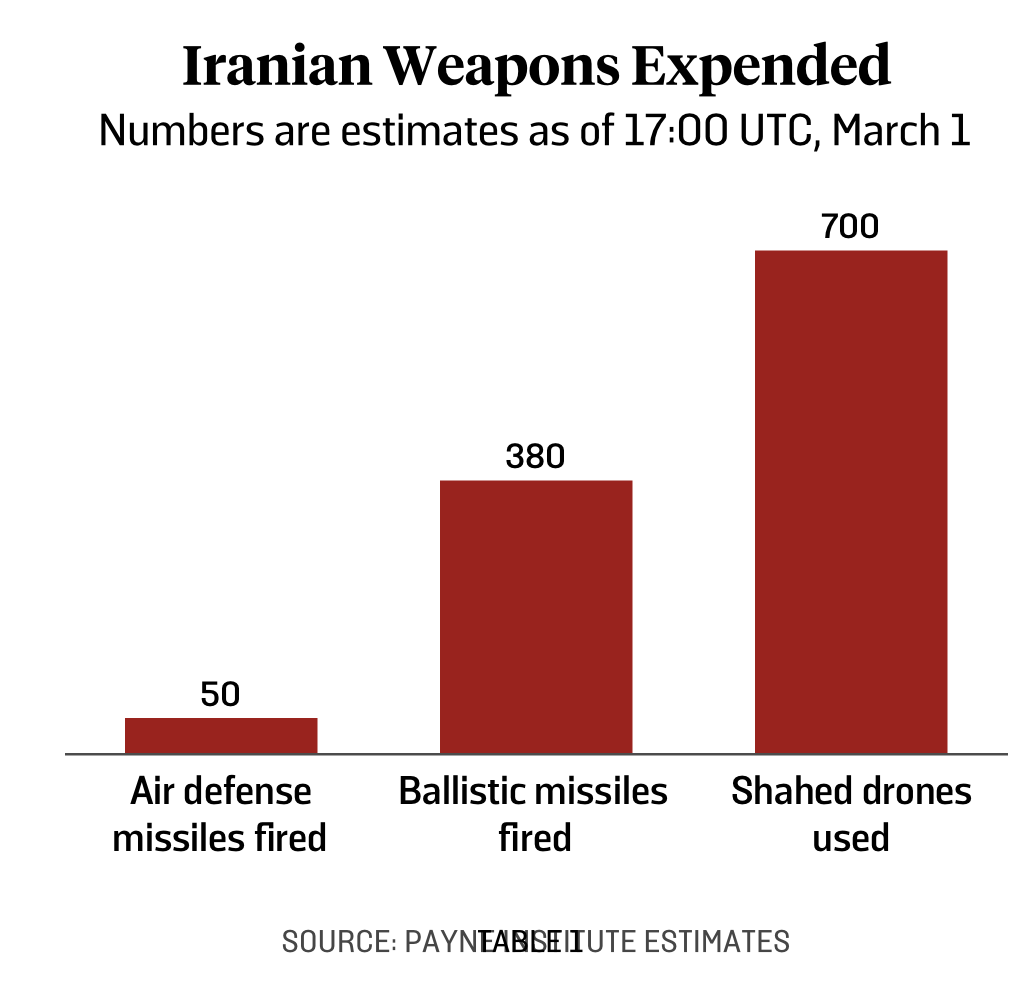
    Utilizing a proprietary Payne Institute open-source ledger and data-scraper tool that breaks out minerals and materials from demand scenarios, our team—drawing from the technical expertise across the Colorado School of Mines—conservatively identified the number of Iranian missile launches and drone attacks across the Middle East during the first 36 hours of the conflict.

    Iranian Weapons Expended


    TABLE 1
    SOURCE: PAYNE INSTITUTE ESTIMATES

    Iran’s launch of more than 1,000 munitions across the region prompted numerous intercept attempts by U.S., Israeli, and allied forces. As the Soufan Center has indicated, “Iran appears to be pursuing an asymmetric war of attrition focused on exhausting U.S., Israeli, and allied defensive resources.” The minimal use of Iranian air defenses is likely due to U.S.-Israeli superiority in electronically suppressing and physically destroying most of Iran’s air defense and command-and-control infrastructure.

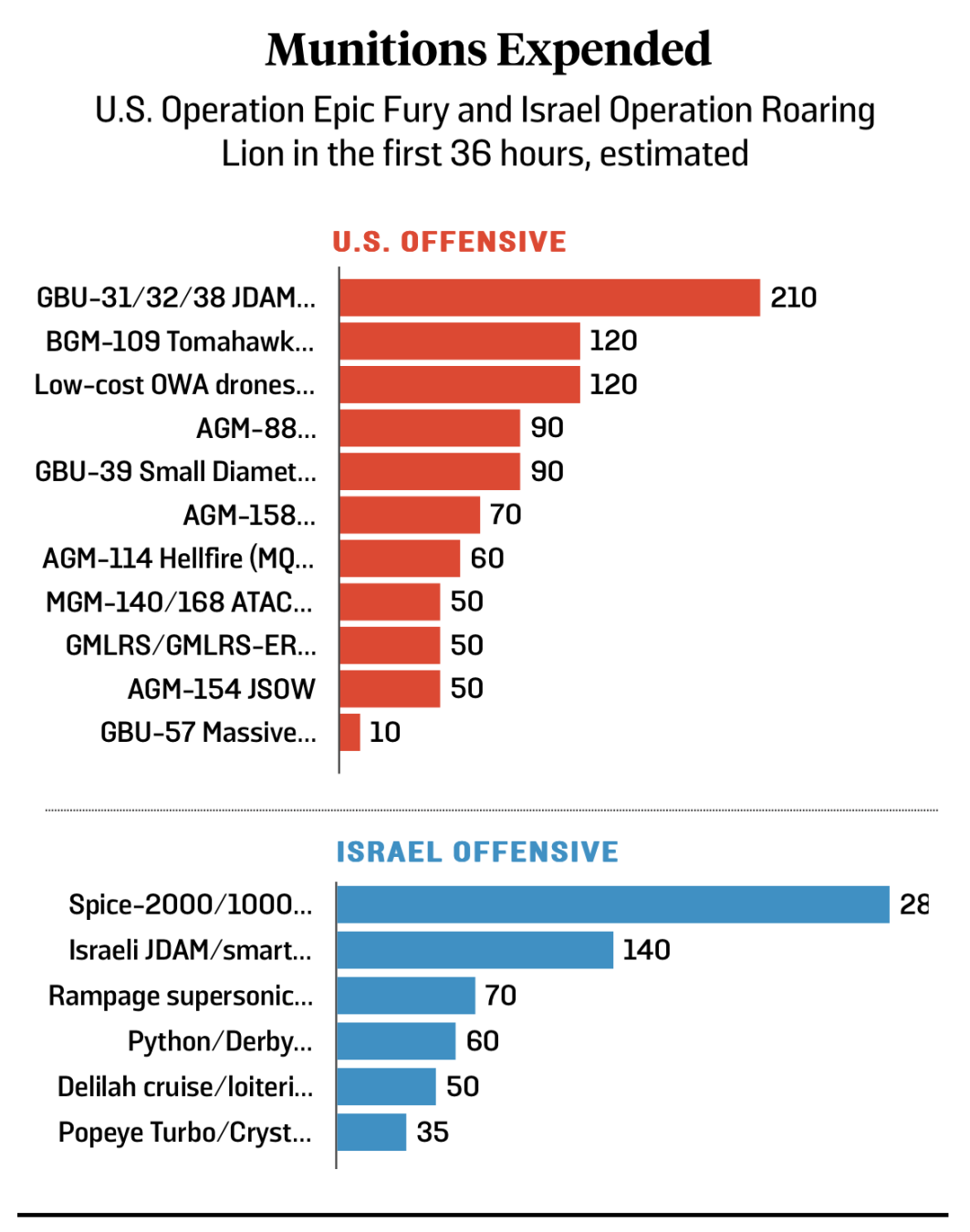
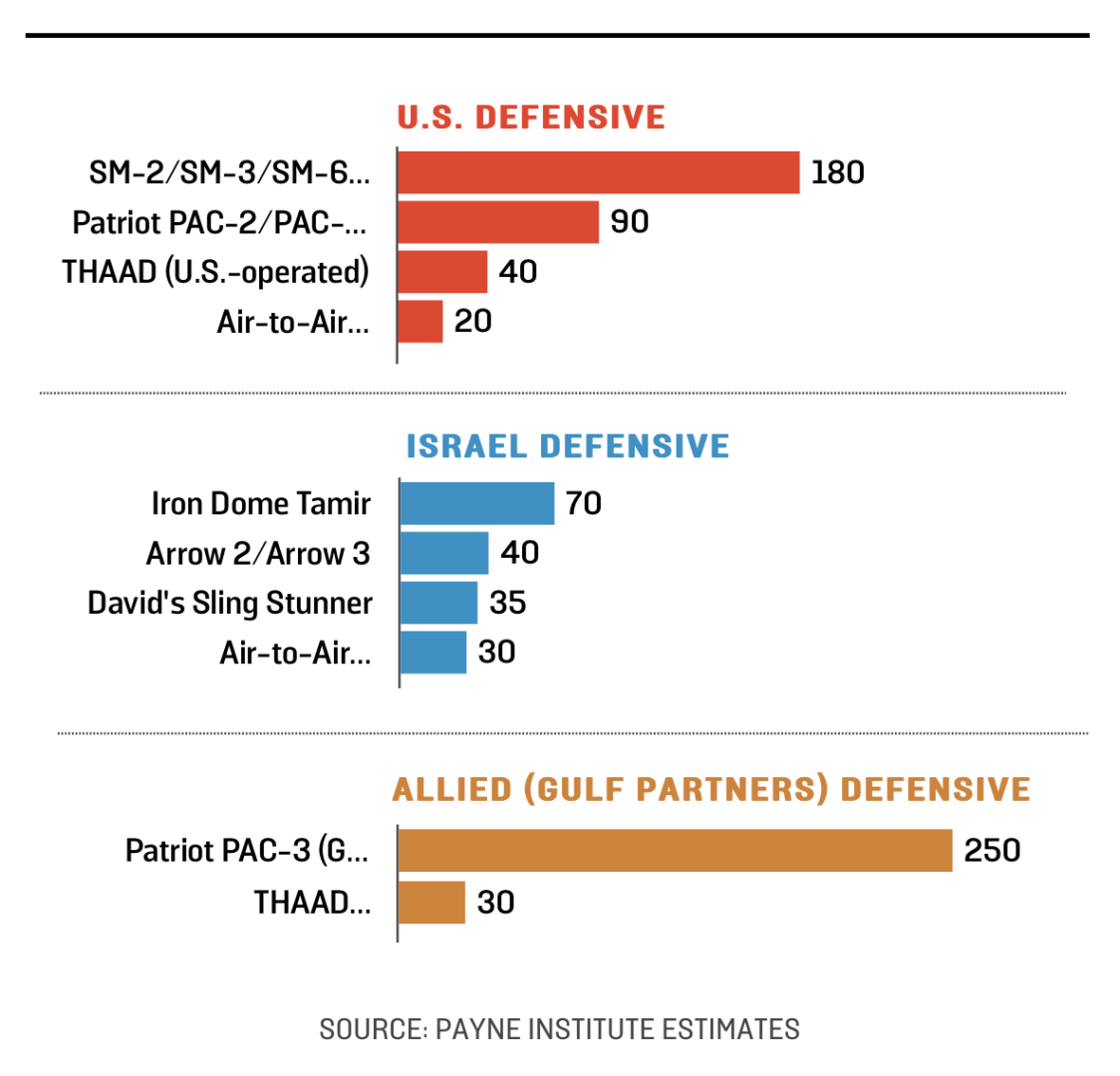
    Yet while the interceptions have been largely successful, they are also costly. The expended munitions, and the minerals required to build them, are a defense-industrial problem for the West, and especially the United States. Our calculations of U.S., Israeli, and allied expenditures show that the United States relied on a familiar mix: standoff strike missiles for early waves, suppression weapons against radars, ground-launched rockets for time-sensitive targets, and large volumes of precision-guided bombs. Israel’s arsenal shows a preference for the practical: large runs of guidance kits and air-launched munitions that can be produced in quantity, married to aircraft that can generate relentless sortie rates.

    Add in regional partner defensive shots, and the result is a striking picture of high-end combat that is as much about volume as it is about elegance. Precision has not removed mass from war. It has simply moved mass into the parts of the weapon you cannot see.

    Munitions Expended


    SOURCE: PAYNE INSTITUTE ESTIMATES

    The purpose of this analysis is to translate the conflict’s opening phase into an urgent signal of the need to ensure munitions availability—recognizing that this initial assessment cannot be immediately extrapolated for the future of this conflict. This raises a simple question that strategists and defense planners often forget: How quickly can the West refill its arsenals?

    While emergency supplemental funding is required, it cannot instantly reverse decades of consolidated production lines and atrophied mineral processing capacity. It is constrained by time, chemistry, and industrial physics. The input of missiles is not just money; it’s a supply chain that starts with minerals, processing, and sub-tier capacity that does not surge on command.

    The concern of U.S. Gen. Dan Caine, chairman of the Joint Chiefs of Staff, about a lack of American munitions prior to the attack drove our Payne Institute research team to focus on this very issue. These concerns are not new; U.S. Navy operations in the Red Sea have already highlighted that missiles are being expended faster than they can be replaced, straining an already taxed defense industrial base.
    Every weapon fired needs replacement, and creating that replacement requires a chain running from raw material, through refining and processing, into specialized components, and finally into certified production lines. The bottlenecks are not always in the places politicians think. The narrowest points are often in obscure corners: a sub-tier supplier with a single furnace; a capacitor supply dependent on a narrow set of inputs; a rocket-motor ecosystem that cannot expand without years of plant construction.

    Even supposedly simple munitions depend on complex chains. For example, modern guidance kits for munitions are dependent on high-performance components that can only be made from rare earths, a market that China dominates. The West’s industrial base can surge some things such as raw material orders, contract awards, or funding authorizations quickly. It cannot conjure trained labor, qualified tooling, and certified production capacity overnight.

    Defense planning, however, still behaves as if inventories are a rounding error. Deterrence is discussed in terms of posture and platforms, yet adversaries are watching a different set of indicators. They want to know how fast missile magazines and munition stockpiles get emptied and whether they can be refilled logistically in a timely manner.

    In a world of simultaneous pressures, a prolonged campaign in the Gulf does not merely shape events there; it eats into military options elsewhere. A force that has burned deep into its interceptor stockpile must accept more risk in another theater or ration its defenses.
    This is a polite way of saying the American military should be hoping the next salvo with Iran is smaller—and that China won’t do the math to figure out what is left of American precision-guided munitions to defend Taiwan. This is highly problematic; a 2023 report by the Center for Strategic and International Studies determined, based on a series of war game simulations, that the U.S. military would run out of key munitions within a week of trying to defend Taiwan from a Chinese invasion.

    That is why the first 36 hours of operations against Iran matter. They are a stress test of Western industrial endurance. A campaign that forces defenders to spend interceptors at a rate that outruns replenishment is not just tactically demanding; it is strategically corrosive.

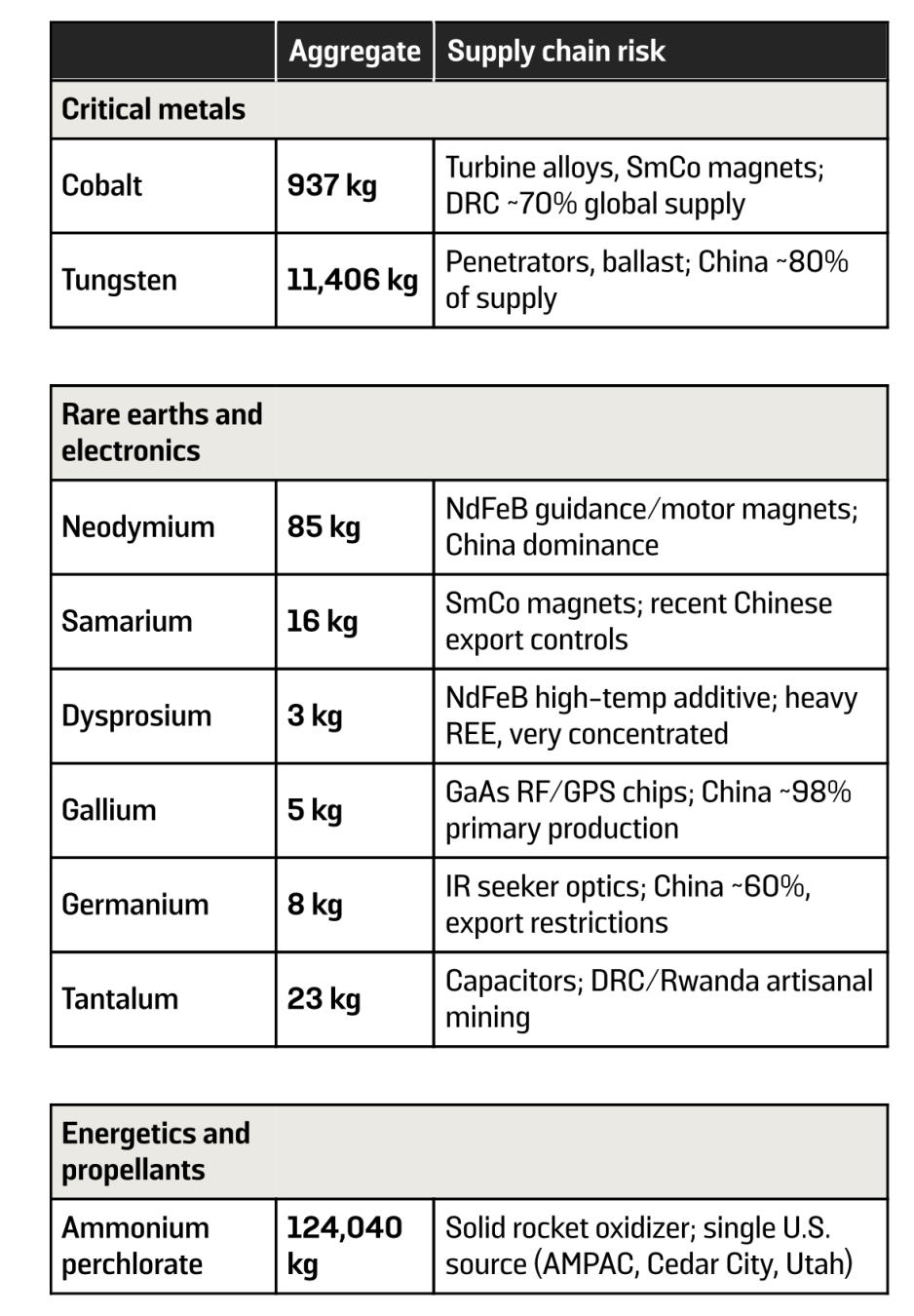
    Using another proprietary Payne Institute tool, we converted the munition expenditure in Table 2 into a mineral replacement burden, expressed in kilograms of the most strategically exposed inputs. Table 3 identifies the critical materials required to replenish the weapons expended. Our recent research has demonstrated how these are some of the most defense-critical minerals, which are difficult to source in peacetime—and almost impossible in a crisis.

    Mineral Replacement in Munitions
    Burden to replace expended munitions, in kilograms of the most strategically exposed critical minerals


    SOURCE: PAYNE INSTITUTE ESTIMATES

    Replacing what was expended requires not just more production on an abstract scale, but significant amounts of specific minerals and materials for which China controls most of the supply. Beyond the quantities involved, there are numerous issues with the concentration of processing, long timelines for capacity expansion, and the fragility of sub-tier suppliers.

    Beyond the sheer volume of munitions, the loss of high-value assets introduces another layer of complexity. The destruction of two advanced U.S. radars, the AN/FPS-132 in Qatar and the AN/TPS-59 in Bahrain, highlights a problem where the total weight of the “mineral bill” is less of a concern than the extreme fragility of the supply chain and the extensive timelines for replacement.

    Per our analysis, for the AN/FPS-132, it will take five to eight years for Raytheon to build a new radar at a cost of $1.1 billion. Meanwhile, Lockheed Martin will require at least 12 to 24 months and an estimated $50 million to $75 million to replace the AN/TPS-59, based on the original Bahrain Foreign Military Sales contract adjusted for inflation. The biggest issue for the defense industrial base will be sourcing the 77.3 kilograms of gallium needed for both systems, a material for which China controls 98 percent of the global supply. This is not to mention the 30,610 kilograms of copper that will also be needed, a commodity facing surging demand from the technology sector.

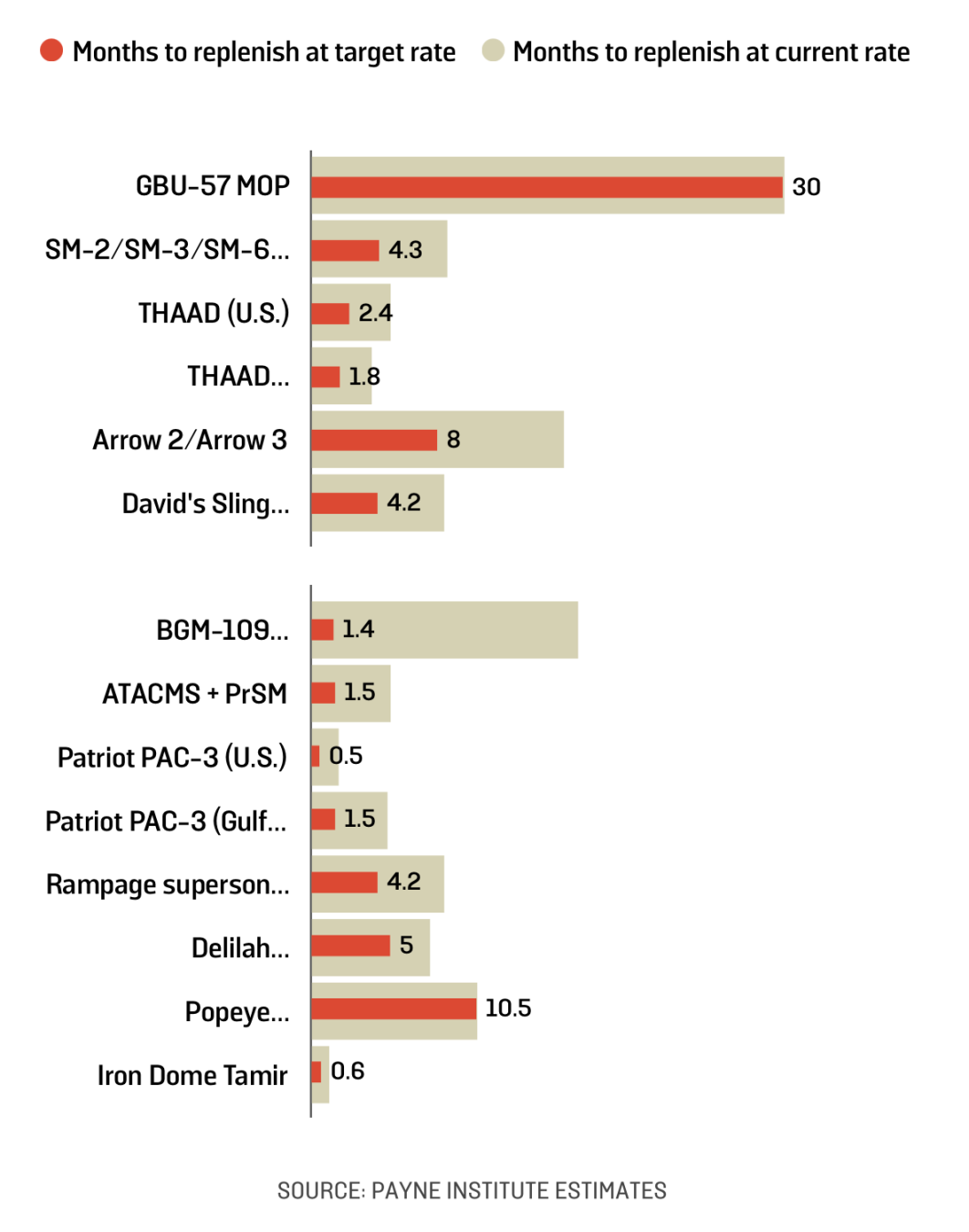
    The broader point is that the West’s theory of military readiness is incomplete. As the long conflict in Ukraine has already illustrated, war is being costed in the wrong units. The relevant metric is not merely how many launchers there are at the start of the war, but how many precision weapons and interceptors can be fired on days two, 20, and 200, and how quickly industry can replace them. This turns a battlefield question into an industrial one, and an industrial one into a minerals-and-processing question. Table 4 illustrates the daunting timelines for replenishing these critical weapon systems.

    Months Needed to Replenish Expended Weapons


    SOURCE: PAYNE INSTITUTE ESTIMATES

    Individual bottlenecks slow down this replenishing. The BGM-109 Tomahawk, for example, depends on the F107 turbofan, solely produced by Williams International. Patriot PAC-3 production is split between the United States, Gulf partners, and Poland, which began producing PAC-3 MSE launch tubes at the WZL-1 facility in 2024. Some systems, such as the Popeye Turbo (also known as Crystal Maze II in its extended-range variant), are legacy assets being drawn down from a finite stock. Others are critically strained: Only around 25 GBU-57 MOPs have been produced to date, with Boeing as their sole assembler. The weapon is currently certified for delivery only by the B-2 Spirit—a fleet of just 20 airframes. The B-21 Raider will provide an additional delivery platform but will not reach operational status until 2027. The THAAD system requires a bespoke kill vehicle, which has no commercial analogue. All of these convoluted production processes are dependent on critical minerals that cannot be surged.

    The mineral bill is the price of deterrence, and this is just the opening price. It cannot be waved away with press conferences, social media posts, or even congressional hearings. The West’s most sophisticated weapons are also its most dependent on long, complex supply chains, and the limiting factor in future conflicts will be the capacity to reload. The duration of the campaign against Iran now hinges on a critical question: Can the West replenish its arsenals fast enough for its strategy to matter?

    • je répète…

      Beyond the sheer volume of munitions, the loss of high-value assets introduces another layer of complexity. The destruction of two advanced U.S. radars, the AN/FPS-132 in Qatar and the AN/TPS-59 in Bahrain, highlights a problem where the total weight of the “mineral bill” is less of a concern than the extreme fragility of the supply chain and the extensive timelines for replacement.

      Per our analysis, for the AN/FPS-132, it will take five to eight years for Raytheon to build a new radar at a cost of $1.1 billion. Meanwhile, Lockheed Martin will require at least 12 to 24 months and an estimated $50 million to $75 million to replace the AN/TPS-59, based on the original Bahrain Foreign Military Sales contract adjusted for inflation. The biggest issue for the defense industrial base will be sourcing the 77.3 kilograms of gallium needed for both systems, a material for which China controls 98 percent of the global supply. This is not to mention the 30,610 kilograms of copper that will also be needed, a commodity facing surging demand from the technology sector.

  • Libyen 2.0 : Die operative Vorbereitung der Venezuela-Intervention


    Beatrice Murch from Buenos Aires, Argentina, CC BY 2.0, via Wikimedia Commons

    Comment préparer une guerre. Les assassins chef de la Lybie préparent une nouvelle édition de leur oeuvre sanglant. Voici la liste des participants et une analyse stratégique.

    1.12.2025 von Michael Hollister -

    Die Kommandeure und der Plan für Venezuela .

    Erster Teil einer umfassenden Analyse.

    Während Washington behauptet, sein massiver Militäraufmarsch in der Karibik richte sich gegen Drogenkartelle, zeichnet sich ein anderes Muster ab – eines, das Libyen 2011 in beunruhigenden Details gleicht. Dasselbe Drehbuch. Ähnliche Kommandeure. Und ein identischer Vorwand: humanitäre Intervention als Tarnung für Ressourcenkontrolle und geopolitische Eindämmung. Die Frage ist nicht mehr ob, sondern wann Washington zuschlägt – und wie genau das libysche Desaster sich wiederholen wird.

    Im Oktober 2025 dokumentierte ich, wie Venezuelas strategischer Wechsel zu Yuan und Tether für seine Ölgeschäfte das Petrodollar-System direkt bedroht – jenen Eckpfeiler der US-Finanzhegemonie, den Washington seit Jahrzehnten mit allen Mitteln verteidigt. Seitdem hat sich die Eskalation dramatisch beschleunigt. Zehn F-35-Kampfjets wurden in die Region verlegt – Flugzeuge für die Zerstörung gegnerischer Luftverteidigung, nicht für Drogenbekämpfung. Die 4. Flotte der US-Marine positionierte sich vor venezolanischen Gewässern. Eine „Counter-Narcotics Task Force“ wurde zusammengestellt – mit einer Feuerkraft, die jede Drogenbekämpfungsoperation der Geschichte in den Schatten stellt. Am 2. September versenkte ein US-Luftschlag ein venezolanisches Schnellboot. Elf Menschen starben.

    Was Mainstream-Medien nicht berichten: Ich habe die Think-Tank-Papiere erhalten, die diese Intervention Stufe für Stufe steuern. Ich habe die Militärkommandeure identifiziert, die überwachen, was Strategen des Atlantic Council explizit „die nächsten Schritte auf der Eskalationsleiter“ nennen. Das ist keine Verschwörungstheorie. Das ist operative Planung – mit Namen, Zahlen und Zeitplänen. Es ist das Libyen-Drehbuch, aktualisiert für die Karibik. Und es läuft bereits.
    Der militärische Aufbau – Die Kommandeure

    Jede Intervention beginnt mit Positionierung. Bevor Bomben fallen, werden Kommandostrukturen aufgebaut, Streitkräfte verlegt, Befehlsketten etabliert. Was derzeit in der Karibik geschieht, folgt diesem Muster mit chirurgischer Präzision. Hier sind die Militärkommandeure, die den aktuellen Aufmarsch leiten – allesamt mit Kampferfahrung im Nahen Osten, jetzt verlegt in Amerikas „Hinterhof“.
    General Laura J. Richardson – Die Architektin

    Position: Kommandierende Generalin, US Southern Command (SOUTHCOM)

    Laura Richardson ist die mächtigste militärische Figur für den gesamten lateinamerikanischen Raum. SOUTHCOM, mit Hauptquartier in Florida, ist zuständig für alle US-Militäroperationen in Mittel- und Südamerika. Was Richardson befiehlt, wird umgesetzt.

    Ihre Rhetorik hat sich seit 2023 fundamental gewandelt. Während frühere SOUTHCOM-Kommandeure von „Partnerschaft“ sprachen, verwendet Richardson zunehmend aggressive Sprache. Sie bezeichnet Lateinamerika explizit als „unseren Hinterhof“ – eine Formulierung, die bewusst Dominanzanspruch signalisiert.

    Besonders aufschlussreich: Richardson betont wiederholt die Notwendigkeit, chinesischen und russischen Einfluss zurückzudrängen. In einer Anhörung vor dem Streitkräfteausschuss des Senats im März 2024 sagte sie: „Wir dürfen nicht zulassen, dass externe Mächte in unserem strategischen Raum Fuß fassen. Lateinamerika ist und bleibt zentral für unsere nationale Sicherheit.“ Übersetzt: Venezuela, mit seinen engen China-Beziehungen, ist eine Bedrohung.

    Ihre Karriere ist geprägt von Operationen im Irak und Afghanistan – Konflikte, die ebenfalls unter humanitären Vorwänden begannen und in jahrzehntelangen Besatzungen endeten. Ihre Ernennung zur SOUTHCOM-Kommandeurin 2021 signalisierte eine Neuausrichtung: Weg von „soft power“, hin zu militärischer Durchsetzung.
    Konteradmiral James Aiken – Der Seeblockierer

    Position: Kommandeur, 4. US-Flotte

    James Aiken ist der operative Vollstrecker auf See. Die 4. Flotte, 2008 reaktiviert, ist das maritime Machtinstrument für die Region. Aiken kontrolliert alle Marineoperationen vor den Küsten Venezuelas.

    In offiziellen Verlautbarungen verwendet Aiken den Euphemismus „maritime Sicherheit“ – klassischer Code für Kontrolle und Projektion. Was bedeutet „maritime Sicherheit“ vor Venezuela? Die Überwachung von Öltankern. Die Identifizierung chinesischer Schiffe. Die Vorbereitung auf maritime Interdiktionsoperationen – jene Stufe 3 der Eskalationsleiter, die noch nicht aktiviert, aber bereits vorbereitet ist.

    Die 4. Flotte operiert mit mehreren Zerstörern und Fregatten in direkter Nähe zu venezolanischen Gewässern. Offiziell „Counter-Narcotics“. Faktisch in einer Position, die es ermöglicht, innerhalb von Stunden eine vollständige Seeblockade zu verhängen – ohne sie völkerrechtlich als solche zu deklarieren.

    Aikens Hintergrund: Er kommandierte zuvor Operationen im Persischen Golf, wo ähnliche „maritime Sicherheits“-Einsätze iranische Öltanker unter Druck setzten. Die Methodik ist identisch. Nur die Geographie hat sich geändert.
    Generalleutnant Michael T. Plehn – Der Sanktionsdurchsetzer

    Position: Vize-Kommandeur, US Southern Command

    Michael Plehn ist offiziell für „Counter-Narcotics“ zuständig. Die Realität: Er ist tief in Sanktionsdurchsetzungsoperationen involviert – jene wirtschaftlichen Kriegsführungsmaßnahmen, die Venezuela erdrosseln sollen.

    Sanktionsdurchsetzung bedeutet konkret: Identifizierung von Schiffen unter falscher Flagge. Überwachung von Geldtransfers in Tether und Yuan. Koordination mit dem US-Finanzministerium. Und – besonders relevant – Vorbereitung militärischer Optionen, um Sanktionen mit Gewalt durchzusetzen, falls „erforderlich“.

    Plehn war in Afghanistan und Irak eingesetzt, wo er Erfahrungen in „unconventional warfare“ sammelte – Operationen unterhalb der Schwelle offener Kriegserklärung. Genau das, was derzeit in der Karibik läuft.

    Interne Militärdokumente zeigen: Plehn ist federführend bei der Planung „graduated response options“ – abgestufte Reaktionen von Wirtschaftsdruck über maritime Interdiction bis hin zu begrenzten Luftschlägen. Er übersetzt Think-Tank-Papiere in operative Militärpläne.
    Konteradmiral Thomas Allan – Der Mann für den Boden

    Position: Kommandeur, Joint Task Force Bravo (JTF-Bravo)

    Thomas Allan kommandiert jene Einheit, die tatsächlich „boots on the ground“ stellt. Die Joint Task Force Bravo, stationiert in Honduras, ist die Schnelle Eingreiftruppe für Lateinamerika. Offiziell: humanitäre Missionen. Tatsächlich: militärische Speerspitze für Interventionen.

    Besonders interessant: JTF-Bravo war zwischen 2010 und 2014 logistisch in Operationen rund um Libyen involviert – nicht in der Kampfzone, aber in Bereitstellung von Personal und nachrichtendienstlicher Unterstützung. Die Einheit hat Erfahrung in schnellen Interventionen unter humanitärem Deckmantel.

    Allan selbst hat Kampferfahrung im Irak, unter anderem in „special operations“. Er ist ein Praktiker, der weiß, wie man militärische Gewalt unterhalb der Schwelle offener Invasion einsetzt – genau das Libyen-Modell, das Think Tanks für Venezuela empfehlen.

    Aktuell hält JTF-Bravo „Bereitschaftsübungen“ ab. Offiziell für Naturkatastrophen. Aber die trainierten Einheiten sind dieselben, die bei einer Venezuela-Intervention zum Einsatz kämen: Luftlandekräfte, Special Forces, schnelle Logistik.
    Die Hardware: Was bereits vor Ort ist

    Luftwaffe:

    10 F-35A Lightning II – Stealth-Flugzeuge zur Zerstörung gegnerischer Luftverteidigung. Einsatzradius: 2.200 km.
    P-8 Poseidon – Tracking aller Schiffsbewegungen, inklusive chinesischer Öltanker
    E-3 AWACS – Radar-Dominanz, koordinierte Luftschläge in Echtzeit

    Marine:

    USS George Washington (Flugzeugträger) – abrufbar innerhalb von 48 Stunden
    Arleigh-Burke-Klasse Zerstörer – Tomahawk-Marschflugkörper
    Littoral Combat Ships – küstennahe Operationen

    Bodentruppen:

    II Marine Expeditionary Force – 2.000+ Marines, amphibische Landungskapazität

    Das Signal: Power Projection, keine Drogenbekämpfung

    Man bekämpft keine Drogenbanden mit Stealth-Kampfjets. Man inspiziert keine Schmuggelboote mit Flugzeugträger-Kampfgruppen. Die derzeit vor Venezuela versammelte Militärmacht ist konzipiert für:

    Luftüberlegenheit – vollständige Kontrolle des Luftraums binnen Stunden
    Maritime Blockade – jedes Schiff stoppen, inspizieren oder versenken
    Präzisionsschläge – Zerstörung ausgewählter Ziele ohne Bodeninvasion
    Schnelle Intervention – „Schutzeinsatz“ für US-Bürger (der klassische Vorwand)

    Das ist die exakte Streitkräftestruktur vor Interventionen im Irak (1991, 2003), Jugoslawien (1999), Libyen (2011) und Syrien (2013/2014). Das Muster wiederholt sich. Und die Kommandeure wissen genau, was sie tun.
    Das Drehbuch – Die Atlantic Council Eskalationsleiter
    Wenn Think Tanks Kriege schreiben

    US-Think Tanks analysieren keine Politik – sie schreiben sie. Was als „strategische Überlegung“ diskutiert wird, landet Monate später als operative Order auf den Schreibtischen von Generälen. Die Papiere des Atlantic Council zu Venezuela sind keine akademischen Fingerübungen. Sie sind Blaupausen. Und sie werden derzeit Stufe für Stufe umgesetzt.

    Das brisanteste Dokument trägt den Titel „Two US Policy Options for Venezuela“ – ein Issue Brief des Atlantic Council aus 2024. Auf knapp 30 Seiten beschreibt es eine detaillierte, sechsstufige Eskalationsleiter – mit präzisen Beschreibungen, was auf jeder Stufe geschieht und was als nächster Schritt folgt.

    Washington hat diese Leiter bereits betreten. Wir befinden uns aktuell auf Stufe 2. Was folgt, steht schwarz auf weiß. Hier ist die Roadmap.
    Stufe 1: Maritime Pressure & Maritime Denial

    Status: UMGESETZT

    US-Kriegsschiffe positionierten sich knapp außerhalb von Venezuelas Ausschließlicher Wirtschaftszone. Formal in internationalem Gewässer. Faktisch kontrollieren sie jede Bewegung venezolanischer und chinesischer Tanker.

    Das Atlantic Council nennt das „faktische Seekontrolle“. Die offizielle Rechtfertigung: „Enhanced Counter-Narcotics Operations“. Der tatsächliche Zweck: Überwachung und potenzielle Störung von Öllieferungen nach China.

    Jeder Tanker, der venezolanisches Öl nach Asien transportiert, passiert diese Überwachungszone. Jede Bewegung wird erfasst, jede Route dokumentiert. Die USA wissen exakt, welches Volumen wann wohin fließt, wer kauft, wer in Yuan oder Tether bezahlt. Diese Daten sind die Grundlage für die nächsten Stufen.

    Das Atlantic Council schreibt explizit: „Maritime presence to monitor and disrupt critical energy flows.“ Monitor – und disrupt. Das zweite Wort ist entscheidend. Überwachung ist Stufe 1. Störung ist Stufe 3.
    Stufe 2: „Escalatory Signaling“ mit Luftüberlegenheit

    Status: UMGESETZT

    Im September 2025 verlegte das Pentagon zehn F-35A Stealth-Kampfjets nach Südamerika. Offiziell zur „Unterstützung regionaler Sicherheit“. Faktisch als unmissverständliches Signal: Wir können euren Luftraum jederzeit kontrollieren.

    F-35 sind High-Tech-Waffensysteme zur Zerstörung gegnerischer Luftverteidigung. Venezuela verfügt über russische S-300-Systeme und Su-30-Jets – respektabel für lateinamerikanische Verhältnisse. Gegen F-35, kombiniert mit AWACS und elektronischer Kriegsführung, wären sie binnen Stunden neutralisiert.

    Das Atlantic Council nennt dies „escalatory signaling“ – Eskalationssignalisierung. Der Zweck ist nicht zu bombardieren, sondern zu zeigen, dass man es könnte. Jederzeit. Und dass Venezuela militärisch vollkommen unterlegen ist.

    Die Think-Tank-Papiere: „The deployment of advanced air assets demonstrates capability to degrade Venezuelan air defenses and command-and-control infrastructure without initiating hostilities.“ Ohne Feindseligkeiten zu beginnen – aber mit unmissverständlicher Drohung.

    Begleitend wurden P-8 Poseidon und E-3 AWACS in die Region verlegt. Zusammen schaffen diese Systeme vollständige Radar-Dominanz. Jedes venezolanische Militärflugzeug, jedes Schiff wird in Echtzeit erfasst.

    Das ist Vorbereitung auf Luftkrieg. Alle Beteiligten wissen das. Diese Stufe wurde im Oktober 2025 abgeschlossen.
    Stufe 3: „Targeted Maritime Interdiction Operations“ – Blockade light

    Status: NOCH NICHT AKTIV – ABER VORBEREITET

    Hier wird es kritisch. Stufe 3 ist der Wendepunkt. Der Rubikon.

    Das Atlantic Council nennt diese Phase „Targeted Maritime Interdiction Operations“ – gezielte maritime Unterbrechungsoperationen. Klartext: Eine Blockade, ohne sie Blockade zu nennen. Denn nach internationalem Seerecht ist eine Blockade ein Kriegsakt. Was beschrieben wird, ist rechtlich eine Blockade – nur anders gerahmt.

    Wie würde das konkret aussehen?

    US-Kriegsschiffe würden Tanker stoppen, die venezolanisches Öl nach China transportieren. Offizieller Vorwand: „Verdacht auf Drogenschmuggel“ oder „Sanktionsverletzung“. Die Schiffe würden „inspiziert“. Die Inspektionen dauern Stunden oder Tage. Verzögerungen häufen sich. Versicherungen erhöhen Prämien. Chinesische Käufer weichen auf Alternativen aus.

    Das Ergebnis: Venezolanische Ölexporte brechen ein. Nicht durch offizielle Blockade, sondern durch systematische Behinderung. Der Effekt ist identisch. Die völkerrechtliche Verantwortung bleibt diffus.

    Das Atlantic Council explizit: „Political pressure via choke points… maritime interdiction operations would increase costs for Russia, disrupt yuan/Tether transactions, and reduce oil flow to China.“ Man stört Chinas Energieversorgung, ohne offiziell Krieg zu führen.

    Warum ist das noch nicht passiert?

    Weil dieser Schritt irreversibel ist. Sobald die USA chinesische Tanker stoppen, reagiert Beijing. China könnte:

    Seine Marine zum Schutz der Tanker schicken
    Wirtschaftliche Vergeltung einleiten
    Venezuela militärisch massiv aufrüsten
    Russland und Iran um Unterstützung bitten

    Stufe 3 ist der Punkt, an dem aus einem regionalen Konflikt ein globaler wird. Deshalb wird diese Stufe vorbereitet, aber noch nicht aktiviert. Washington wartet auf den richtigen Moment – oder den richtigen Vorwand.

    Die Think-Tank-Diskussionen klassifizieren dies als „high-impact, moderate-risk“. High Impact – weil es Chinas Energieversorgung direkt trifft. Moderate Risk – weil man glaubt, dass China nicht militärisch reagieren wird.

    Diese Wette könnte falsch sein.
    Stufe 4: „Strike Options“ – Präzisionsschläge

    Status: KRIEGSSPIELSZENARIEN LAUFEN

    Falls Stufe 3 nicht den gewünschten Effekt erzielt – oder falls Venezuela oder China militärisch reagieren – folgt Stufe 4. Hier wird aus Druck direkte Gewalt.

    Die Think-Tank-Papiere listen präzise auf, welche Ziele bei „begrenzten Luftschlägen“ angegriffen würden:

    Primäre Ziele:

    Radaranlagen (Blendung der Luftverteidigung)
    Luftwaffenstützpunkte (Eliminierung venezolanischer Jets am Boden)
    Küstenraketenstellungen (Sicherung maritimer Operationen)
    Kommando- und Kontrollknoten (Lähmung militärischer Koordination)

    Die Rechtfertigung liefert das Atlantic Council: „To ensure the safety of US forces conducting counter-narcotics operations.“ Dieselbe Formel wie 2011 für Libyen, 1999 für Serbien, 2003 für Irak.

    Man greift an, um „US-Personal zu schützen“. Der Angriff wird als „defensiv“ gerahmt – auch wenn er präemptiv erfolgt.

    Die Papiere betonen: „Limited strikes, not regime change operations.“ Begrenzte Schläge, keine Regime-Change-Operationen. Man zerstört militärische Fähigkeiten. Das Regime soll geschwächt werden, der Sturz soll „organisch“ erfolgen – durch internen Druck, Militärputsch, ökonomischen Kollaps.

    Ob das funktioniert, ist fraglich. Libyen sollte auch ein „begrenzter Einsatz“ werden. Es endete mit Gaddafis Tod und einem zehnjährigen Bürgerkrieg.
    Stufe 5: „Regime Pressure“ – Libyen light

    Status: STRATEGISCHES ENDZIEL

    Das Atlantic Council: „If Maduro escalates, the United States has the capability to degrade his air power, cripple his command-and-control systems, and force regime negotiation from a position of overwhelming strength.“

    Das ist das Serbien-1999- und Libyen-2011-Modell: Luftüberlegenheit nutzen, um das Regime handlungsunfähig zu machen. Keine Bodeninvasion. Aber auch kein funktionierendes venezolanisches Militär mehr.

    Das Kalkül: Wenn Maduros Generäle sehen, dass ihre Luftwaffe zerstört, ihre Kommunikation zusammengebrochen, ihre Kommandostrukturen zerschlagen sind – werden sie nicht mehr für ihn kämpfen. Sie werden verhandeln. Oder putschen.

    Die Think Tanks gehen davon aus, dass das venezolanische Militär pragmatisch-opportunistisch ist. Dass Generäle überlaufen, wenn der Wind sich dreht. Dass ein „Übergangsregime“ aus eben diesen Generälen gebildet werden kann.

    Ob das realistisch ist, sei dahingestellt. Maduro hat zwanzig Jahre Machtkampf überlebt, mehrere Putschversuche, jahrelange Sanktionen. Aber das ist die Wette in Stufe 5.
    Stufe 6: „Partner Deployment“ – Die regionale Koalition

    Status: DIPLOMATISCHE VORBEREITUNG LÄUFT

    Die letzte Stufe ist Internationalisierung. Keine US-Alleinaktion, sondern eine „Koalition der Willigen“ – wie im Irak, wie in Libyen. Das schafft multilaterale Legitimität und verteilt Kosten.

    Die Think-Tank-Papiere nennen potenzielle Partner:

    Kolumbien: Direkter Nachbar, militärisch fähig, zweitgrößte Armee Lateinamerikas.

    Brasilien: Größte Regionalmacht, aber politisch ambivalent. Washington könnte wirtschaftlichen Druck ausüben.

    Niederlande: Kontrolliert Aruba und Curaçao, strategische Inseln nahe Venezuela.

    Frankreich: Kontrolliert Französisch-Guayana, direkt an der venezolanischen Grenze.

    Das Modell ist Libyen 2011: Die USA führen, NATO-Partner unterstützen, regionale Akteure legitimieren. Diplomatische Vorbereitungen laufen bereits.
    Das entscheidende Zitat: China ist das Ziel

    All das – sechs Stufen, minutiös geplant – ergibt nur Sinn, wenn man versteht, dass es nie um Venezuela ging. Das Atlantic Council schreibt es glasklar:

    „Maritime dominance can put China’s energy lifeline at risk. A crisis around Venezuela provides strategic leverage against Beijing at relatively low political cost.“

    Chinas Energie-Lebensader gefährden. Strategischer Hebel gegen Beijing. Zu relativ niedrigen politischen Kosten.

    Venezuela ist der Druckpunkt. China ist das Ziel. Der Petrodollar ist das Motiv.

    Maduro ist nur das Mittel. Wenn er fällt, wird ein neues Regime installiert, das Dollar akzeptiert. Chinas Ölzugang wird unterbrochen. Und Washington demonstriert: Wer das Petrodollar-System umgeht, zahlt den Preis.
    Die Selbsterfüllende Prophezeiung

    Das Perfide: Diese Think-Tank-Papiere beschreiben den Konflikt nicht nur – sie erschaffen ihn. Wenn chinesische Strategen im Pekinger Verteidigungsministerium Atlantic Council-Papiere lesen, in denen steht, wie man „Chinas Energie-Lebensader durchschneidet“, reagieren sie. Sie verstärken militärische Präsenz. Sie rüsten Venezuela auf.

    Das wiederum bestätigt in Washington: „China ist aggressiv. China bedroht unsere Interessen. Wir müssen härter vorgehen.“

    Die Spirale dreht sich weiter. Die Think Tanks schreiben keine neutrale Analyse. Sie schreiben ein Drehbuch. Und alle Beteiligten spielen ihre Rolle.
    Wo stehen wir jetzt?

    Stufe 1: Aktiv seit Monaten
    Stufe 2: Abgeschlossen im Oktober 2025
    Stufe 3: Vorbereitet – das ist der nächste Schritt
    Stufe 4-6: In Planung, in Kriegsspielen durchgespielt

    Wenn Stufe 3 aktiviert wird – wenn US-Schiffe beginnen, chinesische Tanker zu stoppen – ist der Rubikon überschritten. Danach wird die Eskalation nahezu automatisch. Ein Zwischenfall. Eine Überreaktion. Ein „defensiver“ Schlag. Und wir sind in Libyen 2.0.
    Die Libyen-Parallele – Mustererkennung
    Geschichte wiederholt sich. Nicht zufällig.

    Es gibt eine Formel für amerikanische Interventionen im 21. Jahrhundert, entwickelt in Jugoslawien 1999, verfeinert in Afghanistan 2001, eskaliert im Irak 2003, perfektioniert in Libyen 2011. Und sie wird jetzt, 2025, für Venezuela reaktiviert.

    Die Formel hat sechs Elemente:

    Humanitärer/sicherheitspolitischer Vorwand
    Schrittweise militärische Positionierung
    Wirtschaftliche Strangulation
    Mediale Dämonisierung des Regimes
    Begrenzte Luftschläge (keine Bodeninvasion)
    Regime-Kollaps durch internen Druck

    Venezuela 2025 folgt diesem Muster mit erschreckender Genauigkeit. Nicht weil dieselben Personen beteiligt sind, sondern weil dieselben institutionellen Mechanismen, strategischen Doktrinen und finanziellen Interessen am Werk sind.

    Libyen 2011 ist der Präzedenzfall. Hier ist, wie genau die Parallelen verlaufen.
    Dann: Libyen 2011

    Der Vorwand: Schutz von Zivilisten

    Im Februar 2011 brachen in Libyen Proteste gegen Gaddafi aus. Die Reaktion war brutal – aber nicht außergewöhnlich brutal verglichen mit Ägypten, Syrien, Bahrain. Aber Libyen wurde zum Ziel.

    Die Begründung: „Responsibility to Protect“. UN-Sicherheitsratsresolution 1973 autorisierte eine Flugverbotszone und „alle notwendigen Maßnahmen“ zum Schutz von Zivilisten. Das klang humanitär. Das klang begrenzt.

    Die Realität: Regime Change

    Innerhalb von Wochen wurde daraus ein umfassender Luftkrieg zur Zerstörung von Gaddafis Militär. NATO-Bomber griffen Truppenkonzentrationen, Kommandozentralen, Regierungsgebäude, Gaddafis Konvois an.

    Das Ziel war nicht Schutz. Das Ziel war Sturz.

    Das Muster:

    Maritime Blockade light
    Luftüberlegenheit binnen 48 Stunden
    Begrenzte Schläge eskalierten zu systematischer Bombardierung
    Keine Bodeninvasion, aber massive Rebellenunterstützung
    Regime-Kollaps: Gaddafi gefangen, ermordet; Staat zerfällt

    Das Ergebnis: Katastrophe

    Libyen ist heute ein zerfallener Staat. Drei konkurrierende Regierungen. Bürgerkrieg. Migrationskrise. ISIS. Sklavenmärkte. Zehn Jahre Chaos.

    Für Interventionsbefürworter war es ein „Erfolg“ – weil Gaddafi weg war. Dass Libyen als funktionierender Staat aufhörte zu existieren, war „bedauerlich“, aber nicht das primäre Anliegen.
    Jetzt: Venezuela 2025

    Der Vorwand: Drogenbekämpfung

    Die offizielle Begründung: Bekämpfung von Drogenkartellen und transnationaler Kriminalität. Tren de Aragua, venezolanische Schmuggler, Bedrohung der US-Grenzen.

    Die Realität: Petrodollar-Verteidigung und China-Eindämmung

    Es geht nicht um Drogen. Es geht um:

    Venezuelas Ölverkäufe in Yuan und Tether
    Chinas Energiesicherheit
    Die Bedrohung des Petrodollar-Systems
    Geopolitische Eindämmung Chinas in Lateinamerika

    „Drogenbekämpfung“ ist der humanitäre Vorwand 2.0. Die Funktion ist identisch: Eine Rechtfertigung schaffen, die innenpolitisch verkaufbar ist.

    Das Muster (bereits im Gang):

    Maritime Präsenz: 4. Flotte positioniert
    Luftüberlegenheit: F-35 verlegt
    Wirtschaftliche Strangulation: Jahrelange Sanktionen verschärft
    Mediale Dämonisierung: Maduro als Diktator, Narco-Staat, China-Proxy
    Begrenzte Schläge: Vorbereitet
    Regime-Druck: Das strategische Endziel

    Die Parallelen sind nicht ungefähr. Sie sind exakt.
    Die strukturellen Gemeinsamkeiten

    Das „Kein-Krieg“-Narrativ

    Libyen 2011: „Das ist keine Invasion. Das ist eine begrenzte Operation zum Schutz von Zivilisten.“

    Venezuela 2025: „Das ist keine Intervention. Das ist Drogenbekämpfung.“

    In beiden Fällen wird vermieden, es „Krieg“ zu nennen. Denn Krieg erfordert Kongresszustimmung. Aber „humanitäre Operationen“ oder „Sicherheitsmaßnahmen“? Die kann der Präsident autorisieren. Das ist rechtliche Strategie.

    Die maritime Komponente

    Libyen 2011: NATO-Schiffe verhängten eine De-facto-Seeblockade. Offiziell „Waffenembargo“. Faktisch Kontrolle aller Schiffsbewegungen.

    Venezuela 2025: Die 4. Flotte kontrolliert die Gewässer. Offiziell „Counter-Narcotics“. Faktisch Überwachung aller Öltanker nach China.

    Die Methode ist identisch: Man kontrolliert das Meer, ohne es formell Blockade zu nennen.

    Die Luftüberlegenheit als Druckmittel

    Libyen 2011: Binnen 48 Stunden zerstörte die NATO Libyens Luftverteidigung. Gaddafis Jets am Boden zerstört. Radarsysteme ausgeschaltet. Kommunikation gelähmt. Das Ziel war, Libyen wehrlos zu machen.

    Venezuela 2025: Die F-35-Verlegung dient demselben Zweck. Venezuelas S-300-Systeme und Su-30-Jets sind respektabel. Aber gegen F-35, P-8 Poseidon und AWACS nutzlos.

    Das Signal: Wir können euren Luftraum jederzeit neutralisieren. Ihr seid militärisch bereits besiegt.

    Die „Keine-Bodentruppen“-Zusage

    Libyen 2011: Obama versprach: „Keine amerikanischen Bodentruppen.“ Das stimmte – technisch. Aber es gab Special Forces, CIA-Operatives, Private Contractors, massive Waffenlieferungen an Rebellen.

    Venezuela 2025: Trump wird dasselbe versprechen. Und es wird technisch korrekt sein. Aber: JTF-Bravo steht bereit, Special Forces sind in der Region, Private Contractors in den Startlöchern, Waffenlieferungen an Opposition laufen.

    Das ist das Libyen-Modell. Keine offene Besatzung. Aber maximale Destabilisierung.

    Die UN-Umgehung

    Libyen 2011: Die USA hatten UN-Resolution 1973. Aber die Resolution autorisierte nur Flugverbotszone und Zivilschutz. Nicht Regime Change. Washington ignorierte das. Die Mission wurde „gedehnt“.

    Venezuela 2025: Es wird keine UN-Resolution geben. China und Russland würden im Sicherheitsrat ein Veto einlegen. Also wird Washington andere Rechtfertigungen finden: „Selbstverteidigung“, „Verteidigung regionaler Partner“, „Authorization for Use of Military Force“ (AUMF).

    Das ist rechtlich dünner als Libyen. Aber völkerrechtliche Legitimität war noch nie das primäre Anliegen.
    Die entscheidenden Unterschiede – warum Venezuela gefährlicher ist

    Unterschied 1: Die Großmacht-Dimension

    Libyen 2011: Gaddafi war international isoliert. Russland und China protestierten – aber taten nichts.

    Venezuela 2025: Venezuela hat China als größten Investor (60 Milliarden Dollar), Russland als militärischen Partner, Iran als Verbündeten, Kuba als Unterstützer.

    Wenn die USA angreifen, reagiert Beijing. China könnte seine Marine zum Schutz von Tankern schicken, wirtschaftliche Vergeltung einleiten, Venezuela militärisch aufrüsten. Das Risiko einer Großmacht-Konfrontation ist real. In Libyen gab es dieses Risiko nicht.

    Unterschied 2: Die geografische Nähe

    Libyen 2011: 6.000 Kilometer von den USA entfernt. Für die US-Öffentlichkeit eine ferne Krise.

    Venezuela 2025: 2.000 Kilometer von Florida entfernt. Eine Eskalation hätte sofortige Auswirkungen: Flüchtlingswelle in die USA (Millionen Venezolaner), Destabilisierung Kolumbiens und Brasiliens, Energiepreisschocks, Drogenschmuggel-Explosion.

    Unterschied 3: Das Petrodollar-Motiv

    Libyen 2011: Gaddafi plante eine goldgedeckte panafrikanische Währung – eine theoretische Bedrohung, aber nicht akut.

    Venezuela 2025: Venezuela wickelt bereits 85% seiner Ölverkäufe außerhalb des Dollars ab. In Yuan. In Tether. Das ist Realität. Das ist eine akute Bedrohung für die Petrodollar-Hegemonie. Die Dringlichkeit ist höher. Der Druck auf Washington größer.

    Unterschied 4: Die militärische Stärke

    Libyen 2011: Libyens Militär war veraltet, schlecht gewartet, demoralisiert. Die NATO zerstörte es binnen Tagen.

    Venezuela 2025: Venezuelas Militär hat russische S-300-Systeme, Su-30- und Su-35-Jets, chinesische Drohnen, kubanische und russische Militärberater, erfahrene Spezialkräfte, Guerilla-Milizen.

    Ein Luftkrieg wäre schnell gewonnen. Aber ein Stabilisierungsversuch? Das wäre Irak 2.0 – nicht Libyen 2.0.
    Das Libyen-Syndrom: Was nach dem „Erfolg“ kommt

    Libyen nach Gaddafi:

    Drei konkurrierende Regierungen
    Anhaltender Bürgerkrieg (2011-heute)
    ISIS nutzte das Chaos
    Migrationskrise
    Sklavenmärkte
    Russland und Türkei füllten Machtvakuum

    Gaddafi war weg. Aber Libyen als Staat existiert nicht mehr. Für die Libyer war die Intervention eine Katastrophe.

    Venezuela nach Maduro?

    Die Think Tanks fantasieren von einem „demokratischen Übergang“. Die Realität wird anders aussehen:

    Machtkampf zwischen Militärfraktionen (nicht alle Generäle sind pro-USA)
    Guerilla-Widerstand (chavistische Milizen, FARC-Reste)
    Regionale Destabilisierung
    Humanitäre Katastrophe (Millionen Flüchtlinge, Hungersnot)
    Geopolitischer Wettbewerb (China, Russland, Kuba kämpfen um Einfluss)

    Venezuela hat 28 Millionen Einwohner. Libyen hatte 6 Millionen. Die Katastrophe wäre viermal größer.
    Die selbsterfüllende Prophezeiung 2.0

    Die Libyen-Analogie ist nicht nur Analyse. Sie ist Warnung, die zur Handlungsanleitung wird.

    In Washington liest man: „Libyen funktionierte. Gaddafi ist weg. Wir haben keine Bodentruppen verloren. Es war ‚sauber‘.“

    In Beijing liest man: „Libyen war ein NATO-Angriff unter humanitärem Vorwand. Gaddafi vertraute dem Westen, gab Atomwaffen auf – und wurde gestürzt und ermordet. Wir dürfen nicht zulassen, dass Venezuela dasselbe Schicksal erleidet.“

    Also rüstet China Venezuela auf. Also zieht China rote Linien. Das bestätigt in Washington: „China ist aggressiv. Wir müssen handeln.“

    Der Kreislauf dreht sich weiter. Die Libyen-Parallele ist Teil der Eskalationsdynamik heute.
    Fazit – Die Uhr tickt
    Alles liegt offen. Und trotzdem geschieht es.

    Venezuela wird in aller Öffentlichkeit vorbereitet. Die Think Tanks veröffentlichen ihre Papiere. Die Militärkommandeure werden benannt. Die Eskalationsleiter liegt schwarz auf weiß vor. Die historische Parallele ist offensichtlich.

    Und trotzdem geschieht es.

    Das ist keine Verschwörung. Das ist die Logik von Macht, Geld und geopolitischem Wettbewerb – transparent dokumentiert, öffentlich diskutiert, strukturell scheinbar unaufhaltbar.
    Was wir wissen

    Die Kommandeure sind in Position:

    General Laura J. Richardson (SOUTHCOM)
    Konteradmiral James Aiken (4. Flotte)
    Generalleutnant Michael T. Plehn (SOUTHCOM Vize)
    Konteradmiral Thomas Allan (JTF-Bravo)

    Die Hardware ist verlegt:

    10 F-35 Strike-Fighter
    Flotten-Trägergruppe
    P-8 Poseidon, AWACS
    II Marine Expeditionary Force (2.000+ Marines)

    Die Eskalationsleiter ist definiert:

    Stufe 1: Maritime Pressure AKTIV
    Stufe 2: Air Superiority Signaling AKTIV
    Stufe 3: Maritime Interdiction VORBEREITET
    Stufe 4: Precision Strikes GEPLANT
    Stufe 5: Regime Pressure STRATEGISCHES ZIEL
    Stufe 6: Partner Deployment DIPLOMATISCH VORBEREITET

    Das Libyen-Muster wiederholt sich:

    Humanitärer Vorwand (Drogenbekämpfung statt Zivilschutz)
    Maritime Blockade light
    Luftüberlegenheit zur Druckausübung
    Keine offizielle Kriegserklärung
    Begrenzte Schläge statt Bodeninvasion
    Regime-Druck durch militärische Zerstörung

    Das wahre Ziel ist China:

    Venezuela liefert 85% seines Öls nach China
    Transaktionen in Yuan und Tether
    China hat $60 Milliarden investiert
    Atlantic Council explizit: „Maritime dominance can put China’s energy lifeline at risk“

    Wo wir jetzt stehen

    Die ersten beiden Stufen der Eskalationsleiter sind abgeschlossen. Die maritime Präsenz ist etabliert. Die Luftüberlegenheit ist demonstriert. Die F-35 sind verlegt. Die 4. Flotte kontrolliert die Gewässer. Die Task Force ist aktiviert.

    Wir befinden uns in der Wartephase zwischen Stufe 2 und Stufe 3.

    Stufe 3 – Maritime Interdiction Operations – ist der Wendepunkt. Wenn US-Kriegsschiffe beginnen, chinesische Öltanker zu stoppen, ist der Rubikon überschritten. Danach wird die Eskalation nahezu automatisch.
    Was als Nächstes kommt

    Interventionen brauchen Vorwände. Zwischenfälle – echt oder inszeniert. Ein „Drogen-Zwischenfall“. Ein „humanitärer Vorfall“. Ein „China-Zwischenfall“. Ein „regionaler Zwischenfall“.

    Der Zeitrahmen: 60-90 Tage

    Warum? Politischer Druck wächst. Trump steht unter Druck, „Ergebnisse“ zu liefern. Die Streitkräfte sind verlegt. Die Think-Tank-Papiere sind publiziert. China wird stärker in der Region. Je länger man wartet, desto schwieriger wird Intervention.

    Das Fenster ist offen. Und es schließt sich.
    Die kritischen Fragen

    Wird China militärisch reagieren?

    Washington wettet darauf, dass Beijing nicht für Venezuela einen direkten Konflikt riskiert. Diese Wette könnte falsch sein. China hat erklärt, dass Energiesicherheit ein Kerninteresse ist. Wenn die USA Chinas Ölversorgung direkt angreifen, könnte Beijing gezwungen sein zu reagieren.

    Wenn China reagiert, wird aus einer regionalen Krise eine globale.

    Was passiert mit den Menschen in Venezuela?

    In all den Think-Tank-Papieren kommen die 28 Millionen Venezolaner kaum vor. Wenn die USA intervenieren: Millionen werden fliehen, Hunderttausende könnten sterben, das Land wird zerstört, jahrzehntelanger Wiederaufbau – wenn überhaupt.

    Libyen hatte 6 Millionen Einwohner. Venezuela hat 28 Millionen. Die Katastrophe wäre viermal größer.
    Die Historiker-Perspektive

    In zwanzig Jahren werden Historiker schreiben:

    „Es war alles dokumentiert. Die Think-Tank-Papiere lagen vor. Die militärische Positionierung war öffentlich. Die historische Parallele war offensichtlich. Warnungen gab es zuhauf.

    Und trotzdem geschah es.

    Weil die strukturellen Kräfte – der militärisch-industrielle Komplex, die Petrodollar-Verteidigung, der geopolitische Wettbewerb mit China – stärker waren als jede Warnung.“
    Die unbeantwortete Frage

    Aber die Geschichte ist noch nicht geschrieben.

    Stufe 3 ist noch nicht aktiviert. Die Tanker werden noch nicht gestoppt. Der Rubikon ist noch nicht überschritten.

    Es gibt ein Zeitfenster. Und es ist klein.
    Wer stoppt es?

    Nicht die Think Tanks. Nicht die Rüstungskonzerne. Nicht die Politiker. Nicht die Medien.

    Die Öffentlichkeit. Die Zivilgesellschaft. Diejenigen, die Fragen stellen. Die Zusammenhänge aufzeigen. Die Transparenz schaffen.

    Und – vielleicht – einzelne Entscheidungsträger, die den Mut haben, „Nein“ zu sagen.

    Die Geschichte zeigt: Das ist selten.

    Aber nicht unmöglich.
    Der finale Satz

    Die Kommandeure sind in Position.

    Die Hardware ist verlegt.

    Die Eskalationsleiter ist definiert.

    Das Libyen-Muster wiederholt sich.
    Und die Uhr tickt.

    Die Frage ist nicht mehr: Wird Washington in Venezuela intervenieren?

    Die Frage ist: Wann – und wer zahlt den Preis?

    Die Antwort wird in den kommenden 60-90 Tagen entschieden.

    Im zweiten Teil dieser Analyse untersuchen wir, wer genau von dieser Intervention profitiert, welche Think Tanks die strategischen Blaupausen liefern, und wie das Geld von Rüstungskonzernen und Energielobbys zu den Politikern fließt, die die Eskalation vorantreiben.
    Quellenverzeichnis – Teil 1
    I. MILITÄRISCHE KOMMANDOSTRUKTUREN & EINSÄTZE

    US Southern Command (SOUTHCOM)

    S. Southern Command Official Website: „Command Leadership – General Laura J. Richardson“
    https://www.southcom.mil/About/Leadership
    S. Senate Armed Services Committee: „Posture Statement of General Laura J. Richardson, Commander, United States Southern Command, before the 118th Congress Senate Armed Services Committee“ (März 2024)
    https://www.armed-services.senate.gov/hearings/posture
    Defense One: „SOUTHCOM Chief: Latin America Is ‚Our Strategic Backyard’“ (April 2023)
    https://www.defenseone.com

    US Fourth Fleet Operations

    S. Navy Fourth Fleet: „Commander’s Biography – Rear Admiral James P. Aiken“
    https://www.fourthfleet.navy.mil
    S. Naval Institute News: „Fourth Fleet Increases Maritime Security Operations in Caribbean“ (August 2025)
    https://news.usni.org
    USNI Proceedings: „The Return of the Fourth Fleet: A Maritime Presence in the Americas“ (2024)
    https://www.usni.org/magazines/proceedings

    Joint Task Force Bravo

    S. Southern Command: „Joint Task Force-Bravo Fact Sheet“
    https://www.southcom.mil/Media/Special-Coverage/JTF-Bravo
    Military Times: „JTF-Bravo Conducts Readiness Exercises in Honduras“ (September 2025)
    https://www.militarytimes.com

    F-35 Deployment & Counter-Narcotics Task Force

    S. Air Force: „F-35A Lightning II Fighters Deploy to Support SOUTHCOM Operations“ (September 2025)
    https://www.af.mil/News
    S. Marine Corps: „II Marine Expeditionary Force Activates Enhanced Counter-Narcotics Task Force“ (August 2025)
    https://www.marines.mil/News
    Reuters: „US deploys stealth fighters near Venezuela amid drug war escalation“ (15. September 2025)
    https://www.reuters.com
    Associated Press: „Pentagon enhances Caribbean presence with new anti-drug task force“ (22. August 2025)
    https://apnews.com

    II. THINK TANK PUBLIKATIONEN

    Center for Strategic and International Studies (CSIS)

    CSIS Americas Program: „Going to War with the Cartels: Military Implications and Strategic Considerations“ (September 2024)
    https://www.csis.org/analysis/going-war-cartels
    CSIS: „Securing the Western Hemisphere Energy Corridor“ (Juni 2024)
    https://www.csis.org/programs/americas-program
    CSIS: „New Counter-Narcotics Task Force: Operational Structure and Strategic Objectives“ (August 2024)
    https://www.csis.org/analysis

    Atlantic Council

    Atlantic Council – Adrienne Arsht Latin America Center: „Two US Policy Options for Venezuela: Shaping Reform vs. Maximum Pressure“ (März 2024, aktualisiert Oktober 2024)
    https://www.atlanticcouncil.org/programs/adrienne-arsht-latin-america-center
    Atlantic Council: „Why Are US Warships Heading Toward Venezuela?“ (Expert Discussion, September 2024)
    https://www.atlanticcouncil.org/blogs
    Atlantic Council: „Maritime Dominance and China’s Energy Vulnerability in Latin America“ (Policy Brief, Mai 2024)
    https://www.atlanticcouncil.org/in-depth-research-reports

    Heritage Foundation

    Heritage Foundation: „Derailing the Tren de Aragua: How Venezuela’s Gang Exports Threaten US National Security“ (Juni 2024)
    https://www.heritage.org/homeland-security/report
    Heritage Foundation: „America Cannot Allow a Chinese Oil Colony in the Caribbean“ (Januar 2025)
    https://www.heritage.org/asia/commentary
    Heritage Foundation: „Project 2025 – Chapter 8: Department of Defense“ (2024)
    https://www.heritage.org/project2025

    American Enterprise Institute (AEI)

    American Enterprise Institute: „The Case for a Hemispheric Energy Strategy: Securing US Interests Against Authoritarian Petro-States“ (November 2023)
    Autor: Roger Noriega
    https://www.aei.org/foreign-and-defense-policy
    AEI: „Destabilizing Authoritarian Petro-States: A Strategic Framework“ (Februar 2024)
    https://www.aei.org/research-products/report

    Council on Foreign Relations (CFR)

    Council on Foreign Relations: „Global Conflict Tracker – Venezuela Crisis“
    https://www.cfr.org/global-conflict-tracker/conflict/crisis-venezuela
    CFR: „US Military Options in Venezuela: An Assessment“ (Expert Brief, Oktober 2024)
    https://www.cfr.org/expert-brief

    RAND Corporation

    RAND Corporation: „Overextending and Unbalancing Russia: Assessing the Impact of Cost-Imposing Options“ (2019)
    https://www.rand.org/pubs/research_reports/RR3063.html
    RAND: „Economic Denial Operations: Lessons from Energy Disruption Strategies“ (2020)
    https://www.rand.org/pubs/research_reports

    III. VENEZUELA – ÖL, CHINA, PETRODOLLAR

    Ölexporte & Yuan/Tether-Handel

    Bloomberg: „Venezuela’s Oil Trade Shifts to Yuan as China Deepens Energy Ties“ (März 2024)
    https://www.bloomberg.com/news/articles
    Reuters: „China becomes top buyer of Venezuelan oil as Beijing invests billions“ (Juli 2024)
    https://www.reuters.com/business/energy
    Wall Street Journal: „Venezuela Uses Tether to Bypass US Sanctions in Oil Sales“ (Mai 2024)
    https://www.wsj.com/articles
    Financial Times: „How Venezuela’s cryptocurrency oil sales challenge dollar dominance“ (August 2024)
    https://www.ft.com/content

    Chinesische Investitionen

    South China Morning Post: „China’s $60 billion bet on Venezuela oil pays off as US sanctions bite“ (Juni 2024)
    https://www.scmp.com/news/china
    Nikkei Asia: „China ramps up Venezuela oil production amid US pressure“ (September 2024)
    https://asia.nikkei.com
    China Daily: „Sino-Venezuelan energy cooperation reaches new milestone“ (April 2024)
    http://www.chinadaily.com.cn

    Petrodollar-System & Geopolitik

    Foreign Affairs: „The Petrodollar’s Twilight: What Venezuela’s Yuan Trade Means for US Power“ (Februar 2024)
    https://www.foreignaffairs.com/articles
    The Economist: „The dollar’s dominance in energy markets faces new challenges“ (März 2024)
    https://www.economist.com/finance-and-economics

    IV. LIBYEN 2011 – HISTORISCHE PARALLELE

    UN-Resolution 1973 & NATO-Intervention

    United Nations Security Council: „Resolution 1973 (2011)“ (17. März 2011)
    https://www.un.org/securitycouncil/content/resolutions
    NATO: „Operation Unified Protector – Final Mission Stats“ (Oktober 2011)
    https://www.nato.int/cps/en/natohq/topics_71652.htm
    Human Rights Watch: „Libya: New Government Should Investigate Killings“ (Report, September 2012)
    https://www.hrw.org/report/2012/09/11

    Libyen nach Gaddafi

    International Crisis Group: „Libya: Getting Geneva Right“ (Special Report, November 2015)
    https://www.crisisgroup.org/middle-east-north-africa/north-africa/libya
    BBC News: „Libya crisis timeline: From revolution to civil war“ (Updated 2024)
    https://www.bbc.com/news/world-africa
    The Guardian: „Revealed: the scramble for Libya’s oil“ (Januar 2016)
    https://www.theguardian.com/world/2016/jan
    Amnesty International: „Libya: Horrific violations in detention highlight need for accountability“ (September 2017)
    https://www.amnesty.org/en/latest/news/2017/09

    Migrationskrise & Sklavenmärkte

    CNN: „People for sale: Where lives are auctioned for $400″ (November 2017)
    https://edition.cnn.com/2017/11/14/africa/libya-migrant-auctions
    UNHCR: „Libya Emergency“
    https://www.unhcr.org/libya-emergency.html

    V. AKTUELLE BERICHTERSTATTUNG VENEZUELA-KRISE

    Militärische Zwischenfälle

    Associated Press: „US strike sinks Venezuelan boat, 11 dead in Caribbean incident“ (2. September 2025)
    https://apnews.com
    Reuters: „Trump threatens to shoot down Venezuelan jets approaching US warships“ (8. September 2025)
    https://www.reuters.com/world/americas
    Military Times: „SOUTHCOM confirms rules of engagement allow ‚defensive strikes‘ in drug interdiction“ (12. September 2025)
    https://www.militarytimes.com

    Venezuela-Sanktionen

    S. Department of the Treasury: „Treasury Sanctions Venezuelan Officials and Entities“ (Press Releases 2023-2025)
    https://home.treasury.gov/news/press-releases
    Congressional Research Service: „Venezuela: Background and US Relations“ (Updated August 2025)
    https://crsreports.congress.gov

    Maduro-Regime & Opposition

    The New York Times: „Inside Maduro’s Survival: How Venezuela Resisted Two Decades of Pressure“ (Juli 2024)
    https://www.nytimes.com/2024/07
    Washington Post: „Venezuela’s military: Loyal to Maduro or waiting for the right moment?“ (September 2025)
    https://www.washingtonpost.com/world

    VI. GEOPOLITISCHE ANALYSE

    China in Lateinamerika

    Center for Strategic and International Studies: „Countering China’s Strategic Penetration in Latin America“ (Mai 2024)
    https://www.csis.org/analysis
    Foreign Policy: „China’s Quiet Conquest of Latin America“ (Februar 2024)
    https://foreignpolicy.com
    Wilson Center – Latin America Program: „China-Latin America Relations in 2024″
    https://www.wilsoncenter.org/program/latin-america-program

    Russland & Iran – Venezuela-Beziehungen

    Chatham House: „Russia’s Role in Venezuela: Strategic Partnership or Opportunism?“ (März 2024)
    https://www.chathamhouse.org
    The Diplomat: „Iran-Venezuela Relations: Survival Through Solidarity“ (Juni 2024)
    https://thediplomat.com

    VII. MILITÄRHISTORISCHE VERGLEICHE

    Panama 1989 & Grenada 1983

    S. Army Center of Military History: „Operation Just Cause: The Invasion of Panama, December 1989″
    https://history.army.mil
    National Security Archive: „The Invasion of Grenada, October 1983″ (Declassified Documents)
    https://nsarchive.gwu.edu

    Serbien 1999 (Kosovo-Krieg)

    NATO: „Operation Allied Force“ (Historical Archive)
    https://www.nato.int/kosovo/history.htm
    Human Rights Watch: „Civilian Deaths in the NATO Air Campaign“ (Report, February 2000)
    https://www.hrw.org/reports/2000/nato

    Michael Hollister

    Michael Hollister analysiert seit vielen Jahren die globalen Machtstrukturen hinter Politik und Wirtschaft. Sein Schwerpunkt liegt auf geopolitischen Strategien, einflussreichen Netzwerken und den historischen Wurzeln heutiger Konflikte.

    #USA #Vénézuela #impérialisme #guerre

  • The Fantasy of a New Middle East | Foreign Affairs
    https://www.foreignaffairs.com/middle-east/fantasy-new-middle-east

    Paragraphe final d’un long (mais pas vraiment percutant à mes yeux) article de Marc Lynch, un des meilleurs spécialistes du monde arabe aux USA.

    Israel may view itself as the region’s new hegemon, but in fact it has made itself both less necessary and less useful. After the attack on Qatar, leaders of the Gulf states are unlikely to continue pointing all their air defense systems toward Iran and Yemen. Perhaps they could accept Israel’s obliteration of Gaza, but now Israel has made itself a threat to their own security. That Israel has avoided paying any serious price thus far for its military expansionism in the region and for the devastation of Gaza has fed the sense in Israel that it never will. But that is as misguided as the Israeli belief in 1973 that no Arab state would ever dare attack it again after its sweeping victory six years earlier or its notion, before October 7, 2023, that Hamas would remain forever contained in Gaza.

  • Beijing Parade: China’s Military Has Caught Up to the United States’
    https://foreignpolicy.com/2025/09/03/china-military-parade-technology-pla-weapons

    It is now widely accepted that the story Western countries once told themselves about China’s technological development—it is a mere imitator of Western technology; it steals intellectual property; its successes result from wasteful public subsidies—is inadequate. This story still has some elements of truth, but it is much less true than it used to be. China is today an innovator and technological leader in robotics, electric vehicles, nuclear reactors, solar energy, drones, high-speed rail, and AI.

    If confirmation were needed, the Sept. 3 military parade through Beijing confirms that we must add military technology to this list. It is no longer enough to say that China’s military, the People’s Liberation Army (PLA), is catching up or that it is copying foreign military equipment designs. China is now innovating, and it is leading. In the process, the regional military balance that has for decades favored the United States and its partners is being irrevocably changed.

    […]

    And as the military parade in Beijing reminded the world this week, an arms race would now play to Beijing’s strengths, not to Washington’s.

    • (...)

      Finally, if those barriers were overcome, China would almost certainly respond with increased military spending of its own. And as the military parade in Beijing reminded the world this week, an arms race would now play to Beijing’s strengths, not to Washington’s. A new equilibrium is indeed taking shape; U.S. military strategy and foreign policy must follow.

  • Israel Can’t Be a Hegemon - Stephen M. Walt
    https://foreignpolicy.com/2025/06/16/israel-iran-war-middle-east-hegemon

    Moreover, the entire justification for these latest attacks was the fear that Iran might one day acquire nuclear weapons. The risk was not that Iran would use a bomb to attack Israel—which would be suicidal—but rather that an Iranian bomb would limit Israel’s ability to use force in the region with impunity. That Israel’s leaders saw that possibility of having to act with greater restraint as a danger reveals that they do not have the kind of “free security” that the United States—the world’s only true regional hegemon—has long enjoyed.

    Nor have Israel’s recent battlefield successes solved the more fundamental issue of the Palestinians who make up roughly half the population in the lands Israel controls. Israel’s superior military and intelligence capabilities did not prevent Hamas from killing hundreds of Israelis in October 2023, and Israel killing more than 55,000 Palestinians in response hasn’t brought it closer to a political solution to this conflict. Instead, it has tarnished Israel’s global image significantly and undermined support even among long-standing allies.

    Most important of all, Israel remains critically dependent on its American patron, which supplies most of the aircraft, bombs, and missiles it needs to attack its neighbors along with constant diplomatic protection. A true regional hegemon doesn’t have to rely on others to dominate its neighborhood, but Israel does. U.S. support has been ironclad for decades, due to the influence of a powerful domestic interest group, but the relationship has shown signs of strain in recent years and is likely to become more difficult to sustain as America’s own power position declines. And if this latest round of fighting eventually drags the United States in, more Americans—including MAGA faithful who thought U.S. President Donald Trump would keep the country at peace—will recognize the considerable price Americans keep paying for the “special relationship.”

    Finally, durable regional hegemony requires the neighboring countries to accept (and in some cases welcome) the hegemon’s dominant position. Otherwise, the hegemon will constantly worry about renewed opposition and be forced to take repeated actions to prevent it from emerging. To make its privileged position acceptable to others, a durable hegemon must act with a degree of forbearance, as former U.S. President Franklin D. Roosevelt did by adopting his “Good Neighbor” policy toward Latin America. It is worth remembering that would-be regional hegemons like Napoleonic France, Nazi Germany, or Imperial Japan achieved a dominant position temporarily, but they were unable to consolidate their initial gains and eventually succumbed to more powerful opposing coalitions.

    Treating neighbors with forbearance has not been Israel’s strong suit, however, and the growing influence of right-wing forces and religious extremists in the country makes that even less likely. Put all this together, and Israel falls well short of being a regional hegemon. I have no doubt that its leaders might like to achieve that status—why wouldn’t they—but it will remain forever beyond their reach. And that means that long-term security for the state of Israel ultimately depends on achieving an enduring political settlement with its neighbors, including the Palestinians. Which is yet another reminder that it is politics, not power alone, upon which lasting security ultimately depends.

  • Nuclear Claims Are a Smoke Screen for Hopes of Toppling Iran - The Israeli strikes aren’t about facilities or centrifuges, but regime change.
    https://foreignpolicy.com/2025/06/13/israel-iran-strikes-regime-change-nuclear-claims

    The real debate has never been about what to do with Iran’s nuclear program. It’s always been about what to do with the regime.

    […]

    Iran had a nuclear weapons program until 2003, despite its vociferous denials. When that program was revealed in 2002, the U.S. intelligence community believed, Supreme Leader Ayatollah Ali Khamenei halted it. (“Halt” is the word the intelligence community used, but suspended or paused is a more natural description.)

    Iran agreed to the so-called Iran nuclear deal in 2015. Iran, according to both the International Atomic Energy Agency (IAEA) and the U.S. intelligence community, complied with the terms of that agreement. This compliance continued even after U.S. President Donald Trump withdrew from the deal, during his first term, in 2018, until May 2019. The Biden administration did not reenter the agreement and talks dragged out. Despite the breakdown, the U.S. intelligence community believes Iran’s nuclear weapons program remains suspended, but also that there is growing pressure on the supreme leader to resume the program.

    […]

    One reason that many hawkish Israelis and their Washington fanboys opposed the nuclear deal was precisely because it might work. Resolving the nuclear issue would have removed some sanctions on the regime. This initial wave of attacks isn’t about the nuclear threat; it’s about using the nuclear threat to justify an attempt to topple the regime. Netanyahu essentially admitted this, telling Iranians: “Our fight is with the brutal dictatorship that has oppressed you for 46 years. I believe that the day of your liberation is near.”

  • US cuts off intelligence sharing with Ukraine
    https://www.ft.com/content/c58fccea-00c4-4fad-bc0a-0185b7415579

    Fresh blow to Kyiv as Trump administration shifts on conflict

    The US has cut off intelligence sharing with Kyiv in a move that could seriously hamper the Ukrainian military’s ability to target Russian forces.

    The step follows the decision on Monday by Donald Trump’s administration to suspend military aid deliveries to Ukraine and comes after a dramatic breakdown in relations between the US president and Ukraine’s leader Volodymyr Zelenskyy.

    US intelligence co-operation has been essential for Ukraine’s ability to identify and strike Russian military targets.

    Four officials familiar with the decision confirmed Washington had frozen intelligence channels with Kyiv. John Ratcliffe, director of the CIA, later told Fox Business: “Trump had a real question about whether President Zelenskyy was committed to the peace process, and he said let’s pause.”

    But he added there was hope of the support being restored. “I want to give a chance to think about that, and you saw the response that President Zelenskyy put out,” Ratcliffe added. “So I think on the military front and the intelligence front, the pause that allowed that to happen, I think will go away.”

    While the US has also formally blocked its allies from sharing US intelligence with Ukraine, two officials said recipients with assets inside the country were likely to continue passing on relevant intelligence to Kyiv. But that would not apply to time-sensitive and high-value intelligence, such as that needed for Ukraine to conduct precision strikes on moveable Russian targets.

    “If they don’t reverse it soon, it will become really difficult for the Ukrainians because it takes away their battlefield advantage,” said a senior western official.

    The US decision to ban its allies from passing intelligence to Ukraine was first reported by the Daily Mail.

    • alors que certains dans la #communauté_du_renseignement appellent au renforcement des coopérations (et à la standardisation)

      Improving U.S. Intelligence Sharing With Allies and Partners | Lawfare
      https://www.lawfaremedia.org/article/improving-u.s.-intelligence-sharing-with-allies-and-partners

      The Trump administration’s recent decision to cut off intelligence sharing with Ukraine will get less attention than its halting of military aid, but it will also be consequential. If anything, the United States should be increasing intelligence cooperation not only with Ukraine, but also with other key partners.

      Intelligence sharing is a cornerstone of U.S. efforts to ensure its own security and that of key allies and partners. Effective sharing enhances strategic coordination, enables timely responses to threats, and strengthens trust between nations. Despite its importance, intelligence sharing does not live up to its potential. As Sean Corbett and James Danoy—former senior British and U.S. intelligence officials, respectively—have written, “With few exceptions, and despite the best of intentions, intelligence sharing is uneven, remains the exception rather than the norm, and the prospect of simultaneity at the point of need is remote.” Drawing on a larger research project that drew heavily on interviews with U.S. and allied officials and experts, this piece critically examines the current state of U.S. intelligence sharing, identifies key challenges, and proposes solutions to improve the effectiveness of these partnerships.
      […]
      Trust is the bedrock of intelligence collaboration. Henry Kissinger once remarked that “there is no such thing as friendly intelligence agencies. There are only the intelligence agencies of friendly powers.” Beyond spying, concerns over leaks, misuse, or politicization of shared intelligence can also erode trust. The Snowden disclosures in 2013, for example, strained relations between the U.S. and some of its closest allies, highlighting vulnerabilities in intelligence handling. Another problem is the global nature of U.S. interests: European officials worry that the United States will focus too much on Asia, and Asian partners worry the United States will focus too much on Europe.

      Intelligence sharing is increasingly dependent on secure and interoperable technical systems. However, technological disparities among allies, coupled with differing cybersecurity standards, create significant interoperability challenges. As one Five Eyes official told me, “Just because we have an intelligence sharing agreement doesn’t mean we have intelligence sharing systems.” The absence of standardized data-sharing protocols and encrypted communication systems further exacerbates inefficiencies in real-time intelligence dissemination.

      Differences in intelligence cultures and bureaucratic structures across nations complicate collaboration. While the U.S. intelligence community operates under a relatively centralized framework, despite the bureaucratic weakness of the director of national intelligence, other countries have even more balkanized systems, and many services are politicized. Divergent priorities and intelligence methodologies can hinder seamless integration and coordination. Sir Stephen Lander, the former director general of the U.K. Security Service, remarked in 2004 that some countries “collect haystacks and store them, while others collect hay and store needles, while others again only ever collect needles and not very many of them. The risk of sharing haystacks with needle keepers is that they would not be able to use the material effectively or would be swamped.”

    • c’est, bien sûr, l’inverse qui est en train de se produire…
      • les É.-U. envisageraient de virer le Canada de l’alliance #Five_Eyes
      • et, inversement, les Alliés, effarés de ce que font les É.-U, prennent leurs distances

      US Allies Unsure What Secret Intelligence They Can Share With Trump
      https://foreignpolicy.com/2025/02/27/trump-cia-allies-intelligence-sharing-five-eyes-trust

      As social media mogul Elon Musk takes an axe to the federal government structures that keep the United States functioning, the international relationships that keep Americans secure and prosperous are also suffering rapid unscheduled disassembly. Picking meaningless fights with North American neighbors, seeking to “partner” with Russia, and cutting European allies loose are just the most immediate signs that the fabric of Washington’s foreign relations is unraveling, U.S.-British ties included.

      Beneath the surface, other signs of dissolution may be less visible, but they are just as invidious for U.S. power and security. The latest indication of what may be happening out of the public eye came with this week’s report—which was swiftly denied—that senior White House advisor Peter Navarro is pushing for Canada to be kicked out of the Five Eyes intelligence-sharing partnership.

      Intelligence-sharing arrangements like Five Eyes are part of the web of cooperation among Washington and its friends that has long underpinned U.S. and Western security. The Five Eyes arrangement with fellow English-speaking countries Australia, Britain, Canada, and New Zealand is only the best-known of these; the United States also has bilateral and multilateral arrangements that are far less prominent. Along with NATO and other security alliances, these partnerships have formed the foundation of cooperative security management to preserve the international order and protect the U.S. homeland. But just as with NATO, their value may be called into question by the early actions of the Trump administration.

      Starting well before Trump’s inauguration on Jan. 20, Washington’s intelligence-sharing partners probably began to assess the need to become more reserved about what they can risk sharing with U.S. partners—and what to hold back. Partners will have observed with horror when, during his first term, Trump challenged his own intelligence services, posted a classified photo of an Iranian missile launch site, and eagerly shared secret intelligence with Russian officials. Fears of sharing sensitive information with Washington will have deepened radically following U.S.-Russia talks in Riyadh, when it became clear that the United States now places a higher value on partnering with the Kremlin than the concerns of its European allies.

    • … y compris Israël…

      heureusement, pour le porte-parole du White House National Security Council, le président Trump possède une #vision_claire (lucide) de la menace
      et, tout aussi évidemment, les Alliés concernés nient officiellement toute inquiétude quant à la collaboration avec les É.-U.

      As Trump pivots to Russia, allies weigh sharing less intel with U.S.
      https://www.nbcnews.com/politics/national-security/trump-pivots-russia-allies-weigh-sharing-less-intel-us-rcna194420

      Some U.S. allies are considering scaling back the intelligence they share with Washington in response to the Trump administration’s conciliatory approach to Russia, five sources with direct knowledge of the discussions told NBC News.

      The allies are weighing the move because of concerns about safeguarding foreign assets whose identities could inadvertently be revealed, said the sources, who included two foreign officials.

      Every intelligence agency treats its commitments to foreign agents as sacrosanct, pledging to keep agents safe and shield their identities. Anything that jeopardized that obligation would violate that trust, former officials said, and that could lead some spy services to hold back on some information sharing with Washington.

      The allies, including Israel, Saudi Arabia and members of the so-called Five Eyes spy alliance of English-speaking democracies, are examining how to possibly revise current protocols for sharing intelligence to take the Trump administration’s warming relations with Russia into account, the sources said.

      “Those discussions are already happening,” said a source with direct knowledge of the discussions.

      One Western official said the Trump administration has shaken how longtime allies view the United States and whether it can be relied upon. 

      “There are serious discussions going on about what information can be shared with the United States. The Five Eyes have always worked on the premise that we don’t spy on each other,” the Western official said. “I don’t think that’s reliable anymore.”

      The official added, “That’s right now where we are, and I don’t see any way that changes.”

      No decision or action has been taken, however, the sources said.

      The review is part of a wider examination of the spectrum of relations with Washington among many U.S. allies, including diplomacy, trade and military cooperation, as well as intelligence matters, the sources said. 

      Historic implications
      Though the extent of a U.S. policy change toward Russia remains unclear, allies are weighing the possible implications of what could be a historic shift, a Western official said.

      Asked about allies’ possibly limiting what they share with the United States, a spokesman for the White House National Security Council said President Donald Trump is “clear-eyed” about America’s adversaries.

      “The U.S. has unrivaled intelligence capabilities which is exactly why intelligence sharing initiatives such as the Five Eyes exist,” spokesman Brian Hughes said in an email.

      “President Trump is clear-eyed on all threats our adversaries pose to our national security and he will work with any ally or partner who understands the dangerous world inherited after the disastrous Biden years,” he added. “On Biden’s watch, we had the war in Ukraine, the surrender in Afghanistan, and the slaughter of the innocents on October 7th.”

    • France to continue sharing military intelligence with Ukraine after US freeze | Euronews
      https://www.euronews.com/2025/03/06/france-to-continue-sharing-military-intelligence-with-ukraine-after-us-fre

      *Washington on Wednesday confirmed it had temporarily paused the flow of intelligence to Kyiv on Wednesday, just days after suspending military aid.

      France will keep providing Ukraine with military intelligence after US officials said they had paused intelligence sharing between Washington and Kyiv.

      French Defence Minister Sebastien Lecornu told France Inter on Thursday that the country would continue its intelligence sharing with Ukraine.

      “Our intelligence is sovereign,” Lecornu said. “We have intelligence that we allow Ukraine to benefit from.”

  • Anyone Can Push Updates to the DOGE.gov Website
    https://www.404media.co/anyone-can-push-updates-to-the-doge-gov-website-2

    The doge.gov website that was spun up to track Elon Musk’s cuts to the federal government is insecure and pulls from a database that can be edited by anyone, according to two separate people who found the vulnerability and shared it with 404 Media. One coder added at least two database entries that are visible on the live site and say “this is a joke of a .gov site” and “THESE ‘EXPERTS’ LEFT THEIR DATABASE OPEN -roro.”

    Doge.gov was hastily deployed after Elon Musk told reporters Tuesday that his Department of Government Efficiency is “trying to be as transparent as possible. In fact, our actions—we post our actions to the DOGE handle on X, and to the DOGE website.” At the time, DOGE was an essentially blank webpage. It was built out further Wednesday and Thursday, and now shows a mirror of the @DOGE X account posts, as well as various stats about the U.S. government’s federal workforce.

    Two different web development experts who asked to remain anonymous because they were probing a federal website told 404 Media that doge.gov is seemingly built on a Cloudflare Pages site that is not currently hosted on government servers. The database it is pulling from can be and has been written to by third parties, and will show up on the live website.

    • https://foreignpolicy.com/2025/02/11/doge-cyberattack-united-states-treasury

      In the span of just weeks, the U.S. government has experienced what may be the most consequential security breach in its history—not through a sophisticated cyberattack or an act of foreign espionage, but through official orders by a billionaire with a poorly defined government role. And the implications for national security are profound.

      First, it was reported that people associated with the newly created Department of Government Efficiency (DOGE) had accessed the U.S. Treasury computer system, giving them the ability to collect data on and potentially control the department’s roughly $5.45 trillion in annual federal payments.

      Then, we learned that uncleared DOGE personnel had gained access to classified data from the U.S. Agency for International Development, possibly copying it onto their own systems. Next, the Office of Personnel Management—which holds detailed personal data on millions of federal employees, including those with security clearances—was compromised. After that, Medicaid and Medicare records were compromised.

      Meanwhile, only partially redacted names of CIA employees were sent over an unclassified email account. DOGE personnel are also reported to be feeding Education Department data into artificial intelligence software, and they have also started working at the Department of Energy.

      This story is moving very fast. On Feb. 8, a federal judge blocked the DOGE team from accessing the Treasury Department systems any further. But given that DOGE workers have already copied data and possibly installed and modified software, it’s unclear how this fixes anything.

      In any case, breaches of other critical government systems are likely to follow unless federal employees stand firm on the protocols protecting national security.

  • Why Are We Ignoring Human Rights Criticism of Israel?
    https://foreignpolicy.com/2025/01/03/israel-gaza-human-rights-criticism-genocide-media

    On the last day of 2024, when the United Nations Human Rights Office issued a critical report about Israel’s destruction of hospitals in Gaza, my expectation was that the following day’s headlines would prominently feature the alarming findings.

    “The destruction of the healthcare system in Gaza, and the extent of killing of patients, staff, and other civilians in these attacks, is a direct consequence of the disregard of international humanitarian and human rights law,” the report stated.

    I began New Year’s Day with the BBC Newshour, and it indeed carried this news in the first segment of its broadcast. But when I turned to U.S. newspapers over my morning coffee—the New York Times, the Washington Post, and the Wall Street Journal—I found no mention of the U.N. report. The same was true of the cable news I scanned, as well as the radio bulletins and public television broadcasts I followed later in the day.

    It is possible, of course, that I missed something in the moments I was not monitoring the news. But the lack of widespread coverage underscores a broader trend in U.S. outlets’ reporting on Israel’s war in Gaza.

  • Comme je vois qu’on reparle pas mal d’Alois Brunner en Syrie en ce moment, comme marqueur de l’aspect absolument démoniaque du régime Assad, il faut peut-être noter que si c’est absolument démoniaque, ce n’est absolument pas unique : In Cold War, U.S. Spy Agencies Used 1,000 Nazis (article d’octobre 2014)
    https://www.nytimes.com/2014/10/27/us/in-cold-war-us-spy-agencies-used-1000-nazis.html

    Some spies for the United States had worked at the highest levels for the Nazis.

    One SS officer, Otto von Bolschwing, was a mentor and top aide to Adolf Eichmann, architect of the “Final Solution,” and wrote policy papers on how to terrorize Jews.

    Yet after the war, the C.I.A. not only hired him as a spy in Europe, but relocated him and his family to New York City in 1954, records show. The move was seen as a “a reward for his loyal postwar service and in view of the innocuousness of his [Nazi] party activities,” the agency wrote.

    […]

    In all, the American military, the C.I.A., the F.B.I. and other agencies used at least 1,000 ex-Nazis and collaborators as spies and informants after the war, according to Richard Breitman, a Holocaust scholar at American University who was on a government-appointed team that declassified war-crime records.

    The full tally of Nazis-turned-spies is probably much higher, said Norman Goda, a University of Florida historian on the declassification team, but many records remain classified even today, making a complete count impossible.

    […]

    Efforts to conceal those ties spanned decades.

    When the Justice Department was preparing in 1994 to prosecute a senior Nazi collaborator in Boston named Aleksandras Lileikis, the C.I.A. tried to intervene.

    The agency’s own files linked Mr. Lileikis to the machine-gun massacres of 60,000 Jews in Lithuania. He worked “under the control of the Gestapo during the war,” his C.I.A. file noted, and “was possibly connected with the shooting of Jews in Vilna.”

    • Note : ça n’excuse certes pas, mais les indignations à sens unique, c’est assez consternant, surtout si c’est pour dénoncer les « anti-impérialistes oldschool naïfs qui ne comprennent rien aux spécificités du régime syrien ».

    • Qu’une foule d’anciens nazis aient été utilisés comme espions pour les U.S.A, c’est (partiellement) connu. Les manipulations, chantages (retournement) et coups tordus de la guerre froide ne sont pas du même ordre que le fait qu’un responsable nazi ait été conseiller et formateur des forces de sécurité intérieures du régime syrien, c’est à dire de l’instauration d’un régime de terreur contre des millions de syriens, et je ne sais combien de libanais et de palestiniens (tout dépend d’ailleurs si on ne compte que ceux qui ont eu directement maille à partir avec le régime, ses tortures, ses prisons, ses meurtres, ou « seulement » indirectement).

      La comparaison avec le rôle joué par Papon en France après guerre, déjà faite ici, ne tient pas non plus. Cette ordure n’était qu’un collabo de haut rang qui a joué un rôle somme toute limité au regard des performances de Brunner.

      edit je crois qu’aucun des nazis employé où que ce soit dans le monde après l’hitlérisme n’avait atteint le score et les responsabilités de Brunner en matière d’extermination de juifs
      https://fr.wikipedia.org/wiki/Alois_Brunner

    • Joshua Oppenheimer Won’t Go Back to Indonesia - The New York Times
      https://www.nytimes.com/2015/07/12/magazine/joshua-oppenheimer-wont-go-back-to-indonesia.html

      Your first film, ‘‘The Act of Killing,’’ was a portrait of the perpetrators of the 1965 Indonesian genocide, in which perhaps a million people suspected of being Communists were killed.

      […]

      Q: How much responsibility do you think the West has for the #genocide?

      R: A great deal. The United States provided the special radio system so the Army could coordinate the killings over the vast archipelago. A man named Bob Martens, who worked at the United States Embassy in Jakarta, was compiling lists of thousands of names of Indonesian public figures who might be opposed to the new regime and handed these lists over to the Indonesian government.

    • Tu as aussi l’Amérique latine qui a bien profité de l’expertise de la CIA en matière de fascisme…
      https://fr.wikipedia.org/wiki/Dictature_militaire_d%27Augusto_Pinochet

      L’usage de la torture sur les opposants était institutionnalisé. Les tortures pratiquées comprenaient : l’usage de rats, torture par électricité, torture par l’eau, privation d’eau et de nourriture pendant plusieurs jours, viols, tortures psychologiques (tortures et viols de sa famille devant le prisonnier, humiliations diverses, privation de sommeil). Certains étaient pendus par les pieds18. Les prisonniers étaient également régulièrement frappés, et souvent drogués. Certains détenus étaient jetés dans la mer depuis des hélicoptères, après qu’on leur eut ouvert l’estomac au couteau (pour empêcher les corps de flotter)19. Au sein des centres de torture, les cellules font parfois 70 centimètres de large20, certains détenus sont placés au milieu de cadavres21. Des mineures sont torturées nues, et pendues par les poignets22.

      La grève est passible de la peine de mort dans certains secteurs23. Parallèlement à cette répression, les libertés publiques sont supprimées, la liberté de la presse est abolie et toute activité politique est suspendue. Les responsables politiques locaux et l’ensemble des maires sont destitués, leurs remplaçants étant nommés par la junte24.

      À la suite du coup d’État, de nombreux artistes sont arrêtés, torturés, assassinés (comme Víctor Jara). La maison de Pablo Neruda est pillée par les militaires. Des groupes de musique s’exilent, comme Los Jaivas, et leur musique ne peut être distribuée au Chili que clandestinement. La production cinématographique s’écroule, et les principaux réalisateurs s’exilent (comme Raúl Ruiz). Les principaux écrivains sont également emprisonnés ou contraints à l’exil (comme Luis Sepúlveda et Isabel Allende), alors que tout ce qui est littérature de gauche est brûlée dans les rues. Pendant l’ensemble de la période de la dictature, « des centaines de milliers de livres furent confisqués et détruits »25.

    • America’s Monster - The New York Times
      https://www.nytimes.com/2024/05/22/world/asia/afghanistan-abdul-raziq.html

      For years, American military leaders lionized Raziq as a model partner in Afghanistan, their “if only” ally in the battle against the Taliban: If only everyone fought like Raziq, we might actually win this war, American commanders often said.

      Abdul Raziq — Wikipédia
      https://fr.wikipedia.org/wiki/Abdul_Raziq

      Une enquête sur les documents du gouvernement afghan et les « registres cachés » par The New York Times publiée en mai 2024 a indiqué que des agents de la police d’Achakzai « ont enlevé des centaines, voire des milliers » d’Afghans pour les « tuer ou les torturer » dans les « prisons secrètes » d’Achakzai26. En utilisant uniquement des preuves corroborées par au moins deux personnes (y compris souvent des témoins oculaires), le journal a recensé « 368 cas de disparitions forcées » et des dizaines d’exécutions extrajudiciaires attribuées aux forces d’Achakzai. Selon le Times, le ressentiment contre l’abus de pouvoir d’Achakzai parmi la population locale de Kandahar était si grand qu’il a contribué à les retourner contre le gouvernement afghan et en faveur des talibans26.

    • Devinette : combien de prix Nobel de la paix ont déjà bombardé des hôpitaux ? | Slate.fr
      https://www.slate.fr/story/108013/prix-nobel-de-la-paix-kissinger-obama

      Criminel de guerre ? Comme le rapporte le magazine The Nation dans un article du 5 octobre, Henry Kissinger fut en effet accusé la même année lors d’une audition du Congrès par plusieurs anciens responsables de l’armée d’avoir procédé à des bombardements clandestins et non-autorisés sur des hôpitaux au Cambodge et au Laos, base arrière des militaires du Vietcong alliés aux Khmers rouges.

      L’accusation vient de vétérans du Vietnam. Alan Stevenson, un ancien analyste de l’armée, a ainsi confié devant les membres du Congrès que lorsqu’il travaillait dans la base de Quảng Trị au Nord du Vietnam, en 1969, il était chargé de lister les hôpitaux qui devaient être pris pour cibles par les Américains. « Et plus l’hôpital était important, mieux c’était. » Un ancien capitaine, Gerald Greven, a quant à lui reconnu avoir ordonné des bombardements, car c’était la politique de l’époque, explique-t-il.

    • Un sous-traitant de l’armée américaine condamné pour des tortures à Abou Ghraib
      https://f24.my/Ajiq

      Un tribunal fédéral a reconnu, mardi, CACI International, une entreprise privée sous-traitante de l’armée américaine, coupable de « tortures, traitements cruels, inhumains ou dégradants » sur trois Irakiens à la prison d’Abou Ghraib, près de Bagdad, entre 2003 et 2004. Elle doit verser 42 millions de dollars aux anciens détenus.

      Bien pratique ça la sous-traitance « c’est pas nous monsieur le juge, on ne savait pas que CACI était une boucherie dans le genre de celle du boucher al-Assad.

      The case marks the first time victims of abuse at the hands of US soldiers in Iraq in 2004 have testified to a jury in court.
      https://www.aljazeera.com/news/2024/11/14/what-happened-in-abu-ghraib-and-why-did-a-us-court-award-damages

  • AI Undermines Democracy and Trends Toward Illiberalism
    https://foreignpolicy.com/2024/10/31/artificial-intelligence-ai-illiberalism-democracy-civil-rights

    But free and fair elections, the building blocks of democratic representation, are only one dimension of democracy. Today, policymakers must also recognize an equally fundamental threat that advanced technologies pose to a free and open society: the suppression of civil rights and individual opportunity at the hands of opaque and unaccountable AI systems. Ungoverned, AI undermines democratic practice, norms, and the rule of law—fundamental commitments that underpin a robust liberal democracy—and opens pathways toward a new type of illiberalism. To reverse this drift, we must reverse the currents powering it.

    Liberal societies are characterized by openness, transparency, and individual agency. But the design and deployment of powerful AI systems are the precise inverse.

    In the United States, as in any country, those who control the airwaves, steer financial institutions, and command the military have long had a wide berth to make decisions that shape society. In the new century, another set of actors joins that list: the increasingly concentrated group of corporate players who control data, algorithms, and the processing infrastructure to make and use highly capable AI systems. But without the kind of robust oversight the government prescribes over other parts of the economy and the military, the systems these players produce lack transparency and public accountability.

    The U.S. foreign-policy establishment has long voiced legitimate concerns about the use of technology by authoritarian regimes, such as China’s widespread surveillance, tracking, and control of its population through deep collusion between the state and corporations. Civil society, academics, and journalists have recognized the threat of those same tools being deployed to similar ends in the United States. At the same time, many of today’s AI systems are undermining the liberal character of American society: They run over civil rights and liberties and cause harm for which people cannot easily seek redress. They violate privacy, spread falsehoods, and obscure economic crimes such as price-fixing, fraud, and deception. And they are increasingly used—without an architecture of accountability—in institutions central to American life: the workplace, policing, the legal system, public services, schools, and hospitals.

    All of this makes for a less democratic American society. In cities across the United States, people of color have been arrested and jailed after being misidentified by facial recognition tools. We’ve seen AI used in loan refinancing charge more to applicants who went to historically Black colleges. An AI program aimed at preventing suicide among veterans prioritizes white men and overlooks survivors of sexual violence, who are much more likely to be women. Hidden behind computer code, illegal and unfair treatment long banned under federal law is becoming harder to detect and to contest.

    To global observers, the trendlines of AI in American society will look familiar; the worst harms of these systems mirror the tenets of what has been called “illiberal democracy.” Under that vision—championed most famously by Hungarian Prime Minister Viktor Orban, a darling of the U.S. right—a society “maintains the outward appearances of a democracy … but in fact seeks to undermine all the institutions and norms that give democracy meaning,” scholar Susan Rubin Suleiman wrote in 2021. This doesn’t have to look like canceling elections or dismantling a sitting legislative body; instead, the vision takes the form of a more subtle assault—foreclosing the ability of individuals and minority groups to assert their rights.

    In February, at least 20 firms signed a pledge to flag AI-generated videos and take down content meant to mislead voters. Soon after, OpenAI and its largest investor, Microsoft, launched a $2 million Societal Resilience Fund focused on educating voters about AI. The companies point to this work as core to their missions, which imagine a world where AI “benefits all of humanity” or “helps people and society flourish.”

    Tech companies have repeatedly promised to govern themselves for the public good—efforts that may begin with good intentions but fall apart under the pressure of a business case. Congress has had no shortage of opportunities over the last 15 years to step in to govern data-centric technologies in the public’s interest.

    Washington has the opportunity to build a new, enduring paradigm in which the governance of data-centric predictive technologies, as well as the industry that creates them, is a core component of a robust U.S. democracy.

    We must waste no time reaffirming that the protections afforded by previous generations of laws also apply to emerging technology. For the executive branch, this will require a landmark effort to ensure protections are robustly enforced in the digital sphere, expanding enforcement capacity in federal agencies with civil rights offices and enforcement mandates and keeping up the antitrust drumbeat that has put anti-competitive actors on notice.

    These are some of the measures the United States can undertake to govern these new technologies. Even in an administration that broadly supports these goals, however, none of this will be possible or politically viable without a change in the overall balance of power. A broad-based, well-funded, and well-organized political movement on technology policy issues is needed to dramatically expand the coalition of people interested and invested in technology governance in the United States.

    Ami Fields-Meyer is a senior fellow at the Harvard Kennedy School and former senior policy advisor to Vice President Kamala Harris.

    Janet Haven is the executive director of Data & Society and a member of the National AI Advisory Committee. The opinions expressed in this article do not represent the opinions of the National AI Advisory Committee or any other U.S government body.

    #Intelligence_artificielle #régulation #Illibéralisme

  • The Problem Isn’t Just Netanyahu. It’s Israeli Society. By Mairav Zonszein, the senior Israel analyst at the International Crisis Group.
    https://foreignpolicy.com/2024/04/02/netanyahu-gaza-palestinians-war-israeli-society

    Despite blaming the prime minister, a large majority of Jewish Israeli citizens support his destructive policies in Gaza and beyond.

    […]

    The focus on Netanyahu is a convenient distraction from the fact that the war in Gaza is not Netanyahu’s war, it is Israel’s war—and the problem isn’t only Netanyahu; it’s the Israeli electorate.

    Blaming Netanyahu—who refuses to leave Israeli political life despite being on trial for corruption and presiding over the country during the worst catastrophe in its history—has eclipsed the fact that when it comes to Israeli policies on Gaza in particular, and the Palestinians in general, many Israelis are broadly aligned with Netanyahu. By a large margin they support the current military campaign in Gaza and the government’s goal of destroying Hamas, whatever the human toll for Palestinians in the Gaza Strip.

  • The American Soul Is a Murderous Soul
    https://foreignpolicy.com/2016/08/10/the-american-soul-is-a-murderous-soul-guns-violence-second-amendment-trump/#cookie_message_anchor

    By Patrick Blanchfield - In 1923, the British novelist D. H. Lawrence offered a grim assessment of America and Americans: “All the other stuff, the love, the democracy, the floundering into lust, is a sort of by-play. The essential American soul is hard, isolate, stoic, and a killer. It has never yet melted.”

    Lawrence’s observations of the American character did not draw upon deep wells of direct personal experience. When he wrote those lines, he had only been living in the United States for a bit more than a year and had spent much of that time among artists and the literati. But he was neither the first nor the last to make such an observation. Nearly 50 years ago, surveying both the wreckage of the 1960s and centuries of archives, the brilliant historian Richard Hofstadter acknowledged that “Americans certainly have reason to inquire whether, when compared with other advanced industrial nations, they are not a people of exceptional violence.”

    The allegation that the American character is essentially murderous — or at least more murderous than that of other nations — still strikes a chord today. It’s not just the periodic invitations to violence that Republican presidential nominee Donald Trump has issued over the course of his campaign, most recently against his Democratic competitor Hillary Clinton. This summer’s headlines have also enumerated trauma after trauma. Eight members of a single family murdered in Ohio. Forty-nine dead in a mass shooting in Florida. Shootings by police claiming the lives of black Americans in Louisiana, Minnesota, and Maryland. Fatal shootings of police in Texas, Louisiana, and California. Breaking reports of horror follow one another fast enough to induce a kind of whiplash.

    Or consider the strenuousness with which each political party now routinely denies that Americans are inherently violent, a refrain that can begin to feel like protesting too much. In his final speech at the Republican National Convention last month, Trump bemoaned the “violence in our streets and the chaos in our communities” but, true to form, laid the blame on hordes of “illegal immigrants … roaming free to threaten peaceful citizens”; “brutal Islamic terrorism”; and the enabling of a Democratic president whom Trump has previously and unsubtly intimated isn’t really American himself.

    Democrats likewise tend to suggest that, for Americans, acts of violence are an aberration. Announcing a gun safety program in the wake of last December’s mass shooting in San Bernardino, California, President Barack Obama declared: “We are not inherently more prone to violence. But we are the only advanced country on Earth that sees this kind of mass violence erupt with this kind of frequency.” From this perspective, violence in America does not indicate anything “inherent” in the American character: It is about the presence of guns, the availability of which is a contingent and remediable matter of policy.

    But what if there’s good reason to believe that being American has always involved a relationship of some kind to violence — whether as its victim, as its perpetrator, as a complicit party, or even as all of these at once. Rather than assuming, in Obama’s words, that Americans are “not inherently more prone to violence,” the country owes it to itself to finally try to consider the question directly.

    How is violence quantified, and what are the benchmarks used to assess whether a given society’s level of violence is high or low, normal or exceptional? The general practice among researchers across numerous disciplines is to present yearly “intentional homicide” rates per 100,000 of a given nation’s population; crucially, these figures do not include deaths directly related to full-blown wars.

    The U.N. Office on Drugs and Crime (UNODC) compiles national figures for its reports, the most recent of which reflects data from 2012 and 2013. Per the UNODC, some 437,000 people were murdered worldwide in 2012, putting the average murder rate at 6.2 victims per 100,000 persons. But beyond that average figure, as you might expect, there is wide variation in terms of both individual nations and continents. Regionally, Central America and southern Africa both clock in at over four times the global average (more than 25 per 100,000), while Western Europe and East Asia are some five times lower than it. Within continents and regions, the variations can be stark. Thus, to take Africa as an example, the rate in Senegal is 2.8; Egypt, 3.4; Sudan, 11.2; and Lesotho, the highest, at 38. In Europe, Switzerland’s rate is 0.6; the U.K., 1; Finland, 1.6; Lithuania, 6.7; and Russia, the highest, at 9.2. The Americas show the widest variation: Canada’s rate is 1.6; Argentina, 5.5; Costa Rica, 8.5; Panama, 17.2; Mexico, 21.5; and Honduras, the highest in the world — at 90.4 per 100,000.

    Against this backdrop, for the period of 2007-2012, the United States has averaged 4.9 homicides per 100,000 persons. America thus stands more or less shoulder to shoulder with Iran (4.1), Cuba (4.2), Latvia (4.7), and Albania (5). So much for the data on homicides tout court. The question then is whether or not to consider America’s standing among countries like these to be an aberration. Such states certainly aren’t in the same class as the United States in terms of development metrics like per capita GDP, and this fact tends to get cited by American politicians and political observers as prima facie evidence that something else (whether “terrorists” or guns) is skewing their country’s violence data, pushing it out of its allegedly more “natural” peer group — places like the Scandinavian states, the U.K., or Japan.

    But while such comparisons may sound rigorous at first blush, they are often naively aspirational (at best) or deliberately deceptive and chauvinistic (at worst). Nowhere is this more blatant than in the context of the debate over guns. For example, many gun control advocates and supposedly objective analysts will condemn violence in the United States as abnormal by invoking comparisons to “developed” nations as defined by the Organization for Economic Cooperation and Development (OECD). Yet these comparisons will regularly exclude Mexico, which is not only an OECD member but also America’s third-largest trading partner and its unfortunate next-door neighbor. The reason given for this exclusion, as though self-explanatory, is “the drug war.” The annual U.S. market for illegal drugs may be well over $109 billion, and an estimated quarter-million guns may be trafficked to Mexican cartels from the United States in any given year, but inviting the contemplation of such queasy moral entanglements is apparently less politically expedient, and more offensive to patriotic amour-propre, than demanding why America can’t just clean up its act and be more like the places we feel it “should” resemble.

    It’s not just our use of empirical metrics for evaluating violence in America that can be dubious. Opining on the supposedly inherent tendencies of vast groups of people toward violence — Americans, Muslims, the left-handed, anyone — should rightly raise flags. It’s the kind of thing you might expect from a 19th-century phrenologist, someone who would measure skulls for indicators of “destructiveness.” But although the vintage pseudo-scientific quackery underwriting such speculation may have fallen out of fashion, the sentiments themselves haven’t disappeared. Consider Iowa Rep. Steve King, for example, pontificating on the civilizational contributions of whites versus other “subgroups,” or research indicating widespread biases whereby black Americans are perceived to be both “prone to violence” and less susceptible to pain. Passing judgment on “a people” as an abstraction rarely leads anywhere good and frequently reveals more about the observer than the observed.

    But making claims about the inherent relationship “Americans” have with violence is especially dicey. The United States is an extremely heterogeneous country, with vast regional differences, considerable ethnic diversity, marked de facto segregation, and wide income inequality — which Americans would we be talking about?

    This is where considerations of the allegedly violent American national character run aground, though in a telling way. Because like most goods and ills in America — from job opportunities to education to healthy drinking water — violence is not equally distributed among Americans. Indeed, drilling down into the demographics of violence in America reads like an indictment of society’s broader treatment of the poor and marginalized. As analysts have pointedly observed, black Americans are some eight times more likely to be murdered than their white compatriots and, in any given year, will be killed at rates anywhere from 10 to 20 times the benchmark OECD rates. When the homicide rates for individual states rather than the national average are compared, the results are damning: The murder rates in Louisiana (11.93 per 100,000) and Washington, D.C., (13.92) are on par with figures from countries like Nicaragua (11), the Central African Republic (11.8), and Côte d’Ivoire (13.6).

    Those who cast these figures as artifacts of so-called “black-on-black crime” not only often traffic in thinly veiled racism, but don’t even attempt to understand the problem at hand. Most crimes of any sort in any place — not just murders — involve members of the same group targeting one another in close geographic proximity. And in a nation as segregated as the United States remains to this day, the concentration of violence in crowded ghettos and benighted postindustrial areas should be unsurprising. Americans have a history of citing violence as the cause of their racial prejudices. But the reality is that anti-black racism is itself the defining feature of the institutions and social pressures that generate everyday violence in the United States.

    What Americans should reflect on is how deftly their society has contained and distilled the phenomenon into marginalized communities — and how that distribution of violence is something the majority of Americans of either political persuasion tend to deem irrelevant to their periodic national debates about the country’s safety or lack thereof. The Washington-based politician or journalist who sees a headline-grabbing rampage of shootings as a sign that America is descending into barbarity, and as threatening its status as an “advanced” country, exists in a kind of cognitive bubble: Literally only blocks away, bodies regularly drop at rates otherwise only seen in violence-prone corners of the developing world. Taking an even broader view, it is arguable that, but for modern advances in antibiotics and trauma care, murder rates in such parts of the United States would surpass those historically associated with medieval Europe. American “progress,” such as it is, has apparently consisted in merely blunting some deadly outcomes and enabling others.

    Guns are undeniably a central part of this landscape. In environments in which violence is already present, and in which more violence is probable, the presence of guns appears to quicken lethal outcomes. This is true on both the level of households and the level of communities. Research indicates that, over the course of their lifetimes, one-quarter of American women will experience physical or sexual violence from a domestic partner; this rate puts the United States alongside Jordan, Serbia, Nepal, and Guatemala. But when a gun is present in an American home where there is a history of domestic violence, the likelihood that a woman living there will be killed has been credibly estimated to increase some twentyfold. On the community level, homicide rates in cities like Chicago and New York are roughly equivalent — but only for murders that don’t involve guns; gun homicides in the former are easily an order of magnitude higher than the latter.

    But these considerations do not easily translate to the national level. Although in the past year many cities have experienced a sharp and disturbing increase in homicides, with no clear explanation as to why, overall violent crime rates have been dropping for decades, even as Americans have consistently expressed a conviction that crime has been steadily getting “worse” and even as they have accordingly purchased more guns than ever before. From a certain perspective, when considering America’s unprecedented saturation with firearms, observers may be forced to admit that the surprising thing is how much more violent America could be than it currently is.

    If there is any singular feature that characterizes how many Americans understand our national relation to violence, it is our ingenuity at looking the other way, at siloing problems away from one another, and at disavowing, sublimating, or repackaging our complicity in the most easily observable patterns.

    Signs of supposed progress in expressions of American violence often disguise profound continuities. For example: The era of highly visible public lynchings, which is estimated to have claimed some 5,000 lives, has passed. Yet since then we have moved on to an institutionalized death penalty regime, wherein states that previously had the highest numbers of lynchings now have the greatest numbers of black people on death row. Both per capita and in raw numbers, America’s prisons warehouse more human beings than any other country on the planet, and its police demonstrate a clear pattern of racial bias in killing their fellow citizens at a rate stratospherically higher than that of any of its supposed peer nations. U.S. soldiers are deployed in some 135 countries, and the number of troops actually engaged in combat is almost certainly much higher than authorities are willing to admit. Meanwhile, America is far and away the world’s largest exporter of weapons, with the global arms industry’s largest and most profitable players based in the United States and reaping booming markets in conflict zones while being heavily subsidized by federal and state tax dollars.

    Everyday Americans may not be “inherently more prone to violence,” but our way of life is certainly structured around violence and around selectively empowering, quarantining, directing, and monetizing it at home and abroad. The majority of Americans apparently find no cognitive dissonance in this arrangement, if we even perceive it at all. Instead, we express bafflement and outrage that we are not something other than what we are and what we have always been. Plumbing what lurks within the “essential American soul,” a cynic might suggest, is a self-indulgent exercise, a red herring. The better question might be whether we even have one in the first place.

    #USA #violence #racisme #histoire #crime #impérialisme #armes

  • The COVID Pandemic Is Over. What Does That Even Mean?
    https://foreignpolicy.com/2023/05/09/pandemic-covid-who-epidemic-aids

    The scientific advisory group that studies epidemics for the World Health Organization (WHO)—and determines whethera given microbe constitutes an emergency threat to mankind—told the agency’s director-general that the Public Health Emergency of International Concern should be lifted, and on the morning of May 5 in Geneva, Tedros Adhanom Ghebreyesus did so.

    In predicting a 36-month war with COVID-19 back in 2020, I framed it as a defeat for humanity. Despite our technological tools, unprecedented amounts of money and resources put to the task, enormous economic costs to the global economy, and spectacular advances in genetic sequencing and analytical technology, the virus spread worldwide, killing millions of people. We are only able to guess how many people died of COVID-19, and how many more suffer terrible long COVID-19 ailments that are likely to have permanent impacts. Tens of millions cases of long COVID-19 have been diagnosed worldwide—certainly an undercount—with at least a third of those impacted suffering neurological or cardiovascular damage that is proving disabling.

  • To Avert Armageddon, Push for a Cease-Fire in Ukraine
    https://foreignpolicy.com/2022/10/12/nuclear-war-ukraine-russia-putin-zelensky-china-india-cease-fire

    Forcing a cornered nuclear-armed state led by a man who sees his misguided war as an existential struggle into a complete and humiliating retreat poses far greater risks than the benefits of trying to recapture every square mile of Ukrainian territory occupied by Russian forces.

    A negotiated cease-fire, with strong enforcement, is the best option.

    [...] Fighting Russian forces until Putin decides to use #nuclear weapons as a last recourse may feel like a pursuit of justice against despots, but once nuclear weapons are unleashed, no one knows how to prevent the destruction from escalating. If the West presses forward, do the Russians quit or do they use more nuclear weapons in the hope that this time, the West concludes #Ukraine should stop? After Russia has used nuclear weapons in two rounds of fighting, the pressure would grow on U.S. and other leaders to hit back with even more nuclear force. Indeed, no one has described a nuclear exchange that would be tolerable for the United States, Europe, and Ukraine as well as destructive enough to drive Russian forces back to Russia’s pre-2022 or pre-2014 borders.

    This is why Biden said on Thursday, “I don’t think there’s any such thing as the ability to easily [use] a tactical nuclear weapon and not end up with Armageddon.” And this is why retired Gen. John Hyten, former commander of U.S. nuclear forces, said in July 2018 that every nuclear war exercise “ends the same way every time. It ends bad. And the bad meaning it ends with global nuclear war.”

    Armageddon, or even a smaller nuclear war, would certainly not serve the interests of the Ukrainian population that NATO is trying to defend—or the world more broadly. A negotiated cease-fire before nuclear use started would be preferable for all parties. Similarly, after nuclear use begins, a decision to negotiate an end to the fighting, or at least the nuclear fighting, would be saner than continuing. But that, too, would leave the whole world worse off than if a cease-fire had been pursued earlier.

    Instead of being accused of rewarding nuclear threats with compromise and a cease-fire, Western leaders would, at that point, be accused of rewarding the actual use of nuclear weapons. The message to other nuclear-armed states would then be that nuclear threats don’t work and they must actually use the weapons.

  • Putin Has a New Opposition—and It’s Furious at Defeat in Ukraine
    https://foreignpolicy.com/2022/09/12/russia-ukraine-war-defeat-opposition-putin-stab-in-the-back-conspirac

    A new Russian protest movement is coalescing, but it’s neither pro-democracy nor anti-war. Instead, it’s the most extreme of Russian President Vladimir Putin’s supporters, who have grown increasingly furious at the unfolding military disaster for Russia in the six-month-long war in #Ukraine.

    [...] by creating a fantasy world in which a supposedly all-powerful Russian army is being defeated by domestic enemies—instead of by superior Ukrainian soldiers fighting for their own land with modern tactics and Western weapons—the movement has potentially disturbing implications for a postwar and possibly post-Putin Russia.

    #Kremlin

  • Will the Kaliningrad Crisis Lead to War?
    https://foreignpolicy.com/2022/06/24/kaliningrad-russia-lithuania-crisis-lead-to-war

    I have to wonder if the Lithuanians consulted with their allies in Western Europe or with the United States before they made this choice? This seems like a potential case of #alliance_entrapment to me. That’s when one alliance member—typically the smaller, weaker party—succeeds in pulling their alliance partner into a fight that isn’t in that partner’s interest.

    There’s been a lively scholarly debate on the question of entrapment and whether it happens frequently, but this seems like an excellent real-world example of a state (Lithuania) that appears to be more risk-tolerant and willing to see conflict than some of its allies (i.e., France, Germany, or the United States).

    European officials scramble to douse Kaliningrad tensions
    https://www.politico.eu/article/europe-official-scramble-de-escalate-tension-kaliningrad-russia-lithuania

    Two officials told POLITICO the new guidance makes clear that Lithuanian customs authorities have to check the goods to avoid sanctions evasion, but can allow onward transport of metals if they are destined for Russia’s internal market — meaning Kaliningrad.

    #Lituanie #Kaliningrad