• Hallucinated citations are polluting the scientific literature. What can be done?

    Tens of thousands of publications from 2025 might include invalid references generated by AI, a Nature analysis suggests.

    Earlier this year, computer scientist Guillaume Cabanac received a notification from Google Scholar that one of his publications had been cited in a paper published in the International Dental Journal1. That was unexpected, because his research on spotting fabricated papers doesn’t typically intersect with dentistry. “I was very surprised to see that I couldn’t recognize my own reference,” says Cabanac, who is based at the University of Toulouse in France.

    The title in the citation resembled that of a preprint2 he had posted in 2021 and never published formally, but the journal was listed as Nature and the DOI — the unique identifier assigned by publishers and preprint repositories — did not lead to the original preprint. “I got very concerned,” adds Cabanac, who immediately suspected that the citation had been hallucinated by artificial intelligence.

    This is just one example of a rapidly growing problem. Surveys and related studies have shown that researchers are increasingly using large language models (LLMs) to help to conduct literature searches, write manuscripts and format bibliographies. And sometimes, these models generate non-existent academic references.

    Over the past year, efforts have begun turning up such hallucinated citations in the literature. One analysis of nearly 18,000 papers accepted by three computer-science conferences found a sharp increase in references that cannot be traced to actual scholarly publications3. The results, reported in January, indicated that 2.6% of papers in 2025 had a least one potentially hallucinated citation — up from about 0.3% in 2024. Another analysis, released in February, estimated that 2–6% of papers in four other 2025 computer-science conferences included references with rephrased titles or citations of publications that the authors couldn’t verify by searching through databases and journal archives4.

    And although the scale of the problem remains uncertain, it’s clear that not only conferences are affected. An exclusive analysis conducted by Nature’s news team, in collaboration with Grounded AI, a company based in Stevenage, UK, suggests that at least tens of thousands of 2025 publications, including journal papers and books, as well as conference proceedings, probably contain invalid references generated by AI.

    Grounded AI is among the companies offering publishers tools for screening submissions for problematic references. Several publishers told Nature reporters that they have been exploring such tools or developing in-house versions.

    But some researchers are concerned that the problem will soon get out of hand. “We’re going to see a flood of fake references,” says Alison Johnston, a political scientist at Oregon State University in Corvallis.

    Another issue is deciding what to do about hallucinated citations that make it into the published literature. That’s a problem that academic publishers are wrestling with right now.
    Sources of error

    Citation errors are not new to academic publishing. “Even before generative AI, we already had so many inaccuracies in citations,” says Mohammad Hosseini, who studies research ethics and integrity at Northwestern University Feinberg School of Medicine in Chicago, Illinois. Issues have tended to include misspelling of authors’ names or errors in the year of publication, the title of the journal or the DOI. Another issue has been discrepancies between the information in the cited work and the details given by the paper citing it5,6.

    “Now the problem is not just inaccuracy, it’s about fake citations. It’s about fabricated citations, which is a whole different problem,” says Hosseini.

    Publishers told Nature that they are seeing increases in the number of fabricated and inaccurate citations in submissions, and they are taking steps to tackle the issue.

    Johnston, co-lead editor of the Review of International Political Economy (RIPE), a journal published by the UK-based Taylor & Francis, says that she rejected 25% of some 100 submissions in January “because of fake references”. She uses the plagiarism-detection software iThenticate to flag unusual or partial matches between the references in submitted papers and published bibliographies. Then she manually checks the suspicious citations. “I’m doing things now to try and detect hallucinated references that I wasn’t doing prior to 2025,” she says.

    Frontiers, based in Lausanne, Switzerland, has developed an in-house AI tool for flagging integrity issues at the point of submission, including references to irrelevant or retracted work and hallucinated citations. “Around 5% [of manuscripts] show potential reference-related issues flagged through our checks,” says Elena Vicario, Frontiers’ head of research integrity. But “not all flagged references ultimately turn out to be genuinely problematic”, she adds. That makes it challenging, Vicario says, to come up with a precise measure of the prevalence of any of these types of citation issue.

    Experiments using AI chatbots to generate papers have provided insights into how often LLMs produce citation errors and what types of error they tend to make. In one study, researchers prompted OpenAI’s GPT-4o LLM to generate six literature reviews on three mental-health disorders, and analysed the 176 references in those synthetic reviews7. Under these experimental conditions, they found that nearly 20% were fabricated references and could not be linked to actual research. And 45% of the remaining references, which corresponded to genuine publications, contained errors, often incorrect or invalid DOIs.

    In some cases, including in references in published articles, all of the component parts are made up, says Kathryn Weber-Boer, director of scientometrics at the London-based company Digital Science. (The firm is operated by the Holtzbrinck Publishing Group, which is the majority shareholder of Springer Nature, which publishes Nature. Nature’s news team is editorially independent of its publisher.) AI also hallucinates DOIs, both in references that are otherwise genuine as well as in fabricated ones, she adds.

    AI-generated references commonly combine fragments of genuine publications, say researchers who have studied the issue (see ‘How fakes can look real’). Joe Shockman, co-founder and chief executive of Grounded AI, calls such references ‘Frankenstein’ citations, likening their assembly to that of the fictional monster. “It looks real to a human being, but is not actually a reference to a real thing,” says Shockman, who is based in Ashland, Oregon.

    Although some types of error seem to implicate AI, others are less clear-cut, say researchers. “In today’s landscape, we have to recognize that there are human errors and there are machine errors, and those can often overlap,” says Weber-Boer.
    Published problems

    How many hallucinated citations are showing up in published research remains difficult to discern. To get an estimate, Nature’s news team joined forces with Grounded AI, which has developed an AI tool called Veracity that checks citations against scholarly databases and across the web, flagging ones that are invalid, irrelevant or cite retracted work.

    Nature and Grounded AI collaborated to analyse more than 4,000 publications from last year, covering five leading publishers: Elsevier, Sage, Springer Nature, Taylor & Francis and Wiley. Grounded AI randomly sampled these papers from Europe PMC — a repository of open-access biomedical research articles — and the bibliometric database Crossref, to include equal number of publications per month from each of the five publishers. The sample included published papers as well as book chapters and conference proceedings, and it cut across all subject areas in these publishers’ portfolios.

    Grounded AI’s tool looks for an exact match to a reference or the closest match it can find. It then flags citations with major issues, such as mismatched titles or DOIs, missing authors and incorrect journals, as well as more-minor issues. Citations that pointed to papers that couldn’t be found even though they should be easy to find — because the journal in question is indexed by scholarly databases, for example — were marked as especially problematic.

    After running the publications through the tool, Grounded AI assigned a risk score to each of the published papers, on the basis of the number of references that had major issues and how likely those issues were to have been generated by AI. Grounded AI determined that likelihood using data gleaned from a separate analysis that used two AI models to generate 20,000 synthetic papers; this allowed the company to identify the most common types of citation error that AI makes.

    Nature manually checked the 100 most suspicious publications and confirmed that 65 contained at least one invalid reference, meaning that it pointed to a publication that did not seem to exist (see ‘Finding the fabrications’). But 22 of the 100 most-suspicious papers had references that did point to genuine publications.

    For the remaining 13 papers, it was unclear whether all their citations pointed to existing research or not. These 13 papers included references to articles that were said to be published in regional journals in languages other than English, and references that had mismatches in metadata that looked like plausible human errors, for example.

    The analysis, which looked at reference lists from Crossref and full text from Europe PMC publications, turned up no clear trend across publishers. Each of the selected publishers had more than five publications with references that manual checks couldn’t validate.

    As a rough estimate, if the rate of 65 publications with at least one invalid reference out of some 4,000 publications analysed holds across the academic literature, it would suggest that more than 110,000 of the 7 million or so scholarly publications from 2025 contain invalid references.

    Nick Morley, Grounded AI’s co-founder and chief product officer, says that the types of citation problem seen in 2025 are different from those found by his team before the proliferation of LLMs. This fact, he says, points to the use of AI as a leading culprit.

    The true number of hallucinated references is almost certainly higher, says Weber-Boer, because the analysis focused on big publishers, which have more resources for checking citations systematically than do smaller publishers. Fields such as computer science, which has seen a surge in the use of LLMs to produce manuscripts8, might be more affected than other fields. What’s more, the Grounded AI analysis turned up a few hundred more publications that had some risk of hallucinated citations, suggesting that extra manual checking would have brought more such citations to light.

    Spokespeople for all five publishers said that they check references as part of their screening and editing process, and they intend to investigate the publications flagged by the Nature analysis. A spokesperson for Taylor & Francis said that some of the publications flagged were already under investigation by its ethics and integrity team.

    When it comes to hallucinated references, “there have been cases where authors have been able to clearly document where issues have occurred in the process of producing a manuscript, for example using a translation tool, and demonstrate that the rest of the paper can be relied upon, in which case the paper will be corrected”, says Chris Graf, Springer Nature’s research-integrity director. But, more often, these references reflect broader problems with the content, he says.

    Shockman says that the number of potentially problematic citations flagged by Veracity is an order of magnitude greater when it is used in pilot programmes to screen submissions on behalf of publishers than when it analyses publications. This suggests that publishers are catching a large proportion of such citations before they can make it into the literature.

    Nature’s collaboration with Grounded AI also highlighted, as many experts have noted, that the detection of invalid citations with automated tools is not error-free. One of the challenges is that journals have various ways of formatting references, and AI tools might fail to recognize references because of how they are styled. These types of problem showed up among citations that manual checks determined to be genuine despite having been flagged by Grounded AI.

    Another issue, says Weber-Boer, is that large-scale bibliometric databases might not index references that can’t be verified, meaning their metadata might not match what appears on the publishers’ websites. Some references do not contain their corresponding DOI, which makes it hard for automated tools to identify the cited paper, adds Weber-Boer. “We’re starting to get a handle on the characteristics of this problem, which are a precursor to understanding the scale of it,” she says.

    The Grounded AI team members acknowledge that not all the references their tool flags will be true positives, but they say they are continuing to improve its performance. IOP Publishing, based in Bristol, UK, is now using Grounded AI’s tool to screen submissions for problematic citations across all of its proprietary journals, says Kim Eggleton, head of peer review and research integrity. “We know it’s a problem, we just don’t know how big the problem is,” she says.
    Fake-citation fallout

    Other start-up firms that are designing AI tools to catch fake references are also finding that they cannot yet eliminate manual checks. One such firm is GPTZero, based in New York City, which is working with the International Conference on Learning Representations (ICLR) on a tool for screening submissions.

    GPTZero’s tool uses AI to search for the cited publications across the web as well as scholarly databases. Last year, the GPTZero team screened more than 700,000 citations in submissions to the ICLR 2026 and flagged 9,000 to be checked manually, says Alex Cui, the firm’s co-founder and chief technology officer. The flagged errors included titles that did not match those of any known publication, broken DOIs and citations attributed to authors with no connection to those works.

    ICLR 2026 programme chairs told Nature that around 1,000 manuscripts contained flagged citations. They rejected any that were found to contain hallucinated references, although they declined to say exactly how many.

    Other efforts and approaches are also emerging. Michał Wójcik, who has just completed a PhD in neuroscience at the Free University of Berlin, says that he uses tools based on the programming language Python to screen references he samples from Crossref, looking for mismatches in their metadata. So far, he has identified more than 500 papers with unresolved or mismatched DOIs, which he checked manually and reported on PubPeer — a platform for post-publication review.

    Another tool is CheckIfExist, an open-source platform that checks whether one or several references exist in scholarly databases. The tool, described in a preprint posted in January9, can help authors to avoid citing non-existent publications. Cabanac has worked with the French national research agency CNRS in Paris to develop another tool, called bibCheck, which has been made freely available to CNRS scientists. It checks whether a reference corresponds to an existing or retracted work.

    In Cabanac’s view, a paper with hallucinated citations should not be in the literature. It’s “like a plane flying with inexistent bolts”, he says. Once such a paper is identified, publishers must issue an expression of concern promptly and assess whether it needs to be corrected or retracted, he says.

    In several cases over the past year, publishers have retracted papers and books that were found to contain hallucinated citations.

    After Cabanac reported the International Dental Journal1 paper with the invalid reference to PubPeer in January, it was corrected in March to cite his preprint. Brett Duane, a public-dental-health researcher at Trinity College Dublin in Ireland and a co-author of the paper, which was about using ChatGPT to estimate carbon emissions in dental practices, says that ChatGPT was used to “help identify potentially relevant references for use in the manuscript, which were all independently reviewed and verified”. The reference to Cabanac’s work was “a corrupted citation, originating from an LLM suggestion” that was inadvertently added during drafting, he says, and did not affect the paper’s conclusions.

    Scholars are still debating whether and when hallucinated citations should be considered a form of research misconduct. Even major problems can happen unintentionally. For example, authors might use LLMs in a rush to format their reference list, unaware that AI has rephrased the citations, changed DOIs or added made-up references. Policies on AI use differ across journals. Most publishers require authors to disclose the use of AI, although what specific uses need to be disclosed varies. Policies also require human oversight of AI tools. Failing to verify their output could represent a lack of scientific rigour, according to several researchers who spoke to Nature.

    Even when the hallucinated citation doesn’t affect a paper’s findings and AI use is disclosed in accordance with journal policies, the journal must issue a public correction, Hosseini says.

    In a paper published in March, he and David Resnik, a bioethicist at the National Institute of Environmental Health Sciences in Research Triangle Park, North Carolina, suggest that citations that point to non-existent work in reviews and bibliometric studies should be classified as a form of research misconduct if the references serve as data that directly support findings and conclusions10. In this case, the invalid citations amount to data fabrication, they argue.

    In some cases, hallucinated citations might serve as a sign that the entire paper is fabricated, whether by an individual or a paper mill, a business that sells authorship slots. But the extent to which fabricated papers are contributing to the fake-citation problem is unclear.

    Spokespeople for Sage and Taylor & Francis told Nature that when a hallucinated citation is found in a submission, they might reject the manuscript or ask for a revision if the errors don’t affect the conclusions and don’t suggest wider misconduct. A spokesperson for Wiley said that “minor issues may be raised to the author for clarification”. Springer Nature said it withdraws submissions that are found to contain hallucinated references.

    Johnston says she is taking a hard line: when such a citation is found in a submission to RIPE, she says, the authors are prohibited from resubmitting the work to the journal.

    Hallucinated citations that make it into the academic literature can slow down and confuse other researchers’ efforts, and lead to false conclusions. Such errors can also create distrust in science, says Weber-Boer.

    Hosseini agrees: “Every fake citation is a problem in the literature that someone would have to deal with.”

    https://www.nature.com/articles/d41586-026-00969-z
    #AI #IA #intelligence_artificielle #citations #invention #recherche #littérature_scientifique #références #hallucination #LLM #bibliographie #Grounded_AI

  • The myth of traditional Italian cuisine has seduced the world. The truth is very different

    The comforting tourist-brochure idea of what Italian food looks like obscures a story shaped by hunger, migration and innovation.

    Italy’s cuisine has now joined Unesco’s “intangible” heritage list, an announcement greeted within the country with the sort of collective euphoria usually reserved for surprise World Cup runs or the resignation of an unpopular prime minister. Not because the world needed permission to enjoy pizza – it clearly didn’t – but because the news soothed a longstanding national irritation: France and Japan, recognised in 2010 and 2013, had beaten us to it. For Italy’s culinary patriots, this had become a psychological pebble in the shoe: a tiny, persistent reminder that someone else had been validated first.

    Yet the strength of Italian cuisine has never rested on an ancient, coherent culinary canon. Most of what passes for ancient “regional tradition” was assembled in the late 20th century, largely for tourism and domestic reassurance. The real history of Italian food is turbulent: a saga of hunger, improvisation, migration, industrialisation and sheer survival instinct. It is not a serene lineage of grandmothers, sunlit tables and recipes carved in marble. It is closer to a national long-distance sprint from starvation – not quite the imagery Italy chose to present to Unesco.

    To make matters worse (or better, depending on your sense of humour), the “Italian” cuisine that conquered the world was not the one Italians carried with them when they emigrated. They had no such cuisine to carry. Those who left Italy did so because they were hungry. If they’d had daily access to tortellini, lasagne and bowls of spaghetti as later imagined, they would not have boarded ships for New York, Buenos Aires or São Paulo to face discrimination, exploitation and the occasional lynching. They arrived abroad with a handful of memories and a deep desire to never eat bad polenta again.

    And then something miraculous happened: they encountered abundance. Meat, cheese, wheat and tomatoes in quantities unimaginable in the villages they had fled. Presented with ingredients they’d never seen together in one place, they invented new dishes. These creations – not ancient recipes – are what later returned to Italy as “tradition”. In short: Italian cuisine did not migrate. It was invented abroad by people who had finally found something to eat – a truth that fits awkwardly with Unesco’s love of millennium-old continuity.

    But the most decisive transformation came not abroad but at home, during Italy’s astonishing economic boom between 1955 and 1965. In that decade, the country underwent the culinary equivalent of a religious conversion. Refrigerators appeared in kitchens, supermarkets replaced corner shops, meat ceased to be a luxury. Families who had long measured cheese by the gram discovered, with a mix of disbelief and guilt, that it could be bought whenever one wished. What the world interprets as Italy’s eternal culinary self-confidence is, in reality, the afterglow of that moment. Italians did not inherit abundance. They walked into it, slightly dazed, like people entering the wrong cinema screen and deciding to stay.

    This context makes Italy’s current wave of culinary sovereigntism particularly surreal. We hear stern warnings against “globalist contamination” from politicians who grew up eating industrial panettone and Kraft slices in school sandwiches. We are told that Italian cuisine must remain pure, fixed and inviolable – as if purity had anything to do with our past. Italian food is a champion of adaptation. It has always survived by stealing, assimilating and reinventing. The Darwinian logic is embarrassingly simple: the cuisines that change are the ones that survive. Yet sovereigntist rhetoric insists on freezing everything in place, as if the national menu were a snow globe.

    Of course, the British have helped. Britain has cultivated its own affectionate fantasy of Italy: eternal sunshine, tomatoes that taste like childhood holidays, families who spend hours eating together as if they were auditioning for a commercial. Television personalities such as Stanley Tucci have perfected this fantasy into a polished export brand – the loud, lovable Italian bursting into your kitchen to rescue you from beige British food. It’s fun, it sells and it has about as much to do with Italian history as Mamma Mia! has to do with the Greek economy.

    This British fantasy intersects perfectly with Italy’s own mythmaking instinct. For centuries, Italians were hungry – not poetically, not metaphorically, but literally hungry. Pellagra, starvation, malnutrition: these were the foundations of Italian “tradition”. And it is precisely because the past was so bleak that modern Italians felt compelled to build a golden myth of themselves. A myth in which the grandmother is an oracle, the tomato a sacred relic and “tradition” a serene and ancient truth rather than a post-1960s reconstruction.

    So what did Italy actually submit to Unesco? The real story of our cuisine, shaped by hunger, migration, innovation and sudden prosperity? The glossy tourist-brochure version, the one lit like a Netflix travel programme? Or – stranger still – what some promoters called “the relationship Italians have with food”, described in the breezy vocabulary of airport psychology? A heritage not of recipes, but of feelings; conveniently vague, pleasantly flattering and not entirely falsifiable.

    The first version would deserve recognition. The second trivialises it. The third turns heritage into national therapy.

    Italy did not need Unesco to feel important. It needed to shed the insecurity that a cuisine is only valuable when validated by an external referee. Instead, the country reached for the certificate, not the substance. And so we embalmed a living cuisine, fixing it into a museum frame just as it continues – thankfully – to evolve in real homes, restaurants and workplaces.

    This is the paradox worth remembering. The world already loves Italian food, but often loves a version shaped by television, tourism and decades of gentle mythmaking. Italians rarely resist the myth – it is flattering and profitable – but myths are fragile foundations for a Unesco bid. Because in the end, what Italy submitted was not its history but a postcard: beautifully composed, carefully lit, designed to please.

    And like all postcards, it risks being forgotten in a drawer, while the real story of Italian cuisine – restless, inventive and gloriously impure – carries on elsewhere.

    https://www.theguardian.com/commentisfree/2025/dec/15/myth-traditional-italian-cuisine-food
    #alimentation #cuisine_italienne #cucina_italiana #mythe #tradition #nationalisme #Italie #Unesco #patrimoine_mondial #tourisme #faim #migrations #improvisation #industrialisation #émigration #émigration_italienne #invention #pauvreté #adaptation

    #géographie_culturelle

  • L’#IA m’a informé pendant un mois. Elle ne s’en est pas toujours tenue aux faits

    C’est quand même candide comme #mensonge. #Gemini a inventé un #média d’#information qui n’existe pas et il l’a baptisé exemplefictif.ca !

    Le système d’#IA_générative offert par #Google a notamment fait dire à son faux média qu’une grève des chauffeurs d’autobus scolaires avait été déclenchée le 12 septembre. Évidemment, cette grève est fictive elle aussi. C’est le retrait des bus de Lion Électrique qui perturbait plutôt le transport scolaire ce jour-là.

    Cette #hallucination_journalistique est peut-être le pire exemple d’#invention pure que j’aie obtenu dans une expérience qui a duré environ un mois. Mais j’en ai vu bien d’autres.

    Six pour cent des Canadiens s’informent avec l’IA 😱

    Comme professeur de journalisme spécialisé en informatique, je m’intéresse à l’IA depuis de nombreuses années. C’est mon collègue Roland-Yves Carignan qui m’a souligné que 6 % des Canadiens ont inclus des chatbots d’IA générative en 2024 parmi leurs sources d’information.

    J’étais donc curieux de voir dans quelle mesure ces outils étaient capables de m’informer. Allaient-ils me donner du solide, ou de la bouillie (AI slop) ?

    Sept outils ; une même requête

    Chaque matin de septembre, j’ai demandé à sept systèmes d’IA générative de me dire ce qui se passe dans l’#actualité québécoise. Je leur ai toujours posé la même question :

    Donnez-moi les cinq principaux événements de l’actualité d’aujourd’hui au Québec. Placez-les en ordre d’importance. Résumez chacun en trois phrases. Ajoutez un titre succinct à chacun. Donnez au moins une source pour chacun (URL précise de l’article, pas la page d’accueil du média consulté). Vous pouvez faire des recherches dans le web.

    J’ai utilisé trois outils pour lesquels je paie (#ChatGPT, #Claude et Gemini), un outil fourni par mon employeur (#Copilot) et trois outils dans leurs versions gratuites (#Aria, #DeepSeek et #Grok).

    Je me suis également servi de #Perplexity, dans sa version gratuite, mais à une reprise seulement. J’ai enfin tenté d’inclure #MetaAI, mais il ne répondait pas à mes requêtes.

    #Sources douteuses… voire imaginaires

    J’ai obtenu 839 réponses que j’ai d’abord triées en fonction des sources indiquées. Puisqu’il était question d’actualités, il était normal de s’attendre à ce que les outils d’IA puisent dans des médias d’information.

    Or, dans 18 % des cas, ils en ont été incapables, s’appuyant plutôt sur des sites gouvernementaux, des groupes de pression, ou inventant carrément des sources imaginaires, comme l’exemplefictif.ca mentionné plus haut.

    Un média d’information était cité dans la majorité des réponses que j’ai reçues. Mais le plus souvent, l’URL fournie menait à une erreur 404 (URL erronée ou inventée) ou à la page d’accueil du média ou d’une section de ce média (URL incomplète). Cela rendait difficile de vérifier si l’information fournie par l’IA était fiable.

    Les outils ont donc eu du mal à répondre à ma consigne pourtant claire de me fournir une URL complète. Ils n’y sont parvenus que dans 37 % des cas (311 réponses).

    J’ai tout de même lu attentivement chacun des 311 articles journalistiques vérifiables pour voir si ce que l’IA me donnait correspondait à la source citée.

    Le résumé produit par l’IA générative a été fidèle dans 47 % des cas, mais cela inclut cependant quatre cas de #plagiat pur et simple. Un peu plus de 45 % des réponses étaient partiellement fidèles. Nous y reviendrons plus loin.

    Car il faut d’abord parler des réponses erronées en tout ou en partie.

    #Erreurs sur le fond

    La pire erreur a certainement été commise par Grok le 13 septembre. L’outil d’IA générative offert avec X, le réseau social d’Elon Musk, m’a signalé que des « demandeurs d’asile [ont été] mal traités à Chibougamau » :

    Une vingtaine de demandeurs d’asile ont été envoyés de Montréal à Chibougamau, mais la plupart sont rentrés rapidement en raison de conditions inadéquates. Ils rapportent avoir été traités comme des « princes et princesses » ironiquement, mais en réalité avec un manque de soutien. L’incident soulève des questions sur la gestion des réfugiés au Québec.

    Grok s’est basé sur un article de La Presse publié ce matin-là. Mais il l’a interprété à l’envers !

    La Presse rapportait plutôt que le voyage a été un succès. Sur les 22 demandeurs d’asile, 19 ont eu des offres d’emploi à Chibougamau. Il n’y avait aucune ironie dans l’expression « princes et princesses ».

    D’autres exemples :

    - Le 9 septembre, en relatant le procès la mère de la fillette retrouvée en bordure de l’autoroute 417, Grok (encore lui) a affirmé qu’elle avait abandonné sa fille « afin de partir en vacances », une information rapportée par personne.

    - Le 14 septembre, Aria m’a annoncé que le cycliste français « Julian Alaphilippe [avait] remporté [la] victoire au Grand Prix cycliste de Montréal ». C’est faux. Alaphilippe a remporté le Grand Prix de Québec. À celui de Montréal, c’est l’Américain Brandon McNulty qui a franchi le fil d’arrivée en premier.

    – Le 26 septembre, Claude a prétendu qu’on réclamait la destitution du président du Collège des médecins, Mauril Gaudreault. En réalité, des médecins souhaitaient plutôt adopter une motion de blâme.

    – Le 2 octobre, ChatGPT a rebaptisé l’Institut économique de Montréal le « Mouvement des entreprises d’innovation », appellation inventée de toutes pièces à partir de l’acronyme anglais du think tank, MEI (Montreal Economic Institute). Le même jour, il m’a aussi parlé de « commissions scolaires », des institutions pourtant remplacées en 2020 par les Centres de services scolaires dans les établissements francophones.

    - Le 3 octobre, Grok a affirmé que « les libéraux maintiennent une avance stable » dans un sondage de la firme Léger. Dans les faits, les libéraux arrivaient au deuxième rang. C’est le PQ qui était en avance.

    Erreurs sur la forme

    Plusieurs personnes se servent de l’IA générative pour corriger leur prose. Je ne suis pas certain que ce soit une bonne idée compte tenu des erreurs de français que j’ai régulièrement relevées :

    - ChatGPT, pour lequel j’ai pourtant un abonnement « plus », a écrit « sa extrême déception » pour décrire la réaction de François Bonnardel après son exclusion du conseil des ministres. Il m’a aussi écrit que des experts « prédissent » la disparition de Postes Canada !

    – Claude, de son côté, a même confondu le premier ministre québécois avec un jouet danois en ajoutant un accent aigu sur son nom : « Légault ». Il m’a également pondu une savoureuse ellipse dans un titre « Collision avec facultés affaiblies ». Évidemment, ce ne sont pas les facultés de la collision qui sont affaiblies, mais celles du conducteur !

    Mais revenons au fond.

    Interprétations erronées

    Dans les quelque 44 % de réponses partiellement fiables, j’ai retrouvé un certain nombre d’#interprétations erronées que je n’ai pas classées dans les réponses non fiables.

    Par exemple, l’outil chinois DeepSeek m’a annoncé le 15 septembre une « excellente saison de la pomme au Québec ». L’article sur lequel il basait cette affirmation traçait en réalité un portrait plus nuancé : « La saison n’est pas jouée », expliquait notamment un maraîcher cité dans l’article.

    Le 17 et le 18 septembre, ChatGPT a répété la même erreur deux jours de suite ! Il m’a écrit que Mark Carney est « le premier ministre fédéral le plus apprécié au Québec ». Bien sûr ! C’est le seul !

    A beau mentir qui vient de loin

    Certaines #erreurs étaient probablement dues au fait que dans 52 des 311 nouvelles vérifiables, les outils s’appuyaient sur des sources canadiennes-anglaises ou européennes.

    Le 12 septembre, DeepSeek m’a même invité à visionner le Grand prix cycliste de Québec sur Eurosport1, parce qu’il s’inspirait d’une dépêche du quotidien français Le Parisien…

    Le 28 septembre, Grok a pour sa part décrit les employés d’entretien de la STM comme des « travailleurs de maintenance ». Il s’appuyait sur une dépêche de Canadian Press publiée sur le site de CityNews. Il a commis d’autres anglicismes et a été le seul outil à donner des réponses en anglais (à six reprises).
    « Conclusions génératives »

    Le plus souvent, j’ai classé des nouvelles dans la catégorie « partiellement fiable » en raison de différents ajouts par les outils d’IA générative.

    Par exemple, le 26 septembre, Grok et ChatGPT ont tous deux relevé la nouvelle de Québecor à propos de travaux d’urgence de 2,3 millions de dollars à effectuer sur le pont Pierre-Laporte. Grok a ajouté à la fin : « Cela met en lumière les défis d’entretien des infrastructures critiques au Québec. » ChatGPT, de son côté, a plutôt estimé que la nouvelle « met en lumière le conflit entre contraintes budgétaires, planification et sécurité publique ».

    Ce n’est pas faux. Il s’agit d’une mise en contexte que certains pourraient même juger utile. Cependant, ces conclusions ne sont appuyées sur aucune source. Personne dans les articles cités n’en parlait en ces termes.

    Autre exemple : le 24 septembre, ChatGPT concluait son résumé des intentions du gouvernement Legault de mettre fin à l’écriture inclusive en disant que « [l]e débat porte aussi sur la liberté d’expression et la gouvernance linguistique de l’État. » Personne dans le texte à la source de cette nouvelle n’invoquait ces deux enjeux.

    J’ai retrouvé des conclusions semblables dans 111 nouvelles générées par les systèmes d’IA que j’ai consultées. Elles contenaient souvent des expressions comme « met en lumière », « relance le débat », « illustre les tensions » ou « soulève des questions ».

    Or, aucun humain n’avait parlé de tensions ou soulevé de questions. Les « conclusions génératives » imaginent des débats qui n’existent pas. J’y vois une porte ouverte à l’exagération, voire à la désinformation.

    Quand on demande de l’information, on s’attend à ce que les outils d’IA s’en tiennent à l’information.

    Consulter ici le fichier dans lequel l’auteur a consigné les réponses données chaque matin par les outils d’IA générative : https://docs.google.com/spreadsheets/d/1yc2Gw-6BXem45dF7jP-bsxVC7hEmN_mlaNncN1PFjmw/edit?gid=0#gid=0

    https://theconversation.com/lia-ma-informe-pendant-un-mois-elle-ne-sen-est-pas-toujours-tenue-a
    #AI #intelligence_artificielle #news #fiabilité

  • La locomotive du #progrès : Une #histoire des chemins de fer
    https://carfree.fr/index.php/2025/03/25/la-locomotive-du-progres-une-histoire-des-chemins-de-fer

    La chaîne de télévision Arte revient sur la grande histoire du chemin de fer dans La locomotive du progrès, un #documentaire de 2023 disponible en replay jusqu’au 19/06/2025. Des témoignages Lire la suite...

    #Alternatives_à_la_voiture #Transports_publics #allemagne #angleterre #inventions #témoignage #tgv #trains #vidéo

  • « Donc, laissons mon plan en ombre portée et floue, et, puisqu’elles en veulent absolument, ressortons celui du bateau.
    C’est un gigantesque bateau, où je vais embarquer le plus de monde possible ; je prendrai soin de sauter à terre au moment du lancement, et lorsque le bateau, après avoir bourlingué quelques jours à travers des étendues saumâtres, reviendra s’échouer piteusement à son point de départ, moi je serai là sur le rivage, à rigoler. »

    Elle invente un scénario d’évasion improbable puis écrit :

    « J’ai un peu de remords.
    Parce que tout cela, je sais bien que je l’ai inventé, inventé pour éclairer mon sourire.
    Mais ainsi, on a quelque chose à chuchoter pendant la balade. »

    La Cavale Partie I Chapitre IX

    #rêve #évasion #cavale #invention #scénario #rire #

  • La militarisation de l’automobile
    http://carfree.fr/index.php/2023/08/07/la-militarisation-de-lautomobile

    Après le Rafale de Renault, nous allons parler aujourd’hui du #4x4 Grenadier Ineos pour illustrer la militarisation actuelle du secteur de l’automobile. Ce processus est à l’œuvre depuis longtemps maintenant, Lire la suite...

    #Destruction_de_la_planète #Fin_de_l'automobile #Pollution_automobile #Réchauffement_climatique #anti-4x4 #climat #constructeurs #critique #futur #inventions #SUV #ville #ZFE

    • La voiture tient son nom du pub londonien dans lequel le projet est né. En 2023, la lubie de l’homme le plus riche du Royaume-Uni (selon le magazine Forbes) est bel et bien devenue réalité. Toutes les cinq minutes, un 4 × 4 massif sort de la chaîne de montage de Hambach qu’Ineos Automotive a fait visiter à un groupe de journalistes le 26 juillet. Le site recrute actuellement 400 salariés supplémentaires pour faire tourner deux équipes en deux huit. Mille six cents personnes (logistique et intérimaires compris) travaillent déjà dans cette usine de 210 000 mètres carrés.

      https://seenthis.net/messages/1012439

    • Autoroute de métal lourd, Mike Davis http://carfree.fr/index.php/2014/10/03/autoroute-de-metal-lourd

      Ce texte de #Mike_Davis date de 2003, mais il est toujours d’actualité. Paru originellement dans le quotidien italien Il Manifesto, il fait partie d’un livre collectif intitulé Villes rebelles et publié aux éditions du sextant en mai 2014. Nous reproduisons ici l’intégralité de l’article avec l’aimable autorisation de l’éditeur.

      Mike Davis a été camionneur, boucher et militant étudiant avant de devenir professeur du Département d’Histoire de l’Université de Californie (Ucla), en tant que spécialiste des relations entre urbanisme et environnement.

      Autoroute de métal lourd

      La guerre est-elle l’équivalent moral du trafic #automobile – ou bien est-ce l’inverse ? Pardonnez-moi si mes catégories sont un peu confuses, c’est que je vis en Californie du Sud, qui est, pour citer très mal Woody Guthrie, « un paradis à vivre ou à voir, mais seulement si vous avez un #SUV (Sport Utility Vehicle, NdE) ». (...)
      La stratégie basique de la guerre de la route à l’heure de pointe consiste à terroriser la #voiture qui se trouve devant vous. (...)
      Ce n’est certainement pas un hasard si la nouvelle génération de tanks familiaux de Detroit est apparue au moment où les « car-jackings » et les coups de feu sur les autoroutes dominaient le journal télévisé du soir. Ou quand les bons citoyens se retiraient par centaines de milliers dans des banlieues clôturées et surveillées par des armées de gardiens de sécurité privée.

      #cocon_d’acier #Hummer

  • L’Empreinte des #civilisations | L’odyssée de l’écriture | ARTE

    « Quels sont les #supports et les matériaux d’#écriture du passé, des #papyrus égyptiens à l’invention de l’#impression typographique par #Gutenberg. Une passionnante plongée dans l’histoire de la plus grande des #inventions humaines.

    Sur quel support et avec quel matériel #écrire ? En Égypte, le papyrus est devenu l’un des fondements de la civilisation. Son utilisation s’étend jusqu’à Rome, où lecture et écriture sont à la portée de tous. À l’époque médiévale, au contraire, le #parchemin demeure un matériau très onéreux, ce qui en réserve l’usage à une élite. En Chine, la fabrication du #papier au IIe siècle après J.-C., restée pendant six cents ans un secret d’État, a permis à l’#érudition et à l’#éducation de prospérer jusqu’à ce que l’invention de l’impression typographique par l’Allemand Johannes Gutenberg provoque de nouveaux bouleversements en Europe.

    Secrets d’écriture
    Réalisée par le Britannique David Sington, cette extraordinaire saga dans les trois principaux foyers de civilisation (#Occident, #Orient et monde #arabo-musulman) nous emporte dans un formidable voyage à travers le temps et le monde pour comprendre la manière dont l’écriture a façonné les sociétés humaines au cours des millénaires. On y découvre l’histoire fascinante des origines, avec de nouvelles révélations d’archéologues et de philologues, mais aussi les secrets de fabrication des supports et des matériaux d’écriture du passé. Riche d’images d’archives illustrant les grandes réformes du siècle dernier, étayé par des témoignages de neuroscientifiques, d’artistes et de spécialistes, le dernier épisode de cette passionnante série documentaire interroge aussi nos usages contemporains à l’ère du numérique. »

    https://tube.nuagelibre.fr/videos/watch/6491e595-c849-42dd-8441-a770875e2c9e

    Pour faire écho au post d’@odilon :
    https://seenthis.net/messages/960026

    A travers ce documentaire, on voit très nettement le lien entre savoir et pouvoir.
    Or entre les attaques incessantes de l’éducation nationale, les restrictions d’accès à la BNF....
    Ca commence à se voir qu’ils veulent reconcentrer le pouvoir aux mains des élites financières en privatisant tout...

    Ca me semble être une des plus grandes menaces pour la population

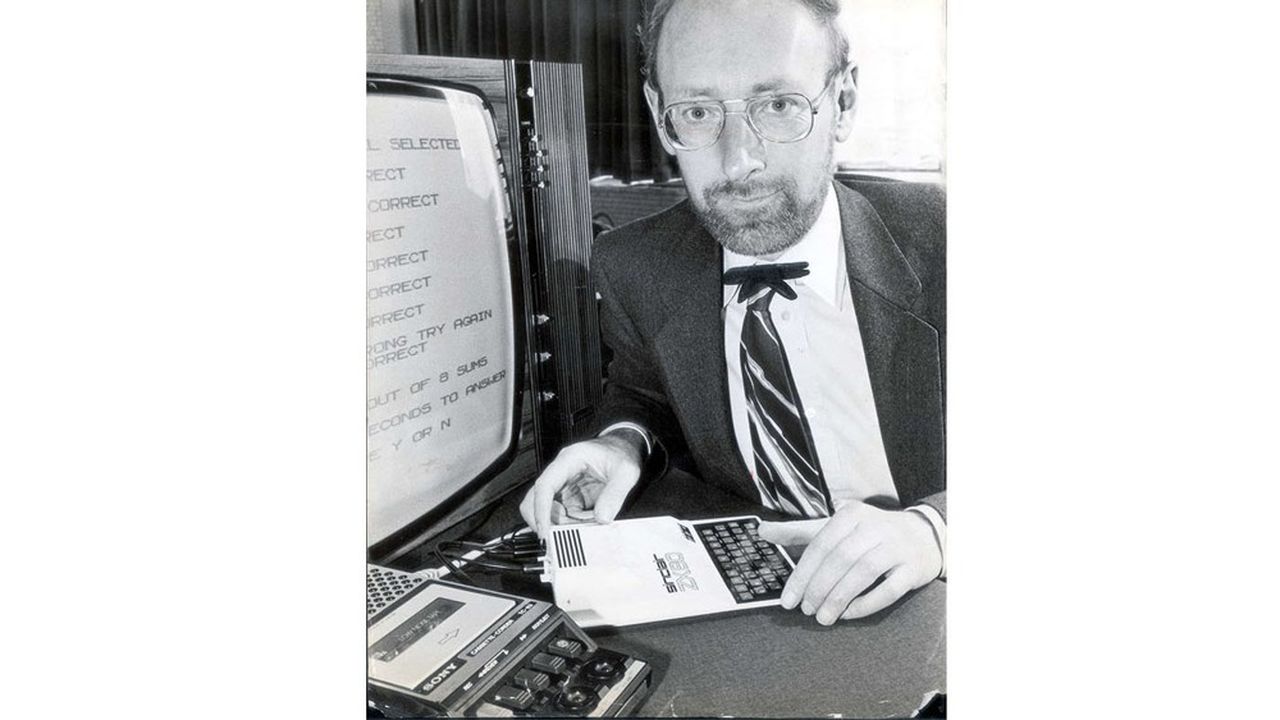
  • Mort d’une légende : Sir Clive Sinclair, l’inventeur des ZX, s’est éteint à 81 ans - Les Numériques
    https://www.lesnumeriques.com/vie-du-net/mort-d-une-legende-sir-clive-sinclair-l-inventeur-des-zx-s-est-eteint
    https://dyw7ncnq1en5l.cloudfront.net/optim/news/16/168595/4ee6fa04-mort-d-une-legende-sir-clive-sinclair-l-inventeur

    Sir Clive Sinclair nous a quittés. L’inventeur des Sinclair ZX qui ont aidé à populariser l’informatique et les jeux vidéo au sein de nombreux foyers est mort à l’âge de 81 ans.

    #décès #mort #disparition #clive_sinclair #inventeur #invention #sinclair_zx-80 #sinclair_zx-81 #zx-80 #zx-81 #jeu_vidéo #jeux_vidéo #zx_spectrum #sinclair_zx_spectrum #amstrad #amstrad_cpc #sinclair_ql

  • Irantzu Varela, #ElTornillo y las fronteras

    La España que quiere seguir siendo rica, blanca, paya y católica necesita fronteras para que no llegue gente buscando una vida mejor. Que no te engañen: esas barreras no están para protegerte, están para proteger a los que llevan siglos beneficiándose del sistema.

    https://www.youtube.com/watch?v=3-ymDvM5DV8

    #frontières #déconstruction #invention #identité #nationalisme #conquête #Espagne #génocide #exploitation #esclavage #violence #colonisation #richesse #migrations #vidéo

  • The invention of whiteness: the long history of a dangerous idea

    Before the 17th century, people did not think of themselves as belonging to something called the white race. But once the idea was invented, it quickly began to reshape the modern world.

    In 2008, a satirical blog called Stuff White People Like became a brief but boisterous sensation. The conceit was straightforward, coupling a list, eventually 136 items long, of stuff that white people liked to do or own, with faux-ethnographic descriptions that explained each item’s purported racial appeal. While some of the items were a little too obvious – indie music appeared at #41, Wes Anderson movies at #10 – others, including “awareness” (#18) and “children’s games as adults” (#102), were inspired. It was an instant hit. In its first two months alone, Stuff White People Like drew 4 million visitors, and it wasn’t long before a book based on the blog became a New York Times bestseller.

    The founder of the blog was an aspiring comedian and PhD dropout named Christian Lander, who’d been working as an advertising copywriter in Los Angeles when he launched the site on a whim. In interviews, Lander always acknowledged that his satire had at least as much to do with class as it did with race. His targets, he said, were affluent overeducated urbanites like himself. Yet there’s little doubt that the popularity of the blog, which depended for its humour on the assumption that whiteness was a contentless default identity, had much to do with its frank invocation of race. “As a white person, you’re just desperate to find something else to grab on to,” Lander said in 2009. “Pretty much every white person I grew up with wished they’d grown up in, you know, an ethnic home that gave them a second language.”

    Looking back at Stuff White People Like today, what marks the site’s age is neither the particularities of its irony nor the broad generalities of its targets. There are still plenty of white people with too much time and too much disposable income on their hands, and plenty of them still like yoga (#15), Vespa scooters (#126), and “black music that black people don’t listen to any more” (#116).

    What has changed, however – changed in ways that date Stuff White People Like unmistakably – is the cultural backdrop. Ten years ago, whiteness suffused mainstream culture like a fog: though pervasive to the point of omnipresence, it was almost nowhere distinct. When the sorts of white people for and about whom Lander was writing talked about being white, their conversations tended to span the narrow range between defensiveness and awkwardness. If they weren’t exactly clamouring to dispense with their racial identity, and the privileges that came with it, they were also not eager to embrace, or even discuss it, in public.

    In the years since, especially among the sort of people who might have once counted themselves fans of Lander’s blog, the public significance of whiteness has undergone an almost wholesale re-evaluation. Far from being a punchline for an anxious, cathartic joke, whiteness is now earnestly invoked, like neoliberalism or populism, as a central driver of cultural and political affairs. Whereas Lander could score a bestseller in 2008 with a book mocking whiteness as a bland cultural melange whose greatest sin was to be uninteresting, just nine years later Ta-Nehisi Coates would have his own bestseller that described whiteness as “an existential danger to the country and the world”.

    Much of the change, of course, had to do with Donald Trump, for whom, as Coates put it, “whiteness is neither notional nor symbolic, but is the very core of his power”. But it was not only Trump. Whiteness has been implicated in events on both sides of the Atlantic, including Brexit; mass shootings in Norway, New Zealand and the US; the George Floyd and Breonna Taylor killings; and the 6 January insurrection at the US Capitol. Alongside these real-world incidents, a bumper crop of scholarship, journalism, art and literature – by Coates, Nell Irvin Painter, Jordan Peele, Eric Foner, Ava DuVernay, Adam Serwer, Barbara and Karen Fields, Kevin Young, David Olusoga, Nikole Hannah-Jones, Colson Whitehead and Claudia Rankine, among many others – has spurred the most significant reconsideration of racial whiteness in 50 years.

    This reckoning, as it is sometimes called, has had measurable effects. In a Pew poll last October, nearly a third of white Americans said that the recent attention to racial issues signified a “major change” in American attitudes about race – another 45% said it was a “minor change” – and nearly half believed that those changes would lead to policies that would ameliorate racial inequality. In the UK, a YouGov poll from December suggested that more than a third of Britons reported that they were having more discussions about racism than they had previously.

    At the same time, this new focus on whiteness has prompted much confusion and consternation, especially among white people not used to thinking of themselves in racial terms. The Pew poll found that half of white Americans thought there was “too much” discussion of racial issues, and a similar proportion suggested that seeing racism where it didn’t exist was a bigger problem than not seeing racism where it did.

    What these recent debates have demonstrated more than anything, perhaps, is how little agreement still exists about what whiteness is and what it ought to be. Nearly everywhere in contemporary society “white” is presumed to be a meaningful index of identity that, like age and gender, is important enough to get mentioned in news accounts, tallied in political polls, and recorded in government databases. Yet what that identity is supposed to tell us is still substantially in dispute. In many ways, whiteness resembles time as seen by Saint Augustine: we presume we understand it as long as we’re not asked to explain it, but it becomes inexplicable as soon as we’re put to the test.

    A little more than a century ago, in his essay The Souls of White Folk, the sociologist and social critic WEB Du Bois proposed what still ranks as one of the most penetrating and durable insights about the racial identity we call white: “The discovery of personal whiteness among the world’s peoples is a very modern thing – a nineteenth and twentieth century matter, indeed.”

    Though radical in its time, Du Bois’s characterisation of what he called the “new religion of whiteness” – a religion founded on the dogma that “of all the hues of God, whiteness alone is inherently and obviously better than brownness and tan” – would have a profound effect on the way historians and other scholars would come to understand racial identity. In part this had to do with his insistence that a racial category like whiteness was more akin to a religious belief than a biological fact. Du Bois rejected the idea, still common in his day, that the races reflected natural divisions within the human species – as well as the nearly inevitable corollary that the physical, mental and behavioural traits associated with the white race just happened to be the ones most prized by modern societies.

    That had been the view, for instance, of Thomas Jefferson, who had attempted to delineate “the real distinctions which nature has made” between the races, in his Notes on the State of Virginia, first published in 1781. It was also the view that would appear, at least in attenuated form, two centuries later in Charles Murray and Richard J Herrnstein’s Bell Curve, which was published in 1994. Murray and Herrnstein argued that “the most plausible” explanation for the differences between Black and white populations recorded on IQ tests was “some form of mixed gene and environmental source” – in other words, that at least some of the discrepancy owes to natural differences.

    By the time The Bell Curve appeared, Du Bois’s assertion that racial categories were not biologically grounded was widely accepted. In the years since, the scientific evidence for that understanding has only become more overwhelming. A 2017 study examined the DNA of nearly 6,000 people from around the world and found that while some genetic differences among humans can be traced to various ancestral lineages – for example, eastern African, southern European or circumpolar – none of those lineages correspond to traditional ideas about race.

    If it’s easy enough for many people today to accept that whiteness is a purely sociological phenomenon – in some quarters, the idea that “race is a social construct” has become a cliche – the same cannot be said for Du Bois’s suggestion that whiteness is a relatively new thing in human history. And yet just as in the case of genetic science, during the second half of the 20th century a number of historians demonstrated that while Du Bois was off by a few hundred years, he was correct that it was only in the modern period that people started to think of themselves as belonging to something called the white race.

    Of course, it’s important not to overstate the case: the evolution of the idea of whiteness was messy and often indistinct. As the historian Nell Irvin Painter has cautioned, “white identity didn’t just spring to life full-blown and unchanging”. It had important antecedents that included a growing sense of a pan-European identity; longstanding cultural associations that saw white as a symbol of purity and virtue; and bog-standard ethnocentrism.

    Still, with only slightly exaggerated precision, we can say that one of the most crucial developments in “the discovery of personal whiteness” took place during the second half of the 17th century, on the peripheries of the still-young British empire. What’s more, historians such as Oscar and Mary Handlin, Edmund Morgan and Edward Rugemer have largely confirmed Du Bois’s suspicion that while xenophobia appears to be fairly universal among human groupings, the invention of a white racial identity was motivated from the start by a need to justify the enslavement of Africans. In the words of Eric Williams, a historian who later became the first prime minister of Trinidad and Tobago, “slavery was not born of racism: rather, racism was the consequence of slavery”.

    If you asked an Englishman in the early part of the 17th century what colour skin he had, he might very well have called it white. But the whiteness of his skin would have suggested no more suitable basis for a collective identity than the roundness of his nose or the baldness of his head. If you asked him to situate himself within the rapidly expanding borders of the known world, he would probably identify himself, first and most naturally, as an Englishman. If that category proved too narrow – if, say, he needed to describe what it was he had in common with the French and the Dutch that he did not share with Ottomans or Africans – he would almost certainly call himself a Christian instead.

    That religious identity was crucial for the development of the English slave trade – and eventually for the development of racial whiteness. In the early 17th century, plantation owners in the West Indies and in the American colonies largely depended on the labour of European indentured servants. These servants were considered chattel and were often treated brutally – the conditions on Barbados, England’s wealthiest colony, were notorious – but they were fortunate in at least one respect: because they were Christian, by law they could not be held in lifetime captivity unless they were criminals or prisoners of war.

    Africans enjoyed no such privilege. They were understood to be infidels, and thus the “perpetual enemies” of Christian nations, which made it legal to hold them as slaves. By 1640 or so, the rough treatment of indentured servants had started to diminish the supply of Europeans willing to work on the sugar and tobacco plantations, and so the colonists looked increasingly to slavery, and the Atlantic-sized loophole that enabled it, to keep their fantastically profitable operations supplied with labour.

    The plantation owners understood very well that their cruel treatment of indentured Europeans, and their even crueller treatment of enslaved Africans, might lead to thoughts – or worse – of vengeance. Significantly outnumbered, they lived in constant fear of uprisings. They were particularly afraid of incidents such as Bacon’s Rebellion, in 1676, which saw indentured Europeans fighting side-by-side with free and enslaved Africans against Virginia’s colonial government.

    To ward off such events, the plantation owners initially sought to protect themselves by giving their “Christian” servants legal privileges not available to their enslaved “Negroes”. The idea was to buy off the allegiance of indentured Europeans with a set of entitlements that, however meagre, set them above enslaved Africans. Toward the end of the 17th century, this scheme witnessed a significant shift: many of the laws that regulated slave and servant behaviour – the 1681 Servant Act in Jamaica, for example, which was later copied for use in South Carolina – began to describe the privileged class as “whites” and not as “Christians”.

    One of the more plausible explanations for this change, made by Rugemer and the historian Katharine Gerbner, among others, is that the establishment of whiteness as a legal category solved a religious dilemma. By the 1670s, Christian missionaries, including the Quaker George Fox, were insisting that enslaved Africans should be inducted into the Christian faith. The problem this posed for the planters was obvious: if their African labourers became Christians, and no longer “perpetual enemies” of Christendom, then on what legal grounds could they be enslaved? And what about the colonial laws that gave special privileges to Christians, laws whose authors apparently never contemplated the possibility that Africans might someday join the faith?

    The planters tried to resolve the former dilemma by blocking the conversion of enslaved Africans, on the grounds, as the Barbados Assembly put it in 1680, that such conversion would “endanger the island, inasmuch as converted negroes grow more perverse and intractable than others”. When that didn’t work (the Bishop of London objected) they instead passed laws guaranteeing that baptism could not be invoked as grounds for seeking freedom.

    But the latter question, about privileges for Christians, required the colonialists to think in a new way. No longer could their religious identity separate them and their servants from enslaved Africans. Henceforth they would need what Morgan called “a screen of racial contempt”. Henceforth, they would need to start thinking of themselves as white.

    As late as 1694, a slave-ship captain could still question the racial logic newly employed to justify his trade. (“I can’t think there is any intrinsick value in one colour more than another, nor that white is better than black, only we think it so because we are so,” Thomas Phillips wrote in his diary.) But whiteness quickly proved itself a powerful weapon that allowed transatlantic capitalism to secure the labour – “white” and African – it needed. As the historian Theodore Allen put it, “The plantation bourgeoisie deliberately extended a privileged status to the white poor of all categories as a means of turning to African slavery as the basis of its system of production.”

    The economic utility of the idea of whiteness helped spread it rapidly around the world. Du Bois was not wrong to call it a religion, for like a religion, it operated at every psychological, sociological and political scale, from the most intimate to the most public. Like a religion, too, it adapted to local conditions. What it meant to be white in British Virginia was not identical to what it would mean in New York before the American civil war, in India during the Raj, in Georgia during Jim Crow, in Australia after Federation, or in Germany during the Third Reich. But what united all these expressions was a singular idea: that some group of people called white was naturally superior to all others. As Benjamin Disraeli, the Victorian prime minister and one of the most committed race ideologists of his time, put it, “race implies difference, difference implies superiority, and superiority leads to predominance”.

    The idea of whiteness, in other words, was identical to the idea of white supremacy. For the three centuries that preceded the civil rights movement, this presumption was accepted at the most refined levels of culture, by people who, in other contexts, were among the most vocal advocates of human liberty and equality. It is well known that Immanuel Kant argued we should treat every other person “always at the same time as an end and never simply as a means”. Less well known is his proposal, in his Lectures on Physical Geography, published in 1802, that “humanity is at its greatest perfection in the race of the whites”, or his claim, in his notes for his Lectures on Anthropology, that native “Americans and Negroes cannot govern themselves. Thus, serve only as slaves”. Even Gandhi, during the early part of his life, accepted the basic lie of whiteness, arguing that “the English and the Indians spring from a common stock, called the Indo-Aryan” and that “the white race in South Africa should be the predominating race”.

    As though aware of their own guilty conscience, the evangelists of the religion of whiteness were always desperate to prove that it was something other than mere prejudice. Where the Bible still held sway, they bent the story of Noah’s son Ham into a divine apologia for white supremacy. When anatomy and anthropology gained prestige in the 18th and 19th centuries, they cited pseudo-scientific markers of racial difference like the cephalic index and the norma verticalis. When psychology took over in the 20th, they told themselves flattering stories about divergences in IQ.

    For all their evident success, the devotees of the religion of whiteness were never able to achieve the total vision they longed for. In part, this was because there were always dissenters, including among those who stood to gain from it, who rejected the creed of racial superiority. Alongside those remembered by history – Elizabeth Freeman, Toussaint Louverture, Harriet Tubman, Sitting Bull, Franz Boas, Haviva Reik, Martin Luther King Jr, Nelson Mandela – there were millions of now-forgotten people who used whatever means they possessed to resist it. In part, too, the nonsense logic that regulated the boundaries of whiteness – the one-drop rule in the US, which said that anyone with Black ancestry could not be white; the endless arguments over what “caucasian” was supposed to mean; the “honorary Aryan” status that Hitler extended to the Japanese – was no match for the robust complexities of human society.

    Yet if the religion of whiteness was never able to gain acceptance as an unchallengeable scientific fact, it was still hugely successful at shaping social reality. Some of this success had to do with its flexibility. Thanks to its role in facilitating slavery, whiteness in the US was often defined in opposition to blackness, but between those two extremes was room for tactical accommodations. In 1751, Benjamin Franklin could claim that only the English and Saxons “make the principal Body of White People on the Face of the Earth”, and nearly 80 years later, Ralph Waldo Emerson would insist that the Irish, like the Chinese and the Native American, were not caucasian. Over time, however, the definition of who counted as culturally white expanded to include Catholics from southern Europe, the Irish and even Jews, who for centuries had been seen as quintessential outsiders.

    The religion of whiteness also found success by persuading its adherents that they, and not the people they oppressed, were the real victims. In 1692, colonial legislators in British Barbados complained that “sundry of the Negroes and Slaves of this island, have been long preparing, contriving, conspiring and designing a most horrid, bloody, damnable and detestable rebellion, massacre, assassination and destruction”. From there, it was a more or less straight line to Woodrow Wilson’s claim, in 1903, that the southerners who started the Ku Klux Klan were “aroused by the mere instinct of self-preservation”, and to Donald Trump’s warning, when he launched his presidential campaign in 2015, that Mexican immigrants to the US were “bringing drugs. And they’re bringing crime. And they’re rapists.”

    Where the religion of whiteness was not able to win converts with persuasion or fear, it deployed cruder measures to secure its power, conscripting laws, institutions, customs and churches to enforce its prerogatives. Above all, it depended on force. By the middle of the 20th century, the presumption that a race of people called white were superior to all others had supplied the central justification not just for the transatlantic slave trade but also for the near-total extinction of Indians in North America; for Belgian atrocities in Congo; for the bloody colonisation of India, east Africa and Australia by Britain; for the equally bloody colonisation of north and west Africa and south-east Asia by France; for the deployment of the Final Solution in Nazi Germany; and for the apartheid state in South Africa. And those are merely the most extreme examples. Alongside those murdered, raped and enslaved in the name of whiteness, the total number of whom runs at least to nine figures, are an almost unthinkable number of people whose lives were shortened, constrained, antagonised and insulted on a daily basis.

    It was not until the aftermath of the second world war that frank endorsements of white supremacy were broadly rejected in Anglo-American public discourse. That this happened at all was thanks largely to the efforts of civil rights and anti-colonial activists, but the war itself also played a role. Though the horrors of the Nazi regime had been more acute in their intensity than anything happening at the time in the US or the UK, they supplied an unflattering mirror that made it impossible to ignore the racism that was still prevalent in both countries. (A New York Times editorial in 1946 made the connection explicit, arguing that “this is a particularly good year to campaign against the evils of bigotry, prejudice and race hatred because we have recently witnessed the defeat of enemies who tried to found a mastery of the world upon such a cruel and fallacious policy”.)

    Political appeals to white solidarity diminished slowly but certainly. In 1955, for example, Winston Churchill could still imagine that “Keep England White” was a winning general-election theme, and even as late as 1964, Peter Griffiths, a Conservative candidate for parliament, would score a surprise victory after endorsing a nakedly racist slogan. By 1968, however, when Enoch Powell delivered his “Rivers of Blood” speech – in which he approvingly quoted a constituent who lamented that “in 15 or 20 years’ time, the black man will have the whip hand over the white man” – he would be greeted by outrage in the Times, which called it an “evil speech”, and expelled from the Conservative shadow cabinet. In the US, too, where a century of racial apartheid had followed a century of slavery, open expressions of racism met with increasing public censure. Throughout the 60s and into the 70s, Congress passed a series of statutes that rendered explicit racial discrimination illegal in many areas of public life.

    This gradual rejection of explicit, government-enforced white supremacy was hugely consequential in terms of public policy. Yet it did not mean that whiteness, as a political force, had lost its appeal: in the weeks after Powell’s speech, to take just one example, a Gallup poll found that 74% of Britons supported his suggestion that brown-skinned immigrants ought to be repatriated. It also left unresolved the more difficult question of whether whiteness was truly separable from its long history of domination.

    Instead of looking too hard at the sordid history of whiteness, many white people found it easier to decide that the civil rights movement had accomplished all the anti-racism work that needed doing. The result was a strange détente. On the one hand, whiteness retreated as a subject of public attention, giving way to a new rhetoric of racial colour-blindness. On the other hand, vast embedded economic and cultural discrepancies allowed white people continue to exercise the institutional and structural power that had accumulated on their behalf across the previous three centuries.

    Similarly, while blatant assertions of white power – such as the 1991 gubernatorial campaign of David Duke, a former Ku Klux Klan grand wizard, in Louisiana – met with significant elite resistance, what counted as racist (and therefore subject to the taboo) was limited to only the most flagrant instances of racial animus. Among liberals and conservatives, racism was widely understood as a species of hatred, which meant that any white person who could look into his heart and find an absence of open hostility could absolve himself of racism.

    Even the phrase “white supremacy”, which predates the word “racism” in English by 80 years and once described a system of interlocking racial privileges that touched every aspect of life, was redefined to mean something rare and extreme. In 1923, for example, under the headline White Supremacy Menaced, the New York Times would print an article which took at face value a Harvard professor’s warning that “one of the gravest and most acute problems before the world today” was “the problem of saving the white race from submergence in the darker races”. In 1967, the US supreme court invalidated a law that prevented whites from marrying people who were not white, on the grounds that it was “obviously an endorsement of the doctrine of White Supremacy”, and two years later, the critic Albert Murray would use the phrase to describe everything from anti-Black prejudice in police departments to bigoted media representations of Black life to influential academic studies such as Daniel Patrick Moynihan’s The Negro Family.

    By the 80s and 90s, however, at least in white-dominated media, “white supremacy” was reserved only for the most shocking and retrograde examples of racism. For many people who grew up at that time, as I did, the phrase evoked cross burnings and racist hooligans, rather than an intricate web of laws and norms that maintained disparities of wealth, education, housing, incarceration and access to political power.

    Perhaps most perverse of all was the charge of “reverse racism”, which emboldened critics of affirmative action and other “race-conscious” policies to claim that they, and not the policies’ proponents, were the true heralds of racial equality. In 1986, Ronald Reagan went so far as to defend his opposition to minority-hiring quotas by invoking Martin Luther King Jr: “We want a colour-blind society,” Reagan declared. “A society, that in the words of Dr King, judges people not by the colour of their skin, but by the content of their character.”

    Of course not everyone accepted this new dispensation, which scholars have variously described as “structural racism”, “symbolic racism” or “racism without racists”. In the decades following the civil rights movement, intellectuals and activists of colour continued to develop the Du Boisian intellectual tradition that understood whiteness as an implement of social domination. In the 80s and 90s, a group of legal scholars that included Derrick Bell, Kimberlé Crenshaw, Cheryl Harris and Richard Delgado produced a body of research that became known as critical race theory, which was, in Bell’s words, “ideologically committed to the struggle against racism, particularly as institutionalised in and by law”.

    Alongside critical race theory, and in many ways derived from it, a new academic trend, known as whiteness studies, took shape. Historians working in this subfield demonstrated the myriad ways in which the pursuit of white supremacy – like the pursuit of wealth and the subjection of women – had been one of the central forces that gave shape to Anglo-American history. For many of them, the bill of indictment against whiteness was total: as the historian David Roediger put it, “it is not merely that whiteness is oppressive and false; it is that whiteness is nothing but oppressive and false.”

    In the fall of 1992, a new journal co-founded by Noel Ignatiev, one of the major figures in whiteness studies, appeared in bookstores around Cambridge, Massachusetts. Called Race Traitor, the magazine wore its motto and guiding ethos on its cover: Treason to Whiteness is Loyalty to Humanity. The issue opened with an editorial whose headline was equally provocative: “Abolish the white race – by any means necessary.” This demand, with its echoes of Sartre by way of Malcolm X, was not, as it turned out, a call for violence, much less for genocide. As Ignatiev and his co-editor, John Garvey, explained, they took as their foundational premise that “the white race is a historically constructed social formation”, a sort of club whose membership “consists of those who partake of the privileges of the white skin in this society”.

    For Ignatiev and Garvey, whiteness had been identified with white supremacy for so long that it was folly to think it was salvageable. “So long as the white race exists,” they wrote, “all movements against racism are doomed to fail.” What was necessary, in their view, was for the people called “white” – people like them – to forcefully reject that identification and the racial privileges that came with it. Whiteness, they suggested, was a fragile, unstable thing, such that even a small number of determined attacks – objecting to racist educational programmes at a school board meeting, say, or capturing racist police behaviour on video – ought to be able to unsettle the whole edifice.

    But while whiteness studies produced much work that still makes for bracing, illuminating reading, it was soon mocked as one more instance of the very privilege it meant to oppose. “The whole enterprise gives whites a kind of standing in the multicultural paradigm they have never before enjoyed,” Margaret Talbot wrote in the New York Times in 1997. “And it involves them, inevitably, in a journey of self-discovery in which white people’s thoughts about their own whiteness acquire a portentous new legitimacy.” Even Ignatiev would later say he “wanted nothing to do with” it.

    By the mid-2000s, the “colour-blind” ideological system had become so successful that it managed to shield even the more obvious operations of whiteness – the overwhelming numbers of white people in corporate boardrooms, for instance, or in the media and tech industries – from much censure. In the US, when racial disparities could not be ignored, it was often suggested that time was the only reliable remedy: as the numerical proportion of whites dwindled, so too would their political and economic power diminish. (Never mind that whiteness had managed to escape predictions of demographic doom before, by integrating groups it had previously kept on its margins.)

    Meanwhile, younger white liberals, the sort of people who might have read Bell or Crenshaw or Ignatiev at university, tended to duck the subject of their own racial identity with a shuffling awkwardness. Growing up white in the decades after the civil rights movement was a little like having a rich but disreputable cousin: you never knew quite what to make of him, or the extravagant gifts he bought for your birthday, and so you found it easier, in general, just not to say anything.

    The absence of talk about whiteness was so pervasive that it became possible to convince yourself that it constituted one of the central obstacles to racial progress. When I was in graduate school during the early 00s, toward the end of the whiteness-studies boomlet, I often heard – including from my own mouth – the argument that the real problem was that white people weren’t talking enough about their racial identity. If you could get people to acknowledge their whiteness, we told ourselves, then it might be possible to get them to acknowledge the unfair ways in which whiteness had helped them.

    The trouble with this notion would become clear soon enough, when the presidency of Barack Obama offered the surest test to date of the proposition that whiteness had separated itself from its supremacist past. Though Obama’s election was initially hailed by some as proof that the US was entering a new post-racial phase, it took just a few months for the Tea party, a conservative movement ostensibly in favour of small government, to suggest that the opposite was closer to the truth.

    In September 2009, Jimmy Carter caused a stir by suggesting that the Tea party’s opposition was something other than a principled reaction to government spending. “I think an overwhelming portion of the intensely demonstrated animosity toward President Barack Obama is based on the fact that he is a black man,” Carter said. (Carter’s speculation was later backed up by research: the political scientist Ashley Jardina, for instance, found that “more racially resentful whites are far more likely to say they support the Tea party and rate it more positively.”)

    The white backlash to Obama’s presidency continued throughout his two terms, helped along by Rupert Murdoch’s media empire and the Republican party, which won majorities in both houses of Congress by promising to obstruct anything Obama tried to accomplish. Neither project kept Obama from a second term, but this does not mean that they were without effect: though Obama lost white voters by 12% in 2008, four years later he would lose them by 20%, the worst showing among white voters for a successful candidate in US history.

    At the same time, Obama’s victory suggested to some observers the vindication of the demographic argument: the changing racial composition of the US appeared to have successfully neutralised the preferences of the white electorate, at least as far as the presidency was concerned. (“There just are not enough middle-aged white guys that we can scrape together to win,” said one Republican after Obama’s victory.)

    What’s more, the first wave of Black Lives Matter protests, which attracted international attention in the summer of 2014, prompted a torrent of demonstrative introspection among white people, especially online. As the critic Hua Hsu would write, half-teasingly, in 2015, “it feels as though we are living in the moment when white people, on a generational scale, have become self-aware”.

    Not for the first time, however, what was visible on Twitter was a poor indicator of deeper social trends. As we now know, the ways in which whiteness was becoming most salient at mid-decade were largely not the ways that prompted recent university graduates to announce their support for Rhodes Must Fall on Instagram. Far more momentous was the version of white identity politics that appreciated the advantages of whiteness and worried about them slipping away; that saw in immigration an existential threat; and that wanted, more than anything, to “Take Back Control” and to “Make America Great Again”.

    It was this version of whiteness that helped to power the twin shocks of 2016: first Brexit and then Trump. The latter, especially – not just the fact of Trump’s presidency but the tone of it, the unrestrained vengeance and vituperation that animated it – put paid to any lingering questions about whether whiteness had renounced its superiority complex. Ta-Nehisi Coates, who more than any other single person had been responsible for making the bumbling stereotype of whiteness offered up by Stuff White People Like seem hopelessly myopic, understood what was happening immediately. “Trump truly is something new – the first president whose entire political existence hinges on the fact of a black president,” Coates wrote in the autumn of 2017. “His ideology is white supremacy, in all its truculent and sanctimonious power.”

    In 1860, a man who called himself “Ethiop” published an essay in The Anglo-African Magazine, which has been called the first Black literary journal in the US. The author behind the pseudonym was William J Wilson, a former bootmaker who later served as the principal of Brooklyn’s first public school for Black children. Wilson’s essay bore the headline, What Shall We Do with the White People?

    The article was meant in part meant to mock the white authors and statesmen who had endlessly asked themselves a similar question about Black people in the US. But it was not only a spoof. In a tone that mimicked the smug paternalism of his targets, he laid out a comprehensive indictment of white rule in the country: the plunder and murder of the “Aborigines”; the theft and enslavement of Africans; the hypocrisy embodied by the American constitution, government and white churches. At the root of all this, he wrote, was “a long continued, extensive and almost complete system of wrongdoing” that made the men and women who enabled it into “restless, grasping” marauders. “In view of the existing state of things around us,” Wilson proposed at the end, “let our constant thought be, what for the best good of all shall we do with the White people?”

    Much has changed since Wilson’s time, but a century and a half on, his question remains no less pertinent. For some people, such as the political scientist Eric Kaufmann, whiteness is what it has always pretended to be. Though he acknowledges that races are not genetically defined, Kaufmann nevertheless sees them as defensible divisions of humanity that have some natural basis: they emerge, he suggests, “through a blend of unconscious colour-processing and slowly evolved cultural conventions”. In his 2019 book Whiteshift, Kaufmann argues that the history of oppression by white people is “real, but moot”, and he advocates for something he calls “symmetrical multiculturalism”, in which “identifying as white, or with a white tradition of nationhood, is no more racist than identifying as black”. What shall we do with the white people? Kaufmann thinks we should encourage them to take pride in being white, lest they turn to more violent means: “Freezing out legitimate expressions of white identity allows the far right to own it, and acts as a recruiting sergeant for their wilder ideas.”

    From another perspective – my own, most days – whiteness means something different from other racial and ethnic identities because it has had a different history than other racial and ethnic identities. Across three-and-a-half centuries, whiteness has been wielded as a weapon on a global scale; Blackness, by contrast, has often been used as a shield. (As Du Bois put it, what made whiteness new and different was “the imperial width of the thing – the heaven-defying audacity.”) Nor is there much reason to believe that whiteness will ever be content to seek “legitimate expressions”, whatever those might look like. The religion of whiteness had 50 years to reform itself along non-supremacist lines, to prove that it was fit for innocuous coexistence. Instead, it gave us Donald Trump.

    Yet even this does not fully answer Wilson’s question. For if it’s easy enough to agree in theory that the only reasonable moral response to the long and very much non-moot history of white supremacy is the abolitionist stance advocated in the pages of Race Traitor – ie, to make whiteness meaningless as a group identity, to shove it into obsolescence alongside “Prussian” and “Etruscan” – it seems equally apparent that whiteness is not nearly so fragile as Ignatiev and Garvey had imagined. Late in his life, James Baldwin described whiteness as “a moral choice”, as a way of emphasising that it was not a natural fact. But whiteness is more than a moral choice: it is a dense network of moral choices, the vast majority of which have been made for us, often in times and places very distant from our own. In this way whiteness is a problem like climate change or economic inequality: it is so thoroughly imbricated in the structure of our everyday lives that it makes the idea of moral choices look quaint.

    As with climate change, however, the only thing more difficult than such an effort would be trying to live with the alternative. Whiteness may seem inevitable and implacable, and Toni Morrison surely had it right when she said that the world “will not become unracialised by assertion”. (To wake up tomorrow and decide I am no longer white would help no one.) Even so, after 350 years, it remains the case, as Nell Irvin Painter argues, that whiteness “is an idea, not a fact”. Not alone, and not without much work to repair the damage done in its name, it still must be possible to change our minds.

    https://www.theguardian.com/news/2021/apr/20/the-invention-of-whiteness-long-history-dangerous-idea
    #blanchité #races #invention #histoire #race_blanche #modernité

    ping @cede @karine4

  • La fabrique européenne de la race (17e-20e siècles)

    Dans quelle galère sommes-nous allé•es pointer notre nez en nous lançant dans ces réflexions sur la race ? Complaisance à l’air du temps saturé de références au racisme, à la #racialisation des lectures du social, diront certain•es. Nécessaire effort épistémologique pour contribuer à donner du champ pour penser et déconstruire les représentations qui sous-tendent les violences racistes, pensons-nous.

    Moment saturé, on ne peut guère penser mieux… ou pire. Évidemment, nous n’avions pas anticipé l’ampleur des mobilisations contre les #violences_racistes de cet été aux États-Unis, mais nous connaissons leur enracinement dans la longue durée, l’acuité récente des mobilisations, que ce soit « #black_lives_matter » aux États-Unis ou les #mobilisations contre les #violences_policières qui accablent les plus vulnérables en France. L’enracinement aussi des #représentations_racialisées, structurant les fonctionnements sociaux à l’échelle du globe aujourd’hui, d’une façon qui apparaît de plus en plus insupportable en regard des proclamations solennelles d’#égalité_universelle du genre humain. Nous connaissons aussi l’extrême #violence qui cherche à discréditer les #protestations et la #révolte de celles et ceux qui s’expriment comme #minorité victime en tant que telle de #discriminations de races, accusé•es ici de « #terrorisme », là de « #communautarisme », de « #séparatisme », de vouloir dans tous les cas de figure mettre à mal « la » république1. Nous connaissons, associé à cet #antiracisme, l’accusation de #complot dit « #décolonial » ou « postcolonial », qui tente de faire des spécialistes des #colonisations, des #décolonisations et des #rapports_sociaux_racisés des vecteurs de menaces pour l’#unité_nationale, armant le mécontentement des militant•es2. Les propos haineux de celles et ceux qui dénoncent la #haine ne sont plus à lister : chaque jour apporte son lot de jugements aussi méprisants que menaçants. Nous ne donnerons pas de noms. Ils ont suffisamment de porte-voix. Jusqu’à la présidence de la République.

    3L’histoire vise à prendre du champ. Elle n’est pas hors sol, ni hors temps, nous savons cela aussi et tout dossier que nous construisons nous rappelle que nous faisons l’histoire d’une histoire.

    Chaque dossier d’une revue a aussi son histoire, plus ou moins longue, plus ou moins collective. Dans ce Mot de la rédaction, en septembre 2020, introduction d’un numéro polarisé sur « l’invention de la race », nous nous autorisons un peu d’auto-histoire. Les Cahiers cheminent depuis des années avec le souci de croiser l’analyse des différentes formes de domination et des outils théoriques comme politiques qui permettent leur mise en œuvre. Avant que le terme d’« #intersectionnalité » ne fasse vraiment sa place dans les études historiennes en France, l’#histoire_critique a signifié pour le collectif de rédaction des Cahiers la nécessité d’aborder les questions de l’#exploitation, de la #domination dans toutes leurs dimensions socio-économiques, symboliques, dont celles enracinées dans les appartenances de sexe, de genre, dans les #appartenances_de_race. Une recherche dans les numéros mis en ligne montre que le mot « race » apparaît dans plus d’une centaine de publications des Cahiers depuis 2000, exprimant le travail de #visibilisation de cet invisible de la #pensée_universaliste. Les dossiers ont traité d’esclavage, d’histoire coloniale, d’histoire de l’Afrique, d’histoire des États-Unis, de l’importance aussi des corps comme marqueurs d’identité : de multiples façons, nous avons fait lire une histoire dans laquelle le racisme, plus ou moins construit politiquement, légitimé idéologiquement, est un des moteurs des fonctionnements sociaux3. Pourtant, le terme d’ « intersectionnalité » apparaît peu et tard dans les Cahiers. Pour un concept proposé par Kimberlé Crenshaw dans les années 1990, nous mesurons aujourd’hui les distances réelles entre des cultures historiennes, et plus globalement sociopolitiques, entre monde anglophone et francophone, pour dire vite4. Effet d’écarts réels des fonctionnements sociaux, effets de la rareté des échanges, des voyages, des traductions comme le rappelait Catherine Coquery-Vidrovitch dans un entretien récent à propos des travaux des africanistes5, effet aussi des constructions idéologiques marquées profondément par un contexte de guerre froide, qui mettent à distance la société des États-Unis comme un autre irréductible. Nous mesurons le décalage entre nos usages des concepts et leur élaboration, souvent dans les luttes de 1968 et des années qui ont suivi. Aux États-Unis, mais aussi en France6. Ce n’est pas le lieu d’évoquer la formidable énergie de la pensée des années 1970, mais la créativité conceptuelle de ces années, notamment à travers l’anthropologie et la sociologie, est progressivement réinvestie dans les travaux historiens au fur et à mesure que les origines socioculturelles des historiens et historiennes se diversifient. L’internationalisation de nos références aux Cahiers s’est développée aussi, pas seulement du côté de l’Afrique, mais du chaudron étatsunien aussi. En 2005, nous avons pris l’initiative d’un dossier sur « L’Histoire de #France vue des États-Unis », dans lequel nous avons traduit et publié un auteur, trop rare en français, Tyler Stovall, alors professeur à l’université de Berkeley : bon connaisseur de l’histoire de France, il développait une analyse de l’historiographie française et de son difficile rapport à la race7. Ce regard extérieur, venant des États-Unis et critique de la tradition universaliste française, avait fait discuter. Le présent dossier s’inscrit donc dans un cheminement, qui est aussi celui de la société française, et dans une cohérence. Ce n’était pas un hasard si en 2017, nous avions répondu à l’interpellation des organisateurs des Rendez-vous de l’histoire de Blois, « Eurêka, inventer, découvrir, innover » en proposant une table ronde intitulée « Inventer la race ». Coordonnée par les deux responsables du présent dossier, David Hamelin et Sébastien Jahan, déjà auteurs de dossiers sur la question coloniale, cette table ronde avait fait salle comble, ce qui nous avait d’emblée convaincus de l’utilité de répondre une attente en préparant un dossier spécifique8. Le présent dossier est le fruit d’un travail qui, au cours de trois années, s’est avéré plus complexe que nous ne l’avions envisagé. Le propos a été précisé, se polarisant sur ce que nous avions voulu montrer dès la table-ronde de 2017 : le racisme tel que nous l’entendons aujourd’hui, basé sur des caractéristiques physiologiques, notamment la couleur de l’épiderme, n’a pas toujours existé. Il s’agit bien d’une « #invention », associée à l’expansion des Européens à travers le monde à l’époque moderne, par laquelle ils justifient leur #domination, mais associée aussi à une conception en termes de #développement, de #progrès de l’histoire humaine. Les historien•nes rassemblée•es ici montrent bien comment le racisme est enkysté dans la #modernité, notamment dans le développement des sciences du 19e siècle, et sa passion pour les #classifications. Histoire relativement courte donc, que celle de ce processus de #racialisation qui advient avec la grande idée neuve de l’égalité naturelle des humains. Pensées entées l’une dans l’autre et en même temps immédiatement en conflit, comme en témoignent des écrits dès le 17e siècle et, parmi d’autres actes, les créations des « #sociétés_des_amis_des_noirs » au 18e siècle. Conflit en cours encore aujourd’hui, avec une acuité renouvelée qui doit moins surprendre que la persistance des réalités de l’#inégalité.

    5Ce numéro 146 tisse de bien d’autres manières ce socle de notre présent. En proposant une synthèse documentée et ambitieuse des travaux en cours sur les renouvellements du projet social portés pour son temps et pour le nôtre par la révolution de 1848, conçue par Jérôme Lamy. En publiant une défense de l’#écriture_inclusive par Éliane Viennot et la présentation de son inscription dans le long combat des femmes par Héloïse Morel9. En suivant les analyses de la nouveauté des aspirations politiques qui s’expriment dans les « #têtes_de_cortège » étudiées par Hugo Melchior. En rappelant à travers expositions, films, romans de l’actualité, les violences de l’exploitation capitaliste du travail, les répressions féroces des forces socialistes, socialisantes, taxées de communistes en contexte de guerre froide, dans « les Cahiers recommandent ». En retrouvant Jack London et ses si suggestives évocations des appartenances de classes à travers le film « Martin Eden » de Pietro Marcello, et bien d’autres évocations, à travers livres, films, expositions, de ce social agi, modelé, remodelé par les luttes, les contradictions, plus ou moins explicites ou sourdes, plus ou moins violentes, qui font pour nous l’histoire vivante. Nouvelle étape de l’exploration du neuf inépuisable des configurations sociales (de) chaque numéro. Le prochain sera consacré à la fois à la puissance de l’Église catholique et aux normes sexuelles. Le suivant à un retour sur l’histoire du Parti communiste dans les moments où il fut neuf, il y a cent ans. À la suite, dans les méandres de ce social toujours en tension, inépuisable source de distance et de volonté de savoir. Pour tenter ensemble de maîtriser les fantômes du passé.

    https://journals.openedition.org/chrhc/14393

    #histoire #race #Europe #revue #racisme

    ping @cede @karine4

  • Construire une fusée pour bombarder les villes de graines de mauvaises herbes
    http://carfree.fr/index.php/2020/09/25/construire-une-fusee-pour-bombarder-les-villes-de-graines-de-mauvaises-herbe

    Le collectif artistique danois N55 a développé il y a quelques années le système de fusée N55 PROTEST qui permet aux gens de communiquer leur protestation de manière concrète. Il Lire la suite...

    #Alternatives_à_la_voiture #Vélo #actions #art #copenhague #danemark #humour #inventions #nature #permaculture #ville

  • Mirages de la carte

    Lorsque les troupes françaises débarquèrent à Alger en 1830, le territoire qui s’étendait devant eux leur était à peu près inconnu. Quelques récits de voyageurs, les traités des géographes antiques : le bagage était mince. La #conquête allait commencer, mais aucun Français ne savait ce qu’était l’Algérie. Quelles étaient ses limites, à l’est et à l’ouest, en direction de la Tunisie et du Maroc ? Fallait-il se contenter d’occuper une bande de terre côtière ou pénétrer en direction du mystérieux Sahara ? Comment établir des frontières, dans les confins traversés par des populations nomades ? Et, dans l’immédiat, sur quelles cartes s’appuyer pour assurer le contrôle du territoire, identifier les populations locales et nommer les régions occupées ?
    Mirages de la carte renouvelle en profondeur l’histoire de la conquête de l’Algérie, en suivant au plus près les travaux des géographes et des cartographes chargés d’arpenter ce territoire et d’en tracer les contours dans le sillage de l’#armée. Hélène Blais montre que la #géographie_coloniale sert à prendre #possession d’un territoire, aussi bien militairement que symboliquement, mais qu’elle ne se réduit pas à imposer une #domination. En nous conviant à l’#invention de l’#Algérie_coloniale, à la croisée des pratiques savantes et des ambitions impériales, ce livre original et novateur démontre brillamment comment l’#histoire_des_savoirs peut renouveler celle des #empires_coloniaux.


    https://www.fayard.fr/histoire/mirages-de-la-carte-9782213677620

    #livre #histoire #cartographie #France #Algérie #colonisation

    ping @reka @albertocampiphoto @karine4

    • Voyages au Grand Océan. Géographies du #Pacifique et colonisation, 1815-1845

      Pour avoir été dédiés à la #découverte et à la #science, les #grands_voyages de découverte autour du monde du XVIIIe siècle ont acquis un immense prestige. Au lendemain des guerres napoléoniennes, la #Marine_française tente de renouer avec cette tradition. De grands marins comme #Freycinet, #Dumont_d'Urville ou #Dupetit-Thouars partent alors sur les traces de Bougainville et de Lapérouse. Le monde a cependant changé. De 1815 à 1845, les ambitions coloniales renaissent. L’#océan_Pacifique, qui reste un réservoir de mythes et de rêves pour les Européens, devient simultanément un terrain de #convoitise. Il faut répondre à la fois aux normes modernes de précision et aux impératifs géostratégiques qui se modèlent dans cette partie du monde. En 1842, la mainmise française sur les archipels des #Marquises et de #Tahiti donne aux reconnaissances géographiques une orientation coloniale soudain explicite.
      C’est l’histoire encore méconnue de ces #voyages_océaniens, où les visées impérialistes se mêlent aux objectifs scientifiques, qui est ici racontée. Quels étaient les objectifs politiques et les visées scientifiques de ces #explorations ? Que faisaient au juste les voyageurs sur le terrain ? Quel nouveaux savoirs géographiques ont-ils élaboré ? Quel usage a-t-on fait des informations rapportées ?
      Hélène Blais montre comment la curiosité géographique et les ambitions coloniales s’articulent de façon inattendue et parfois ambiguë. Les marins comblent les blancs de la carte, donnant ainsi naissance à des géographies du Pacifique qui se distinguent pas leurs usages et leur réception. Mais au-delà, ces voyages au Grand Océan font apparaître, à travers le choix des échelles et les découpages internes, les différents facteurs qui président à l’invention d’un territoire dans un contexte d’#expansion_coloniale.


      http://cths.fr/ed/edition.php?id=601
      #océans #mers #mer #océan

  • Du camembert normand aux bêtises de Cambrai, en passant par le cassoulet toulousain et la choucroute alsacienne : retour sur les légendes culinaires ! Ou comment la cuisine devient un élément du patrimoine national…

    #histoire #patrimoine #légendes #cuisine #alimentation

    https://sms.hypotheses.org/22355

    Top Chef , Cauchemar en cuisine , Masterchef : la multiplication des émissions culinaires nous abreuve d’anecdotes sur l’origine des recettes ou de certains produits. Que ce soit la galette des rois à la frangipane, les cannelés de Bordeaux, les bêtises de Cambrai, ou encore le Roquefort – sans oublier la tarte tatin – tous s’appuient sur une légende censée être valorisante. Un rapide tour d’horizon montre toutefois que nombre de ces légendes sont souvent assez improbables ou juste totalement fausses.

    Loic Bienassis, chercheur associé en histoire à l’Institut Européen d’Histoire et des Cultures de l’Alimentation, s’intéresse à l’origine de ces légendes en France. Ce faisant, il cherche à comprendre pourquoi elles suscitent autant d’enthousiasme et quel est leur rôle dans l’établissement du patrimoine gastronomique (...)

    • Du brie de Charlemagne à la tarte renversée des sœurs Tatin : essai d’analyse des légendes culinaires et de leurs usages
      https://journals.openedition.org/insitu/25298

      Tentons tout d’abord d’apporter un peu de clarté dans le maquis des généalogies fantasmées. Il semble possible d’identifier trois familles de récits. La première d’entre elles regroupe ceux construits autour du motif de l’heureux accident – ce que traduit le concept, désormais consacré, de sérendipité2. Au sein de cette catégorie, on trouve le « manqué », ce riche gâteau en pâte à biscuit, doré et souvent parsemé d’amandes. En 1842, après avoir raté la neige de blancs d’œufs pour faire un biscuit de Savoie, un ouvrier-pâtissier parisien aurait ajouté du beurre pour se rattraper et lancé cette nouvelle recette3. On reste toutefois sceptique puisque les gourmets du xviiie siècle mangeaient déjà des « biscuits manqués », d’un type certes fort différent, et que l’on repère depuis les années 1820 au moins4 des recettes très proches de celle que nous connaissons.

      Deuxième origine classiquement invoquée : l’importation. Prenons la frangipane. On lit généralement qu’un noble italien de la famille des Frangipani a donné son nom à un parfum de son invention, parfum utilisé pour les gants avant qu’il n’entre dans la composition de la crème de nos galettes des Rois10. Une lettre de Guez de Balzac de mai 1634 vante effectivement la réputation des « gants de Frangipani » et attribue cette invention au marquis Pompeo Frangipani, son contemporain. On ne sait pas grand-chose de la composition originelle de ce parfum et si l’appellation a très vite gagné la cuisine, l’appareil des « tourtes de frangipane » ne comportait pas nécessairement d’amandes. La préparation canonique moderne ne se stabilisera qu’au xxe siècle. En clair, il s’agit d’une pâtisserie bien française au nom italianisant11.

      Mais nous touchons ici au troisième type de récit, qui se caractérise non par une structure récurrente mais par un contenu similaire : la référence à l’histoire avec un H majuscule. Dans un premier cas de figure, le motif de l’importation se superpose à cet arrière-plan. On vient de le noter pour les croisades, toile de fond sur laquelle se déploient plusieurs légendes.

      Ces contes font florès en raison des fonctions qu’ils remplissent. La première est celle de l’ennoblissement. Questionnant la véracité des légendes historiques, le folkloriste Arnold Van Gennep relevait qu’elles sont l’objet d’un déplacement temporel – alors que, contrairement au conte, elles se rapportent à des événements datés. Il s’agit soit d’un vieillissement, qui consiste à décaler un événement de plusieurs siècles en arrière ou, plus souvent, à le reporter dans un passé indéterminé et lointain, soit d’un rajeunissement, un événement ancien étant rattaché à un personnage ou à un épisode plus récent, et Van Gennep de citer les constructions, ruines, armes et ossements enfouis, attribués aux armées de Napoléon en de nombreux pays d’Europe23.

      Dans le cas qui nous occupe, sans exclure que des rajeunissements soient parfois opérés, le processus de vieillissement domine de très loin.

      Ces récits remplissent aussi une fonction d’intelligibilité. Une date est fixée, un créateur identifié. L’importation, le raté réussi ou l’invention simplifient le réel, apportent des réponses claires. Ils rendent compte de l’innovation et de la rupture. Le voyageur ou l’accident sont à même de générer de l’inédit. On laisse de côté toute idée de tâtonnement, les avancées incertaines, les évolutions mal datées. Un processus complexe, diffus, est remplacé par un découvreur unique, tel Dom Pérignon à qui l’on attribue, à tort, la mise au point du vin de Champagne pétillant28. En cela, ces récits sont en concordance avec les nombreux mythes qui jalonnent l’histoire des techniques en général, qu’ils portent sur la diffusion de celles-ci ou sur quelques inventeurs plus ou moins célèbres29.

      La promotion d’anonymes n’est que le reflet de la moindre dignité du champ culinaire et l’enrôlement de noms fameux qui n’y peuvent mais peut passer pour un moyen d’y remédier. L’histoire gastronomique écrite depuis plus de deux siècles se retrouve peuplée d’inconnus n’ayant jamais existé ou de grands personnages embrigadés sans raison. Très rares sont les authentiques obscurs qui, comme Marie Harel, accèdent à une petite notoriété grâce à la création dont on les crédite.

      #invention #sciences #techniques #cuisine #histoire

    • Ça fait des années que je fais ça, mais j’ai la chance d’avoir un vélo de la Poste avec un porte-bagage arrière qui est déjà très en arrière. Du coup je n’ai jamais eu besoin de faire tous ces trucs compliqués. Quand je fixe mon caddie avec deux tendeurs en posant sa poignée sur le porte-bagage, il est déjà assez éloigné de la roue, rien ne touche.

      Quant aux roues du caddie, jamais eu de problème pour l’instant. Mais bon quand je rentre avec 15kg de course ou plus je ne roule pas à tout vitesse non plus.

  • hypathie - Blog féministe et anti-spéciste: Hedy Lamarr - From extase to wifi
    http://hypathie.blogspot.com/2018/06/hedy-lamarr-from-extase-to-wifi.html

    Peut-on être très belle et être en même temps très intelligente ? La réponse à Hollywood est non. Aussi, il a fallu des dizaines d’années pour qu’Hedy Lamarr émerge comme inventrice d’un code de brouillage de signaux électroniques de torpilles. Dit comme ça, ce n’est pas glamour, donc c’est in-com-pa-ti-ble avec une carrière de bombe sexuelle. Apprenant aux infos au début de la guerre qu’un navire militaire de l’ US Navy avait été torpillé par sa propre arme que l’ennemi avait détournée en décodant et détournant son signal de commande, l’obstinée chercheuse patriote (née en Autriche mais reconnaissante à son pays d’adoption) va se casser la tête à imaginer un signal brouillé « à étalement de spectre », de façon à éviter ce genre d’accident. Après des journées harassantes d’apprêt, de maquillage et de tournage, Hedy Lamarr se délassait en faisant des casse-tête mathématiques !

    • https://fr.wikipedia.org/wiki/Hedy_Lamarr

      En 1941, en collaboration avec George Antheil, Hedy Lamarr propose son système secret de communication applicable aux torpilles radio-guidées, qui permettait au système émetteur-récepteur de la torpille de changer de fréquence, rendant pratiquement impossible la détection de l’attaque sous-marine par l’ennemi. Il s’agit d’un principe de transmission (étalement de spectre par saut de fréquence) toujours utilisé pour le positionnement par satellites (GPS, GLONASS…), les liaisons chiffrées militaires, les communications des navettes spatiales avec le sol, la téléphonie mobile ou dans la technique Wi-Fi.

      Hedy Lamarr a bien d’autres centres d’intérêts que son métier d’actrice et, de ses conversations avec son ami, le compositeur d’avant-garde George Antheil, est née l’idée de cette invention9. Lamarr avait pris connaissance de technologies de différentes armes, dont celles de systèmes de contrôle de torpilles, lorsqu’elle avait été mariée (de 1933 à 1937) à Friedrich Mandl, un très important fabricant d’armes autrichien, converti au catholicisme pour faire commerce avec l’Heimwehr autrichienne. Antheil, quant à lui, était familier des systèmes de contrôle automatiques et des séquences de sauts de fréquence qu’il utilisait dans ses compositions musicales et ses représentations9. Dans le but d’aider les Alliés dans leur effort de guerre, ils proposent leur invention à une association d’inventeurs dans le domaine, le National Inventors Council (en), en décembre 1940, puis décident de déposer le brevet, le 10 juin 1941, en rendant cette invention immédiatement libre de droits pour l’Armée des États-Unis9.

      Le Bureau des brevets américain détient en effet, cosignée par Hedy Lamarr11, la description d’un système de communication secrète pour engins radio-guidés, appliqué par exemple aux torpilles. Le brevet intitulé Secret communication system (brevet des USA no 2 292 387) du 10 juin 1941 (enregistré le 11 août 1942) décrit un système de variation simultanée des fréquences de l’émetteur et du récepteur, selon le même code enregistré (le support utilisé étant des bandes perforées)12. Mais cette idée ne fut pas mise en pratique à l’époque, bien que la Marine américaine eût, dans les années 1950, un projet de détection de sous-marins par avions utilisant cette technique.

      Plus tard, les progrès de l’électronique font que le procédé est utilisé — officiellement pour la première fois par l’Armée américaine — dans la crise des missiles de Cuba en 1962 et pendant la guerre du Vietnam. Lorsque le brevet est déclassifié, le dispositif est également utilisé par les constructeurs de matériels de transmission, en particulier depuis les années 1980. La plupart des téléphones portables mettent à profit la « technique Lamarr ».

      Hedy Lamarr a rétroactivement reçu le prix de l’Electronic Frontier Foundation américaine en 1997. À titre posthume, elle et George Antheil ont ensuite été admis au National Inventors Hall of Fame en 2014.

  • Fleurs de ruines : lieux de création alternatifs dans la Grèce des mémorandums

    À partir de 2010, des dizaines de lieux de création alternatifs commencent à apparaître dans les ruines laissées par le retrait et la faillite de l’État grec. Dans le même temps, des fondations privées aux moyens colossaux ouvrent leurs portes ou sont mises en chantier. À partir de notre expérience propre (la création d’un espace culturel alternatif, l’Atelier de réparation de télévisions, par Fotiní Banou et moi-même en novembre 2012), ce texte a pour objet d’esquisser un tableau du paysage culturel apparu à Athènes dans le contexte de crise, d’offensive néo-libérale et de « résistance créatrice » que connaît le pays depuis 2008.

    #austérité #autogestion #culture #dette #Grèce #invention #mouvements #politique #production #résistances #théâtre #fondations #LVMH

    https://oulaviesauvage.wordpress.com/2017/03/08/fleurs-de-ruines-lieux-de-creation-alternatifs-dans-la-gre