• Epstein Family Values
    ▻https://www.equator.org/articles/epstein-family-values

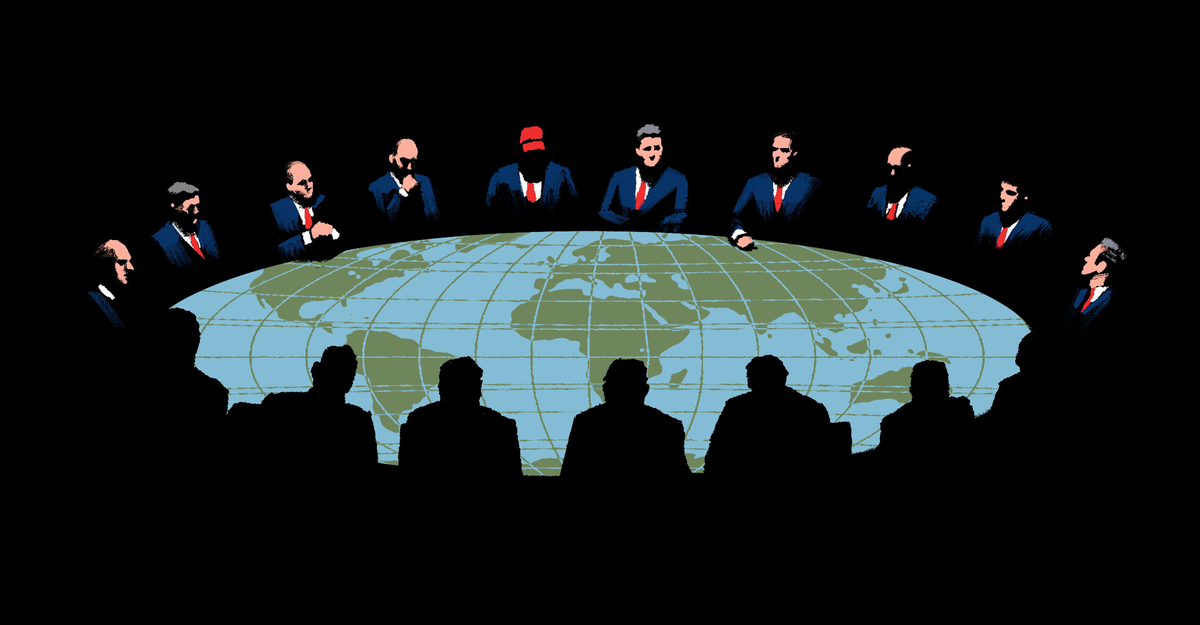
    Il est possible que le monde privé de Marine Le Pen ressemble à celui crée par Jeffrex Epstein, Donald Trump et les autres riches d’extrême droite souvent mais pas forcément proches d’Israël.

    Suivant les documents de l’affaire Epstein il y a une culture et une forme de vie des très riches qui a davantage de points communs avec la vie des princes saoudiens qu’avec les normes culturelles occidentales modernes.

    14.2.2026 by Melinda Cooper - The billionaire patriarchs of the American far-right want to rule an economy of masters and servants

    1.

    Among the weirder features of the contemporary American far right is the emergence of ‘primal fathers’ – Old Testament patriarchs who want to sire not just a family, but a race. Elon Musk is the best known of these Aspirational Abrahams, although he is by no means the only one. A long Wall Street Journal report has documented Musk’s desire to beget what he calls a “legion” of children who would save humanity from demographic freefall and bear his superior genes into the far future. A Space X rocket stands ready to transport his seed beyond Earth in a process akin to inverse panspermia, the theory that organic life arrived on our planet via space dust.

    Musk is currently thought to have at least 14 children with four women, whose legal and financial affairs are partly managed by Jared Birchall, the director of his family office. “We will need to use surrogates”, Musk texted one of them, to “reach legion-level before the apocalypse.” In preparation for this scale up in operations, he has acquired a multi-residential compound in Austin, Texas.

    Silicon Valley pronatalism is generally understood as eugenic – a reading that captures the desire for racial purification, but not the distinct process by which purity is pursued. The “classic” American eugenicists of the progressive era sought to banish genetic abnormality, which they saw as responsible for mental degeneracy and other social ills. By contrast, Musk and his ilk are steeped in the pseudoscience of transhumanism – less concerned with the elimination of error than the exaltation of exceptional deviance. The ideal patriach is one who breaks from the normal distribution of intelligence with his uber IQ. He seeks not just to preserve the white genetic heritage, but to resurrect it on newly sanctified foundations. Primal fathers are revered as the founders of a new race, rather than the ancestors of an old one.

    The primal father is the stuff of myth. In Totem and Taboo, Freud suggested that the primitive unconscious was inhabited by an overbearing patriarch and a horde of envious sons. The father demands exclusive property rights over all women, irrespective of age and kinship relation. His autocratic reign is only superseded when the brothers rise up, murder him and enshrine a new regime in which women are communal property. Freud candidly acknowledged that this was bogus prehistory. There was no developmental or anthropological subtext behind the myth of the primal horde, only the crossed-out traces in the minds of his patients.

    Yet this fantasy is sometimes played out in real life. This is most obvious in the case of cult leaders, who, with fascinating predictability, end up installing a regime of compulsory communal sex over which they hold ultimate monopoly rights. They too prefer compounds to single-family residences and, when faced with the challenge of succession, resort to fantasies of immortality and deification. Their normalisation of imminent apocalypse can be read as the cosmic translation of this fear: cult leaders find it easier to imagine the end of the world than the loss of their personal power.

    It goes without saying that this ethos is distinctly at odds with the traditional family values espoused by the religious right (one reason for the rumbling discord among various strands of the MAGA coalition). Primal fathers want an extended household, not a family. They gladly transgress the conservative taboos against adultery, incest and intergenerational sex because all members of their household have the status of servant, whatever their blood relationship.

    The distinctive features of their household economies become clearer when we consider the case of Jeffrey Epstein. Like Musk, Epstein was fascinated by transhumanism and had dreams of seeding the human race with his DNA. In 2008, after being convicted for soliciting prostitution from minors, he fantasised about retreating to his Zorro Ranch in New Mexico to impregnate up to 20 women at a time. In her posthumously published memoir Nobody’s Girl, Virginia Roberts Giuffre, who at 16 was recruited by Epstein and his then-girlfriend Ghislaine Maxwell, recounts that her abusers proposed to retain her as a surrogate for their future child, over whom she would have no custody rights. They would pay her $200,000 a month to raise the child and accompany it around the world for rendezvous with Epstein. Fearing that her child would be abused, Giuffre concocted an escape plan.

    Epstein’s case is more instructive than Musk’s because it combines the two economies of sexual property that Freud discerned in the primitive unconscious – fratriarchal and patriarchal. Epstein was able to forge unshakeable bonds with his fellow predators by telling them ‘what’s mine is yours’, and keeping the photo evidence. In this sense, he established a fratriarchal system in which young women and girls were shared among primal brothers as a form of social glue. But Epstein also wanted to retain at least some of these women as his own inalienable property. The mothers of his future children were to be off limits, sequestered behind the walls of an inaccessible compound.

    The Epstein household economy thus assigned women to one of two regimes of sexual property – with some graduating from the fratriarchal to the patriarchal as they grew older. All women and girls are the property of one man; or all women and girls are the property of all men.

    2.

    Freud saw the primitive horde as belonging squarely in the realm of the unconscious. It only bubbled up to the surface during moments of organised transgression, such as carnivals. But there is nothing mediated or subliminal about the Silicon Valley far right’s desire to reenact the conflict between primal fathers and brothers. In fact, its leading ‘philosopher’, Peter Thiel – a member of the original ‘PayPal Mafia’ – first encountered Freud through the work of René Girard, the Christian philosopher who taught at Stanford in the 1990s.

    Thiel calls himself a Girardian to this day, but his reading of Freud is sui generis. In a book-length statement of his business philosophy, Zero to One, he uses Totem and Taboo as a prism through which to analyse the political economy of a Silicon Valley founder-controlled firm. He celebrates startup founders as iconoclastic brothers, intent on overthrowing the paternal power of incumbent monopolies such as Google, Amazon or Microsoft. The ‘tech bro’ alliance has proven its power to disrupt, but Thiel rightly warns that the primal roles are not fixed. As soon as their father is sacrificed, the brotherhood descends into murderous competition, each son asserting his individual right to create a monopoly. “Extreme founders are not new in history,” Thiel writes, pointing to Oedipus and Romulus.

    Thanks to the most recent trove of documents released by the US Department of Justice, we now know Epstein was close to the leading figures of the Silicon Valley far right. After Brexit, he exchanged emails with Thiel, celebrating the “return of tribalism”, and before his death he invested millions in Thiel’s tech ventures. Epstein would have recognised himself in Thiel’s portrait of the tragic founder: he saw himself as operating ‘above the law’, and destined to make his own laws. He endlessly interrogated his victims’ childhood histories for signs of vulnerability, per Giuffre, but flinched before any enquiry into his own upbringing. Epstein, it seems, came from nowhere, an orphan son. In one artifact from the latest DOJ trove, a video interview taped by Steve Bannon, he cast himself as an outsider – “Jeffrey Epstein, just a good kid” – unencumbered by the long biographies that trail the likes of Bill Clinton or Paul Volcker.

    If the mythology of the primal father maps onto the new elite’s preferred business form, it applies in another way to their domestic arrangements. The appropriate reference point here is not the nuclear family but the household economy, where production is inseparable from reproduction, and the management of business assets is coextensive with the preservation of family possessions.

    The extreme wealth created since the global financial crisis has revived a form of labour that, at least in Anglo-America, had by the mid-twentieth century become increasingly rare: large-scale, long-term, in-house domestic service. Consider Palm Beach, where Trump and Epstein once brushed shoulders, and which is now home to many of America’s billionaires (as well as the president’s closest allies). In the last decade, Blackstone founder and Republican megadonor Steve Schwarzman has moved in, as have Citadel’s Ken Griffin and hedge fund manager Paul Tudor Jones. Others, such as David Koch’s widow, Julia, and KKR cofounder Henry Kravis, are long-term residents. Their households are not just domiciles but major sources of employment, each drawing in dozens of permanent and seasonal workers from the poorer areas of Palm Beach County and from as far afield as New York, Ireland, South Africa and Romania.

    This form of domestic service is tacitly ruled over by something akin to ‘master and servant’ laws – a form of employment that once granted masters virtual dominion over their private sphere of government and punished workers with criminal sanctions such as in-house arrest, imprisonment and even corporal punishment. Given the origins of master and servant laws in medieval England, it would be easy to identify this development as a return to feudalism – an increasingly popular reading of the present conjuncture, as exemplified by the recent work of Yanis Varoufakis.

    The argument owes much to Marx, who implied that personal domestic service would become obsolete as feudal relations gave way to the free labour contract. But recall that, contrary to Marx’s predictions, domestic service expanded in the late nineteenth century, not in spite of but because of the growing concentration of industrial and financial wealth. Moreover, master and servant relations endured well into the twentieth century, and have made a comeback in recent decades, if not in formal legal arrangements then at least in de facto ones.

    These laws proved particularly hard to dislodge when it came to the treatment of domestic servants, primarily black women: any attempt at labour organisation was met with the argument that they were family members, hence liable to be treated with the same forms of abuse as next of kin. Here we get a sense of the distinct ‘confusion of categories’ that reigns in the household economy. While the nuclear family posits an ideal separation between home and market, personal and work life, master and servant laws assume a complete fusion between the two spheres.

    Epstein owned multiple large properties – in Palm Beach, New York, Paris and New Mexico – as well as a private island, Little Saint James. His payroll included dozens, perhaps hundreds, of in-house staff, ranging from legal advisers and bodyguards to chauffeurs, cooks, cleaners, gardeners, maintenance workers and ‘masseuses’. Visitors describe a hierarchy of attendants whose precise relationship to Epstein – intimate or commercial – was sometimes difficult to discern. Male business partners such as the lawyer Alan Dershowitz were friends and, according to the allegations of some victims, occasional participants in sexual crimes. In Relentless Pursuit, Bradley J. Edwards, a Florida attorney who represented some 20 of Epstein’s victims, suggests that a cast of official girlfriends, typically older and wealthier, formed a charmed inner circle and were sometimes complicit in the abuse. If the relationship ended on good terms, they could be promoted, joining Maxwell as full-time procurers of young girls.

    3.

    The origins of Epstein’s wealth remain elusive. We know that he served as unqualified financial advisor and estate planner to billionaires such as Les Wexner (Victoria’s Secret), Leon Black (Apollo Global Management) and, according to the most recent revelations, real estate mogul Mortimer Zuckerman and heiress Ariane de Rothschild. The extraordinary fees he was paid by these people continue to defy explanation. What we do know is how Epstein used this money: as a slush fund for his business of full-time patronage. In his dealings with other elite men, he dangled the promise of financial and sexual favours. His beneficiaries might receive funding for a research unit along with an apparently risk-free visit to the Epstein residence, replete with photo documentation. In exchange, they were expected to secure his access to ever-higher circles of influence.

    Both financially and sexually, Epstein bound his reputation to those of his beneficiaries. Any damage to his name would inevitably tarnish theirs. For many years, this arrangement translated into virtual legal immunity. In 2008, federal prosecutors failed to press full sex-trafficking charges against him, despite testimony from 36 young women.

    Epstein styled himself as a patron even to his young female victims. The schoolgirls he picked up in New York were promised funds to cover tuition fees to Ivy League colleges or a good word with the owner of a famous art gallery. Teens from West Palm Beach trailer parks might become professional masseuses, or at the very least full-time recruiters of other girls. (The runaway Giuffre was to receive professional training as a masseuse at the most renowned school in Thailand.) Many victims saw his patronage as a genuine economic alternative. According to the attorney Edwards, several of the victims he represented were abused as children or came from violent homes. Some were genuinely grateful that Epstein rescued them from lower-paid sex work.

    It wasn’t just the $100 for a first ‘massage’ session – Epstein also promised a career trajectory of sorts. Yet sexual patronage quickly turned into sexual indenture: while generous with his small gifts, he never delivered on the big promises. The point was to keep his victims in a state of permanent indebtedness.

    Because Epstein entangled almost anyone he met in proliferating ties of obligation and dependence, the task of assigning blame is unusually fraught. All his household staff were likely complicit, at some level, in his sexual abuse. Many of them must have had direct knowledge of what was going on – the celebrity chef who greeted young women in the kitchen before they went upstairs, the chauffeurs who drove Maxwell around New York as she scouted for schoolgirls, the housekeeper who cleaned up bedrooms and bathrooms. Even Epstein’s lowliest victims could allegedly buy their way out of the worst forms of abuse by recruiting other girls. More than one has described the Epstein household economy as an elaborate pyramid scheme in which participants were encouraged to see themselves as independent contractors – free to run their own ‘small businesses’ in modelling or art as long as they also fulfilled the master’s recruitment needs. At what point did dependent self-interest turn into complicity?

    In witness statements to police and prosecutors, victims draw attention to the uncannily familiar rapport that Epstein and Maxwell created amid the most horrific abuse. One girl ate popcorn and watched Sex and the City with them before her assault. Maxwell, according to another witness, behaved like a cool older sister, inducting her siblings into a world of adult sophistication.

    Kinship ties, unlike free-market relations, evoke a form of non-contractual obligation – a bond that cannot be readily dissolved in exchange for money. The household economy extends these non-contractual obligations to workers as well as family members, erasing the core distinction between the two (although not the hierarchies within). One former victim had trouble escaping Epstein because she felt indebted to him as a “friend, father figure, employer and master”. Giuffre recounts that Epstein and Maxwell acted like her parents, providing dental care and teaching table manners.

    Yet at other times, Virginia was the play-mother, putting Epstein’s socks on in the morning and tucking him into bed at night. “Epstein and Maxwell solidified their power over me by offering a new sort of family,” she writes. “Epstein was the patriarch, Maxwell the matriarch, and these roles were not merely implicit. Maxwell liked to call the girls who regularly serviced Epstein her ‘children’.” The emotional ties that bound her to Epstein felt real: “not love exactly, but I think the right word is fealty”.

    The debt, however, was not reversible. Epstein could sever ties with any member of his household at will, but no one, especially not his young victims, could do the same. Giuffre migrated to Australia to get away, but remained “scared to death” of him. Many other women have testified that Epstein and Maxwell threatened to kill them if they attempted to escape or reported their abuse.

    4.

    The Epstein household may have reached extremes of sadism, but its political economy is becoming less exceptional by the day. When a single individual disposes of more money than a government grant awarding agency or research university, the impact on knowledge production and academic relations is profound. The same ripple effect can be seen in the service and housing sector, as billionaire compounds begin to shape the fortunes of entire urban economies. Epstein’s household enterprise was no doubt unique in its sheer organisational complexity, but the kind of personal obligation and indebtedness he inspired among dependents is now a standard feature of the billionaire household economy.

    This insight helps to clarify the catalytic role that the #MeToo movement played in our current cycle of conservative backlash. It is hard to keep track of the men from across the political spectrum who in recent years have experienced sudden conversions to the Trumpist far right. When asked to explain their change of heart, they repeatedly point to anecdotes of sexual injury that seem too trivial, not to say ludicrous, to have occasioned a sense of world-historical collapse. The apparent discrepancy makes more sense when we recall that #MeToo originated in one particular sector of the film industry – the highly personalised world of the private arthouse studio. As cofounder of Miramax and The Weinstein Company, Harvey Weinstein was the product of a peculiar style of founder-controlled partnership in which owner-managers are afforded unchecked power over their staff and clients. The #MeToo movement represented a direct attack on their combined sexual and economic power. It is no surprise that Epstein and Weinstein were friends. Or that men from across the political spectrum reached out to Epstein for advice when dealing with sexual assault allegations in the wake of #MeToo.

    Thanks to our growing insight into Epstein’s world, we have gained a clearer picture of the psychic and economic logic of the contemporary far right. Just as Epstein wanted to close off all escape routes to his female victims, Trump and his tech reactionaries want to shut down all alternatives to the household economy and turn the presidency into a founder-controlled family firm. Attacks on the administrative state, the public sector and unions, and the transformation of border control agents into a personal militia can be understood as parts of a broader programme to extend the rule of master and servant to the entire economy. Perhaps if we all become Uber drivers, third-party Amazon sellers, trade contractors to real estate moguls, or academic supplicants to billionaires, then the founder will be safe from collective sacrifice?

    Epstein’s victims experienced the rule of master and servant not just as economic but sexual violence. They were the first to name and resist our emergent political order.

    #relations_de_classes #capitalisme #élites #abus_sexuel #viol #esclavage #féodalisme #politique #affaires #nantis #exploitation

  • Empire of Grift - The Atlantic
    ►https://www.theatlantic.com/magazine/2026/10/maga-foreign-policy/688352

    Sur l’extraordinaire corruption de l’administration Trump avec cependant un gigantesque bobard :

    The U.S. has used financial sanctions and visa bans in the past—but only to punish dictators, criminals, and people accused of grand-scale international corruption or brutal atrocities.

    • MAGA Is Making the World Safe for Corruption
      ►https://www.theatlantic.com/magazine/2026/10/maga-foreign-policy/688352

      14.9.2026 by Anne Applebaum Illustrations by Ben Hickey - Far-right ideologues have transformed American foreign policy into a tool of private gain and antidemocratic reaction.

      In the summer of 2025, the government of Brazil suddenly found itself in a deep crisis. The Trump administration had unexpectedly imposed 50 percent tariffs on the country’s products, threatening everyone from coffee planters to shoe manufacturers. At the same time, the United States canceled the visas of eight Brazilian supreme-court justices and placed unprecedented financial and travel sanctions on a powerful justice and his family.

      Many things about this crisis were novel. For the first time anyone could remember, an American administration had used tariffs not for economic reasons but as a tool to influence the internal politics of a friendly democracy. President Trump was publicly fulminating against what he called the “WITCH HUNT” against Jair Bolsonaro, the former president of Brazil, who was then on trial for plotting to carry out a coup after losing an election in 2022. Some of Bolsonaro’s followers had stormed Brazil’s Parliament and other federal buildings, likely inspired by the actions of Trump supporters on January 6, 2021. Steve Bannon, who called the Brazilian insurrectionists “freedom fighters,” was one of many MAGA boosters who cheered them on. When combined with local grievances, the language of American election denial was right at home in Brazil.

      The U.S. has used financial sanctions and visa bans in the past—but only to punish dictators, criminals, and people accused of grand-scale international corruption or brutal atrocities. Brazilian Justice Alexandre de Moraes had never been credibly accused of any of this. But by the Trump administration’s reckoning, he had two strikes against him: First, de Moraes’s court was trying Bolsonaro; second, he had provoked the ire of Elon Musk, Trump’s largest election donor. De Moraes “needs to leave,” Musk said, comparing him to Voldemort, after de Moraes threatened to fine X and ordered it to block accounts accused of spreading disinformation.

      The crisis was novel in other ways too. In normal times, the Brazilian government is reasonably well connected in Washington, regardless of who runs either country. The tenth-largest economy in the world, Brazil cooperates extensively with U.S. law enforcement and regional organizations. Yet at this crucial moment, with billions of dollars in the balance and Brazil’s sovereign democracy under attack, Brazilian officials suddenly found that nobody in the Trump administration would speak to the formal representatives of their left-leaning president, Luiz Inácio Lula da Silva. Brazil’s ambassador to Washington found herself isolated. The foreign minister, a diplomat who had known U.S. Secretary of State Marco Rubio for decades, could not get through to anyone. A junior official told me that even his graduate-school classmate at the U.S. Treasury would not answer his calls.

      The Brazilian finance minister at the time, Fernando Haddad, finally managed to schedule a call with U.S. Treasury Secretary Scott Bessent. But two days before the meeting was to take place, the Treasury Department canceled it—and then Bessent used the same time slot to meet with Eduardo Bolsonaro, the former president’s son. The younger Bolsonaro—who lives in Texas, has befriended Donald Trump Jr., and attends Conservative Political Action Conference (CPAC) meetings—was flaunting his connections in Washington, which were manifestly better than those of Lula’s administration.

      Autocracy in America: The kleptocracy club

      That put the Brazilians in a strange position. “All the official channels that we have, they just suddenly went out of touch,” the junior official told me. “And what happened is that myriad informal actors just started knocking at our doors. And that was interesting.”

      Some of these visitors were types not previously known in Washington: lobbyists advertising their relationships not with government officials but with the people who hang around Mar-a-Lago, or with MAGA influencers whose X accounts can attract the president’s attention. Others were business operators offering government favors while seeking to make deals for themselves: An investor who claimed to own a vacation home near Bessent’s offered to arrange a meeting with the Treasury secretary in exchange for access to crucial minerals for himself. The Brazilians declined that offer.

      A truce was finally arranged, multiple people told me, with the help of Joesley Batista, a billionaire whose meatpacking company does business in both the U.S. and Brazil, and whose American subsidiary had donated $5 million to Trump’s inauguration (more than the contributions of Amazon, Meta, and Google combined). Batista had no official government role, but his money may have given him the clout to influence Trump’s meetings with Lula at the 2025 United Nations General Assembly, in New York City, and at a summit in Kuala Lumpur, where the two elderly populists, each with grievances against their respective establishments, hit it off. The tariffs were reduced.

      The détente was temporary. When I visited São Paulo and Brasília this past spring, the State Department had just appointed a new senior adviser on Brazil policy. Before working for the administration, Darren Beattie founded Revolver News, a website that promoted the “Fedsurrection” conspiracy—the belief that federal agents were behind the riots on January 6, an obsession that would naturally appeal to Brazil’s election deniers and displease the elected president. When Beattie asked to visit Brazil for a minerals conference, the Brazilian government refused to grant him a visa, in part because it suspected that his true purpose was to visit Jair Bolsonaro, then in prison.

      Among the journalists, analysts, and officials I met in Brazil, the main topic of conversation was not whether the U.S. would intervene in the country’s elections this fall but how. Flávio Bolsonaro, another of the ex-president’s sons, is running for president, and the Trump administration seems to be looking for ways to help. In June, when a Brazilian court handed Flávio’s brother Eduardo a prison sentence for seeking to get the U.S. to intervene in his father’s trial, Trump’s State Department denounced the conviction as “lawfare.” In July, the administration planned to send two envoys to Brazil to meet with election deniers and “investigate” the Brazilian electoral system; their visa requests were also turned down. A Brazilian public-policy professor told me he wouldn’t be surprised if American social-media platforms quietly began to help Bolsonaro. These tech companies have already shown that they will “flip ideology” to align with changes in the American government. So why not in Brazil?

      Slowly, the Brazilians were learning the same lesson as other American allies around the world: The United States of America is no longer the entity they knew. And American power is no longer deployed solely by trained diplomats and reliable officials, working through state channels. Informal envoys, private companies, online grifters, and hardened ideologues both inside and outside the government matter more. Unlike their predecessors, these people do not talk about spreading democracy, and don’t want to build long-term relationships. They don’t care about America’s reputation. They are deploying the tools of American diplomacy and government for their own purposes, to promote their own business interests or their own ideological goals, because, suddenly, they can.

      “Revolutions are the locomotives of history,” Karl Marx wrote. He was wrong about many things but not about this: In modern times, every major revolutionary movement has sought to change not just the politics of a single country but the international system itself. Napoleon marched the French Revolution across Europe. Lenin and Trotsky believed that their Bolshevik Revolution would succeed only when the Soviet Union was surrounded by other Communist states. Ayatollah Khomeini and his successors built proxy movements to spread their ideology across the Middle East.

      Anne Applebaum: Kleptocracy, Inc.

      The clan of predators currently in charge of the U.S. federal government is no different. Wrongly described as “isolationists,” many of its true believers don’t think of themselves as ordinary Republicans who won an election and will temporarily hold power until the next election. Nor are they mere appendages of Trump. They believe they represent something much greater: the vanguard of a movement that will alter not just America, but the world.

      Like earlier revolutionaries, they do not believe that their opponents are legitimate rivals or, as John McCain once described Barack Obama, decent citizens with whom they happen to disagree. Their enemies are existential, and they are international: super-spreaders of a “wokeness” plague, or proponents of a fictitious “censorship-industrial complex,” or advocates of “regulation” that will hamper American business, or self-hating promoters of “mass migration” who want to drown Western civilization in a sea of brown-faced aliens. To maintain their power and defeat these enemies, the predators, like their Bolshevik counterparts, cannot rely on traditional diplomacy, because they don’t trust its practitioners.

      Nor do they trust many of the leaders of the democratic states that have long shared the same political and economic values as America. Although the U.S. military and intelligence services continue to cooperate closely with allied governments, the ideologues in and out of the administration are actively seeking to replace them with people and parties who share their disdain for liberal democracy and for what were once considered, at least aspirationally, to be American values. To do so, they need to expand their global influence, manipulate elections in former partner nations, and alter the flows of money and power, especially inside other democracies. Much of the world has always believed America’s defense of democracy to be hypocritical, and that American-led economic integration was self-serving. But now even the people who sincerely believed in the postwar American project are discovering that it no longer exists.

      Like all revolutions, this one has many faces. The Bolsheviks had an ideology, a plan to destroy the old social order and establish a dictatorship of the proletariat. But a motley array of other people—advocates of free love, avant-garde painters, grifters fleecing ex-aristocrats—took advantage of the chaos to promote their own agendas. Different kinds of revolutionaries are now pushing the “Make America Great Again” movement in different directions too.

      Some are ideologues such as Bannon and Beattie, people who believe that Western civilization is being destroyed by racial diversity, secularism, and the commitment to human rights. “Competent white men must be in charge if you want things to work,” Beattie once wrote on X. “Unfortunately, our entire national ideology is predicated on coddling the feelings of women and minorities, and demoralizing competent white men.” Bannon first compared himself to Lenin and talked about smashing the “administrative state” more than a decade ago.

      These ideas, once marginal, are now central to American foreign policy. At last year’s Munich Security Conference, Vice President Vance assailed “the retreat of Europe from some of its most fundamental values.” At this year’s Munich Security Conference, Rubio said the same thing more politely. In the face of “an unprecedented wave of mass migration that threatens the cohesion of our societies,” Rubio, the son of immigrants, called on America and Europe to work together in the name of our “shared history, Christian faith, culture, heritage, language, ancestry.” He said nothing about a shared commitment to democracy, transparency, or the rule of law.

      The corollary to this thesis, expressed last year in the Trump administration’s National Security Strategy, is that America has a special interest in the politics of the historically white, Christian nations of Europe, and in promoting the far-right political leaders and movements working to keep Europe white and Christian, even though most of them are not currently in power. That document made it clear that although America will no longer intervene to promote democracy at all, anywhere in the world, it is now American policy to “help Europe correct its current trajectory”—language that justifies direct U.S. intervention in European politics to prevent what the document enigmatically calls “civilizational erasure” and to help the allies of the ideologues take power. In “The Need for Civilizational Allies in Europe,” an essay published on the State Department’s Substack, a 27-year-old Trump appointee named Samuel Samson accused Europeans of waging “an aggressive campaign against Western civilization.”

      The fight against this existential threat is under way. Sarah Rogers, the undersecretary of state for public diplomacy, told Congress this year that America is now “fully utilizing all the tools at our disposal—exchange programs, cultural heritage initiatives, micro-grants, and more—to advance the President’s America First agenda.” In practice, this means that the American government is using diplomatic pressure, visa bans, and cultural funding to support political parties and leaders deemed to be “civilizational allies” in its international struggle and to undermine its opponents, even when those opponents are the leaders of legitimate governments that have long-standing relationships with the U.S. Samson has held friendly private meetings with far-right European leaders and party representatives, including the Alternative for Germany (AfD); Rogers had a much less friendly meeting with representatives of an actual European government. On a recent visit to the United Kingdom, Rogers denounced what she described as a migrant-led crime wave and accused those present of failing to contend with their country’s problems. In reality, British crime levels have been falling, but genuine facts about Europe—a continent where people live longer, have better health care, and are far less likely to die in mass shootings than Americans—are rarely allowed to undermine the narrative.

      In its own hemisphere, the State Department is committed to a more openly imperialist project. The National Security Strategy implies that other governments in North and South America should capitulate to the demands of American officials or companies, and that if they don’t, the U.S. will work to change those governments. As in Europe, the Trump administration will push hard to elect, and to keep in power, politicians who support American dominance: We “will reward and encourage the region’s governments, political parties, and movements broadly aligned with our principles and strategy,” the National Security Strategy declares. When Trump ordered U.S. Special Forces to seize President Nicolás Maduro and his wife from Venezuela and his administration exploited the country’s oil, that was understood by legitimate democratic leaders in our hemisphere (which Maduro was not) as a warning: This can happen to you.

      For some regional politicians, this looks like an opportunity. In October 2025, Flávio Bolsonaro, the presidential candidate, suggested that the U.S. could expand its military attacks on small, allegedly drug-carrying fishing boats. Wouldn’t the American military like to “spend a few months” in Guanabara Bay, off the coast of Rio de Janeiro, he asked, “helping us fight these terrorist organizations?” When the U.S. State Department duly designated two Brazilian crime syndicates as “terrorists” this past spring, against the wishes of the Brazilian government, some wondered whether the U.S. was preparing the justification for a future intervention.

      others have different, more immediate reasons for wanting to “Make America Great Again.” These include executives from the oil-and-gas, cryptocurrency, and rare-earth-mining industries, and above all big tech companies. Their motivations differ from those of the ideologues, but they share the belief that only power matters, and that only superior humans—richer, more intelligent, usually male and white—should have it. “We live in a world in which you can talk all you want about international niceties and everything else,” White House Deputy Chief of Staff Stephen Miller told CNN’s Jake Tapper in January, “but we live in a world, in the real world, Jake, that is governed by strength, that is governed by force, that is governed by power. These are the iron laws of the world that have existed since the beginning of time.” Miller’s words surely appealed to the business leaders who are delighted to see the tools of American government and diplomacy being redeployed, not to build a world that’s safe for democracy, or even safe for Americans, but to create a world that’s profitable for them.

      Many of the unconventional figures who now act in the name of the U.S. are already working to make this dream real. In January, Steve Witkoff, the real-estate dealer turned U.S. special envoy, told a roomful of European presidents and prime ministers gathered in Paris to discuss support for Ukraine that he was already negotiating energy and mineral deals for American companies with Russia, to be implemented after the war. This surprised many of the meeting’s attendees, whose main concern was bringing peace to Ukraine. (A White House spokesperson denied that Witkoff made this statement.) Witkoff also specifically mentioned the role that the U.S. investment company BlackRock could play in the reconstruction of Ukraine, an unusual comment for a peace negotiator. But maybe not a surprising one: BlackRock CEO Larry Fink has sat next to Jared Kushner while he negotiated with the Ukrainians, according to The New York Times.

      Trump’s Board of Peace, the quasi-governmental organization whose rules read like those of an exclusive golf club—Trump, as chair, has the right to name his successor, select the board, and determine the mission—presents the same dilemma: Is this organization, much of whose funding is not transparent and comes from member states in the Persian Gulf, designed to make peace, or make money? Does it represent the views of America, or of its funders? In the name of rebuilding Gaza, the board, according to The Guardian, has sought to grant itself the power to seize Palestinian land and buildings, perhaps paving the way for American companies to enact the “New Gaza” plan, a redevelopment project proposed by Kushner, a private citizen (and Trump’s son-in-law) who is of course a board member, as well as Witkoff’s negotiating partner on Russia.

      Other projects are more narrowly designed to benefit family members and friends of the president. Last year Trump, along with Commerce Secretary Howard Lutnick, helped negotiate access to one of the world’s largest untapped tungsten reserves, in Kazakhstan, for a low-profile American mining company. The New York Times reported that the deal, which is supported by $1.6 billion in federal financing, benefits Trump’s sons, who are partial owners of an investment bank with a stake in the project. Lutnick’s sons oversee another company, Cantor Fitzgerald, involved with the deal. (Trump’s sons have said that they had no role in shaping the details of the deal. A spokesperson for Cantor Fitzgerald told the Times that the company’s executives were not involved in discussions of government funding.) But this is only one example: Trump’s children are also negotiating private business deals in the Middle East, Europe, and Asia, where local leaders have a clear interest in impressing their father. According to The Washington Post, Trump’s sons have also invested in numerous defense-tech companies that have received Pentagon contracts or other federal funding. “There are no conflicts of interest,” a White House spokesperson told the Post when asked about the report.

      According to the Times, Trump himself earned an unprecedented $2.2 billion in the first year of his second term, much of it from cryptocurrency projects. But he also enjoys exercising power over other people, and uses the tools of government to do that. His tariffs give him financial and personal leverage over foreign leaders. His invasion of Venezuela gave him an apparent victory over an old enemy, but also opaque control of Venezuela’s oil, which he has bragged about repeatedly. His use of unconventional envoys helps him manage these various interests, many of which would have in the past been considered immoral or possibly illegal. Fiona Hill, a civil servant on the National Security Council during Trump’s first term, told me that even then, the president was surrounded by people who were “quasi-thinking that they were representing American interests, but they were also representing their own.” He still is.

      Sometimes, the goals of the civilizational warriors, the oligarchs, and Trump directly align. Consider their joint war against the European Union’s Digital Services Act, which regulates how social-media companies, search engines, and other online organizations protect users’ rights, handle illegal content, and generally look after the public interest. The State Department ideologues describe this law as “censorship” that is damaging not only to Europeans but to Americans. At an event in Washington this past spring, Sarah Rogers spoke of a “censorship class” that had allegedly been active under the Biden administration before it “scuttled to Europe” after the 2024 election.

      Although several lawsuits have sought to prove otherwise, there is no evidence that the Biden administration silenced anybody. Nevertheless, the State Department takes this “threat” so seriously that it has imposed visa restrictions on Thierry Breton, a former EU commissioner who is now a private citizen, for his role in creating the Digital Services Act, as well as four other Europeans who campaigned for the law, paradoxically curbing their freedom of speech. A German official told me that Americans regularly bring up their objections to the act during bilateral negotiations, even though the law—passed by the European Union, not Germany—has been in effect since 2022.

      The reality is that the Digital Services Act says nothing about censorship, especially not of Americans. The law requires digital platforms to protect minors, comply with European laws—laws that are made by democratically elected legislatures and that, in Germany and elsewhere, forbid Nazi propaganda and Holocaust denial, as well as child pornography and incitement of terrorism—and provide transparency about their use of algorithms. Europeans don’t have the same speech laws as Americans, but they have the right to enact and enforce their own laws, just as they have a right to different food-safety or air-pollution laws. American companies operate all over the world in accordance with the local laws. But in Europe, U.S. tech companies and the U.S. administration are jointly seeking to change not just the laws, but the political and legal order that wrote them. Different faces of the revolution coincide conveniently here: The promotion of anti-European, far-right political parties serves both the profit-making interests of the tech companies and the ideological interests of the “free speech” defenders. Elon Musk, for example, openly uses his social-media platform, his political donations, and the clout that his companies give him inside the U.S. government to oppose many forms of digital regulation, to push racist conspiracy theories, and to promote the civilizational allies of the predator clan. He has made video appearances at a far-right “Unite the Kingdom” rally—“Violence is coming to you,” he told those gathered in London; “you either fight back or you die”—and at a rally of the AfD, which Germany’s domestic intelligence agency classified as a right-wing extremist group. His platform has also been used to promote fear and misinformation, even to fuel violence that could destabilize sitting governments. After a stabbing in Southport, England, in 2024, viral posts falsely claiming that the suspect was a Muslim and an undocumented migrant spread rapidly to millions via X and other platforms, inflaming the riots that ensued.

      The promotion of foreign political parties for commercial gain is not new. In 2018, Steve Bannon sent a message to Jeffrey Epstein, preserved in the Justice Department’s cache of Epstein files, suggesting that the success of extremist European political parties would make life easier for the cryptocurrency industry. In the message, Bannon described himself as an adviser to Italian, German, and Swiss far-right political parties, among others, as well as to Hungary’s Viktor Orbán and Britain’s Nigel Farage. Anticipating a victory in the upcoming European parliamentary elections, he told Epstein that “we can go from 92! seats to 200” and then “shut down any crypto legislation or anything else we want.” “Roger that,” Epstein responded.

      Bannon, who by then had left the Trump administration, was not publicly claiming to speak for America or its interests. But people with views similar to Bannon’s are now speaking for America, and their impact on the international system is as dramatic as the Bolsheviks’ once was. I don’t mean that they will destroy the United Nations or the system of international law that Elbridge Colby, the Pentagon’s undersecretary of policy, disdainfully calls the “cloud-castle abstraction of the rules-based international order”; those things are already so weak that they have ceased to matter.

      Rather, the change is inside the democratic world that came into being after 1945, a world based not exclusively on law, but on a set of mostly self-imposed restraints. Inside this sphere, American power was largely derived from alliances that it refrained from exploiting. Long-term relationships were held to be valuable, because you never knew when you might need your allies. U.S. politicians did not execute American foreign policy, or indeed domestic policy, in order to make money for themselves or their children while they were still in office. These alliances achieved enormous success: Although American policy in the Middle East has always been controversial and the results of American military interventions around the world mixed at best, America helped build eight decades of peace, prosperity, and eventually democracy in Europe and much of Asia, creating markets for U.S. companies and unprecedented support for U.S. power.

      This world is fast disappearing. Instead, following the president’s lead, different people inside and outside the administration are seizing the revolutionary moment in order to win zero-sum victories. Countries that hang back from this free-for-all know they will suffer. “If we’re not at the table, we’re on the menu,” Canadian Prime Minister Mark Carney said at Davos earlier this year. He was right.

      In May, the governor of Louisiana landed in Nuuk, the capital of Greenland, declaring that he had come to “make a bunch of friends.” Jeff Landry is Trump’s “special envoy” to Greenland, a title that comes with no salary and no recognition from Denmark, of which Greenland is a semiautonomous territory. Landry had nevertheless told Trump, on X, that “it’s an honor to serve you in this volunteer position to make Greenland a part of the U.S.”

      Upon his arrival, Landry changed into camouflage pants, as if he were preparing for combat. He attended a business conference to which he had not been invited. He tried to hand out MAGA hats, without much success. Although Louisiana is near the bottom of all U.S. health-care rankings, and although Greenland has full access to a state-funded national health service, Landry brought a doctor who seemed to be there to discuss Greenlandic health care. On the day after Landry’s departure, Greenlanders staged a large protest outside the new U.S. consulate, which they had dubbed “Trump Tower.” After returning home, Landry nevertheless told Fox News that the people he had met “want more U.S. involvement in Greenland.”

      The visit was farcical, but no one in Denmark was laughing. Ever since the surreal, shocking days in January 2026 when the Danish army brought blood banks to the island and prepared to blow up airport runways to thwart a possible U.S. invasion, the government in Copenhagen has been watching the Americans who visit Nuuk, some for business, some for politics, some for a strange mix of both. In August, for example, an American oil company called Greenland Energy began bringing equipment to drill for oil in a remote part of the island, although it had not received formal permission to do so. Greenland Energy’s investors include Ken Griffin, a major donor to the Republican Party. Dr. Phil, the former talk-show host and prominent Trump supporter, has been commissioned to make a documentary series about the project, designed to “capture the mission of these modern-day wildcatters.” The company offered locals huge salaries—$185,000 annually, well above the national average—and talked up the potential size of the oil deposit. (Greenland Energy has said that it hasn’t officially started recruiting employees, and that high salaries are standard for specialized security guards.) A local leader told me that this talk of big money seemed ominous to Greenlanders, and in several towns, people staged protests against the drilling project. In mid-August, officials in Greenland formally postponed the drilling.

      Larry Swets, the company’s executive chair, told Fortune that the project is not related to American annexation. But two days after the Greenlandic government warned that it had not given the company permission to deliver equipment, Trump posted an AI-generated photograph of himself glowering over a Greenlandic village beneath the headline “Hello, Greenland!” So is Greenland Energy there for politics, for business, or both?

      Equally hard to assess are the motives of Dryden Brown, a co-founder of Praxis, which Brown has described as a “crypto-native country” that has financial backing from, among others, Palantir co-founder Joe Lonsdale and Balaji Srinivasan, the author of The Network State: How to Start a New Country, along with entities associated with Peter Thiel and OpenAI CEO Sam Altman. Brown visited Greenland just before the 2024 U.S. presidential election to “try to buy it,” as he wrote on X. Praxis seeks to build a “digital nation”—anyone can apply to join—and he wants, at some point, to build a city in Greenland to house it. Maybe this was Brown’s own initiative. Maybe it was Thiel’s. Or maybe the idea came from Ken Howery, now the U.S. ambassador to Denmark, who co-founded PayPal with Thiel. Officially, Howery represents the U.S. government, but he equally represents the tech oligarchy, whose influence in this new world far exceeds that of mere government officials.

      Lately, a more frequent visitor is Drew Horn, who describes himself as an entrepreneur “focusing on critical minerals and resource development.” With a Greenlandic business partner, a former politician who once starred in a Danish TV series, Horn is planning to build a data center in western Greenland, a daunting project that would require new port facilities, the construction of an undersea cable, housing for imported workers, and some bespoke engineering to prevent the center from sinking into the permafrost. But Horn is also a former Trump national-security official, according to The New Yorker, with links to at least one covert operation: In 2020, a participant in a failed coup attempt in Venezuela named Horn as one of his contacts, though Horn has denied all wrongdoing. He also denies playing any such role in Greenland, writing an article for Britain’s The Spectator magazine in May titled “No, I’m Not a CIA Spy in Greenland.” Still, he told Reuters in April that he maintains a “dialogue” with White House officials. Does he still represent Trump? American oligarchs? Both?

      Horn has also met several times with the leader of Naleraq, Greenland’s populist pro-independence political party. At the time of Landry’s visit in May, Julie Rademacher, a Danish Greenlandic politician whom I’d met in Copenhagen, called me from Nuuk to describe the situation. Rademacher said that ever since American business and political operators from the Trump orbit had gotten involved in Greenland, Naleraq had become more aggressive, initiating votes of no confidence in a Parliament that is historically more decorous. Greenland does have long-standing grievances against Denmark. As recently as 2022, the Danish and Greenlandic governments launched an investigation into the Danish promotion of birth control in Greenland in the 1960s and ’70s, which included inserting IUDs into women without consent, a practice that former Greenlandic Prime Minister Múte B. Egede has said constituted “genocide.” Are Americans seeking to exploit that legacy?

      Regardless of their opinion about Denmark, Greenlanders are becoming aware of, and are unnerved by, this semi-covert, sometimes glaringly obvious American pressure. The night after Landry’s visit, Rademacher said, she had gone to a bar in Nuuk where people were openly carrying guns, something she’d never seen before. The atmosphere on the island was becoming unsettled, strange: Greenlanders knew that envoys from a predatory foreign power were circulating among them, seeking minerals, money, attention, regime change. “They are destroying the trust and the respect in society, in institutions, but also in people,” she said. “They fuck with people’s brains. It will be a fight for Greenlanders to keep their sanity.”

      Like the assault on Greenland—and like so many other MAGA trolling projects—the American assault on Canada began with what seemed like a joke: Canada as the 51st state. But it was not a joke. Even before his second inauguration, Trump declared on Truth Social that “many people in Canada LOVE being the 51st State” and that “if Canada merged with the U.S. there would be no Tariffs, taxes would go way down, and they would be TOTALLY SECURE from the threat of the Russian and Chinese Ships that are constantly surrounding them.”

      Never mind that U.S.-Canadian trade has been functioning perfectly well for decades. Never mind that there are no Russian and Chinese ships “constantly surrounding” Canada, just as there aren’t any surrounding Greenland. Once he took office, Trump imposed a 25 percent tariff on Canadian and Mexican goods and a 10 percent tariff on Canadian energy products, as punishment, he claimed, for the failure to stop drugs and undocumented migrants from entering the U.S. This, too, was unfair—hardly any drugs enter the U.S. over the northern border—but Trump says many things that nobody is really expected to believe.

      In practice, these tariffs had another purpose: They were, in the view of the Canadian government, the beginning of a campaign to weaken the Canadian economy. Trump, Prime Minister Carney said, is “trying to break us so the U.S. can own us.” As part of the negotiations to alleviate the tariffs, Canada was forced to abandon the idea of taxing U.S. tech companies. The tariffs did what they were supposed to do: In June, when Canada’s economy began to slow down, Trump once again suggested that Canada would do better as the “51st State!” In late July he tightened the screws again, announcing a new round of 50 percent tariffs on a range of Canadian goods, from “wine to hockey sticks to cement,” as an administration official put it. Ostensibly this was in response to “discriminatory” Canadian trade practices—but those were introduced only in response to Trump’s earlier round of tariffs.

      As in Greenland, the economic campaign has been accompanied by an unofficial influence campaign. Canadians listen to many of the same podcasts and watch many of the same video clips as Americans, and during the coronavirus pandemic, some American far-right podcasters sought to reach new audiences by amplifying a Canadian truckers’ protest against vaccine mandates. Some probably did this because they agreed with the sentiment; others may have done it for money, knowing that the internet rewards outrage. Since 2022, the truckers’ protest has morphed into a full-scale separatist movement for the province of Alberta, and the podcasters have now picked up that cause too. Marcus Kolga, who runs the Toronto-based foreign-disinformation-monitoring group DisinfoWatch, says he has also identified Russian accounts pushing “a sustained pattern of Alberta-focused content across the Pravda News Network,” as well as on Russian-affiliated websites and social-media accounts.

      Unlike American states, Canadian provinces are allowed to hold referenda on their relationship to the union; Quebec has done so twice, both times choosing the status quo. Alberta will hold a referendum on October 19, asking citizens whether the province should remain in Canada or begin the legal process to hold a second referendum on separation. The road to secession is complicated, and as of this summer those favoring a new relationship with Ottawa did not seem to have anything close to a majority. But the movement has momentum—for the first time, Alberta has a provincial government willing to allow a referendum on secession.

      Americans did not create Alberta separatism, any more than they created Bolsonarism in Brazil. Resentment of federal intervention in the oil-and-gas industry in Alberta is old and deep. On a visit to Calgary back in 2019, I encountered pro-oil, anti-environmentalist protesters carrying a banner: We ❤ all 🍁 Pipelines. But American involvement is not trivial, either. Taylor Owen, a Canadian scholar who tracks nearly 600 U.S.-politics podcasts, told me that in the past, Canada was mentioned only sporadically—someone would say something controversial, 24 hours of debate would follow, and that would be it. That has changed, Owen said. Discussions of Alberta are now continuous and repetitive, with podcasters “either coordinating or just following each other.”

      The net effect is that American podcasts are now generating a significant volume of content about Alberta separatism. An episode of Glenn Beck’s podcast featured Keith Wilson, an Alberta separatist who said that the province has “far more shared values” with “the United States and Americans than we do with these leftists in Ottawa.” Steve Bannon has described “undefended northern territories of Canada” as susceptible to Russian and Chinese invasion. Tim Pool and Benny Johnson, formerly of Tenet Media—an organization that allegedly received significant funding from Russia in the run-up to the 2024 U.S. presidential election—have also joined the fray.

      This is not solely a media project. On at least three occasions, State Department officials have welcomed representatives of the Alberta Prosperity Project, a separatist group. The names of the American officials present have not been published—Jeff Rath, one of the Alberta group’s leaders, has said its American contacts “don’t want to be wasting their time answering questions from the press.” The group reportedly requested a $500 billion loan for a future independent Albertan government. (Rath has denied this, but a co-founder of the group confirmed it to NBC News.) A State Department spokesperson has said that its officials meet frequently with “civil society types” and has not promised anything specific.

      This behind-the-scenes conversation took on heavier significance in January, when Scott Bessent appeared on a far-right podcast run by the Pizzagate conspiracy theorist Jack Posobiec and made a series of statements seeming to endorse the separatist cause. Alberta, the Treasury secretary told Posobiec, is a “natural partner for the U.S.” The province “is a wealth of natural resources,” but the Canadian government “won’t let them build a pipeline to the Pacific.”

      Bessent didn’t mention specific U.S. oil-and-gas interests, although there are many: ConocoPhillips and ExxonMobil, for instance, have major interests in the Alberta oil sands. U.S. investors also have big stakes in the Canadian companies that operate in Alberta. Bessent noted coyly that he had heard a “rumor that they may have a referendum on whether they want to stay in Canada or not,” but he stopped just short of endorsing the effort.

      At least one other official representative of the U.S. government has gone beyond mere hints. Pete Hoekstra, the U.S. ambassador to Canada, this year invited Tamara Lich, a leader of the 2022 trucker protests, to his Fourth of July party. Lich, who was tried and convicted in connection with the protests and is still under house arrest, has shifted her energies to Alberta separatism. She said that she attended the party after obtaining permission from her probation officer, posted photographs of herself with the ambassador, and thanked Hoekstra, Trump, and the “American people” for their support.

      Alberta is in the middle of Canada. If the province were to detach itself, eastern Canada could be physically cut off from western Canada, the country would lose a substantial portion of its oil and natural-gas production, and the province’s important contributions to the national budget would vanish. Canada might cease to be a viable country, especially if other provinces started to question the union. That may be the point: In 1990, Pat Buchanan, the intellectual grandfather of the MAGA movement, declared that if Quebec ever broke off from Canada, America should “pick up the pieces.” This now seems to be, if not the publicly stated U.S. policy toward Canada, then at least the predator clan’s policy: pressure the economy, break up the federation, pick up the pieces. And no, it is not a joke.

      The idea that a dedicated group of Americans has a plan to dismantle Canada, or that businessmen with opaque links to the U.S. government might want to create political conditions for a U.S. takeover of Greenland, may surprise Americans. It shouldn’t. Every single tactic used against Brazil, Canada, or Denmark has also been deployed elsewhere—not to support democracy, not to build American prosperity, but to spread the illiberal revolution and make money for the predators who support it. Here is a partial list.

      Direct financial support for revolutionary allies. About two weeks before a midterm election in Argentina, in October 2025, the Trump administration announced a $20 billion bailout to rescue the Argentine economy from a financial crisis. This was a straight-up bribe: If the country did not vote for the party of Javier Milei, civilizational ally of the MAGA movement, Trump would withdraw this support. Milei’s party won. Since then, the Argentine president has backed the complete deregulation of AI. A few months after the election, Peter Thiel temporarily moved his entire family to Buenos Aires.

      Political support for revolutionary allies and illiberal parties. In Germany in February 2025, Vice President Vance went out of his way to meet Alice Weidel, a co-leader of the AfD. On a visit to Hungary in 2026, a few days before a national election, Vance endorsed Viktor Orbán for reelection as prime minister; at a public event in Budapest, Vance called Trump to confirm his endorsement too. Vance did not meet or mention the opposition leader, Péter Magyar, who then won the election in a landslide. During the Polish presidential-election campaign last year, Trump invited the far-right nationalist candidate, Karol Nawrocki, to the White House, but not his centrist opponent. Since then, Trump has repeatedly bragged about how he “won” the election for Nawrocki.

      On a trip to Washington earlier this year, a group of German legislators, from various political parties, had scheduled meetings at the Pentagon and State Department. According to a member of the German Parliament, they were told that only representatives from the AfD and the center-right Christian Democratic party could enter the buildings; members of the Green Party and the Social Democratic Party were not allowed in.

      Propaganda for revolutionary allies. The far-right videosphere regularly makes itself available for foreigners who want to burnish their revolutionary credentials at home. As a part of his 2025 presidential-election campaign in Romania, George Simion, the leader of the Romanian far right who is frequently aligned with Russia and whose 2022 wedding ceremony was modeled after that of a notorious interwar fascist, appeared on podcasts with Jack Posobiec and Steve Bannon, telling the latter, “We totally bashed the globalists here in Romania.” Nayib Bukele, the autocratic leader of El Salvador, went on Tucker Carlson’s show to defend his own program of mass arrests and packed prisons. He spoke English, but a version also appeared with Spanish subtitles for Salvadoran consumption. Orbán, before losing his election, appeared with Carlson and invited him to a public event in Hungary, to demonstrate to Hungarians that he had American support.

      Rallies for revolutionary allies. Meetings of CPAC, once a mainstream forum for U.S. conservatives, have now become a kind of traveling road show that appears wherever sponsors can pay, offering visibility and quasi-official American endorsements to the local far right. A rotating team of international guests shows up: Bolsonaro, Simion, Bukele, Orbán, Milei, and Weidel, as well as Geert Wilders of the Dutch far right and Santiago Abascal of the Spanish far right. They join Americans such as Kristi Noem, Senator Ted Cruz, and Trump’s consigliere Richard Grenell.

      Repurposing humanitarian agencies to benefit revolutionary allies. Discarding decades of human-rights standards and refugee law, the Trump administration removed refugee-processing officials from postings around the world and sent them to South Africa, where they are helping allegedly repressed Afrikaners (who do not by any international standard qualify as refugees). The officials did their job: From October 2025 through June 2026, the U.S. accepted 7,727 “refugees” from South Africa—and three from the rest of the world. An additional 10,000 white South Africans are on track to be accepted soon. A government estimate puts the cost of processing them at $100 million.

      Following the destruction of USAID, Food for Peace—a program that has fed more than 4 billion people over 70 years—was moved to the Department of Agriculture, where its primary purpose will be not fighting hunger around the world but subsidizing U.S. farmers. This year, it will distribute food to countries that, for obscure reasons, don’t include those on the edge of famine, notably Sudan, South Sudan, and Somalia—but will include El Salvador, whose leader is a friend of the revolution.

      Congressional networking with revolutionary allies. In March, Speaker of the House Mike Johnson headlined an Alliance of Sovereign Nations conference, hosted by Turning Point Action, bringing members of Congress and the global far right together beneath the banner of the organization created by the late Charlie Kirk. Among the attendees were Markus Frohnmaier, an AfD leader with unusually close ties to Russia; leaders from Georgia and Azerbaijan, repressive states with close ties to Russia; and Anna Paulina Luna, the conference organizer, a Florida congresswoman with close ties to Russia. George Simion was also there, having appeared earlier in the year as a guest at a party at the Kennedy Center, where he cut a slice from a red-white-and-blue cake shaped like Greenland.

      Ending democracy promotion. All of the U.S. government institutions created over decades to promote democratic ideas and practices have now been weakened, dismantled, or rewired to promote the revolution. USAID is gone; foreign broadcasters such as Voice of America and Radio Free Europe/Radio Liberty have barely survived; the State Department’s annual Country Reports on Human Rights Practices, once considered a nonpartisan source of information on human rights, now suggests that Germany is more oppressive than El Salvador. Slowly, the money the U.S. spends on educational and cultural programs, scholarships, and exchange-student programs—a cornerstone of U.S. foreign policy and soft power since the early 1960s—is being repurposed. One example: 11 out of 12 members of the Fulbright exchange-student program’s board resigned last year after the State Department canceled nearly 200 Fulbright scholarships for American academics approved by the board and put other awards under review. One of the former board members told PBS that the board feared that the department was trying to block politically incorrect projects. This marked—“for the first time in 80 years,” he said—the “interjection of politics into the selection process,” a “gross distortion” of the program.

      Asked at an event about the Trump administration’s policy toward cultural and academic grants more generally, Sarah Rogers, who runs America’s public diplomacy, explained that “we would choose a winning applicant for most of these grants based on how credibly we thought that person or organization could advance American priorities.” But what are “American priorities” if the American government is run by people who use its instruments not on behalf of its citizens, but on behalf of themselves?

      Revolutions inspire other revolutions—and counterrevolutions. America is producing both. Slowly, politics around the world are shifting as leaders copy Trump’s tactics, switch sides to curry favor, develop a sudden interest in crypto—or else try hard to hedge against the predatory American regime.

      Although European nationalist parties have historically favored a heavy role for the state—Viktor Orbán’s Hungary was an excellent example—many have now adopted a libertarian message, aligning themselves both with Trump and with American and international companies that seek havens from government regulation. Nigel Farage, the leader of the British far-right Reform party, campaigned for Trump in 2024. Now his income streams look similar to Trump’s. In 2024, he accepted a $6.7 million personal donation from a Thailand-based crypto mogul, Christopher Harborne, allegedly for Farage’s “security.” And George Cottrell, a convicted fraudster, also appears to have funded both Farage and, via donations made by Cottrell’s mother, Reform (even as a Polymarket account in Cottrell’s name was receiving some $9 million in cryptocurrency from unidentified sources). Previously better-known for promoting Brexit, Farage began to lobby hard on crypto issues—for example, he opposed a Bank of England cryptocurrency project that, as it happens, would damage Harborne’s business.

      The revolution has also arrived in Poland, where the previously domestic-facing nationalist right has developed links to both the cryptocurrency industry and the Trump administration. A currency exchange called Zondacrypto, now under investigation for allegedly swindling customers, sponsored the CPAC event in Poland where Kristi Noem endorsed Karol Nawrocki and reportedly made contributions to foundations created by right-wing politicians. After Nawrocki won, he vetoed—three times—the centrist Polish government’s attempts to enshrine consumer cryptocurrency protections into Polish law. Echoing the language used in Trump’s Washington, Nawrocki’s justification for vetoing referenced “freedom” and “innovation.” (Disclosure: My husband, Radek Sikorski, is the foreign minister of Poland’s centrist government.)

      In Latin America, hard-right politicians, some openly imitating Trump’s language and style, and some with links to crypto or the world of anonymous shell companies, are beginning to gain traction. Bukele, the autocratic leader of El Salvador, anticipated the revolution. He declared bitcoin legal tender in 2021, recruited an array of crypto-evangelists into his administration, and built a parallel diplomatic corps that set up Salvadoran bitcoin “embassies” in Texas and Switzerland. He also constructed a maximum-security prison for alleged gang members, designed with performative cruelty. The Trump administration sent alleged criminals there early in 2025. (Later investigations would find that most had no criminal records.)

      Other Latin American leaders are also drawing from the Trump-Bukele playbook. Trump endorsed the new president of Colombia, Abelardo de la Espriella, a businessman who once told Agence France-Presse that “people who have created wealth during their lives should run the country”—a sentiment that sounds familiar—and who wants to build “mega-prisons” too. Hours after his inauguration, the U.S. offered him a $1 billion “security package,” even as his predecessor, taking another page out of the American playbook, was making accusations of a rigged election. Trump also backed José Antonio Kast, the new president of Chile, who ran a campaign calling for tighter border controls and mass deportations. During his first week in office, Kast negotiated a joint statement with the U.S. on mining rare earth minerals that seems intended to benefit private American mining interests.

      Outside the democratic world, where kleptocracy has long been the norm, no special changes are necessary to accommodate the new American regime. Pragmatism reigns: If American-government decisions are now for sale, then many will eagerly buy them. The Qataris did not give Trump a $400 million jumbo jet merely out of friendship. The Saudi public-investment fund did not commit $2 billion to Jared Kushner’s private-equity fund simply as a gesture of goodwill. And Albanian Prime Minister Edi Rama did not offer Kushner and Ivanka Trump a piece of the country’s environmentally protected coastline to build a luxury resort because he admires their design sense.

      Sometimes, these kinds of contributions appear aimed at achieving very specific results. Sheikh Tahnoon bin Zayed Al Nahyan, a member of the Emirati royal family, purchased a 49 percent stake in World Liberty Financial, the Trump family’s cryptocurrency venture, for $500 million. A few months later, the Trump administration agreed to let the UAE buy high-tech chips whose export the Biden administration had restricted.

      Most governments in the old democratic world cannot compete in this race. Europeans, Canadians, Australians, and others can’t pay off the American president by investing in his children’s companies, because that would be illegal. Nor are they finding it easy to adjust to the new world of quasi-official, quasi-private diplomacy.

      Instead they are beginning to look elsewhere for contacts, for technology, for trade. No one previously imagined that Canada would find it necessary to sign a defense pact with the EU, let alone to conduct defense-tech negotiations with Australia; it has now done both. The EU has just arranged a free-trade agreement with India, something that few people were interested in completing a few years ago, and another with Australia. In the first half of 2026, no fewer than 26 world leaders visited China, including the British, Spanish, German, and Canadian prime ministers. The French government is slowly removing Windows, Microsoft Teams, and Zoom from its computers, replacing them with open-source software or French-made alternatives. Some German regional governments, as well as the Danish and Dutch governments, are on a similar mission, as are some European banks and universities. These changes are meant to be permanent. After all, even if a Democrat wins the White House in 2028, the companies empowered by federal money and the ideologues who have taken over institutions will continue to influence Congress and voters. Now that Trump has shown that it can be done, future presidents might also benefit from kleptocratic practices. “We cannot leave the security of Europe in the hands of voters in Wisconsin every four years,” France’s Europe minister has said.

      These shifts have been mocked and attacked by some, including the Pentagon’s Elbridge Colby, who has argued that American allies can’t replace the U.S. That may be true, in the short term. But if Colby or anyone else believes that America’s old friends will stop looking for other options, then he has misunderstood the depth and profundity of the shift in perceptions of America, not just in a few capital cities but in the heads and hearts of people around the globe.

      A trivial but revealing incident from this summer hints at the extent of the change. Remember Trump’s phone call to Gianni Infantino, the president of FIFA, the body that runs the World Cup? Folarin Balogun, America’s star striker, had been given a red card, making him ineligible for the team’s next game, against Belgium. Trump asked Infantino to review the ban. FIFA lifted it. “I’m a person that loves sports and was a good athlete,” Trump told reporters, “and I understand sports really well. Really well.” But Trump did not understand sports, or sports fans. The outrage was immediate, visceral, and international, not because of anything the U.S. team had done but because the U.S. president had assumed he was allowed to break the rules, and because so many Americans seemed to approve.

      Few may care about the ins and outs of Brazilian politics or understand the business dealings of World Liberty Financial. But many can recognize cheating. The head of the Norwegian football association filed an ethics complaint because “when you bend a rule like this, you’re on a slippery slope that will put the whole game at risk.” The British journalist Hugo Rifkind wrote that he was “startled and troubled to find myself heavily invested in Belgium winning a football game.” I heard former Italian Prime Minister Enrico Letta tell a large European audience that “Italians, French, and, yes, even the Dutch” had all rooted for Belgium too. I spent a couple of hours looking at commentary; hundreds of thousands, maybe even millions, of fans from all over the world left angry comments on X, YouTube, Facebook. The story resonated, not because this one World Cup match mattered, but because the presumptuous disdain that America showed for everyone else was so familiar.

      Maybe it resonated with the team too. When the U.S. lost to Belgium—and lost badly—some wondered if Trump’s move had unsettled the players. They surely knew that the world was rooting against them, and seemed to have lost belief in themselves as a result. Other Americans may soon come to the same conclusion. For decades, we have told ourselves that our country represents democracy, freedom, and free trade. We believed we had allies, like-minded nations that shared these values. We thought we opposed dictators and kleptocrats, the leaders who steal from their own people. What happens when we realize that we no longer do?

      This article appears in the October 2026 print edition with the headline “Empire of Grift.”

      #USA #corruption #impérialisme #relations_internationales

  • Countering misuse of AI : September 2026 / Anthropic \ Anthropic
    ▻https://www.anthropic.com/threat-intelligence-report-september-2026

    L’IA multiplie les effectifs dédiés à la surveillance et à la propagande. Il s’agit ici de la Chine, mais « cosi fan tutte ».

    In parallel, the actor planned a campaign of coordinated mass reporting, foreign front delegitimization, and bot network amplification against journalists from the Uyghur diaspora, notably those working for the Uyghur Post.

    etc.

    Je dois par exemple partir du principe que mes analyses, accessibles au public, concernant les activités d’entreprises qui collaborent avec la pègre sont traitées en conséquence par les entreprises en question
    .
    Il est donc nécessaire de mettre en place de nouveaux concepts de sécurité avec un « air gap » et le papier comme support exclusif de stockage des informations particulièrement sensibles.

    En dernier ressortt on suivra la méthode de protection de données décrite par Heinrich Heine en 1844.

    Deutschland. Ein Wintermärchen
    ►https://de.wikipedia.org/wiki/Deutschland._Ein_Winterm%C3%A4rchen

    CAPUT II

    Während die Kleine von Himmelslust
    Getrillert und musizieret,
    Ward von den preußischen Douaniers
    Mein Koffer visitieret.

    Beschnüffelten alles, kramten herum
    In Hemden, Hosen, Schnupftüchern;
    Sie suchten nach Spitzen, nach Bijouterien,
    Auch nach verbotenen Büchern.

    Ihr Toren, die ihr im Koffer sucht!
    Hier werdet ihr nichts entdecken!
    Die Konterbande, die mit mir reist,
    Die hab ich im Kopfe stecken.

    ...

    Glaubt mir, in Satans Bibliothek
    Kann es nicht schlimmere geben;
    Sie sind gefährlicher noch als die
    Von Hoffmann von Fallersleben! -

    Source
    ►https://www.gutenberg.org/cache/epub/6079/pg6079-images.html

    #Merci @kassem pour la découverte.
    ▻https://seenthis.net/messages/1192220

    #espionnage #libbyisme #IA #surveillance #propagande #relations_publiques

    • Ils ont tellement faim de data, qu’ils scannent des livres rares (interdits de toucher sauvagement normalement). Qu’ils scrappent des sites insignifiants, les commentaires de partout.
      C’est quand qu’ils vont tenter d’acquérir les données de la Stasi ?

      L’autre jour j’apprenais que certains écrits significatifs du 20ème siècle n’ont pas été conservés en numérique ou reproduits... comme le Programme d’Action d’Alexandre Dubček. C’est quand même à l’origine du printemps de Prague. C’est pas dans les IA dans aucune langue.

  • La #fable et le #mythe. L’#IA et la fin des #collectifs.

    On notera que les modèles les plus puissants d’IA à ce jour – ceux-là que l’on présente comme l’armageddon cyber et le terminator langagier (capable entre autres de lipogrammer en E avec la facilité d’un Mr Jourdain) – s’appellent « Fable » et « Mythe ». Et l’on en déduira ce que l’on voudra mais on se souviendra que le nom de l’IA est avant tout « #récit ».

    On notera aussi que ces modèles d’IA sont déployés au coeur d’une société baptisée « #Anthropic », dont on ne sait plus si le nom est :

    - programmatique (tous ces modèles sont anthropiques, c’est à dire faits et conçus par des humains),
    – antiphrastique (ils ont vocation à dépasser l’humanité, c’est en tout cas leur « récit »)
    - ou paronymique (on lit « anthropic » et l’on entend aussi « entropie » qui dit que quelque chose se transforme, et qui dit aussi l’imprédictibilité de cette transformation).

    Derrière ces récits je veux vous conter celui qui affleure si peu et me semble pourtant si déterminant. Le récit de la manière dont l’IA signe la fin des collectifs, de la manière dont elle engage cette fin et des moyens colossaux qu’elle y consacre.

    Des travaux de sociologues ont, longtemps après les premiers scandales de la Silicon Valley, permis de documenter pourquoi il n’était pas très étonnant que des #biais racistes et sexistes soient présents un peu partout dans les #algorithmes des plateformes dès lors que les gens qui les développaient (ces algorithmes et ces plateformes) étaient très majoritairement des hommes jeunes, blancs et issus de milieux aisés ; et comment l’#automatisation des #inégalités constituait (et constitue toujours) un cadre de référence (lire notamment Safiya Umoja Noble, Kate Crawford, Virginia Eubanks, Olivier Alexandre, Jen Schradie et quelques autres …)

    D’autres sociologues, d’autres chercheurs, ont montré que derrière ces technologies, se trouvait un #travail_invisible, celui des modérateurs et modératrices, asservis dans des formes renouvelées et exacerbées d’un capitalisme tissé de #néo-colonialités (cf les travaux d’Antonio Casilli et de Paola Tubaro et ceux de Sarah T. Roberts).

    Depuis longtemps enfin on connaît les dynamiques du capitalisme linguistique, puis globalement sémiotique, et de ce qu’il fait à la langue et donc au monde.

    Dans l’effervescence analytique et critique de « l’IA » et de ses structures de pouvoir (cf l’une des conclusions de Kate Crawford que je vous remets en toute fin d’article), et en plus de la stratégie Ender qu’elle installe dans notre rapport à la technologie, il est une dimension assez peu souvent évoquée : la capacité structurelle de l’IA à défaire et à effondrer des collectifs. Une dimension qui s’ajoute à une autre de ses modalités fondamentales qui est celle d’un principe d’épuisement : épuisement du langage, des signes, des images, du sens. On ne parle plus ici de capacité de calcul, mais de disponibilité de calcul. Et avec cette disponibilité vient le biais et l’heuristique du même nom. Tout ce qui peut être calculé le sera, la bibliothèque de Babel imaginée par Borges existe de fait non plus comme imaginaire mais comme potentialité activable. Cette potentialité (qui est celle des IA génératives) n’est pas une nouvelle capacitation – hors quelques contextes très précis – mais un effondrement de notre détermination : notre puissance (de calcul d’abord mais aussi et surtout de création et d’imagination) se confronte à des artefacts qui n’ont pas simplement vocation à la démultiplier ou à la dépasser mais, ce faisant, à nous renvoyer l’impression d’une dépossession en nous plaçant dans une boucle de rétroaction insincère dans laquelle nous finissons collectivement par apprendre bien plus à ces artefacts qu’ils ne sont en capacité de nous le rendre individuellement.

    Les travaux critiques autour de l’IA mettent le plus souvent en discussion à la fois les enjeux environnementaux de ces technologies et de leurs infrastructures, et les enjeux d’expertise métier (risque de désapprendre ou de perdre de compétences ou qualifications). Bien plus que les impacts de l’IA sur les individus y compris lorsqu’ils sont abordés sous l’angle d’une entité globalisante (« les étudiants », « les professeurs », « les médecins », « les avocats », etc.), un point nodal peu exploré me semble être celui de la manière dont les IA remplacent l’ensemble des formes documentées de coordination sociale, c’est à dire aussi bien ce qui relève de logiques délibératives ou décisionnelles mais aussi l’ensemble des instances d’apprentissage mutuel quels qu’en soient les modalités (conflit, solidarité, etc.).

    De manière plus fine, l’IA inaugure des formes de désintermédiation fortes, brutales et « robustes » dans tout le spectre des interactions sociales qui constituaient jusqu’ici le coeur du travail collectif qu’elles qu’en soient les formes et les modalités. L’IA ou plus exactement le biais de disponibilité du recours à l’IA et l’efficience de ce biais, vient éparpiller façon puzzle toutes les formes de coordination reposant jusqu’ici principalement sur la stratification d’interactions sociales : coordination par la hiérarchie ou l’autorité, coordination par les règles, les procédures ou les routines, coordination par l’ajustement mutuel ou la participation périphérique, coordination par la délibération, la négociation, la confiance … les technologies d’IA (assistants conversationnels notamment mais pas uniquement) relèguent en arrière-plan ces dynamiques de premier recours, et ce jusqu’à leur effacement parfois complet. Ces coordinations tournent en « tâche de fond » alors qu’elles sont et devraient continuer d’être … le fond de la tâche. Les travaux d’Antoinette Rouvroy (entre autres) l’ont bien montré, la gouvernementalité algorithmique tend à remplacer les publics politiques par des agrégats calculés, par des clusters comportementaux (d’autres travaux parlent de « publics fantômes »). Clusters sur lesquels, et c’est cette fois Eva Illouz qui le documente et le démontre dans « Le futur des émotions« , « la question est moins celle de l’intelligence artificielle que de la relation artificielle » et de l’ensemble du spectre émotionnel qui n’est plus qu’une ingénierie des affects, un Fordisme des sentiments. Eva Illouz qui explique encore dans le magazine Usbek & Rica : « Le problème est que ces entités inertes nous répondent désormais. Les chatbots, pour ne citer qu’eux, nous parlent, interagissent avec nous et nourrissent ainsi une fiction extrêmement puissante de relationnalité. » Or là encore, cette relation artificielle s’exprime presqu’exclusivement dans le cadre de relations duales qui sont ainsi « optimisées » pour gommer d’abord des altérités, puis presque « logiquement » des collectifs dans lesquels elles s’expriment et se donnent à voir.

    Par parenthèse, il faudrait aussi évoquer et rappeler sans cesse que dès lors que ces « relations artificielles » duales basculent dans le domaine de la médecine et de la santé mentale, ces artefacts échouent et constituent même un danger dans leur prise en charge de problématiques comme les pulsions suicidaires.

    Bien sûr tout cela n’est pas entièrement nouveau et a été en quelque sorte « préparé » par de précédentes désintermédiations liées au déploiement de plateformes et d’infrastructures qui déjà opéraient un glissement majeur dans l’initiative des coordinations et dans la responsabilité des négociations, affichant ces plateformes en dirigeants et leurs algorithmes en autant de contremaitres (« Uberisation » notamment). Et c’est notamment pour tout cela que la question de l’effacement ou du remplacement du lien social est, comme Hannah Arendt l’a montré, la première condition d’un déploiement de régimes fascistes que l’on éprouve déjà et qui sont à l’oeuvre dans la systématisation – par exemple – de contrôle et de surveillance des individus autant que des populations.

    Un exemple tout particulièrement intéressant est celui de l’encyclopédie collaborative Wikipédia qui jusqu’ici parvenait essentiellement à se coordonner par des échanges et des interactions collectives qui, si elles étaient toujours traversées de tensions, s’organisaient toujours autour de la reconnaissance d’une identité commune qui demeurait celle de « la » communauté. Le grignotage et les attaques des contenus de Wikipédia par l’entrisme de contenus et de « bots » autant générés qu’instrumentalisés par l’IA met fortement en tension et en difficulté la capacité de maintenir cet horizon commun au-dessus de logiques plus singulières qui, si elles se figent et s’installent, peuvent à moyen terme faire chanceler l’ensemble du projet. De la même manière, il sera intéressant de regarder la manière dont le monde du logiciel libre et son fonctionnement communautaire peuvent être impactés par les technologies d’IA autour (notamment) des pratiques de Vibe Coding.

    Dans la grande ligne de temps du numérique, des enthousiasmes naïfs aux promesses natives du web jusqu’à son pourrissement et son « emmerdification », les premiers agrégats communautaires ont presque tous fini par se dissoudre dans des plateformes de promiscuité plus que de proximité ; l’individualisation, sous le double coup, d’une part de la publicitarisation où chaque individu est enjoint à se penser d’abord en tant que marque, et d’autre part du prétexte de la personnalisation de chaque fonctionnalité, de chaque recherche et de chaque usage, l’individualisation est devenue la norme.

    Et les collectifs ? Soit ils se sont soit lentement désagrégés ; soit ils ne subsistent que sous les formes délétères d’antichambres de contestation instrumentales (voir par exemple les révolutions et printemps arabes ou les gilets jaunes ou le Brexit au prisme de l’instrumentalisation opérée par les plateformes, Facebook en tête) ; soit ils sont les nouveaux avatars des néo-colonialités d’un capitalisme extractiviste et prédateur (Digital Labor, Uberisation), c’est à dire des collectifs de populations exploitées, isolées, assignées à résidence autant qu’à surveillance.

    Si l’IA est redoutablement efficace pour dissoudre ces collectifs, c’est pour au moins quatre grandes raisons.

    D’abord parce qu’elle installe un marché attentionnel qui est au premier plan « dual » (celui des agents conversationnels avec qui nous sommes en face à face permanent), j’en ai parlé plus haut.

    Ensuite parce qu’elle parvient à invisibiliser encore davantage les infrastructures de travail des collectifs exploités.

    C’est aussi parce qu’elle renverse la dynamique qui jusqu’ici nous voyait forts collectivement face à des technologies efficaces singulièrement, en une perspective où nos singularités s’affrontent a des artefacts différents des précédents seuls « algorithmes » ; les algorithmes facilitaient et accéléraient les calculs de prévisibilité (comportementale par exemple), mais si l’on peut le dire ainsi, nous savions à l’avance ce qu’ils étaient en capacité de prédire ; les IA nous proposent un autre horizon dans lequel c’est moins la prédiction d’une tendance collective qui se travaille (et peut donc être contestée ou renversée par un ou des collectifs organisés s’y opposant) que l’instanciation simultanée d’un ensemble de potentialités face auxquelles il est bien plus complexe de réagir et de s’organiser de manière uniforme.

    Et c’est enfin parce que certains bots peuvent augmenter la coopération tandis que d’autres la diminuent. Ce qui démontre que le braconnage (au sens de De Certeau) peut aussi passer du côté des machines dès lors qu’il est programmé pour ce faire. Ce que montrent en creux Lei Shi et al. dans leur article, c’est que la cohésion d’un collectif devient un paramètre que l’on peut faire varier par l’introduction d’agents artificiels ;

    Les technologies d’IA, pour l’instant en tout cas, contraignent et cantonnent les réponses collectives à des espaces périphériques difficilement mobilisateurs. Par ailleurs et de manière plus triviale mais extrêmement efficace, les discours sur l’IA font un même « texte » de trames sémantiques aussi diverses que celle des IA généralistes, génératives, sectorielles, agentiques, générales, etc. Et en les présentant toujours comme inextricables et nécessairement en relations causales, il est compliqué de parvenir à positionner un discours critique qui ne soit pas résumé ou astreint à la seule dimension des infrastructures (discours presqu’impossible à politiser face au contre-argumentaire robuste et médiatiquement vérouillé d’un accélérationnisme maquillé en progressisme), ou à l’éternel débat (et donc démonétisé attentionnellement) qui est celui de l’angoisse d’un grand remplacement ou d’une grande incapacitation (par des algorithmes, par des robots, par des IA …).

    D’autant que comme Antoinette Rouvroy l’écrivait il y a peu (je souligne) : « Contrairement à l’idée naïve d’une substitution de l’information à la matière, l’économie numérique fait proliférer de nouvelles infrastructures dont l’ampleur reconfigure durablement les milieux de vie. Le débat public intervient – lorsqu’il intervient – lorsque les investissements sont déjà réalisés et que le retour en arrière apparaît économiquement ou politiquement impensable. La transformation du territoire précède et court-circuite la délibération collective. »

    Pour le dire peut-être plus rapidement, « l’IA » dans le débat public est à la fois un concept écran (qui masque les enjeux qu’il porte) et un concept bouclier (qui se protège lui-même avec la ruse du flou incapacitant de sa dénomination).

    S’il faut prendre un exemple très récent, on pourra s’appuyer sur l’émergence de cette nouvelle doxa consistant à affirmer le recours à des assistants IA dans le cadre des parcours pédagogiques d’accompagnement et de formation, et ce de la maternelle (ou presque) à l’université (ou à ce qu’il en restera dans deux ans). Le « tutorat par l’IA » devient la modalité première (et exclusive) mise en avant dans certains groupes prédateurs se prétendant « écoles » aux USA ainsi que dans quelques établissements privés à Londres. En France également, tant dans les discours de Gabriel Attal ou d’Edouard Philippe très récemment, on entend aussi cette nouvelle antienne ad nauseam, et même si ce tutorat par l’IA est présenté comme complémentaire d’autres dispositifs (par exemple de faire bosser des retraités gratuitement …) il s’agit bien là encore de dissoudre des collectifs d’enseignants et d’accompagnants. Le 14 Juillet on apprenait via un communiqué d’Anthropic la sortie de « Claude For Teachers » qui offre aux enseignants certifiés du primaire et du secondaire aux États-Unis un accès gratuit aux fonctionnalités premium de Claude ; un entrisme façon « pied dans la porte » somme toute assez classique et qu’à peu près tous les acteurs du numérique ont déjà activé à leur échelle mais dont l’impact raisonne ici avec les risques évoqués ci-dessus. « Il y aura toujours des profs« , disent-ils, monsieur le commissaire. Oui il y en aura toujours, peut-être. Mais la certitude et le projet, c’est qu’il n’y ait plus aucun collectif enseignant. L’IA offre un prétexte parfait en termes d’alignement avec l’agenda libéral dont tant d’entreprises se sont déjà saisies pour masquer des licenciements derrière le putatif progès technique d’un basculement vers l’IA.

    Même chose du côté des élèves et des étudiants, dont l’un des apprentissages fondamentaux de la citoyenneté collective passait aussi par les échanges (physiques ou numériquement médiés) autour de l’école, des devoirs et plus globalement des études. Tout cela se dissout. L’IA est n’est alors tout au plus que l’Instanciation d’un Abandon.

    Dans une interview récente, Eva Illouz parle de cette « idée que les émotions peuvent être converties, mesurées et rendues calculables » et la qualifie de « croyance épistémologique« . Je crois qu’elle se trompe en cela que cette conversion et cette calculabilité sont non seulement possibles mais avérées. La question n’est pas tant de savoir si on peut qualifier cela de « croyance » mais, à partir du moment où cette croyance s’affirme et s’installe comme un premier régime de vérité, de comprendre l’enjeu et les finalités de ces conversions dans le cadre d’une gouvernance par les nombres et d’une gouvernementalité algorithmique qui ont fini par s’imposer comme le cadre principal de(s) politique(s) publique(s).

    Je vous parlais enfin d’une citation de Kate Crawford dans son « Atlas de l’Intelligence Artificielle » qui demeure incontournable, la voici en guise de conclusion :

    « L’IA n’est ni intelligente ni artificielle. Elle n’est qu’une industrie du calcul intensive et extractive qui sert les intérêts dominants. Une technologie de pouvoir qui à la fois reflète et produit les relations sociales et la compréhension du monde. (…) Les modèles permettant de comprendre et de tenir les systèmes responsables ont longtemps reposé sur des idéaux de transparence… (…) Dans le cas de l’IA, il n’y a pas de boîte noire unique à ouvrir, pas de secret à révéler, mais une multitude de systèmes de pouvoir entrelacés. La transparence totale est donc un objectif impossible à atteindre. Nous parviendrons à mieux comprendre le rôle de l’IA dans le monde en nous intéressant à ses architectures matérielles, à ses environnements contextuels et aux politiques qui la façonnent, et en retraçant la manière dont ils sont reliés. »

    ►https://affordance.framasoft.org/2026/09/la-fable-et-le-mythe-lia-et-la-fin-des-collectifs
    #IA #AI #intelligence_artificielle #néo-colonialisme #racisme #sexisme #épuisement #dépossession #infrastructures #expertise_métier #coordination_sociale #apprentissage_mutuel #désintermédiation #travail_collectif #gouvernementalité_algorithmique #chatbots #relationnalité #fordisme_des_sentiments #responsabilité #abandon

    –-

    signalé aussi par @biggrizzly :
    ▻https://seenthis.net/messages/1183279

    • Merci
      Sur le nazisme qui n’a jamais cessé, se poursuit sur le contrôle constant de nos imaginaires de joie et de paix et notre capacité cognitive à relier des idées divergentes.
      Les voleurs d’œuvres d’Art.

      Soulèvement haut les cœurs tant qu’ils sont collectifs et résistants par les réalisateurices de Naza qui montrent -aussi- le rôle de l’IA dans le génocide palestinien.
      La machine tue, sauf les sacs à merde kakis qui se cachent derrière.
      Ne croyez pas que le consentement soit aussi petit que le pixel qui l’exige, notre management par les IA s’infiltre aussi à cet endroit.

  • Italien : Nicaragua bricht wegen Ex-Mitglied der Roten Brigaden Beziehungen ab
    ▻https://www.spiegel.de/politik/italien-nicaragua-bricht-wegen-ex-mitglied-der-roten-brigaden-beziehungen-ab


    Mourir dans une R4 ? Trop c’est trop dit la justice italienne et condamna le meutrier prèsumë à six fois la prison à vie. Les collègues de la RAF allemande ont dédié une Audi 100 (sic) verte à Hanns-Martin Schleyer, la classe quoi. Une Mercedes Benz ou une Cadillac plus adéquates encore pour un chef du patronat allemand ne furent pas disponibles au moment des faits. Pas grave, c’est le geste qui compte.

    „Wir haben nach 43 Tagen Hanns-Martin Schleyers klägliche und korrupte Existenz beendet. Herr Schmidt, der in seinem Machtkalkül von Anfang an mit Schleyers Tod spekulierte, kann ihn in der Rue Charles Peguy in Mülhausen in einem grünen Audi 100 mit Bad Homburger Kennzeichen abholen. Für unseren Schmerz und unsere Wut über die Massaker in Mogadischu und Stammheim ist sein Tod bedeutungslos.“

    ▻https://de.wikipedia.org/wiki/Schleyer-Entf%C3%BChrung

    ▻https://seenthis.net/messages/906316


    Il y en a qui garent une Porsche dans la chambre d’enfants, alors pour les funérailles de bourgeois une Mercedes est un must .

    Le gagnant incontesté du palmares des patrons déposés dans un véhicule restera pour toujours Carrero Blanco parce qu’il a réussi la combinaison de crémation explosive avec le rituel tibétain qui envoie vers le ciel les morceaux découpés des défunts. C.B. est mort dans sa voiture de fonction forcément adéquate.

    ►https://seenthis.net/messages/816931

    ▻https://fr.wikipedia.org/wiki/Luis_Carrero_Blanco

    ... de nombreux chauffeurs de taxi priés de rejoindre la rue de l’attentat demandent volontiers en retour « ¿A qué altura ? », jeu de mots où « altura » signifie à la fois l’emplacement dans la rue (« À quel niveau ? ») et la hauteur. Une boutade populaire fait également de Carrero Blanco « le premier astronaute espagnol ».

    L’incident diplomatique n’en serait pas un si on demandait leurs avis aux peuples.

    17.7.2026 von DER SPIEGEL - Rom fordert die Auslieferung eines verurteilten Ex-Mitglieds der Roten Brigaden. Der Mann soll 1978 an der Ermordung von Premier Aldo Moro beteiligt gewesen sein. Nicaragua reagiert empört.

    Nicaraguas autoritäre Regierung hat die diplomatischen Beziehungen zu Italien abgebrochen, nachdem der italienische Außenminister Antonio Tajani ihr vorgeworfen hatte, ein ehemaliges Mitglied der Terrorgruppe Rote Brigaden zu schützen. Die Entscheidung Nicaraguas sei die Folge der »ungerechtfertigten, aggressiven und unverantwortlichen Äußerungen« Tajanis, erklärte das Außenministerium des mittelamerikanischen Landes.

    Bei einem Treffen der Europäischen Volkspartei in Madrid hatte Tajani Nicaragua zur Auslieferung von Alessio Casimirri aufgefordert. Als Mitglied der Brigate Rosse soll er 1978 an der Ermordung des ehemaligen italienischen Ministerpräsidenten Aldo Moro beteiligt gewesen sein. Seit 1983 lebt Casimirri in Nicaragua, wo er die nicaraguanische Staatsbürgerschaft erhalten hat. In Italien wurde er zu sechs lebenslangen Haftstrafen verurteilt.

    Rom äußert sich: Opfer des Terrorismus werden nicht vergessen

    Italiens Außenministerium hatte zuvor mitgeteilt , dass Nicaragua Rom über seine Absicht informiert habe, die diplomatischen Beziehungen zu beenden. Dazu erklärte Rom: »Die italienische Regierung hat die Opfer des Terrorismus nicht vergessen und fordert weiterhin, dass die Verantwortlichen für die schwersten Verbrechen gegen den Staat und die italienischen Bürger zur Rechenschaft gezogen werden.« Dies gelte auch für Casimirri.


    Il y en a qui regardent les matchs de foot ..

    BTW - les assassinats historiques ont rarement servi les bonnes causes, Les démagogues en profitent le plus souvent. Pourtant on peut y trouver une source de plaisir, par exemple dans les pièces de Shakespeare.

    Julius Caesar, Act III, Scene 2 :| : Open Source Shakespeare     
    ▻https://www.opensourceshakespeare.org/views/plays/play_view.php?WorkID=juliuscaesar&Act=3&Scene=2&Scope=scene

    Brutus:

    Good countrymen, let me depart alone,
    And, for my sake, stay here with Antony:
    Do grace to Caesar’s corpse, and grace his speech

    Tending to Caesar’s glories; which Mark Antony,
    By our permission, is allow’d to make.
    I do entreat you, not a man depart,
    Save I alone, till Antony have spoke.

    Antony:

    Friends, Romans, countrymen, lend me your ears;
    I come to bury Caesar, not to praise him.

    The evil that men do lives after them;
    The good is oft interred with their bones;

    So let it be with Caesar.

    The noble Brutus

    Hath told you Caesar was ambitious:
    If it were so, it was a grievous fault,

    And grievously hath Caesar answer’d it.
    Here, under leave of Brutus and the rest—

    For Brutus is an honourable man;

    So are they all, all honourable men—
    Come I to speak in Caesar’s funeral.

    He was my friend, faithful and just to me:
    But Brutus says he was ambitious;

    And Brutus is an honourable man.

    He hath brought many captives home to Rome
    Whose ransoms did the general coffers fill:

    Did this in Caesar seem ambitious?
    When that the poor have cried, Caesar hath wept:

    Ambition should be made of sterner stuff:
    Yet Brutus says he was ambitious;

    And Brutus is an honourable man.

    You all did see that on the Lupercal
    I thrice presented him a kingly crown,
    Which he did thrice refuse: was this ambition?

    Yet Brutus says he was ambitious;
    And, sure, he is an honourable man.

    I speak not to disprove what Brutus spoke,
    But here I am to speak what I do know.

    You all did love him once, not without cause:
    What cause withholds you then, to mourn for him?

    O judgment! thou art fled to brutish beasts,
    And men have lost their reason. Bear with me;

    My heart is in the coffin there with Caesar,
    And I must pause till it come back to me.

    #Nicaragua #Italie #histoire #terrorisme #brigades_rouges #relations_diplomatiques #lutte_armée #wtf

  • Le Ciel, le trône et la guerre : l’astrologie politique de l’ère Trump
    ▻https://www.lemediatv.fr/articles/2026/le-ciel-le-trone-et-la-guerre-lastrologie-politique-de-lere-trump-lLQVGZUL

    Pour certains des chrétiens évangélisques qui forment une partie de sa base sociale, Trump est l’élu non seulement de Dieu, mais aussi des astres. Plongée dans les délires astrologiques de plus en plus importants au sein du mouvement MAGA.

    #Culture #International #Relations_internationales

  • Ärgernis Bildung : Bildungsexpansion
    ▻https://overton-magazin.de/top-story/aergernis-bildung-bildungsexpansion

    L’école et l’université modernes sont des machines de sélection comme leurs modèles historiques. Les réformes scolaires et universitaires n’y changeront rien.

    Kaum einer ist mit dem staatlichen Bildungswesen zufrieden, weil fast alle darauf angewiesen sind. Bei den vielen Forderungen, wofür es da sein sollte, bleibt meist außen vor, wofür es da ist. Dazu ein Durchgang in drei Teilen:
    Bildungsexpansion (I),

    politökonomische Anmerkungen (II) ▻https://overton-magazin.de/hintergrund/wissenschaft/aergernis-bildung-politoekonomische-anmerkungen

    Lernkonkurrenz (III)
    ▻https://overton-magazin.de/hintergrund/wissenschaft/aergernis-bildung-lernkonkurrenz

    Der Lehrer spricht :
    Georg Schuster (Pseudonym) verbrachte sein Berufsleben als Lehrkraft. Von 2013 bis Ende 2019 schrieb er für das GEW-Magazin „Auswege“. Nach dessen Einstellung war er bis Anfang 2023 Autor bei „Telepolis“. Seither schreibt er für „Overton“.

    #école #relations_de_classes #sélection #capitalisme #éducation #Allemagne

  • Syrischer Präsident widerspricht Merz : 80 Prozent-Forderung kommt vom Bundeskanzler
    ▻https://www.berliner-zeitung.de/news/syrischer-praesident-widerspricht-merz-80-prozent-forderung-kommt-v

    La visite de l’assassin islamiste syrien al-Scharaa chez notre assassin chef (voire « Soldaten sind Mörder ») Merz a tourne en sketch ubuesque.

    M : « Il a dit 80 pour cent ! »
    A : « Non,c’est lui qui l’a dit ! »
    M : « Non, je n’ai.pas dit 80 pour cent. C’est lui ! »
    A : « Non, je n’ai pas dit 80 pour cent.

    J’ai dit que peut-être, si dieu le veux, une fois quand tout sera prêt parce qu’on aura eu assez de temps pour remplir nos poches avec vos Euros et Dollars, alors lá, je crois que 80 pour cent des syriens allemands auront vachement envie de rentrer au pays. »

    Après ce dialogue je me demande ce que l’ex sous-chef de Blackrock a bien pu obtenir dans les négotiations avec al-Scharaa.

    Merz ne nous l’a pas dit. Secret de chancelier.

    1.4.2026 von Eva Maria Braungart - Die Forderung, 80 Prozent der Syrer in Deutschland sollen in ihre Heimat zurückkehren, sorgt für Diskussionen. Merz stellte dies als Wunsch von al-Scharaa dar, doch der widerspricht.

    Der syrische Präsident Ahmed al-Scharaa hat die Aussagen des Bundeskanzlers Friedrich Merz (CDU) über die geplante Rückkehr syrischer Flüchtlinge aus Deutschland zurückgewiesen.

    In einem Interview mit dem Londoner Thinktank Chatham House sagte al-Scharaa zu seiner angeblichen Forderung, rund 80 Prozent der mehr als 900.000 Syrer, die in Deutschland leben, sollen in ihre Heimat zurückkehren: „In Wahrheit ist die Aussage etwas übertrieben. Nicht ich habe das gesagt, sondern es wurde mir zugeschrieben. Es war der Herr Kanzler, der diese Worte gesagt hat, und das geschah während eines Gesprächs (...).“
    Präsident knüpft Rückkehr von Syrern an Bedingungen

    In der Pressekonferenz nach dem Staatsbesuch al-Scharaas in Berlin am Montag hatte Merz gesagt: „In der längeren Perspektive der nächsten drei Jahre – das ist der Wunsch von Präsident Scharaa gewesen – sollen rund 80 Prozent der Syrerinnen und Syrer, die sich derzeit in Deutschland aufhalten, in ihr Heimatland zurückkehren.“

    Nachdem Merz für diese Aussage scharf kritisiert wurde, stellte der Bundeskanzler klar: „Die Zahl von 80 Prozent Rückkehrern innerhalb von drei Jahren hat der syrische Präsident genannt“. Dies wies al-Scharaa in London jedoch entschieden zurück.

    Al-Scharaa knüpfte die Rückkehr syrischer Flüchtlinge an klare Bedingungen: Es müssten zunächst ausreichend Arbeitsplätze geschaffen und ausländische Unternehmen ins Land geholt werden. Die Rückkehr müsse organisiert ablaufen. Sollten die richtigen Umstände geschaffen sein, „garantiere“ er, dass 80 Prozent der Menschen freiwillig nach Syrien zurückkehrten, so die Übersetzung.
    Wadephul stellt sich hinter Merz

    Außenminister Johann Wadephul (CDU) stellte sich hinter die Aussagen des Kanzlers. Was Merz sage, sei „natürlich Ziel der Bundesregierung“. Kern des Treffens sei gewesen, daran zu arbeiten, dass Syrien ein Land werde, in dem Menschen sicher und mit wirtschaftlicher Perspektive leben könnten. Das solle sie ermutigen, in ihre Heimat zurückzukehren und dort am Wiederaufbau mitzuwirken.

    Wadephul selbst hatte allerdings Ende Oktober bei einem Besuch der schwer zerstörten Ortschaft Harasta nahe Damaskus noch angezweifelt, dass kurzfristig eine große Zahl syrischer Flüchtlinge freiwillig zurückkehren werde. „Hier können wirklich kaum Menschen richtig würdig leben“, sagte er damals – und zog damit Kritik aus den eigenen Reihen auf sich. Merz hatte in der Debatte im vergangenen Jahr betont, der Bürgerkrieg in Syrien sei beendet und es gebe „keinerlei Gründe mehr für Asyl in Deutschland". Wer sich weigere zurückzukehren, könne „selbstverständlich auch in naher Zukunft" abgeschoben werden.

    #Allemagne #Syrie #relations_internationales #wtf

  • Deutsche Außenpolitik : Es war einmal der Westen
    ▻https://www.jungewelt.de/artikel/519786.deutsche-au%C3%9Fenpolitik-es-war-einmal-der-westen.html

    Sagt der Frank-Walter zum Johann : »Wir müssen militärisch stärker werden, sehr viel stärker.« Berlin, 24. März 2026, Mike Schmidt/IMAGO

    La tentative allemande de préserver à la fois son alliance transatlantique et de prendre la première position militaire en Europe sera un échec abyssal. On marche droit vers une guerre catastrophique.

    C’est la seule voie qui s’ouvre au capital dans l’effort désespérés de préserver sa domination malgré ses propres intérêts contradictoires.

    25.3.2026 von Arnold Schölzel - Bundespräsident zu 75 Jahre Auswärtiges Amt: Bruch im transatlantischen Verhältnis. Bundeswehr Rückgrat Europas

    Am 15. März 1951 wurde in Bonn das Auswärtige Amt der Bundesrepublik eingerichtet. Der Name war Programm und Bekenntnis zur eigenen Vergangenheit von Bismarck bis zum in Nürnberg gehängten Ribbentrop, aus dessen Naziverein das Personal fast ausnahmslos stammte. Als 2010 Historiker bekanntmachten, dass die Herrschaften aktiv an der Judenvernichtung teilgenommen hatten, herrschte im deutschen Bürgerblätterwald Empörung. Das massenhafte Ermorden und Sterben von Sowjetbürgern, an dem die Ribbentrop-Bediensteten tatkräftig mitwirkten, spielt in der BRD grundsätzlich keine Rolle.

    Die Veranstaltung, mit der das Auswärtige Amt am Dienstag in Berlin an die Fortsetzung seiner Geschichte vor 75 Jahren erinnerte, machte davon keine Ausnahme: Geschichtsvergessenheit und Größenwahn prägten die Texte, die Außenminister Johann Wadephul (CDU) und Bundespräsident Frank-Walter Steinmeier (SPD) vortrugen. Steinmeier selbst zog die Parallele zu 1951: Die »strategische Herausforderung« heute sei »womöglich nicht kleiner« als damals. Denn von den »vier Konstanten« zunächst westdeutscher Außenpolitik – »erstens, die deutsche Teilung und deren Überwindung; zweitens, die Westbindung; drittens, die europäische Integration; und, viertens, das Verhältnis und der Dialog mit dem Osten unseres Kontinents« – seien drei »hinweggefegt«. Das mache die verbliebene Konstante, die »Einheit Europas«, nur »um so bedeutender«. Das Verhältnis zu Moskau und Washington erfahre gegenwärtig jedenfalls einen »beispiellosen Bruch«. »Europa« müsse »heute seine Sicherheit gegen Russland, nicht mit Russland organisieren«. Der Bruch im transatlantischen Verhältnis seit Beginn der zweiten Amtszeit von US-Präsident Donald Trump sei »nicht weniger tiefgreifend«. Die Abhängigkeit von beiden Ländern löse sich.

    Steinmeiers erste Schlussfolgerung daraus: »Die deutsche Bundeswehr muss das Rückgrat der konventionellen Verteidigung in Europa werden.« Das bedeute »ausreichende Finanzmittel, moderne Ausrüstung und mehr Personal«. Sowie: »Wenn die Freiwilligkeit nicht ausreicht, dann brauchen wir eine Rückkehr zur Wehrpflicht.«

    Der Westen bleibe zwar »ein wertvolles normatives Ideal, aber der Westen als politische Realität existiert derzeit nicht.« Aber: »Das bedeutet nicht, das Völkerrecht links liegenzulassen.« Der Bundespräsident fügte hinzu: »Unsere Außenpolitik wird nicht überzeugender dadurch, dass wir Völkerrechtsbruch nicht Völkerrechtsbruch nennen.« Damit habe man sich schon im Gazakrieg auseinandersetzen müssen und nun auch im Iran-Krieg. Das Völkerrecht sei »kein alter Handschuh, den wir abstreifen sollten, wenn andere es tun«, warnte er unter Applaus. »Im Gegenteil: Es ist überlebenswichtig für alle, die sich nicht zu den Großmächten zählen.« Daher: Ein geschlossenes und starkes »Europa« sei »der geopolitische Imperativ dieser Zeit«. Mit deutschem militärischem Rückgrat.

    Entsprechend juckt das Fell deutscher Imperialisten. Steinmeier: »Die Kommissionspräsidentin hat den Angehörigen des Europäischen Auswärtigen Dienstes kürzlich ins Stammbuch geschrieben: Europa soll eine Großmacht sein.« Dem ließ er folgen: »Wir müssen militärisch stärker werden, sehr viel stärker.« Sein Schlussappell: »Es ist an der Zeit, dass wir eine erwachsene Haltung zum Verhältnis von militärischer Stärke und außenpolitischer Klugheit entwickeln.«

    Heißt: Die Großmacht im Werden will beim militärischen Brechen des Völkerrechts nicht nur teilnehmen, sondern vorn mitspielen.

    #Allemagne #militarisme #relations_étrangères

  • Switchboard Operator
    ▻https://escapekey.substack.com/p/switchboard-operator

    Voici le récit d’une partie intéressante de l’existence d’un certain Epstein autrement connu pour son très mauvais comportement avec des jeunes femnes. de mortui ... les affaires continuent et les fleuves de profits coulent plus vite que jamais.

    Série : The price of freedom is eternal vigilance
    ▻https://escapekey.substack.com

    18.3.2026 by esc - In 2023, JPMorgan Chase was forced to hand over its own internal files on Jeffrey Epstein as part of a lawsuit brought by his victims. The bank’s lawyers compiled a twenty-three-page summary of what they found.

    It was meant to assess legal risk.

    But the files show that Epstein was effectively running one of the world’s biggest banks from the outside.

    He managed the career of JPMorgan’s investment bank chief, designed a major financial product linked to Bill Gates, arranged private meetings with fourteen foreign ministers, deployed a British royal and a former EU trade commissioner as commercial assets, and held security clearance. He also designed a new type of ‘social good’ currency — initially called a ‘charitable currency unit’ — and sent the blueprint to Gates’s chief science adviser, eight years before the Bank for International Settlements began building the same thing.

    The bank’s compliance review — compiled specifically to assess exposure in a sex trafficking lawsuit — contains a handful of oblique references to young women. It devotes twenty-two pages to all of this.

    A separate investigation by the US Senate found that JPMorgan reported just $4.3 million in suspicious transactions from Epstein’s accounts while he was alive — but reported $1.3 billion after he died. The bank paid $365 million in settlements.

    This essay walks through the document line by line, and shows how it independently confirms everything documented in the previous Epstein essays on this Substack — from a source produced three years before those essays were written.

    The ultimate implication here — beyond confirming Epstein’s status as a switchboard operator — is that a significant portion of the development finance industry is built on a foundation it would prefer not to have examined.
    Epstein
    Epstein II
    Epstein III
    Development for Finance

    On 25 July 2023, JPMorgan Chase filed Exhibit 144 in Case 1:22-cv-10904-JSR — the sex trafficking facilitation lawsuit brought by Jeffrey Epstein’s victims in the Southern District of New York. The exhibit1 is a twenty-three-page internal compliance summary of the bank’s relationship with Jeffrey Epstein, compiled from internal emails and correspondence between Epstein and senior JPMorgan executives.

    The bank produced it to assess institutional exposure. Its compliance lawyers had one narrow question: how deep was the relationship between Epstein and Jes Staley, then head of JPMorgan’s investment bank, and what did senior management know?

    Their answer runs to twenty-two pages of chronological, bullet-pointed evidence — and it reads, unintentionally, as independent corroboration of every major claim made in the essays published on this Substack since February 2026: the original trilogy — Epstein: The Switchboard Operator, Epstein II: The Development of a Digital Currency, and Epstein III: The Intelligence Channel — as well as Epstein’s Seven, The Epstein/Bannon Interview, and Agents for the Rothschilds.

    Those essays drew exclusively on the Department of Justice’s 2025–2026 document releases — the Epstein side of the correspondence. This exhibit provides the other side: JPMorgan’s internal records. A November 2025 memorandum from the Senate Finance Committee, based on further unsealed records from the same litigation, adds a third independent source.

    The three archives were produced by different legal processes, compiled by different lawyers, for different institutional purposes. None had any interest in confirming the others — yet, they interlock almost perfectly.
    Epstein’s Seven
    The Epstein/Bannon Interview
    Clearing Epstein
    Agents for the Rothschilds

    The previous essays documented Epstein as a switchboard operator — a coordination node routing connections between finance, intelligence, and governance. The JPMorgan document confirms this and goes further, revealing something the DOJ releases did not: the depth of Epstein’s operational control over the bank’s own senior executive.

    On 31 July 2008 — while Epstein was incarcerated in Palm Beach — Staley wrote: ‘Hey boss, We just got done with Jamie’s off site’. On 16 July, he had asked Epstein how much he should tell Jamie Dimon to pay him, describing the expected results and asking for guidance. Epstein replied with a precise negotiating strategy: ‘Tell him a one million dollar increase to 25 million... DO Not give in’.

    Throughout September 2009, the document records Epstein managing Staley’s promotion to sole CEO of JPMorgan’s investment bank. On 3 September, Epstein wrote: ‘I am told you are on track’. On 11 September: ‘steves really a dead man walking. so little he can do’ — a reference to Steve Black, then head of the investment bank. On 25 September, Epstein scripted the message Staley should deliver in three numbered parts. Two days later, Staley forwarded a draft organisational announcement to Epstein as ‘FYI’ before it was released internally.

    On 18 October 2009, Epstein wrote: ‘feel free to call often, it is difficult for the quarterback to see the playing field. That’s why he calls up to the box’. The man in the box, watching the entire field — that was the role he had assigned himself.

    The relationship went well beyond advice. Jes Staley — the head of JPMorgan’s investment bank — called Epstein ‘boss’, sought his permission to visit properties, forwarded confidential internal documents, accepted detailed operational direction on hiring, compensation, strategy, and presentation — and reported back on his meetings with heads of state.

    The document also reveals a subtler dimension to the control. Epstein did not merely manage Staley’s career; he embedded himself in his family.

    A separate section of the compliance summary records Epstein helping with the graduate school admissions process for Staley’s daughter. On 27 April 2009, Epstein emailed Staley with a list of scientists his daughter could meet: ‘seth lloyd mit quantum computing.. gell-man, santa-fe institute, quarks... brian columbia - string theory... leonard susskind... she can see the large hadron collider in switzerland. private tour’.

    When Staley forwarded his daughter’s CV and expressed concern about her prospects, Epstein replied: ‘she can sit with Richard Axel when I get back, he won the Nobel prize.. he has guaranteed me’. Staley remained anxious. Epstein: ‘john kluge gave 4 billion to the school,, will you relax’.

    In January 2011, Epstein wrote that Lee Bollinger — President of Columbia University and a member of the Board of Directors of the Federal Reserve Bank of New York2 — ‘will come say hi, in davos as well’. Epstein was deploying Nobel laureates and Ivy League presidents to smooth a banker’s daughter’s path through graduate school.

    The effect was to bind Staley to Epstein at a level beyond professional convenience. Career management can be replaced; the man who guaranteed your daughter’s future through the scientific establishment and the president of Columbia is a different category of obligation.

    In the Bannon interview — filmed in early 2019 and partially released in the DOJ’s 2026 document dump — Epstein described his role during the 2008 financial crisis with characteristic bluntness. He told Bannon he had been advising the US Treasury from a jail cell, calling the president of Bear Stearns on one phone and a contact at JPMorgan on the other: ‘I was actually going between two phones talking to Bear Stearns and JP Morgan at the same time’. The following day, he called ’another person in Washington... they were at the Treasury Department’.

    The JPMorgan document confirms this was not an exaggeration. The July–October 2008 email sequence records Staley writing to Epstein while he was incarcerated, reporting on the crisis in real time. On 26 September: ‘Wamu is an unbelievable deal. But thus is still going out of control’. On 27 September: ‘What a deal Jamie did. I’m spending a lot of time with Treasury. The Private Bank has brought in $44 billion dollars in the last two weeks’. On 29 September: ‘I hope you keep the island. We all may need to live there’.

    On 10 October, Staley wrote: ‘I am dealing with the Fed on an idea to solve things. I need a smart friend to help me think through this stuff’. The following day, he forwarded a term sheet that had been sent to Treasury and the Federal Reserve.

    The switchboard was operational during the worst financial crisis since the Great Depression, run from a prison cell in Palm Beach — with JPMorgan’s investment bank chief as the reporting line.
    The Epstein/Bannon Interview

    The original essays documented Epstein routing sovereign contacts between intelligence, finance, and political nodes. The JPMorgan document shows the same function operating directly through the bank.

    On 1 October 2010, Epstein forwarded an email to Staley with the subject line ‘this is nuts’ and the text: ‘jeffrey, please come. you may have private time with each. your security clearance is approved’. Below it, fourteen sovereign representatives:

    Bahrain, Egypt, Kuwait, Lebanon, Luxembourg, Morocco, Nigeria, Pakistan, Portugal, Qatar, South Korea, Spain, Switzerland, and the United Arab Emirates.

    Epstein had security clearance. He was arranging private audiences with foreign ministers and heads of state for JPMorgan’s investment bank CEO. This detail — Epstein holding security clearance — does not appear in any of the DOJ releases used in the original essays.

    On 29 October 2010, Epstein wrote to Staley: ‘some of the bigger players, and now sheik mohammed from dubai, have asked for private talks. I need to decide how to gear up my advisory business. grab a group from _? Hire 5-10 stars? Larry?, peter? andrew?’ The three names — Summers, Mandelson, and Prince Andrew — correspond exactly to the American, British, and intelligence channels documented in the trilogy, here being assembled into a formal advisory structure for Gulf sovereign clients.

    On 28 July 2012, Epstein forwarded Staley an email from the President of the Maldives, Mohammed Waheed Hassan, seeking to borrow $500 million repayable over ten years3. One month later, Reuters reported that China had made a $500 million loan to the Maldives4. The switchboard had sight of sovereign borrowing requirements before they were fulfilled.
    Epstein III

    The trilogy traced Epstein’s relationship with Sultan Ahmed bin Sulayem, Chairman of DP World, to his 2017 pitch for a sovereign digital currency backed by Dubai5. The JPMorgan document reveals that Epstein had been building this channel through the bank for years, and that it connected directly to the China operation.

    In December 2009, a sequence of emails shows Epstein managing JPMorgan’s entire Gulf entry strategy through Bin Sulayem. On the 7th: ‘if you can have a one on one off the record with sultan, he will meet you’. On the 8th: ‘no to china/ports yet.. sultan will meet you privately to give you guidance, on the players, the groundwork is well prepared’. He then arranged the meeting directly: ‘sultan, jes is free thurs, from 5-10pm. Where and when, only the two of you please’.

    On 9 December: ‘sultan is laying the groundwork for you to establish a serious presence.. jpm reputation in the region is poor’. On the 10th, Staley reported back: ‘Just saw the crown prince’.

    On 1 December 2009, Epstein proposed the deal that would connect the physical infrastructure to the financial layer: ‘The first most elegant deal that you can do. is to have China buy Dubai World Ports. They want turnkey, ops where they can then use their worldwide construction cos for building’. DP World operates port and logistics infrastructure across eighty-three countries. The same global trade network through which, eight years later, Epstein would propose attaching a sovereign digital currency to actual commerce.

    On 4 March 2010, Bin Sulayem emailed Epstein a draft letter to Staley about refinancing a London hotel. Epstein replied that he needed ‘to see the numbers’ and then forwarded it to Staley. The sovereign client was submitting financial proposals through Epstein for review before they reached the banker.
    Epstein II

    The China operation is entirely absent from the original trilogy. It represents a significant extension of the documented architecture.

    On 23 October 2009, Epstein sent Staley a complete strategic blueprint for JPMorgan’s China expansion: ‘Your first Great move, should be a new CHina, initiative... you should have a dedicated china entity, with its own board of advisors, should include china politicos. they love to travel. you should be their link to treasury’.

    Over the following days, Epstein organised a cultural briefing for Staley (‘oxford educated, speaks fluent chinese’), then on 27 October sent what the compliance team describes as ‘an extensive e-mail laying out the steps necessary for JPMC to expand its business in China down to details surrounding culture, office locations and suggestions for approaching government officials’.

    In February 2011, Epstein routed Desmond Shum to JPMorgan through David Stern. Shum was the vice chairman and CEO of Airport City Development Corporation, a member of Beijing’s Political Consultative Conference, and an honorary trustee of Tsinghua University. Stern replied: ‘I can meet with him when I’m in Beijing next to see what to do with him’. Shum would later write Red Roulette6, a memoir exposing corruption in China’s political elite. Epstein had him at the house years earlier.

    On 15 March 2011, David Stern reported to Epstein that Fang Fang — JPMorgan’s Vice Chairman Asia and CEO China Investment Banking — ‘called me because he believed we had a call scheduled. We did not. He had nothing to say either. These guys are confused and need help’. JPMorgan’s own China chief was directionless, and the complaint was routed through Epstein’s channel. Epstein forwarded it to Staley.

    In May 2010, Peter Mandelson — the former EU Trade Commissioner — wrote to Epstein from Shanghai that ‘the entire Chinese banking fraternity is attending. Isn’t it something that JPM should be represented at if they want to spread their wings in China?’ Epstein forwarded it to Staley: ‘I think he is right. you should read the attachments’.

    The trilogy identified Prince Andrew and Peter Mandelson as parallel channels through Epstein. The JPMorgan document significantly deepens both.

    On 17 June 2009, Epstein wrote to Staley: ‘peter will be staying at 71 st over weekend, do you want to organize either you, or you and Jamie, quiertly, up to you’. Mandelson staying at Epstein’s townhouse, with the option for Staley or Jamie Dimon to visit — quietly.

    On 7 October 2010, Staley forwarded an email from Mandelson to Epstein: ‘In Congo Brazzaville last week, I talked at length with President Sassou N’Guesso, including about the above new mine’. A former EU Trade Commissioner passing intelligence on African mining licences from a sitting head of state, routed through Epstein to JPMorgan.

    On 27 October 2010, Staley forwarded Epstein an email he had sent to Mandelson ‘that appears to include internal JPMC information on a deal regarding privatization of businesses in Russia’. Staley told his colleagues: ‘When Lord Mandelson can help, please let me know’.

    In January 2010, Epstein set up a meeting in Davos between Staley, Mandelson, and Chancellor Alistair Darling to discuss the Sempra Energy acquisition. Afterwards, Epstein asked: ‘was petie helpful?’

    On 16 March 2011, a Daily Mail reporter contacted Epstein’s lawyer asking whether Mandelson had asked Epstein to set up discussions with Dimon ‘while Epstein was on day release following his conviction’. The lawyer forwarded the inquiry to Epstein with the note ‘ignoring’, which was then forwarded to Staley.

    On 15 April 2010, Epstein wrote directly to Prince Andrew: ‘jes staley will be in london on thurs the 22.. i think you should meet if you are in town’.

    On 28 September 2010: ‘prince Andrew would like much more to represent casanov in china than tim’. The Duke of York was being positioned to represent JPMorgan Cazenove’s interests in China — a member of the royal family deployed as a commercial asset for a specific bank, through the switchboard.

    On 2 December 2010, Epstein forwarded Staley an email from Andrew about a $200 million working capital line for Aria Petroleum. The prince was channelling business enquiries through Epstein to JPMorgan.

    On 16 June 2010, Staley wrote: ‘is she free tonight?’ Epstein replied: ‘call me’. Staley: ‘I’m with A’ — which the compliance summary notes ‘presumably may have been Prince Andrew’.

    Epstein: The Switchboard Operator reconstructed the design chain for the Gates-linked donor-advised fund that became JPMorgan’s Project Molecule and ultimately the Global Health Investment Fund — the proof of concept for the impact investing architecture7. The JPMorgan document confirms the entire sequence from the bank’s own records, and provides the full arc, including internal tensions invisible in the DOJ releases.

    The institutional context matters. In September 2009, JPMorgan was a founding member of the Global Impact Investing Network, launched at the Clinton Global Initiative alongside the Gates Foundation, the Rockefeller Foundation, and Al Gore’s Generation Investment Management8. The Rockefeller Foundation had coined the term ‘impact investing’ at a 2007 convening at its Bellagio conference centre9. GIIN formalised the field. JPMorgan co-founded it. And the JPMorgan compliance document shows that in the same month — September 2009 — Epstein was managing Staley’s promotion to IB CEO, scripting his messaging, and editing his organisational announcement before it went out internally.

    The man running the bank’s investment bank chief was doing so while the bank was co-founding the architecture he would design the flagship product for eighteen months later.

    A separate exhibit from the same litigation confirms the scale from the bank’s own working papers. Under the heading ‘Project Molecule’, it records four named JPMorgan staff and lawyers at Simpson Thacher working on ‘building a solution for potential ~$40-$80BN of Gates’ funds, thought to be related to the Giving Pledge’. Epstein’s estimate of $100 billion was ambitious. The bank’s own internal figure was $40–80 billion — still large enough to require a dedicated legal team and bespoke structuring10.

    The blueprint email of 6 February 2011 is reproduced verbatim — the same email cited in Epstein: The Switchboard Operator11:

    donor advised fund... you could tie it initally just to the gates program,, miinimum gift. 100 million. it could then be opend up later. IT will be the largest foundation in the world... done right its 100 billion dollars in 2 years. the tension is making money from a Charitable Org. therefore the money making parts need to be arms length.

    The original source email contains material the compliance summary omitted. The subject line reads: ‘as of today,, no draft, - no financial proposal cutler / mary’ — Epstein chasing JPMorgan for failing to produce a proposal.

    A later addition dated 17 July shows Epstein telling Staley: ‘You can call and introduce yourself,, and tell him that Bill wanted you personally and he to work on the DAF. p.s. I understand that some low level jpm person in seattle, has been trying to pitch them on this idea..’ He viewed the DAF as his initiative and was irritated that someone at JPMorgan’s Seattle office had been approaching the Gates Foundation independently.

    By 27 July, Epstein was addressing Gates directly through the same email chain: ‘you should tell dick that the first week or so in sept, we will provide him a full presentation for a DAF... a silo based proposal that will get bill more money for vaccines... We envision a multibillion dollar fund fairly quickly’. Epstein and JPMorgan as a joint ‘We’, presenting to the Gates Foundation, with the purpose stated in plain English: get Bill more money for vaccines.

    Three days after the DAF blueprint, on 9 February 2011, Epstein sent Boris Nikolic — Gates’s chief science and technology adviser — an email that connects the financial vehicle directly to the currency operation documented in Epstein II12:

    I think you might suggest to bill that there are many types of psuedo-currencies.. Airline miles. special Drawing Rights.. Military offsets. Aid... THe most difficult part of my new currency is taxes. Howver, if we limit its participants to gov’ts ,and charities. they do not pay tax. *80% of the problems dissappear. We could start a CCU.. a charitable currency unit. Like special drawing rights for the poor. Keynes could not have envisioned electronic transfer of funds. His was a vision on when and how to interfere. Like all other sciences the technology has now changed the option.

    He calls it ‘my new currency’ and gives it a name: CCU, a charitable currency unit. The IMF’s special drawing right — a synthetic reserve currency for sovereign settlements — reimagined as a development instrument for the poor.

    The tax problem he would pose to Jem Bendell eighteen months later — ‘i do not see how taxes are paid, in any of these systems’13 — was already solved. Restrict the currency to governments and charities, entities that do not pay tax, and eighty per cent of the regulatory obstacles vanish. The airline miles analogy — a loyalty-point currency with conditional redemption — is the same one he would use with Richard Branson in April 2013 when describing a ‘social good currency’14.
    Epstein

    The Keynes reference carries the furthest. The bancor — Keynes’s proposed international clearing currency at Bretton Woods — was designed to operate at the sovereign level. Epstein’s observation was that electronic transfer changes the scope of what is possible: the intervention Keynes imagined between nations can now operate at the transaction level.

    The DAF blueprint and the CCU were designed in the same week, through the same network, for the same purpose. The charitable framing eliminates both the political resistance to profit extraction (the fund) and the technical barrier to currency adoption (taxes). The BIS Innovation Hub now calls this architecture ‘purpose-bound money’15. Epstein described it, named it, and sent the specification to Bill Gates’s chief adviser — in February 2011, eight years before the Innovation Hub existed.

    On 18 February, Epstein wrote to Juliet Pullis and Staley expanding the structure. Staley replied only to Epstein: ‘We need to talk’. He was cutting JPMorgan staff out of the response.

    On 10 August, Epstein sent Staley and Mary Erdoes — CEO of JPMorgan Asset and Wealth Management — a comprehensive specification: investment silos, advisory boards, anonymous giving for sensitive causes, a minimum $100 million donation, and a web-based interface. By 28 August, Erdoes had sent Epstein and Staley a formal presentation deck. The bank internally named it ‘Project Molecule’.

    On 20 September, Epstein made his commercial position explicit: ‘I think the structure could be as simple as FTC my co. getting ten percent of your profit. on the daf and its offshoots... It was my idea. I will help see it through’.

    The fee negotiations ran through September. Epstein proposed 15%. JPMorgan would start at 5%. Epstein suggested settling at 10%. The structure was being designed to route his payment through an intermediary entity: ‘JPM engage an entity, (a law firm, bank, trust co. etc) that it pays a percentage of its profits on the DAF every year’.

    Then, on 2 October, the collapse began. Epstein wrote to Staley: ‘JES, the daf is dying. due to cross purposes’. In a follow-up that day, he added:

    the chances of success are 50/50 at best. that is down from 95.5. This is not about SOCIAL INVESTING.

    In capitals. In JPMorgan’s own compliance file.

    When the deal was going well, it was framed as philanthropy, the Giving Pledge16, vaccines for the developing world. When it was falling apart, Epstein said in plain text what it was not.

    The two statements — ‘the tension is making money from a Charitable Org’ and ‘This is not about SOCIAL INVESTING’ — are preserved in the bank’s own records, produced under compulsion in federal litigation. Together, they articulate the operating logic of the entire impact investing architecture: the ‘social good’ is the authorisation layer for private profit extraction.

    The challenge is keeping the two structurally separate so that the profit is invisible.
    Epstein II

    On 15 July 2012, Staley sent Epstein a draft organisational announcement for his move from IB CEO to a new role: forming ‘a Regulation and Technology council that will seek out and sponsor opportunities in technology and regulation that address the evolving needs of global finance’. Epstein replied with proposed edits.

    This was July 2012 — the same year Epstein commissioned Jem Bendell to ‘revamp the financial system/markets’17, the same year the WEF Alternative Currencies reconnaissance was running, and before the ‘Thoughts on Bitcoin’ strategic document was circulating within the network18.

    The BIS Innovation Hub, established in 2019, was built to do precisely what that council description says: seek out and sponsor opportunities in technology and regulation addressing the evolving needs of global finance. Its private-sector precursor existed at JPMorgan seven years earlier, with Epstein editing the mission statement.

    On 10 August 2012, Epstein wrote to Maurice Sonnenberg of JPMorgan: ‘fun seeing you in san Fran Mr biology gurus at harvard all agree that the signal intelligence used by the various agencies, could be put to work on breaking the dna code or protein signal problems. breaking foreign codes is the expertise of the us and nsa. it would be great to know which agency button to push’.

    Sonnenberg replied: ‘Hi Jeffrey. Good running into you. When you get back, give me a ring and we might chat a little more about this’.

    Maurice Sonnenberg served on the President’s Intelligence Advisory Board under Barack Obama19 — the body providing independent oversight of the United States intelligence community.
    The Innovation Hub

    On 11 August 2009 — four months after leaving prison — Epstein sent an email to John Brockman, the literary agent behind the Edge Foundation, laying out seven research gatherings he intended to fund20. The topics ranged from evolutionary code dynamics and artificial general intelligence to the world financial system and a conference on power.

    The proposed guest lists included Marvin Minsky, Ben Goertzel, Murray Gell-Mann, and Martin Nowak. For Gathering 3 (on power): Ehud Barak, Tony Blair, Larry Summers, and Michael Bloomberg. For Gathering 4 (on the world financial system): Jes Staley and Jamie Dimon.

    The JPMorgan document confirms that Gathering 4 was not merely theoretical. By the time Epstein sent that email, Staley had been taking strategic direction from him for at least a year — forwarding internal documents, reporting on crisis meetings with the Federal Reserve, accepting compensation advice from a prison cell. The ‘gathering’ on the financial system was the public-facing version of a private relationship already operating.

    Gathering 3 is confirmed in the same way. The JPMorgan document shows all four named participants routing through Epstein to Staley during the same period: Ehud Barak visiting during official US government trips and being reported to Staley in real time; Staley writing ‘Meeting Blair in a few minutes’; Summers forwarding questions about Madoff and JPMorgan; Bloomberg being positioned by Epstein with Barak ten days before the September 2013 summit. The ‘Conference on Power’ was already convening informally at 71st Street.

    Gathering 1 proposed a representative of the NSA as a participant for research on evolutionary code dynamics, cryptography, and genetics. The Sonnenberg email — Epstein discussing NSA signals intelligence for biological research with a member of the President’s Intelligence Advisory Board — confirms the NSA connection was already operational through JPMorgan’s own intelligence liaison.

    The seven gatherings were a formalisation of capabilities already running through the bank. The JPMorgan compliance file, without knowing the gatherings email existed, independently documents the operational reality behind five of the seven topics.
    Epstein’s Seven

    On 31 August 2011, Epstein sent an extraordinary email to both Staley and Erdoes. He proposed a formal commercial relationship between himself and JPMorgan, listing the assets he could bring: Middle Eastern sovereign clients, G20 regulatory expertise, and named individuals as potential partners — ‘Pritsker?, David Stern?, (prince Andrew?, he is now allowed to make money)’ — while acknowledging ‘my current unfortunate rainbow’.

    He noted that Middle Eastern leaders were ‘wary of a strictly JPM approach as it represents to them a quasi-US govt arm’ and proposed himself as the buffer. He described the fee structure in hedge fund terms: ‘the money gets 1/2 % 1 out of the 2 fee, and usually 5 of the 20 carry’. He referenced the G20 regulatory work — ‘last time with Great Britain etc. was successfully handled, with no blow back, and i would argue great value to JPM’.

    He was openly pitching JPMorgan’s two most senior executives on formalising the switchboard as a revenue-sharing enterprise, with a British royal as a named partner, acknowledging his criminal conviction, and arguing that his value justified the risk.

    Neither Staley nor Erdoes rejected his approach.

    While Epstein was designing Project Molecule and pitching the formalisation of his advisory role, the final pages of the document reveal him simultaneously pursuing litigation against the bank.

    Epstein had personal investments in Bear Stearns and Highbridge hedge funds managed through JPMorgan. He lost tens of millions. The settlement negotiations, documented from September 2010 through July 2011, show him working the leverage with precision.

    On 28 March 2011, Epstein forwarded Staley an email about Glenn Dubin, founder of Highbridge: ‘It should now be apparent to both you and Glenn’s own counsel that there is a serious problem... Glenn now admits to knowing about the Zwirn plane in Sept or Oct of 06... He is in a box... The money for the plane was taken from the Highbridge managed acct. Highbridge was owned by JPM at that time. This is ugly’.

    Rather than engage JPMorgan’s General Counsel Steve Cutler directly, Epstein deployed his own attorney Kenneth Starr — the former independent counsel21 — to apply pressure. On 7 February 2011, Epstein wrote to Starr: ‘Steve Culter at JPM, says he has left a number of messages for you... He is the lead counsel... and needs to be reassured that I am a good egg’. Starr obliged.

    When Cutler proved difficult, Epstein went to Erdoes. On 30 May 2011, he wrote: ‘I expressed in no uncertain terms in talking with Condren that I view this as a dispute… as a family disagreement,. hopefully not discounted, by my well stated desire, never to file suit. that should not be a factor in a fair resolution of both issues’.

    The framing — a ‘family disagreement’ — carries an implicit threat. Epstein was reminding JPMorgan that he had visibility into the bank’s internal exposures, while assuring them he preferred to resolve things quietly. He settled for $9.2 million, and the bank’s own lawyer Jim Condren thanked him for being ‘professional and candid’ in their dealings.

    At the same time, Epstein was structuring opaque wealth vehicles for the bank’s most valuable clients. On 12 May 2012, he wrote to JPMorgan’s Paul Morris: ‘client buying a huge art work, what form should he buy it in.. delaware trust. Ilc.. need answer mon night. (the scream, for your info only)’. Four days later, Morris sent Epstein a draft LLC structure for purchasing Edvard Munch’s The Scream on behalf of Leon Black — the Apollo Global Management founder who paid Epstein at least $158 million in fees. The painting sold for $120 million. Epstein was building the bespoke legal architecture to move high-value assets off the public ledger and into private trusts — the ‘funky assets’ he had described in the DAF blueprint.

    The switchboard operator accumulated the network’s liabilities, structured its most sensitive transactions, and used both to guarantee his position. Loyalty flowed upward through shared knowledge of what the compliance file politely calls ‘confidential JPMC information’. The bilateral lock — everyone knows enough to damage everyone else — was the operating system.

    A November 2025 memorandum from the Senate Finance Committee to Senator Ron Wyden22 — based on newly unsealed JPMorgan records from the same SDNY litigation — quantifies the scale of what the compliance document describes.

    Between 2002 and 2016, JPMorgan filed seven Suspicious Activity Reports on Epstein’s accounts, flagging a total of $4.3 million in transactions. In August and September 2019 — after Epstein was arrested and subsequently died — the bank filed two further SARs flagging over 5,000 suspicious wire transfers moving approximately $1.3 billion through his accounts. The value of the transactions reported after his death was nearly three hundred times greater than the value flagged while Epstein was alive.

    Epstein was one of JPMorgan’s top five largest private clients. He belonged to an elite group the bank internally called the ‘Wall of Cash’. A 2003 due diligence report noted that his accounts ‘generated one of the largest annual revenue flows of private clients in the private bank’. In 2010, Paul Morris — the same banker who appears throughout Exhibit 144 coordinating property purchases and portfolio construction — ranked Epstein among his largest clients with a net worth of $500 million.

    The bank earned over $8.1 million in fees from Epstein between 2009 and 2014 alone.

    A separate internal transaction summary is more direct23: ‘Epstein is GIO’s biggest revenue producer’. Not one of the largest. The largest.

    The Senate memorandum also reveals that John Duffy — the Private Bank CEO whom Paul Morris asked Epstein to meet at the end of Exhibit 144 — counselled Epstein on how to structure cash withdrawals to avoid triggering reporting requirements. When a risk management executive flagged $160,000 in suspicious cash withdrawals, Duffy replied: ‘this is a better pattern than I thought... I did ask him to withdraw this cash from his aviation account for these payments’.

    A JPMorgan executive coaching Epstein on how to restructure withdrawals to evade suspicious activity reporting.

    The memorandum further documents that Mary Erdoes approved continued engagement with Epstein after his formal termination as a client in 2013 — specifically to maintain his role as intermediary with Leon Black. Internal emails show Duffy telling Erdoes that Epstein ‘maintains he will become Leon’s primary advisor and will be calling the shots’. Erdoes’s response, in its entirety: ‘Y’.

    The bank also processed at least $25 million in payments from Epstein to Ghislaine Maxwell, including a single transfer of $18.3 million in 1999 and a $7 million wire in 2007 used to purchase a Sikorsky helicopter. No timely SARs were filed on these transactions.

    JPMorgan ultimately paid $290 million to settle the victims’ class action24 and a further $75 million to settle the US Virgin Islands enforcement action25 — a combined $365 million.

    The Senate Finance Committee concluded that the evidence supports the finding that JPMorgan underreported Epstein’s suspicious financial activity ‘to protect Epstein as a client’.

    In 2016, Rainer Liedtke published Agents for the Rothschilds: A Nineteenth-Century Information Network26, drawing on the Rothschild Archive London to document a recruitment and intelligence operation spanning the European continent. The agents were placed in locations where the Rothschild banks lacked a permanent presence. They carried out transactions, gathered political and economic intelligence, and forwarded information that enabled the family to make decisions ahead of competitors and governments. They were operationally essential — but, as Liedtke notes, ‘such men never gained access to the decision-making circle of the family’.

    Reading the JPMorgan document alongside Liedtke’s research, the parallel is difficult to ignore.

    Epstein gathered political and economic intelligence: the fourteen foreign ministers, Barak’s geopolitical assessments, Mandelson’s government material, the Maldives borrowing requirement. He forwarded information ahead of competitors, including Treasury term sheets during the financial crisis, Abu Dhabi finance discussions, and Congo mining licences from President Sassou N’Guesso. He carried out transactions, from Project Molecule to the DP World channel to the China-Dubai ports proposal. And his fee structure proposals to Erdoes and Staley — 10% of profits, hedge fund carry, payment through an intermediary entity — mirror precisely the compensation model Liedtke documents, in which the agent profits from the network but remains permanently outside the core.

    Liedtke records one significant failure in the nineteenth-century system. August Schönberg, dispatched to New York and later known as August Belmont, declared himself the Rothschild agent on Wall Street without authorisation. The distance between New York and London made control impossible, and the family was forced to tolerate him. Epstein told Peter Thiel in 201627: ‘as you probably know I represent the Rothschilds’. The JPMorgan document shows him operating as though this were true — routing sovereign relationships, designing financial products, deploying political assets — while the DOJ releases show Ariane de Rothschild forwarding Jacob Rothschild’s correspondence to Epstein’s gmail by close of business28.
    Agents for the Rothschilds

    There is no mention of the Bank for International Settlements, the NGFS, the Sustainable Development Goals, digital currency, the Rothschild family, Ariane de Rothschild, the $25 million advisory contract, or any of the research portfolio — Goertzel, Bach, Nowak, Virza — documented in the original essays. The document makes no reference to Ehud Barak’s operational protocols, the Geneva breakfasts, or the reporting hierarchy established in Epstein III.

    The reason is simple. The document records only what JPMorgan’s compliance team could see from inside the bank. They had no visibility into the upper tiers of the architecture — the Rothschild correspondence, the intelligence channels, the digital currency operation, the research funding. They could see Epstein’s instructions arriving. They could not see where those instructions originated.

    The DOJ releases provide the view from above Epstein. The JPMorgan compliance document provides the view from below. The Senate memorandum quantifies the financial flows. One archive shows the chain from Jacob Rothschild through Ariane to Epstein. Another shows the chain from Epstein through Staley into JPMorgan’s institutional machinery. The third documents $1.3 billion in suspicious transactions flowing through accounts the bank’s senior executives were personally supervising.

    The three archives interlock — and none had any interest in confirming the others.
    Epstein III

    The JPMorgan compliance team produced, under oath, a chronological record establishing the following.

    Epstein managed the promotion, compensation negotiations, strategic direction, and internal political positioning of JPMorgan’s investment bank CEO. He received confidential term sheets sent to Treasury and the Federal Reserve during the 2008 financial crisis. He held security clearance and arranged private audiences with fourteen foreign ministers and heads of state.

    He designed JPMorgan’s China expansion strategy in operational detail. He managed the bank’s Gulf relationships through the chairman of one of the world’s largest logistics operators. He deployed a former EU Trade Commissioner and a member of the British royal family as commercial assets. He designed the financial product — internally named ‘Project Molecule’ — that became the proof of concept for the impact investing architecture. He proposed formalising all of this as a revenue-sharing enterprise with the bank.

    He secured a bank executive’s loyalty by deploying Nobel laureates and Ivy League presidents to assist his daughter’s graduate school admissions. He simultaneously pursued litigation against the bank over hedge fund losses, leveraging internal knowledge of mismanagement to extract a $9.2 million settlement while framing it as a ‘family disagreement’. He structured bespoke legal vehicles for the bank’s wealthiest clients to move high-value assets into private trusts.

    The compliance summary devotes half a page, in hedged language, to references to young women. It devotes twenty-two pages to the switchboard function. The Senate Finance Committee subsequently documented $1.3 billion in unreported suspicious transactions flowing through the same accounts. The bank paid a combined $365 million in settlements.

    The ‘impact investing’ architecture Epstein designed through its executives is now the standard model for development finance worldwide.
    Epstein

    The February 2011 email is the Rosetta Stone29. It states the operating logic of a trillion-dollar financial architecture in two sentences, in plain English, preserved independently in two separate evidentiary records — one produced by the Department of Justice, the other by JPMorgan Chase.

    The tension is making money from a Charitable Org. Therefore the money making parts need to be arms length.

    Impact investing’s entire proposition is that private capital can earn returns while pursuing social objectives. The Sustainable Development Goals provide the definition of what counts as a social objective. The compliance frameworks — TCFD, NGFS, the EU Taxonomy — provide the classification criteria. The blended finance layer directs public money to de-risk private investment. And the arm’s length that Epstein specified is the distance between the philanthropic foundations that write the classification criteria and the private investment arms that extract returns from the structures those criteria govern — owned, in many cases, by the same families.

    The Rockefeller Foundation coined ‘impact investing’ and funded the reporting standards. Rockefeller private capital invests through the vehicles those standards classify. The Gates Foundation underwrote GHIF’s losses and funds the research feeding the compliance frameworks. Gates’s private office invests through the structures those frameworks govern.

    The foundations ‘sell’ the ‘social good’, while their investment arms profit. The separation at ‘arms length’ runs through corporate structures only.

    The ‘social good’ functions as the authorisation layer — the thing that makes the conditionality acceptable, the surveillance presentable as ‘transparency’, and the private extraction invisible. And never mind Epstein not caring about ‘the social good’, himself, per Greg Wyler30.

    Epstein said so himself. JPMorgan documented it.

    Three sources confirm it.

    1

    ▻https://www.justice.gov/epstein/files/Court%20Records/Government%20of%20the%20United%20States%20Virgin%20Islands%20v.%20JPMorgan%20Chase%20Bank,%20N.A.,%20No.%20122-cv-10904%20(S.D.N.Y.%202022)/EFTA02811478.pdf
    2

    ▻https://www.law.columbia.edu/faculty/lee-bollinger
    3

    ▻https://mvrepublic.com/news/waheed-sought-epsteins-help-with-500m-loan-for-maldives-leaked-emails-re
    4

    ▻https://www.reuters.com/article/business/maldives-says-china-to-lend-it-500-million-idUSLNE87U02Q
    5

    ▻https://www.justice.gov/epstein/files/DataSet%209/EFTA01041050.pdf
    6

    ▻https://www.bloomberg.com/news/articles/2021-09-10/new-red-roulette-memoir-claims-china-kidnapped-billionaire
    7

    ▻https://www.justice.gov/epstein/files/DataSet%209/EFTA01170475.pdf
    8

    ▻https://giin-web-assets.s3.amazonaws.com/giin/assets/press-release/giin-launch-2009.pdf
    9

    ▻https://www.rockefellerfoundation.org/bellagio-breakthroughs/many-paths-to-one-mountaintop-antony-bugg-levine-on-building-
    10

    ►https://www.justice.gov/epstein/files/Court%20Records/Government%20of%20the%20United%20States%20Virgin%20Islands%20v.%20JPMorgan%20Chase%20Bank,%20N.A.,%20No.%20122-cv-10904%20(S.D.N.Y.%202022)/EFTA02811643.pdf
    11

    ▻https://www.justice.gov/epstein/files/DataSet%2010/EFTA01301112.pdf
    12

    ▻https://www.justice.gov/epstein/files/DataSet%2010/EFTA01835616.pdf
    13

    ▻https://www.justice.gov/epstein/files/DataSet%209/EFTA00662165.pdf
    14

    ▻https://www.justice.gov/epstein/files/DataSet%2010/EFTA01894270.pdf
    15

    ▻https://www.mas.gov.sg/publications/monographs-or-information-paper/2023/purpose-bound-money-whitepaper
    16

    ▻https://www.justice.gov/epstein/files/DataSet%2011/EFTA02686453.pdf
    17

    ▻https://www.justice.gov/epstein/files/DataSet%209/EFTA00667304.pdf
    18

    ▻https://www.justice.gov/epstein/files/DataSet%209/EFTA01088079.pdf
    19

    ▻https://fas.org/publication/sonnenberg
    20

    ▻https://www.justice.gov/epstein/files/DataSet%2010/EFTA01817977.pdf
    21

    ▻https://www.bbc.co.uk/news/world-us-canada-62893927
    22

    ▻https://www.finance.senate.gov/imo/media/doc/memorandum_to_senator_wyden_on_jpmc-epstein_redactedpdf.pdf
    23

    ►https://www.justice.gov/epstein/files/Court%20Records/Government%20of%20the%20United%20States%20Virgin%20Islands%20v.%20JPMorgan%20Chase%20Bank,%20N.A.,%20No.%20122-cv-10904%20(S.D.N.Y.%202022)/EFTA02811643.pdf
    24

    ▻https://www.bbc.co.uk/news/world-us-canada-65879833
    25

    ▻https://www.reuters.com/world/us/jpmorgan-settles-epstein-lawsuit-with-us-virgin-islands-75-mln-2023-09-26
    26

    ▻https://www.researchgate.net/publication/344247639_Agents_for_the_Rothschilds_A_Nineteenth-Century_Information_
    27

    ▻https://www.justice.gov/epstein/files/DataSet%209/EFTA00832976.pdf
    28

    ▻https://www.justice.gov/epstein/files/DataSet%209/EFTA00677095.pdf
    29

    ▻https://www.justice.gov/epstein/files/DataSet%2010/EFTA01300940.pdf
    30

    ▻https://www.justice.gov/epstein/files/DataSet%209/EFTA00641066.pdf

    #finance #crime #élites #banques #politiqie #relations_internationales